Solar Greenhouse Fan 3 Kit
4.1Editor score
Three 30-watt panel configurations
IP67 weather-resistant construction
Flexible intake or exhaust setup
Solar greenhouse fans provide an energy-conscious way to circulate air, remove heat, and control moisture in greenhouses, chicken coops, sheds, and pet enclosures. The most useful model combines dependable daytime airflow with durable construction, flexible placement, and a mounting system suited to outdoor spaces.
This guide compares ten solar greenhouse fan options by examining panel power, fan speed, airflow, battery or backup-power capabilities, waterproofing, cord length, installation hardware, and intended enclosure size. It also highlights practical distinctions among single-fan, dual-fan, thermostat-controlled, and remote-controlled configurations.
Each review reveals what a model is best suited to, along with the compromises that may affect a purchase. Battery-backed fans are distinguished from direct-solar models, while premium systems are compared on automated controls and stronger airflow. Product availability and pricing can change, so check the current listing before buying.
4.1Editor score

4.8Editor score

4.1Editor score
As an Amazon Associate we earn from qualifying purchases.
The comparison below places all ten options side by side, emphasizing the differences that matter most: power resilience, airflow capability, weather protection, control options, and installation flexibility.


The Solar Fan 30W Kit is a direct-solar ventilation set designed for greenhouses, small chicken coops, sheds, pet houses, window vents, and other compact areas. Its 3.9 rating reflects a straightforward design that prioritizes easy installation and outdoor durability over user controls. The dual-fan format can be arranged for exhaust, intake, or separated placement when the enclosure layout calls for it.
We may earn a commission when you buy through this link, at no additional cost to you.
Its 30-watt solar panel drives two guarded fan units through an 8.2-foot extension cord. The split architecture gives the installer more freedom than a single, permanently attached fan, while the metal protective layers help reduce accidental contact with the blades. Waterproof components and an IPX7 rating make the kit a practical option for exposed greenhouse and coop installations.
The main limitation is that operation depends entirely on available sunlight. There is no battery, on/off switch, or speed control, so airflow weakens under cloud cover and stops at night. That makes the kit best suited to users who prioritize automatic daytime ventilation and do not need consistent evening airflow or adjustable operating modes.
Choose this model for a small enclosure that needs straightforward, affordable ventilation and where the solar panel can receive unobstructed direct sunlight. It is a sensible first solar fan for a compact greenhouse, pet house, or chicken coop, although shoppers seeking stronger controls should consider a battery-backed or thermostat-equipped alternative.
Because the two fan heads are physically separate from the panel, they can be positioned on opposite walls for cross-ventilation or grouped together to emphasize intake or exhaust. This flexibility is valuable in small structures where one central fan may create uneven circulation.
Waterproof connectors, an IPX7 rating, and metal blade guards support use in humid greenhouse and coop environments. The panel also includes pre-drilled mounting holes, making it easier to obtain direct sun without improvising a mounting point.
We may earn a commission when you buy through this link, at no additional cost to you.
The 7.1-Inch Solar Fan 2 Pack combines two independent 25-watt solar systems with high-velocity brushless motors and thin fan blades. Its 4.1 rating and stated performance make it one of the more capable direct-solar options in this guide. The pair is particularly useful when a greenhouse or coop needs both intake and exhaust rather than a single directional fan.
We may earn a commission when you buy through this link, at no additional cost to you.
Under favorable sunlight, the listed specification reaches up to 3,800 RPM and 900 CFM, with suitability stated for spaces of approximately 150 to 230 square feet. Each fan has its own 16.5-foot cord and separate panel, allowing one unit to draw in fresh air while the other removes warm, stale air. The separated components also simplify positioning around obstructions.
There is no battery, so output depends on current solar conditions. Cloudy weather causes the system to run at a lower speed, and it will not continue after dark. Buyers who need overnight air exchange or stable performance during poor weather will be better served by one of the battery-backed models in this roundup.
This two-pack is an excellent fit for medium-sized greenhouses, chicken coops, sheds, pet houses, and similar outdoor spaces. It offers a compelling balance of airflow, independent placement, and straightforward ventilation without a thermostat. It is the overall choice for buyers who want a ready-made intake-and-exhaust arrangement powered directly by sunlight.
The pure copper brushless motor and ultra-thin blade design are intended to move substantial air while the 7.1-inch housing handles larger enclosed spaces. This makes the system more relevant to medium greenhouses than a small directional fan.
Giving every fan a dedicated panel and 16.5-foot cord allows the two units to face different sun angles or serve opposite sides of a structure. Separate components also make it easier to replace or reposition one side without disturbing the other.
We may earn a commission when you buy through this link, at no additional cost to you.
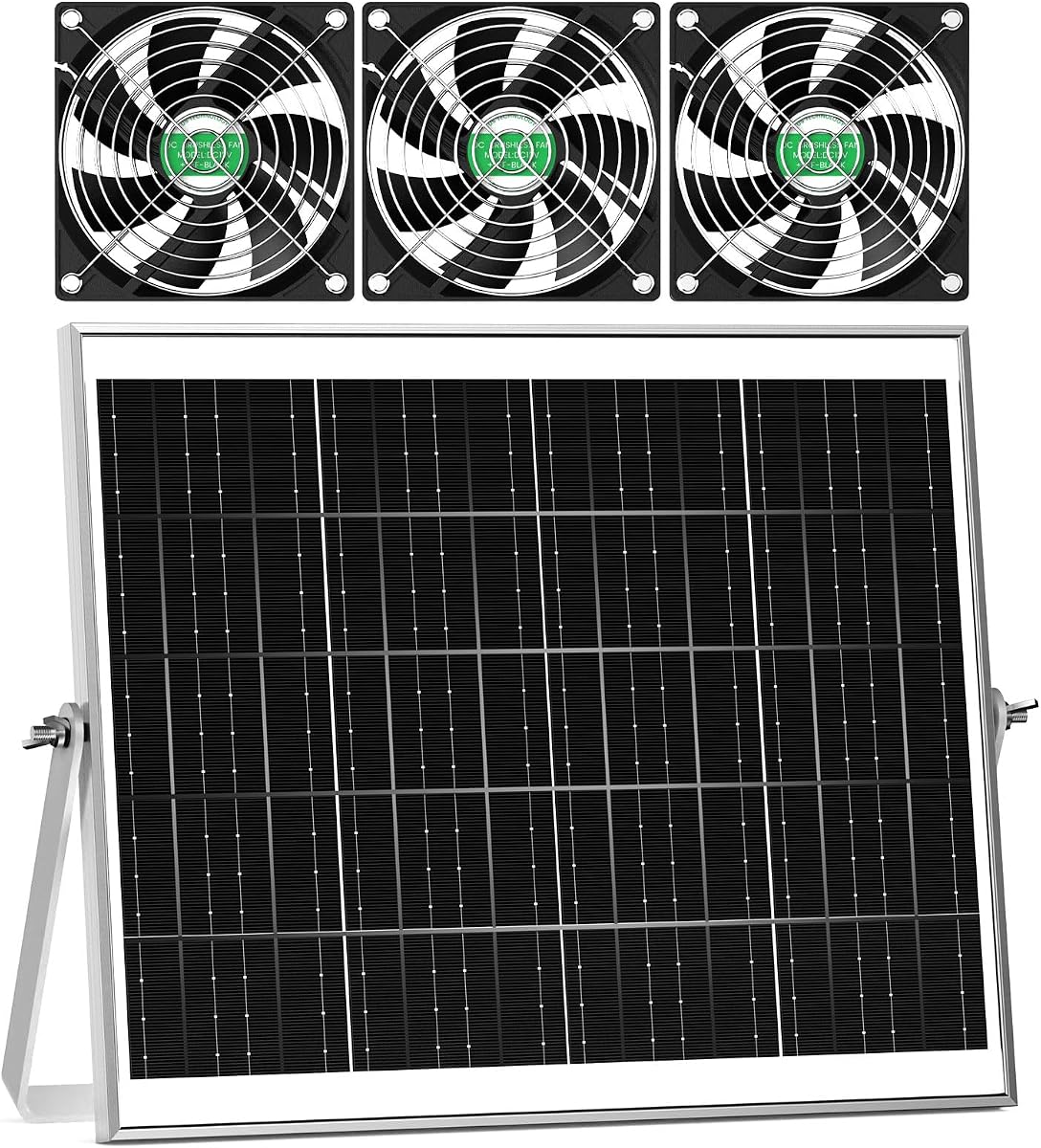
The Solar Greenhouse Fan 3 Kit is a broad bundle of 30-watt solar ventilation configurations designed for greenhouses, chicken coops, sheds, and related outdoor structures. Its 4.1 rating reflects a strong balance of performance, weather resistance, and installation hardware. The three-kit format gives buyers several ways to divide airflow across one structure or several smaller enclosures.
We may earn a commission when you buy through this link, at no additional cost to you.
The system uses a large monocrystalline panel to support speeds stated at up to 3,800 RPM. Heavy-duty aluminum, an IP67 waterproof rating, and double metal guards make it suited to exposed outdoor service. A 16.5-foot plug-and-play cord, mounting bracket, screws, plates, and nylon ties provide several ways to secure the panel and fans.
The system has no built-in battery, so it is designed for daytime use. Full sun delivers the strongest airflow, while cloud cover and dusk reduce performance. Although the fan cord includes an on/off switch for manual control, there is no automatic temperature regulation or nighttime power reserve.
This is the budget-focused pick for a buyer who wants multiple solar ventilation units and a generous accessory set without moving into battery-backed systems. It is especially suitable for a coop or greenhouse that could benefit from distributed intake and exhaust. Those who require ventilation through the night should prioritize a built-in battery or household-power backup.
The three configurations can be distributed according to the number and size of the spaces being ventilated. This gives an installer greater flexibility than a fixed single-fan package while keeping each panel and fan arrangement independent.
The supplied bracket, screws, plates, and nylon ties cover upright, wall, roof, base, and pole-style mounting. With a 16.5-foot cord, the panel can be placed in strong sun while the fan sits where the enclosure needs airflow.
We may earn a commission when you buy through this link, at no additional cost to you.
The MARBERO Solar Fan Kit is a 4.4-rated dual-fan system for small greenhouses, backyard chicken coops, sheds, pet houses, dog houses, attics, and window ventilation. Its appeal lies in a coordinated package: one 15-watt monocrystalline panel powers two metal-guarded fans, and the supplied cables provide enough reach for several installation layouts.
We may earn a commission when you buy through this link, at no additional cost to you.
Both fans can be used for exhaust, both can be used for intake, or one can perform each function. The main cable is 9.8 feet long and each fan adds 3.2 feet, allowing a combined reach of up to 13 feet. A maximum speed of 2,500 RPM and the larger panel design are intended to provide stronger airflow than basic comparable kits under equivalent sunlight.
Durability is a clear strength. The fan components use heavy-duty aluminum, epoxy resin-coated surfaces, waterproof brushless motors, and double protective metal nets. As with many direct-solar products, however, cloudy weather and shade significantly reduce output, and the fan does not operate at night or during rainy weather.
This MARBERO kit is a strong choice for a small enclosure that benefits from matched intake and exhaust fans but does not need automatic controls. It offers a high customer rating and a thorough installation package. Choose it when sunlight availability is dependable and simple daytime ventilation is the primary goal.
Using both fans as exhaust concentrates removal of hot air, while using them as intake draws cooler air inward. Splitting the functions creates cross-ventilation and is often the most useful arrangement in a greenhouse or coop.
The aluminum construction, coated surfaces, waterproof brushless motors, and metal guards are designed for humid, exposed installations. Protective meshes also help protect people and animals from accidental contact with the moving blades.
We may earn a commission when you buy through this link, at no additional cost to you.
The Solar Exhaust Fan with Thermostat adds two features that direct-solar models generally lack: a rechargeable battery and automatic temperature control. With a 4.2 rating, it is a compelling middle ground for a greenhouse, shed, or other area where continued airflow and temperature-based operation matter. The system can run for up to 10 hours after being fully charged in sunlight.
We may earn a commission when you buy through this link, at no additional cost to you.
Two 25-watt solar panels support both the fan and battery charging, while the control box lets the user set an ambient temperature threshold. The fan then switches on and off according to the selected condition. This makes the unit more suitable for variable daytime conditions than a simple panel-powered fan that simply changes speed with the weather.
The four-inch fan is rated at 339 CFM and is suitable for spaces up to 2,540 cubic feet. Installing fans on opposite sides creates cross-ventilation and can accelerate the movement of air through the enclosure. The trade-off is an IP44 waterproof rating, which is lower than the IP67 protection cited by several alternatives in this guide.
This model is best for a temperature-sensitive greenhouse or a user who wants automatic operation without relying on a manual switch. It is less compelling for a large enclosure requiring maximum airflow, but its battery, thermostat, and dual panels make it versatile for smaller spaces. Its IP44 rating also calls for thoughtful placement in severe weather.
The thermostat lets the fan respond to the selected ambient temperature rather than relying entirely on available sunlight. This approach can reduce unnecessary operation and maintain a more consistent ventilation routine.
The 8,800mAh battery gives the system up to 10 hours of operation after full solar charging. That reserve bridges cloudy periods and nighttime hours, although actual performance depends on sunlight and charging conditions.
We may earn a commission when you buy through this link, at no additional cost to you.
The Dual IPX7 Solar Fan Kit is a compact two-fan solution for small greenhouses, coops, sheds, pet houses, RVs, cars, and camping setups. Its 4.0 rating reflects a practical direct-solar design with a clear size recommendation: spaces around six feet by six feet or smaller. It is best understood as a targeted ventilation aid rather than a high-volume system for a large structure.
We may earn a commission when you buy through this link, at no additional cost to you.
A monocrystalline panel powers two separate five-inch fans, and each fan cable has an on/off switch. The two heads can be installed together as intake or exhaust, split across opposite sides, or positioned independently for separate uses. Aluminum housings, double metal protective nets, and an IPX7 waterproof motor help the units handle humid outdoor environments.
The kit includes a wall or roof bracket for the panel, iron plates and screws for fan attachment, and nylon ties for hanging from a pole or tent. Since there is no battery, the fans operate directly from solar power and slow down when sunlight is weak. Users needing consistent night ventilation must provide another source or choose a battery-backed model.
This kit is a good match for a mobile or compact setup where size and simple placement matter more than maximum airflow. It is especially convenient for small coops, window ventilation, or an outdoor vehicle or campsite. Its limitation is scale: larger greenhouses will usually benefit from the higher-output 7.1-inch or 7.5-inch systems.
Five-inch heads are easier to place in tight structures and around small openings. Their separate cords make it possible to build a basic intake-and-exhaust circuit without purchasing additional fans.
The stated IPX7 rating covers the motor against substantial water exposure, while the aluminum housing adds resistance to impacts. Double metal nets protect the blades and help reduce accidental contact in occupied outdoor spaces.
We may earn a commission when you buy through this link, at no additional cost to you.
The 7.5-Inch Solar Fan 2 Pack is designed for small greenhouses, sheds, pet houses, coops, cabins, campsites, and other outdoor spaces up to about 210 square feet. Its 4.2 rating reflects a strong combination of large fan size, dual-panel operation, and durable construction. The pair can create balanced intake and exhaust or be separated for distinct areas.
We may earn a commission when you buy through this link, at no additional cost to you.
Each fan uses a large monocrystalline solar panel and can reach a stated maximum speed of 3,200 RPM. The split design permits each panel to be positioned outdoors for strong sunlight while the corresponding fan is mounted where airflow is needed. A 4.2 rating places it among the better-reviewed direct-solar configurations in the roundup.
Its IP67 waterproof design, heavy-duty aluminum construction, and double-layer metal guards support outdoor use. Installation hardware includes a panel bracket, fan mounting plates, screws, nylon ties, and a plug-and-play cord. The manual on/off switches offer control, but there is no battery or automatic thermostat, and cloud cover or dusk reduces performance.
This two-pack suits medium-small enclosures that need more fan area than a five-inch model can provide. It is a solid choice for a greenhouse around 200 square feet or a comparable chicken coop. For night ventilation or automatic temperature control, choose one of the battery-backed premium options instead.
The 7.5-inch size offers more moving area than compact five-inch kits, while the stated 3,200-RPM speed supports circulation across larger structures. Two units allow one side to exhaust while the opposite side draws in replacement air.
Separate panels allow each installer to seek suitable sunlight for its fan. This is helpful around greenhouse frames, shed eaves, tree cover, or other obstructions that might leave one shared panel partially shaded.
We may earn a commission when you buy through this link, at no additional cost to you.
The Dual-Panel Solar Exhaust Fan is the premium high-output option in this guide, with airflow stated at up to 1,020 CFM. Its 4.1 rating reflects a feature-rich system aimed at larger sheds, greenhouses, attics, garages, workshops, and chicken coops. A 10-inch fan, full-metal housing, aluminum blades, and a pure copper brushless motor distinguish it from smaller direct-solar kits.
We may earn a commission when you buy through this link, at no additional cost to you.
Dual 20-watt all-black monocrystalline panels collect solar energy, and their positions can be adjusted to face the same direction or expose separate surfaces to sunlight. A built-in 60Wh rechargeable battery stores daytime energy and keeps the fan running for more than 10 hours at its default speed. This makes the unit substantially more resilient after dark or during periods of reduced sunlight.
Control is handled through an included remote with 12 speed levels and timer functions. The remote can operate from up to 26 feet away, allowing the fan to be adjusted without entering the enclosure. Its stated operating noise of 40 to 60 dB is also relevant for greenhouses, workshops, and occupied animal areas where excessive sound would be undesirable.
This is the premium pick for a buyer who needs substantial airflow, extended operation, and precise control. It is more complex than direct-solar models, and the panel, battery, fan, and remote require careful setup. Even so, it is the strongest choice here for larger enclosures or users who cannot accept a complete stop at sunset.
The stated maximum of 1,020 CFM suits spaces requiring more air movement than the compact and mid-size kits can provide. The default setting produces 790 CFM, giving the user a strong starting point before adjusting the output.
Twelve speed levels and timer controls make it possible to tailor ventilation to changing conditions without repeatedly visiting the fan. The 26-foot remote range is particularly useful when the unit is installed high on a wall, roof, or gable.
We may earn a commission when you buy through this link, at no additional cost to you.
The 25W Solar Exhaust Fan is an eight-inch ventilation kit for sheds, chicken coops, greenhouses, dog houses, garages, attics, and similar spaces. Its 4.1 rating is supported by a useful combination of solar operation, household-power backup, and a stated airflow of 430 CFM. It is designed for a fixed exhaust opening rather than a portable or ceiling-mounted circulation fan.
We may earn a commission when you buy through this link, at no additional cost to you.
The monocrystalline panel can deliver up to 21.5% photovoltaic conversion efficiency, while the fan is rated to reach 2,300 RPM and operate at 36 decibels. A 16.4-foot cord allows the panel to sit on a roof or in a strong-sun location, while the fan mounts in a drilled opening. The included adjustable bracket helps optimize the panel angle.
Unlike pure solar models, the kit can also connect to an included power adapter through a 4.66-foot household-power cable. That flexibility addresses the main weakness of direct-solar fans: operation after sunset or during poor weather. The trade-off is that it needs a suitable opening and more attention to connection routing than a compact enclosed fan.
The integrated anti-backflow valve is a useful detail because it stays closed when the fan stops, helping keep insects and animals outside. This is a strong option for an owner who wants solar energy during the day but occasional household-powered ventilation at night. It is less flexible than a dual-fan system but offers a well-specified fixed exhaust solution.
The included adapter allows continued operation when sunlight is absent or insufficient. This hybrid arrangement is more dependable than a battery-free fan without requiring a large built-in battery.
A stated 36-decibel operating level is suitable for spaces where lower noise is important. The anti-backflow valve helps block outside insects and animals when the fan is not running.
We may earn a commission when you buy through this link, at no additional cost to you.
The HG Power 12-Inch Exhaust Fan combines a 40-watt bifacial solar panel, 12-inch shutter fan, thermostat, and household-power backup in one integrated package. Its 4.8 rating is the highest in this roundup, reflecting a strong balance of automation, airflow, and installation convenience. It is well suited to greenhouses, workshops, barns, basements, sunrooms, garages, attics, and coops.
We may earn a commission when you buy through this link, at no additional cost to you.
The fan delivers a stated 764 CFM and automatically favors solar power when sunlight is available, switching to the included AC adapter when it is not. Two modes cover different priorities. Energy Saving mode varies fan speed with sunlight and uses AC backup for steadier operation, while Performance mode allows speeds from 1 to 4 when the adapter is connected.
Its thermostat can be set from 68 to 113 degrees Fahrenheit. Once the temperature rises above the setting, the fan starts; after the area cools below the threshold, it continues running for 10 minutes before shutting off. This delay is designed to prevent frequent motor cycling rather than indicating a fault. One limitation is that Performance mode requires the AC adapter.
This is the strongest all-around recommendation for a buyer who values dependable ventilation, flexible power, and automated climate response. The complete kit includes the controller and temperature probe, AC/DC adapter, bifacial panel, fan, brackets, cables, screws, and manual. It does not store energy in a battery, but its adapter backup means it does not need to stop at night.
Automatic switching between solar and AC power keeps the fan operating when sunlight is weak or absent. Unlike battery-backed models, it does not lose ventilation as stored energy is depleted.
The adjustable temperature range allows the fan to respond to greenhouse or shed conditions. A ten-minute post-cooling delay reduces short cycling and helps protect the motor from unnecessary starts and stops.
We may earn a commission when you buy through this link, at no additional cost to you.
The right solar greenhouse fan depends on enclosure size, sunlight access, desired airflow, acceptable installation work, and whether ventilation must continue after sunset. These factors help narrow the field before comparing individual models.
Prioritize the power arrangement that matches your location and schedule rather than choosing a larger panel alone. A powerful panel cannot overcome heavy shade or an approaching night.
Match the stated area or airflow to the enclosure and use paired fans for cross-ventilation whenever possible. A small fan in a large structure may look impressive but move air too slowly to control heat and humidity effectively.
Measure the sun path before installation and avoid relying on brief patches of light. Full, unobstructed exposure produces the strongest and most consistent airflow.
Check both the fan and panel ratings rather than assuming the whole kit has the same rating. Use protective guards and maintain safe mounting clearances in animal-accessible areas.
Choose the simplest controls that meet your needs. Automatic controls are valuable when temperatures can change quickly or when you cannot regularly visit the greenhouse.
Plan the complete airflow path before drilling holes or mounting brackets. If possible, place intake and exhaust on opposite walls and account for the direction of prevailing outdoor air.
A complete accessory package reduces extra trips and compatibility problems. Confirm that the mounting hardware suits the surface and that the cable length reaches the intended locations.
Look for published noise figures when noise is important, and position the outlet to disperse air rather than aim it directly at occupants. Proper intake and exhaust placement also reduces the amount of fan power needed.
Begin by mapping the greenhouse or enclosure, identifying a high or central exhaust point, and selecting a separate low intake point when possible. Mount the solar panel in unobstructed sunlight using the supplied bracket, screws, or ties. Keep the panel away from shaded roof sections, and follow the stated guidance for an appropriate angle. Connect the fan only after both the mounting hardware and electrical connectors are secure.
Position the fan to create a clear path for air. When using one fan for exhaust and another for intake, place them on opposite sides of the structure and aim the exhaust toward the prevailing outdoor airflow. Secure all cables away from sharp edges, moving parts, water channels, and areas where animals or people may snag them. For a fixed exhaust fan, seal the opening around the housing as directed to reduce unwanted air leakage.
Inspect the guards, blades, connectors, and mounting points periodically, especially after storms or seasonal weather changes. Remove accumulated dust and debris with the fan stopped and disconnected. Check that the panel remains unobstructed and that the cable connections remain dry and firmly seated. If airflow declines, check sunlight exposure and panel orientation before assuming the fan has failed. Use the thermostat, timer, or remote settings where available to maintain a stable ventilation routine without unnecessary continuous operation.
Most direct-solar models do not work at night because they have no stored power source. They operate only while the solar panel receives enough sunlight, and output generally decreases under clouds or shade. Battery-backed models can continue after sunset, while the HG Power model can switch to its included AC adapter for continuous operation. Choose the power configuration that matches the ventilation schedule you need.
A larger or more efficient panel can support greater airflow, but panel size alone does not determine ventilation quality. Fan diameter, motor design, blade area, enclosure size, and airflow direction all affect performance. The placement of the panel is equally important because shade can reduce output regardless of the panel's stated wattage. Match the complete system to the greenhouse dimensions and available sunlight.
One fan can provide targeted exhaust, especially in a small greenhouse or coop. Two fans generally create better cross-ventilation when one draws in fresh air and the other removes warm, stale air. Separate fans can also serve two different enclosures. If the structure is larger or humidity and heat are persistent, paired fans usually offer more balanced circulation.
Cloudy weather reduces the energy produced by the solar panel, so direct-solar fans usually run more slowly or may stop. Battery-backed or AC-backup systems provide more continuity because they use stored or household electricity. Even under clouds, placing a panel in the brightest available location and angling it toward the sun can help maintain as much performance as conditions permit.
Mount the panel where it receives direct sunlight for the greatest portion of the day. An exterior roof, sunny wall, or unobstructed pole can work well, provided the bracket and cable reach safely. Avoid tree cover, greenhouse frames, overhangs, and walls that remain shaded. A longer panel cord allows the fan to remain in a useful interior position while the panel stays in stronger sunlight.
The models in this guide include protective metal blade guards intended to reduce accidental contact. Safe installation still requires keeping the fan beyond the reach of people and animals and securely attaching every bracket and cable. Check airflow direction so animals are not exposed to a strong cold draft. For wet environments, select a model with suitable waterproofing and keep all electrical connections dry and correctly seated.
Most products use plug-and-play DC cables rather than household wiring, allowing the solar panel and fan to connect without complex electrical work. However, the panel still needs a secure mounting point, and the cable must be routed safely through the enclosure. The HG Power model and the 25W exhaust kit also support household power through included adapters, while other models rely entirely on solar generation or a built-in battery.
First check whether the panel is shaded, dirty, or oriented away from the sun. Then inspect connectors, mounting hardware, and cable condition, making sure the fan is not blocked by debris. For models with batteries, charging time and battery condition can also influence performance. If the unit operates normally in strong direct sunlight but not under clouds, that behavior is consistent with its direct-solar design.
The HG Power 12-Inch Exhaust Fan stands out as the most complete overall choice because it combines strong airflow, a thermostat, flexible operating modes, automatic solar-to-AC power switching, and a full installation kit. The MARBERO dual-fan kit is a strong simpler option for small spaces, while the 7.1-Inch Solar Fan 2 Pack offers high output and independent panels for direct-solar ventilation.
Prioritize the details that match your actual environment rather than fan size alone. Confirm available sunlight, enclosure dimensions, and whether ventilation must continue after sunset. Then choose between direct solar, battery storage, or AC backup, and plan the intake and exhaust locations carefully. Waterproofing, mounting hardware, controls, and safe blade access deserve equal attention.
Ratings and product details provide a useful starting point, but current specifications and availability can change. Review the latest listing, installation instructions, enclosure guidance, and included accessories before purchasing. Checking the current product page also helps confirm the configuration and any support or warranty information relevant to your setup.