
Flashfish 100W Foldable Solar Panel
4.4Editor score
Up to 23% conversion efficiency
USB-C PD up to 65W
USB-A QC3.0 up to 18W
Four integrated kickstands
Compare the 10 best solar charger for fishing electronics, including portable panels, battery maintainers, output, ports, weather resistance, and portability.
Keeping essential fishing electronics powered away from shore requires more than a nominal wattage figure. The best solar charger for fishing electronics must balance usable charging output, readable controls, durable construction, weather resistance, and the space it occupies in a tackle bag or on a boat. The right setup depends heavily on whether you need portable device charging or battery maintenance.
This guide compares ten real solar products based on their stated power ratings, connection options, conversion efficiency, portability, environmental protections, and intended applications. It includes foldable panels for phones, GPS units, cameras, lights, and power banks, along with fixed solar maintainers designed to preserve 12-volt batteries. Portable charging and stationary battery charging are compared separately because their requirements differ.
Each product entry explains the most useful features, practical limitations, and likely fit for anglers. The selections range from a highly compact 15W panel to a 100W folding model suited to broader off-grid power needs, plus dedicated maintainers for boats, trailers, and vehicles. Product ratings and availability can change, and current prices should be checked before purchasing.
4.4Editor score

4.5Editor score

4.2Editor score
The comparison below separates portable solar charging panels from fixed 12-volt battery maintainers while evaluating output, ports, construction, portability, and intended fishing-related use.



The GEYOTO 45W Solar Panel Charger combines a relatively capable solar rating with a folding format suited to mobile anglers. Its 4.5 rating reflects a favorable balance of features, and its standout qualities include up to 26% conversion efficiency, three USB outputs, IP68 water and dust resistance, and a packed size close to that of an iPad.
We may earn a commission when you buy through this link, at no additional cost to you.
Two USB-C ports and one USB-A port make this one of the more versatile direct-charging panels in the group. The primary USB-C connection supports PD output up to 25W, while the panel can serve compatible phones, tablets, power banks, handheld devices, and other USB-powered electronics. Its 1.65-pound weight and 8.44 by 12.52 by 1.26-inch folded dimensions make it easier to carry than the larger folding options.
There are practical limits. This is not an energy-storage system, so it generates usable power only when exposed to sunlight. Output varies with cloud cover, panel angle, temperature, device behavior, and partial shading. Although the laminated panel is rated IP68, GEYOTO advises keeping the charging ports dry and wiping the surface before storage, which means anglers should not treat the entire connected assembly as waterproof.
This is the strongest general-purpose recommendation for anglers who regularly need to top up a phone, GPS unit, camera, or power bank away from an electrical outlet. It offers more ports and a higher rated output than most compact alternatives, yet remains manageable in a backpack. It is especially attractive for shore fishing, backcountry lakes, boat trips, and emergency kits where flexible direct charging is more valuable than a large stationary installation.
The three-port arrangement allows compatible devices to charge at the same time, reducing the need to carry several small solar accessories. A phone can use one USB-C port while a camera, GPS unit, or power bank uses another, although actual output depends on sunlight and the power demands of each connected device.
The IP68 panel construction and laminated surface suit fishing environments where splashes, dust, and variable weather are likely. Because the ports and attached cables remain vulnerable to moisture, the best practice is to deploy the panel in good weather, keep connections dry, and pack the complete unit properly after use.
We may earn a commission when you buy through this link, at no additional cost to you.
The SOLUPUP 30W Portable Foldable Solar Charger provides a balanced middle ground for anglers who want direct USB charging without carrying a large panel. It carries a 4.4 rating and stands out for monocrystalline construction, more than 23% stated conversion efficiency, an adjustable stand, and a smart chip that identifies connected devices.
We may earn a commission when you buy through this link, at no additional cost to you.
Its USB-A and USB-C outputs can handle two devices simultaneously under suitable sunlight, with maximum output listed at 15W. The charging electronics are designed to guard against overcurrent, overvoltage, and short circuits. An auto-optimization function reconnects charging when sunlight returns after an interruption, a useful feature on a shifting cloud bank or when shade temporarily crosses the panel.
The tradeoff is that the rated 30W panel cannot offer the headroom of the 45W, 40W, or 100W alternatives. Its listed 5V and 3A output also means it is primarily intended for phones, power banks, tablets, and other smaller electronics rather than demanding laptops or large power stations. Seasonal conditions, temperature, positioning, and clouds affect real output, and the IPX5 rating does not make it suitable for submersion.
For anglers carrying a phone, GPS unit, camera, and one backup power bank, this panel offers a useful balance of capacity and portability. The included carabiners make it convenient to attach to a backpack, and the stand allows stable positioning when the angler stops. It is a sound choice for hikers reaching remote water or boaters who want a light direct-charging option rather than a permanently mounted maintainer.
The automatic reconnection function is particularly relevant on lakes and rivers where moving clouds repeatedly interrupt direct sunlight. It helps the charger resume without requiring the angler to unplug and reconnect every time illumination returns.
The foldable format and included adjustable stand let the panel sit securely on a deck, tailgate, picnic table, or shoreline gear bag. Carabiners add another way to secure it to a pack when the angler is moving between access points and fishing spots.
We may earn a commission when you buy through this link, at no additional cost to you.
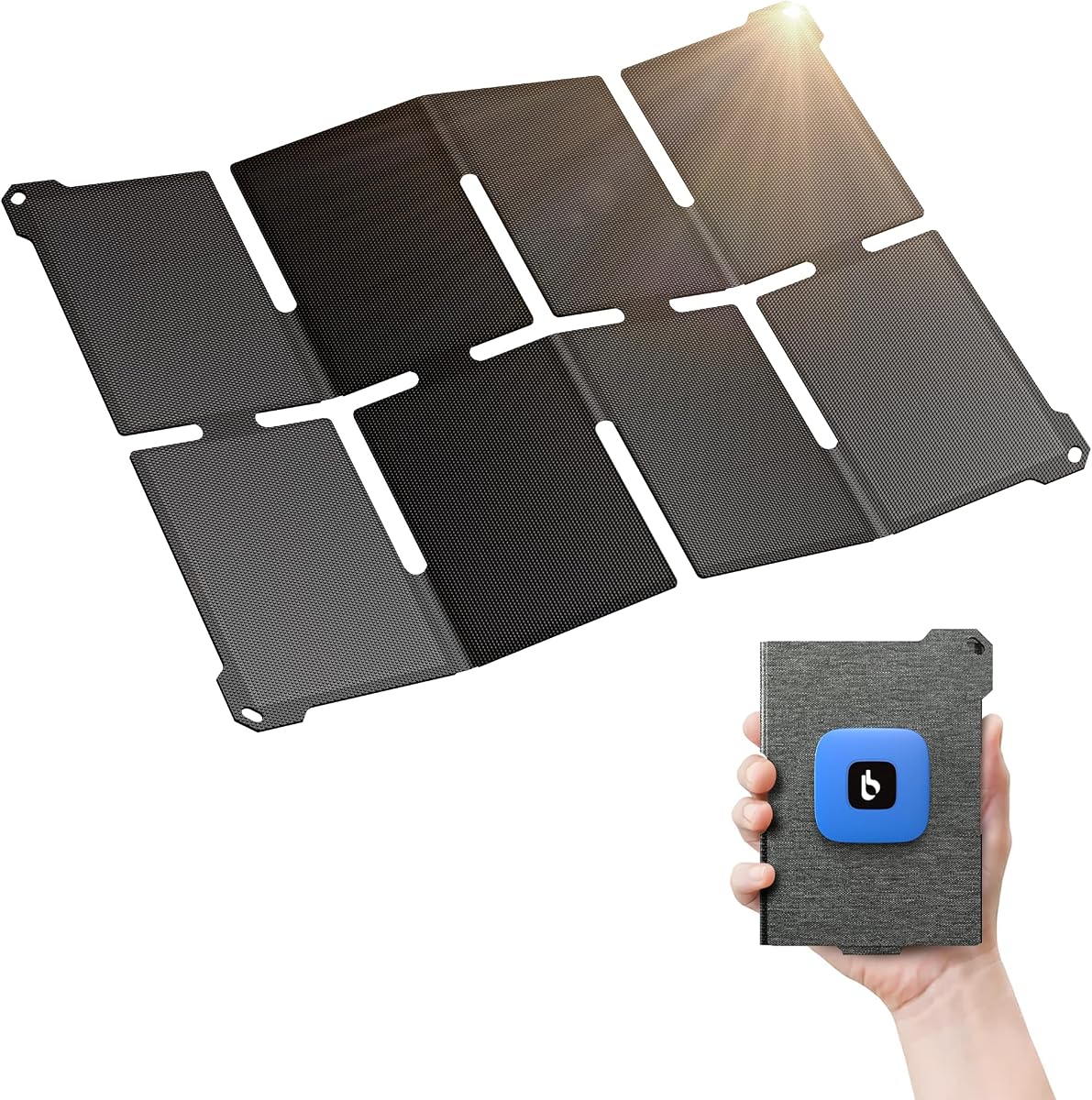
The Flashfish 100W Foldable Solar Panel is the premium, high-output option in this roundup. It holds a 4.4 rating and offers substantially more potential generation than the portable panels designed mainly for phones and small accessories. Its main attraction is the combination of a 100W rating, USB-C PD output up to 65W, USB-A QC3.0 output up to 18W, and a direct DC connection.
We may earn a commission when you buy through this link, at no additional cost to you.
The panel can charge two USB-powered devices simultaneously and is listed for use with laptops, tablets, smartphones, drones, cameras, and other compatible electronics. The DC5521 connection and included adapters broaden its usefulness with compatible portable power stations and other DC-powered equipment. Four kickstands provide stable positioning, while the folding design reduces the space required when the panel is not in use.
This is still a direct solar charger rather than a battery bank, and its 100W nameplate rating should not be confused with constant real-world output in every environment. Conversion efficiency is stated at up to 22–23%, and actual performance depends on direct illumination, angle, heat, and shading. Its size and complexity also make it more cumbersome than the 25W, 30W, 40W, or 45W choices for a solo hiker.
It is best suited to anglers camping at a site with a boat, RV, or larger base camp, particularly those charging several devices or pairing the panel with compatible portable power equipment. The included DC cable, three connector types, user manual, warranty, and customer support create a comprehensive package. For demanding mobile electronics, it offers the most capability of the products reviewed.
The 65W USB-C PD connection gives compatible laptops, tablets, drones, and cameras considerably more potential power than the smaller direct-charging panels. Device compatibility, cable requirements, sunlight, and thermal conditions still determine whether the full rated output is available.
Four kickstands allow the panel to be positioned without improvised support. This makes it more practical for anglers who establish a stationary camp, organize a boat deck, or need to keep the panel aimed toward changing sunlight throughout the day.
We may earn a commission when you buy through this link, at no additional cost to you.
The POWOXI 7.5W Solar Battery Charger is designed to maintain a 12-volt battery rather than directly charge a phone or GPS. It has a 4.4 rating and stands out for simple installation, scratch-conscious construction, an LED status indicator, and compatibility with cars, boats, motorcycles, tractors, ATVs, and other 12V systems.
We may earn a commission when you buy through this link, at no additional cost to you.
Installation can be completed by inserting the appropriate connector into a vehicle's cigar lighter socket or by connecting the alligator clips directly to the battery. The built-in controller, blocking diode, and protection system are designed to guard against overcharging, overvoltage, and short circuits. The high-transparency tempered-glass surface and ABS-and-PC frame resist bending and help protect the panel.
The principal limitation is its narrow charging role. With a 7.5W rating, it is much better understood as a trickle maintainer than a rapid charger for depleted deep-cycle batteries. It also does not provide USB ports for fishing electronics. Its stated 25–30% conversion efficiency reflects ideal manufacturing conditions rather than guaranteed output under shade, heavy cloud, or poor positioning.
For anglers with a boat, trailer, ATV, or vehicle that sits unused for extended periods, this is a simple way to help maintain a compatible 12V battery. The red and green indicators make it easy to tell whether sunlight is being received and whether charging is active. It is best for maintenance rather than daily equipment charging.
The socket-and-clip installation options make it convenient to connect to a boat or vehicle without complex wiring. Anglers should choose the connection method that suits the battery location and follow the manufacturer’s wiring instructions carefully.
The ABS-and-PC frame helps protect the cells from bending and avoids the paint-scratch risk associated with metal frames. That makes it a more considerate option for a boat console, trailer, or vehicle body where surface finish matters.
We may earn a commission when you buy through this link, at no additional cost to you.
The FlexSolar 40W Foldable Solar Panel Charger is a strong all-around option for mobile anglers who want more than basic USB charging. It has a 4.4 rating and stands out for three output types, up to 24% conversion efficiency, a compact 1.76-pound weight, and an IP67-rated panel construction.
We may earn a commission when you buy through this link, at no additional cost to you.
The USB-C PD2.0 and USB-A QC3.0 ports each support up to 18W, while the 19V DC port can directly power compatible small stations at up to 40W. An integrated chip detects connected devices and optimizes delivery, while protection against overcurrent, overheating, and short circuits adds safety. The ETFE laminate is described as more abrasion-resistant than standard PET construction.
FlexSolar recommends prioritizing a single port for peak efficiency and positioning the panel at roughly a 45-degree angle toward direct sunlight. Partial coverage can reduce output substantially. Although the panel is rated IP67, the junction box is not fully waterproof, so heavy rain calls for bringing it indoors. It is also an instant-conversion device without internal battery storage.
This panel is a good fit for anglers who want direct charging for a phone, tablet, power bank, and compatible DC equipment without moving to the largest model. Its folded size of 8 by 11.1 by 1.8 inches is convenient for a backpack or vehicle kit. It is less appropriate for someone who expects power to remain available after sunset.
Combining two smart USB outputs with a 19V DC connection gives the panel broader device compatibility than simpler models. Anglers can charge common electronics directly while retaining an option for compatible portable stations or other DC equipment.
At 1.76 pounds, the panel sits between the smallest models and larger high-output units. That middle ground works well for boaters, hikers, and anglers who need more charging headroom while keeping the setup reasonably light.
We may earn a commission when you buy through this link, at no additional cost to you.
The SOLPERK 20W Solar Panel Kit is a complete 12-volt battery-maintenance solution with one of the strongest ratings in the group at 4.5. Its defining features include an adjustable mounting bracket, a smart MPPT controller, a 10A charging rating, and a monocrystalline panel with stated cell efficiency of 21–30%.
We may earn a commission when you buy through this link, at no additional cost to you.
The bracket rotates 360 degrees, allowing the panel to be aimed toward the sun more effectively than a fixed installation. The controller uses three-stage charging and is designed to prevent overcharging, overvoltage, and short circuits. Pre-drilled holes, matched screws, plug-and-play wiring, an alligator clip, and an O-ring make the supplied package unusually complete for installation.
As a fixed maintenance product, it does not include USB ports and will not directly charge a phone or fish finder. Its low-iron tempered glass and corrosion-resistant aluminum frame are intended to withstand demanding outdoor conditions, with stated wind-pressure and snow-load tolerances. As with every solar device, actual charging depends on irradiance, orientation, temperature, and battery condition.
This kit makes the most sense for anglers with a boat, RV, trailer, truck, tractor, or other 12V system that needs dependable trickle maintenance. The adjustable hardware is especially useful where a permanent location can be changed to follow seasonal sun angles. It is less relevant for backpack-based fishing or anglers who want a portable direct charger.
A 360-degree bracket helps the owner optimize the angle between the panel and available sunlight. This is valuable where mounting space is limited and seasonal sun position changes the best orientation.
The kit provides the panel, MPPT controller, adjustable bracket, alligator clip, O-ring, and mounting hardware. That completeness makes installation easier for owners who do not want to separately source brackets, leads, or a charge controller.
We may earn a commission when you buy through this link, at no additional cost to you.
The BigBlue 28W High-Efficiency Solar Panel Charger combines three USB ports with a compact folding design. Its 4.3 rating reflects a capable portable option that is particularly relevant to anglers who want to charge several small electronics while moving between fishing locations.
We may earn a commission when you buy through this link, at no additional cost to you.
Two USB-C ports and one USB-A port each have a maximum listed output of 5V and 3A, with combined output stated at 5V and 4.8A. BigBlue uses N-type solar cells and a shadow-free front surface without metal lines, claiming conversion efficiency up to 25.4%. The panel folds to 11 by 6 by 1.4 inches and weighs 1.5 pounds, making it easy to fit in a tight backpack.
The charging is direct rather than stored, and BigBlue explicitly states that the panel is not powerful enough for laptops or large power stations. It also advises keeping connected devices shaded because heat can cause thermal protection to reduce or pause charging. The panel carries IP44 protection, but its USB junction box is not waterproof, so it should not be left exposed like a fully sealed product.
This is a good choice for small electronics such as phones, GPS units, flashlights, and power banks. Its three-port design gives it a useful advantage over many similarly sized competitors. For an angler who values a long-established portable format, efficient charging, and flexible device connections more than 100W of potential output, it remains a well-rounded option.
BigBlue describes its N-type cells as providing improved low-light efficiency and longevity. That does not eliminate the effects of clouds or shade, but it makes the panel more useful when sunlight is weaker than at midday.
Keeping a phone or tablet shaded while the panel remains in direct sun can help avoid thermal throttling. This setup takes a little planning, but it may improve the consistency of charging during a bright fishing day.
We may earn a commission when you buy through this link, at no additional cost to you.
The BigBlue Ultra-Light Portable 25W Solar Panel Charger focuses on compactness. Its 4.2 rating does not make it the highest-scoring product here, but its 0.84-pound weight and exceptionally small folded dimensions make it one of the most appealing options for anglers who must minimize pack size.
We may earn a commission when you buy through this link, at no additional cost to you.
The panel uses USB-A at up to 5V and 2.4A and USB-C at up to 5V and 3A, allowing two compatible devices to charge simultaneously. BigBlue specifies N-type cells without metal lines on the front and claims conversion efficiency up to 25.4%. The ETFE coating, UV-resistant EVA, solid baseplate, and IP68 rating are intended to support outdoor durability.
Despite its compact dimensions, the panel is still a direct charger without internal battery storage. It needs unobstructed direct sunlight, and the total output is lower than the 28W, 30W, 40W, 45W, and 100W alternatives. The two USB ports also limit the range of compatible equipment compared with the GEYOTO and BigBlue 28W models.
This model is particularly useful for solo anglers carrying a phone, compact GPS unit, camera, or small light. Its folded dimensions of 4.65 by 6.42 by 1.38 inches fit easily into side pockets, and the included carabiners and elastic strap make it easy to attach to a backpack or tent. It is a focused, lightweight solution rather than a broad power station.
At only 0.84 pounds and roughly iPad-sized when folded, this is one of the easiest portable panels to carry. It suits anglers who want emergency charging capability without dedicating substantial room to a solar kit.
USB-C and USB-A provide compatibility with most current phones, cameras, lights, and power banks. The smart charging system is designed to optimize delivery to two connected devices under suitable sunlight.
We may earn a commission when you buy through this link, at no additional cost to you.
The SUNER POWER 12W Solar Battery Charger and Maintainer is designed for intelligent upkeep of 12-volt batteries. Its 4.4 rating and strongest selling point are the built-in Ultra-Smart MPPT controller, which the manufacturer claims provides tracking efficiency up to 99% and peak conversion efficiency of 98%.
We may earn a commission when you buy through this link, at no additional cost to you.
A three-stage bulk, absorption, and float algorithm helps recharge the battery effectively, while the maintainer stops charging when the battery is full and resumes after discharge. Protections cover overcharge, overdischarge, overvoltage, overcurrent, overload, short circuit, reverse polarity, and overtemperature. The panel also includes suction cups and plug-and-play cabling for simpler installation.
Its 12W rating is modest compared with the 20W SOLPERK system and the 7.5W POWOXI model, though panel efficiency is stated at 21–30%. The product is a fixed battery-maintenance device without USB ports, so it cannot directly top up a phone, camera, or fish finder. Installation and the condition and chemistry of the connected battery still need consideration.
For boat, marine, trailer, RV, vehicle, and power-sport owners, it offers an intelligent and broadly compatible maintenance package. It is especially appropriate for preserving a battery during storage and helping manage the normal discharge-and-recharge cycle. Anglers should position the panel where it receives strong, unobstructed sunlight.
Bulk, absorption, and float stages give the charger a more structured approach than a simple trickle device. This is useful for owners who want the charger to manage charging automatically without frequent manual intervention.
Compatibility includes flooded, gel, AGM, SLA, maintenance-free lead-acid, and LiFePO4 batteries. That makes it relevant to a wide range of boats, trailers, ATVs, tractors, and other 12V equipment, provided the connection and battery settings are handled correctly.
We may earn a commission when you buy through this link, at no additional cost to you.
The 15W Portable Small Solar Panel Charger is the budget-oriented choice in this guide. Its 4.2 rating reflects a straightforward product with a few appealing features, most notably a built-in digital display that reports power, voltage, and current so anglers can see whether the panel is positioned effectively.
We may earn a commission when you buy through this link, at no additional cost to you.
It uses 23.5% efficient monocrystalline cells with an ETFE coating intended to resist scratches, heat, and outdoor wear. USB-C and USB-A outputs support phones, power banks, cameras, GPS units, mini fans, and other USB-powered electronics. Intelligent protection is included for overcharging, overheating, and short circuits.
This is the lowest-rated panel among the portable models, so its main limitation is generating capacity. A 15W nameplate rating is best suited to small devices and power banks rather than tablets, laptops, or larger electronics. It has no internal energy storage, meaning the display can help assess incoming solar power but cannot make energy available after dark.
Despite those limits, the 0.82-pound weight and folding design make it easy to carry in any backpack. It is a sensible backup for anglers who want a phone or camera charger for a day trip and value visibility into charging performance. The included carabiners and one-year warranty add convenience, while the display helps users make better angle adjustments.
The digital readout gives users immediate information about power, voltage, and current. It is particularly useful for anglers learning how panel angle, cloud cover, and partial shade affect real charging output.
At only 0.82 pounds, this panel is easy to add to a daypack without creating a major bulk burden. It is most appropriate for maintaining a small device or power bank rather than operating a multi-device charging station.
We may earn a commission when you buy through this link, at no additional cost to you.
The right choice depends first on whether you need portable device charging or stationary 12V battery maintenance, followed by output requirements, device compatibility, environmental exposure, and the amount of space available in your fishing setup.
Portable solar panels in this guide use USB-A or USB-C outputs to charge phones, GPS units, cameras, lights, and compatible power banks directly in sunlight. They generally have no internal battery and stop delivering useful power when the sun is obscured or the device is disconnected. Solar battery maintainers serve a different purpose: they connect to 12V batteries on boats, trailers, vehicles, and other equipment. Choosing between these categories is more important than comparing wattage figures alone because a maintainer cannot charge a phone directly.
A 15W panel is appropriate for phones, compact cameras, GPS units, and small lights, while 25W to 45W panels provide more flexibility for tablets, multiple devices, or power-bank charging. The 100W Flashfish model is aimed at higher-demand electronics and compatible power equipment. Advertised wattage is a maximum panel rating, not guaranteed charging speed. Conversion efficiency, sunlight intensity, panel angle, temperature, cable losses, and the connected device all influence delivered power. Review each device’s charging requirements rather than relying only on the number printed on the solar panel.
USB-C is the most relevant choice for modern phones, tablets, GPS units, cameras, and many power banks, while USB-A remains useful for older accessories and lighting equipment. Some panels provide both and can charge two devices simultaneously, but output may be shared. DC outputs and included adapters can expand compatibility with compatible portable power stations. Verify the voltage and connector shape before buying, and confirm whether a USB-C cable is included. The GEYOTO and BigBlue models explicitly support direct USB use, while the maintainer kits require compatible 12V battery connections.
Fishing gear is exposed to rain, spray, dust, mud, and UV light. IP ratings indicate resistance against solids and water, but they do not mean every part of a charging system has the same rating. The GEYOTO 45W panel and BigBlue 25W panel carry IP68 ratings, while the FlexSolar panel is rated IP67. The BigBlue 28W junction box is not waterproof, and the FlexSolar junction box is also not fully waterproof. Even with a durable panel, connection ports should remain dry whenever possible. The fixed maintainers use glass and corrosion-resistant frames intended for permanent outdoor installations, but wiring still requires care.
The smallest options weigh approximately 0.82 to 0.84 pounds and suit solo anglers, day trips, and emergency kits. Panels in the 30W to 45W range add generation capacity while remaining backpack-friendly, with listed weights between 1.5 and 2.4 pounds. The 100W folding panel provides the greatest output but is less convenient for hikers carrying a full fishing load. Also consider folded dimensions, included carabiners, storage pouches, straps, and stands. A charger that is easy to deploy and orient toward sunlight is often more useful than one with extra nominal capacity that is cumbersome to position.
Conversion efficiency indicates the proportion of incident sunlight converted into electrical energy under specified test conditions. The panels here state efficiencies ranging from 21% to 30%, with the portable models generally claiming 23% to 25.4%. These figures are not equivalent to the rate at which a phone will charge. Real-world results are affected by reflection, heat, partial shadow, panel orientation, and device behavior. Some manufacturers recommend positioning the panel near a 45-degree angle, and all emphasize clean, unobstructed surfaces. Treat efficiency as a relative indicator of panel technology rather than a guaranteed charging-speed promise.
For a 12V battery maintainer, look for a built-in MPPT controller, multi-stage charging, and protection against overcharging, overvoltage, short circuits, reverse polarity, and overheating. The SOLPERK kit includes an adjustable 10A MPPT controller and bracket, while the SUNER POWER unit uses a built-in controller and three-stage charging. The POWOXI option is simpler and smaller but has the lowest rated output. Confirm the battery chemistry, such as lead-acid, AGM, gel, SLA, or LiFePO4, and follow the manufacturer’s connection instructions. A maintainer helps manage battery condition, but it does not replace a proper charger for a deeply discharged battery.
Status LEDs and digital displays help distinguish a working panel from one that is poorly positioned, shaded, or disconnected. The 15W model displays power, voltage, and current, while the BigBlue 28W uses a blue charging light and the POWOXI maintainer uses red and green indicators. These features do not increase rated output, but they can make field setup more effective. An angler who often moves between shaded and sunny fishing spots may value visible feedback more than a marginally larger panel.
Begin by choosing a clean, unshaded location with the panel aimed directly toward the sun. If it is mounted on a boat or vehicle, adjust the angle throughout the day when practical. For portable models, connect the device after positioning the panel, use the appropriate cable, and check that the charging indicator or display shows incoming power. Keep the device itself in shade when possible because excessive heat can cause thermal protection to slow or interrupt charging.
For a portable panel, fold it only after disconnecting cables and confirm that the surface is dry. Store it in its pouch or another clean, dry location rather than leaving it loose in a wet tackle bag. For a battery maintainer, switch off the system or follow the prescribed disconnection sequence, inspect the terminals, and protect wiring from abrasion, standing water, and salt spray. Keep panel surfaces clear of mud, fishing line, sunscreen residue, and salt deposits, because even partial obstruction can reduce output.
Do not submerge any charging unit, and do not assume a waterproof panel makes exposed ports or junction boxes waterproof. Dry connections before reconnecting them, and avoid charging incompatible batteries or devices. A solar panel without internal storage provides power only while sunlight is available, so use a power bank when continuous access to stored energy is needed. Periodic checks of cable condition, mounting tightness, indicator lights, and battery status will help the system remain dependable.
A foldable panel with both USB-C and USB-A provides the most practical phone-charging compatibility. The GEYOTO 45W, BigBlue 28W, and 15W display model are lightweight choices, while the GEYOTO offers the most ports and highest stated conversion efficiency among the compact recommendations. Charge in direct sunlight, keep the phone shaded, and recognize that cloud cover or panel orientation will reduce output.
Only if the panel provides enough separate ports and the connected devices are compatible. The GEYOTO 45W has two USB-C ports and one USB-A port, and the BigBlue 28W has a similar three-port layout. Simultaneous output may be shared, so check each device’s requirements and avoid assuming every port will deliver its maximum rating at the same time.
The portable panels reviewed here are direct-charging devices without internal battery storage. They produce power only while exposed to sunlight and connected to a compatible device. Pair one with a solar-charged power bank if you need stored energy after sunset, or choose a separate power station system designed for that purpose.
Yes, when the goal is to help maintain a compatible 12V battery while the boat is stored or lightly used. The SOLPERK 20W kit, SUNER POWER 12W maintainer, and POWOXI 7.5W kit are designed for this role. None directly charges a phone or fish finder, and a maintainer is not equivalent to a rapid charger for a severely depleted battery.
Many compact GPS units and cameras can operate with relatively modest USB power, making a 15W to 25W folding panel suitable if the device accepts the panel’s output. Larger tablets, drones, laptops, and some cameras may require a higher-output USB-C connection. Always verify the device’s input voltage, current, connector, and charging protocol.
Direct outdoor sunlight is the safest approach for these portable panels. A windshield or window can introduce glare, reflections, heat, and partial filtering that may reduce or destabilize output. Position the panel outdoors, keep the connected device shaded, and wipe the glass or panel surface to remove salt and grime for more consistent results.
IP67 indicates protection against dust and temporary water immersion under specified test conditions, while IP68 indicates a higher level of water protection, also under defined conditions. Those ratings apply to the specified enclosure and do not automatically cover exposed USB ports, cables, junction boxes, or the connected device. Marine anglers should still keep connections dry and follow the manufacturer’s storage instructions.
A power bank adds storage and allows the collected energy to be used later or after sunset. Let the panel charge the power bank during strong daylight, then connect the power bank to the fishing electronics. Choose a power bank with compatible input and output ratings, and do not expect a small solar panel to restore a large battery quickly.
The GEYOTO 45W Solar Panel is the most balanced overall recommendation because it combines a capable 45W rating, three USB ports, high stated efficiency, a manageable folded size, and IP68 panel protection. The Flashfish 100W panel is the premium choice for higher-demand charging and broader DC compatibility, while the 15W display model is the budget pick for lightweight backups and small electronics.
Prioritize the charging task before considering other details. Choose a portable USB panel for phones, GPS units, cameras, lights, and power banks; choose a dedicated MPPT or multi-stage maintainer for a 12V battery on a boat, trailer, or vehicle. Within the portable category, balance output against weight, verify connector compatibility, and account for weather exposure rather than relying on wattage alone.
Current prices, ratings, product availability, and included accessories can change, so check the latest listing before buying. Also review the manufacturer’s compatibility notes and warranty. The most effective setup is one you can safely deploy in direct sunlight, connect without strain, and keep dry at the shoreline or on a wet boat deck.