
2 Pack PoE++ Surge Protector
4.9Editor score
Dual GDT and TVS protection
Gigabit PoE++ compatibility
Flexible mounting options
This Ethernet Surge Protector guide compares network speeds, PoE support, protection levels, mounting options, and installation features for every model.
Ethernet Surge Protectors add a layer of defense for routers, switches, network cameras, modems, and other connected equipment exposed to lightning, electrostatic discharge, and power-line transients. A useful model should protect data lines without slowing the network, support the correct wiring standard, and fit the intended installation environment.
The products in this guide represent two related categories. Some are dedicated inline RJ45 network protectors with gas discharge tubes, PoE compatibility, and grounding provisions, while others are multi-outlet home-theater surge strips that include Ethernet protection alongside AC, telephone, and coaxial connections. Their specifications were compared by protection technology, data speed, PoE capability, installation method, outlet count, and warranty coverage.
Each review highlights the features that distinguish its model, including useful compromises and important limitations. The featured choices range from compact couplers for basic networks to metal-housed units designed for industrial temperatures, high-speed Gigabit connections, and demanding PoE equipment. Product details and availability can change, so readers should confirm current specifications before purchasing.
4.9Editor score

5.0Editor score

4.6Editor score
The comparison below organizes all ten products by their most important characteristics. Pay close attention to the distinction between dedicated inline Ethernet protectors and full power strips, as well as the required PoE mode, supported data rate, protection method, and physical installation needs.




The Eaton Tripp Lite TLP1208SAT is a broad home-entertainment surge strip with 12 AC outlets and a 2,880-joule suppression rating. Its 4.7 rating reflects a well-rounded design for televisions, routers, cable equipment, and other household electronics. Rather than functioning only as an inline Ethernet protector, it combines AC, RJ45 Ethernet, RJ11 telephone, and coaxial protection in one housing.
We may earn a commission when you buy through this link, at no additional cost to you.
The most useful feature is the variety of protected connections. Four outlets are designed to accept bulky plugs without obstructing neighboring sockets, while the included Ethernet, phone, and coaxial cables make it possible to connect the main entertainment components immediately. Diagnostic LEDs indicate whether the wall outlet is properly grounded and protected, while the 15A circuit breaker adds an overload shutoff. Keyhole mounting slots also allow the strip to sit under a desk or against a wall.
Its main limitation is the Ethernet specification. The protected RJ45 connection supports speeds up to 100 Mbps, so it is better suited to conventional home networks, cable internet, and older routers than to modern Gigabit systems requiring faster local transfers. The 2,880-joule figure is also lower than those of several larger Tripp Lite models in this comparison, making this a practical general-purpose option rather than a maximum-capacity unit.
Choose this protector when one central strip can conveniently protect a television, modem, router, game console, and associated line-based equipment. It is especially attractive for a home theater or entertainment center where cord management matters as much as surge protection. For newer multi-gigabit networks, however, a dedicated Gigabit inline protector is the more technically suitable choice.
Combining AC and data-line protection reduces the number of separate protective devices around a home entertainment setup. The supplied phone and coaxial leads are particularly useful when those older line connections still form part of the installation.
Diagnostic LEDs offer a quick way to verify that the connected wall outlet is properly grounded and that the protector is active. This feedback is more useful than a simple power indicator when troubleshooting an installation.
We may earn a commission when you buy through this link, at no additional cost to you.
The Eaton Tripp Lite TLP810NET combines eight AC outlets with protection for high-definition coaxial connections and RJ11 telephone or modem lines. Its listed rating is 4.6, and the 3,240-joule suppression capacity sits between the smaller TLP1208SAT and the larger TLP118DBNET. The result is a balanced option for a conventional home theater built around a television, set-top box, router, and related equipment.
We may earn a commission when you buy through this link, at no additional cost to you.
Its coaxial connector is specified for 2.2 GHz high-definition signals, making the unit relevant to cable, satellite, and antenna connections. The RJ11 and built-in RJ45 jacks protect telephone and Ethernet data lines, while EMI/RFI filtering helps reduce interference that can affect video and audio performance. Three outlets are designed to accommodate transformer plugs without preventing access to the others, a useful detail in entertainment centers crowded with power bricks.
The right-angle, space-saving plug and 10-foot cord provide more placement flexibility than many compact strips. The trade-offs are the 100 Mbps Ethernet ceiling and a lower outlet count than the other Eaton models featured here. The stated 3,240-joule capacity is solid for mixed consumer electronics, but buyers seeking the highest suppression figure in this roundup should consider the TLP118DBNET instead.
This model is a good match for a home theater where cable television or satellite remains in use and the Ethernet network does not require Gigabit throughput. Its generous cord, transformer-friendly layout, and protection across several signal types make installation straightforward. It is less appropriate for a modern office rack or a high-speed backbone where dedicated Gigabit protection would be more valuable.
Three transformer-compatible outlets help preserve access to the remaining sockets. Combined with the long cord and flat right-angle plug, this design is easier to arrange behind media furniture and near wall-mounted displays.
Coaxial, telephone, and Ethernet protection in a single enclosure makes the TLP810NET a useful consolidation point for older entertainment systems that still use cable, antenna, or phone connections.
We may earn a commission when you buy through this link, at no additional cost to you.
The Eaton Tripp Lite TLP118DBNET stands out as the most capable home-theater power strip in this group, carrying a 5.0 rating and a 4,200-joule suppression specification. It includes 11 AC outlets plus dedicated protection for Ethernet, telephone, and coaxial lines. That combination makes it a central protection hub for a living-room television, router, cable box, game equipment, and other consumer electronics.
We may earn a commission when you buy through this link, at no additional cost to you.
Six side-facing outlets accept bulky transformer-style plugs, reducing the frustrating blockage that occurs with tightly packed conventional strips. The flat, braided 8-foot extension cord can sit cleanly behind furniture, and keyhole slots permit under-desk or wall mounting. A 15A resettable circuit breaker combines the power switch and overload protection, while LEDs confirm grounding and device protection status. UL certification to the 1363 and 1449 standards adds another layer of construction credibility.
The key compromise remains Ethernet speed. Although the RJ45 line is protected from dangerous data-line surges, it passes signals only up to 100 Mbps. The unit is therefore optimized for home entertainment and standard network access rather than high-speed local file transfers or modern multi-gigabit infrastructure. Its large protection capacity and outlet count do not change that data-path limitation.
This is the strongest all-around pick for a conventional household media and network installation where one device can handle both power and several data-line connections. Buyers should choose it for outlet capacity, strong suppression, status feedback, and flexible mounting. If future network upgrades may require Gigabit Ethernet, pair it with a dedicated inline Gigabit protector rather than relying on its RJ45 port for that portion of the system.
A 4,200-joule rating and 11 AC outlets create substantial headroom for a television, streaming devices, game consoles, routers, and associated power adapters. The side-facing transformer layout keeps those bulky adapters from monopolizing the strip.
LED status indicators simplify grounding checks, while the flat braided cord and underside keyholes help the unit fit neatly into entertainment furniture. A resettable 15A breaker provides practical control without requiring a disposable fuse.
We may earn a commission when you buy through this link, at no additional cost to you.
This two-pack of dedicated Ethernet surge protectors is designed for Gigabit networks carrying PoE and High PoE++. Each inline RJ45 unit protects a differential line pair with gas discharge tube technology and is rated for a peak surge current of 20KA using an 8/20 microsecond waveform. The 4.6 rating reflects solid compatibility for routers, switches, modems, and network cameras.
We may earn a commission when you buy through this link, at no additional cost to you.
PoE support is unusually broad. The specification references IEEE 802.3af, at, and bt standards, including Mode A and Mode B arrangements and power levels of 15V, 24V, 30V, 48V, 50V, and 56V. It also lists 1.6A over two pairs and 3.2A over four pairs, making the protector relevant to modern powered network equipment. The aluminum case and 12AWG ground wire support a more permanent installation than a lightweight plastic coupler.
Because the unit is an inline protector, correct placement matters. It should sit between the incoming Ethernet cable and the protected network device, with the grounding lead connected to a suitable protective earth point. A loose or inappropriate ground connection can reduce the protective value. The package also includes two units, which is convenient for protecting both the main network uplink and a secondary piece of equipment without buying separate accessories.
This two-pack is well suited to Gigabit home and small-office networks using PoE cameras, access points, VoIP phones, or switches. It is a better fit than the coupler-style alternatives when modern data rates and high-power PoE matter. Installation requires basic grounding work and careful cable routing, but the result is a purpose-built defense between the network line and expensive endpoint equipment.
Unlike a basic RJ45 coupler, this unit is designed around transient suppression for high-speed copper Ethernet. It offers a direct path for protecting a router, switch, camera, or modem while preserving Gigabit operation.
Support across common IEEE PoE modes and a broad listed voltage range makes the protector useful with modern network devices. Buyers should still verify the exact power and wiring requirements of the connected equipment.
We may earn a commission when you buy through this link, at no additional cost to you.
The two-pack of 10/100/1000Mbps PoE++ surge protectors earns a 4.9 rating by combining dual protection, broad PoE compatibility, and flexible installation. Each metal-housed unit uses both gas discharge tube and transient voltage suppression technology, with 20KV common-mode resistance, 1.5KV differential-mode resistance, and a 20KA discharge-current specification.
We may earn a commission when you buy through this link, at no additional cost to you.
PoE performance is a major strength. The units support IEEE 802.3af, at, and bt standards, Mode A and Mode B operation, conventional and non-PoE devices, and up to 120 watts per port. The stated maximum of 154W applies to High PoE++ conditions, while the maximum DC input is listed at 60V. Gigabit data rates and insertion loss no greater than 0.5dB help make the protector suitable for routers, cameras, switches, modems, and servers.
The aluminum alloy housing offers heat dissipation, corrosion resistance, and mechanical strength, while the included 12AWG grounding wire supports installation. IN and OUT markings remove ambiguity about cable direction. DIN rail, wall, and desktop placement are all supported, and the side flanges make the units practical in a network cabinet or on a wall. The operating range of -40°F to 185°F also suits locations where temperature fluctuations are a concern.
This is a compelling budget choice for a small business, home lab, or surveillance system needing two protected Gigabit PoE links. It offers more refined installation options than most low-cost couplers and stronger multi-stage protection than a basic TVS-only device. Proper grounding and adherence to the marked signal direction remain essential, but for compatible installations the package provides considerable versatility in a two-unit set.
Using GDT and TVS components together addresses different classes of transient event. The stated response time of no more than 1ns also helps the protector avoid introducing a meaningful delay into normal data traffic.
DIN rail support is useful inside equipment cabinets, while wall flanges and desktop placement cover less permanent installations. Clear IN and OUT labels reduce errors when connecting protected and unprotected sides.
We may earn a commission when you buy through this link, at no additional cost to you.
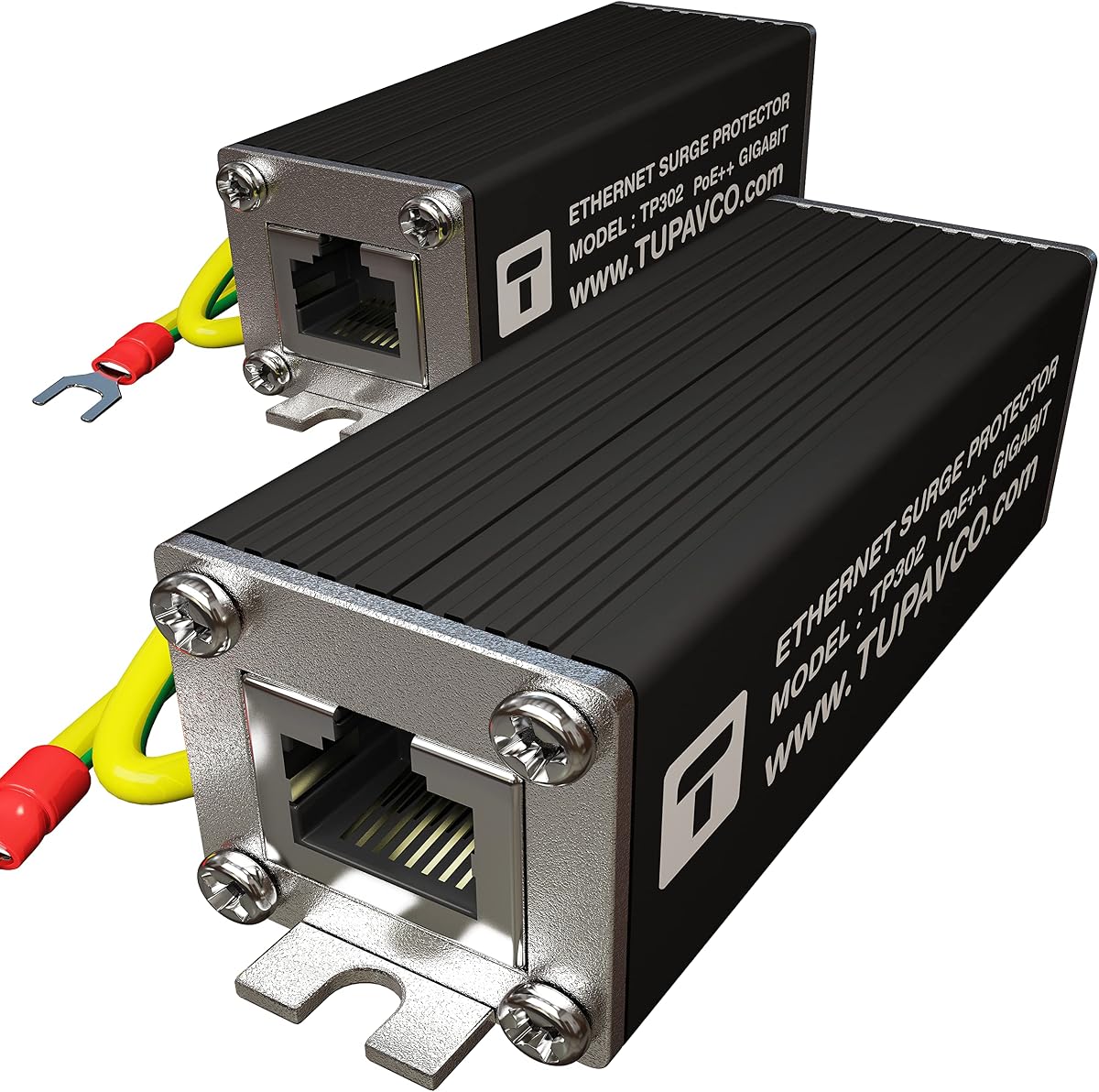
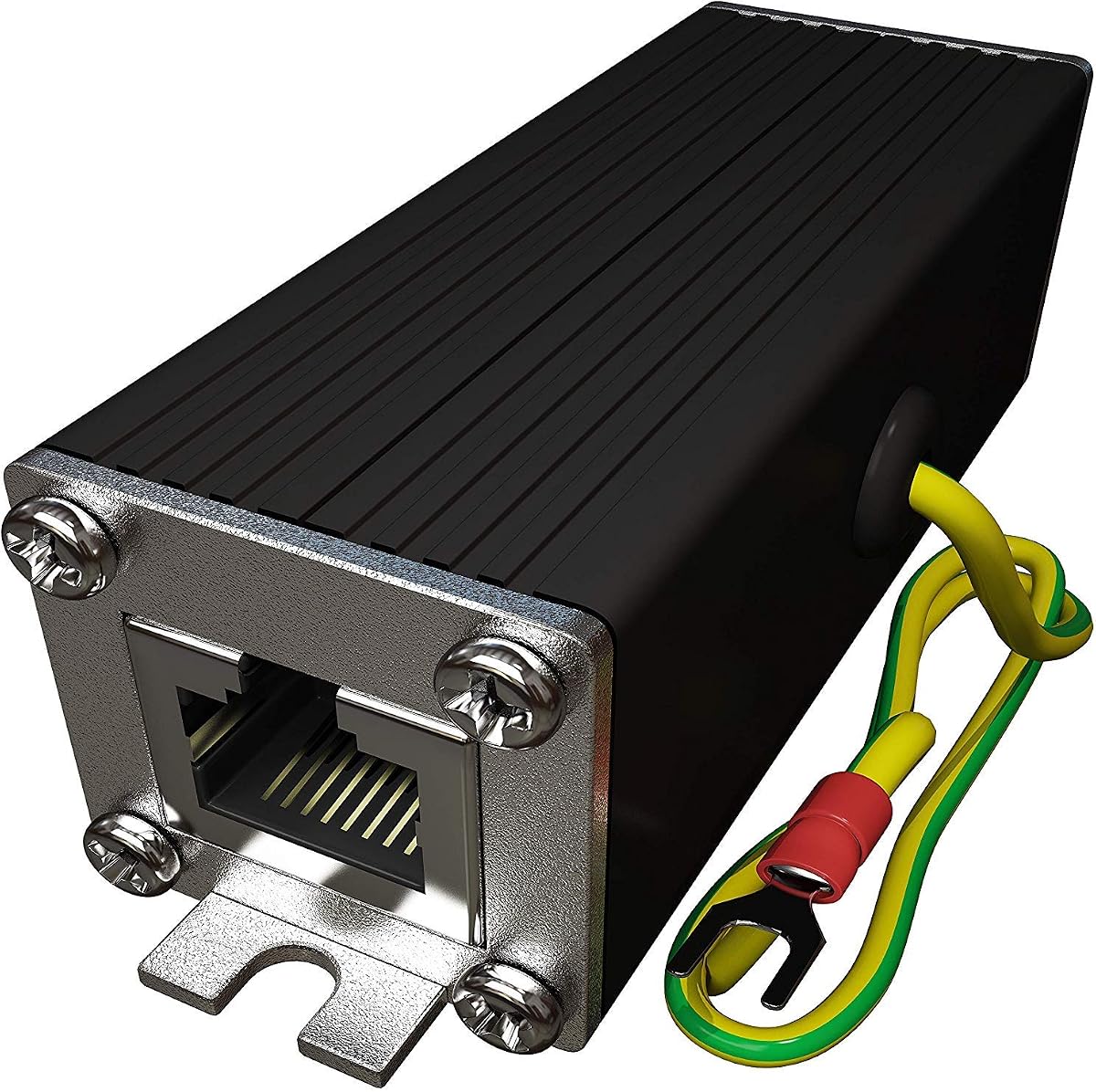
The TP302 is a single-purpose Gigabit Ethernet surge protector with PoE and High PoE++ compatibility. Its 4.4 rating places it below the strongest models in the group, but the core specifications are relevant for a modern network. It supports 1000 Mbps Ethernet, uses gas discharge tube protection, and is rated for a 20KA 8/20 microsecond surge current.
We may earn a commission when you buy through this link, at no additional cost to you.
The enclosure is aluminum, and the unit includes a 12AWG grounding wire. Bidirectional line-to-line and line-to-ground clamping is specified for transient suppression. PoE compatibility follows the IEEE 802.3af, at, and bt family, including Mode A and Mode B arrangements and listed transmission voltages from 15V through 56V. Current ratings cover both two-pair and four-pair PoE arrangements.
Its main disadvantage is that it is a single protector rather than a multipack. Mounting flanges permit screw attachment to a wall, electrical panel, or network rack cabinet, but the lack of the more extensive temperature, insertion-loss, and installation data found on newer competing models means buyers must assess compatibility carefully. It is also less convenient when two endpoints need protection at the same time.
The TP302 makes sense for a single exposed Ethernet connection, particularly one serving a PoE camera, router, or switch in a small installation. Its Gigabit support and grounded aluminum construction offer a meaningful upgrade over a basic plastic coupler. Choose it when a straightforward inline protector with conventional wall or rack mounting is needed and only one protected link is required.
The aluminum case and 12AWG grounding lead provide a more permanent construction than lightweight coupler-style suppressors. Correct attachment to protective earth remains essential to the unit's intended performance.
Broad PoE standards and voltage support allow the TP302 to protect several common network endpoint categories. Gigabit throughput ensures that surge protection does not inherently limit the connection to an older Ethernet rate.
We may earn a commission when you buy through this link, at no additional cost to you.
The CERRXIAN two-pack is a straightforward in-line coupler with built-in surge suppression, intended for basic Ethernet networks and outdoor PoE antenna connections. Its 4.2 rating reflects a simple, accessible design rather than the specification depth of the metal-housed industrial units. Each adapter has female RJ45 ports on both sides and can also join two cables to extend a run.
We may earn a commission when you buy through this link, at no additional cost to you.
Eight TVS components are included to help block lightning-related and abnormal current entering through the network cable. The shielded external housing is designed to reduce electromagnetic and radio-frequency interference, while the stated fire rating is 100V0. Installation requires no tools because both ports are identical. That symmetry makes orientation easy, although it removes the explicit protected-side labeling found on more sophisticated inline units.
The biggest limitation is the stated 100 Mbps transmission rate. This makes the adapter unsuitable for Gigabit networks, and the supplied information does not establish compatibility with PoE power standards. It also lacks a dedicated grounding lead and does not describe the same high-current gas discharge protection offered by the other dedicated Ethernet products. It should be regarded as a basic surge and coupling device rather than a full-featured industrial lightning arrester.
Buyers can consider this pair for an older 100 Mbps network, a compatible outdoor antenna arrangement, or a short cable extension where cost and simple installation are the main priorities. It is less appropriate for modern Gigabit offices, high-wattage PoE cameras, or mission-critical network infrastructure. Its two-pack format is convenient when multiple basic links need the same treatment.
Identical RJ45 interfaces on both ends remove the need to identify an input and output side. This makes the adapter quick to install, although the protected endpoint must still be connected on the appropriate side of the surge path.
The coupler can extend a network cable while adding basic transient protection. Its 100 Mbps ceiling and limited published PoE information make it most appropriate for older, uncomplicated installations.
We may earn a commission when you buy through this link, at no additional cost to you.
The Belkin 12-outlet strip is a general-purpose power protection solution rather than a dedicated Ethernet surge protector. It carries a 4.8 rating and combines 12 AC outlets with a 4,156-joule overcurrent and overload protection rating. The long 10-foot cord and widely spaced outlets make it well suited to desks, workstations, game rooms, and home offices with several chargers.
We may earn a commission when you buy through this link, at no additional cost to you.
Telephone protection is provided through a 1-in-2-out RJ11 arrangement that allows a continuous phone-line connection, and a coaxial input supports cable or satellite equipment. A three-prong angled plug and durable 3M cord help the strip fit into tight spaces and tolerate regular repositioning. The product is backed by a lifetime warranty and connected-equipment warranty, adding reassurance for a device intended to serve multiple household or office loads.
Despite appearing in this roundup, it does not offer a dedicated Ethernet data-line port or RJ45 protection. The coaxial and telephone protections therefore make it a useful companion to a network, but it cannot serve as the inline surge barrier between an Ethernet cable and a router, switch, or camera. Its size and outlet-oriented design are also less discreet than a compact RJ45 arrester.
Choose this Belkin strip when the primary need is many protected AC outlets around a desk or entertainment area and legacy phone or coax connections also need coverage. Pair it with one of the dedicated Gigabit Ethernet models if network equipment requires surge protection. In that arrangement, the Belkin handles power-side protection while the inline unit handles the data path.
Twelve widely spaced AC outlets reduce competition among computers, monitors, phones, cameras, and other charger bricks. The 10-foot cord offers practical reach across a larger workstation or entertainment area.
RJ11 and coaxial connections add value for installations that still route telephone, cable, or satellite signals. They do not replace the dedicated RJ45 protection required for an Ethernet network.
We may earn a commission when you buy through this link, at no additional cost to you.
The PROCET PT-PR04G is an industrial-oriented Gigabit Ethernet surge protector with a 4.6 rating and an extensive operating specification. It protects four pairs, supports 10/100/1000Mbps data rates, and combines gas discharge tube technology with 20KV common-mode and 1.5KV differential-mode surge voltage figures. Its construction and temperature range position it as a premium choice for demanding installations.
We may earn a commission when you buy through this link, at no additional cost to you.
PoE capability is central to the design. The unit supports up to 120 watts per port, accepts a maximum input of 60V DC, and works with IEEE 802.3af, at, and bt devices as well as non-standard Ethernet equipment. A sturdy zinc alloy shell resists mechanical wear, while the listed operating range of -40°F to 185°F supports use in hot outdoor enclosures, industrial cabinets, and other variable environments.
Installation is flexible through a bracket that can be mounted on the back or side, placed on a desk, or attached to a wall. DIN rail compatibility is particularly useful for network cabinets and control systems. As with any properly engineered inline surge protector, the unit needs to be positioned between the exposed line and the protected equipment, with any required protective-earth connection completed according to the installation instructions.
This model is appropriate for a professional network, outdoor surveillance system, industrial control installation, or a high-value equipment cabinet where broad environmental tolerance and dependable PoE support justify a more specialized unit. It is more substantial than a basic coupler and calls for careful placement. Buyers who need that combination of industrial construction, four-pair protection, high-power PoE, and extreme-temperature operation will find it especially compelling.
The -40°F to 185°F operating range and zinc alloy shell go beyond the environmental needs of a typical home office. These characteristics suit protected cabinets and outdoor network equipment exposed to wide temperature swings.
Support for 120 watts per port and all four cable pairs makes the PT-PR04G relevant to modern cameras, access points, and industrial endpoints. Its Gigabit data support preserves local network performance while adding transient protection.
We may earn a commission when you buy through this link, at no additional cost to you.
The 20KA Gigabit two-pack is an inline RJ45 lightning arrester intended for routers, computers, cameras, switches, and servers. Its 4.0 rating is the lowest in this comparison, but the core functionality covers Gigabit Ethernet, PoE and non-PoE connections, and protection against lightning, electrostatic discharge, ground surges, and voltage spikes. Two units allow protection at more than one endpoint.
We may earn a commission when you buy through this link, at no additional cost to you.
The listed protection performance includes 10KV surge protection and a peak current of 20KA using an 8/20 microsecond waveform. A network transformer is incorporated to reduce electromagnetic interference, and a gas discharge tube provides an additional suppression layer. Response time is listed at no more than 1ns, insertion loss at no more than 0.5dB, and operating voltage at 48V DC. Mode A and Mode B PoE arrangements are supported.
Installation requires attention to the marked IN and OUT connections. A 12AWG grounding wire measures 7.87 inches, and dual-side flanges support wall mounting, although screws are not included. The aluminum housing offers good heat dissipation, corrosion resistance, and mechanical strength. CAT5, CAT5e, and CAT6 cables are listed as compatible, making it suitable for common residential and small-office wiring.
This pair is worth considering when two Gigabit links need inline protection and the buyer wants clear directional labeling in a compact metal enclosure. The 4.0 rating calls for more careful compatibility checking than the leading models, particularly around unusual PoE requirements. It is best suited to straightforward networks where Gigabit speed, common PoE standards, and two protected endpoints are the priorities.
The listed response time and insertion loss indicate that the protector is designed to preserve normal network performance. Gigabit support also avoids limiting a modern local connection to an older Ethernet rate.
Marked IN and OUT sides help place the protected equipment on the correct side of the arrester. The included two-pack is useful for a router plus one camera, or two switches in separate locations.
We may earn a commission when you buy through this link, at no additional cost to you.
The right Ethernet Surge Protector depends on network speed, PoE requirements, grounding, installation environment, and whether the product must also protect AC power or legacy connections. These factors determine whether a compact coupler, a grounded inline arrester, or a full home-entertainment surge strip is the more appropriate form of protection.
Begin by identifying the maximum speed used by the protected Ethernet link. Most contemporary routers, switches, access points, and network cameras use Gigabit data rates, so a protector limited to 100 Mbps can become an unintended bottleneck. The dedicated models in this guide generally support 10/100/1000Mbps, whereas several Tripp Lite home-theater units list Ethernet pass-through speeds of up to 100 Mbps. Those home-theater protectors remain useful for power and conventional line protection, but they are not the stronger choice for a modern Gigabit backbone.
Choose a model that explicitly supports the network's full operating rate. Also consider future upgrades: selecting Gigabit protection now prevents a later need to replace a lower-speed inline unit when local network traffic increases.
PoE equipment adds a power component to the same twisted-pair cable used for data. A compatible surge protector must accommodate the applicable standard, voltage, and current while continuing to carry network traffic. The strongest options list IEEE 802.3af, at, and bt compatibility, including Mode A and Mode B. Some also specify support for 120 watts per port, 154 watts for High PoE++ conditions, and maximum DC input voltages around 60V. By contrast, the basic CERRXIAN coupler does not publish PoE support in the supplied specifications.
Check both the standard used by your equipment and its actual power draw. Do not assume that a connector physically accepting a PoE cable means the protector can safely carry the required power. Matching the device's mode, wattage, and voltage requirements is essential.
Gas discharge tubes, transient voltage suppressors, and network transformers can provide different forms of transient handling. GDT-based units are common in dedicated Ethernet arresters and are intended to divert larger surge events. TVS components respond quickly to lower-energy spikes and electrostatic discharge, while the two-pack model that combines GDT and TVS adds a dual-protection approach. A full power strip uses joule-based AC suppression and may include separate data-line protection.
Look for a clearly stated protection method, surge voltage, and peak current rather than relying on broad claims. A model that states 20KV common-mode resistance, 1.5KV differential-mode resistance, and 20KA discharge current provides more useful information for a technical installation.
A surge protector is only as effective as its connection to protective earth. Dedicated metal-housed models commonly include a 12AWG grounding wire or mounting arrangement intended to support a proper ground connection. Installers should follow the manufacturer's wiring guidance and connect the earth lead to a suitable protective-earth point. Do not improvise with a neutral conductor or an unrelated metal object.
Correct placement also matters. The unprotected network line should enter the marked IN side, and the protected device should connect to the OUT side. For powered equipment, follow all applicable electrical codes and use a qualified electrician when the installation involves fixed wiring or uncertain grounding conditions.
Home and office networks usually benefit from a compact inline unit secured near a wall or cabinet. Industrial and outdoor-adjacent installations demand more rugged construction and a wide temperature tolerance. The PROCET PT-PR04G, for example, uses a zinc alloy shell and lists an operating range of -40°F to 185°F. Other metal models offer aluminum housings for heat dissipation, corrosion resistance, and mechanical strength.
Consider cable bending, moisture exposure, vibration, and available mounting space. DIN rail support is valuable in control cabinets, wall flanges work well near entry points, and desktop placement may be sufficient for a simple home setup. Outdoor use should also involve a suitably rated enclosure and cable routing that prevents direct exposure where practical.
A dedicated inline protector is focused on the Ethernet path and usually provides the most appropriate surge barrier for a router, switch, camera, or access point. A multi-outlet home-theater strip is better when several AC adapters need one central connection and the installation also uses telephone or coaxial lines. The Eaton models in this roundup combine 8, 11, or 12 AC outlets with RJ45, RJ11, and coax protection.
The two formats solve different problems. A power strip does not necessarily protect Ethernet adequately, while an inline arrester does not provide additional AC outlets. Some users can benefit from both, using a protected power strip for household devices and a grounded inline arrester at the exposed network entry point.
Outlet count and physical layout can be as important as protection specifications. A strip with widely spaced sockets or side-facing transformer outlets reduces interference between bulky power bricks. Cord length determines where the unit can be placed, with 8-foot and 10-foot leads covering many furniture arrangements. Flat or right-angle plugs can sit more neatly behind entertainment centers and against walls.
Diagnostic LEDs are also valuable because they can reveal an improperly grounded wall outlet or an interrupted protection path. Look for a resettable circuit breaker on multi-outlet models, since it provides overload control without requiring a replacement fuse. Always read the label and instructions before connecting high-load equipment.
Manufacturer support can be important when a protector is part of a larger home or business installation. The Tripp Lite models listed here are supported by a lifetime limited manufacturer warranty, with some also including connected-equipment insurance. Belkin states a lifetime warranty and connected-equipment warranty for its 12-outlet strip. For specialized industrial units, confirm the exact support terms and documentation before installation.
Warranty coverage should complement, not replace, correct installation. Keep receipts and model information, follow all grounding and wiring requirements, and document the protected devices and network lines. These steps make support requests easier and help maintain a clear installation history.
Before installation, identify the network line entering the building or equipment area and the exact device that needs protection. For a dedicated inline unit, disconnect the Ethernet cable from the router, switch, camera, or access point. Connect that cable to the protected OUT side, then run the line or service cable into the IN side. Never reverse the intended path on a model that clearly labels its two sides.
Ground the protector according to the manufacturer's instructions. Attach the protective-earth lead to a verified grounding point, using appropriate wiring methods and electrical safety practices. Keep the ground connection short and direct where directed. After installation, power on the equipment, confirm the link lights operate normally, and check any diagnostic LEDs or protection-status indicators.
For a multi-outlet home-theater model, connect the flat plug directly to a properly grounded wall outlet and use the included Ethernet, telephone, and coaxial leads only with the corresponding ports. Do not use extension cords downstream unless the manufacturer expressly permits it. Periodically inspect cables for damage, verify that plugs remain secure, and replace the protector after a severe surge event or if status indicators show a fault.
A properly selected protector should preserve the data rate of the protected link. Many dedicated models support 10/100/1000Mbps, but some home-theater units are limited to 100 Mbps. Always compare the protector's listed pass-through speed with the speed used by the router, switch, camera, or other endpoint before installation.
No. A surge protector diverts or clamps transient voltage events, while an uninterruptible power supply also supplies backup battery power during outages. A surge protector may include a resettable circuit breaker for overload protection, but it does not keep a router operating when utility power fails unless a separate UPS is installed.
Only if the protector explicitly supports the camera's PoE standard, mode, voltage, and power level. Models that mention IEEE 802.3af, at, and bt compatibility are designed for a broader range of PoE equipment, but the connected device's requirements should still be checked. A protector without stated PoE support may pass data while interfering with or failing to protect the power component.
The best position is where the external or exposed Ethernet line enters the building, cabinet, or protected equipment area. The unprotected side should connect toward the incoming line, and the protected side should connect to the sensitive router, switch, camera, or access point. This placement gives the transient a path to protective earth before it reaches the endpoint.
The dedicated metal-housed models generally include a grounding lead, and proper protective-earth connection is important to their intended operation. The basic CERRXIAN coupler does not list a dedicated ground lead, so it should not be treated as equivalent to a fully specified industrial arrester. Follow the instructions included with whichever model is selected.
A multi-outlet home-theater strip can provide Ethernet protection for one line while supplying many AC outlets, but it does not create multiple independent protected Ethernet paths. Protecting several separate devices usually requires one inline protector per exposed line or a network arrangement with protection at the entry point and a protected switch downstream.
No product can guarantee immunity from every severe lightning event or eliminate all damage. A properly specified and grounded protector can greatly reduce the chance that transient energy reaches connected equipment, but it should be part of a broader plan involving surge-protected power, suitable cabling, bonding, and professionally assessed electrical and lightning-protection systems.
Multi-outlet models with diagnostic LEDs can indicate grounding and protection status, but inline network arresters are generally passive and do not provide a comprehensive health display. Inspect the unit for physical damage after a serious event, confirm normal network performance and link lights, and replace a unit that has been damaged or has uncertain protection status.
The featured recommendations cover three distinct priorities. The Eaton Tripp Lite TLP118DBNET is the most capable all-around entertainment strip, combining 11 outlets, a 4,200-joule rating, data-line protection, grounding diagnostics, and flexible mounting. The two-pack of PoE++ protectors offers strong dedicated Gigabit protection with dual suppression technology, while the PROCET PT-PR04G provides the most specialized option for industrial temperatures, high-power PoE, and four-pair protection.
The most important decision is to match the device to the line being protected. A home-theater strip with RJ11 and coaxial ports may be ideal for a television area, but a modern Gigabit router, switch, or PoE camera needs a dedicated inline model with compatible speed, PoE, and grounding specifications. Installation quality and correct IN/OUT placement are just as important as the product itself.
Finally, verify the current specifications, included accessories, warranty terms, and device compatibility at the time of purchase. Product features can vary between revisions, and current availability is worth checking before ordering. Selecting the right protection level, installing it correctly, and pairing it with appropriate power and lightning safeguards offers the most dependable result.