
VEVOR 24-Inch Compost Spreader
4.3Editor score
24-inch steel drum
Three adjustable handle heights
2.66 cubic-foot capacity
Powder-coated steel construction
A compost and peat moss spreader applies bulky lawn materials more evenly than a shovel, helping reduce missed patches, waste, and repeated bending. The best model should combine a suitably sized drum, durable mesh, secure closures, comfortable handle adjustment, and predictable flow across different materials and terrain.
We compared all ten options by examining drum width and capacity, mesh construction, loading access, handle configuration, push or tow versatility, adjustment systems, and the materials each model is designed to spread. The list includes compact 24-inch spreaders, larger professional-style drums, and self-cleaning designs for damp compost.
Each review highlights the reasons a model may suit a particular lawn, garden, or farm, along with its practical trade-offs. The top picks represent the strongest combinations of value, overall versatility, and large-scale capability. Product availability, features, ratings, and prices can change, so confirm current details before purchasing.
4.3Editor score

4.5Editor score

4.0Editor score
As an Amazon Associate we earn from qualifying purchases.
This side-by-side comparison evaluates drum size, capacity, handle versatility, and material-handling features across ten compost and peat moss spreaders, helping shoppers identify the right combination of coverage and convenience for their space.


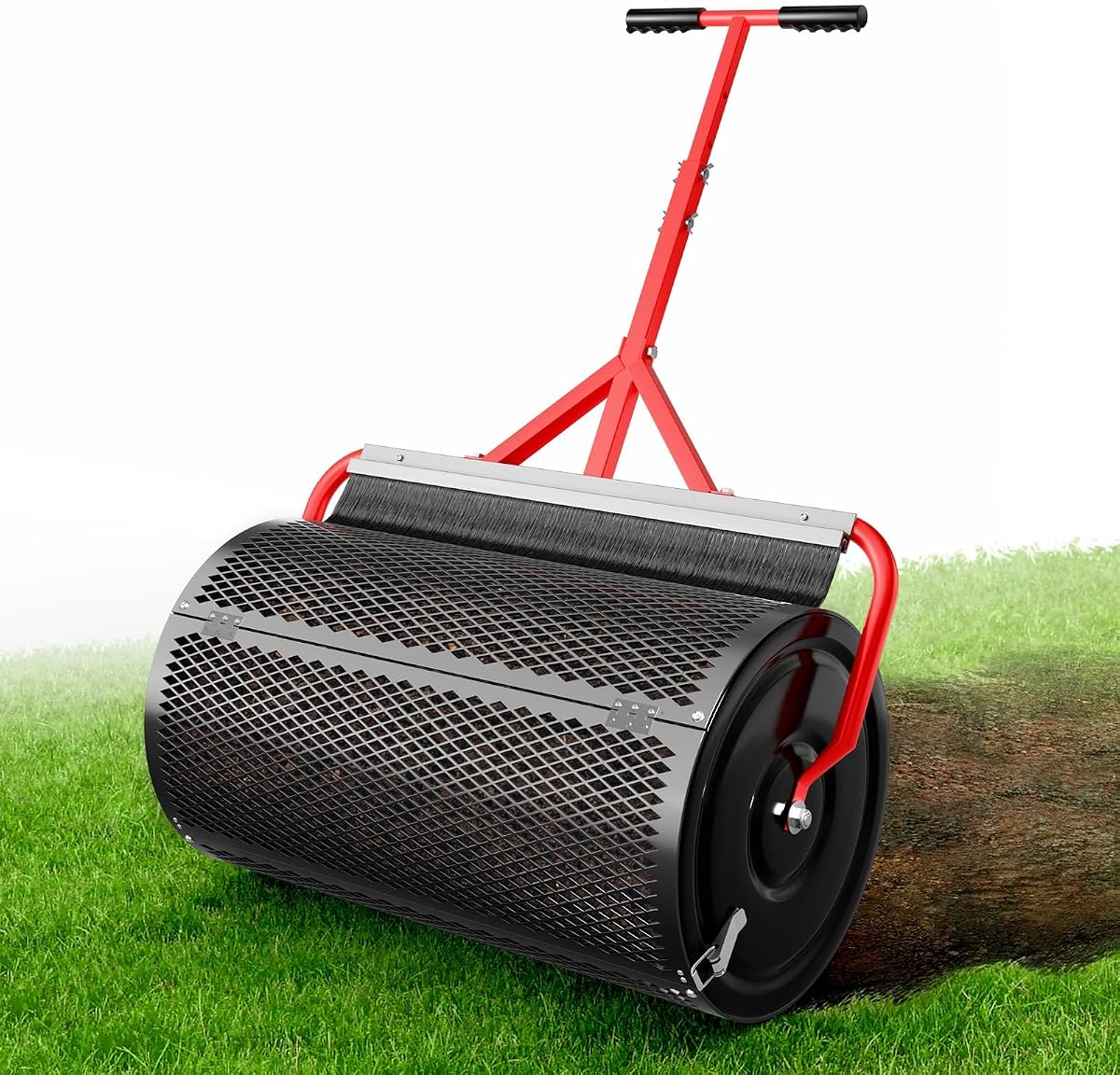


The VEVOR Compost Spreader is a 24-inch steel model with a 4.3 rating, combining a useful capacity, adjustable T-handle, and a compact enough footprint for residential lawn work. Its integrated drum and large openings are intended to handle compost, soil conditioner, grass seed, and similar loose materials, making it a flexible choice for seasonal yard care.
We may earn a commission when you buy through this link, at no additional cost to you.
Three handle settings—42.91, 44.88, and 48.03 inches—allow different users to select a more comfortable operating height. The straight-bar design offers direct directional control, while the 2.66 cubic-foot drum should reduce the need to stop and reload while working over moderate lawn areas. The 12 by 20 millimeter mesh is designed to break up material and support consistent distribution.
The main drawback is that assembly is required, and the manufacturer recommends two people for faster, easier setup. Buyers should therefore allow extra time before the first use. It also offers a simpler feature set than models with flow controls, tow attachments, or a cleaning brush, although that simplicity makes the operating concept straightforward.
This is a strong selection for homeowners who want a wide, durable, adjustable spreader without moving to a much larger machine. It is particularly useful for spreading compost and peat moss over ordinary lawns, gardens, and moderate yard projects. Among the 24-inch options, it stands out as a balanced and economical all-rounder.
The three distinct handle heights make it easier for multiple household members to use the same spreader. A straighter control bar can also help the operator maintain a steady walking pace and keep the drum aligned.
A 2.66 cubic-foot capacity balances useful loading volume with manageable dimensions. It is especially appropriate for users who want fewer passes than a small hand cart can provide without needing a wide farm-scale implement.
We may earn a commission when you buy through this link, at no additional cost to you.
The TrailBlaze 24 Inch Compost & Peat Moss Spreader Roller is notable for its three-level current control, a feature intended to help users match output to light peat moss or heavier compost. It has no published rating in the supplied product information, so its strongest case rests on its design rather than a quantified customer score.
We may earn a commission when you buy through this link, at no additional cost to you.
The all-steel, powder-coated frame and thick diamond-mesh drum are designed to resist rust, break up clumps, and support season-after-season use. Upgraded side locks help keep the drum closed while rolling, while the large hinged door simplifies refilling. A non-slip T-handle has two height settings at 41.1 and 43.1 inches, and the package includes gloves and a cleaning brush.
Some shoppers may want a larger handle adjustment range, particularly if household users differ greatly in height. The absence of a displayed rating also makes it harder to compare long-term satisfaction with highly reviewed products. Nevertheless, the flow control adds meaningful versatility for users who alternate between materials of different densities.
The TrailBlaze model is best for gardeners who want more deliberate material output from a 24-inch roller. It is well suited to topdressing, seeding, and spreading lighter or heavier materials without changing drums. Buyers prioritizing a flow-control mechanism and helpful accessories should give it particular consideration.
The three-level control lets the operator adjust how quickly material leaves the drum. This is valuable when a task calls for a light application of peat moss rather than a heavier compost layer.
The hinged door opens wide for refilling, while the included brush makes routine mesh maintenance more convenient. Side latches add security once the drum is loaded.
We may earn a commission when you buy through this link, at no additional cost to you.
The Best Choice Products Compost Spreader has the highest listed rating in this group at 4.5. Its 24-inch drum, reinforced mesh, and reinforced triangle bracket make it an appealing option for users who prioritize strength and consistent topdressing over the widest possible operating range.
We may earn a commission when you buy through this link, at no additional cost to you.
The heavier steel construction is intended to prevent bending or deformation under load. A secure clasp helps prevent shifting or accidental opening, while the triangular bracket adds balance during use. The listed overall dimensions are 42 to 46 inches long by 28 inches wide by 16 inches high, with a drum measuring 24 inches wide by 16 inches high.
The adjustable T-handle and quick-assembly design support comfort and setup convenience, but this model does not list a specific cubic-foot capacity, a tow mode, or a flow-control mechanism. Those omissions may matter for people who work across very large properties or need to fine-tune the application rate.
This is the top editorial pick because it combines the strongest listed rating with focused reinforcement in the places that affect dependable spreading. It is a particularly good match for residential users applying compost, sand, manure, mulch, peat moss, or topsoil to a lawn or garden. It remains versatile enough to serve as a general-purpose yard spreader.
The thicker mesh and reinforced triangle bracket are designed to withstand load while keeping the drum stable. These details make the model appealing for dense compost and repeated topdressing sessions.
The 24-inch drum covers a useful strip with each pass, reducing the number of tracks across a lawn. That efficiency makes the model suitable for users who regularly spread several different landscape materials.
We may earn a commission when you buy through this link, at no additional cost to you.
The Thunderbay 24-inch Compost Spreader is a push or tow-behind roller with a 3.7 rating, placing it toward the lower end of this group based on the supplied information. Its practical strengths include an 11-inch filling door, upgraded side latches, and compatibility with compost, manure, sand, peat moss, topsoil, and fertilizer.
We may earn a commission when you buy through this link, at no additional cost to you.
The diamond-shaped slits measure 0.5 by 0.8 inches and are designed to roll smoothly while helping distribute material evenly. A rust-resistant powder-coated finish supports outdoor durability, and the ergonomic U-shaped handle is intended to make the unit easier to guide. Its 20-pound material capacity is clearly stated.
The comparatively modest 3.7 rating suggests some uncertainty in overall customer satisfaction, while the 20-pound load limit is lower than the volume and weight demands of many bulk-material jobs. Buyers planning to move large quantities of damp compost should also consider whether the stated capacity provides enough working margin.
Thunderbay is a practical option for a backyard user who values the ability to push or tow the spreader and appreciates a generous loading door. It may suit lighter topdressing and fertilizer work particularly well. Those needing high-volume transport or a more refined flow-control system should compare it with larger-capacity alternatives.
The tow-behind format can reduce the effort required on larger lawns, while manual pushing gives the operator direct control in compact spaces. This dual approach is useful when the same property includes both open and confined areas.
The 11-inch hinged door provides a broad opening for loading compost or topsoil. Upgraded side latches help keep the drum secure after the operator closes the door.
We may earn a commission when you buy through this link, at no additional cost to you.
The TEMFAR Compost Spreader is a 36-inch push or tow model with a 4.0 rating. Its wider drum is the defining feature, allowing operators to cover more ground with each pass and making the spreader well suited to sizable yards, farms, or commercial work.
We may earn a commission when you buy through this link, at no additional cost to you.
The towing interface can connect to tractors or riding mowers, while manual push mode offers precision around smaller areas. A half by three-quarter-inch metal mesh breaks up clumps and filters large debris. The powder-coated high-strength steel frame is designed to withstand weather and heavy use, and a side latch plus B-type pin secure the roller during operation.
The product description claims a 70-percent time reduction compared with manual spreading, but actual results depend on material, loading technique, and the size of the treated area. No specific drum capacity is supplied, which makes it harder to estimate refill intervals. Its 36-inch width also requires adequate storage and maneuvering room.
TEMFAR is a compelling choice for buyers who work across broad terrain and want fewer passes. The ability to tow it is especially valuable when carrying bulk materials becomes tiring. For smaller suburban lawns or tight storage areas, one of the 24-inch models may be more manageable.
The 36-inch drum covers substantially more ground per roll than a standard 24-inch unit. That makes the spreader attractive for farmgrounds, large estates, and professional maintenance routines.
Manual push mode helps with careful placement around garden beds, while towing supports efficient transport across open areas. The choice can be made according to the scale of the task.
We may earn a commission when you buy through this link, at no additional cost to you.
The VEVOR 44-Inch Compost Spreader combines a 44-inch spreading width with a 7.2 cubic-foot capacity, making it the largest and highest-capacity model featured. It is designed for users who spread peat moss, topsoil, compost, sand, or manure across substantial lawn or farm areas.
We may earn a commission when you buy through this link, at no additional cost to you.
The drum measures 47.2 inches long by 19.3 inches in diameter. Dense diamond-shaped mesh of 0.8 by 0.5 inches filters debris and clumps to support consistent distribution. A 13.6-inch opening simplifies filling from bags or carts, and metal side latches reduce the chance of the drum opening during use.
The push-and-tow arrangement adds flexibility: operators can walk behind it or attach it to a tractor, ATV, or UTV with a 1-inch hitch pin. Four handle positions—47.3, 48.5, 50.5, and 53.5 inches—offer more adjustment options than most 24-inch competitors. The substantial size and capacity, however, may be excessive for a small yard.
This is the premium pick for high-volume work because the large drum reduces refill frequency and the wide roller accelerates coverage. A triangular bracket improves stability on gravel, lawns, and hard ground. It is best suited to owners of large properties, farms, or grounds-maintenance operators who can store and maneuver its full size.
The 7.2 cubic-foot drum holds more material than the other models in the comparison. That capacity can reduce stops and make repeated applications across large grounds more practical.
A 44-inch rolling width covers a substantial strip in one pass. Combined with towing capability, it gives operators a productive workflow for large lawns, fields, and similar surfaces.
We may earn a commission when you buy through this link, at no additional cost to you.
The 24-Inch Compost Peat Moss Spreader with Brush Mesh Cleaner is built around a removable brush that clears damp debris from the drum while the spreader moves. Its 3.8 rating is moderate, but the cleaning system gives it a distinct advantage for moist compost and sticky peat moss.
We may earn a commission when you buy through this link, at no additional cost to you.
The drum measures 16 inches in diameter by 24 inches in length, holds 2.79 cubic feet, and is described as supporting up to 85 pounds. The manufacturer estimates coverage of 250 to 300 square feet per load. Reinforced side clamps, a protected side lock, and a large hinged door support stable movement and convenient refilling.
Because the brush is removable, users can retain it for wet or sticky material and take it off for smoother rolling with dry, non-sticky loads. Assembly support is available, but the product description recommends using a wrench for easier, more secure installation. A brush is another component that may require occasional cleaning.
This is the most targeted choice for homeowners whose compost is consistently damp or whose lawn treatments tend to stick to mesh openings. Its capacity, reinforced frame, and adjustable non-slip T-handle also make it suitable for general topdressing. It is less compelling for someone who only handles very dry material and wants the simplest possible mechanism.
Angled brush bristles remain in contact with the diamond mesh to dislodge sticky residue during use. This can help maintain a clearer discharge path when compost or peat moss holds moisture.
Removing the brush for dry loads reduces unnecessary contact with the mesh. The same spreader can therefore accommodate both damp applications and smoother, lighter materials.
We may earn a commission when you buy through this link, at no additional cost to you.
The Seeutek 24-Inch Peat Moss Spreader has a 4.3 rating and a balanced feature set centered on a 2.8 cubic-foot drum. It can operate in push or tow mode, giving it more versatility than several other residential spreaders in the comparison.
We may earn a commission when you buy through this link, at no additional cost to you.
Its steel frame is powder-coated and heat-treated for rust and corrosion resistance, while the roller measures 15.8 inches in diameter by 24 inches in length. A non-slip rubber T-handle adjusts to 45, 48, and 53.9 inches. At the lowest setting, the spreader can be configured for towing with compatible tractors.
The six-millimeter side latches and support rod help prevent the drum from opening during travel, and the hinged door makes filling easier. The product description states that one load can cover more than 300 square feet, although actual coverage varies with the material and spreading technique. There is no listed flow-control system for fine output adjustment.
Seeutek is a strong middle-ground option for users who want a reasonably large drum without moving to a wide 36- or 44-inch implement. It is useful on residential lawns, gardens, and farms where both precise pushing and broader towing may be needed. The three-height handle also supports comfortable operation by different users.
The 2.8 cubic-foot drum offers a useful balance between refill frequency and maneuverability. It remains a more manageable option than the largest spreaders while still supporting efficient topdressing.
Larger-than-standard latches and a support rod work together to keep the drum closed. This is especially helpful when operating over uneven ground or turning at the end of a pass.
We may earn a commission when you buy through this link, at no additional cost to you.
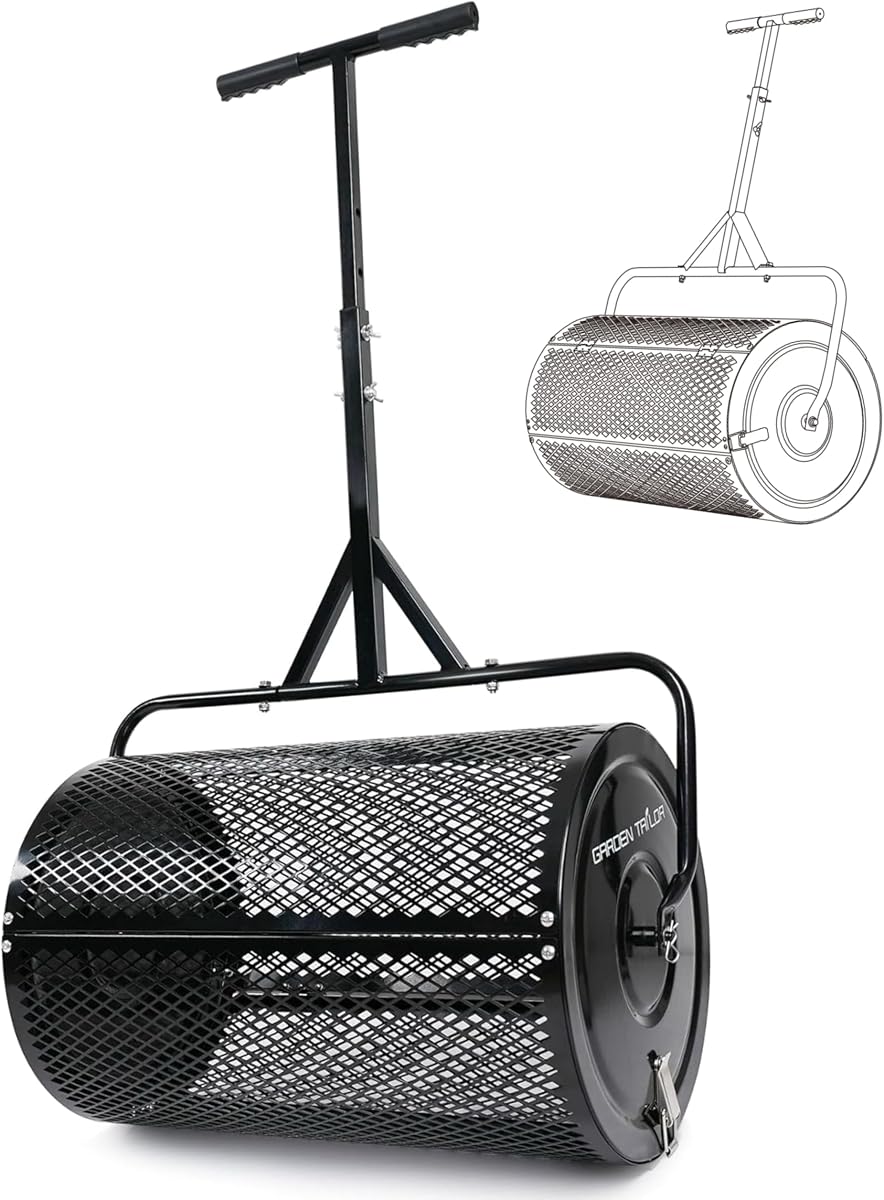
The Garden Tailor 24-Inch Peat Moss Spreader is a straightforward topdressing model with a 4.3 rating. Its strongest selling points are accessible setup, a durable mesh basket, and an adjustable T-handle designed for regular lawn and garden work.
We may earn a commission when you buy through this link, at no additional cost to you.
The product description states that proprietary supports enable setup in approximately 15 minutes without complicated tools. A half by three-quarter-inch metal mesh crushes clumps and separates larger pieces as the drum rolls, while heat-treated, powder-coated materials help resist rust. The T-handle can be adjusted to suit different user heights.
The description claims a 75-percent reduction in topdressing time and a 30-percent reduction in compost use compared with traditional methods, though outcomes will vary with application technique. It does not list a specific cubic-foot capacity, towing capability, or granular flow control, making it more appropriate for user-pushed residential work.
Garden Tailor is well suited to first-time spreader owners and anyone who values quick assembly and accessible support. The company offers assembly guidance, troubleshooting, and replacement parts, which can be useful for long-term ownership. It is a sensible option for evenly distributing compost, manure, dirt, and topsoil over a manageable lawn.
The proprietary support system is designed to make assembly faster and less intimidating. Users can begin spreading sooner and avoid the need for a complicated tool-intensive setup process.
Assembly guidance, troubleshooting assistance, and replacement parts are offered for long-term use. This can be particularly helpful when a latch, mesh section, or support component eventually needs attention.
We may earn a commission when you buy through this link, at no additional cost to you.
This Seeutek 24-Inch Peat Moss Spreader is a second distinct listing with a 4.3 rating. It combines a heavy-duty steel frame, 2.8 cubic-foot drum, and three-position handle with both push and tow operation, giving owners flexibility across different property sizes.
We may earn a commission when you buy through this link, at no additional cost to you.
The 15.8 by 24-inch roller uses heat-treated, powder-coated metal mesh to resist rust and corrosion. The rubber T-handle offers a secure, non-slip grip. Upgraded six-millimeter side latches and a support rod keep the drum closed during use, while the hinged door provides a broad loading opening.
The claimed capacity covers more than 300 square feet in one pass, though actual results vary according to the material and technique. As with the other Seeutek listing, no separate flow-control adjustment is specified. Buyers may also wish to compare the two listings carefully because their core dimensions and feature descriptions are similar.
This model is a good choice for users who want to push around garden beds and tow across a larger lawn. The dense diamond mesh is intended to break up clumps and distribute compost, peat moss, fertilizer, topsoil, and mulch evenly. It is best for users who value steel construction and two-way operation more than a specialized cleaning brush.
The lowest of the three handle positions allows the spreader to be set up for towing with most tractors. Higher settings support comfortable manual pushing in lawns and gardens.
Heat-treated mesh helps the drum resist outdoor exposure, while stronger latches and a support rod limit unwanted movement. These features make repeated loading and rolling more dependable.
We may earn a commission when you buy through this link, at no additional cost to you.
The right compost and peat moss spreader depends on lawn size, material moisture, loading frequency, and available storage. Comparing capacity, mesh design, controls, closures, and handle configuration prevents an unsuitable purchase.
Drum width directly affects how much area a spreader can cover per pass. Most residential models in this guide measure 24 inches wide, which balances efficient coverage with manageable storage and turning. A 36-inch model such as the TEMFAR is better when the priority is completing broad lawns or farm areas quickly. The 44-inch VEVOR goes further, trading additional size and bulk for fewer passes and a high-volume drum.
Capacity determines how much compost, peat moss, topsoil, or fertilizer can be loaded before stopping. The VEVOR 24-inch model holds 2.66 cubic feet, while several competing 24-inch models hold close to 2.8 cubic feet. The large VEVOR offers 7.2 cubic feet, substantially reducing refill frequency on extensive areas. Capacity alone does not determine performance, because material density also affects weight, but it remains one of the clearest indicators of workload efficiency.
The drum mesh breaks up clumps, filters debris, and helps determine how material exits the spreader. Common openings in this group range from 12 by 20 millimeters to roughly half-inch by three-quarter-inch grids. A dedicated cleaning brush can be valuable for damp compost that sticks to the mesh. Users spreading dry, clean material may prefer a simpler mesh without an attached brush, while those with consistently wet organic material should prioritize clog resistance.
A comfortable handle reduces fatigue and makes uneven terrain easier to manage. Most models offer two or three adjustment positions, with ranges around 41 to 54 inches depending on the design. Height adjustment is especially important when several people share the tool or when the operator has a pronounced difference in preferred operating height. Non-slip grips, T-shaped bars, and straight control shafts can further improve comfort and steering.
Push-only spreaders provide direct control and fit well around beds, paths, and confined lawns. Tow-behind models can cover broad grounds more efficiently and reduce the strain of transporting heavy loads. The Seeutek models and the large VEVOR support towing when configured appropriately, while the TEMFAR includes a dedicated towing interface. A tow-capable spreader still requires a compatible tractor, mower, ATV, or UTV and enough storage for the larger implement.
A wide hinged door makes it easier to load bulky bags, dump wheelbarrows, or use carts with less spillage. Secure side latches or support rods help keep the drum closed while rolling over uneven ground. The TrailBlaze, Garden Tailor, and Seeutek models emphasize upgraded closures, while the large VEVOR uses metal side latches. Buyers should inspect how the latch hardware is positioned and ensure it can be operated with gloves.
A dedicated flow or current control is useful when switching between light peat moss, seed, fertilizer, and heavier compost. The TrailBlaze provides three levels, allowing the operator to adapt output to the task. Many other models rely on material loading, mesh behavior, and the user's rolling pace. That can still produce satisfactory results, but buyers who require more precise application rates should prioritize a model with an explicit control mechanism.
Steel frames and powder-coated finishes are common because they provide a useful balance of strength and outdoor durability. Heat treatment can add further corrosion resistance, as seen in the Seeutek and Garden Tailor models. Buyers should also consider how the mesh will be cleaned, whether hardware is protected from impact, and whether replacement parts or assembly support are available. A coated surface and accessible closures simplify long-term care.
Begin by assembling the spreader on a level surface, checking that the mesh, handle, brackets, side latches, support rod, and any tow pin are fully tightened. Install the cleaning brush if the material is damp or sticky, and remove it for dry material. Set the handle to a comfortable height, then open the hinged door and load compost or peat moss without packing it more tightly than necessary.
Close and secure the door before moving. Begin at the edge of the lawn and roll at a steady pace, keeping the drum aligned so the strips overlap slightly rather than leaving gaps. Adjust the handle or flow control as needed, and make turns carefully to prevent the drum from twisting or spilling. For towing models, attach the hitch pin only to a compatible vehicle and operate on a clear, even surface.
After each use, stop the spreader on firm ground, remove leftover material, and brush the mesh so openings do not remain clogged. Rinse off damp organic residue when appropriate, dry the metal thoroughly, and inspect the frame, latches, and handle fasteners. Store the unit in a dry, covered location, and address rust or loose hardware before the next application.
A compost spreader uses a large mesh drum to roll out bulky, uneven materials such as compost, peat moss, manure, and topsoil. A conventional granular fertilizer spreader often uses smaller openings and calibrated controls for precise fertilizer or seed distribution. A compost spreader is better suited to heavier topdressing, while a granular spreader is better for controlled chemical or seed application.
For most residential lawns, a 24-inch drum provides an effective balance between coverage and maneuverability. It can reduce the number of passes compared with hand spreading while remaining easy to turn near garden beds. Very large properties may benefit from a 36- or 44-inch model, particularly when the spreader can be towed.
Yes, but moisture can make organic material cling to the mesh and create clumps. A model with a removable cleaning brush, such as the 24-Inch Brush Mesh Spreader, is particularly suited to wet material. Users can also avoid overloading the drum, clean residue promptly, and select a larger mesh opening when the material is very damp.
A tow-behind design is most useful for large lawns, farms, and other expansive properties. It reduces the effort required to transport heavy loads and enables faster coverage, but it also requires compatible towing equipment, more storage, and careful operation. A push spreader is usually more convenient for residential yards and confined garden areas.
The listed 24-inch models in this guide generally hold around 2.66 to 2.8 cubic feet, while the 44-inch VEVOR holds 7.2 cubic feet. Actual weight varies with material density, and a volumetric capacity should not be treated as a universal weight rating. The ThunderBay separately lists a 20-pound material capacity.
A rate control is helpful when alternating between light peat moss, fertilizer, and dense compost because it allows the operator to adjust the discharge rate. The TrailBlaze offers three levels for this purpose. Models without a dedicated control can still work well, but the operator must manage output through material consistency, loading depth, and rolling speed.
Load the drum without compacting the material, and avoid placing wet, oversized clumps inside. Choose an appropriate mesh design, use the cleaning brush on models that provide one, and stop spreading if the drum starts carrying material forward. Cleaning the mesh immediately after use prevents residue from hardening and narrowing the openings.
Yes, most of the models in this guide list sand, topsoil, mulch, manure, or similar materials among their intended uses. Dense materials increase the load, so users should not exceed the manufacturer’s capacity guidance and should avoid overfilling the drum. The largest model is generally better suited to bulk topsoil and manure.
The Best Choice Products Compost Spreader is the strongest editorial pick for its 4.5 rating, reinforced mesh, stable bracket, and secure clasp. The VEVOR 24-Inch model is the best-value option for straightforward residential use, while the VEVOR 44-Inch model stands apart for buyers who need a high-capacity drum, broad coverage, and towing capability.
Prioritize the factors that match your actual workload. Choose 24 inches for most lawns, a larger drum for bulky applications, a cleaning brush for damp compost, and a tow system for expansive properties. Also consider handle adjustment, loading access, mesh openings, and how much storage space you have before settling on a model.
Ratings, availability, construction details, and prices can change over time, so check the current product listing before buying. Compare the manufacturer’s dimensions, loading guidance, material compatibility, and included components with the way you plan to use the spreader. The right model should make regular topdressing faster, cleaner, and more consistent.
