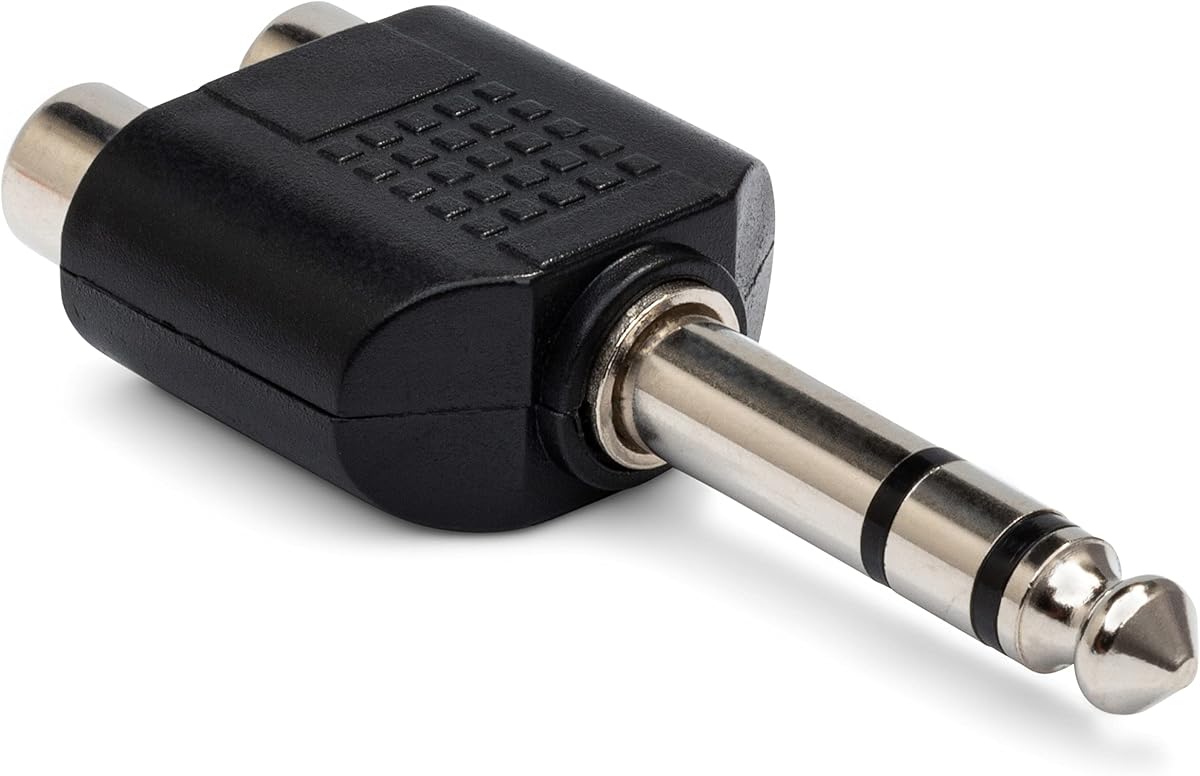
Hosa GPR-484 Adaptor
4.6Editor score
Direct RCA-to-TRS design
Compact portable form
Stereo signal conversion
An RCA to TRS converter bridges two very different audio connections, allowing equipment with RCA stereo inputs to work with a 3.5 mm or 6.35 mm TRS jack. The right adapter depends on connector gender, signal direction, channel configuration, and whether the equipment handles balanced audio.
The products in this guide were compared using their stated construction, connector configuration, length, supported equipment, and intended signal path. The list covers compact Y-cables, longer breakout leads, reversible designs, and a direct dual-RCA-to-TRS adapter, with special attention to stereo compatibility.
Each review explains where the converter is most useful, what makes it stand out, and where its limitations matter. Ratings reflect the listed customer feedback, while availability and prices can change, so compare the current product page before making a final purchase.
4.6Editor score

4.7Editor score

4.6Editor score
As an Amazon Associate we earn from qualifying purchases.
This side-by-side comparison highlights each converter's connector arrangement, cable length, construction, and best-fit equipment so you can identify the right signal path without paying for features your setup does not need.


This Togconn converter combines a 3.5 mm TRS male plug with two female RCA connectors in a compact eight-inch Y-cable. Its 4.7 rating reflects strong customer satisfaction, and the red-and-white channel markings, dual shielding, gold-plated connectors, and brass shells make it a well-considered option for connecting a 3.5 mm source to a stereo RCA-equipped device.
We may earn a commission when you buy through this link, at no additional cost to you.
The main appeal is straightforward stereo integration. A phone, tablet, MP3 player, or other device with a 3.5 mm headphone output can feed left and right channels into a receiver, amplifier, speaker system, or home-theater setup. The Y configuration separates the stereo signal into two color-coded RCA connections, reducing the chance of reversing the channels while wiring the system.
The stated 10,000-plus bend-test result also makes the short cable more reassuring than a typical lightweight lead. It is also described as usable in either 3.5 mm-to-RCA or RCA-to-3.5 mm orientation, which is helpful when the source and destination are not obvious from the connector shapes. The trade-off is the 8-inch overall reach, which is best for equipment positioned close together rather than across a room.
This is a strong choice for a compact home audio setup, a desktop stereo system, or a portable speaker arrangement. Choose it when you already own RCA cables, value a short and durable lead, and want an uncomplicated way to connect a 3.5 mm stereo source to a dual-RCA destination.
The red and white RCA shells identify left and right channels immediately, making the connection easier to inspect and correct. This is especially useful behind receivers, amplifiers, and compact speaker systems where labels may be difficult to see.
Dual shielding, gold-plated contacts, brass shells, and a stated 10,000-plus bend-test result support dependable everyday use. The compact form is also easy to carry without becoming a tangled cable in a bag.
We may earn a commission when you buy through this link, at no additional cost to you.
This two-pack of Togconn 6.35 mm TRS-to-dual-RCA adapters is aimed at users who need more than one connection point. Each adapter is 10 inches long, carries a 4.6 rating, and uses aluminium-alloy shells with 24K gold-plated plugs for a more robust alternative to a lightweight basic lead.
We may earn a commission when you buy through this link, at no additional cost to you.
Its configuration is particularly relevant to amplifiers, guitars, pianos, speakers, receivers, and other equipment that exposes a 6.35 mm stereo jack alongside RCA connections. The 6.35 mm male plug enters the source, while the two female RCA sockets accept conventional left and right audio cables. That makes the adapters useful for temporary setups, mobile rigs, or keeping a second equivalent path nearby.
The flexible PVC wire and stated 10,000-plus bend lifespan are appealing for repeated routing. The supplier also includes 24 months of replacement service, adding some reassurance for a frequently handled accessory. However, the female RCA configuration means users need separate RCA cables, and the product description places the emphasis on audio rather than microphone use.
Choose this pack if you work across multiple systems and want a spare 6.35 mm-to-RCA adapter available. It is less suitable for someone wanting a single self-contained cable with male RCA plugs, but it is a well-equipped option for connecting existing RCA leads.
The two-pack provides more flexibility than a single short adapter. One can remain connected to a primary setup while the other is packed for a rehearsal, teaching space, or backup system.
Aluminium-alloy shells, 24K gold-plated plugs, and a flexible PVC cable body give the adapters a refined construction. The stated minimum-signal-loss design is particularly useful for line-level stereo connections.
We may earn a commission when you buy through this link, at no additional cost to you.
This single Togconn 6.35 mm TRS-to-dual-RCA Y-adapter is a practical option for connecting equipment with a quarter-inch stereo output to a receiver or amplifier with RCA inputs. It has a 4.6 rating, a 10-inch total length, and the same metal-shell and gold-plated connector approach used in the brand's two-pack version.
We may earn a commission when you buy through this link, at no additional cost to you.
The plug-and-play design removes the need for tools, software, or complicated box adapters. The 6.35 mm male end can connect to an amplifier, guitar, piano, speaker, or AV receiver, while the two RCA female ends accept left and right cables. This arrangement suits compact rigs where the devices are already near one another.
The stated construction includes a flexible PVC wire, aluminium-alloy shells, gold-plated plugs, and a 10,000-plus bend lifespan. Those details make it more reassuring than an unshielded miniature adapter. The trade-off is that the short cable offers little distance, while the female RCA connectors require the user to supply matching cables.
This is the better single-unit choice for a musician, home-theater user, or technician who values a compact 6.35 mm-to-RCA path and has RCA cables on hand. Buyers seeking a spare should consider the two-pack, while those needing male RCA ends should look to a breakout cable instead.
The adapter makes 6.35 mm stereo equipment easier to integrate with conventional RCA audio components. It is especially handy for temporary connections involving amplifiers, instruments, speakers, and receivers.
The direct form factor needs no tools or external converter box. Once the RCA leads are connected, the 6.35 mm plug completes the path in a familiar stereo arrangement.
We may earn a commission when you buy through this link, at no additional cost to you.
The Hosa GPR-484 is a direct dual-RCA-to-6.35 mm TRS adapter rather than a long Y-cable. Its 4.6 rating and simple signal path make it a focused solution for connecting consumer RCA outputs to a balanced or stereo TRS input without introducing a bulky converter box.
We may earn a commission when you buy through this link, at no additional cost to you.
One side presents two male RCA plugs for left and right channels, while the other accepts a 6.35 mm TRS plug from the destination. This arrangement is useful with mixers, interfaces, amplifiers, and other equipment whose TRS socket would otherwise need separate RCA connections.
The main benefit is simplicity and portability. There is no electronics, power requirement, or configuration process; the adapter simply provides the physical connection. Its compact design also makes it easy to store with a travel case. The limitation is that it needs an existing 6.35 mm TRS cable because the adapter's TRS side is female.
Buy the Hosa GPR-484 when you already have dual RCA cables and need to terminate them into a single TRS connection. It is less convenient for a phone-to-receiver setup, but it is a clean and economical answer for professional or semi-professional stereo hookups.
The adapter performs only the connection users need, keeping the signal path uncomplicated. Its compact form makes it convenient to carry and use at rehearsal spaces, studios, or temporary installations.
The dual RCA male side is designed to accept standard left and right audio cables. The female TRS end then connects the combined stereo signal to compatible equipment.
We may earn a commission when you buy through this link, at no additional cost to you.
This two-pack converts a 3.5 mm TRS male connection into a single RCA female connection for audio equipment. Its 5.0 listed rating is the highest among the products reviewed, although that rating should be considered alongside the adapter's deliberately narrow mono output configuration.
We may earn a commission when you buy through this link, at no additional cost to you.
The design is useful when a device has only one RCA input, such as a subwoofer, amplifier, receiver, speaker, mixer, or home-audio processor. A rugged molded housing and metal connectors are intended to withstand repeated handling, while the small shape works well in fixed installations and portable kits.
The important limitation is channel reduction. Because the product uses one RCA female connector rather than separate left and right sockets, it cannot provide a conventional full stereo breakout. Users should also verify that the receiving equipment accepts the mono signal and that the intended source does not require separate channel control.
This two-pack is a good match for a subwoofer or single-input audio component. It is not the right choice for preserving discrete left and right channels, but for a straightforward mono connection it offers a simple, compact solution with two adapters for backup or multiple installations.
One 3.5 mm plug and one RCA socket provide a clean path to equipment with a single audio input. This is useful for subwoofers and compact systems that lack dual-RCA connections.
The pack includes two adapters, so one can serve a permanent installation while the other remains available for another room, device, or replacement. No tools or software are required.
We may earn a commission when you buy through this link, at no additional cost to you.
This two-pack of Togconn 3.5 mm-to-dual-RCA adapters is a convenient option for users who connect phones, tablets, or MP3 players to stereo receivers and speakers. The adapters hold a 4.7 rating and include dual shielding, gold-plated connectors, brass shells, and a stated 10,000-plus bend-test capability.
We may earn a commission when you buy through this link, at no additional cost to you.
The 10-inch overall length offers a little more reach than the brand's eight-inch version while remaining compact. Each adapter divides a 3.5 mm stereo source into two RCA female sockets, and the red and white markings make it easy to assign left and right correctly. The supplied compatibility list includes home theater, HDTV, gaming consoles, amplifiers, projectors, subwoofers, and other RCA-enabled equipment.
Its broadest use case is connecting a mobile device to a larger stereo setup using the RCA cables already present in the home. The two-pack is useful if one adapter stays with the entertainment system and another travels with a device. As with other female-RCA designs, it cannot connect directly to male RCA leads without separate cables.
Choose this pack for a flexible mobile-to-home-audio arrangement, especially if you move between two locations. It is less appropriate as the only link in a long installation because the 10-inch cable is short and the RCA side requires accessories.
A 3.5 mm TRS plug carries left and right channels into two color-coded RCA sockets. The format suits phones, tablets, MP3 players, and similar sources feeding a home stereo.
The listed range includes receivers, home theaters, gaming consoles, amplifiers, projectors, subwoofers, cameras, and other RCA-equipped devices. Verify the destination's audio input before buying.
We may earn a commission when you buy through this link, at no additional cost to you.
The Poyiccot cable combines a 6.35 mm TRS female jack with two male RCA plugs. Its 4.5 rating, 10-inch length, and fully shielded construction make it useful for adapting an existing RCA source cable to equipment with a quarter-inch TRS stereo input.
We may earn a commission when you buy through this link, at no additional cost to you.
The configuration works in the opposite direction from many short Y-adapters: the RCA male plugs connect directly to a source such as a TV, CD or DVD player, or another RCA-enabled device, while the 6.35 mm female end accepts a TRS cable leading to a subwoofer, amplifier, preamp, or receiver.
Shielding is designed to reduce EMI and RFI interference, while the separate RCA outputs preserve the left and right channels. The description clearly notes that it is a 6.35 mm adapter, not a 3.5 mm connector, and it is not intended for microphone use. That distinction matters for anyone choosing between line-level and balanced or instrument signals.
This cable is ideal for users who already own RCA leads and want to connect them to a TRS-equipped device. It is less convenient for those who need male RCA plugs terminating directly into a 6.35 mm source, and it should not be treated as a general-purpose microphone adapter.
The dual male RCA plugs can attach to an existing source without requiring a new RCA cable. The female TRS end allows a separate quarter-inch cable to complete the route to the destination.
The fully molded, shielded construction is intended to suppress electromagnetic and radio-frequency interference. Separate RCA outputs maintain the left and right signals as they feed a TRS connection.
We may earn a commission when you buy through this link, at no additional cost to you.
The J&D cable is a six-foot stereo breakout with a 6.35 mm TRS male plug and dual male RCA plugs. Its 4.6 rating, copper-shell construction, dual shielding, and gold-plated joints give it a durable profile for connecting 6.35 mm audio equipment to RCA-enabled receivers, speakers, and amplifiers.
We may earn a commission when you buy through this link, at no additional cost to you.
One notable feature is bidirectional use. The manufacturer states that either the 6.35 mm side or the two RCA sides can serve as the input, allowing the cable to work as a 6.35 mm-to-RCA or RCA-to-6.35 mm path. That flexibility makes it useful when moving between stage equipment, home audio, and recording components.
The six-foot length is the main practical advantage over the short adapters in this list. It can span a modest distance between equipment without requiring an extension or separate patch cable. Its heavy-duty PVC jacket, copper core, and shielding are intended to reduce signal loss and protect against corrosion, though the larger male RCA plugs need sufficient clearance.
Choose the J&D cable when a studio, rehearsal room, or home-theater setup needs both reach and a self-contained stereo breakout. It is a better match than a pocket adapter when devices are farther apart, and its bidirectional design adds flexibility to the signal path.
Six feet provides useful flexibility for routing around racks, stands, tables, and entertainment units. It remains short enough for temporary setups but long enough to avoid placing equipment directly beside one another.
The stated bidirectional capability allows the dual RCA or 6.35 mm connection to serve as the input. This makes the cable useful across AV receivers, amplifiers, speakers, and other equipment with compatible ports.
We may earn a commission when you buy through this link, at no additional cost to you.
The MOSWAG 3.3-foot cable combines a 6.35 mm TRS male plug with dual RCA male plugs in a pro-style braided cable. With a 4.6 rating, oxygen-free copper conductors, dual shielding, and gold-plated connectors, it is designed for dependable line-level connections in home, studio, and live audio environments.
We may earn a commission when you buy through this link, at no additional cost to you.
The stated applications are extensive, including AV receivers, amplifiers, speakers, mixers, equalizers, compressors, crossovers, recording equipment, computer sound, cameras, and hi-fi systems. Its bidirectional design also allows either end to function as the input, which is useful for console channel inserts and effects processors.
The nylon-braided outer jacket is the distinguishing physical feature. It adds protection, improves handling, and is designed to resist tangling during routing. Gold-plated, corrosion-resistant connectors and dual shielding are intended to limit EMI, RFI, distortion, static, and signal loss while the cable is routed through working environments.
This cable is a strong option for users who want a conventional stereo breakout with a durable finish rather than a tiny adapter. It is especially relevant to music setups and home theaters where a 3.3-foot run is convenient. Confirm that the destination provides female RCA inputs or that appropriate RCA cables are available.
The nylon yarn wrap protects the inner cable while helping it resist tangling. It is a practical feature for installations that are moved, coiled, or routed around frequently used equipment.
Oxygen-free copper conductors and dual shielding are intended to preserve a clean stereo signal while reducing electromagnetic and radio-frequency interference. Gold-plated contacts add corrosion resistance.
We may earn a commission when you buy through this link, at no additional cost to you.
The compact Togconn 3.5 mm-to-dual-RCA Y-cable is an approachable option for connecting a small audio source to a conventional stereo system. It carries a 4.7 rating and provides an 8-inch cable with a 3.5 mm TRS male plug and two color-coded female RCA connectors.
We may earn a commission when you buy through this link, at no additional cost to you.
Its construction is more considered than many similarly short adapters. The product description cites dual shielding, gold-plated contacts, brass shells, and a cable that passed more than 10,000 bend tests. The design can be used in either 3.5 mm-to-RCA or RCA-to-3.5 mm orientation, depending on the equipment arrangement.
The primary limitation is length. At 8 inches including the connectors, the cable is intended for close placements such as a phone beside a small speaker, a computer near a compact amplifier, or a tablet docked next to a stereo receiver. The female RCA end also means separate cables are required to reach the destination's male RCA sockets.
This is a sensible budget adapter for a basic home audio setup, particularly when portability and quick channel identification matter more than reach. For a fixed installation spanning several feet, a longer breakout cable would be more convenient, while the compact format makes this one easy to store.
The short, lightweight form fits easily into a drawer, travel pouch, or device bag. It is a practical bridge between nearby consumer sources and dual-RCA audio equipment.
Dual shielding, gold-plated connectors, brass shells, and extensive bend testing support reliable use. These details help justify the adapter for regular home-audio use rather than a single temporary connection.
We may earn a commission when you buy through this link, at no additional cost to you.
The right RCA to TRS converter depends first on matching the physical connectors, then on preserving the intended stereo or mono signal. Cable direction, length, shielding, and equipment type should all be considered before checkout.
TRS denotes a stereo tip-ring-sleeve connection, but the physical diameter can be 3.5 mm, also called 1/8 inch, or 6.35 mm, also called 1/4 inch. A 3.5 mm TRS plug normally connects to phones, tablets, computers, and portable devices, while a 6.35 mm TRS plug is common on audio equipment, mixers, amplifiers, and studio hardware. Choosing the wrong diameter produces a loose or impossible fit regardless of the adapter's electrical quality.
In short, measure or identify the source jack before buying and select a converter with the matching TRS diameter.
A converter can send stereo from one TRS connector to two RCA connectors, combine dual RCA channels into a TRS connection, or provide a single mono RCA output. The male and female ends show how the cable physically attaches, while the product's stated signal path confirms whether it is a breakout, combiner, or mono adapter. A reversible model is convenient when either side of the equipment chain may provide the output.
In short, identify which device produces audio and which device receives it, then choose a converter whose stated direction matches that chain.
Full stereo requires separate left and right paths. Dual-RCA or Y-cable designs maintain those channels, while a one-RCA adapter reduces the output to mono and may combine or select part of the TRS signal. A mono connection can be perfectly appropriate for a subwoofer or other single-input device, but it will not reproduce a discrete stereo image.
In short, choose two RCA connectors for stereo and one RCA connector only when mono operation is appropriate.
RCA male and female ends determine which existing cable or socket can be used. Male RCA plugs fit female RCA sockets, while female RCA sockets accept standard male-ended RCA cables. The short Togconn adapters use female RCA ends because they typically sit between a 3.5 mm source and conventional RCA leads. Breakout cables with male RCA plugs are more self-contained when the destination has female sockets.
In short, check the gender of the destination sockets and the gender of any RCA cable you already own before selecting an adapter.
Compact adapters are convenient when the equipment sits close together, but a cable that is too short can force awkward positioning or create strain at the plugs. Six-foot and 3.3-foot breakouts provide more freedom for home theaters, racks, rehearsal rooms, and desktop systems. Longer is not automatically better, however, because excess cable can become tangled or introduce avoidable clutter.
In short, select a length that bridges the actual gap with a little flexibility, not one that requires tightly looping or stretching the cable.
Shielded cable helps reduce electromagnetic and radio-frequency interference, especially near computers, game consoles, fluorescent lighting, or poorly isolated power adapters. Gold-plated contacts resist corrosion and maintain consistent contact over repeated use. Copper or oxygen-free copper conductors, metal shells, and flexible PVC or nylon-braided jackets are additional construction indicators, but they should complement rather than replace compatibility checks.
In short, favor shielded cable and corrosion-resistant contacts when the connection will be moved frequently or used near electronic interference.
TRS can carry stereo on an unbalanced connection or balanced audio when the equipment uses a standard balanced pin arrangement. An RCA breakout may expose the tip and ring of a TRS plug separately, whereas a direct RCA-to-TRS adapter can combine the two RCA channels into one stereo TRS connection. Neither arrangement automatically makes an unbalanced RCA path truly balanced, so equipment specifications matter.
In short, do not assume a TRS label guarantees a fully balanced signal path; confirm the source, destination, and grounding method.
A short adapter is easy to carry and can be stored near a receiver, while a longer cable is more useful in a permanent installation. Packs provide a spare for multi-system users or convenient access in different rooms. Warranties and replacement service can add value for frequently handled accessories, although buyers should also consider compatibility and construction as the primary criteria.
In short, balance portability, reach, and included service according to how often and where the converter will be used.
Begin by identifying the source and destination. Disconnect power from active equipment, then check that the converter's TRS diameter, RCA gender, and signal direction match both ends of the intended path. Connect the TRS plug fully without forcing it, and inspect the red and white RCA markings to confirm the left and right channels.
After wiring the adapter, restore power to the equipment and begin with a low volume. Confirm that the expected source is selected and that both stereo channels are present before increasing the level. If the sound is distorted, silent, or unstable, unplug the converter and check each connection rather than compensating with extreme volume.
Store the converter loosely after use rather than creating a tight coil around the TRS plug. Avoid pinching the cable under heavy equipment, pulling on the molded connector, or exposing it to moisture. Periodically clean the contacts with a dry cloth and inspect the jacket for cracking, especially if the cable is moved or routed frequently.
RCA is a pair-based connection commonly used for left and right stereo audio, while TRS uses one plug with three conductive sections for tip, ring, and sleeve. Depending on the equipment, a TRS plug may carry a stereo signal, a balanced signal, or another audio configuration. The adapter must match both the connector size and the signal arrangement required by the destination.
No. A 3.5 mm TRS plug is often called a 1/8-inch plug, while a 6.35 mm TRS plug is the larger 1/4-inch version. They are not physically interchangeable, although both can carry stereo audio. Check the diameter printed near the source jack and match it before choosing a converter.
The RCA gender must match the socket or cable on the opposite end. A male RCA plug connects directly to a female RCA socket, while a female RCA socket accepts a male-ended RCA cable. A converter with female RCA ends is often used as a short Y-adapter, whereas one with male RCA plugs is commonly used as a standalone breakout cable.
Only when the TRS side matches the headphone connection and the source equipment provides a suitable audio output. A 3.5 mm TRS adapter generally works with headphone-style sockets, while a 6.35 mm TRS version suits larger equipment and headphones with quarter-inch plugs. Check impedance and intended use, and never connect a microphone output to an audio input unless the manufacturer permits it.
Not by itself. A dual-RCA breakout exposes two RCA channels through a TRS plug, but RCA is an unbalanced connection. A direct dual-RCA-to-TRS adapter can package stereo into one TRS plug, yet it does not turn the underlying wiring into a true balanced system. Genuine balanced operation depends on the source, destination, pinout, and grounding arrangement.
The usual causes are an incorrectly seated plug, reversed left and right wiring, a faulty RCA cable, or an incorrect input selection on the destination. Disconnect everything and reconnect one end at a time, making sure the red and white channels correspond on both devices. Test with another known-good cable before assuming the converter is defective.
Choose a short adapter when both devices are close together and you want a compact, portable solution. Choose a longer cable when equipment sits across a desk, rack, room, or stage and the connection needs flexibility. A longer lead can also be more convenient for permanent installations, though it should be routed without tight bends or strain.
A stereo dual-RCA adapter can feed a subwoofer that has separate left and right RCA inputs, provided those inputs are designed to combine the signals appropriately. A mono one-RCA adapter is generally better suited to a subwoofer with a single input. Confirm the subwoofer's specifications, as passive models may require speaker-level signals rather than line-level audio.
The UGREEN cable is the most versatile all-around selection for a 3.5 mm source and dual-RCA destination, thanks to its useful length, color-coded stereo ends, shielding, and broad device compatibility. The Hosa GPR-484 stands out when a direct, compact dual-RCA-to-TRS adapter is needed, while the J&D cable offers a longer bidirectional option with durable copper-shell construction.
Prioritize connector size, gender, and signal direction before considering materials or extras. For full stereo, select a dual-RCA design; for a single subwoofer input, a mono adapter may be more appropriate. Also verify whether the destination needs a 3.5 mm or 6.35 mm TRS connection and whether the source output is line-level or designed for another signal type.
Customer ratings and product configurations can change, and current prices vary by seller and time. Review the latest product page, connector drawings, and equipment requirements before buying so the converter matches the exact signal path you intend to build.