
QPower QBOMB12VL
4.6Editor score
Practical 1.8 cubic feet volume
Durable 0.75-inch MDF
Weather-resistant bedliner finish
A single 12 inch subwoofer box is the foundation of a capable car-audio bass system, but the right enclosure depends on more than diameter. Air volume, port tuning, MDF thickness, mounting depth, and available cargo space all shape the result. A well-matched enclosure can make a capable subwoofer sound deeper, cleaner, and more consistent.
This guide compares ten single-driver boxes using the specifications and construction details provided by each manufacturer. It covers compact vented designs, larger competition-oriented enclosures, a passive down-firing enclosure, and two complete amplified subwoofer systems. Each review also highlights installation considerations and potential trade-offs.
The selections reveal how different priorities lead to different recommendations: Skar Audio options stand out for competition-oriented performance, QPower models offer practical configurations, Atrend emphasizes precise construction, and Rockford Fosgate simplifies installation with integrated amplification. Ratings and prices can change, so check current listings before purchasing.
4.6Editor score

4.8Editor score

4.7Editor score
As an Amazon Associate we earn from qualifying purchases.
The comparison below places every enclosure side by side, focusing on driver format, internal volume, construction, port configuration, and installation convenience. Use these specifications to narrow the field before considering your subwoofer, amplifier, and vehicle.


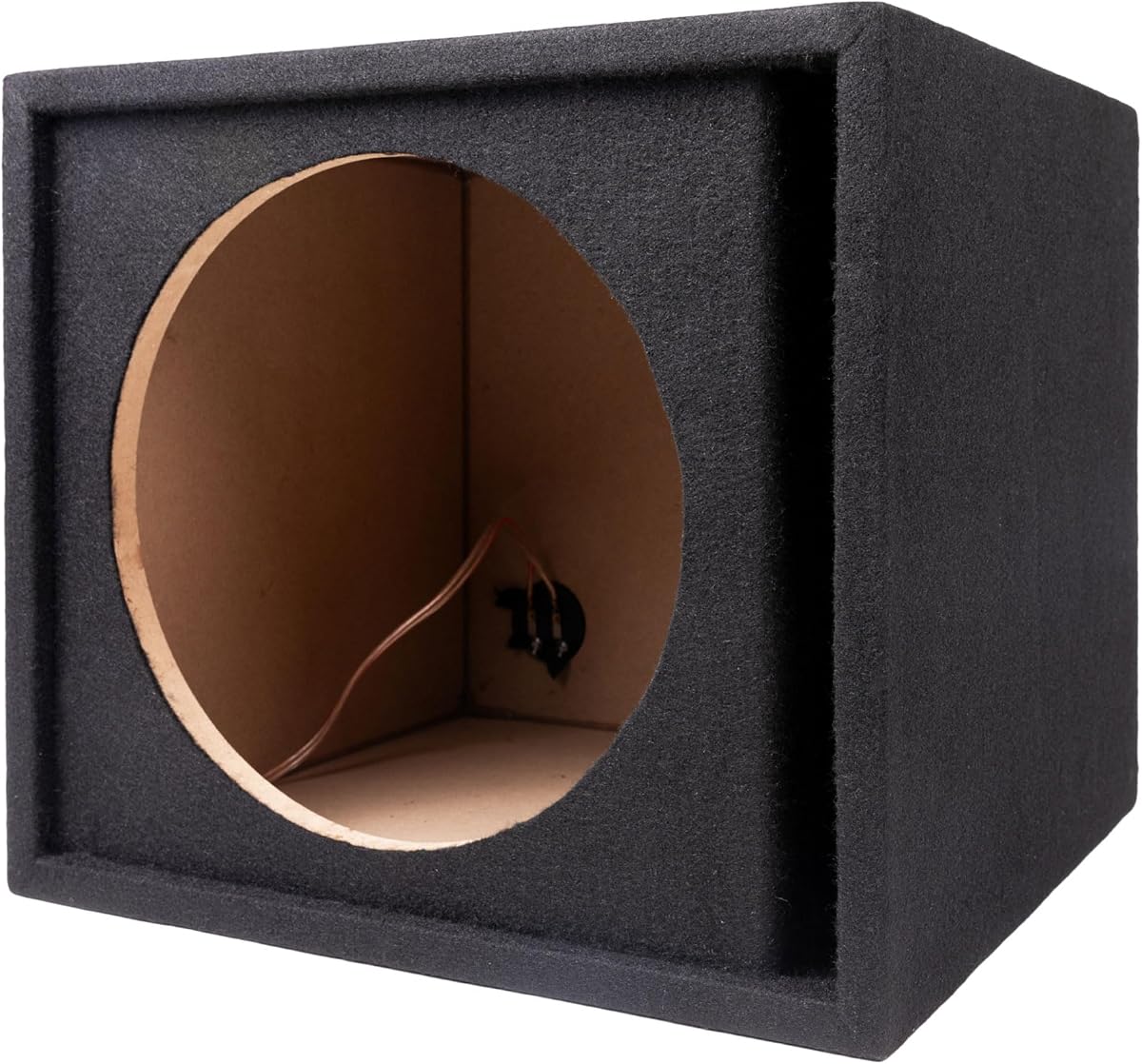


The QPower 12-inch Single Subwoofer Box is a straightforward vented enclosure designed to balance usable cargo-space requirements with a useful amount of low-frequency loading. It carries a 4.2 rating and is built around 1.65 cubic feet of internal air space, a configuration that can suit a broad range of conventional 12-inch subwoofers.
We may earn a commission when you buy through this link, at no additional cost to you.
Its solid MDF construction is intended to limit panel flex and floor vibration, while the vented design promotes airflow around the driver. The enclosure is tuned to 42 hertz and measures 16 by 18 by 13.25 inches, making it considerably easier to consider than a large competition box. A charcoal carpeted exterior helps it blend into a typical vehicle interior.
The trade-offs are mostly associated with enclosure tuning rather than build quality. A 1.65-cubic-foot chamber offers less low-bass extension than the 2.00-, 2.65-, and 3.70-cubic-foot options in this list, and the supplied description does not identify premium terminal types or a specific mounting cutout. Those details should be confirmed against the chosen subwoofer before installation.
This is a good choice for someone who wants a relatively compact single-driver enclosure without giving up a vented design. It is especially practical for daily-driven vehicles where trunk usability matters, moderate cargo space, and clean appearance are all important.
The 16-by-18-inch footprint and 13.25-inch depth make this QPower box a practical option for many trunks and hatchbacks. Its moderate internal volume also offers more flexibility than a very small enclosure when pairing it with a modern 12-inch subwoofer.
The vented construction lets air move through the cabinet, while the carpeted finish is intended to blend into the vehicle and provide a more understated appearance. This combination suits systems intended for regular use rather than show-only display.
We may earn a commission when you buy through this link, at no additional cost to you.
The Skar Audio SK1X12V is a premium-oriented competition-grade enclosure with a 4.7 rating. Its 2.00 cubic feet of air space and 36-hertz tuning target deeper, more assertive bass than the smaller QPower and Maxxlink designs, while retaining the familiar convenience of a vented single-subwoofer layout.
We may earn a commission when you buy through this link, at no additional cost to you.
The defining feature is its kerf-rounded port design, which is intended to support deep, accurate, and responsive low-frequency output. The enclosure also provides premium push terminals and internal speaker-wire leads, reducing some of the connection work required during installation. An 11-inch cutout and 13.75-inch mounting depth must be matched to the selected driver.
Its larger tuning chamber may demand more cargo space and careful amplifier adjustment than a smaller box. A subwoofer optimized for a different air volume may not deliver its intended performance simply because it physically fits, so pairing should be guided by the subwoofer manufacturer's recommendations.
The SK1X12V is best for enthusiasts seeking low port tuning, a well-finished enclosure, and straightforward electrical connections. It is a strong all-around option when the vehicle has adequate room and the subwoofer supports a 2.00-cubic-foot chamber.
Tuned at 36 hertz, the SK1X12V is designed for bass extension below the range of many compact enclosures. The deeper tuning can produce a more substantial low-bass response when paired correctly with a suitable driver and amplifier.
Premium push terminals and internal speaker-wire leads are useful details for a straightforward install. They do not replace correct polarity or amplifier safety practices, but they can make the final wiring process tidier and more accessible.
We may earn a commission when you buy through this link, at no additional cost to you.
The QPower QBOMB12VL combines a 4.6 rating with a 1.80-cubic-foot chamber, giving it a useful middle ground between compact daily-driver boxes and larger high-output enclosures. Its single vented design allows airflow intended to support stronger low-frequency output while keeping the overall concept straightforward.
We may earn a commission when you buy through this link, at no additional cost to you.
The enclosure uses 0.75-inch MDF, a spring-loaded terminal, and a black bedliner finish described as resistant to weather and corrosion. Those features make it a sensible choice for a car or truck installation where durability and straightforward wiring matter. Its stated dimensions are 22 inches wide, 15 inches tall, and 13.5 inches deep.
The main limitation is that no specific tuning frequency or mounting cutout is provided in the available product data. Drivers with unusual mounting requirements should be checked carefully. The relatively broad width also calls for a cargo-space measurement before purchase, even though the internal volume is moderate.
This QPower model is a compelling option for a practical first subwoofer enclosure or a system upgrade. It gives buyers a credible 4.6 rating, a conventional vented layout, durable materials, and enough volume for many widely used 12-inch drivers without moving into an oversized competition format.
The black bedliner finish is designed to resist weather and corrosion, which is valuable in a car or truck environment. It also provides a more rugged appearance than a decorative carpeted cabinet.
A single chamber keeps the enclosure concept uncomplicated and makes it easier to identify a compatible 12-inch driver. The spring-loaded terminal supports secure connections, although the amplifier and enclosure should still be disconnected during wiring.
We may earn a commission when you buy through this link, at no additional cost to you.
The Atrend Bbox 12SVSC differentiates itself through assembly quality rather than an extreme tuning specification. It carries a 4.5 rating and uses a vented design intended to improve bass response and low-frequency reproduction. The emphasis is on creating a stable, quiet chamber around the driver.
We may earn a commission when you buy through this link, at no additional cost to you.
Atrend uses 5/8-inch MDF, CNC-mitered parts, aliphatic wood glue, a second glue application around internal joints, brad nails, and recessed side panels. Its dado construction is intended to improve precision and reduce rattle and noise. Nickel-finish terminals are also featured for electrical connection.
The enclosure measures 16 inches wide, 13.625 inches high, and 17.375 inches deep, with a mounting depth of 13.875 inches and an 11.125-inch cutout. Those dimensions may be less convenient in a shallow trunk, and the supplied data does not list a tuning frequency or internal volume. Those omissions make compatibility checks important.
This Bbox is well suited to builders who place a high priority on fit, finish, and the likelihood of a quiet enclosure. It is a particularly compelling option for a polished installation where visible workmanship and long-term panel integrity matter.
CNC mitering, dado joints, recessed panels, and repeated glue application all support the goal of a stable, airtight chamber. These construction choices can help minimize rattles and air leaks that compromise bass response.
Recessed nickel-finish terminals are positioned on the side panels, helping protect the connections while keeping them accessible. Check the enclosure depth against the available cargo area before committing to this model.
We may earn a commission when you buy through this link, at no additional cost to you.
The QPower HD112VL is built for substantial, aggressive bass and is among the largest conventional enclosures in this guide. Its 3.70 cubic feet of internal air space is the greatest volume listed among the single passive-driver boxes, while its 4.5 rating indicates generally favorable customer feedback.
We may earn a commission when you buy through this link, at no additional cost to you.
The side-ported configuration is intended to improve airflow and efficiency, while the MDF construction uses a one-inch face and three-quarter-inch panels elsewhere. Gold-tipped spring-loaded terminals are included for amplifier connections. These details support a high-output installation where strong enclosure rigidity and clean wiring are priorities.
The cabinet measures 30 inches long and 14.75 inches wide and high, so it demands substantial vehicle space. Its large volume and side port may also require careful orientation to avoid the port being blocked. The product data does not provide a cutout diameter or tuning frequency, making driver compatibility harder to confirm without further information.
This enclosure is best for large SUVs, trucks, hatchbacks, or dedicated installations where maximum internal volume is worth the space commitment. Buyers should select it for the performance objective and available room rather than as a general-purpose compact enclosure.
At 3.70 cubic feet, the HD112VL provides substantially more air volume than the other passive boxes. That additional space can support deep, high-output bass when the chosen subwoofer is designed for a similarly large enclosure.
A one-inch front baffle and thick MDF side panels help limit flex under demanding conditions. The rigid cabinet is especially relevant for high-output systems, where excessive panel movement can contribute to rattles and reduce tonal control.
We may earn a commission when you buy through this link, at no additional cost to you.
The Skar Audio AR1X12V-SPL is the highest-rated product in this group, earning a 4.8 rating. It is explicitly engineered as a universal-fit, SPL-grade ported enclosure for 12-inch drivers, with an emphasis on deep bass and maximum high-level output.
We may earn a commission when you buy through this link, at no additional cost to you.
Its 2.65 cubic feet of gross internal air space and 41-hertz tuning provide a middle path between compact daily-driver designs and very large high-volume boxes. The enclosure uses a one-inch MDF front baffle with three-quarter-inch material elsewhere. Its rear port is positioned on the right side and measures 2.50 inches wide.
The driver cutout is 11.20 inches, while maximum mounting depth is 13.8125 inches. These are critical fitment numbers for any subwoofer with a deep basket or motor. The larger chamber also means the enclosure should be paired with a driver whose manufacturer supports similar volume and tuning.
This is the leading recommendation for someone specifically seeking competition-oriented bass in a 12-inch vented format. Its top rating, substantial construction, and carefully stated fitment details make it especially appealing to informed enthusiasts.
The 41-hertz tuning and 2.65-cubic-foot chamber are intended to produce deep, high-SPL bass. A compatible high-output subwoofer and appropriately configured amplifier are important for achieving the intended performance.
The armor coating is intended to withstand demanding installation environments better than a basic exposed finish. It also gives the enclosure a competition-oriented appearance suited to a visible trunk or cargo installation.
We may earn a commission when you buy through this link, at no additional cost to you.
The Maxxlink 12 Inch Single Ported Subwoofer Enclosure is a compact option centered on a 1.30-cubic-foot chamber and 38-hertz tuning. Its 4.2 rating places it in the same general feedback tier as the smaller QPower vented enclosure, but its smaller internal volume calls for more careful subwoofer matching.
We may earn a commission when you buy through this link, at no additional cost to you.
MDF construction is used to improve rigidity and reduce vibration, while a UV-treated black carpet gives the enclosure an OEM-style appearance intended to blend into a vehicle interior. A spring-loaded wiring terminal supports fast setup and secure connections without requiring the enclosure to be modified.
Because the chamber is relatively small, not every 12-inch subwoofer will perform optimally in it. The available data does not specify mounting cutout or maximum depth, so those measurements should be confirmed before ordering. The low tuning frequency is useful, but it cannot overcome a mismatch between driver design and enclosure volume.
Maxxlink is most appropriate for drivers specifically recommended for a compact, 1.30-cubic-foot box. It may work well in a vehicle with limited cargo room, and its low tuning can still provide a strong sense of depth when correctly paired.
The 38-hertz tuning gives this compact enclosure a low-frequency target despite its 1.30-cubic-foot volume. This makes it potentially useful for subwoofers designed for smaller sealed or moderately ported cabinets.
The UV-treated black carpet is intended to resist fading and blend into an OEM-style interior. It provides a cleaner visual result in a visible cargo area while adding some protection to the enclosure surface.
We may earn a commission when you buy through this link, at no additional cost to you.
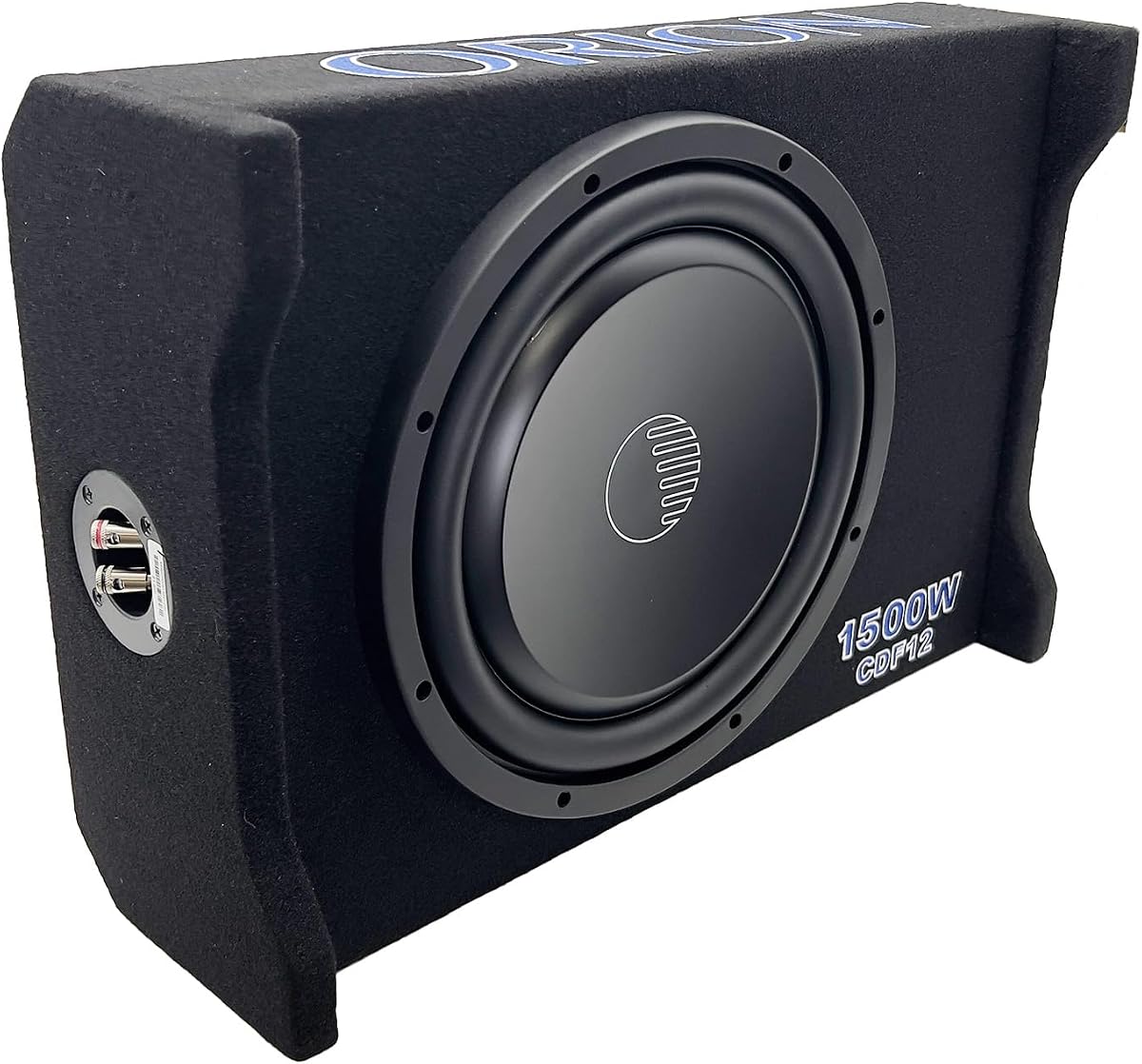
The ORION Cobalt CDF12 takes a different approach from the conventional horizontal vented boxes in this guide. It is a passive down-firing enclosure with a 1500-watt maximum rating and a 3.7 rating, the lowest feedback score among the ten products shown.
We may earn a commission when you buy through this link, at no additional cost to you.
Down-firing places the driver on the bottom of the cabinet, a configuration described as protecting the cone while helping produce low-frequency output. The MDF enclosure has an airtight seal and a carpeted finish intended to minimize vibration. Its dimensions of 20.47 by 6.7 by 14.1 inches make it a vertical or low-profile option for tight installations.
The supplied data includes an unusual compatibility statement saying that the enclosure works with most 8-inch subwoofers, even though the product is named as a 12-inch model. That discrepancy makes independent confirmation of the driver opening and mounting requirements essential. The stated maximum power figure should not be treated as a recommendation for amplifier output without checking the paired driver's requirements.
The CDF12 is worth considering for someone who values a protected, space-conscious down-firing layout more than a conventional front-firing or side-ported installation. Its lower rating and unclear compatibility information make it the most research-intensive choice in this guide.
A down-firing arrangement places the cone above the cabin floor, protecting it from direct contact and helping keep the enclosure low. This layout can be attractive under a seat or in a shallow cargo area when clearance permits.
The available specifications refer to compatibility with most 8-inch subwoofers despite the 12-inch product name. Check the actual cutout, mounting depth, and the manufacturer's intended applications before making a final choice.
We may earn a commission when you buy through this link, at no additional cost to you.
The Rockford Fosgate Punch P300-12T is a complete amplified subwoofer system rather than an empty enclosure. Its 4.7 rating reflects a favorable combination of features for installers who want a 12-inch subwoofer, enclosure, and amplifier in one self-contained package.
We may earn a commission when you buy through this link, at no additional cost to you.
The built-in 300-watt class-D amplifier is optimized for the included high-output 12-inch driver. An adjustable 12-decibel-per-octave low-pass crossover, onboard bass-boost equalization, and a phase switch provide basic tuning controls. Speaker-level inputs allow connection to factory systems, while traditional line-level inputs suit aftermarket installations.
The enclosure is unusually slim for a powered system, with listed dimensions of 15 by 25.8 by 4.8 by 8.5 inches. Its length still requires a substantial cargo opening, although the lower height may help it fit beneath or behind a seat. Because the amplifier is integrated, the system cannot be matched to a different enclosure or upgraded independently.
The P300-12T is an excellent candidate for a first installation, a factory-system upgrade, or a buyer who values simplicity over component-level flexibility. It also comes with a one-year warranty, adding some reassurance to a complete integrated system.
The matching amplifier, subwoofer, and enclosure remove the need to source three separate components. That simplicity can reduce installation complexity and make the system appealing to first-time car-audio builders.
Speaker-level and line-level inputs provide flexibility for different source systems. The adjustable crossover, bass boost, and phase control allow basic system matching without having to install separate signal-processing equipment.
We may earn a commission when you buy through this link, at no additional cost to you.
The Rockford Fosgate Punch P500-12P is a complete 12-inch powered subwoofer system with a 4.4 rating. It combines a high-output vented enclosure, a single 12-inch driver, and a built-in 500-watt class-D amplifier, offering more amplifier capability than the P300-12T while retaining installation convenience.
We may earn a commission when you buy through this link, at no additional cost to you.
Its controls include an adjustable 12-decibel-per-octave low-pass filter, bass-boost equalization, high- and low-level inputs, and a switchable zero- or 180-degree phase setting. A remote bass-level control allows the listening level to be adjusted from the driver's seat, a useful feature in a finished daily-driven installation.
The precision-constructed MDF wedge enclosure has a heat-activated vinyl finish and measures 15 inches high, 24.76 inches wide, 10.91 inches at its deepest point, and 7.71 inches at its shallow point. That wedge shape can fit around interior contours, but the dimensions need careful comparison with the available space.
The P500-12P is best for a user who wants meaningful integrated amplifier power and remote control without building a fully custom system. Its one-year warranty and all-in-one design make it a practical choice for hatchbacks, sedans, and SUVs, provided the enclosure dimensions fit.
The integrated 500-watt class-D amplifier provides more power than the smaller P300-12T. The included remote bass-level control makes it easy to balance the subwoofer with front speakers while driving.
The shallow-to-deep wedge profile can follow the shape of a trunk floor or cargo area more closely than a rectangular box. Measure both the available footprint and the enclosure height at the driver and amplifier locations.
We may earn a commission when you buy through this link, at no additional cost to you.
Choosing a single 12-inch subwoofer box requires matching the enclosure to the driver, amplifier, and available space. The most important variables are internal air volume, tuning frequency, physical dimensions, construction, port placement, and whether you want a passive enclosure or a complete powered system.
Internal air volume is one of the most consequential enclosure specifications because it directly affects how the subwoofer cone loads and moves. A small chamber may suit a driver designed for a compact enclosure, while a high-output driver may require substantially more volume to reach its intended excursion and tonal balance. The boxes reviewed range from 1.30 cubic feet for the Maxxlink to 3.70 cubic feet for the QPower HD112VL, with other options falling between those figures.
Start with the subwoofer manufacturer's recommended enclosure volume and compare it with the box specification. Avoid selecting an enclosure solely because the driver physically fits.
A vented enclosure uses a port to let air move in and out behind the cone. Its tuning frequency indicates the approximate frequency at which the cabinet is designed to produce strong output. A lower figure, such as the Skar SK1X12V at 36 hertz, generally emphasizes deeper bass, while a 42-hertz box may place more emphasis on punch and upper low-end response. The tuning should be matched to the selected driver and the vehicle's acoustics.
Choose a tuning style that fits your musical preferences, then verify compatibility with the driver manufacturer. Port tuning cannot compensate for an incorrectly sized enclosure.
External dimensions determine whether the enclosure can actually enter the vehicle, while cutout diameter and mounting depth determine whether the subwoofer can be installed. Some listings emphasize the overall width, height, and depth, while others provide a cutout and maximum mounting depth. Both kinds of information matter, particularly for hatchbacks, sedans, and trucks with irregular cargo areas.
Measure the narrowest cargo opening, the usable floor area, and the height under any parcel shelf. Also compare the enclosure's depth with the driver's required mounting depth and allow room for the grille, terminals, and wiring.
MDF is widely used because its density and stiffness help control enclosure flex, but panel thickness varies across these products. The Atrend Bbox uses 5/8-inch MDF, the QPower QBOMB12VL uses 0.75-inch MDF, and the Skar AR1X12V-SPL uses a one-inch front baffle with three-quarter-inch material elsewhere. Joinery, glue application, recessed panels, and CNC mitering also influence how airtight and quiet the cabinet remains.
Favor rigid panels, precise joints, and secure terminal placement when the system will operate at demanding levels. A thicker baffle is particularly useful around the driver mounting area.
Port orientation can determine whether a vehicle's seats, cargo cover, or interior trim obstruct airflow. The Skar AR1X12V-SPL uses a rear port on the right side, the QPower HD112VL uses a side port, and the ORION CDF12 uses a bottom-firing layout. Each arrangement offers different installation possibilities, but none should be installed with its airflow path blocked.
Plan the orientation before drilling, wiring, or securing the enclosure. Leave adequate clearance around every port, and check whether carpeting or trim could deform the port opening.
A passive enclosure gives the installer control over the amplifier, wiring, and system design. A powered subwoofer includes an integrated amplifier and is often easier to add to a factory or aftermarket system. The Rockford Fosgate P300-12T and P500-12P both include built-in class-D amplification, speaker-level inputs, line-level inputs, low-pass filtering, bass boost, and phase controls.
Choose a passive box when you already have suitable amplification or want maximum component flexibility. Choose an integrated system when simplicity, compact installation, and fewer separate components matter more.
The best enclosure is one that fits securely without obstructing visibility, seat movement, or cargo access. A down-firing or wedge-style enclosure can help in unusual spaces, while a large rectangular competition box may be easier to place in a truck bed or large SUV. Remember that ported boxes need airflow, while sealed-style layouts generally have fewer placement constraints.
Secure the cabinet appropriately and protect wiring from sharp edges. If the enclosure sits in a frequently accessed cargo area, confirm that its finish and shape will not interfere with the vehicle's daily use.
Terminal quality affects convenience and connection security. The Skar SK1X12V uses push terminals with internal speaker-wire leads, the Skar AR1X12V-SPL lists premium terminal options, the Atrend Bbox features recessed nickel-finish terminals, and the Rockford Fosgate systems use integrated wiring arrangements. Spring-loaded or recessed terminals can reduce installation hassles, but they should not be used to conceal loose or under-terminated wires.
Check whether the terminal location is reachable after installation. Ensure the enclosure can be grounded to chassis metal and that the power cable is protected from abrasion and heat.
Before installing the enclosure, disconnect the vehicle battery and verify all cargo-area measurements, including the subwoofer cutout, mounting depth, terminal access, and port clearance. Mount the driver according to its manufacturer's instructions, use the specified screws and gasket, and confirm that the grille or trim does not interfere with the cone.
Connect the enclosure to a correctly configured amplifier using appropriately sized wiring. Observe polarity, tighten every terminal, and secure the cable away from sharp edges, moving seats, and heat sources. A fused amplifier feed and properly installed chassis ground are essential for reliable operation and vehicle safety.
For a passive system, begin with the amplifier's low-pass filter at a conservative setting, then adjust gain and crossover frequency gradually while listening for clean, distortion-free output. For a powered system, use the onboard crossover, bass boost, phase switch, and remote level control conservatively before making further changes.
During use, keep the enclosure dry and avoid leaving damp clothing, tools, or heavy objects pressed against the cabinet or terminals. Inspect the mounting screws, terminal connections, and carpet or coating periodically. If the box begins rattling, air leaks become audible, or the driver distorts, lower the system level and investigate the cause before increasing volume again.
The best internal volume depends on the subwoofer's design and the manufacturer's recommended enclosure specifications. Many single-driver boxes in this guide range from 1.30 to 3.70 cubic feet, but a larger box is not automatically better. Match the driver's displacement, excursion needs, recommended volume, and tuning before considering the external dimensions.
A ported box generally supports stronger output and a more pronounced low-frequency effect, while a sealed box is often associated with controlled, precise bass and different installation behavior. The products reviewed are mostly ported, except for the down-firing ORION Cobalt CDF12. The right choice depends on the selected driver, available space, and the sound you want to achieve.
You need enough room for the enclosure's full width, height, and depth, plus clearance for the port, grille, wiring, and terminal access. Measure the narrowest opening and the usable cargo floor rather than relying on vehicle cargo-volume figures. A model with a 30-inch length or a 22-inch width can require considerably more space than a compact enclosure.
Many vehicles can support an aftermarket subwoofer, but the signal source and amplifier arrangement determine the installation method. The Rockford Fosgate P300-12T and P500-12P include speaker-level inputs intended to simplify connection to factory systems. For a passive box, a suitable aftermarket amplifier and an appropriate signal connection are generally required.
Thicker MDF can reduce panel flex, particularly around the driver baffle and at high output levels, but construction quality also depends on machining, joints, glue, sealing, and the port design. An enclosure with precise joints and a consistent seal can perform very well even when its listed panel thickness is not the highest. Match overall build quality and fitment rather than focusing on one number.
Check the driver's cutout diameter, mounting depth, basket clearance, and any ventilation requirements against the enclosure specifications. Also confirm the box's external dimensions and port orientation will fit the installation area. A subwoofer that physically fits can still sound wrong if its recommended internal volume or tuning differs from the enclosure.
No separate external amplifier is required for the Rockford Fosgate P300-12T or P500-12P because each has a built-in class-D amplifier designed for its included driver. A passive enclosure, such as most of the QPower, Skar Audio, Atrend, and Maxxlink options, does require a compatible amplifier. The integrated system is generally simpler to install.
Rattling can come from loose screws, an unsecured grille, panel vibration, a poor internal seal, or a cable striking the enclosure. Check mounting points and terminal security first, then inspect the cabinet for loose joints. Keep objects and trim from pressing against the enclosure, and make sure the port itself is not blocked or rubbing against a panel.
The Skar Audio AR1X12V-SPL is the strongest competition-oriented recommendation, with a 4.8 rating, 2.65 cubic feet of air space, and clearly stated fitment details. The Skar SK1X12V offers a premium 36-hertz alternative for systems prioritizing deeper tuning, while the QPower QBOMB12VL delivers a more practical combination of 1.80 cubic feet, durable construction, and a strong 4.6 rating.
Prioritize driver compatibility, internal volume, tuning frequency, and actual cargo-space measurements before considering finish or styling. Passive boxes provide greater freedom in system design, whereas the Rockford Fosgate P300-12T and P500-12P simplify installation with integrated amplification, remote or onboard controls, and multiple input options. The ORION Cobalt CDF12 stands apart with its protected down-firing format but deserves extra fitment verification.
Ratings, manufacturer specifications, availability, and prices can change, so confirm the current listing and the latest fitment information before ordering. Also check the subwoofer manufacturer's enclosure recommendations to make sure the selected box is genuinely compatible with your driver and amplifier.