
GoveeLife WiFi Refrigerator Thermometer Sensor with Alarm, 2-Pack & Gateway
4.4Editor score
Remote app temperature monitoring
Built-in 80dB audible alarm
Supports ten connected sensors
A freezer thermometer with app turns temperature monitoring into a remote, proactive system rather than a task you remember only after opening the door. The best models combine dependable readings, configurable alerts, useful history, and flexible installation across household freezers, refrigerators, garages, and other temperature-sensitive spaces.
We compared the following products by examining sensor accuracy, supported temperature ranges, app connectivity, notification methods, gateway requirements, wireless coverage, power options, data storage, and installation flexibility. The list covers direct-WiFi models, hub-based systems, and long-range Bluetooth and LoRa devices for different monitoring needs.
Each pick highlights a distinct approach, from budget two-sensor kits to expandable whole-property systems and high-precision monitors for demanding environments. Ratings, features, and availability can change over time, so readers should confirm current product details and prices before purchasing.
4.4Editor score

4.6Editor score

4.6Editor score
As an Amazon Associate we earn from qualifying purchases.
The comparison below highlights each monitor's connectivity, sensing capability, alert options, and expansion potential, making it easier to identify the right system for a home freezer, remote location, or multi-zone property.


The GoveeLife WiFi Refrigerator Thermometer Sensor with Alarm combines two probe sensors, a gateway, and three alert methods in a practical monitoring package. Its 4.4 rating reflects a balanced mix of accurate readings, straightforward installation, and useful remote functions, making it an accessible choice for households that want continuous freezer and refrigerator oversight.
We may earn a commission when you buy through this link, at no additional cost to you.
The slim 2.7mm NTC probe measures from -40°F to 158°F with stated accuracy of plus or minus 0.9°F and refreshes readings every two seconds. Users can set a temperature range and receive app notifications, email alerts, or an 80dB local alarm. The gateway accommodates up to ten sensors within a stated range of 230 feet, so the system can grow beyond the two included units.
The principal compromise is dependence on the included gateway, which must be powered and connected for remote monitoring. The sensors also lack a local LCD, making the app the central interface. Nevertheless, the magnetic or hanging installation, included probe holder, flexible probe length, and selectable audible alarm make the package well suited to regular home monitoring.
This is an appealing choice for buyers who want the core benefits of a smart freezer thermometer without assembling a complex sensor network. It works particularly well for a kitchen freezer and refrigerator, while also providing enough gateway capacity for additional rooms or appliances. For most home users, the included sensors, alert flexibility, and expandable capacity justify the added hub component.
Preset ranges turn the system from a passive display into an active safeguard. App notifications, email messages, and the local buzzer provide several ways to learn that a temperature has moved outside the desired band.
The included gateway can support up to ten sensors, allowing a second refrigerator, pantry, wine area, or additional freezer to join the same monitoring arrangement.
We may earn a commission when you buy through this link, at no additional cost to you.
The GoveeLife WiFi Refrigerator Thermometer 2-Pack with Gateway and LCD Display is a versatile choice for users who want both an immediate physical reading and remote app oversight. It earns a 4.4 rating and includes two sensors, a gateway, app and email notifications, and a two-year history feature.
We may earn a commission when you buy through this link, at no additional cost to you.
Each sensor measures from -40°F to 158°F with stated accuracy of plus or minus 0.9°F and offers a two-second refresh. The local LCD makes it easier to check the temperature without opening the app, while the gateway supports as many as ten sensors. Users can view graphs online, export recorded data, and configure a one-to-ten-minute delay before an overrun notification is sent.
One important distinction is that the device itself does not sound an alarm. Notifications depend on the app and the connected gateway, and the listed system uses 2.4GHz WiFi. The anti-false-alarm function is particularly useful for frequent door openings, though the adjustable delay still requires users to choose a threshold appropriate for their appliance.
This kit suits households that value readable local displays along with two years of remote history. It is especially effective for monitoring a refrigerator and freezer simultaneously, and the magnetic, lanyard, and probe-holder options make placement easier. Buyers should confirm that they need the LCD and historical data features rather than a local audible alarm.
The LCD provides a quick local reference, while the app and gateway extend visibility to historical graphs, custom ranges, and remote alarm notifications.
A configurable one-to-ten-minute delay helps avoid unnecessary alerts during brief door openings while still identifying sustained temperature changes.
We may earn a commission when you buy through this link, at no additional cost to you.
The MOCREO WiFi Thermometer Freezer Alarm offers an unusually broad set of monitoring and alert options for a two-sensor system. Its 4.4 rating reflects reliable performance, flexible notifications, and useful data tools, while the hub serves as both a local alarm and the connection point for remote monitoring.
We may earn a commission when you buy through this link, at no additional cost to you.
App push notifications, email alerts, and a 90dB hub beep cover three distinct alert paths. The hub can also be muted from the app, and settings include power-outage alerts, low-battery warnings, offline notices, and anti-false-alarm controls. The H6Lite hub supports up to 30 compatible Bluetooth sensors within a stated 230-foot range, offering more expansion capacity than most compact kits.
The sensors operate from -40°F to 158°F with stated accuracy of plus or minus 0.9°F. Their 0.9mm flat cables can pass through tight door seals, and magnetic backing, a mounting plate, clips, and organizers support neat placement. The stated battery life is up to two years using three replaceable AAA batteries, with a low-battery warning below 10 percent.
This system is a strong fit for users who want several notification methods, remote hub muting, and easy expansion. It suits a freezer, refrigerator, hot tub, garage unit, greenhouse, or nursery, although the hub must remain powered and connected to the 2.4GHz network. Users who prioritize long-range coverage over hub capacity may prefer the next MOCREO model.
Push notifications, email, and a loud local hub beep ensure that a single missed interaction does not necessarily mean a missed temperature event.
With support for up to 30 compatible Bluetooth sensors, the hub can serve several appliances or environmental zones without replacing the core setup.
We may earn a commission when you buy through this link, at no additional cost to you.
The MOCREO WiFi Remote Thermometer Freezer Alarm stands out for long-range monitoring and extensive hub compatibility. It holds a 4.6 rating and pairs two wireless sensors with a digital hub that can support as many as 100 devices, making it the editor's choice for properties with more than one remote temperature zone.
We may earn a commission when you buy through this link, at no additional cost to you.
The H5Pro hub communicates with sensors at a stated open-air distance of up to 1,640 feet and connects through Ethernet or 2.4GHz WiFi. Its LCD can present current readings, historical information, alarms, a clock, weather, and calendar updates. The app adds charts, trend tracking, power-outage notices, WiFi-disconnection alerts, low-battery warnings, and false-alarm prevention.
The LS1 sensors have an IP66 splash-proof rating and measure from -4°F to 131°F with stated accuracy of plus or minus 0.9°F. A key limitation is that fully enclosed metal spaces, including thick commercial freezer doors, may impair the wireless signal. The stated battery life of up to two years applies when temperatures remain above 32°F.
This kit is well suited to RVs, greenhouses, nurseries, garages, restaurants, pet shelters, offices, and widely separated household sensors. Its local alarm produces a 95dB hub beep, while app and email alerts support remote response. For buyers seeking broad range and large capacity, the hub's complexity is justified; for a single kitchen freezer, it may be more than necessary.
A stated one-third-mile open-air range allows sensors to be distributed around larger properties instead of being confined to one room or appliance.
The hub's LCD and app-based history give users a unified view of readings, trends, and alert conditions across as many as 100 compatible devices.
We may earn a commission when you buy through this link, at no additional cost to you.
The WiFi Freezer Thermometer with App Alarm offers a simple, cable-free approach to refrigerator and freezer monitoring. Its 3.8 rating places it below the more precise alternatives, but the two wireless sensors, app notifications, humidity tracking, and one-year export remain useful for consumers prioritizing easy installation.
We may earn a commission when you buy through this link, at no additional cost to you.
Each IP65 sensor tracks temperature from -4°F to 140°F with stated accuracy of plus or minus 1.8°F and humidity from 0 to 99 percent relative humidity. The system connects to 2.4GHz WiFi, supports as many as nine sensors, and has a stated wireless range of up to 492 feet. That range can be useful for a garage or basement unit monitored from indoors.
The absence of probe cables is a meaningful advantage because there is no cable to hold a door slightly open, create a seal problem, or become tangled. Freeze-resistant AAA batteries are included, with a stated life of up to two years, though the instructions recommend replacing them with the same type during continued refrigerator use.
This product is a practical option for home users who do not need laboratory-level precision. Its lower accuracy and -4°F minimum make it less appropriate for deep-freeze or safety-critical applications. It works best for refrigerators, secondary freezers, cold storage, and other locations where cordless placement and humidity data matter more than extreme precision.
Wireless sensors avoid the need to route probe cables through a gasket, which can simplify placement and help maintain an even seal.
Humidity tracking adds context beyond the temperature reading, which can be useful for monitoring enclosed cold-storage environments.
We may earn a commission when you buy through this link, at no additional cost to you.
The YoLink Freezer Temperature Sensor Kit provides three sensors, a dedicated hub, and notably strong accuracy, making it the premium choice in this guide. Its 4.6 rating is supported by a measurement range of -4°F to 122°F, stated accuracy as fine as plus or minus 0.36°F between 32°F and 129°F, and long-range LoRa communication.
We may earn a commission when you buy through this link, at no additional cost to you.
The system does not depend on the household WiFi network. Its LoRa-based protocol is designed for long-range, low-power transmission, with a stated open-air monitoring distance of up to 2,034 feet. Each sensor uses two AA batteries and can operate for up to five years depending on usage and environmental conditions. Low-battery notifications are sent through the app.
Custom temperature thresholds can trigger text, email, or push notifications, with Critical Alerts available for Apple users and similar controls for Android. IFTTT applets can be triggered by high or low set points, and Alexa can provide a voice temperature query. SMS service is limited, however, and Alexa routines are not supported.
This kit is a strong fit for a home, greenhouse, barn, nursery, chicken coop, dog kennel, or freezer located beyond convenient WiFi reach. Its three sensors make it useful for immediate multi-location monitoring. Buyers who need only one basic reading may find the smaller one-sensor configuration more efficient, while those prioritizing precision and long battery life will find this kit compelling.
The stated plus or minus 0.36°F accuracy in the warmer portion of the range supports more confident alarm settings in spaces where small temperature changes matter.
Using a dedicated low-power protocol keeps the sensors independent of WiFi capacity and supports placement in areas where a conventional network signal is difficult to obtain.
We may earn a commission when you buy through this link, at no additional cost to you.
The GoveeLife Bluetooth Refrigerator Thermometer with LCD Disaplay is a one-sensor option that bridges local monitoring and app-based visibility. Its 4.4 rating reflects solid stated accuracy, a broad temperature range, and a helpful LCD, although full remote operation depends on the way it is connected.
We may earn a commission when you buy through this link, at no additional cost to you.
Without a gateway, the H5108 uses Bluetooth with a stated range of up to 197 feet and can provide proximity alerts while the app remains active in the background. Connecting it to the H5151 gateway or specified compatible gateways turns it into a WiFi thermometer with remote monitoring. The gateway is not included with this one-pack.
The sensor measures from -40°F to 158°F with stated accuracy of plus or minus 0.9°F and a two-second refresh. It offers adjustable overrun delays of one to ten minutes, low-battery reminders, and access to graphs and exported data covering up to two years. The device itself has no audible alarm.
This is a sensible choice for one freezer or refrigerator when a user wants a local LCD and occasional app checks without purchasing a complete multi-sensor kit. It can also serve as an expansion sensor for an existing compatible GoveeLife gateway. Buyers wanting unattended remote alerts from any distance should include the appropriate gateway in their setup.
The sensor can provide nearby app visibility through Bluetooth or gain remote connectivity when paired with a supported gateway.
A minimum reading of -40°F and stated plus or minus 0.9°F accuracy make this sensor suitable for standard household freezer conditions.
We may earn a commission when you buy through this link, at no additional cost to you.
The AcuRite Digital Wireless Fridge and Freezer Thermometer with Alarm is the most traditional option in the guide, offering local wireless monitoring without an app. Its 4.5 rating and straightforward display make it a dependable choice for users who want immediate readings and audible alarms but do not need remote notifications.
We may earn a commission when you buy through this link, at no additional cost to you.
The system includes separate refrigerator and freezer thermometers that transmit to a digital display. It tracks maximum and minimum temperatures, includes customizable alarms for spikes caused by open doors or appliance trouble, and provides a readable LCD. A magnetic back, wall keyhole, and foldout stand give the display several placement options.
Silicone sensor straps can wrap around a wire shelf or attach using the included suction cups. The stainless steel finish helps the display blend into a kitchen environment, and the separate probes make it convenient to monitor two appliances at once. No app, gateway, or WiFi setup is necessary.
The main limitation is the absence of smart connectivity. Users cannot check readings remotely, receive push notifications, or export historical graphs. This model is best for apartments, kitchens, restaurants, or offices where the display remains near the monitored appliances and local audible warnings are sufficient.
A visible digital display, max/min tracking, and a local alarm provide useful information without requiring a smartphone or network connection.
Shelf straps, suction cups, magnetic mounting, a wall slot, and a foldout stand make it possible to position both components around different appliances.
We may earn a commission when you buy through this link, at no additional cost to you.
The MOCREO WiFi Freezer Alarm Refrigerator Thermometer simplifies connected monitoring by connecting directly to a 2.4GHz WiFi network without a separate hub. Its 4.5 rating, continuous USB-C power, and broad -40°F to 257°F measurement range make it a strong choice for a single freezer with reliable nearby network access.
We may earn a commission when you buy through this link, at no additional cost to you.
Temperature changes can generate app push notifications, emails, a flashing red display, and an audible beep on current units. The alarm delay is adjustable, reducing unwanted notifications during short door openings. For Apple users, Critical Alerts can bypass Do Not Disturb, while separate power-outage and offline notices help identify appliance or network failures.
The NS1 provides stated accuracy of plus or minus 0.9°F across its wide range. Its 4.9-foot ultra-thin flat probe can pass through a gasket and can also be used in reptile enclosures or wine coolers. Users can compare its reading with another thermometer in the app and export up to two years of history to CSV.
The direct-WiFi design eliminates another powered device and removes the need to maintain a gateway. However, the freezer must be within reach of a 2.4GHz router, and a wall outlet must be available near the probe. A USB power adapter is not included, so this setup works best where existing power and network access are convenient.
Direct WiFi connectivity removes the hub from the setup while preserving app, email, offline, and critical temperature notifications.
USB-C power removes routine battery maintenance, while the broad measurement range covers standard freezers and higher-temperature monitoring locations.
We may earn a commission when you buy through this link, at no additional cost to you.
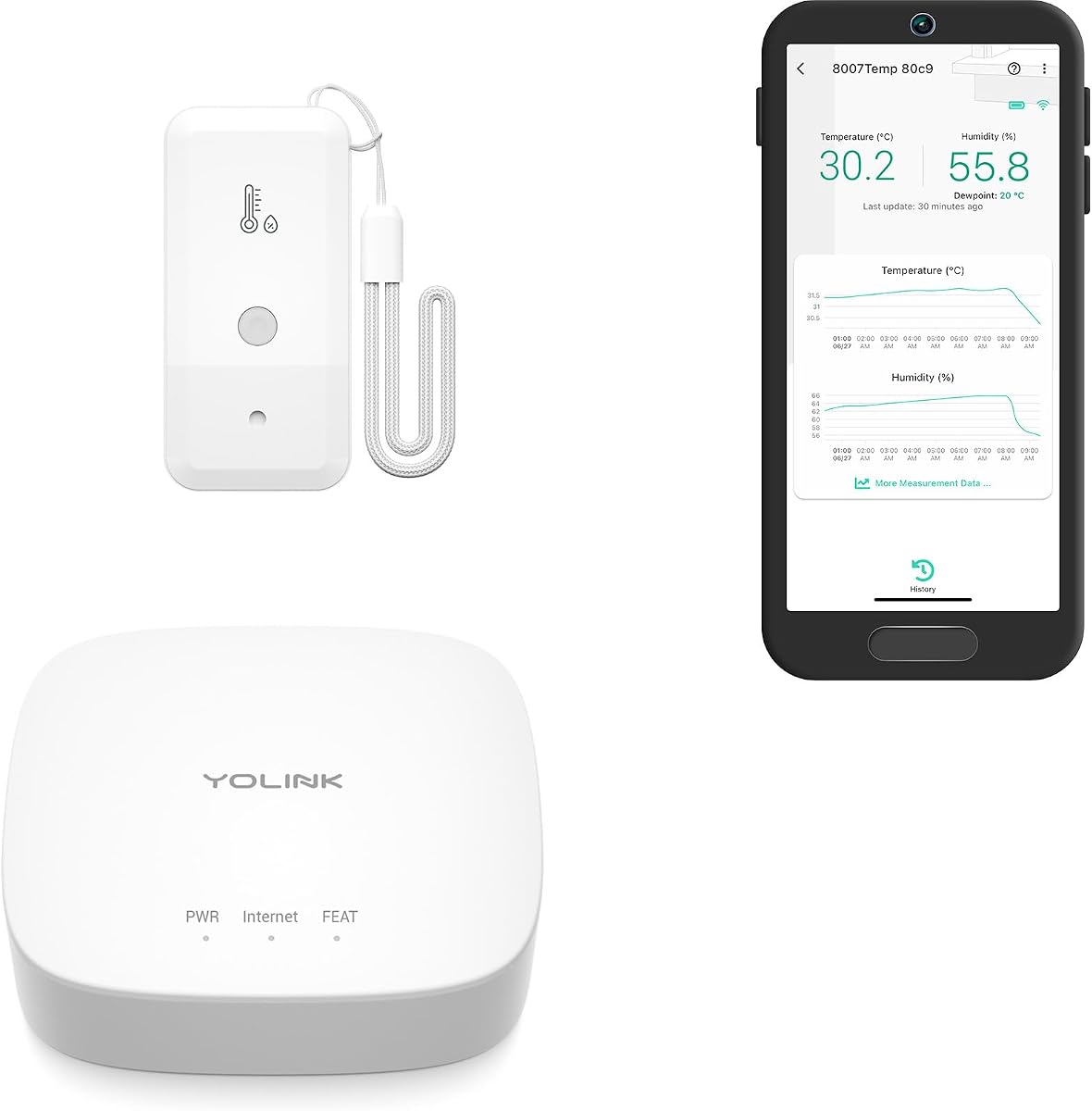
The YoLink Freezer Thermometer Hygrometer Kit has the highest listed rating in this roundup at 4.7. It includes one compact sensor and a hub, combining temperature and humidity monitoring with long-range LoRa communication, customizable notifications, and an estimated operating life of up to five years.
We may earn a commission when you buy through this link, at no additional cost to you.
The sensor's stated open-air range is up to 2,034 feet, allowing it to operate in refrigerators, freezers, greenhouses, barns, nurseries, chicken coops, and other locations that may be beyond ordinary WiFi coverage. The hub and sensor do not occupy the user's WiFi network, which can simplify setup in crowded or remote locations.
Users can set separate temperature and humidity thresholds and receive text, email, or push notifications. Apple Critical Alerts and similar Android options are available, while SMS usage is limited to five messages per device plus five additional messages under the stated hub and one-sensor allowance. Low-battery notifications help manage the two AA batteries.
This kit works best for buyers who need one dependable remote location rather than a multi-sensor network. IFTTT applets can respond to high or low temperature set points, and Alexa can answer temperature queries, although humidity queries and Alexa routines are not supported. It is compact, capable, and highly rated, with the main limitation being its single-sensor configuration.
The combined readings help users evaluate a cold environment holistically, particularly in enclosed storage areas where humidity may affect comfort or equipment.
Two AA batteries and a stated operating life of up to five years reduce routine maintenance for freezers, nurseries, and outdoor storage areas.
We may earn a commission when you buy through this link, at no additional cost to you.
The right connected thermometer depends on where the appliance is located, how many zones you need to monitor, and whether dependable remote warnings matter more than local displays, cordless placement, or low-maintenance power.
A useful app should show current readings, temperature history, device status, and customizable alarm thresholds. The most valuable alert methods are push notifications and email, while local hub beeps or device sirens can help households react even when a phone is silenced. Before buying, confirm whether the monitor connects directly to WiFi, needs a separate hub, or relies on Bluetooth proximity. Also check whether remote notifications require the manufacturer's app to remain active in the background.
Accuracy determines how confidently you can set an alarm threshold. Several featured products state accuracy of plus or minus 0.9°F, while the YoLink three-sensor kit reaches plus or minus 0.36°F within its stated warmer range. The minimum temperature is equally important: a product rated only to -4°F is unsuitable for a freezer that routinely becomes colder. Check both the stated accuracy and the lowest temperature the sensor can measure, and avoid assuming that display precision equals measurement accuracy.
Wired probes can be positioned precisely, but the cable must pass through the door gasket without preventing a proper seal. Cordless sensors avoid this issue and are convenient for refrigerators or locations where routing a cable is difficult. Wireless models may have less freedom to reach a consistent temperature zone, so consider the sensor housing and its ability to remain in open air rather than against a cold wall or vent.
A gateway creates a bridge between sensors and the internet, but it must remain powered, online, and within effective radio range. Direct-WiFi products reduce the number of components, while long-range hubs allow sensors to be separated across a property. Many app-connected systems support only 2.4GHz WiFi, so a router that also broadcasts a 5GHz network may require a compatible 2.4GHz network or extender. Check network compatibility before installing equipment in a garage, basement, or remote cabin.
Range is most useful when the freezer is in a garage, basement, workshop, greenhouse, or separate building. Wireless specifications generally describe open-air performance, and walls, metal doors, appliances, and other obstructions can weaken a signal. Expansion capacity also affects long-term value. Hub-based products range from relatively small networks to systems supporting dozens or even 100 compatible sensors, while some complete kits include only one or two sensors and require additional purchases for growth.
Battery-powered sensors are convenient and remain functional during a power outage, but they require eventual replacement. Stated battery life is an estimate that varies with temperature, transmission frequency, and alert settings. Continuous USB power removes battery maintenance and may be preferable for a stationary freezer, although a separate power adapter may be required. Whichever power method you choose, enable low-battery notifications and make sure you can reach the sensor when it needs service.
Historical graphs help reveal compressor cycling, recurring warm periods, door-ajar events, and gradual temperature changes that a single alert may miss. Two years of storage is offered by several GoveeLife and MOCREO systems, YoLink provides longer-life monitoring with alert integration, and the compact WiFi kit includes one year of export. CSV export is useful for record keeping, while a subscription-free service avoids a recurring cost. Check whether the app provides both a readable chart and downloadable records.
Temperature is the primary requirement, but humidity can add useful context in freezers, refrigerators, greenhouses, and storage rooms. A combined hygrometer is especially useful when condensation, mold, or comfort conditions matter. Some systems also support compatible temperature, humidity, water, door, and long-range sensors from the same brand. Confirming the broader ecosystem can make a single hub more useful, but only add modules needed for a genuine monitoring need.
Begin by identifying the appliance's normal temperature range and setting conservative alarm thresholds. Place the probe near the center of the storage area, away from vents, heating elements, the door, and walls where readings can swing during defrost or compressor cycles. For wireless sensors, position the housing where it can sense the surrounding air and confirm that the door closes normally over any cable.
Connect the sensor according to its instructions, then place the gateway or hub in an open, dry location with reliable network access. Pair the devices in the app, name each sensor after its appliance or room, and confirm that the displayed reading agrees with a trusted thermometer after the system has stabilized. Test the notification path by temporarily using a narrow threshold or triggering the device's test function.
Review graphs periodically rather than waiting for an alarm. Check battery notices, gateway connection status, and the placement of any probe that has been moved. Clean exposed sensor surfaces gently and keep the app and firmware updated when updates are offered. Recalibrate or compare readings with a separate thermometer if you notice a persistent discrepancy, and replace batteries promptly when prompted.
It depends on the model. The MOCREO NS1 connects directly to a 2.4GHz WiFi network, while the GoveeLife and MOCREO hub-based systems require their included gateway for remote app access. Bluetooth-only operation may work nearby, but reliable unattended remote alerts generally require a powered, connected gateway.
Battery-powered sensors can continue reporting and may send an offline alert if the gateway loses power, although their ability to notify depends on the remaining system power and network. The MOCREO NS1 uses continuous USB-C power, so a household outage also stops that device. In either case, confirm how long the battery, hub, and router are expected to remain operational.
Place it in an area representative of the food-storage zone, preferably near the middle rather than directly against a wall, vent, or the top of the cabinet. Keep the door seal unobstructed and avoid positions affected by warm air entering during defrost cycles. For a probe model, route the slim cable carefully so the gasket closes fully.
A stated accuracy around plus or minus 0.9°F is sufficient for many household applications, while the YoLink three-sensor kit offers finer stated accuracy over part of its range. Accuracy should be considered together with the sensor's minimum temperature and the stability of the reading. A second independent thermometer can help confirm whether a freezer or monitor is behaving as expected.
Most hub-based models are designed for multiple sensors, with stated capacities ranging from 10 to 100 compatible devices. The MOCREO H5Pro system also supports several families of compatible sensors. A one-pack or two-pack is simply the number included initially, so check expansion requirements and compatible sensor models before planning a large installation.
The featured systems generally advertise subscription-free monitoring and alert functions. Several provide two years of data history, one offers one year of export, and YoLink includes a limited monthly SMS allowance. Check the current app terms and the specific service limits before relying on a feature for commercial record keeping.
WiFi provides direct internet access when the network is available. Bluetooth is suitable for close-range app monitoring and can gain remote capabilities through a compatible gateway. LoRa uses a dedicated low-power protocol between the sensor and hub, allowing long open-air range without relying on the household WiFi network.
Opening a freezer causes a rapid, temporary temperature change, so many systems include a configurable delay. Set an overrun delay that covers normal door-opening periods while still identifying a sustained problem. If alerts continue during brief openings, reposition the probe away from the door and check whether the appliance's normal defrost cycle is causing similar fluctuations.
The GoveeLife WiFi 2-Pack is the strongest all-around starting point for most households because it includes a gateway, two sensors, remote alerts, and expansion capacity. The MOCREO Long-Range 2-Sensor Kit is the editor's choice for large properties and remote locations, while the YoLink Three-Sensor Kit is the premium option for users who prioritize long-range LoRa connectivity, high accuracy, and extended battery life.
Prioritize the requirements that cannot change easily: dependable connectivity at the appliance location, a low enough minimum temperature, a readable interface, and notification methods you will actually notice. Cordless sensors are convenient, direct WiFi reduces components, and gateway systems are better when you plan to monitor multiple zones. Accurate placement remains as important as the headline accuracy specification.
Product features, ratings, compatibility, and prices can change, so review the current listing and app requirements before ordering. Once selected, set a realistic threshold, test the alert path, and document the sensor's location to make future troubleshooting and maintenance easier.