
Coast XPH30R
4.7Editor score
1200-lumen turbo output
Twist-focus beam control
Detachable magnetic base
IP54 water resistance
Multiple brightness levels
Our headlamp for hunting guide compares ten rechargeable and battery-powered models for brightness, beam control, weather resistance, comfort, runtime, and
A hunting headlamp must provide more than a bright beam. It needs controlled lighting, dependable runtime, weather resistance, comfortable fit, and controls that remain usable when your hands are cold, wet, or occupied. The right model helps you navigate trails, identify game signs, handle field tasks, and move safely after dark.
This guide compares ten headlamps using the information supplied for each model. We examine light output, beam flexibility, red-light and emergency features, battery design, charging options, water resistance, durability, mounting flexibility, comfort, weight, and suitability for hunting and other nighttime outdoor activities.
Each pick highlights a different practical advantage, from focused long-range beams to wide flood lighting and motion controls. Ratings and product details can change over time, and marketplace availability also changes, so verify the current listing details and fit your choice to your expected hunting conditions.
4.7Editor score

4.7Editor score
4.5Editor score
The comparison below places all ten headlamps side by side, emphasizing the features that most affect nighttime hunting: usable brightness, beam control, power source, weather protection, mounting flexibility, and low-light or emergency functions.


The DanForce Bold-S 1080L combines a high-output white LED, red light, and a zoomable beam in a practical hands-free package. Its 4.5 rating reflects broad appeal among users looking for a single lamp for camping, work, travel, outdoor activities, and hard-hat use. For hunting, the combination of adjustable beam control and multiple light modes makes it adaptable to changing field conditions.
We may earn a commission when you buy through this link, at no additional cost to you.
The strongest feature is the ability to alter the beam rather than relying on one fixed spread. A wider setting can illuminate a campsite, game-processing area, or the ground immediately ahead, while a tighter beam helps examine distant trail features. The red-light function is useful for preserving a darker adaptation when checking equipment or moving through camp, although hunters should still use the lowest appropriate white setting when full visibility is needed.
Its built-in rechargeable design eliminates the need for a separate battery, while the adjustable headband and lightweight construction are favorable for long wear. Aluminum construction and an IP54 rating add useful outdoor durability. The supplied information does not provide exact runtime figures across modes or confirm whether the internal battery is user-replaceable, so buyers should treat those details as unresolved rather than assume them.
This is a strong general choice for hunters who want one headlamp to cover trail travel, camp tasks, detailed work, and occasional distant viewing. It is less specialized than a model offering an explicit blood-tracking mode, but its zoom, red light, and multiple outputs compensate well. Choose it when flexibility and broad utility matter more than having a feature designed exclusively around tracking wounded game.
A zoomable beam is especially useful on wooded hunting routes, where nearby branches and obstacles may require a controlled light, while open fields may benefit from a broader spread. This model lets the user adapt the output without carrying a separate handheld light.
The red-light function is practical for checking maps, organizing gear, or handling a task without flooding the surroundings with white light. Hunters should still reserve it for appropriate low-light situations and remember that red illumination does not eliminate all effects on night vision.
We may earn a commission when you buy through this link, at no additional cost to you.
The LHKNL Sensor Headlamp is built around convenient controls and a broad set of lighting choices. It carries a 4.5 rating and pairs a rechargeable 1500mAh battery with eight modes, including strong and weak main and side beams, a red beam, and an SOS red strobe. That mix is useful for hunters who move between detailed close-range work and broader trail illumination.
We may earn a commission when you buy through this link, at no additional cost to you.
The motion sensor is the defining feature. Waving a hand can switch the lamp on or off, allowing operation without touching the controls when the wearer's fingers are cold, muddy, or occupied. The long-press shutdown also improves everyday use because the user does not need to cycle through every mode to turn the headlamp off. In sensor mode, the available choices are more limited than in key-controlled mode, so users should understand the difference before relying on gestures.
The stated battery life is four to ten hours when fully charged, depending on use. A battery indicator helps prevent an unnoticed power shortage, and the product description states that it can operate while charging. Its 1.87-ounce weight, adjustable elastic band, and 60-degree lamp rotation improve comfort and stability, while IPX4 protection covers ordinary rain and snow exposure.
This headlamp is a good fit for hunters who value fast controls and several lighting levels more than a large, specialized beam system. It is particularly handy around camp, for map reading, and for tasks that leave both hands occupied. The packaged set of two adds value for households, families, or hunting partners, although one-unit buyers may prefer a model sold with a more specialized feature set.
Motion activation reduces the need to find a small button when your hands are wet or carrying equipment. The feature is also useful during camp tasks, allowing the lamp to be switched on at the exact moment it is needed.
Strong and weak options for both main and side emitters allow hunters to balance visibility and battery use. Lower levels can suit close work, while stronger settings are more appropriate for trails, vehicle recovery, and unexpected emergencies.
We may earn a commission when you buy through this link, at no additional cost to you.
The Coast XPH30R is the most sophisticated headlamp in this group, combining a 1200-lumen turbo mode with a twist-focus optic, USB-C charging, and a detachable magnetic base. Its 4.7 rating is among the highest listed, and its clearly defined output levels make it easier to choose a sensible setting for different hunting tasks.
We may earn a commission when you buy through this link, at no additional cost to you.
Coast's twist-focus system is particularly valuable because it transitions between short-range flood and long-range viewing without halos or hot spots. The available outputs are 1200 lumens in turbo, 500 lumens at high, 160 lumens at medium, and 46 lumens at low. Stated runtimes are 6.75 hours at high, 10 hours at medium, and 28 hours at low, giving hunters a clearer basis for planning than models that advertise only a maximum runtime.
The headlamp body detaches from the strap and bracket, becoming a handheld flashlight with a built-in magnetic base. That flexibility allows the light to be attached to metallic surfaces, aimed independently of the wearer's head, or used while inspecting equipment. Its IP54 water-resistance rating and one-meter drop protection support regular field use, while the lifetime warranty against defects adds reassurance.
At 4.37 ounces, it is not the lightest model here, but its detachable design partly offsets that drawback because the lamp need not remain on the head continuously. It is an excellent recommendation for serious hunters who value precise beam control, documented runtime, strong mounting options, and the ability to switch between headlamp and task light.
The patented focusing optic creates a deliberate transition between wide field illumination and concentrated distance viewing. This makes the model suitable for following trails, scanning clearings, and inspecting equipment without changing devices.
Removing the lamp from its strap converts it into a compact handheld flashlight. The magnetic base can then secure it to suitable metal surfaces, freeing both hands for field tasks where a fixed head position would be inconvenient.
We may earn a commission when you buy through this link, at no additional cost to you.
The FINICO 99000 Headlamp is oriented toward long-duration outdoor use, offering a stated 95-hour low-mode runtime, USB-C charging, and a broad collection of lighting and emergency functions. Its 4.3 rating is slightly below the leading products, but the feature set is unusually comprehensive for a model intended for camping, hunting, fishing, travel, repairs, and other nighttime activities.
We may earn a commission when you buy through this link, at no additional cost to you.
Its main attraction is endurance. The low setting is advertised to operate for up to 95 hours, while a 25%, 50%, 75%, and 100% power display helps users judge remaining capacity. A fast-charging chip and USB-C interface allow charging from a car charger, computer, or USB outlet in approximately three to five hours. The lamp can also provide power to a mobile or other device through its USB output port.
Five lighting modes are available in both flood and focus states, including high, medium, low, flash, and SOS. Red steady and red flashing functions appear on the battery case, and a reminder tail light provides a visible rear warning. The housing uses aluminum alloy, carries an IPX7 rating, and includes a rubber seal. Comfort is addressed with an adjustable headband, sponge forehead padding, 125-degree rotation, and a lightweight construction.
The built-in battery is explicitly described as non-detachable, which is the model's most important trade-off. A hunter planning multi-day trips should account for the need to recharge rather than carry spare cells. For campers and hunters who value runtime, readable power status, multiple outputs, and emergency charging, however, this is a capable and adaptable choice.
The advertised 95-hour low-mode runtime makes this a practical option for users who may spend long periods away from reliable charging opportunities. Actual duration depends on the selected mode and conditions, but the power display helps support better planning.
The USB output can charge a phone or another compatible device, adding an emergency function beyond illumination. This can be valuable during an unexpected overnight delay, although users should preserve battery capacity for essential lighting needs.
We may earn a commission when you buy through this link, at no additional cost to you.
This DanForce Bold-S 1080L listing offers the same practical core as the first model in the roundup: USB charging, a 1080-lumen maximum, multiple modes, red light, a zoomable beam, and IP54 water resistance. It earns a 4.5 rating and is positioned for adults who need hands-free illumination during camping, outdoor work, travel, and hard-hat tasks.
We may earn a commission when you buy through this link, at no additional cost to you.
Hunting applications include illuminating a game trail, checking a loading area, handling equipment after dark, or working around camp. Its adjustable headband and lightweight fit help maintain comfort, while the red-light setting can provide a less disruptive option for limited close-range tasks. The aluminum construction should better withstand knocks than a simple plastic housing, and the water-resistant design is appropriate for ordinary wet-weather exposure.
The main limitation is the lack of quantified runtime information and mode-by-mode output in the supplied details. That makes it harder to compare confidently with the Coast XPH30R, which provides specific runtimes and output levels. The description also does not establish that the internal rechargeable battery is removable, so anyone who values replaceable cells should confirm this detail before purchase.
This listing is a good alternative for buyers who prioritize a familiar general-purpose headlamp with red illumination, zoom, and rechargeable convenience. Its strengths are particularly relevant for hunters moving between close-range camp work and wider outdoor visibility. Choose it as a flexible everyday option, while considering models with documented runtime or specialized blood-tracking features if precise planning is your top concern.
A lightweight housing and adjustable band reduce the chance that the lamp will become distracting during a long night hike or stationary watch. The hands-free design also leaves both hands available for equipment, field dressing, navigation, or other tasks.
Zoom, multiple modes, and red illumination make the headlamp useful beyond simple trail navigation. This versatility is valuable when one headlamp must handle camp activity, close inspection, and general outdoor illumination.
We may earn a commission when you buy through this link, at no additional cost to you.
The TDC 1080L Headlamp combines a 1080-lumen maximum with a clearly separated flood and spotlight design. Its 4.4 rating reflects a balanced approach, with a stated runtime of up to 10 hours, four light modes, and a lightweight body secured by a fully adjustable, sweat-resistant headband.
We may earn a commission when you buy through this link, at no additional cost to you.
The two beam geometries are the most useful hunting distinction. A 145-degree flood offers broad visibility for campsites, open trails, or searching around a vehicle. A focused 25-degree spotlight reaches farther and provides more concentrated illumination for distant landmarks, game-sign areas, or checking a trail across a clearing. Four modes—low, medium, high, and emergency strobe—provide a straightforward hierarchy for balancing visibility and power use.
USB-C charging is convenient for hunters who already manage compatible cables for phones, navigation tools, or other electronics. The stated four-hour recharge time is practical for preparation the evening before a trip, while the ten-hour runtime claim suggests good coverage for a typical night outing. Its IPX4 rating and dust-resistant housing offer protection against ordinary rain, snow, mud, and rugged use.
One notable absence is a dedicated red-light function, which may matter to buyers who routinely move or read maps at camp. The included 90-degree mount adds flexibility, while the simple four-mode interface may appeal to users who prefer uncomplicated operation. This is a strong choice for hunters who value focused output, broad flood coverage, and predictable charging over a very large mode list.
The pronounced difference between a 145-degree flood and a 25-degree spotlight makes the TDC easy to adapt to changing surroundings. A wide beam supports awareness, while a narrow beam concentrates light where distant detail matters.
The sweat-resistant adjustable strap is designed to remain stable during active use. That matters on steep trails or when a hunter is moving quickly and needs illumination to stay directed ahead rather than bouncing or shifting.
We may earn a commission when you buy through this link, at no additional cost to you.
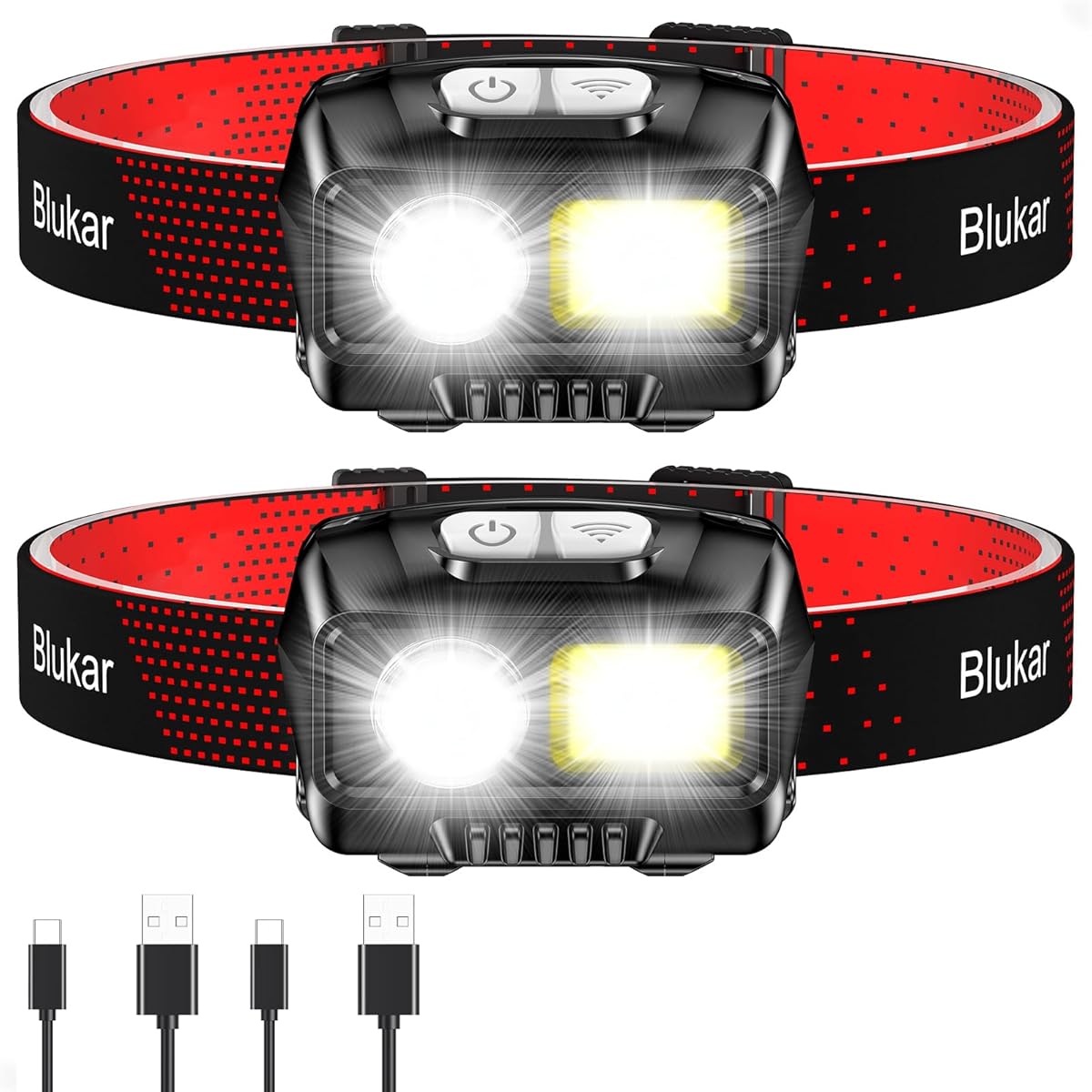
The Blukar 2000L Headlamp combines high stated output, flexible dimming, motion activation, and a broad mode selection in a light 2.96-ounce package. Its 4.5 rating makes it one of the strongest all-around choices here, particularly for hunters who want numerous controls without moving to a more specialized premium design.
We may earn a commission when you buy through this link, at no additional cost to you.
Its XPG and COB emitters support five normal modes: XPG white, COB white, combined XPG and COB white, COB red, and COB red strobe. Three additional sensor modes cover XPG white, COB white, and the combined white output. A long press adjusts brightness from full to 30 percent, which provides smoother control than stepping through only preset levels. The red modes add low-light utility around camp.
The built-in 1200mAh battery recharges through USB-C, and a cable is included. Although the supplied information does not state a precise runtime, the battery capacity and mode selection indicate a practical rechargeable setup. IPX5 water resistance covers rainy or snowy conditions, while the removable, washable, breathable band adds comfort. The lamp head tilts 45 degrees to keep the beam aligned with the wearer's gaze.
This headlamp is a compelling recommendation for budget-conscious hunters who still want motion controls, red illumination, dimming, and high maximum output. The main trade-off is complexity: with eight configurations, users should learn the controls before entering the field. In return, they gain a flexible tool that works well for trail travel, camp chores, fishing, repair work, and emergency lighting.
Stepless adjustment from 100 to 30 percent makes it easier to select just enough light for a task. This can reduce unnecessary glare while retaining visibility, whether following a trail, checking equipment, or working around camp.
Separate red and combined white emitters provide options for low-light camp activity and broader visibility. Hunters should use the red setting judiciously and select full white illumination when terrain hazards require maximum awareness.
We may earn a commission when you buy through this link, at no additional cost to you.
The TIROFLX Multi-Color Headlamp stands out for extensive visibility options, including 13 modes, separate spotlight and flood functions, an energy-saving mode, and rear warning-light functions. Its 4.5 rating makes it an appealing choice for hunters who often travel in groups, work around vehicles, or need conspicuous rear signaling in addition to forward illumination.
We may earn a commission when you buy through this link, at no additional cost to you.
The listed brightness specifications describe 160,000 lux for spotlight and 210,000 lux for floodlight, with irradiation distances stated up to 5,085 feet. Because these figures use a different measurement from lumen ratings elsewhere in the list, direct output comparisons should be made cautiously. In practical terms, the useful feature is the ability to move between focused and broad beams and among high, medium, and strobe settings for each.
The battery cover adds a display and five SOS-style rear modes, including green, red-and-green, red, and flashing red indicators. These are relevant when walking with companions, cycling, or working near roads. The Type-C charging process takes approximately three and a half to four hours, while the stated active runtime is more than 13 to 20 hours depending on the mode. Standby life is listed at up to 95 hours to 30 days.
IP65 water resistance, a sealed charging cover, and an aluminum alloy housing suit demanding outdoor use, although the product is not designed for swimming or full immersion. Six helmet clips are included. This is an excellent option for hunters needing many signaling modes and group visibility, while those who prefer simple operation may find the feature-heavy design less attractive.
Rear green and red indicators can improve group awareness when members are traveling together in darkness. They are particularly useful around roads or when a hunter needs to remain noticeable from behind.
Included helmet clips allow the headlamp setup to be adapted for more rigid head protection. A wide padded band and 125-degree adjustment support stable positioning during outdoor work.
We may earn a commission when you buy through this link, at no additional cost to you.
The Blukar Three-Light Headlamp uses T6 and XPE emitters to create a balanced beam for close and distant viewing. Its 4.6 rating is among the strongest in the group, and the combination of zoom, five modes, a rear red reminder light, USB-C charging, and IPX6 water resistance makes it a well-rounded option for hunting and general outdoor use.
We may earn a commission when you buy through this link, at no additional cost to you.
One-touch controls select the main white light, side white light, all white lights, flashing white output, and main red output. Rotating the main lens changes the focal length, allowing the user to move between spotlight and flood behavior. This is useful on a hunting route that alternates between dense cover and open terrain, where both concentrated distance light and peripheral visibility are useful.
The battery is an integrated, non-removable pack that recharges by USB-C and takes approximately five hours. Its sealed battery compartment and IPX6 rating provide strong protection against water and shocks, although the lack of a stated runtime makes long-trip battery planning less certain. The head rotates 90 degrees, and the breathable elastic band can be adjusted to fit different head shapes or attached to a helmet.
The rear red light adds another layer of personal visibility while moving through camp or with a group. This model is a strong middle ground for hunters who want more focused control than a basic wide-beam lamp but do not need a detachable premium optic system. It is especially suitable for users who value a compact, rechargeable design with dependable water protection.
T6 and XPE emitters support main, side, and combined lighting choices. This gives hunters options for close work, broad awareness, and focused viewing without carrying multiple flashlights.
The IPX6 rating and sealed battery compartment offer useful resistance during rain, snow, and damp field conditions. It is still sensible to avoid deliberate immersion and to dry the charging area before reconnecting a cable.
We may earn a commission when you buy through this link, at no additional cost to you.
The Bushnell TRKR 325L is the most purpose-specific model in this roundup. Its 325-lumen output is modest compared with many competitors, but the dedicated blood tracking mode gives hunters a feature directly tied to following a wounded animal. Its 4.7 rating places it among the most highly rated products here.
We may earn a commission when you buy through this link, at no additional cost to you.
The multi-color design and tracking function distinguish it from general-purpose high-output headlamps. For hunters who require that specialized lighting pattern, the lower maximum output may be a worthwhile trade. IPX4 weather resistance helps handle rain and accidental splashes, while one-meter impact resistance provides a useful durability standard for equipment that will be carried, dropped, and used in rough terrain.
Three AA batteries are included, and the replaceable battery format offers an important operational advantage: spare cells can be carried for extended trips. That avoids dependence on a charging cable and avoids the complication of an integrated battery that cannot be replaced by the user. The trade-off is that disposable cells add ongoing weight and require responsible removal and recycling.
This is the best choice for hunters whose priority is tracking rather than maximum brightness or extensive mode selection. It is less suitable for someone who wants a high-output flood beam for camping or navigation, but it directly addresses a specialized need with a simple, durable package. For that use case, its focused design and replaceable power make it an especially sensible recommendation.
The dedicated blood tracking mode sets this model apart from general camping headlamps. It provides a purpose-built option for hunters who need to inspect the ground or vegetation while following a wounded animal.
AA cells make it easier to prepare for a multi-night trip by carrying spare batteries. Users should keep replacements accessible and dispose of used cells responsibly, especially in wilderness areas.
We may earn a commission when you buy through this link, at no additional cost to you.
The best hunting headlamp is not automatically the one with the largest stated output. Beam control, runtime, fit, weather protection, controls, and specialized functions should match the type of hunting and the duration of each outing.
A spotlight concentrates light into a narrower beam for distant trails, clearings, and game-sign areas. A floodlight spreads illumination across a wider area, helping with navigation, campsite work, and close-range tasks. Models with zoom, twist-focus, or separate flood and spot settings give hunters the flexibility to adapt to changing terrain. High maximum output can be useful for unusual hazards or emergencies, but excessive brightness may waste battery life and create glare when a lower setting is sufficient.
Consider whether the light uses replaceable batteries, an integrated rechargeable cell, or AA batteries. Rechargeable models are convenient for repeated outings when a USB or USB-C cable is available. Integrated batteries reduce loose components, while replaceable cells are valuable on remote trips where carrying a spare power source is practical. Review the stated runtime for realistic brightness levels rather than relying only on the maximum figure, and carry an appropriate backup light for extended expeditions.
Lumen ratings provide a useful measure of total light output, but beam shape and color rendering also influence real-world usefulness. A product with 300 to 500 lumens may be perfectly capable for close trail and tracking use, while high-output models offer greater reach and emergency headroom. Because some listings in this category use lux or distance figures instead of lumens, comparisons should focus on documented modes rather than mixing unlike measurements.
Red light can make map reading, gear checks, and movement around camp less disruptive to dark adaptation than bright white light. It does not eliminate every effect on night vision, so users should reserve it for suitable tasks and switch to low white illumination when terrain hazards demand full awareness. Models also offer strobe functions, which are most useful for signaling or emergencies rather than continuous hunting illumination.
Hunting often takes place in rain, snow, fog, mud, or near wet vegetation. IPX4 offers protection against splashing water, IPX5 adds stronger water-jet protection, IPX6 handles powerful water jets, and IPX7 indicates temporary immersion protection under the applicable standard. Aluminum bodies and impact-resistance ratings add mechanical durability. Regardless of the rating, charging-port covers should be closed in wet conditions, and immersion should be avoided unless the manufacturer explicitly permits it.
A hunting headlamp may be worn for hours, so weight, padding, strap breathability, and stability matter. A secure band helps prevent the lamp from shifting over uneven ground or when the wearer bends and crawls. Adjustable or removable straps can accommodate different head sizes and allow use under a cap. Helmet-compatible models may be useful for hunting from tree stands or other positions where a stable, unobstructed fit is important.
Motion sensors can turn a light on or off without touching a button, which is useful with dirty or cold hands. Long-press shutdown can prevent accidental activation inside a pack, although a physical lockout is still worth considering. Specialized blood-tracking modes, rear warning lights, emergency strobes, and power-bank outputs add value for particular users. More modes are not automatically better; a clear interface and the exact functions you need usually matter more than a long specification list.
A secure headband keeps both hands available, but some hunters also need the lamp detached from the head. Magnetic bases, helmet clips, mounting brackets, and adjustable lamp pivots allow the light to be placed on metal surfaces, redirected toward a work area, or secured under head protection. Evaluate whether the included mounting hardware fits the equipment you actually use and whether detaching the light would leave the remaining strap awkward.
Before every outing, charge a rechargeable headlamp fully, install fresh batteries if it uses replaceable cells, and test every mode in a safe location. Confirm that the strap fits securely, the pivot holds its position, and the beam points where expected. Carry a second light or backup batteries even when the primary model has a long stated runtime, because cold conditions and repeated use can reduce available operating time.
Adjust the headband so the lamp sits comfortably without pressing the forehead, and tilt the lamp after putting it on rather than before. Begin with the lowest white setting that provides enough visibility, move to a focused beam for distance, and use a wide flood for campsites and close tasks. Keep red light for compatible low-light activities, and avoid pointing a high-intensity beam toward other hunters or wildlife.
After use, switch the light off and wipe away moisture, dirt, and mud. Close the charging-port cover before exposing the lamp to rain, and allow wet components to dry before charging. Do not immerse a headlamp unless its manufacturer specifically permits full waterproof immersion. Use only compatible charging cables and batteries, and follow the manufacturer's guidance for storage, cleaning, and battery replacement.
The necessary brightness depends on the terrain, time, and type of hunting. A focused beam of several hundred lumens can be useful for distant viewing, while lower settings are often sufficient for trails and camp tasks. A headlamp with several brightness levels and adjustable beam control is generally more versatile than one that only offers maximum output.
A red light is helpful for checking maps, reading gear labels, and performing limited tasks around camp with less disruption to dark adaptation. It is not a substitute for a low white beam when hunters need to identify obstacles or navigate safely. The best choice usually includes both white and red options.
Rechargeable models are convenient for regular use and reduce the need to carry spare cells. Replaceable-battery models can be more practical on remote or multi-night trips because spare cells can be carried. Consider charging access, expected trip length, and the weight of spare batteries before choosing.
IPX4 indicates resistance to water splashing in multiple directions. It is appropriate for many ordinary outdoor conditions, such as light rain, wet vegetation, and accidental splashes. It does not mean the lamp can be submerged, and charging-port covers should remain closed when the headlamp is wet.
No. A high-output beam can improve distance visibility, but maximum brightness is only one part of useful performance. Beam shape, controls, runtime, comfort, red-light access, and waterproof protection may matter more for a particular hunter. Choose the model that best matches your terrain and typical tasks.
A motion sensor can be convenient when your hands are cold, muddy, or occupied because you can turn the lamp on by waving near it. It is especially useful around camp or during repeated field tasks. Hunters should still learn the manual controls and verify the sensor does not activate unintentionally inside a pack.
A dedicated blood-tracking mode is the most relevant specialized feature, followed by a controlled low-level beam that can reveal traces without overwhelming the scene. The Bushnell TRKR 325L directly includes such a mode. Hunters should combine the correct lighting with a disciplined search pattern and remain mindful of local hunting regulations.
Carry the headlamp in a protected pocket or bag where it cannot be activated accidentally, and pack the appropriate backup power source. Fully charge the unit before departure, carry spare batteries or a charging cable as appropriate, and test the light after long periods of inactivity. A second small light provides valuable redundancy if the main unit fails or its battery becomes depleted.
The Coast XPH30R stands out for precise twist-focus control, documented brightness levels, a detachable magnetic base, and a strong 1200-lumen turbo mode. The Bushnell TRKR 325L is the most specialized recommendation because its dedicated blood tracking mode and replaceable AA batteries directly address tracking and remote-trip reliability. The Blukar 2000L offers the best value-oriented combination of output, dimming, motion control, red light, and USB-C charging.
Most hunters should prioritize beam control, dependable power, weather resistance, and a stable fit before focusing on headline brightness. A red mode can improve low-light utility, motion control can make the lamp easier to operate, and replaceable batteries may be preferable far from charging access. Whatever the feature set, carry backup illumination and use the correct white-light level for safe terrain awareness.
Before buying, review the current listing details for runtime, charging requirements, included mounting accessories, and the manufacturer's latest usage guidance. Product specifications and marketplace availability can change, so confirm that the selected headlamp remains suitable for your expected terrain, weather, battery strategy, and hunting tasks.