
MaxGuard Bed Bug Traps, 24 Traps
3.9Editor score
Twenty-four traps included
Non-toxic adhesive construction
Timed-release attractant
Long-lasting monitoring design
Discover the best bed bug traps for early detection, monitoring, and household pest control, with 10 options compared for design, coverage, and ease of use.
Bed bug traps are among the most useful tools for detecting activity early, monitoring treated rooms, and capturing insects that travel along furniture legs. A good trap should be easy to position discreetly, provide a visible indication of catches, and remain effective without relying on routine spraying. The right choice depends on your home layout, pest concerns, and monitoring goals.
This guide compares ten bed bug traps using the information supplied for each product, including pack size, trap construction, placement guidance, chemical-free claims, and intended uses. It covers passive interceptor designs, adhesive traps, enclosed monitors, and general-purpose glue boards. The list explains where each option fits best rather than treating every trap as an interchangeable bed bug solution.
Each review highlights the product's strongest features, practical limitations, and ideal placement, while the comparison table makes the major differences easier to scan. No trap should be assumed to eliminate an entire infestation on its own, so pairing monitoring with professional treatment and careful cleaning remains important. Product details, availability, and current listing terms may change.
3.9Editor score

4.3Editor score

4.5Editor score
The table below compares all ten traps by their pack size, monitoring style, construction, and recommended use. It is designed to make it easier to identify whether you need a dedicated bed leg interceptor, an adhesive monitor, or a broader multi-pest trap.



The MaxGuard Bed Bug Traps are an adhesive monitoring option built around a large 24-trap pack, making them appealing for homeowners who want broad placement without buying several separate products. They carry a 3.9 customer rating, but the combination of a timed-release attractant, non-toxic construction, and a stated effectiveness period of up to six months makes this one of the most practical budget choices in the list.
We may earn a commission when you buy through this link, at no additional cost to you.
The traps use a timed-release attractant to draw crawling insects toward an industrial-grade sticky surface. Instructions call for peeling, assembling, and placing each trap near a bed post or furniture leg. Because the product is marketed not only for bed bugs but also for spiders, crickets, cockroaches, and ants, it can serve as a general household monitoring tool instead of a narrowly specialized bed bug monitor.
The main trade-off is that this is an attractant-and-adhesive system rather than a deep interceptor that physically prevents insects from leaving. The supplier specifically advises allowing time to see results, which means buyers should not mistake a single quiet inspection for proof that no pests are present. Its 3.9 rating is also lower than the strongest interceptor options, so expectations should remain measured.
This is a good choice for budget-conscious users who want numerous placement points or want to monitor several pieces of furniture. It is less suitable for someone seeking a guaranteed one-step capture mechanism. For households addressing a suspected infestation, use these traps alongside cleaning, inspection, and evidence-based treatment rather than as the sole response.
With 24 traps in each box, this product makes it easier to create a distributed monitoring pattern across bed posts, sofas, and other frequently used furniture. A larger deployment can reveal activity in multiple rooms or reveal which locations are most likely to bring insects into contact with the adhesive.
The timed-release attractant helps the traps remain useful as monitoring tools, while the adhesive avoids reliance on a conventional insecticide. Buyers who want to limit pesticide use around sleeping areas may appreciate that combination, provided they inspect the traps regularly and follow all placement instructions.
We may earn a commission when you buy through this link, at no additional cost to you.
The black eight-pack of Bed Bug Blocker Interceptor Traps is the strongest all-around recommendation in this guide. Its 4.3 rating reflects a well-regarded product with a clear monitoring purpose, and the supplied information notes that independent third-party laboratory testing concluded the traps effectively trap bed bugs and are suitable as monitoring devices.
We may earn a commission when you buy through this link, at no additional cost to you.
These passive interceptors do not depend on chemicals, pesticides, or lures. Their textured exterior encourages bed bugs to climb toward the bed, while a smooth outer pitfall reservoir makes escape difficult. Placing one under each bed post or furniture leg creates a physical barrier along a common travel route, allowing the traps to work continuously without repeated spraying.
A limitation is that effectiveness depends on correct placement. The furniture leg must sit where bed bugs will encounter the trap, and the interceptor should not be positioned where it is easily kicked, moved, or obstructed. The eight-piece format also may not cover every bed and furniture item in a large home, so additional packs could be needed for comprehensive monitoring.
The product is an excellent fit for new tenants, travelers, landlords, hotel operators, and anyone establishing a long-term monitoring baseline. It is also useful before and after pest treatment because caught insects provide visible evidence. Buyers seeking a dedicated, chemical-free interceptor with documented laboratory testing will find this to be the most complete option here.
The strongest distinguishing feature is the reported third-party laboratory testing. Entomologist testing and real-home field use add confidence that this is more than a simple glue board, although actual household results still depend on insect activity, placement, and the extent of any infestation.
The traps continuously intercept insects that travel up bed posts, making them suitable for long-term monitoring without scheduled spraying. Their no-chemical, no-lure approach is especially attractive for bedrooms, rentals, dormitories, hospitals, and other settings where pesticide use may be restricted.
We may earn a commission when you buy through this link, at no additional cost to you.
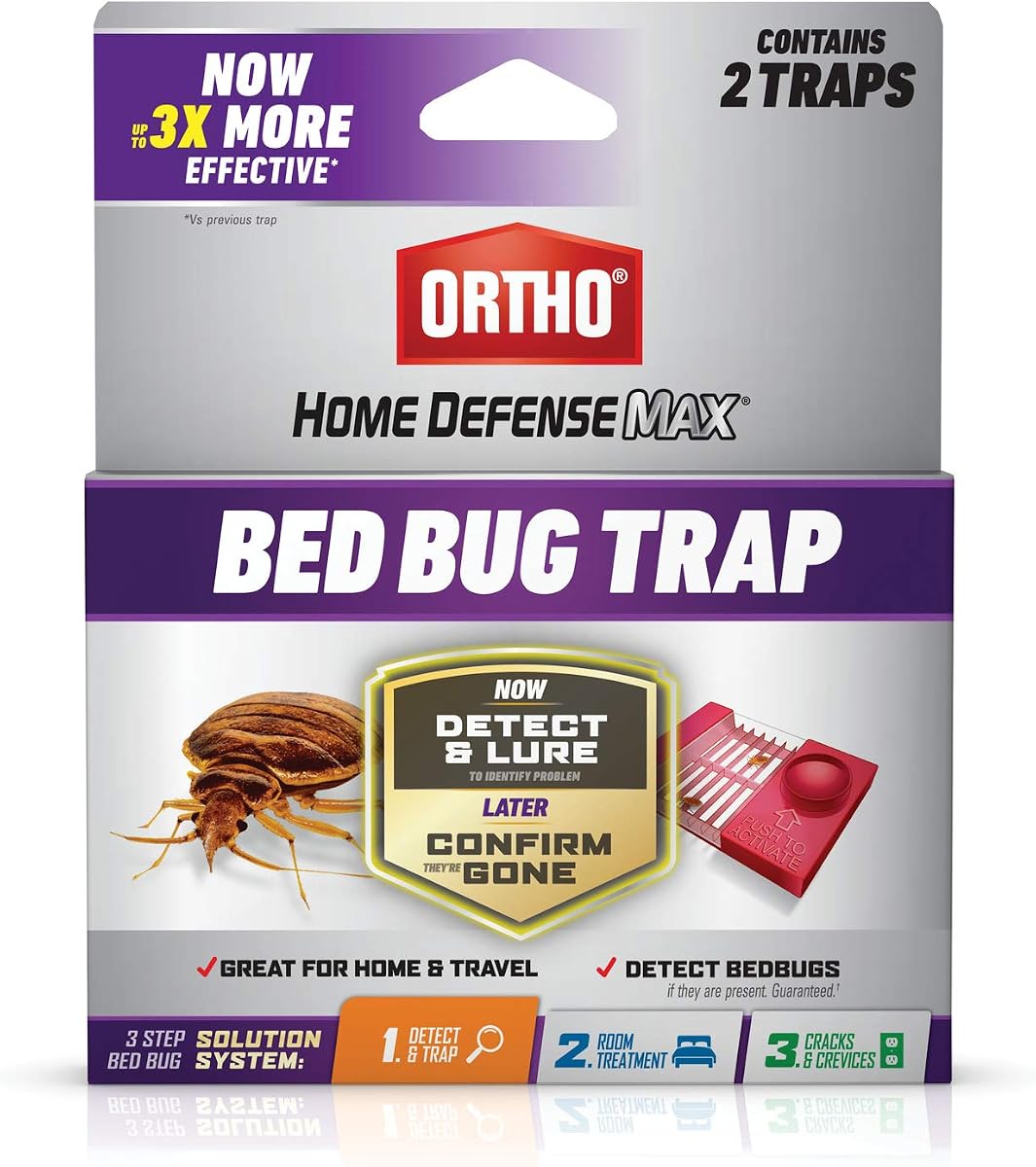
The Ortho Home Defense Max Bed Bug Trap is a compact, targeted monitoring set with a 3.6 customer rating. Its two-trap format is modest, but the design serves a specific purpose: detecting and luring bed bugs from nearby hiding places so homeowners can confirm activity before beginning treatment or verify that it has declined afterward.
We may earn a commission when you buy through this link, at no additional cost to you.
Each trap is activated by pressing a button, which initiates the attractant. A peel-back window allows the user to monitor the interior without dismantling the trap. Placement guidance includes bed headboards, bed legs, the gap between a mattress and box spring, and heavily used furniture such as sofas and recliners.
The biggest drawback is the limited quantity. Two traps can establish a small monitoring network but may not cover an entire multi-room home, particularly when bed posts and common furniture all need attention. Its 3.6 rating is the lowest among the products reviewed, and the attractant-based approach does not offer the same one-way capture structure described for interceptor traps.
This product is best for a targeted check in one sleeping area, a temporary rental inspection, or a two-location pre- and post-treatment comparison. Users wanting whole-home coverage should plan a more extensive placement strategy. It is less compelling than larger packs when the goal is continuous monitoring across many furniture legs.
The peel-back window provides a straightforward way to inspect trapped activity. This makes the trap convenient for monitoring intervals where you need to know whether insects are entering the device without fully unfolding or relocating it.
Ortho explicitly positions the traps for confirming bed bug presence before treatment and checking for activity afterward. That makes them useful components in a broader solution system, alongside room and crevice treatments rather than as a replacement for them.
We may earn a commission when you buy through this link, at no additional cost to you.
The white eight-pack of Bed Bug Blocker Interceptor Traps shares the core performance of the top-ranked black version while offering a more discreet color option. It has a 4.3 rating and uses no synthetic additives or lures, allowing users to monitor a room passively without adding a chemical treatment to the equation.
We may earn a commission when you buy through this link, at no additional cost to you.
Bed bugs are attracted to the carbon dioxide associated with sleeping people and commonly travel up bed posts. The trap's textured outer surface permits entry, while its slippery pitfall reservoir is designed to prevent escape. The product is also described as field-tested in homes and used in hotels, dormitories, hospitals, nursing homes, and other residences.
As with any interceptor, the furniture leg needs to rest securely on the trap, and the device needs to remain in an undisturbed position. The white finish may be less conspicuous in bright rooms, though visual concealment is not the same as effectiveness. An eight-pack offers reasonable coverage for one bed, but larger properties may require additional sets.
This is a strong option for light-colored bedrooms, hospitality spaces, and users who want a dedicated monitor with a 4.3 rating and reported laboratory trapping evidence. It is particularly attractive to households wanting a no-lure, no-chemical setup. Buyers should focus on consistent placement and regular inspections to gain the most from the traps.
The white finish makes the interceptors less visually intrusive in rooms with pale floors or light furniture. That discretion can help a monitor remain in place for longer because it is less likely to be moved during dressing, cleaning, or changing the bed.
The reported use across homes, apartments, hotels, hospitals, dormitories, and nursing homes highlights the trap's flexibility as a monitoring device. Institutional users should still follow local pest-management procedures and coordinate trap placement with licensed professionals.
We may earn a commission when you buy through this link, at no additional cost to you.
Trapper Max Glue Boards combine a 4.5 customer rating with a design intended for both rodents and insects. The 12-board pack includes peanut butter-scented traps, and the product information specifically lists bed bugs, spiders, and cockroaches among the potential targets, making it a flexible choice for broader household pest monitoring.
We may earn a commission when you buy through this link, at no additional cost to you.
Each trap has a glue-covered measuring surface of 4.5 by 6.5 inches, while the complete trap measures 5.25 by 7.75 inches. They can be used flat or folded and placed wherever target pest activity has been observed. That flexibility makes the boards useful near furniture, along walls, or in other areas selected through careful inspection.
The tradeoff is that these are general-purpose glue boards rather than dedicated bed bug interceptors. A bed bug-specific design can provide a more obvious one-way capture mechanism and better placement around bed posts, whereas a glue board relies on direct contact. The product also provides no detailed bed bug-specific monitoring claims beyond being suitable for catching the insects.
This product is best for buyers who want one adhesive product to monitor several crawling pests, especially where space is tight. Its 4.5 rating is among the highest in the list, though ratings alone cannot guarantee capture. Use it alongside a careful bed bug inspection and dedicated interceptors if bed bug presence is specifically suspected.
The ability to target rodents, bed bugs, spiders, and cockroaches makes this a practical catch-all for a multi-pest household. Its broad use also means placement decisions should focus on observed activity rather than placing every board in the same generic location.
The board format can be laid flat for a wider adhesive area or folded into a more compact shape. This flexibility helps users work around furniture legs, wall edges, and other constricted spaces, although folding should follow the product's included configuration.
We may earn a commission when you buy through this link, at no additional cost to you.
This eight-pack of black bed bug interceptors has a 4.3 rating and focuses on a sturdy, supportive design for furniture. Its strong plastic construction, widened base, and grippy inner threads are intended to keep bed, sofa, desk, and other furniture legs stable while also creating a barrier against crawling insects.
We may earn a commission when you buy through this link, at no additional cost to you.
The outer surface and inner platform have a matte texture that allows bed bugs to climb inside. Smooth, deep inner walls are then intended to prevent escape. The product is marketed for continuous monitoring in homes, apartments, hotels, hospitals, and dormitories, which gives it broad applicability for both residential and shared environments.
One potential issue is bulk. A wide base and deep reservoir take up more floor space than a small adhesive board, which can matter in tight rooms or beneath low furniture. The package includes eight units, and the listing notes that they can provide monitoring and protection for one bed or several smaller furniture items rather than a complete large-home network.
This is a good pick for people who want interceptors that also function as stable furniture supports. It is particularly relevant for sofas, desks, and beds with suitable leg dimensions. For maximum monitoring coverage, confirm that all relevant legs can be accommodated and consider additional packs for multiple rooms.
The widened base and internal threads distinguish this model from simpler disposable monitors. Those features are intended to improve stability and reduce movement, which helps preserve proper placement around a leg and discourages accidental disturbance.
The design is advertised for beds, sofas, desks, and other furniture. Before purchasing, users should measure leg and clearance dimensions to ensure the furniture sits correctly on the interceptor without forcing it out of position or preventing normal movement.
We may earn a commission when you buy through this link, at no additional cost to you.
The HARRIS Bed Bug Traps 20-Pack is a discreet, pesticide-free monitoring option with a 3.9 rating. Its folding construction and simple top tab make it easy to create numerous small monitoring points without the bulk of a deep interceptor, which is useful when floor clearance is limited.
We may earn a commission when you buy through this link, at no additional cost to you.
The supplied information describes the traps as easy to use: fold the body and insert the tab at the top to hold it together. They slide under furniture and bedding, and the product is intended for both residential and commercial early detection. No chemicals of any kind are used, making the design straightforward for users who prefer non-chemical monitoring.
Compared with interceptor traps, the HARRIS product provides less information about its one-way capture mechanics and does not highlight independent laboratory evidence. It may also be less suitable for furniture that requires substantial load support because it is designed as a monitor rather than a structural base. Assembly takes a little more effort than an already rigid interceptor.
This pack suits landlords, travelers, dorm occupants, and homeowners who want numerous portable monitors. It is especially helpful in locations where a large, deep trap would interfere with furniture movement. Buyers should fold each trap securely, place it where insects are likely to travel, and inspect it regularly.
The low-profile traps can slide beneath furniture and bedding without demanding the clearance needed by a deep interceptor. This makes them convenient for renters, frequent travelers, and shared sleeping environments where a bulky device would be inconvenient.
With no chemicals used, the product supports a non-pesticide monitoring strategy. Its practical value comes from placing many small monitors where signs of activity are found, then inspecting them as part of a consistent monitoring routine.
We may earn a commission when you buy through this link, at no additional cost to you.
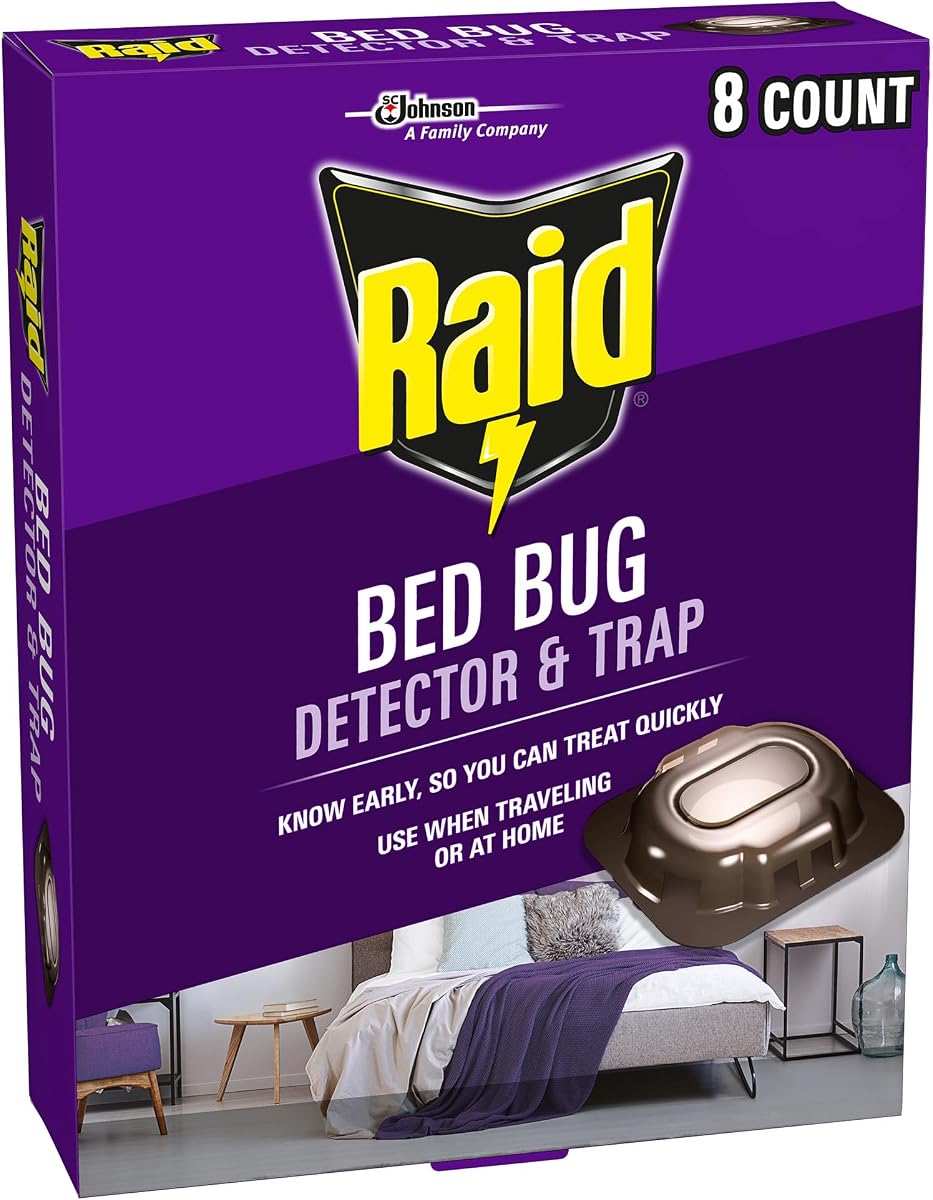
The Raid Bed Bug Detector & Trap is a portable eight-count monitoring set designed for homes and travel. Its 3.9 rating is supported by a simple, practical format: a partially enclosed trap with a see-through window that makes it possible to look for captured activity without fully opening the device.
We may earn a commission when you buy through this link, at no additional cost to you.
Because the traps are intended for indoor use, they are appropriate for checking a hotel room, guest room, rental, or primary bedroom. The enclosed form helps conceal the monitor, while easy disposal simplifies removal when a trap has caught an insect or needs to be replaced after an inspection period.
The product information offers fewer details about the capture mechanism than some of the dedicated interceptors, so buyers should not assume it offers the same one-way escape prevention. It is also limited to indoor environments and may not be useful for outdoor entry points, crawl spaces, or other exterior monitoring tasks.
This set is a practical travel companion and a convenient early-detection tool for temporary accommodations. It is less likely to suit someone wanting a deep interceptor or a large commercial deployment. Regular visual checks and complementary inspection of mattress seams, bed frames, and furniture are still necessary.
The eight-count pack can be split between luggage and a residence, allowing travelers to monitor temporary lodging and their home at the same time. Indoor placement and compact enclosed construction make the set easier to deploy than larger floor-standing interceptors.
The see-through window allows users to check for activity with minimal handling. This convenience supports regular monitoring, although the window should still be examined under suitable light and according to the product instructions.
We may earn a commission when you buy through this link, at no additional cost to you.
The four-pack version of Bed Bug Blocker Interceptor Traps has a 4.3 rating and offers the same passive, chemical-free monitoring concept in a more compact quantity. It is a sensible choice when one bed, sofa, or small group of furniture legs needs focused monitoring rather than a large property-wide deployment.
We may earn a commission when you buy through this link, at no additional cost to you.
The traps are described as laboratory tested by entomologists, with independent third-party research concluding that they effectively trap bed bugs and are suitable monitoring devices. Their textured exterior permits bed bugs to climb in, while a slippery outer pitfall reservoir is designed to keep them from escaping. No chemicals, pesticides, or lures are required.
The obvious limitation is coverage. Four traps may suit a single bed with compatible leg positions, but they will not monitor every post in a master bedroom or provide coverage across a larger home. The device also needs to remain under the furniture without being moved, and a limited quantity can be frustrating if activity is detected in multiple locations.
This is a good starter set for a new residence, a single suspicious bedroom, or a concise pre-treatment inspection. Its reported testing and 4.3 rating make it more evidence-focused than many generic glue boards. Users can expand to a larger pack if the first placement points reveal signs of activity.
Four traps are easiest to deploy consistently around one bed or a small cluster of furniture. Concentrating the devices in a high-risk area can provide clearer information than scattering a limited supply thinly throughout an entire home.
The reported entomologist and independent third-party laboratory testing adds confidence in the product's trapping function. Users should still pair the traps with professional assessment when signs are significant, since catching one insect does not establish the full scope of an infestation.
We may earn a commission when you buy through this link, at no additional cost to you.
The Trapper Insect Trap includes 90 individual traps arranged as 30 monitor boards and has a 4.5 rating, tying for the highest customer rating among the products in this guide. Its scale is the defining feature, providing enough units to create a dense monitoring network across several rooms, beds, and furniture pieces.
We may earn a commission when you buy through this link, at no additional cost to you.
The product information identifies bed bugs, spiders, and cockroaches among the intended insects. Because each board folds into multiple small traps, it can support widespread placement while remaining relatively easy to distribute. This makes it attractive to landlords, property managers, and anyone who prefers a monitor-and-remove workflow over fixed bed post interceptors.
The design is not as specialized as the Bed Bug Blocker products. Its listing does not describe the same laboratory testing, deep escape reservoir, or clearly stated one-way capture sequence. With 90 units, placement discipline matters: placing too many traps indiscriminately can create clutter and make consistent inspection difficult, while incorrect placement can reduce results.
This is a strong choice for broad, multi-pest monitoring and the most useful option here when quantity is the priority. Its 4.5 rating and substantial trap count justify serious consideration, but serious bed bug concerns should still be addressed through inspection, sanitation, and professional treatment when warranted.
Ninety traps make it practical to monitor numerous sleeping and sitting areas without constantly repurchasing smaller packs. A property manager could place them in guest rooms, apartments, dormitory units, and common furniture locations while maintaining a consistent inspection schedule.
The monitor boards can be used for bed bugs, spiders, and cockroaches, making the large set useful for a mixed pest-monitoring program. Users should still prioritize placements where each target species is most likely to travel and avoid treating a large count as a substitute for proper inspection.
We may earn a commission when you buy through this link, at no additional cost to you.
The most useful bed bug trap is one that can be placed where target insects travel, inspected regularly, and incorporated into a broader response plan. Consider trap design, coverage, visibility, and ease of removal before choosing a product.
Interceptor traps are designed around furniture legs and often use steep or smooth walls that prevent a captured insect from escaping. Glue traps rely on direct contact with an adhesive surface and may also be scented to attract specific pests. Interceptors tend to be better suited to continuous bed leg monitoring, while glue boards are flexible for general household crawling insects and areas where a small, low-profile monitor is more convenient.
Choose based on how you plan to monitor. Use interceptors around beds and frequently touched furniture; consider glue traps for broad multi-pest surveillance or locations with limited clearance.
A pack should contain enough traps to place one under every relevant furniture leg and in secondary locations without leaving obvious gaps. A two-trap set is useful for a focused inspection, while four or eight traps suit a single bed or nearby seating. A 20- or 24-trap pack offers broad placement across several rooms, and a 90-trap system is practical for extensive property monitoring.
Count the furniture legs you need to protect before selecting a quantity. Remember that some beds have more than four posts and that sofas, recliners, and nightstands may also serve as travel routes.
A useful trap should make captured insects easy to see without requiring extensive disassembly. A see-through window, peel-back label, or open adhesive surface supports quick inspection. Designs featuring a deep reservoir or one-way escape mechanism can add confidence that an insect has been retained until the trap is replaced.
Prioritize clear inspection features and a capture structure you can understand. Also consider whether the trap must be replaced frequently to keep monitoring results easy to read.
Chemical-free interceptors rely on physical interception and are well suited to sensitive environments, shared facilities, and bedrooms. Adhesive traps may attract insects with a scent or timed-release attractant, which can improve detection but may also collect other crawling insects. Consider household sensitivities, professional treatment plans, and any local restrictions before choosing an attractant-based design.
The key is consistency with your broader pest strategy. A trap that supports treatment monitoring and your household's safety preferences is usually a better fit than one selected only for a stronger scented or chemical claim.
Interceptor traps must be compatible with the height, width, and weight of the furniture leg they support. Low-profile folding monitors may fit where a deep interceptor cannot, while wide-base designs can provide more stability for substantial furniture. Measure the available clearance and observe whether the furniture will sit flat, slide, or wobble after placement.
If the trap prevents a piece of furniture from moving normally, it may be moved accidentally and lose consistency. Choose a form that suits the furniture rather than forcing a mismatched trap into service.
Most bed bug traps are intended for indoor use in bedrooms, living spaces, hotels, dormitories, or similar environments. A portable enclosed monitor may be especially convenient for travel, while a larger set may be more valuable in apartments, rental properties, and institutional rooms. Verify that the trap is approved for the location and compatible with the surfaces on which it will be placed.
Choose portable traps for temporary lodging and larger stationery systems for shared facilities. Outdoor placement is not a default use, even when a product can physically withstand the environment.
Traps only provide useful information if they are checked consistently. Look for captured insects, damaged surfaces, or other visible signs at regular intervals, and record where activity appears. A trap with an easy-disposal design is useful for travel and frequent replacement, while a fixed interceptor may remain in place longer if it is performing as intended.
Establish a schedule that matches the seriousness of the concern and follow the manufacturer's handling directions. Replace or remove traps when they become full, dirty, damaged, or difficult to inspect.
Products may offer laboratory testing, field use, or simply a straightforward physical design. Independent testing can provide additional confidence in a trap's function, but it does not replace local inspection or predict the result in every home. For suspected infestations, combine visible evidence with professional identification, sanitation, source control, and an integrated treatment plan.
Prioritize a trap that gives you reliable, understandable evidence. Then use that evidence to guide the next step instead of assuming that an empty trap proves the absence of bed bugs.
Begin by identifying the furniture legs and high-risk areas most likely to encounter bed bugs. Clean the selected placement areas first, move the furniture carefully, and position interceptors squarely beneath every relevant leg. For adhesive or folding monitors, activate or assemble the trap according to its instructions and place it where observed insect activity, mattress edges, or furniture travel routes suggest it will be effective.
Keep the traps undisturbed and inspect them on a regular schedule. Look for visible insects through windows, peel-back panels, adhesive surfaces, or reservoir walls. Record the location and date of every catch, because a pattern of activity can help determine which rooms or furniture pieces require more attention. Replace damaged, dirty, or full traps, and handle used traps according to the product's disposal instructions.
For a suspected infestation, do not rely on traps as the only response. Separate the bed from nearby furniture when practical, clean seams and upholstery thoroughly, reduce clutter that creates hiding places, and seek professional pest identification or treatment when evidence is substantial or repeated. Continue monitoring after treatment so that remaining activity can be detected and addressed.
Usually, no. Bed bug traps are most valuable for early detection, monitoring, and capturing insects traveling along furniture legs. A serious infestation often requires comprehensive cleaning, source control, heat or chemical treatment selected by a professional, and follow-up monitoring. An empty trap also does not prove that no bed bugs are present.
Place interceptors under bed posts and other frequently touched furniture legs, with additional traps near sofas, recliners, nightstands, and other suspected travel routes. Adhesive monitors can also be positioned near mattress and box-spring edges where activity is visible. Keep every trap stable and avoid locations where it will be crushed, moved, or easily ignored.
Check them regularly, especially when you have visible signs of bed bugs or are awaiting professional treatment. A consistent schedule helps you document new catches and determine whether activity is declining. The appropriate frequency depends on the severity of the concern, but traps should not be left unchecked for long periods during an active monitoring program.
Chemical-free interceptors can be effective monitoring devices because they use the physical structure of the trap to capture insects climbing furniture legs. The Bed Bug Blocker options described in the guide have reported laboratory evidence of trapping bed bugs. Actual performance still depends on correct placement, insect activity, and the extent of the infestation.
Yes, provided the traps are intended for indoor use and are placed according to the manufacturer's directions. Portable enclosed detectors can be especially useful in travel luggage and hotel rooms, while rigid interceptors work well beneath compatible furniture legs. If you suspect a problem in a rental, document it and notify the property manager or owner.
Ideally, you need enough to place one beneath every relevant bed or furniture leg and to monitor secondary high-risk locations. A four-pack may cover one bed, an eight-pack can cover a bed and nearby pieces, and larger packs suit multiple rooms or properties. Focus on complete placement along travel routes rather than placing every trap in a single room.
Some products are designed for several crawling insects. The Trapper Max Glue Boards and the 90-count Trapper Insect Trap explicitly list cockroaches, spiders, and bed bugs among their intended targets, while the MaxGuard traps also mention crickets and ants. A dedicated interceptor is generally more focused on bed bug behavior along furniture legs.
Place the trap in a sealed container or bag without crushing the specimen, then contact a qualified pest professional for identification and treatment advice. Clean the surrounding area, inspect nearby bed frames, mattress seams, and furniture, and avoid moving belongings to another room because that can spread the problem. Continue monitoring after treatment to check for renewed activity.
The Bed Bug Blocker eight-pack is the strongest all-around pick because it combines a 4.3 rating, reported independent laboratory testing, passive chemical-free operation, and a well-defined one-way capture structure. The MaxGuard 24-pack is the best budget-oriented choice for extensive adhesive placement, while the 90-count Trapper Insect Trap offers the greatest coverage for multi-pest monitoring.
The most important priority is placement rather than simply owning the largest pack. Put traps where insects travel, keep them stable, inspect them consistently, and use the evidence they provide to guide cleaning and professional care. Dedicated interceptors are generally more focused for bed posts, while portable adhesive monitors and general glue boards offer flexibility for travel and other crawling pests.
Before purchasing, check the current product listing for the latest package details, instructions, and availability. Product information and listing terms can change, so confirming what is included ensures that the trap design and quantity still match the monitoring plan you have chosen.
