
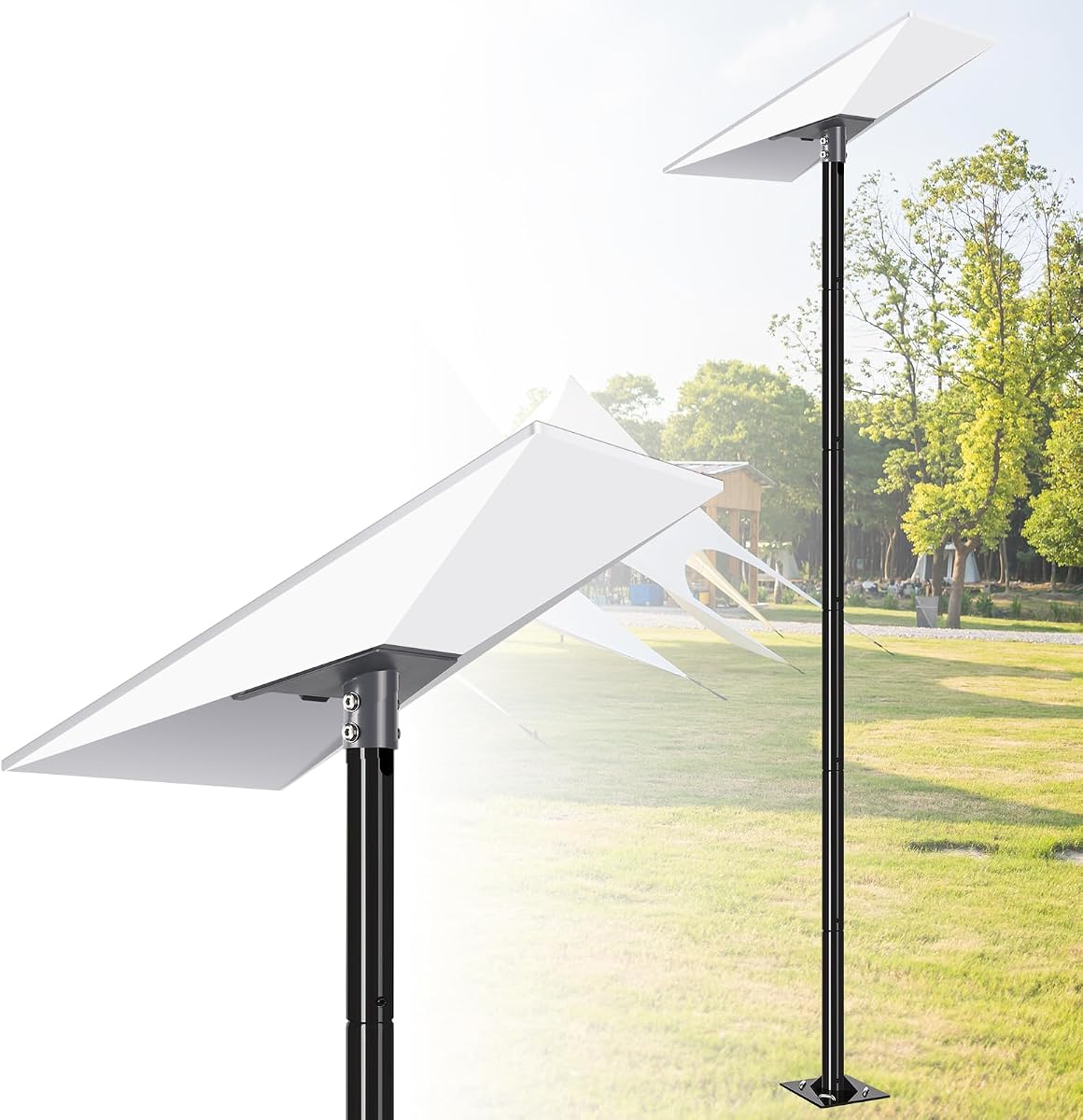
10FT Ground Anchor Mount
5.0Editor score
Ten-foot stainless steel pole
Heavy-duty spiral ground anchor
Five threaded height sections
All-weather corrosion resistance
Starlink Pole Mount guide comparing 10 options for compatibility, height, stability, weather resistance, installation, and setups for home, RV, or outdoor use.
A Starlink pole mount can place the dish in a clearer line of sight, improve alignment, and reduce problems caused by roofs, trees, walls, or nearby obstructions. The right system depends on dish generation, pole diameter, ground conditions, required height, and how often the installation will be relocated.
This guide compares ten mounting solutions based on the supplied compatibility information, materials, adjustment ranges, installation methods, weather resistance, and mounting features. It covers ground poles, pipe adapters, telescoping wall mounts, and adjustable rooftop or eave systems for supported Starlink Standard dish models.
Each review explains who benefits most from a particular design and where compromises may arise. Product specifications, ratings, and availability can change, so readers should verify the current listing, included hardware, and terminal compatibility before purchasing a mount.
5.0Editor score

4.4Editor score

4.6Editor score
The following comparison highlights each mount's physical format, supported Starlink hardware, adjustment capabilities, and intended installation environment.




This ground pole kit combines a 10-foot stainless steel pole, a dedicated dish adapter, and a spiral ground anchor in a package suited to Starlink Standard 4, 4X, and Gen 3 equipment. Its 4.4 rating reflects a broadly practical approach, while the elevated design gives users a straightforward way to move the terminal above grass, shrubs, roof edges, and other low obstructions.
We may earn a commission when you buy through this link, at no additional cost to you.
The strongest feature is the no-dig installation system. Rather than requiring a permanent hole, the spiral anchor is designed to be driven into the ground for a firm hold. That makes the kit especially appealing for yards, cabins, campsites, and seasonal installations. The five threaded pole sections provide a more positive connection than friction-only or clip-on extensions, and the total height can be reduced when a full 10 feet is unnecessary.
Stainless steel addresses rust and deformation concerns in variable climates, while the dedicated adapter is intended to prevent the dish from sliding or rotating once fitted. There are trade-offs. A tall pole requires careful assembly and placement, and a ground installation depends on suitable soil. Buyers should also verify that the included adapter matches their specific terminal and review the dimensions of every component before ordering.
This is the most complete general-purpose pick for a new Starlink Standard installation that needs meaningful height without permanent construction. It suits rural users, homeowners, and travelers who want a portable ground setup. Those seeking only a simple pipe adapter can use a less substantial option, but this kit offers the better-balanced package for clearing obstructions and keeping the dish stable.
The spiral ground anchor changes the installation process by eliminating the need to dig and fill a conventional hole. Once the pole is positioned, the anchor can be driven into the ground to resist movement. This is useful where a permanent foundation is undesirable or where the terminal may need to move.
Five threaded sections make it possible to select a suitable height and then collapse the pole to a compact two-foot length for transport. Threaded joints also help limit the shifting and wobbling commonly associated with simple telescoping poles.
We may earn a commission when you buy through this link, at no additional cost to you.
This 10-foot ground system is presented as a premium elevated solution for Gen 3, Standard 4, and Standard 4X terminals. It has the highest listed rating in the group at 5.0, and its central advantage is straightforward: the pole raises the antenna above roofs, tree branches, and other nearby obstructions to create a more open view of the sky.
We may earn a commission when you buy through this link, at no additional cost to you.
The construction focuses on outdoor durability. Thick stainless steel, an anti-corrosion finish, and tightly connected threaded sections are designed to withstand rain, snow, salt fog, ultraviolet exposure, and wind. The dedicated dish base is intended to prevent sliding and rotation, which helps preserve a consistent signal angle after the terminal has been positioned.
Installation uses a heavy-duty spiral ground anchor, allowing the setup to move among yards, campsites, and seasonal cabins without concrete work or permanent ground damage. The main point to check is the adapter arrangement. The supplied information states that the stainless pole is compatible with a separately purchased Starlink V5 original pipe adapter, even though the kit is described as including a dedicated adapter. Buyers should inspect the package and current listing to confirm exactly which terminal connection is provided.
This system is best for users who need a tall, robust, relocateable installation and have a terminal setup requiring a compatible pole adapter. It is less attractive for a small balcony, patio, or permanent wall where a ten-foot footprint would be impractical. For users who can confirm the included hardware matches their dish, however, it is a strong premium choice.
At ten feet, the pole can place the terminal above many common obstructions. That extra elevation is particularly useful near detached buildings, mature trees, fences, and low rooflines where a short wall or pipe mount would leave the dish in a restricted sightline.
The stainless steel body and corrosion-resistant finish target the conditions encountered by permanently exposed installations. Locking threaded joints also create a more rigid pole structure than lightweight friction-fit designs.
We may earn a commission when you buy through this link, at no additional cost to you.
This compact pipe adapter delivers the essential features many buyers need without supplying a complete pole system. It supports Starlink Gen 3 and Standard 4/4X terminals, fits poles measuring 1.18 to 2.17 inches in diameter, and provides 360-degree adjustment. Its 4.6 rating makes it a strong budget choice for an existing installation.
We may earn a commission when you buy through this link, at no additional cost to you.
The adapter is made from high-strength manganese steel with a thickened anti-rust coating. That combination is intended to preserve structural integrity during prolonged outdoor exposure. Full rotation lets installers fine-tune the terminal's direction after securing the adapter to a suitable pole, which is especially helpful when trees, structures, or neighboring objects limit the ideal sightline.
Installation is designed to be approachable. The simplified assembly and tool-free process reduce setup complexity, and no extra pole is required if the user already has a compatible one. The limitation is scope: this is an adapter, not a complete ground installation. Buyers needing elevation must source a pole with a diameter in the supported range, and they should confirm the pole is rigid enough to avoid transmitting movement to the dish.
It is a sensible pick for renters, patio users, RV setups, and homeowners with an existing pole. Its value comes from adaptable positioning and broad pole compatibility at a modest entry point. It does not outperform the larger systems on maximum height, but it solves a narrower problem efficiently and remains our best budget pick.
The 360-degree rotation makes it easier to experiment with the terminal's orientation before settling on a final position. This is valuable on properties where a nearby roof, tree canopy, or wall creates a narrow usable viewing direction.
A 1.18 to 2.17-inch fit range covers many common metal and treated wooden poles. Reusing an existing support can simplify the installation and avoid the need for a complete ground-mount package.
We may earn a commission when you buy through this link, at no additional cost to you.
This aluminum pipe adapter is a well-rounded option for supported Starlink Gen 3, Standard 4X, and V4 Standard dishes. Its 4.8 rating is among the strongest in the group, and the design is aimed at users who already understand the basics of a pole installation but need a stable terminal connection.
We may earn a commission when you buy through this link, at no additional cost to you.
The extended 70mm socket provides a longer engagement area than a short clamp, which can improve grip and resist movement in wind and rain. The stated pole range of 25 to 53mm offers flexibility for common residential, RV, rooftop, trailer, and remote installations. Mounting hardware is included, while the pole itself is explicitly not included.
This product does not specify the same broad rotational adjustment as several competitors. Instead, its advantages center on secure fit, weather-resistant aluminum construction, and a clean installation with managed cable routing. The lack of a supplied pole may also be considered an inconvenience for first-time buyers, but it also makes the adapter adaptable to a separately selected pole of the correct size.
Choose this model for a fixed RV or rooftop pole, an existing outdoor support, or a setup where a long socket and weather-resistant body are priorities. It is less suited to buyers seeking a complete no-dig ground system or extensive tool-free angle adjustment. With a properly sized pole, it offers a balanced and highly rated mounting solution.
The 70mm socket gives the adapter more contact with the pole than a shallow bracket. That can improve stability while keeping cable routing neat, which is useful on exposed RV and rooftop installations.
The adapter is described for RVs, vans, trailers, cabins, rooftops, and off-grid locations. Because it accepts a broad pole range, it can be paired with a support selected for the available space rather than forcing the installation around one fixed pole size.
We may earn a commission when you buy through this link, at no additional cost to you.
This mount combines a rotating pole, a telescoping arm, and a weighted base to position a compatible Starlink Standard terminal around nearby obstructions. It supports Gen 3, Standard 4, and Standard 4X dishes and earns a 4.6 rating. The design is particularly interesting for locations where a conventional vertical post cannot clear an eave or other projecting surface.
We may earn a commission when you buy through this link, at no additional cost to you.
Two adjustment mechanisms work together. The mounting pole rotates through 360 degrees to change the terminal's direction, while the arm can extend horizontally or vertically. This dual movement is valuable when the required line of sight is not directly above the anchor point. Pre-drilled cable holes help route wiring neatly, and the listed stone and wood mounting options broaden the range of suitable surfaces.
The reinforced weighted base is intended to improve load-bearing capacity and resist wind and rain, but a substantial base may be less attractive on balconies, decks, or other surfaces with strict load limits. The product information does not state a precise extension measurement, so users needing a known clearance should verify the dimensions before ordering. It also offers less total elevation than the 10-foot ground systems in this guide.
This is a good option for a wall, eave, patio, or existing support when the main challenge is navigating around an obstruction rather than gaining maximum height. Buyers should confirm the mounting surface, base footprint, and extension clearance. In return, they gain flexible positioning and a more integrated support than a simple fixed pipe adapter.
The telescoping arm can move away from a wall or under an eave, while the rotating pole changes the terminal's direction. This gives installers more freedom when the clearest sky view is not directly overhead.
Pre-drilled openings provide routes for the power and data cables without leaving them stretched across moving parts. The weighted metal base adds resistance to movement, particularly helpful where the mount is installed on an exposed exterior surface.
We may earn a commission when you buy through this link, at no additional cost to you.
This 10-foot kit supports Starlink Standard 4, 4X, and Gen 3 dishes while offering two distinct installation methods. One option uses drilling for wooden or concrete surfaces, while the other uses a ground-anchor pole design for grass. Its 4.3 rating is the lowest among the products reviewed, but the range of installation choices gives it practical value in mixed environments.
We may earn a commission when you buy through this link, at no additional cost to you.
The pole consists of seven sections and uses a 1.5-inch diameter with 1.5mm walls. A cable hole is included, and the package provides an adapter, a ground-anchor pole, and accessories associated with the two installation approaches. That breadth makes the kit relevant when a user may need to move from a temporary ground location to a more permanent surface installation.
The relatively thin pole walls are the main concern. Although the seven-piece construction creates useful height flexibility, it may not offer the same perceived rigidity as heavier stainless systems with thicker sections. The ground-anchor method also depends on suitable soil, while the drilled method requires the correct tools and appropriate fastening for the surface. These are meaningful trade-offs for anyone expecting a permanent tower.
This kit is best for users who want flexibility between ground and drilled installation, particularly if their property includes both lawn and a wall, deck, or concrete area. It is also attractive as a ten-foot option with more height sections than several competitors. Buyers prioritizing maximum material thickness may prefer a heavier ground pole, but this remains a versatile choice.
A spiral-style ground installation avoids a permanent hole in lawns, while drilled mounting provides an option for wood, concrete, and other firm surfaces. This flexibility is useful when site conditions or future relocation plans are uncertain.
Multiple pole sections allow the installer to reduce overall height without discarding the system. The 1.5-inch diameter is intended to support secure ground insertion and provide a stable base for the supported terminal.
We may earn a commission when you buy through this link, at no additional cost to you.
This aluminum mount is designed for Starlink Gen 3, Standard 4, and Standard 4X systems already supported by the supplied information. It fits poles from 31 to 51mm in diameter and uses six reinforced triangular set screws to secure the terminal. Its 4.5 rating reflects a solid, conventional approach to an existing-pole installation.
We may earn a commission when you buy through this link, at no additional cost to you.
The number of set screws is the most interesting feature. Rather than relying on a single clamp point, the triangular screw arrangement creates several contact areas around the pole. That configuration is intended to improve grip and reduce rotation, which matters when a dish must maintain the same direction in wind. The gray aluminum body also presents a clean appearance that can blend into many outdoor installations.
This is an adapter rather than a complete pole system. Installation involves sliding it onto an existing pole, tightening the set screws, and securing the compatible terminal hardware. The supplied information notes that the Starlink Gen 3 wedge mount kit is not included, so buyers should verify whether their terminal requires an additional component. It also does not provide a ground anchor, meaning pole height and stability remain the user's responsibility.
Choose this option if a suitable pole already exists and the priority is a strong, uncluttered connection. It is well suited to permanent yard, patio, or rooftop arrangements where a refined appearance matters. It is not the best choice for someone wanting a single package with a ten-foot pole, spiral anchor, and portable ground setup.
Six reinforced triangular screws distribute the clamping force around the pole. Compared with a basic two-screw collar, this arrangement is better suited to maintaining a consistent terminal direction in exposed conditions.
The mounting process centers on sliding the bracket onto a compatible pole and tightening the supplied hardware. The simple aluminum design avoids the complexity of a motorized bracket or a full ground-anchor assembly.
We may earn a commission when you buy through this link, at no additional cost to you.
This black roof and wall mounting kit is built for Starlink Standard V3, Gen 3, Standard 4, and 4X terminals. It combines a 30-inch extension tube with a locking base that allows the terminal's angle, direction, and height to be changed without removing screws. Its 4.5 rating makes it a strong option for installers who expect to fine-tune the position after installation.
We may earn a commission when you buy through this link, at no additional cost to you.
The extension can help the terminal clear deep eaves, roof edges, and nearby obstructions, while the 180-degree locking base and 360-degree support provide broad orientation control. The product description states that better positioning can improve reception by up to twice the signal under suitable conditions, although actual performance depends on the terminal, location, obstruction pattern, and Starlink service conditions.
The 0.06-inch carbon steel construction and 1.5-inch tube are intended to reduce flex and unwanted movement. Included lag screws, expansion anchors, a drill bit, a wrench, and other hardware cover common wood and concrete installations. Buyers should note the exclusions: it is not for Standard Mini, Performance Gen 2 or 3, or Standard Actuated models.
This is an excellent selection for a home or cabin with a wall, beam, eave, or roof edge that blocks the terminal's preferred sightline. Its no-disassembly adjustment makes it particularly useful for seasonal repositioning. It does not replace a tall ground pole, but for installations that need lateral reach and precise alignment, it provides a comprehensive and flexible mounting system.
The locking base and rotating support allow the installer to alter the terminal's orientation while the assembly remains connected. This reduces the inconvenience of removing fasteners whenever a small directional change is needed.
The 30-inch tube can move the terminal beyond a projecting roof edge or deep eave. This lateral reach is especially helpful where moving the dish completely away from the structure would place it beyond the property boundary or beyond the reach of the service cable.
We may earn a commission when you buy through this link, at no additional cost to you.
This white pipe adapter supports Starlink Standard Gen 3, Standard 4, and Standard 4X dishes. It has a 4.7 rating and distinguishes itself with both 360-degree rotation and a 60-degree tilt, giving users a useful combination of directional and vertical adjustment when attaching the terminal to a pole.
We may earn a commission when you buy through this link, at no additional cost to you.
The weather-resistant aluminum construction is appropriate for a permanent outdoor installation. Compatibility with poles from 25 to 51mm in diameter covers many common supports, while the adjustment range makes it easier to align the dish around a roofline, tree, or neighboring obstruction. The understated white finish may also blend more readily with some exterior structures than a dark industrial bracket.
Installation is direct: remove the original terminal mount, position the adapter on the pole, and tighten the securing screws. The main limitation is that the pole is not part of this product, and the listed compatibility excludes other Starlink families. The 60-degree tilt should also be considered in relation to the terminal's permitted articulation and the geometry of the chosen installation.
This adapter is best for users who already have a stable pole but need finer control than a fixed collar can offer. It is particularly suitable for permanent outdoor installations where the dish may require periodic alignment. The straightforward replacement process and broad rotation make it a versatile middle ground between simple pipes and more complex adjustable wall systems.
Horizontal rotation handles changes in the terminal's viewing direction, while the 60-degree tilt range allows the installer to correct elevation and avoid a direct obstruction. Together, these controls make fine positioning easier after the pole is secured.
The adapter is designed to replace the original dish mount and attach directly to an existing pole. That approach makes it useful for installers who are comfortable with the physical installation but want improved pole adjustment.
We may earn a commission when you buy through this link, at no additional cost to you.
This wall bracket provides a compact mounting solution for Starlink Standard 4, 4X, Gen 3, V3, and V4 terminals. Its retractable support arm extends both vertically and horizontally, while an adjustment range of 90 to 180 degrees lets installers select a more favorable signal angle. The listed 4.6 rating indicates a well-received product within the group.
We may earn a commission when you buy through this link, at no additional cost to you.
The top-grade metal construction is described as rustproof, windproof, and weatherproof, making it suitable for exposed walls and exterior structures. Hidden cable holes protect wiring from unnecessary wear and improve the appearance of the installation. Expansion screws for concrete and lag screws for wood cover several common mounting surfaces, including walls and wooden roofs.
The installation process requires care around the terminal because the dish does not have screw holes. Spacers must first be placed into the existing openings, and the two securing screws should be tightened gently to avoid turning the spacers through the dish. The product also excludes Starlink Mini, Performance Gen 2, Performance Gen 3, and Standard Actuated systems, making model verification essential.
This bracket is a strong fit for users who want to avoid a tall ground pole and have a suitable wall, beam, or roof face. Its retractable arm provides more positioning flexibility than a fixed wall plate while remaining more compact than the 30-inch extension kit. It is particularly useful for patios, exterior walls, cabins, and homes where a low-profile installation is preferred.
The support arm can extend up, down, forward, and back to help the terminal clear nearby surfaces. Its compact form makes it more practical than a long fixed arm when appearance and wall space are important.
Hidden cable holes reduce direct contact between the cable and the metal bracket. This can limit avoidable wear while preserving a cleaner appearance around the installed terminal.
We may earn a commission when you buy through this link, at no additional cost to you.
The best mount balances terminal compatibility, unobstructed positioning, structural strength, and a practical installation method for the intended site.
Starlink mounting hardware is not interchangeable across every terminal family. The products in this guide support selected Standard 4, Standard 4X, Gen 3, and V3 or V4 configurations, but several explicitly exclude Standard Mini, Performance Gen 2 and 3, and Standard Actuated versions. Check the exact model printed on the dish or power supply before selecting a bracket, and confirm whether the listing includes the particular terminal adapter needed for your version.
In short, compatibility comes before adjustment. A sophisticated mount is of little value if it cannot connect securely to the terminal you own.
A pole should lift the terminal above nearby roofs, fences, trees, shrubs, and other objects that block its view of the sky. Ten-foot systems are useful for open yards and rural properties, while wall-mounted extensions are often better for deep eaves or structures where a tall ground pole would be inconvenient. Consider not only the dish's final height but also the cable's ability to reach the router and power source.
Choose enough height to clear the relevant obstruction without adding unnecessary size. A stable, level position is more valuable than the maximum available height.
Pipe adapters usually specify a supported diameter range, such as 25 to 53mm or 30 to 55mm. Measure the outside diameter rather than relying on a nominal pipe label. The pole should also be rigid enough that wind does not shake the terminal out of alignment, particularly for a full-size dish mounted high above ground.
Match both the diameter and the strength of the pole. A perfect adapter cannot compensate for a thin, unstable, or poorly anchored support.
Rotation, tilt, and telescoping movement can make the difference between a clear and obstructed signal path. A 360-degree rotating adapter is useful for changing direction around a building, while a tilting mount helps correct vertical alignment. Telescoping arms are especially valuable for clearing eaves, although their length and direction should be checked against the available installation space.
Prioritize the movement you actually need. More adjustment is beneficial, but the most important factor is whether the mount can reach a position with a clear view of the sky.
Ground systems with spiral anchors avoid digging and can be relocated, making them attractive for lawns, campsites, and seasonal cabins. Wall and eave brackets suit permanent structures but require suitable wood, masonry, or concrete and safe access during installation. RV and rooftop users should consider vibration, wind, and the need to secure or remove the terminal during travel.
Choose the method that matches the surface and the intended permanence. Installation convenience includes the available tools, surface preparation, anchoring requirements, and cable routing.
Stainless steel and aluminum are common choices for exposed outdoor mounts because they resist corrosion and are lighter than many rigid steel alternatives. Carbon steel can also work well when coated and properly assembled. Pay attention to the thickness of the pole, the number of locking points, and whether the joints are threaded, bolted, or held only by friction.
Choose a construction that suits the climate and exposure level. Resistance to rain, wind, sun, and corrosion helps preserve alignment and reduces maintenance over time.
The dish's power and data cables need enough slack to follow a moving arm without being pinched or sharply bent. Pre-drilled cable holes, concealed channels, and protected routes are useful on exterior installations. If the terminal must be moved frequently, leave a service loop and avoid placing fasteners where they could damage the cable or the dish housing.
Good cable management is both a safety and an appearance feature. It protects wiring while making the mount easier to inspect and adjust.
Permanent wall brackets suit stable homes, while folding or sectioned ground poles are better for travelers, renters, and people who move service between properties. Portability requires attention to packed length, component security, and weight. A long pole that fits poorly in a vehicle may be less useful than a shorter adjustable bracket even if it can reach higher when extended.
Choose a system for the way the terminal will actually be used. Stable and repeatable installations benefit from permanent hardware, while mobile setups need compact, organized components.
Begin by identifying the terminal model, reviewing the included hardware, and comparing the mount's dimensions with the intended pole, wall, roof, or ground location. For a ground installation, select a level area with a clear view of the sky and enough distance from obstacles that can grow into the sightline. Assemble the pole sections securely before driving the spiral anchor, then allow the fixture to settle before attaching the dish.
Attach the terminal using the correct model-specific adapter and tighten all set screws gradually while checking the movement. A pipe should not rotate freely inside the adapter, and the terminal should not shift under moderate hand pressure. Adjust the height, tilt, and rotation while watching the dish's alignment indicator, then make a small final adjustment after the complete assembly has been tightened.
Route the power and data cables through the designated openings or protected channels without pinching them. Check the installation periodically for loose fasteners, cable wear, pole movement, and changing obstructions. Clean dirt and debris from the base, avoid harsh chemicals on the finish, and keep ground anchors clear of standing water. After severe weather, inspect the mounting points and retighten any hardware that has loosened.
No. The products in this guide support selected Starlink Standard 4, Standard 4X, Gen 3, V3, and V4 terminals, but their exact compatibility varies. Several listings explicitly exclude Standard Mini, Performance Gen 2 and 3, and Standard Actuated systems. Always verify the full terminal model and the included adapter before buying a pole mount.
A ten-foot ground pole is usually better when trees, rooflines, or vegetation obstruct a low installation and the property has open soil. A wall bracket is usually better when there is a solid structure nearby, deep eaves need lateral clearance, or a freestanding pole would be inconvenient. The best choice depends on the obstruction and installation surface.
Several pipe adapters do not include a pole. The complete ground kits in this guide do provide multi-section poles, while products described as pipe adapters require the buyer to supply a compatible support. Check the package contents and measured pole diameter before ordering, particularly if you already own a pole or plan to build a custom support.
The required unobstructed view depends on the terminal, service conditions, and surrounding objects, but more clearance generally reduces the chance that roofs, branches, or structures interfere with the signal. A good installation provides a broad open view in the direction the dish faces, with the pole or wall structure outside that view whenever possible.
Usually, yes. Spiral ground anchors are designed for installation without concrete and can be pulled or driven out for relocation. Before moving the unit, disconnect power, remove the dish if necessary, and inspect the pole threads and anchor for damage. The new location should be level, firm enough for the anchor, and clear of obstructions.
The included wall-mounting kits in this guide provide lag screws for wood and expansion fasteners for concrete or masonry on supported models. The correct fastener and drilling method should match the surface and structure. A qualified installer may be needed where masonry is brittle, load limits are uncertain, or cables must pass through concealed wall materials.
Use a rigid pole, tighten all adapter set screws evenly, and confirm that the terminal remains fixed under gentle pressure. Multi-screw adapters and extended sockets generally resist movement better than short friction clamps. Periodic inspections are important because outdoor vibration and changing weather can gradually loosen connections.
Inspect the mount periodically for loose fasteners, corrosion, cable damage, and movement around the anchor or wall fasteners. Remove ordinary dirt with a soft brush or damp cloth and avoid abrasive tools or harsh chemicals. After severe wind, snow, or ice events, check the pole sections and mounting hardware before assuming the installation is secure.
The Starlink Standard 4/4X Pole Mount is the most versatile overall option because it combines a ten-foot ground pole, a no-dig spiral anchor, a dedicated adapter, and portable sectional construction. The 10FT Ground Anchor Mount stands out for premium outdoor durability, while the Starlink 4/4X/Gen 3 Mount provides the most budget-friendly route to an adjustable existing-pole installation.
Prioritize exact terminal compatibility first, then choose the installation method that matches the site. A full ground pole is valuable when a low terminal cannot see the sky, a wall or eave extension is better when nearby structures cause the obstruction, and a pipe adapter is sufficient when a stable pole already exists. Adjustment, cable routing, anchoring, and resistance to weather should guide the final decision.
Specifications, ratings, included components, and current prices can change, so check the latest product listing before ordering. Also verify the physical dimensions of the mount, the pole diameter, the required adapter, and the hardware needed for the installation surface to avoid an incompatible or incomplete setup.