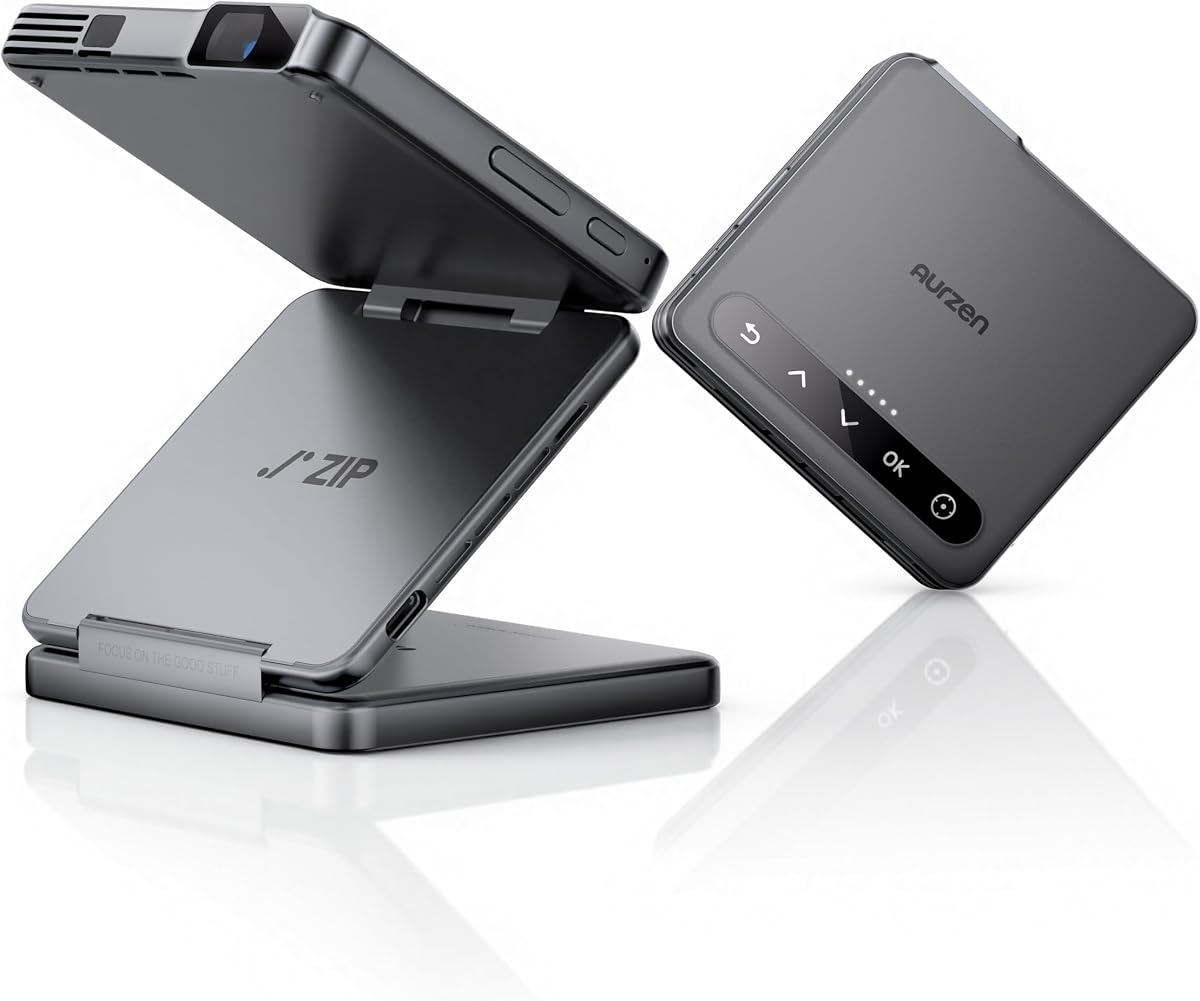
Aurzen ZIP Tri-Fold DLP Pocket Mini Projector, Grey
3.8Editor score
Wallet-size tri-fold design
Automatic focus and correction
Vertical full-screen mode
A portable pocket sized pico projector is designed to turn almost any wall, sheet, or blank surface into an instant viewing area. The best models balance compact dimensions, usable brightness, simple connections, and enough battery life for travel, presentations, crafts, or casual movie viewing.
This guide compares ten projectors using the specifications and feature information supplied for each model. The evaluation covers physical portability, image capability, connection options, wireless functions, audio, power options, and practical features such as automatic focus, keystone correction, tripods, and carrying cases.
Each entry reveals the reason its projector stands apart, from the highly compact Aurzen ZIP models to several KODAK Luma versions with different bundles and capabilities. Ratings and availability can change, while prices fluctuate, so readers should verify current product details before making a final purchase decision.
3.8Editor score

5.0Editor score

4.1Editor score
As an Amazon Associate we earn from qualifying purchases.
The comparison below highlights the most relevant differences among the ten projectors, including format, brightness, power, connections, orientation, and included accessories.


The KODAK Luma 150 Mini Projector combines a genuinely portable body with several connection methods, making it a flexible option for movies, presentations, photographs, and gaming. Its supplied feature information lists a 4.2 rating, 60 ANSI lumens, 854 x 480 native resolution, 1000:1 contrast, and support for 4K source content. The image can expand to as much as 150 inches, giving it unusually generous display flexibility for a compact projector.
We may earn a commission when you buy through this link, at no additional cost to you.
Connectivity is one of the model's strongest attributes. HDMI and micro USB-C cables support connections to compatible cameras, storage drives, computers, laptops, and other devices. AirPlay and Miracast provide wireless mirroring for compatible phones, computers, and tablets, while the built-in speaker allows the projector to provide basic audio without another device. This makes the Luma 150 suitable for users who want one compact unit to handle several source types rather than relying on a single connection method.
The main trade-off is native image resolution. Although the projector can accept 4K input, its 854 x 480 output is much lower than the native 720p figure claimed by the Aurzen ZIP models. Its 60-ANSI-lumen rating also places it below the ZIP's 100 ANSI lumens. It is therefore more appropriate for casual viewing, darker rooms, and moderate screen sizes than for exceptionally detailed daytime projection. Copyrighted streaming services also cannot be mirrored directly, although a compatible streaming dongle can provide another route.
This Luma 150 is a good match for travelers who want flexible media options and a battery that can support up to 2.5 hours of use. It is particularly useful when the available wall is large but the surrounding environment is dim. Buyers prioritizing maximum compactness may prefer the ZIP, while those prioritizing image detail should consider a 720p model. Within the broad KODAK family, however, this version offers a compelling combination of connectivity, display scale, and everyday portability.
HDMI, micro USB-C, AirPlay, and Miracast give users several ways to send images, videos, and presentations. The inclusion of a built-in speaker also reduces the need to carry a separate audio device for casual viewing.
The rechargeable battery supports up to 2.5 hours of operation, making the projector practical for short movie sessions, travel entertainment, or presentations where an outlet is not immediately available.
We may earn a commission when you buy through this link, at no additional cost to you.
The white Aurzen ZIP Tri-Fold is one of the most unusually compact projectors in the roundup, weighing only 0.62 pounds and folding to a wallet-like size. Its 3.8 rating reflects a different balance of priorities from the KODAK models: maximum portability, creative projection, and intelligent setup rather than long battery life or a broad set of physical media inputs. The built-in Z-shaped stand makes it easy to position on a table or other flat surface.
We may earn a commission when you buy through this link, at no additional cost to you.
The projector uses DLP technology, 100 ANSI lumens, and native 720p resolution with 1080p support. ToF technology measures distance 30 times per second to provide zero-lag automatic focus, while automatic keystone correction helps create a properly aligned image. These features are particularly useful for tracing, cookie decorating, sewing, doodling, tufting, and other tasks where a square, stable projection matters. A vertical full-screen mode also suits short-form social video.
There are some limitations to consider. The 5000mAh battery supplies up to 1.5 hours of portable entertainment in eco-mode, which is shorter than the KODAK Luma 150's stated 2.5-hour runtime. Built-in screen mirroring does not directly support DRM-protected content, so supported services may require the separately sold CastPlay Pro USB-C dongle and a compatible source device. The product also does not support Google Cast, including use with Pixel, Motorola, and Chromebook devices.
Despite those boundaries, the ZIP is hard to overlook when pocketability is the leading requirement. Its folding body, integrated stand, no-network mirroring, automatic focus, and vertical mode make it especially useful for travelers, casual viewers, and creative hobbyists. It is less suited to viewers who need long unplugged sessions or extensive file and media connectivity. For those priorities, the more conventional Luma options may be easier to manage.
The tri-fold body and integrated stand make the ZIP unusually easy to carry. Its focus and keystone features also reduce the manual adjustment normally required for tracing, decorating, and other precision-based projects.
One-click mirroring works with iOS, Android, and Windows without requiring a Wi-Fi network. That convenience is balanced by exclusions for Google Cast devices and DRM-protected applications.
We may earn a commission when you buy through this link, at no additional cost to you.
The black KODAK Luma 150 is a straightforward portable projector centered on cordless use and easy device connections. It carries a 4.2 rating and includes a 3800mAh rechargeable battery, AirPlay and Miracast support, a built-in speaker, and HDMI, USB-A, and microSD inputs. The supplied information says it can create an image as large as 100 inches for movies, games, or presentations.
We may earn a commission when you buy through this link, at no additional cost to you.
Its physical inputs are particularly useful for a portable media setup. HDMI can accept content from a laptop, tablet, game console, or other source, while USB-A and microSD expand access to compatible storage devices and local media. Wireless mirroring provides a cleaner option for compatible phones and Android devices when a cable is inconvenient. A built-in speaker means basic sound is available immediately, although external speakers may be preferable for louder viewing.
The main limitation is battery endurance. The listed viewing time of up to 1.5 hours suits a short presentation, a planned game session, or a travel stop but may fall short of a full feature-length film. This model also focuses on media playback and mirroring rather than providing the onboard Android interface found in the Luma 350. The 30,000-hour LED rating indicates a long expected light-source lifespan, but it does not change the limits of its internal battery.
For someone who wants a black, compact projector with multiple physical connections and cordless flexibility, this Luma 150 is a practical choice. It is less compelling for long trips without charging or for users who want to stream directly from the projector. Its strongest audience is the traveler or presenter who values familiar ports, wireless sharing, and a speaker within one small device.
HDMI, USB-A, and microSD allow users to choose among computers, phones, storage devices, and local media. The variety makes the projector adaptable to situations where connection standards vary.
The internal 3800mAh battery removes the need for a nearby outlet during short sessions. Wireless mirroring then lets compatible devices send images without relying on a physical cable.
We may earn a commission when you buy through this link, at no additional cost to you.
The KODAK Ultra Mini Portable Projector offers a classic palm-sized pico design and a 4.1 rating. Its DLP optical engine, LED light source, built-in speakers, and support for 1080p source material make it a recognizable all-in-one option for casual entertainment. The product is positioned for use in dark or dimly lit rooms, where its output can be viewed more comfortably.
We may earn a commission when you buy through this link, at no additional cost to you.
A simple control philosophy is part of its appeal. The supplied information highlights a plug, project, and play approach, with HDMI, USB, and microSD connections available for computers, cable boxes, gaming consoles, and video players. The integrated media player and built-in speakers mean users do not necessarily need a separate sound system. Its ability to display 16.7 million colors also supports richer-looking photographs, games, movies, and slideshows than a very basic portable display.
The principal trade-off is viewing environment. The feature information explicitly says performance is best in dark to dim-lit rooms, so buyers expecting a daylight projector for a bright living space may encounter limitations. The advertised 1080p support should also be understood as input compatibility rather than confirmation of native 1080p output. Although the device is exceptionally portable, its feature set is less focused on modern wireless automation than newer alternatives.
This Ultra Mini is best for someone who values a tiny, uncomplicated projector with familiar ports and built-in sound. It works well for bedside movies, gaming, family slideshows, and private travel viewing. Buyers wanting a smartphone-first experience with automatic alignment may prefer the Luma 150 Type 4, while those seeking the smallest possible folded design will find the Aurzen ZIP more specialized.
The DLP optical engine is designed to deliver focused, colorful images from a compact body. The product is best suited to controlled lighting rather than bright, naturally illuminated rooms.
Built-in speakers reduce setup time for casual viewing, while HDMI, USB, and microSD provide multiple routes for feeding content from compatible devices and storage.
We may earn a commission when you buy through this link, at no additional cost to you.
The grey Aurzen ZIP combines an exceptionally small 0.62-pound body with features usually associated with larger portable projectors. Its 3.8 rating reflects a distinctive package: native 720p resolution, 100 ANSI lumens, automatic focus, automatic keystone correction, vertical viewing, and a built-in stand. The folding form turns a conventional mini projector into something closer to a travel accessory.
We may earn a commission when you buy through this link, at no additional cost to you.
Automatic image handling is especially useful in a pocket-sized device. ToF technology measures distance 30 times per second for zero-lag focus, reducing the need to make tiny manual adjustments. The same compactness makes the ZIP useful for tracing artwork, sewing patterns, cookie and cake decoration, tufting, and other projects where a stable reference image is more important than home-theater-scale output. Its vertical full-screen mode is also convenient for social-media content and sporting events.
Power limitations are the clearest concern. The built-in 5000mAh battery delivers up to 1.5 hours in eco-mode, and simultaneous charging while playing requires a 24W-or-higher adapter. DRM-protected services need the separately sold CastPlay Pro dongle, while Google Cast is unsupported on Pixel, Motorola, and Chromebook devices. Bluetooth 5.4 is limited to audio rather than video, and external soundbars may provide a better sonic result than the built-in speaker.
This grey ZIP makes the most sense for creators, frequent travelers, and viewers who value a genuinely pocketable design over long runtime. It is also a smart option for anyone willing to work around app-specific content restrictions. For conventional movie nights, longer battery life and a larger port selection may be more valuable, making one of the KODAK Luma models a better fit.
ToF-based autofocus and automatic keystone correction help the projection remain sharp and rectangular. These features are particularly helpful when the surface, angle, or projector position changes frequently.
Bluetooth 5.4 supports audio output for a more immersive setup or standalone music use. The feature does not carry video, so screen content still requires a supported wired or mirroring connection.
We may earn a commission when you buy through this link, at no additional cost to you.
The KODAK Luma 350 is the roundup's clearest smart-projector option because it includes onboard Android 6.0, Wi-Fi, and Bluetooth. Its 4.1 rating reflects the convenience of a device that can function as more than a simple screen. Users can browse, install applications, download content, and manage entertainment from the projector itself rather than relying entirely on a phone or laptop.
We may earn a commission when you buy through this link, at no additional cost to you.
The integrated speaker system strengthens its home-entertainment appeal. Together with wireless connectivity and a rechargeable battery, it allows the projector to create a relatively self-contained viewing setup for movies, games, and presentations. Touch controls and the onboard operating system are designed to make navigation more intuitive than the button-heavy interfaces found on some smaller pico projectors.
There are important qualifications to the otherwise flexible software approach. Android 6.0 is an older platform, so app compatibility and long-term support may be less extensive than on a current system. Users should also keep the firmware updated and verify the limitations of content mirroring before planning to stream protected services. The product is most compelling as a portable entertainment unit with onboard apps, not as a specialized presentation projector.
This Luma 350 is ideal for buyers who want a self-contained portable media device and want the option to install apps directly. It differs meaningfully from the other Luma models, which generally focus on source-device connections and mirroring. Those who prioritize modern smartphone workflows may favor a Luma 150, while this model suits someone who wants the projector to act more like a standalone smart display.
Android 6.0 lets users install and launch applications directly on the projector. This can be useful when carrying a phone or laptop would otherwise add unnecessary weight or complexity.
Wi-Fi and Bluetooth support a more flexible entertainment setup, while the integrated speakers provide immediate audio. Updating the firmware and checking app availability can help maintain a smooth experience.
We may earn a commission when you buy through this link, at no additional cost to you.
The white KODAK Luma 150 Mini Projector holds a 4.8 rating and is a balanced choice for travel, presentations, and casual home viewing. Its headline capabilities include a display of up to 120 inches, AirPlay and Miracast wireless mirroring, HDMI, USB, and microSD inputs, an integrated speaker, a 3.5mm audio jack, and a tripod-mountable design.
We may earn a commission when you buy through this link, at no additional cost to you.
Its wireless options are the most visible convenience. Compatible iPhone and Android users can share presentations or streamed content without running a cable across the room. Wired inputs preserve flexibility for laptops, tablets, phones with adapters, and compatible storage devices. The integrated speaker supports immediate casual playback, while the 3.5mm jack offers private listening or a route to a larger audio system.
The supplied information does not state native resolution or brightness for this specific listing, so it should not automatically be assumed to match the 60-ANSI-lumen, 854 x 480 specifications of another Luma 150 version. The 120-inch maximum is an image-size capability, not a promise of high brightness across that size. The tripod mount improves stability and placement for presentations, although it is not included according to the listed features.
This model is well suited to buyers who want wireless sharing and a polished white design without moving to a larger portable projector. Its high rating indicates strong user satisfaction, while the broad input selection handles most common source devices. The Type 4 bundle may be more complete for a first-time owner, but this version provides a strong core feature set for anyone who already owns a tripod or has a preferred screen.
AirPlay and Miracast make it simple to display compatible phone or tablet content without a wired connection. These functions are useful for business presentations as well as informal entertainment.
The built-in speaker handles everyday sound, the 3.5mm jack supports headphones or amplified audio, and tripod mounting helps keep the projected image steady.
We may earn a commission when you buy through this link, at no additional cost to you.
The KODAK Luma 150 Type 4 Pocket DLP Pico Projector Kit stands out with a 5.0 rating, a weight of just 7.75 ounces, and a genuinely complete portable bundle. Instead of supplying only the projector, it includes a carrying case, tripod, and 60-inch screen. That combination is especially attractive for users who want to begin projecting without separately buying storage, stability hardware, and a viewing surface.
We may earn a commission when you buy through this link, at no additional cost to you.
Its setup features are designed to remove common sources of friction. Automatic image alignment adjusts the picture after placement, reducing the need for manual keystone work. Wireless mirroring supports Android, iOS, and Windows devices, while HDMI, USB, and microSD inputs provide wired access to laptops, tablets, phones, and storage devices. The result is a flexible projector for movies, gaming, presentations, and travel.
One limitation is that this listing's supplied information does not state brightness or native resolution. That makes direct technical comparison with detailed models such as the 100-ANSI-lumen Aurzen ZIP or the 60-ANSI-lumen KODAK Luma 150 difficult. The included 60-inch screen can provide a more controlled image than a textured wall, but it also means the kit is best suited to viewers who can use a portable screen in a dimmer environment.
This Type 4 kit is the most complete starting package in the roundup. Its exceptional rating, extremely low weight, automatic alignment, and three core accessories create a polished experience for travel, family viewing, presentations, and dorm or small-apartment entertainment. It is a particularly strong recommendation for a first portable projector because it reduces the number of additional items buyers need to source.
The carrying case, tripod, and 60-inch screen cover storage, placement, and display needs. This bundled approach is convenient for new owners and simplifies packing for trips.
Automatic image alignment helps correct the projected picture after the projector has been positioned. It is particularly useful in temporary spaces where finding a perfectly square placement is difficult.
We may earn a commission when you buy through this link, at no additional cost to you.
The KODAK Luma 75 Mini Projector is a value-oriented option for users seeking a pocket-friendly projector with broad media support. Its 4.1 rating, pocket-sized body, integrated media player, rechargeable battery, and 100-inch maximum display position it as a practical choice for travel, presentations, casual movies, and gaming marathons.
We may earn a commission when you buy through this link, at no additional cost to you.
Standalone playback is a useful feature. The integrated media player can show content without requiring a separate external device, while HDMI, USB, microSD, and 3.5mm connections provide additional ways to bring in media or attach audio. This makes the projector adaptable to different locations: it can serve as a self-contained unit when files are available locally or connect to a phone, tablet, laptop, or other compatible source.
Battery life is limited to as much as 1.5 hours of viewing or presenting. That is enough for a short session but may not cover a complete film, and a charging cable or nearby outlet will be needed for longer use. The supplied data also does not provide a brightness rating or confirm the precise native resolution, despite 1080p HD appearing in the product title. Buyers should therefore consider 1080p as a stated feature rather than a verified output specification.
The Luma 75 is a sensible pick for anyone prioritizing portability, flexible inputs, and cordless freedom at a lower-tier level within this roundup. It is well suited to casual travel and private viewing in dim conditions. Those wanting more accessories, stronger stated brightness specifications, or direct wireless mirroring may prefer the Luma 150 Type 4 or the Aurzen ZIP.
The integrated media player allows compatible local content to be used without a phone, tablet, or laptop. Multiple inputs make it easy to switch to external sources when needed.
The rechargeable battery provides up to 1.5 hours of cordless operation. It is well suited to short presentations and travel stops where charging between sessions is possible.
We may earn a commission when you buy through this link, at no additional cost to you.
The white KODAK Luma 150 Mini Portable Projector combines a 5.0 rating with a compact 3.94-inch by 3.94-inch footprint and a thickness of only 0.91 inch. It is designed to fit comfortably into a bag or drawer while remaining easy to carry between homes, offices, and travel destinations. A travel case and tripod stand are included, giving the product more practical support than a bare projector.
We may earn a commission when you buy through this link, at no additional cost to you.
Wireless freedom is central to the design. AirPlay and Miracast support content sharing from compatible Android, iOS, and Windows devices, which makes the projector suitable for presentations and entertainment without a permanent cable connection. HDMI, USB, and microSD inputs expand compatibility with laptops, tablets, phones, and storage devices, allowing users to choose a wired method when preferred.
The supplied information does not state battery runtime, brightness, or native resolution, so buyers should examine current product details for those important specifications. The stated 30,000-hour LED life suggests a long-lasting light source, but that rating is separate from battery endurance and does not determine image brightness. A slim, compact body can also limit sustained thermal performance or output compared with larger portable projectors, depending on the environment.
This Luma 150 is a strong recommendation for a traveler who values the smallest package, wireless sharing, and useful included accessories. Its square design should pack neatly into luggage, while the travel case protects it and the tripod assists with placement. It is a particularly attractive option for users who want modern smartphone integration without carrying separate speakers, although longer-session viewers should verify battery information before finalizing their choice.
The 3.94-inch square body and 0.91-inch profile make the projector easy to accommodate in a bag. The included travel case adds protection and a convenient way to keep accessories together.
AirPlay and Miracast support compatible Android, iOS, and Windows devices, while HDMI, USB, and microSD provide wired alternatives. This combination supports both quick sharing and more permanent media setups.
We may earn a commission when you buy through this link, at no additional cost to you.
The right pocket projector depends on how you plan to use it. Consider image size, brightness, native resolution, battery life, connection methods, physical dimensions, and setup features before comparing models.
A genuinely pocket-oriented projector should be easy to carry without becoming dependent on a bag full of accessories. Pay attention to the listed weight and dimensions rather than relying only on the words mini or pico. The Aurzen ZIP weighs 0.62 pounds and folds into a wallet-like form with an integrated stand, while the KODAK Luma 150 Type 4 weighs 7.75 ounces and includes a carrying case, tripod, and 60-inch screen. Bundles can make a product feel more complete, but they may also add bulk.
Choose based on your actual routine. A folding model is useful for frequent travel, while a boxed kit may be more practical for a buyer setting up a permanent small-screen entertainment area. Always check the physical dimensions and consider whether the included case, stand, or screen will be carried every time.
Brightness determines how easily an image remains visible, but ANSI lumens should be compared using the same standard. The supplied data rates the Aurzen ZIP at 100 ANSI lumens and the original KODAK Luma 150 listing at 60 ANSI lumens. Other listings do not provide brightness figures. Small projectors are generally most satisfying in dim rooms, and a larger image does not automatically mean a brighter or sharper picture across the entire surface.
If you mainly watch movies after dark or use the projector for crafts and presentations in a controlled room, a lower stated output may be adequate. Daylight use, large walls, and colorful graphics benefit from more light. Choose a clearly stated brightness figure when that condition matters and use a dedicated screen or darker surface when possible.
Native resolution describes the detail the projector itself produces, while input support describes what source devices it can accept. The Aurzen ZIP has native 720p resolution and supports 1080p sources. Another KODAK Luma 150 listing has 854 x 480 native resolution but supports 4K input, while the Kodak Ultra Mini lists 1080p source support. These are meaningfully different claims.
For readable presentations, detailed drawings, and straightforward HD video, 720p native output is a more useful baseline than 480p. Higher input compatibility alone does not create additional native detail. Check both specifications and consider the type of content you expect to display before deciding.
Battery capability is central to portability because a projector that needs a nearby outlet is less useful on the move. Stated runtimes range from 1.5 hours for the Aurzen ZIP in eco-mode and the KODAK Luma 75 to 2.5 hours for the original Luma 150. The Luma 150 Black includes a 3800mAh battery, while the ZIP uses a 5000mAh battery and supports USB-C Power Delivery fast charging.
Estimate a runtime based on common sessions rather than assuming it will cover a full movie. A longer battery is helpful for flights, camping, and presentations in locations without power. If the projector can operate while plugged in with an appropriate adapter, that can provide a practical fallback for extended use.
The strongest portable projectors support both wired and wireless methods. HDMI is the most broadly useful video input, while USB and microSD can provide access to compatible files and storage. AirPlay and Miracast cover many Apple, Android, and Windows workflows, but compatibility varies by model and application. The ZIP's one-click mirroring does not require Wi-Fi, although it does not support Google Cast devices.
Protected streaming content can create another limitation. The original Luma 150 and ZIP listings warn that DRM-protected content cannot be mirrored directly in some cases. A compatible streaming dongle may be required. Check device compatibility, application restrictions, and adapter requirements before relying on wireless streaming for a particular service.
Compact projectors are frequently used in temporary locations where placement is less precise. Automatic focus and keystone correction can make a large difference in how quickly the image becomes usable. The Aurzen ZIP uses ToF technology to measure distance 30 times per second for automatic focus, and the Luma 150 Type 4 provides automatic image alignment. Both features reduce manual setup.
The ZIP also offers vertical full-screen orientation for short-form video and specialized creative uses. If you plan to project recipes, artwork, sewing patterns, or social content, these features may be more valuable than a generic maximum screen-size claim. For conventional widescreen viewing, a standard 16:9 image remains the central requirement.
Built-in speakers add convenience, but their size limits the audio output a pocket projector can provide. Several KODAK models include integrated speakers, while the ZIP supports Bluetooth 5.4 audio and can pair with an external soundbar. A 3.5mm audio jack on the white Luma 150 provides another option for headphones or amplified sound.
The Luma 350 stands apart with onboard Android 6.0, Wi-Fi, and Bluetooth, allowing direct app browsing and installation. That convenience comes with an older operating system and potential app-compatibility limitations. Decide whether independent streaming matters enough to accept those trade-offs or whether a simpler mirrored and wired model will better suit your needs.
Begin by charging the projector fully and identifying a suitable viewing surface. A dedicated portable screen, plain white wall, or smooth sheet can all work, but darker rooms provide the best result with compact models. Position the projector within the range recommended for the desired image size, then use the tripod, built-in stand, or a stable surface to prevent movement. Automatic focus and image alignment features should be allowed to complete before making further adjustments.
Choose the connection that best matches the source. Connect a laptop, tablet, phone, game console, camera, or storage device through HDMI, USB, or microSD when those options are available. For wireless display, confirm that the source device supports AirPlay or Miracast and that the selected app permits projection. DRM-protected services may require a compatible external streaming dongle rather than direct mirroring. Connect headphones, a speaker, or a soundbar through the available audio output when built-in sound is not sufficient.
For care, keep the lens clean and protected from fingerprints, dust, and scratches. Do not aim the lens directly at a bright light source, and avoid operating the projector in an enclosed space where heat cannot dissipate. Between sessions, unplug the device and allow it to cool before placing it in its case. Store it in a dry area, avoid placing heavy objects on the folding panels or screen, and use the supplied case or suitable padded container during transport.
They are generally most suitable for dim or dark rooms because their compact light sources cannot match a large home theater projector. Models with clearly stated ANSI brightness ratings, such as the Aurzen ZIP at 100 ANSI lumens, are easier to compare. A controlled environment and a dedicated screen can also improve perceived brightness and image consistency.
Direct screen mirroring may not support DRM-protected content, depending on the projector and application. The supplied information for the KODAK Luma 150 and Aurzen ZIP specifically notes this limitation. A compatible external streaming dongle, such as the CastPlay Pro for the ZIP, may be an alternative when the source device and service support it.
Native resolution is the detail the projector can actually produce, while supported input resolution identifies which source formats it can accept. A projector may accept a 1080p or 4K signal but output a lower native image. The Aurzen ZIP lists native 720p with 1080p support, while one Luma 150 listing lists 854 x 480 native resolution with 4K input support.
The listed models range from up to 1.5 hours to 2.5 hours, although actual runtime depends on brightness mode, content, and use of wireless or audio features. The Aurzen ZIP is rated for 1.5 hours in eco-mode, while the original Luma 150 lists up to 2.5 hours. Bringing a USB-C charger or confirming that the projector can run while plugged in is advisable for longer sessions.
A tripod or stable stand helps keep the image aligned, while a case protects the lens and body during transport. These accessories are especially useful in temporary locations. The KODAK Luma 150 Type 4 includes both a tripod and a carrying case, while the Luma 150 White includes a tripod and travel case.
It can provide a large image for travel, presentations, gaming, and casual viewing, but it is not a direct replacement for a bright living-room television. Compact projectors generally perform best after dark, offer modest built-in audio, and may need a separate soundbar. They are better viewed as a supplemental and highly mobile entertainment option.
Wireless mirroring is usually the simplest because it avoids adapter and cable clutter. AirPlay and Miracast are supported by multiple models in the roundup, while the Aurzen ZIP offers no-network one-click mirroring for iOS, Android, and Windows. Compatibility can vary, so confirm that the phone and selected application support the required method.
Outdoor use requires a sufficiently dark environment and either a rechargeable projector or a portable power source. Battery-powered models provide more freedom away from an outlet, but runtimes can be limited. The supplied KODAK Luma 75 is listed for up to 1.5 hours of cordless viewing, so longer outings require planning around charging.
The KODAK Luma 150 Type 4 is the most complete package, with a 5.0 rating, 7.75-ounce weight, automatic alignment, carrying case, tripod, and portable screen. The Aurzen ZIP leads in specialized compactness, offering a folding 0.62-pound body, native 720p output, 100 ANSI lumens, and automatic focus. The KODAK Luma 75 stands out as a value-oriented cordless model with standalone media playback.
Prioritize the feature that most affects your intended use. Frequent travelers may value the ZIP's folding body, creators may appreciate its tracing and vertical functions, and viewers wanting a complete kit may prefer the Luma 150 Type 4. Those who prioritize longer runtime should examine the stated battery figures, while bright-room users should focus on verifiable ANSI brightness and native resolution.
Finally, check the current listing for specifications, included accessories, device compatibility, and application restrictions. Ratings and prices can change over time, and a product's availability may also affect which bundles are currently offered. Comparing the final listing with the priorities in this guide will help identify the most suitable portable pocket sized pico projector for your particular setup.