
TCL Q65 QLED
4.2Editor score
QLED quantum dot color
120Hz panel refresh
Dolby Vision and Atmos
Game Accelerator 240
A 95 inch smart TV can transform a living room, home theater, or media room with a cinematic picture and a smart platform that puts streaming, live TV, and voice controls within reach. However, the closest widely available models are often 98 or 100 inches, so screen-size tolerance and room planning deserve careful attention.
The products in this guide were compared using their stated display technology, resolution, refresh rate, HDR support, gaming features, audio capabilities, smart-TV functions, and customer ratings. The list spans LED, QLED, and Mini LED models from Samsung, TCL, LG, and Hisense, including premium and value-oriented options.
Each review explains the strongest features, practical trade-offs, and likely type of viewer. The recommendations cover 98-inch and 100-inch sets because they fall within the practical size range shoppers use when searching for a near-95-inch television. Prices and promotions change often, so confirm current offers before purchasing.
4.2Editor score

4.4Editor score

4.3Editor score
As an Amazon Associate we earn from qualifying purchases.
The comparison below highlights the major differences among these exceptionally large smart TVs, including backlight technology, refresh rate, HDR formats, gaming tools, audio, and smart-TV platform. Because most available models are 98 or 100 inches, buyers should also verify that the slightly larger dimensions suit their intended room.




The Samsung DU9000 is a 98-inch 4K UHD LED television designed around the practical needs of an enormous screen rather than the most elaborate premium hardware. Its standout feature is the Supersize Picture Enhancer, which uses AI-assisted processing to reduce visible noise and improve sharpness as the display area increases. That focus on large-screen image quality makes it a sensible starting point for buyers who want Samsung polish without moving into a Mini LED flagship.
We may earn a commission when you buy through this link, at no additional cost to you.
Picture performance is supported by the Crystal Processor 4K, 4K upscaling, PurColor, Mega Contrast, and HDR. Motion Xcelerator 120Hz is valuable for football, action films, and console gaming, although it does not match the higher refresh-rate figures advertised by several Mini LED competitors. Q-Symphony is another practical strength: compatible Q-Series and S-Series soundbars can work with the television's speakers as a unified system. Tizen provides a mature application interface, voice assistance, gaming features, and a wide selection of streaming services.
The main compromise is the basic LED backlight. Without the precise local dimming of a Mini LED television, dark scenes may not achieve the same deep blacks or bright-object separation. Its Object Tracking Sound Lite also cannot provide the spatial audio experience promised by Dolby Atmos-equipped models. These limitations are most noticeable in a dark, dedicated theater and less significant in a bright family room where the set is likely to be viewed at a greater distance.
Choose the DU9000 if you want a large 4K television with a recognizable smart platform, dependable 120Hz motion, useful gaming features, and less complexity than a high-end display. It is particularly appropriate for general entertainment, sports, and everyday streaming. A buyer whose main priorities are deep blacks, exceptional peak brightness, and sophisticated home-theater audio should instead consider the Samsung Neo QLED QN90D.
The Supersize Picture Enhancer specifically targets the visibility of noise and softness on a very large panel. Combined with 4K upscaling and Crystal Processor 4K analysis, it should make streaming and standard-definition sources appear cleaner than they would on a less focused large-screen design.
The Game Bar includes AI Auto Game Mode, Mini Map Auto Detection, and Virtual Aim Point, while 120Hz motion handling benefits supported consoles. Tizen also adds voice control, streaming apps, and compatibility with Alexa, making the set convenient for a mixed entertainment household.
We may earn a commission when you buy through this link, at no additional cost to you.
The TCL 98Q651G is a 98-inch QLED 4K television that combines quantum-dot color, a 120Hz native panel, Dolby Vision, Dolby Atmos, and an unusually broad gaming feature set. It stands out as a value-focused model without making obvious compromises in the areas many viewers notice most: color saturation, motion clarity, HDR compatibility, and smart-TV convenience.
We may earn a commission when you buy through this link, at no additional cost to you.
Its QLED PRO backlight is designed to cover nearly the entire DCI-P3 color space, while the High Brightness+ LED backlight supports strong output for movies, sports, and games. The TCL AIPQ PRO processor uses deep-learning AI to optimize color, contrast, and clarity. Compatibility with Dolby Vision, HDR Pro+, HDR10+, HDR10, and HLG gives it broad format support. Audio also receives more attention than on many similarly positioned sets because a built-in subwoofer adds deeper bass than ordinary television speakers.
Gaming specifications are impressive, but they need context. The panel natively refreshes at 120Hz and supports variable refresh behavior up to 144Hz, while Game Accelerator 240 can reach up to 240Hz with suitable source content and game configurations. AllM and Auto Game Mode support responsive play, although buyers should check the resolution and timing combinations required by their console. Because it uses a conventional QLED backlight without detailed Mini LED local dimming, black levels and halo control trail the premium Mini LED models in this list.
The Q65 is a strong fit for buyers who want most of the headline features of a high-end 98-inch television without moving to premium pricing. It is especially attractive for sports, family use, mixed content, and console gaming. Viewers who regularly watch dark films in a fully blacked-out room and prioritize precise local dimming should examine the TCL QM6K or QM8L instead.
Quantum-dot color, high-brightness backlighting, and support for every major HDR format give the Q65 broad appeal. It should look especially vivid with compatible movies and sports, while the AI processor helps keep ordinary streaming and broadcast content clear and balanced.
The 120Hz native refresh rate is more meaningful for daily console gaming than a headline number that requires unusually high-bandwidth source content. Game Accelerator 240, AllM, and automatic game mode add flexibility, but users should verify their preferred resolution and refresh-rate combinations.
We may earn a commission when you buy through this link, at no additional cost to you.
The Samsung 98Q7F is a 2025 QLED model that emphasizes AI-assisted picture processing, strong large-screen clarity, and an approachable smart-TV experience. Its most important feature is not a specialized gaming specification or Mini LED backlight, but the way Samsung's processing is designed to make huge displays look refined. The stated enhancements focus on reduced noise, clearer detail, richer color, and improved upscaling.
We may earn a commission when you buy through this link, at no additional cost to you.
Quantum HDR is supported for greater contrast and detail, and the Q4 AI Gen1 processor powers 4K upscaling, color improvements, and general picture analysis. Motion performance can reach up to 4K 120Hz, which makes the set well suited to supported consoles, sports, and fast-moving entertainment. The Gaming Hub offers a central place for games, while Object Tracking Sound Lite adjusts sound to the action on screen. Samsung TV Plus provides more than 2,700 free channels, including hundreds of premium offerings, without requiring an additional subscription.
As a QLED rather than a Mini LED television, the Q7F does not offer the highest level of local dimming. Bright content placed against a dark background may therefore show less separation than on the premium Mini LED choices. The listed audio configuration also lacks Dolby Atmos, and Object Tracking Sound Lite cannot recreate the spatial effects of a dedicated surround system or compatible soundbar. A refined Samsung alternative is the QN90D, which adds Mini LED lighting, Neo Quantum HDR+, Dolby Atmos, and a 144Hz motion specification.
The Q7F is a compelling middle option for shoppers who prioritize Samsung's AI processing, mature smart-TV functions, free channels, and ease of use over flagship contrast performance. It is well suited to general viewers who want a very large television that is likely to be used for streaming, sports, films, and gaming in equal measure.
Samsung's large-screen enhancements focus on practical presentation issues such as noise and clarity. The Q4 AI Gen1 processor also adds scene-aware color and upscaling, which can make lower-resolution content look more polished on a display approaching 100 inches.
Samsung TV Plus offers thousands of free channels, including news, sports, movies, children's programming, and reality television. This broadens the set's usefulness for households that do not want to maintain several paid streaming subscriptions.
We may earn a commission when you buy through this link, at no additional cost to you.
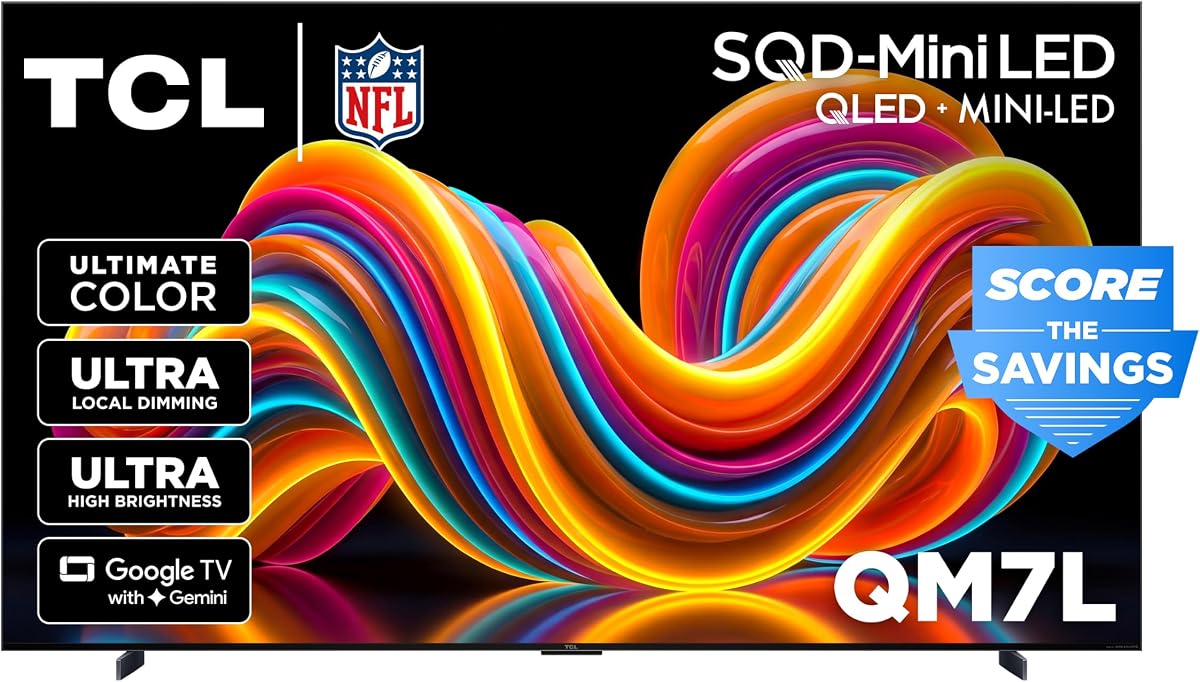
The TCL 98QM7L is a 2026 SQD-Mini LED television that sits below the QM8L in the lineup but introduces several sophisticated large-screen technologies. Its major attraction is the combination of an HVA 2.0 Pro anti-reflective panel, more than 2,100 controlled local-dimming zones, and TCL's fifth-generation Ultra Color Filter. These features target the two central challenges of owning a very large display: reflections that can wash out the image and weak black levels in a dim room.
We may earn a commission when you buy through this link, at no additional cost to you.
The panel's anti-reflective treatment should be particularly useful during daytime viewing or when the screen faces windows and lamps. Its 144Hz native refresh rate and TCL Game Pack support smooth motion, responsive gaming, AMD FreeSync Premium Pro, and variable refresh rates up to 288Hz. The AIPQ Pro processor controls picture clarity, contrast, color, motion, upscaling, and backlight behavior. Complete HDR support gives the set flexibility with Dolby Vision, HDR10+, HDR10, and other advanced formats.
Audio by Bang & Olufsen is a meaningful upgrade over standard television speakers, and the system can be expanded with an optional wireless subwoofer and satellite speakers. Google Gemini adds interactive AI features, while the platform supports voice control for common tasks. The trade-off is the complexity and physical scale of the hardware. Mini LED local dimming requires a large chassis, and an anti-reflective panel still benefits from sensible placement that minimizes direct light sources.
The QM7L is an excellent choice for buyers who want premium-level contrast control and brightness refinement without moving to the QM8L's even more advanced dimming specification. It is particularly appropriate for a dedicated media room with controlled lighting, as well as for viewers who want a genuinely modern 144Hz gaming display.
More than 2,100 precisely controlled dimming zones help the backlight follow dark and bright areas of the frame with finer granularity. The HVA 2.0 Pro panel's anti-reflective surface adds another layer of practical protection against washed-out daytime images.
A 144Hz panel, Game Accelerator 288, Game Bar, and AMD FreeSync Premium Pro create a strong foundation for modern consoles. Bang & Olufsen tuning and support for optional wireless speakers make the set more suitable for movie nights as well as gaming.
We may earn a commission when you buy through this link, at no additional cost to you.
The Samsung U9000H is a 98-inch Crystal UHD television for 2026 that prioritizes smooth gaming, AI-driven picture processing, and a modern smart-TV experience. Its 144Hz performance and variable refresh rate support distinguish it from many conventional 60Hz large-screen LED sets, while the NQ4 AI Gen2 processor handles sharpening, color, motion, sound, and 4K-style upscaling.
We may earn a commission when you buy through this link, at no additional cost to you.
One of the more unusual features is the AI Sound Controller, which can adjust the relative volume of dialogue, music, and sound effects. This is useful for viewers who often struggle to hear speech over a loud soundtrack. AI processing can also transform non-HDR material into an HDR-like presentation, and the processor adds foreground contrast for a more dimensional image. Samsung TV Plus supplies thousands of free streaming options, including hundreds of subscription-free channels.
The central concern is picture hardware rather than software. A standard LED backlight does not provide the numerous local-dimming zones found in the TCL Mini LED models or the Quantum Matrix backlight in Samsung's QN90D. Its listed customer rating is also the lowest among the products in this guide, indicating comparatively mixed customer satisfaction. That does not establish a specific defect, but it is a meaningful signal when other options have stronger rating histories.
The U9000H is best considered by gamers and general viewers who value high refresh rates, useful AI controls, and Samsung's ecosystem at a more modest level than the company's Neo QLED flagship. For dedicated home-theater use, a Mini LED television offers the more substantial contrast improvement. Buyers should compare the U9000H with the TCL Q65 if their budget priorities center on picture fundamentals rather than newer AI tools.
The 144Hz specification and variable refresh rate make this model attractive for fast games and sports. Samsung's gaming features also focus on reducing tearing and stuttering, although the image hardware remains conventional for its size.
The NQ4 AI Gen2 processor applies scene analysis to upscaling, color, contrast, and motion. The separate AI Sound Controller can isolate voices, music, and effects, offering a practical solution for dialogue-heavy content.
We may earn a commission when you buy through this link, at no additional cost to you.
The Hisense 100E6QF is one of the largest televisions in this guide, combining a 100-inch QLED 4K panel with a native 144Hz refresh rate, Dolby Vision IQ, Dolby Atmos, and Fire TV. Its headline appeal is straightforward: it delivers an enormous picture with many of the format and gaming features associated with more expensive premium sets, including HDR10+ Adaptive, HDR10, HLG, and a 48Hz-to-144Hz variable refresh range.
We may earn a commission when you buy through this link, at no additional cost to you.
Hisense's AI Light Sensor adjusts screen brightness according to ambient conditions, which is valuable because a display this large can be overpowering in a dark room. The AI 4K Upscaler and AI Smooth Motion with MEMC focus on improving source quality and action clarity. Filmmaker Mode preserves the original aspect ratio, frame rate, color, and audio settings, making it useful for movies. Game Mode Pro and AMD FreeSync Premium support responsive console and PC gaming, while the voice remote works with Alexa.
The main limitation is that a QLED backlight without Mini LED local dimming will not match the black levels or bright-object separation of the premium Mini LED options. Sound is improved by Dolby Atmos, but a separate sound system remains advisable at this size. The 100-inch panel also has the greatest placement demands in the list, requiring enough distance for comfortable viewing and a furniture plan that can support its weight and footprint.
The E6QF is a fitting recommendation for a dedicated media room or a very open living space where maximum screen size matters more than flagship contrast. It is also a strong choice for gamers who want a native 144Hz panel and Dolby Vision at a size that can create a genuine theater-like presence. Shoppers wanting even deeper blacks should compare it with the TCL QM6K or Samsung QN90D.
At 100 inches, the E6QF can provide a more enveloping image than 98-inch sets, although the difference is easier to appreciate from a suitable viewing distance. Its large canvas makes detailed 4K content, live sports, and cinematic films particularly immersive.
The ambient-light sensor can tune brightness throughout the day, while Filmmaker Mode offers a more direct presentation for movies. Dolby Vision IQ and Dolby Atmos make the television a strong all-in-one entertainment system when a larger external audio setup is unnecessary.
We may earn a commission when you buy through this link, at no additional cost to you.
The LG 98NU850B is a 98-inch Nano AI 4K television built around detailed image processing, convenient gaming controls, and LG's webOS platform. The Alpha 8 processor drives the Nano Detail Enhancer, which analyzes and refines textures, outlines, and color, as well as AI Super Upscaling for HD and standard-definition sources. These features are particularly relevant on a screen where smaller shortcomings remain easy to notice.
We may earn a commission when you buy through this link, at no additional cost to you.
For gaming, the set supports a 144Hz refresh rate, Motion Booster 288, AMD FreeSync Premium, ALLM, the LG Game Dashboard, and Game Optimizer. The latter tools can help users adjust picture settings without navigating deeply into the television's menus. HDR10 Pro dynamically adjusts brightness to reveal detail in bright and dark scenes, and Filmmaker Mode with Ambient Light Technology is designed to preserve the director's intended color, frame rate, and overall presentation.
The smart-TV side is equally important. LG's 2026 webOS is powered by Google Gemini and Microsoft Copilot, while Alexa compatibility provides another voice-control option. LG Channels offers more than 400 free channels along with a large on-demand library. AI Sound Pro and Wow Orchestra are intended to create a more spacious presentation and can work with compatible LG audio equipment for a more complete home-theater setup.
The U9000H is a natural alternative for buyers focused on gaming and AI picture processing, while the Mini LED models are the stronger choices for contrast. The E6QF is a fitting recommendation for a dedicated media room or a very open living space where maximum screen size matters more than flagship contrast. It is also a strong choice for gamers who want a native 144Hz panel and Dolby Vision at a size that can create a genuine theater-like presence. Shoppers wanting even deeper blacks should compare it with the TCL QM6K or Samsung QN90D.
The Alpha 8 processor supports both Nano Detail Enhancement and AI Super Upscaling. On lower-resolution material, these tools can make edges and textures appear cleaner, which is useful when standard broadcasts, older movies, and compressed streaming are part of the viewing mix.
The Game Dashboard and Game Optimizer make critical settings easier to reach, while ALLM can automatically activate the appropriate gaming behavior. A 144Hz panel and Motion Booster 288 provide additional flexibility for supported high-frame-rate content.
We may earn a commission when you buy through this link, at no additional cost to you.
The TCL 98QM6K is a Mini LED QLED 4K television that brings a major picture-hardware upgrade into a more accessible large-screen configuration. QD-Mini LED combines tiny backlight LEDs with quantum-dot color, while the TCL Halo Control System uses local dimming to improve black levels, shadow detail, and picture accuracy. Compared with a conventional QLED set, this is the feature most likely to produce a visible improvement in dark cinematic scenes.
We may earn a commission when you buy through this link, at no additional cost to you.
The display supports Dolby Vision, HDR10+, HDR10, and HLG, covering the major formats used by current streaming services, Blu-ray discs, broadcasts, and games. Its native 144Hz refresh rate and Motion Rate 480 are intended to keep sports and action content smooth. The smart Google TV platform provides familiar navigation, voice control, app support, and a voice remote, while Dolby Atmos with Onkyo audio adds a more dimensional soundtrack than standard television speakers.
The trade-off is that the QM6K sits below the QM7L and QM8L in TCL's more advanced SQD-Mini LED family. It does not claim their larger zone counts, more sophisticated optical systems, or enhanced anti-reflective HVA 2.0 Pro panel. Google TV is also a platform choice: households deeply invested in another ecosystem may find competing smart-TV interfaces more familiar. Neither issue materially reduces the value of the core Mini LED picture design.
The QM6K is a strong recommendation for anyone who understands the importance of local dimming but wants to avoid the complexity and cost of the top-tier 98-inch models. It is particularly good for mixed content, sports, movies, and gaming, and it should serve a bright family room or a controlled media room well.
The local-dimming backlight adjusts brightness in multiple screen zones, giving dark scenes more depth and reducing the gray haze associated with conventional LED televisions. Quantum dots preserve saturated color while the dimming system controls the background around bright objects.
A native 144Hz panel and Motion Rate 480 target fast sports and action. Broad HDR compatibility and Google TV app support make it versatile for everyday viewing, while Onkyo-branded Dolby Atmos provides a convenient built-in audio upgrade.
We may earn a commission when you buy through this link, at no additional cost to you.
The TCL 98QM8L represents one of the most technically ambitious displays in the guide. Its SQD-Mini LED backlight, more than 4,000 discrete dimming zones, up to 6,000-nit peak brightness, and 7000:1 static contrast specification create a strong foundation for premium home-theater performance. The fifth-generation Ultra Color Filter uses 5-nanometer particles rather than the standard 60-nanometer version described for conventional filtering, supporting more precise color reproduction.
We may earn a commission when you buy through this link, at no additional cost to you.
The picture processor applies AI to color, contrast, clarity, motion, upscaling, and sound. A 26-bit dynamic backlight controller and the TCL Halo Control System are designed to reduce blooming and create clean separation around bright objects. The panel also supports advanced HDR formats. For gaming, the 144Hz panel, Game Accelerator 288, Game Bar, and AMD FreeSync Premium Pro provide a strong performance package. Audio by Bang & Olufsen, with optional wireless subwoofer and satellite speakers, makes the set more home-theater oriented than most competitors.
This level of engineering does not eliminate practical trade-offs. The television's large cabinet requires accurate measurement, careful transport, and a furniture plan made before delivery. A very high brightness figure may be less useful in a bright room where reflections can overpower the image, and the elaborate picture processing benefits from careful selection rather than leaving every enhancement active for all source material.
The QM8L is the premium choice for viewers who want the most advanced contrast and brightness behavior in this roundup. It is especially well suited to a dedicated theater, a dark media room, or a high-end living space where the television is the visual centerpiece. If your priority is the deepest blacks, highest brightness, and most precise local dimming, this is the model to put at the top of your shortlist.
The backlight's thousands of independently controlled zones allow bright highlights to sit against deep blacks with less haze than a standard edge-lit LED. This is particularly valuable in dark movies, where accurate shadow detail can make the difference between an immersive image and one that looks flat.
A 7000:1 static contrast specification and up to 6,000-nit peak brightness provide a wide range for HDR highlights. The finer color-filter particles support accurate hue reproduction, while the AI processor adapts picture characteristics to incoming content.
We may earn a commission when you buy through this link, at no additional cost to you.
The Samsung QN98QN90D is a 98-inch Neo QLED Mini LED television and one of the strongest all-around premium options in this guide. Quantum Matrix mini LEDs provide precise backlight control, allowing the display to pair high brightness with much deeper blacks than a standard LED screen. Neo Quantum HDR+ then expands the visible range through contrast, color, and scene-aware detail, while the NQ4 AI Gen2 processor performs 4K upscaling and other enhancements scene by scene.
We may earn a commission when you buy through this link, at no additional cost to you.
The picture processing is designed to create depth as well as sharpness. Real Depth Enhancer Pro identifies a focal point in each frame and adjusts foreground contrast to make the image feel more dimensional. Auto HDR Remastering attempts to give non-HDR material an HDR-like appearance, and the HDR Brightness Optimizer adapts tone mapping to ambient viewing conditions. These tools are useful across streaming, broadcast, gaming, and older source material.
Audio and gaming are equally serious. Built-in Dolby Atmos works with Object Tracking Sound+ to move audio around the screen as on-screen action changes, creating a more convincing three-dimensional presentation. Motion Xcelerator 144Hz supports fast action, while the processor and gaming tools focus on low latency, smooth motion, and tear-free play. Tizen provides a mature smart-TV environment, built-in Alexa, and convenient access to popular streaming services.
The QN90D is a superb choice for a dedicated home theater, a sports-focused family room, or a mixed-use space where both picture quality and sound matter. It is also an excellent console-generation upgrade. Buyers should compare it with the TCL QM8L, whose 4000-plus-zone specification represents a more advanced approach to local dimming, while Samsung offers a more mature overall smart-TV and audio ecosystem. At this performance level, proper setup and room calibration have a major effect on results.
Quantum Matrix mini LEDs illuminate the panel in a controlled manner, enabling bright specular highlights and substantially darker neighboring areas. Neo Quantum HDR+ uses that hardware capability to reveal fine detail across a wider range of luminance than conventional SDR playback.
Dolby Atmos and Object Tracking Sound+ create the impression that sound follows objects and action across the screen. Although it cannot fully replace a calibrated home-theater speaker system, it is one of the more engaging built-in audio implementations in this list.
We may earn a commission when you buy through this link, at no additional cost to you.
Choosing a television this large requires balancing picture technology, room size, sound, gaming needs, installation constraints, and the smart-TV platform. Because a 95-inch class television is physically uncommon, shoppers should also be prepared to consider nearby 98-inch and 100-inch models.
The distance between the television and the primary seats determines whether the large screen feels immersive or overwhelming. A 98-inch or 100-inch panel generally needs a large room and a fairly distant seating arrangement to remain comfortable, while placement too far away can make details and subtitles difficult to read. Measure the wall, furniture, delivery route, and intended viewing seats before ordering because these exceptionally large sets require more planning than ordinary televisions.
Choose the largest practical size, not simply the largest listed size. A slightly smaller model can be easier to install and may deliver a better image if it is viewed from a less extreme distance.
Conventional LED and QLED sets use edge or direct lighting without the granular control of Mini LED. A Mini LED backlight divides the picture into numerous dimming zones, allowing bright elements to appear brighter while adjacent areas remain dark. This produces stronger contrast, deeper blacks, and better separation of subtitles or objects from their backgrounds. The TCL QM8L and QM6K emphasize zone density, while the Samsung QN90D uses Quantum Matrix mini LEDs.
Prioritize Mini LED if movies and dark-room viewing are central to the purchase. A bright QLED set can still look vibrant, but it is less capable of creating cinema-like black levels.
Refresh rate matters most for sports, fast action, and high-frame-rate gaming. A 120Hz panel is a practical all-around target, while 144Hz provides more headroom for recent consoles and compatible PC gaming. Frame insertion, motion enhancement, and variable refresh rate can make movement appear clearer, although they do not all produce the same result. Some advertised gaming rates are achievable only at reduced resolutions or with specific source content.
For most buyers, prioritize a genuine native refresh rate over the largest headline number. Verify which refresh rates are available at 4K and how the television behaves with the console or PC you plan to use.
A television is more useful when it supports the formats found across major streaming platforms, physical media, broadcasts, and games. Dolby Vision, HDR10+, HDR10, and HLG provide a flexible foundation, while excellent upscaling can improve older and lower-resolution material. AI processors can refine sharpness, noise, color, contrast, and motion, but accurate source processing remains important. Filmmaker Mode offers a more direct presentation for viewers who want to preserve a film director's intended look.
Check broad format support first, then assess local-dimming hardware and brightness. Processing cannot fully replace the contrast capability produced by a well-engineered Mini LED backlight.
The smart-TV system determines how easily you can find streaming apps, live channels, recordings, and connected devices. Samsung uses Tizen, LG uses webOS, and the featured TCL and Hisense models use Google TV or Fire TV. Consider the interface you find easiest to navigate, the services you use, and whether you prefer Google Assistant, Alexa, Samsung's ecosystem, or another voice assistant. Free ad-supported channels can provide useful content without additional subscriptions.
Choose a platform that feels familiar and supports your preferred apps. The operating system also affects gaming hubs, voice search, Bluetooth peripherals, and how the television works with other smart-home equipment.
Gaming performance involves more than refresh rate. Variable refresh rate, automatic low-latency mode, input-lag handling, HDR gaming, and accessible game settings all contribute to responsiveness. The TCL Game Pack, LG Game Dashboard and Game Optimizer, Samsung Gaming Hub, Hisense Game Mode Pro, and the Auto Game Mode found in this roundup each provide different ways to manage those features.
Check HDMI input specifications, ALLM support, VRR ranges, and the resolution available at each refresh rate. A simple Auto mode may be sufficient for casual play, while competitive gamers should understand the television's menu controls and supported signal combinations.
Television speakers become harder to hear as viewing distance increases, and an 98-inch or 100-inch display is usually watched from across a room. Dolby Atmos, Object Tracking Sound+, Bang & Olufsen tuning, Onkyo audio, and built-in subwoofers can improve the out-of-box experience. For a dedicated media room, however, a soundbar or a surround system with a subwoofer will usually deliver greater impact and clearer dialogue. Compatibility with wireless rear speakers or a separate subwoofer may be worth checking before purchase.
Treat built-in audio as a convenience rather than the final home-theater solution. If cinematic sound is a major priority, budget for external speakers and use the television's object-tracking or room-calibration features when compatible.
Large televisions are difficult to move after delivery. Confirm the manufacturer's wall-mount pattern, weight capacity of any mounting hardware, room for cables, and whether the pedestal is included. Some models support wall mounting more readily than others, while manufacturers may impose size-based mounting or transport conditions. Review the warranty, return window, and local delivery terms before purchase, and keep the original packaging in case the set must be serviced.
Measure twice and follow the manual. A wall mount, narrow console, or narrow entryway that was not considered beforehand can turn an exciting television purchase into a major installation problem.
Begin by choosing Picture Mode according to the room rather than automatically leaving the television in its brightest retail setting. Filmmaker Mode or a calibrated custom mode can provide accurate color for movies, while a brighter mode may work better in a daylight-filled family room. Allow the screen several hours to stabilize before making fine adjustments, and use the included AI light sensor or automatic brightness feature if the room lighting changes throughout the day.
Connect the television before securing it to a wall or placing it on a narrow stand. Update the smart-TV software, sign into the streaming accounts you use, connect external speakers, and test each HDMI input with the intended console or source. If using variable refresh rate or high frame rates, enable the relevant television and console settings and confirm that the expected mode is active.
Treat the large panel with appropriate care. Use a soft microfiber cloth lightly dampened with water, avoid spraying cleaner directly onto the screen, and do not press hard on the surface. Keep vents unobstructed, remove excessive dust from the rear housing, and follow the manual for cleaning the anti-reflective panel. For long periods of inactivity, it is also sensible to disconnect unnecessary accessories and use the appropriate power-saving mode.
A precisely sized 95-inch smart TV is uncommon in the current market, so many shoppers use that search term to identify televisions in the near-95-inch category. The products reviewed here are 98 or 100 inches. If exact dimensions are essential, compare each model's listed screen size and cabinet dimensions before ordering.
Mini LED generally delivers deeper blacks, better shadow detail, and stronger separation around bright objects because its backlight can be dimmed in numerous local zones. QLED remains a strong option for bright rooms, colorful sports, and value-conscious buyers who want excellent quantum-dot color without the more advanced backlight. Your viewing environment and movie habits should guide the decision.
A 120Hz television is already highly capable for many console games, while 144Hz offers additional smoothness with supported consoles and PCs. The better option also depends on input lag, variable refresh rate support, and whether 4K is available at the advertised rate. Check the model's detailed input specifications rather than relying on the largest advertised gaming figure.
A soundbar is strongly recommended in most large living rooms because the built-in speakers are farther from viewers than on a typical television. Some sets include Dolby Atmos, object tracking, or a subwoofer, but these features do not reproduce the channel separation and bass of a dedicated home-theater system. Your room size, seating distance, and content preferences should determine how much audio equipment is worthwhile.
The ideal distance depends on resolution, content, and personal preference, but a near-98-inch display generally needs to be viewed from substantially farther away than a 55-inch television. Many people begin with a viewing distance around 10 to 13 feet and adjust from there. The best way to decide is to compare the physical screen size with a familiar television at the same viewing distance.
Many large smart TVs can be wall mounted, but the exact model, mounting pattern, weight, and manufacturer instructions must be checked. The included pedestal may not be universal across every installation method. Use compatible mounting hardware, have the screen handled by appropriate support staff, and verify all wall and electrical requirements before delivery.
The best platform is the one that supports your preferred streaming accounts, feels intuitive to navigate, and integrates with the voice assistant and smart-home products you already use. Google TV, Fire TV, Tizen, and webOS all provide major streaming apps and free channels. Consider app availability, update speed, gaming menus, and accessibility features as well as interface appearance.
A 4K panel provides enough resolution for most 98-inch viewing situations when content is viewed from an appropriate distance. Picture quality also depends on upscaling, contrast, brightness, color, and local dimming. A strong processor can improve lower-resolution material, but high-quality native 4K streaming and source content will generally look sharper and more detailed.
The Samsung Neo QLED QN90D is the strongest all-around recommendation, combining a Quantum Matrix Mini LED backlight, Neo Quantum HDR+, 144Hz motion, Dolby Atmos, and a mature Tizen platform. The TCL Q65 QLED is the value pick for shoppers seeking broad HDR and gaming support at a more modest level, while the TCL QM8L is the premium choice for extreme brightness and precise local dimming.
Before ordering, prioritize the features that match your room and habits. Dark-room movie viewers should emphasize local dimming and peak brightness, gamers should confirm native refresh rate and input specifications, and bright-room users should consider anti-reflective treatment and strong color. Large screens also demand careful attention to viewing distance, wall or furniture support, delivery access, and external audio.
Pricing, retailer availability, bundles, and promotions can change at any time, so compare the current product page before buying. Also verify the model's physical dimensions and installation requirements, because 98-inch and 100-inch sets are much less forgiving than conventional televisions. With those checks completed, one of these models can provide a compelling large-screen home-entertainment experience.


