
SEESII 30MHz DDS
5.0Editor score
Independent dual channels
14-bit high-resolution output
Seven integrated instrument modes
Our Amfm Signal Generator guide compares ten options for frequency, modulation, output control, portability, display, and use in electronics work and labs.
An Amfm Signal Generator produces controlled test signals for troubleshooting radios, amplifiers, receivers, sensors, PLC systems, and other electronic circuits. A useful model must offer accurate frequency control, suitable output levels, dependable modulation, and an interface that remains understandable whether the instrument is used on a bench or in the field.
This guide compares ten signal generators based on the specifications and features listed in their product information. The list covers handheld RF sources, dual-channel arbitrary waveform generators, industrial current and voltage simulators, and compact units designed for radio testing, education, maintenance, and electronic development.
Each review highlights the capabilities that distinguish its model, along with practical trade-offs and the situations in which it makes the most sense. Ratings and availability can change over time, and current prices vary between sellers, so readers should confirm the latest listing information before purchasing.
5.0Editor score

5.0Editor score

4.6Editor score
The table below compares all ten products by output type, frequency or signal range, modulation and control features, and practical form factor.




The UNI-T UTG962E is a compact, two-channel arbitrary waveform generator with a listed 5.0 rating and a 60MHz maximum output frequency. It combines a 200MSa/s sample rate, 4Kpts of waveform memory, and support for sine, square, ramp, pulse, noise, DC, and arbitrary waveforms, making it one of the most versatile instruments in this guide.
We may earn a commission when you buy through this link, at no additional cost to you.
Its strongest quality is the combination of dual-channel output and flexible modulation. Each channel can carry the listed standard or stored waveform, while AM, FM, PM, and FSK cover many radio and circuit-testing scenarios. Linear and logarithmic scanning add value when examining systems across a range of frequencies, and 24 non-volatile waveform slots help preserve custom test signals.
The trade-offs are modest. This is a feature-rich instrument rather than the simplest possible model, so beginners may need time to understand the controls and menu structure. The supplied information does not identify the display size or output amplitude, meaning buyers who need those exact details should verify them in the current manual or listing. Its palm-sized enclosure, however, clearly favors portability.
This is the strongest all-around recommendation for a buyer who wants real RF bandwidth, two channels, several modulation formats, and arbitrary waveform support without choosing a large bench instrument. Electronics enthusiasts, educators, and technicians working across multiple signal types can get more flexibility from the UTG962E than from a narrow-band or single-purpose source.
Two channels let users compare signals, create differential tests, or monitor more than one point in a circuit. Independent modulation and waveform choices make the instrument useful beyond ordinary single-tone troubleshooting.
The 60MHz ceiling and 1μHz resolution offer a broad operating envelope for radio-frequency experiments, component testing, education, and general electronics work.
We may earn a commission when you buy through this link, at no additional cost to you.
The OWON DGE2035 is a dual-channel, 35MHz function and arbitrary waveform generator with a 4.2 rating. Its 125MSa/s sampling rate, 14-bit resolution, and support for waveforms up to 8K points position it as a capable general-purpose bench instrument for education, research, and electronics testing.
We may earn a commission when you buy through this link, at no additional cost to you.
The model includes five standard waveforms and 150 built-in arbitrary waveforms. AM, FM, PM, and FSK modulation are supported alongside sweep, burst, and 16 non-volatile waveform storage locations. A 3.6-inch color TFT display presents real-time waveform status and menu settings, while shortcut keys and an ultra-thin design help make the instrument manageable on a crowded bench.
Its main limitation is its 35MHz maximum output, which is lower than the UNI-T UTG962E and SEESII DDS models. The 4.2 rating is respectable but not among the strongest in this list, and buyers who require extensive custom waveform memory or wider bandwidth may prefer a different option. USB remote control is a meaningful advantage for automated or semi-automated testing.
The DGE2035 is an excellent match for students, educators, lab technicians, and engineers who want many waveform choices, a clear display, and PC connectivity. It provides a particularly balanced combination of portability, waveform variety, modulation, and familiar instrument controls.
With 150 preset arbitrary waveforms alongside standard sine, square, pulse, ramp, and noise outputs, the generator gives users a quick starting point for many laboratory and classroom experiments.
USB control allows the instrument to fit into PC-assisted testing setups. This is useful when repeated adjustments, measurement sequences, or documentation are more convenient from a computer.
We may earn a commission when you buy through this link, at no additional cost to you.
The six-band signal generator covers 100kHz to 150MHz and is aimed specifically at radio testing, laboratory work, and electronic equipment maintenance. No customer rating is provided in the supplied listing, so its 5.0 numerical value is shown as 0.0 rather than assigning a rating that has not been established.
We may earn a commission when you buy through this link, at no additional cost to you.
Its defining attraction is straightforward RF operation across six frequency ranges. The device supports AM and FM modulation, uses a clear knob-and-button layout, and is described as producing a low phase noise signal. That combination is practical for technicians who need a dependable source while aligning, testing, or troubleshooting radio equipment.
The instrument is less elaborate than the dual-channel waveform generators. Only AM and FM are specifically listed, and there is no stated arbitrary waveform library, memory depth, or remote-control function. A potentially difficult-to-read specification also notes that the sine output can include some noise, so users who require laboratory-grade spectral purity should verify expectations before buying.
For radio repair benches, training labs, and basic RF troubleshooting, this model is a focused and understandable tool. Its broad range, straightforward operation, and sturdy construction make it more appealing than a general-purpose simulator for users whose work is specifically centered on radio-frequency sources.
The reasonably arranged front panel, clearly marked controls, and accessible knob make this source approachable for technicians who want direct adjustment without navigating a complex waveform editor.
The metal and plastic-sprayed housing is described as scratch-resistant, impact-resistant, and resistant to corrosion and deformation, making it suitable for repeated workshop use.
We may earn a commission when you buy through this link, at no additional cost to you.
The SG-A9 reaches from 35MHz to 4400MHz, giving it the highest upper frequency limit among the products in this comparison. Its 3.7 rating reflects a narrower feature set than many alternatives, but the wide tuning range makes it distinctive for radio testing, scanning, and service work involving higher-frequency sources.
We may earn a commission when you buy through this link, at no additional cost to you.
The source offers single-frequency and sweep modes, which allows users to test either a selected frequency or move across a range. It also retains its parameters when powered down and returns to the previous frequency at startup. Power can come from a mobile charger, power bank, or USB connection to a computer, adding flexibility where a dedicated outlet is unavailable.
The listing specifies a sine wave with some noise and output power of approximately 1mW. That noise detail and the modest rating are important considerations for precision RF work. There is also no mention of AM, FM, arbitrary waveforms, dual channels, calibrated amplitude controls, or computer control, so the instrument is best understood as a focused high-frequency source rather than a full laboratory generator.
The SG-A9 is most appropriate for technicians and hobbyists who specifically need coverage into the gigahertz range and value sweep operation, memory, and USB-powered portability. It is less suitable for users seeking clean, programmable, modulated waveforms or precise general-purpose bench testing.
The 35MHz to 4400MHz span covers substantially higher frequencies than the other RF sources here, making the SG-A9 relevant to wideband radio experiments and component inspection.
Power-off parameter retention reduces repeated setup, while operation from a USB charger or power bank allows the source to be used at temporary workstations.
We may earn a commission when you buy through this link, at no additional cost to you.
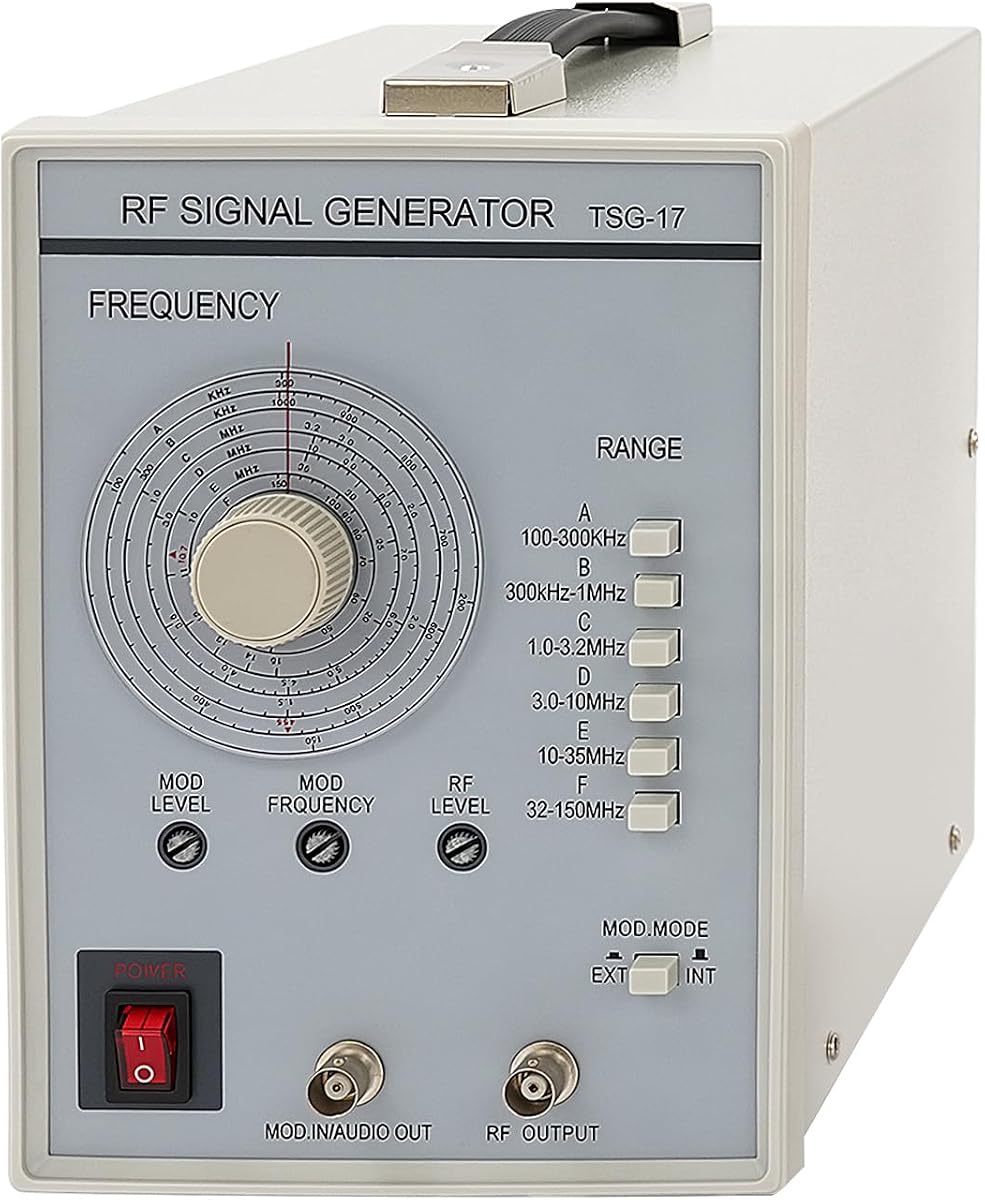
The TSG-17 is a mains-powered RF and AM signal source covering 100kHz to 150MHz, with a stated third harmonic extending to 450MHz. Its 2.5 rating is the lowest among the listed products, so buyers should weigh its specialized AM and external-modulation capabilities carefully against the stronger general-purpose alternatives.
We may earn a commission when you buy through this link, at no additional cost to you.
The output section provides sine and amplitude-modulated waves, while the external modulation input accepts signals from 50Hz to 20kHz. Output control is stated as 1mV to 100m, although the unit and notation are not completely clear in the supplied information. The listed RF output reaches at least 100mV RMS when unloaded up to 35MHz.
The model is limited by its narrow waveform selection and comparatively low rating. There is no listed arbitrary waveform support, display specification, sweep function, channel control, or computer interface. Its strengths are concentrated in AM radio testing and applications where an external modulation source is useful.
The TSG-17 makes the most sense for a dedicated AM-oriented repair or experimentation setup that does not need advanced arbitrary waveforms or modern PC connectivity. For broader work, an instrument with a clearer display, stronger feature set, and better customer feedback is usually the safer purchase.
Amplitude modulation is the defining output mode, and the external modulation input gives users a way to vary the modulating signal beyond the unit's own controls.
The listed third-harmonic capability extends the usable range to 450MHz, although the base signal range remains 100kHz to 150MHz.
We may earn a commission when you buy through this link, at no additional cost to you.
The Adjustable Signal Generator 4-20mA 0-12V is a compact process and function generator designed around current, voltage, and PWM outputs. Its 4.1 rating places it among the stronger entries in the industrial-simulation portion of this guide, although it serves a very different purpose from the RF waveform instruments.
We may earn a commission when you buy through this link, at no additional cost to you.
Current output is adjustable from 0 to 24mA, with a factory default of 4-20mA, while voltage output spans plus or minus 12V and defaults to 0-10V. The stated post-calibration accuracies are 0.05mA and 0.03V. PWM output covers 1-150kHz with a 0-100% duty-cycle range, although the listing notes that its fixed 5V high level is not appropriate for every 12V or 2V system.
The 1500mAh battery generally needs more than six hours to charge and provides approximately one to five hours of use depending on output load. That variable runtime is a limitation for prolonged field work. The unit does, however, include short-circuit protection, reverse-connection protection, charging protection, and power-off value storage.
This model is a good choice for technicians who need to simulate current-loop or voltage inputs without carrying a full bench generator. It is especially relevant to PLC, sensor, and actuator commissioning where PWM testing is also useful. Users should verify the intended system voltage before using the PWM output.
Combining current, voltage, and PWM in one enclosure reduces the number of separate tools required for common industrial and electronics testing tasks.
Short-circuit, reverse-connection, and charging protection make the unit more practical around field-wired equipment, where accidental contact with live connections is possible.
We may earn a commission when you buy through this link, at no additional cost to you.
The Riiai 0-10V 0/4-20mA is a compact analog signal simulator with a 4.6 rating, making it one of the best-regarded products in this guide. It generates adjustable voltage and current rather than RF waveforms, but that makes it directly useful for PLC panels, sensors, flow valves, inverters, servo controls, dimmers, and other industrial inputs.
We may earn a commission when you buy through this link, at no additional cost to you.
Its voltage output extends from minus 10V to plus 10V at 0.01V precision, while current output extends from 0 to 22mA at 0.01mA precision. An encoder knob provides direct adjustment, and the four-digit display can switch among voltage, current, percentage, and 0-50Hz views. Nine fast output points allow frequently used values to be recalled quickly.
The product includes a built-in 1000mAh rechargeable battery, with charging through micro USB and operation alternatively possible through 5V micro USB or a 15-30V external DC supply. Output ranges can be programmed and calibrated, while short-circuit and power-supply reverse-connection protection improve safety. The four-digit screen is practical without being as elaborate as a color touchscreen.
This is the best budget option for a technician or learner who needs an affordable current and voltage source for process-control troubleshooting. It cannot replace an RF or arbitrary waveform generator, but for its intended simulator role it offers excellent portability, useful programmability, and one of the strongest customer ratings in the list.
Users can switch between voltage and current modes and adjust the value with one encoder, simplifying repeated checks of 4-20mA inputs and 0-10V control signals.
Nine fast output points are helpful when a test requires returning to several common signal values, reducing repetitive manual adjustment during a diagnostic sequence.
We may earn a commission when you buy through this link, at no additional cost to you.
The Riiai SG003A is a feature-rich analog signal simulator with a 4.4 rating. It is designed for PLC testing and can output current, voltage, passive current, and frequency signals, with a 2.4-inch 240 by 320 color TFT display that provides visual feedback and an adjustable-button backlight.
We may earn a commission when you buy through this link, at no additional cost to you.
Current and voltage modes each cover 0 to 24 units at 0.01-unit precision, while frequency output extends to 9999Hz with five-digit precision. The conversion interface supports voltage-to-active-current, voltage-to-passive-current, and current-to-voltage transformations. Automatic modes can create a single rise, a single fall, or a repeating cycle, and PWM output allows voltage, frequency, and duty-cycle adjustment.
The 3000mAh battery is one of the strongest in this guide and charges over approximately four to six hours, with stated working time of up to 26 hours. The product is still not a full RF generator, and no PC interface is stated. Its many modes may also take time for a new user to learn, but they make the device well suited to recurring industrial diagnostics.
The SG003A is a strong choice for maintenance personnel and engineers who regularly test PLC analog inputs, current loops, voltage inputs, and automated systems. Compared with simpler potentiometer simulators, it provides clearer visualization, flexible signal types, programmable patterns, and a larger battery.
The conversion modes let one source emulate several physical signal types, reducing the need to carry separate tools when troubleshooting mixed PLC and instrumentation setups.
A 3000mAh battery and stated working duration of up to 26 hours support extended commissioning sessions and service calls away from a convenient power outlet.
We may earn a commission when you buy through this link, at no additional cost to you.
The DROK 4-20mA Generator is a straightforward dual-signal simulator with a 4.3 rating. It provides 0 or 4-20mA current output and 0-10V voltage output from one module, using a multi-turn precision potentiometer to adjust the selected value.
We may earn a commission when you buy through this link, at no additional cost to you.
The device targets a narrow but common need: injecting an adjustable analog signal into PLC panels, LEDs, current inputs, or other equipment. Combining current and voltage in one enclosure is convenient because the same tool can cover two common industrial signal standards without separate modules.
The supplied information does not mention a display, battery, power options, programming, waveform generation, or remote control. That minimalist specification makes the tool easier to understand but prevents comparison with advanced models on sophisticated features. Users needing repeatable presets or automatic ramps should look to the Riiai simulators instead.
The DROK is best for quick manual testing, education, and bench work where a direct analog adjustment is all that is required. Its 4.3 rating suggests a generally satisfactory tool, while the simple controls make it approachable for users who do not need a large feature set.
A dedicated multi-turn potentiometer offers direct control without navigating software, making the simulator effective for quick injection and adjustment.
The 0/4-20mA and 0-10V formats match widely used PLC and control-system inputs, allowing technicians to work with familiar process signals.
We may earn a commission when you buy through this link, at no additional cost to you.
The SEESII Dual Channel 30MHz DDS is a multifunction signal generator with a 5.0 rating. It combines two equal-performance channels, a 266MSa/s sample rate, 14-bit resolution, and frequency coverage from 0.01μHz to 30MHz, making it one of the most technically substantial products in this comparison.
We may earn a commission when you buy through this link, at no additional cost to you.
Both channels can produce the same or different waveforms, and their phase difference can be adjusted continuously from 0 to 359.9 degrees. This supports synchronized, differential, and phase-sensitive testing. Standard sine, square, triangle, and adjustable pulse signals are complemented by 60 preset arbitrary waveforms, while precise pulse-cycle and pulse-width adjustment improves timing simulation.
The instrument combines seven functions: function generator, arbitrary waveform generator, pulse generator, noise generator, frequency meter, counter, and sweeper. A 2.4-inch TFT LCD shows real-time waveforms and parameters. Its 30MHz ceiling is lower than the 60MHz UNI-T model, and its 60 built-in arbitrary waveforms are fewer than the OWON's 150, but the phase control and multi-instrument design distinguish it.
The SEESII is a premium-style choice for engineering research, factory inspection, university teaching, electronic competitions, and detailed circuit development. The package includes two red-and-black alligator clip cables, a Q9-to-Q9 test cable, a USB cable, a power adapter, and a manual for a ready-to-use setup.
Continuous phase adjustment from 0 to 359.9 degrees enables paired-channel tests that a basic single-output generator cannot perform.
Combining generation, pulse, noise, measurement, counting, and sweeping functions can streamline lab work and reduce the number of separate bench instruments.
We may earn a commission when you buy through this link, at no additional cost to you.
The right signal generator depends on the signals your equipment expects, the frequency range you need, the precision of your measurements, and how often you will use the instrument away from a bench.
AM and FM signal generators are useful for radio-frequency testing, but many modern troubleshooting tasks involve current-loop, voltage, pulse, or arbitrary waveforms instead. An RF-focused source should be chosen for radio receivers, transmitters, filters, and RF amplifiers, while a process simulator is better for PLC inputs, sensors, valves, inverters, and industrial control loops. A general waveform generator is the safest choice when the test bench must cover both standard and user-created shapes.
The maximum output frequency must exceed the frequency of the circuit under test. A 30MHz or 35MHz model suits many audio, low-RF, and general electronics applications, while a 150MHz unit reaches further into the radio spectrum. The SG-A9 extends to 4400MHz, which is useful for higher-frequency radio work but does not make it a better choice for precise waveform experiments. Check both the upper limit and the resolution at low frequencies if your application depends on fine tuning.
AM, FM, PM, and FSK cover different modulation needs. AM and FM are central to conventional radio work, PM appears in communications and signal-processing tests, and FSK is useful for digital and data-link experiments. Some inexpensive RF sources provide only AM and FM, while waveform generators commonly support all four. If the device under test receives a modulated signal, choosing a model with the exact required mode avoids a later replacement.
Dual-channel models can output the same signal, two different signals, or signals with an adjustable phase relationship. This is valuable for differential amplifier testing, amplifier input-versus-output comparison, and phase-sensitive measurement. The UNI-T and SEESII offer equal or clearly specified independent channels, while the OWON also supports two outputs. A single-channel instrument is simpler and may be sufficient for basic troubleshooting.
Sample rate, vertical resolution, frequency accuracy, amplitude stability, and phase noise determine how faithfully a source represents the intended signal. The UNI-T offers 200MSa/s and 4Kpts of memory, the OWON provides 125MSa/s and 14-bit resolution, and the SEESII combines 266MSa/s with 14-bit resolution. For process simulators, compare current and voltage precision instead, including the stated calibration accuracy and usable range.
Standard sine, square, ramp, pulse, noise, and DC outputs solve many routine tests. Arbitrary waveform support expands that range to simulated sensor patterns, custom communications signals, and other complex shapes. Stored waveform memory is useful when a signal must be reproduced consistently. The OWON provides 150 built-in arbitrary waveforms and 16 storage locations, while the SEESII provides 60 presets and the UNI-T stores up to 24 custom arbitrary waveforms.
A bench instrument can be more convenient when it is always connected to mains power, but field service benefits from a rechargeable battery, compact enclosure, and flexible charging options. The Riiai and adjustable process generators use internal batteries, and the SG-A9 can run from a power bank or computer USB port. Consider battery capacity, stated operating time, charging time, included leads, and whether the unit is easy to hold or transport.
A clear display makes it easier to recognize the selected frequency, waveform, modulation, amplitude, and other settings. The OWON's 3.6-inch color TFT screen, the SEESII's 2.4-inch TFT display, and the Riiai SG003A's 240 by 320 color screen offer visual status information. Smaller or unspecified displays may be adequate for simple potentiometer-based simulators but less convenient for complex waveform navigation and multi-parameter control.
Begin by identifying the signal your circuit requires, including waveform, frequency, amplitude, modulation, and output impedance. Connect the generator to the circuit with the correct cable or probe, keep the output terminated as required by the test setup, and begin with a conservative output level. Confirm all connections before applying a modulated or sweeping signal, especially when testing sensitive receivers or input stages.
For a typical troubleshooting session, select the required waveform, set the frequency, adjust the amplitude while observing the circuit response, and then add the relevant modulation mode. Use scan, sweep, ramp, or pulse functions only after the basic test is stable. For PLC simulators, verify that current-loop polarity, voltage range, and common wiring match the equipment before connecting the output.
Care for the generator by storing it in a dry environment, avoiding exposed liquids and excessive heat, and inspecting test leads for damaged insulation. Recharge process simulators before long field sessions, use the specified charging method, and do not treat a PWM output as suitable for every voltage system. Periodic calibration and confirmation of output readings help maintain confidence in future measurements.
An AM/FM signal generator produces controlled amplitude- or frequency-modulated RF signals for testing radio receivers, transmitters, amplifiers, filters, communications modules, and related circuits. It allows a technician to inject a known signal instead of relying on an external transmitter. Models with PM and FSK support can also cover more specialized communication and control tests.
No. A higher ceiling matters only when the circuit under test operates at that frequency. For lower-frequency electronics, an RF source with excessive range may lack the waveform, resolution, display, or modulation features needed for the work. The SG-A9 reaches 4400MHz, while the UNI-T reaches 60MHz and offers broader waveform flexibility for general signal generation.
An RF generator creates radio-frequency waveforms for radio and communications testing. A process signal simulator creates adjustable voltage or current outputs used to imitate industrial sensors and PLC inputs. The SEESII and similar instruments are general waveform sources, whereas the Riiai and DROK models are process simulators for current-loop and control-system work.
Dual channels are valuable when testing two circuits simultaneously, comparing a source and response, or creating a phase-shifted pair. The UNI-T, OWON, and SEESII support two outputs, and the SEESII provides especially detailed phase adjustment. For a single amplifier or sensor test, one channel may be enough and can make the setup less complicated.
Arbitrary waveform output allows the generator to create waveforms beyond the standard sine, square, pulse, ramp, noise, and DC shapes. Such signals can simulate real sensor behavior, communications patterns, or custom timing conditions. Built-in waveform libraries and non-volatile memory make common patterns easy to recall, while custom editing offers greater control for advanced testing.
Yes, when its current output and wiring configuration match the PLC input. A generator such as the Riiai model can simulate 0/4-20mA and adjustable voltage signals for checking analog inputs, scaling, alarms, and control responses. Confirm the input range, loop power, polarity, and grounding arrangement before connecting the simulator.
Phase noise describes unwanted variations in the timing of a signal and can spread energy around the intended carrier. A source with lower phase noise is generally easier to distinguish from adjacent channels and more suitable for sensitive receiver or filter measurements. It may not materially affect a basic low-level troubleshooting task, but it can influence the outcome of precise RF work.
Look for battery capacity, realistic operating time, charging time, enclosure size, included cables, and the controls you will actually use while working. The process simulators in this guide emphasize rechargeable operation, while the UNI-T combines portability with a wide RF feature set. The best portable unit is the one that covers your test signal comfortably in a durable, understandable package.
The UNI-T UTG962E is the strongest overall choice because it combines 60MHz bandwidth, two channels, four modulation types, multiple waveforms, scan functions, and portable construction. The SEESII 30MHz DDS stands out for independent phase-controlled channels and seven integrated instrument functions, while the Riiai 0-10V 0/4-20mA offers the most approachable way to simulate common industrial process signals.
Prioritize the output that your equipment actually needs. Choose an RF source for radio-frequency work, a dual-channel waveform generator for comparison and phase testing, a process simulator for PLC and sensor loops, and a high-bandwidth model only when the circuit operates at those frequencies. Waveform quality, modulation, memory, display, power, and included accessories should be weighed together rather than independently.
Customer ratings, seller availability, and prices can change, so readers should check the current product listing and confirm required specifications before ordering. Comparing the final cost with the signal range, control features, accessories, and intended workload will help identify the most suitable instrument for the actual test bench.
