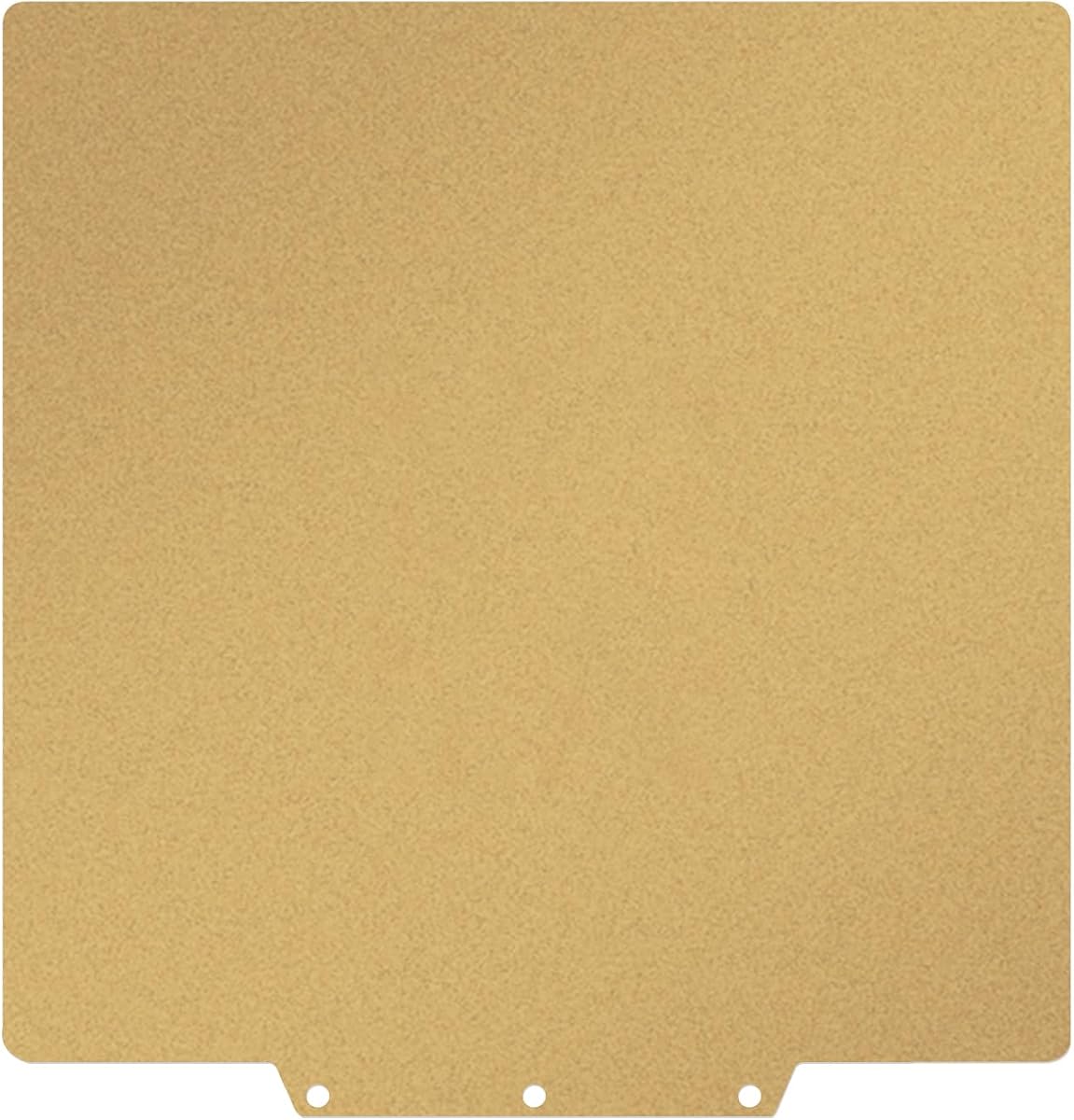
Gold PEI Build Plate 235x235mm
4.7Editor score
Double-sided frosted PEI
Flexible spring steel core
Wide 235 mm compatibility
This guide compares the best build plate for 3D printer options by adhesion, material compatibility, heat resistance, flexibility, and printer fit.
A build plate for 3D printer directly influences first-layer adhesion, surface texture, model removal, and the repeatability of every print. A strong plate should grip the first layer without damaging delicate finishes, tolerate the temperatures required by your filament, and fit your machine without compromising leveling or bed detection.
We compared ten plates using the information supplied for each product, focusing on printer compatibility, surface construction, supported materials, temperature claims, magnetic or spring-steel design, and maintenance requirements. The list includes dedicated Bambu Lab plates, universal 235 mm options, textured PEI designs, and flexible removable surfaces.
Each review explains where that plate stands out, while also noting setup restrictions, identification-code issues, and material-specific cautions. Ratings and availability can change over time, and prices fluctuate, so readers should confirm the current listing, printer dimensions, and required bed type before ordering.
4.7Editor score

4.4Editor score

4.5Editor score
The comparison below organizes all ten plates by construction, fit, surface characteristics, and practical advantages, making it easier to identify the right option for a particular printer and filament mix.




The BIQU CryoGrip Pro Glacier 257x257mm combines a seven-layer cobalt oxide surface with a removable platform format and broad support for current Bambu Lab machines. Its 4.4 rating reflects a well-rounded design for users who want dependable first layers, a refined underside texture, and a safer way to exchange plates. It is particularly attractive for owners of the P1S, P1P, P2S, X1C, X1E, X2D, and A1.
We may earn a commission when you buy through this link, at no additional cost to you.
The coating stack includes a base plate, base coat, intermediate coating, and top coat, creating a delicate texture that can make the bottom of a print look smoother. A strongly magnetic substrate helps keep the first layer attached and limits stress-related warping. The hollow handle remains cooler than the exposed bed area, and the product description states that it can be handled when the bed reaches 100°C.
There are two important qualifications. Glacier adhesion with PLA and PETG is described as weaker than the CryoGrip Pro Frostbite surface, so users seeking the maximum grip in those materials may need to optimize their settings. P2S owners must close the build-plate printing detection when using this plate. These are model-specific configuration issues rather than general installation failures.
This is a strong choice for Bambu Lab users who print a mixture of PLA, PETG, ABS, PA, and other filaments and value rapid plate changes. The low-heat handle, magnetic retention, detailed texture, and extensive printer coverage outweigh the small learning curve. Verify the bed size, select the correct surface in the slicer, and clean the plate before starting.
The high-magnetic substrate is designed to keep the first layer fixed against the print area. That stability is especially useful for larger flat parts, where edge movement can turn a successful print into a warped or detached failure.
The hollow handle is intended to remain comfortable to touch even when the bed is hot. That allows a finished plate to be removed and replaced more quickly, although the plate itself should still be handled carefully.
We may earn a commission when you buy through this link, at no additional cost to you.
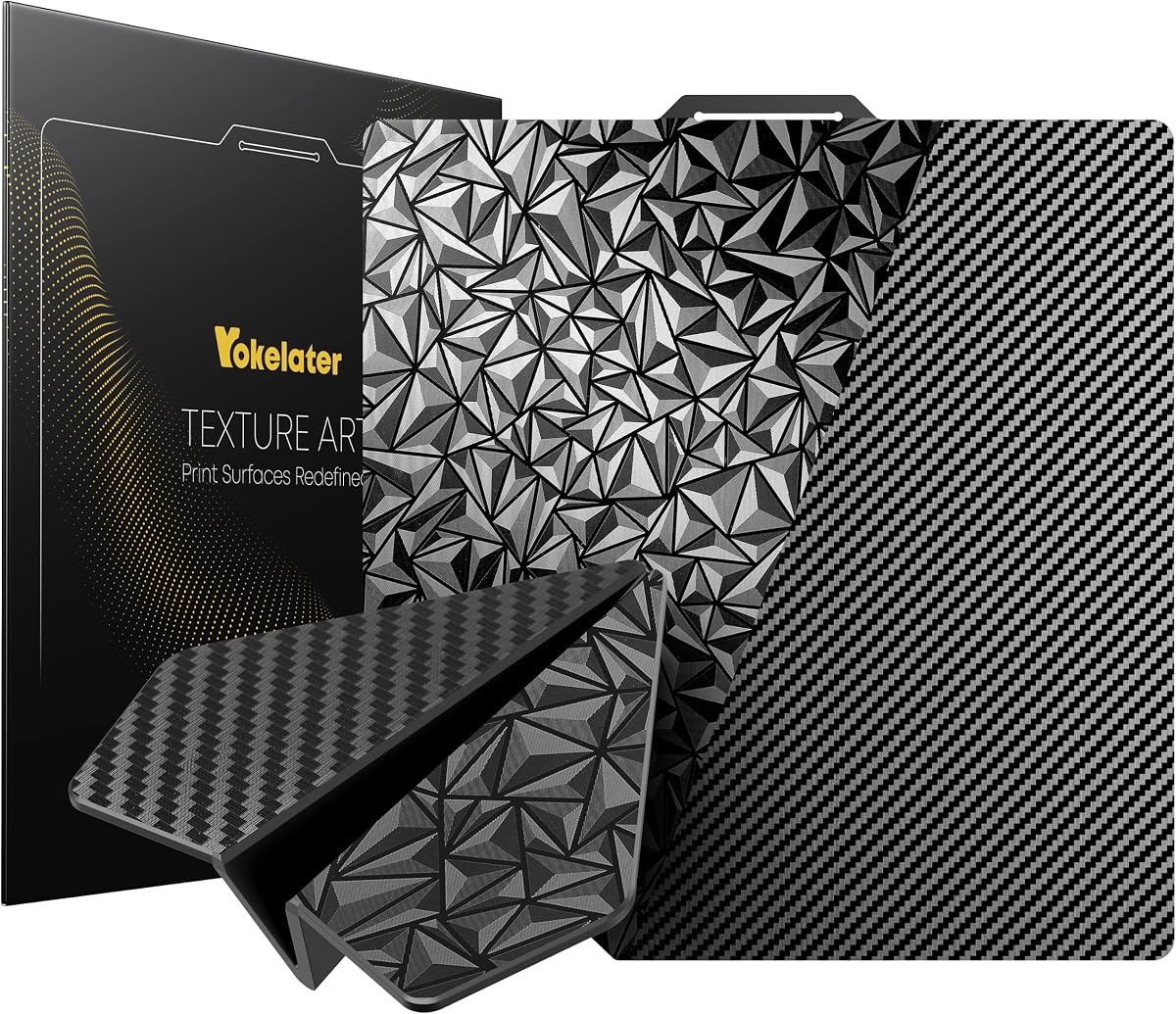
The Sahvaim PEO PET plate offers two visually distinct sides: a diamond-patterned PEO surface and a carbon-fiber-style PET surface. It is designed for 257x257mm Bambu Lab platforms, including the X2D, P2S, P1S, P1P, A1, X1C, X1, and X1E. The plate has a 4.5 rating and stands out for users who want more than one aesthetic option in a single build plate.
We may earn a commission when you buy through this link, at no additional cost to you.
The diamond texture has a smooth, matte appearance that pairs effectively with silk and other glossy filaments. The carbon-fiber-style side has a subtler pattern and can produce an attractive finish with charcoal-gray filament. Because each side is optimized for a different visual result, the plate is useful for display pieces, color-matched parts, and general workshop production.
The surface resists temperatures up to 150°C, making it suitable for PLA, PETG, and TPU when appropriate bed temperatures are selected. The spring-steel construction provides flexibility for model removal, but the plate should be cooled first. A damp wipe followed by a dry wipe is recommended because fingerprints and oils can interfere with adhesion.
Owners of X1, X1C, and X1E systems may need to turn off build-plate position detection before choosing the proper plate type. Within that setting requirement, this is a flexible and attractive option. It is especially appealing to Bambu Lab users who print both matte and glossy PLA and want two finish choices without carrying separate plates.
A diamond PEO side and carbon-fiber PET side let users change the visible texture simply by flipping the plate. The choice can complement silk, matte, gray, and dark filaments without requiring a completely different printing system.
The elastic core makes it possible to flex the plate after the model cools, helping release the print without deforming the sheet. Gentle bending is more appropriate than forcing a still-warm part away from the surface.
We may earn a commission when you buy through this link, at no additional cost to you.
The Upgraded QR Cool Plate is built around a 257x257mm stainless steel platform with a sky-blue textured treatment on both sides. It fits the P2S, X2D, X1, A1, P1S, X1C, X1E, and P1P, and its 4.4 rating reflects a useful combination of recognizable appearance, broad filament support, and simple maintenance.
We may earn a commission when you buy through this link, at no additional cost to you.
Its primary visual appeal is the blue surface, which gives the print bed a distinctive look and produces a matte texture on the underside of finished models. The blue color remains on the plate rather than transferring to the filament, so the model retains its natural filament color with a subtle surface pattern. This is an aesthetic benefit rather than a color-casting effect.
The product supports PLA, TPU, PETG, ABS, and nylon, with adhesive suggested when extra stability is needed. Installation is straightforward: place the cold platform on the heated bed. Cleaning with water or alcohol before use helps maintain a consistent printing surface. On P2S and X2D models, the identification-code option must be unchecked in Settings.
This plate is a good fit for users who want a visually distinctive Bambu Lab bed and want to experiment with different filament types on one platform. It is less suitable for anyone who expects the plate color to appear on the model or for users unwilling to adjust identification settings on newer machines. Otherwise, it provides an eye-catching and practical upgrade.
The sky-blue finish changes the appearance of the printer and leaves a fine matte texture beneath models. The filament color remains unchanged, which is important for buyers who want visual interest without printed color contamination.
Support for common filaments including PLA, TPU, PETG, ABS, and nylon makes this a practical plate for mixed-production printers. Bed temperature, leveling, and adhesion settings should still be matched to the selected material.
We may earn a commission when you buy through this link, at no additional cost to you.
The Creality Original Ultra Removable Magnetic Build Surface takes a different approach from ordinary spring-steel plates. It consists of an upper magnetic build surface and a lower magnetic adhesive base, and two surfaces are included. Its 4.4 rating and broad compatibility make it an interesting option for users who want to remove a finished print by releasing an entire flexible sheet.
We may earn a commission when you buy through this link, at no additional cost to you.
The upper surface can be detached from the lower magnetic base, bent, and allowed to release the model. This method is especially convenient for fragile prints that might be damaged by scraping or prying. The flexible sheet can also be cut to fit different build sizes, making the product less dependent on a particular printer footprint than a fixed-size plate.
Installation requires care. The soft magnetic underside and upper layer must be attracted in the correct orientation before the base is attached to the bed. If they do not connect, rotating the sheet by 90 degrees can resolve the direction. The manufacturer recommends warming the bed briefly before removal, so users should avoid touching the heated base directly.
This product is most suitable for FDM owners seeking an unusual and flexible build surface, especially those who often switch printers or want to cut a custom sheet. It works with heated and non-heated beds, but the magnetic base and removable design are less predictable on surfaces with unusual geometry, severe dust, or residue. Follow the alignment steps carefully.
Separating the flexible upper surface from its base creates a convenient way to flex the print away from the build area. This can reduce the leverage applied directly to a finished part during removal.
Because the upper layer can be cut to fit, the system can be tailored to unusual build dimensions. Cutting affects the original fit, so users should preserve enough material for a secure magnetic engagement.
We may earn a commission when you buy through this link, at no additional cost to you.
The Double-Sided PEI Build Plate provides a smooth side and a black textured PEI side for 257x257mm Bambu Lab printers. It supports the X2D, A1, P2S, P1P, P1S, X1, X1C, and X1E, and its 4.2 rating reflects a conventional, versatile approach with strong material coverage.
We may earn a commission when you buy through this link, at no additional cost to you.
The textured side is intended to offer better adhesion than smooth PEI, helping models remain attached without glue. It is also the side with the higher heat-resistance claim, rated to withstand 300°C. That makes it the logical side for demanding materials such as ABS, ASA, PA, PC, and nylon when the printer and settings are appropriate.
The smooth PEI side can provide a smoother model underside, but it generally requires glue for reliable adhesion, with PLA noted as an exception. Its heat-resistance claim is 200°C. The protective film must be peeled from the smooth side before use, and the bed should be leveled again whenever the plate is flipped. Strong detergents and harsh chemical cleaners should be avoided.
This plate is a strong candidate for Bambu Lab owners who regularly switch between decorative PLA prints and engineering materials. It is less convenient than a fully textured double-sided design because one side needs adhesive and both sides benefit from a separate leveling check. For users who value a smooth finish and understand the additional preparation, the material range is excellent.
The textured PEI side is claimed to withstand temperatures up to 300°C, giving it an advantage when printing with high-temperature engineering polymers. Actual settings should remain within the filament, nozzle, and printer recommendations.
Textured PEI favors reliable attachment, while smooth PEI can create a cleaner underside. Because adhesion differs substantially, changing sides also calls for re-leveling and, on the smooth side, an application of glue.
We may earn a commission when you buy through this link, at no additional cost to you.
The Dual-Texture Bambu Build Plate places multiple surface types on a 257x257mm flexible spring-steel plate. It is compatible with the A1, X2D, P2S, X1, X1C, X1E, P1P, and P1S, and its 4.3 rating makes it a strong all-purpose option for users who want more texture variety than a simple smooth-versus-textured PEI plate.
We may earn a commission when you buy through this link, at no additional cost to you.
The product description identifies PET, PEO, PEY, and PEI surfaces designed for different filament and finish requirements. PET and PEO surfaces are described as suitable for PLA, TPU, and PETG with bed temperatures up to 120°C, while PEY is listed up to 90°C. The PEI option supports a wider collection including PLA, PETG, ABS, TPU, ASA, PVA, PET, PA, and PC, with resistance up to 260°C.
The surface materials are designed to resist scratches, cleaning wear, and common residues. After a print cools, the spring-steel core can be bent gently to release the model, reducing reliance on scrapers. The main requirement is to adjust settings for the selected face instead of treating every side as equivalent.
This plate suits Bambu Lab users who value finish experimentation and print a broad assortment of materials. Its multiple-temperature design is more involved than a simple one-surface plate, but it provides meaningful flexibility without requiring a separate plate for every aesthetic. Confirm which side is installed, select it correctly in the slicer, and level after any change.
Multiple textures allow the same printer to create different underside patterns. That variety is useful for decorative parts, prototypes, and functional pieces where appearance and release behavior are equally important.
Each surface has a distinct compatibility and temperature range. Treating the sides as separate profiles helps avoid excessive heating, poor adhesion, or choosing a finish that is not appropriate for the selected material.
We may earn a commission when you buy through this link, at no additional cost to you.
The Powder-Coated PEI Flexi Steel Magnetic Build Plate is a 235x235mm upgrade aimed primarily at Creality Ender users. It has a 4.7 rating, placing it among the strongest customer-rated products in this guide, and its magnetic spring-steel construction focuses on stable attachment and convenient model removal.
We may earn a commission when you buy through this link, at no additional cost to you.
Listed compatibility includes the Ender 3, Ender 3 Pro, Ender 3X, Ender 3 V2, Ender 5, Ender 5 Pro, and CR 20 Pro, with the product title also naming the Ender 3 S1 Pro, Ender 3 Neo, Ender 3 V2 Neo, and Aquila X2. Buyers should still compare their exact bed dimensions and mounting arrangement, especially if using a modified or uncommon setup.
The powder-coated PEI approach is intended to provide adhesion without the tape or glue required by many basic surfaces. The spring-steel sheet can be bent or popped away to release a model, while the magnetic base keeps the plate in place. As with other flexible plates, letting the part cool before bending helps reduce the risk of damaging thin features.
This is a straightforward choice for Ender 3 and Ender 5 owners who want a more durable magnetic bed and easier release than an uncoated surface. It does not offer the newest printer identification features or the broadest cross-brand fit, but its high rating, flexible core, and clear compatibility list make it a practical upgrade for the intended machines.
Powder-coated PEI is designed to secure prints without the repeated application of tape or glue. The magnetic base also reduces the need to work around adhesive residue on the original bed.
The spring-steel core lets a cooled print release with gentle bending. This makes routine maintenance faster and reduces reliance on metal scrapers that can scratch the model or the coating.
We may earn a commission when you buy through this link, at no additional cost to you.
The Comgrow Ender 3 V3 KE PEI Spring Steel plate is a 235x235mm textured build surface with a 4.6 rating. Its frosted PEI coating emphasizes abrasion resistance, while a high-strength magnetic base and spring-steel core are intended to withstand normal heat cycles and repeated use.
We may earn a commission when you buy through this link, at no additional cost to you.
Positioning holes and double handles support more precise installation than a simple magnetic sheet dropped onto the bed. These features can help users align the plate consistently, which matters when bed movement or imperfect leveling affects the first layer. The spring steel can be flexed slightly to release a cooled model without prying against it.
The listed filament range is broad, including PLA, ABS, ASA, PETG, TPU, nylon, PA, and PC. Compatibility information extends across Ender 3 variants, Ender 5 models, Creality K1 and K1C, ELEGOO Neptune models, CR-20 platforms, the Ender 3 S1 family, and other 235mm-style printers. Buyers should verify both bed size and physical mounting requirements.
This plate is a well-rounded choice for owners of one of the many listed 235mm printers. Its textured PEI surface, magnetic retention, and positioning features make it easier to install correctly, while the 4.6 rating suggests strong user satisfaction. It is particularly compelling for users who want broad material support without moving to a more specialized textured system.
The built-in positioning holes and handles make it easier to place the plate in a consistent orientation. A stable, repeatable setup is essential because even a small alignment error can affect leveling and the first layer.
The frosted coating is intended to resist scratching while supporting a broad range of polymers. Users should still select the correct bed temperature and surface profile for the specific material and printer.
We may earn a commission when you buy through this link, at no additional cost to you.
The Gold PEI Build Plate combines two frosted PEI surfaces on a flexible 235x235mm spring-steel platform. It carries a 4.7 rating and is designed for Adventurer 5M, 5M Pro, and AD5X printers as well as a long list of similarly sized machines. That combination of high customer satisfaction and broad fit makes it an appealing value-focused upgrade.
We may earn a commission when you buy through this link, at no additional cost to you.
Double-sided PEI gives users two serviceable printing faces, reducing the need to replace the plate when one side becomes worn. The textured surface is claimed to resist temperatures up to 300°C and is listed for PLA, PLA+, PETG, PETG-CF, ABS, TPU, nylon, PC, PA, ASA, and PVA. The spring-steel core provides durability and makes a cooled model easier to release by flexing the plate.
Compatibility is extensive but not literally universal. The list includes K1 and K1C printers, several Ender models, CR-20 variants, Kobra models, Neptune 4 and 3 Pro, and SV05, SV06, and SV07 platforms. Physical fit still depends on a 235x235mm bed and compatible mounting arrangement, so buyers should measure before ordering.
This is a strong choice for budget-conscious users who want a versatile textured plate without paying for a proprietary surface system. It works especially well for mixed-material users because both sides offer a frosted finish and the stated temperature tolerance is generous. For a reliable general-purpose upgrade, it combines the highest rating in the group with extensive machine coverage.
Using both sides can extend the useful life of the plate and provides a second surface if one face becomes scratched or contaminated. The two sides still need to be cleaned and checked for flatness before each new setup.
The long compatibility list includes several major printer families, reducing the chance that a popular 235mm machine will be unsupported. Bed dimensions and mounting points should still be compared with the original plate.
We may earn a commission when you buy through this link, at no additional cost to you.
The BIQU CryoGrip Pro Glacier 235x235mm is a premium-oriented surface for users who want firm adhesion across PLA, PETG, ABS, PA, and other engineering materials. Its seven-layer construction and polymer surface are designed to promote first-layer attachment at lower bed temperatures, and its 4.5 rating reflects a strong balance of features.
We may earn a commission when you buy through this link, at no additional cost to you.
Recommended temperatures are 45–55°C for PLA and 60–75°C for PETG, which can reduce the heat needed for reliable placement. The product is also described as performing better with many engineering materials than conventional PEI spring-steel sheets. The coating has a self-recovering characteristic, so a clean wipe can restore adhesion after fingerprints or other contamination.
The honeycomb handle is insulated from the print surface and is intended to remain touchable even when the bed reaches 100°C. This allows faster plate exchange, while the flexible surface still releases a model with slight bending. The plate is not the strongest CryoGrip option for PLA and PETG, however; the Frostbite surface is identified as superior for those materials.
This is the premium choice for multi-material users who value lower-temperature adhesion, engineering filament support, and a safer handle. Compatibility covers Adventurer 5M, 5M Pro, and 5X machines plus numerous Creality, Kobra, Neptune, and SV-series printers. Confirm that the printer uses a 235x235mm magnetic bed and that its physical mounting arrangement is compatible.
The Glacier surface is engineered to hold PLA and PETG at lower bed temperatures than many traditional plates. This can benefit users who want strong first layers while limiting unnecessary heat exposure.
The insulated handle improves plate-change ergonomics, while the self-recovering coating can be restored with water, soap, or alcohol. Prompt cleaning remains important because contamination can undermine even a well-designed surface.
We may earn a commission when you buy through this link, at no additional cost to you.
The most useful build plate is one that fits the printer physically, matches the surface profile in the slicer, and provides reliable adhesion for the materials actually used. Size, construction, temperature tolerance, and surface finish should be evaluated together rather than in isolation.
Measure before purchasing and check the manufacturer listing for the exact printer variants it supports.
Choose the visible finish first, then confirm how much setup each side requires.
Prioritize reliable first-layer contact and stable magnetic retention over dramatic texture alone.
Use the filament maker's recommended bed temperature and remain well within the plate's stated limit.
Cool the model before flexing and avoid forcing a warm print away from the plate.
Read the machine-specific setup notes and configure the correct plate profile before the first print.
Clean with the manufacturer-approved method, remove oils completely, and let the surface dry before printing.
Begin by confirming the plate dimensions, magnetic base, locating tabs, and printer-specific identification settings. Place the cold plate onto a clean, level bed and make sure the magnetic layer is fully engaged. Select the matching build-plate type and temperature profile in the slicer rather than relying on a generic textured setting. Before the first print, inspect the surface for fingerprints, oil, scratches, debris, or a damaged coating and wipe it using the instructions supplied with the plate.
During printing, use the bed temperature and adhesion settings recommended for the filament. Avoid increasing heat beyond the plate's stated resistance or using a high-temperature profile simply because the printer supports it. Watch the first few layers closely for edge lift, bubbles, or gaps. If the model does not adhere, clean the surface, check leveling, confirm the correct plate profile, and make small adjustments rather than applying excessive adhesive immediately.
Allow the finished model to cool before removing it. A cool spring-steel plate can be flexed gently, while a removable magnetic surface can be separated and bent as a sheet. Clean the plate promptly after every print, use mild soap or approved alcohol where permitted, and dry it fully. Re-level after flipping a double-sided plate, and store the plate flat and away from impact or contamination.
A textured PEI plate usually provides stronger first-layer adhesion and works with more filaments without glue. A smooth PEI plate can create a cleaner-looking underside but often needs adhesive for reliable attachment, except with some PLA settings. The best choice depends on whether grip, finish, or simple maintenance matters more to the user.
Many third-party plates are designed for Bambu Lab printers with a 257x257mm bed, but the model and detection method must be checked. Some newer printers require build-plate position detection to be disabled or the identification-code option to be unchecked. Select the correct plate type in the slicer and review the seller's setup notes before the first print.
The numbers refer to the outer plate dimensions, not necessarily the printer's usable print area. A 235mm plate commonly fits Ender, Kobra, Neptune, Adventurer, and other compact models, while 257mm plates serve many Bambu Lab systems. Measure the bed and compare the mounting arrangement rather than relying only on the model name.
Yes, cooling the plate and model first reduces the chance of deforming thin features, damaging the coating, or breaking a print during removal. Once cool, a spring-steel sheet can usually be flexed gently. A dedicated removable surface can be detached before bending, but the hot bed and magnetic base still require care.
Use a soft cloth and the cleaning method approved for the specific plate. The listed products permit methods ranging from water or alcohol to mild soap, while the Sahvaim PEO PET plate should be wiped damp and then dried. Avoid strong detergents, abrasive pads, and scraping tools because they can leave residue or damage the finish.
No. A high plate rating means it can withstand more heat, but the filament supplier's recommended bed temperature remains the controlling factor. Start with the material's suggested range, keep the plate flat and clean, and increase settings in small steps only if adhesion remains inconsistent.
Yes, if the plate is rated for the required temperature and the chosen face supports the filament. Several listed plates handle PLA, PETG, ABS, ASA, PA, PC, nylon, and related materials. Switching surfaces or materials may require a new slicer profile, fresh leveling, and different bed temperatures.
A highly textured or high-adhesion surface can make removal difficult if the part cools slowly, has a large footprint, or was printed with a surface profile that encourages strong bonding. Let the model cool, flex the spring-steel sheet, and avoid prying against a hot or fragile part. If the finish matters, a smoother surface may be a better match.
The BIQU CryoGrip Pro Glacier 257x257mm is the leading all-around choice for compatible Bambu Lab printers because it combines a detailed seven-layer surface, strong magnetic retention, and a low-heat handle. The Gold PEI Build Plate stands out as a budget-conscious 235mm option with two frosted faces and the highest customer rating in the group, while the 235mm BIQU Glacier plate is the premium pick for multi-material and engineering-focused users.
The right plate should be chosen by matching the physical size, printer detection method, surface profile, and material temperature to your workflow. Textured PEI is a versatile baseline for many FDM printers, but PEO, PET, PEY, cobalt oxide, and Glacier surfaces can provide distinct benefits in finish, adhesion, low-temperature use, or plate handling. Double-sided and flexible designs also add value when one surface can serve multiple purposes.
Ratings, product availability, and prices can change, so check the current listing before ordering. Confirm the exact printer model, bed dimensions, required plate profile, and any identification-code steps. That final compatibility check can prevent the most common installation problems and help ensure the new plate is ready for a reliable first print.