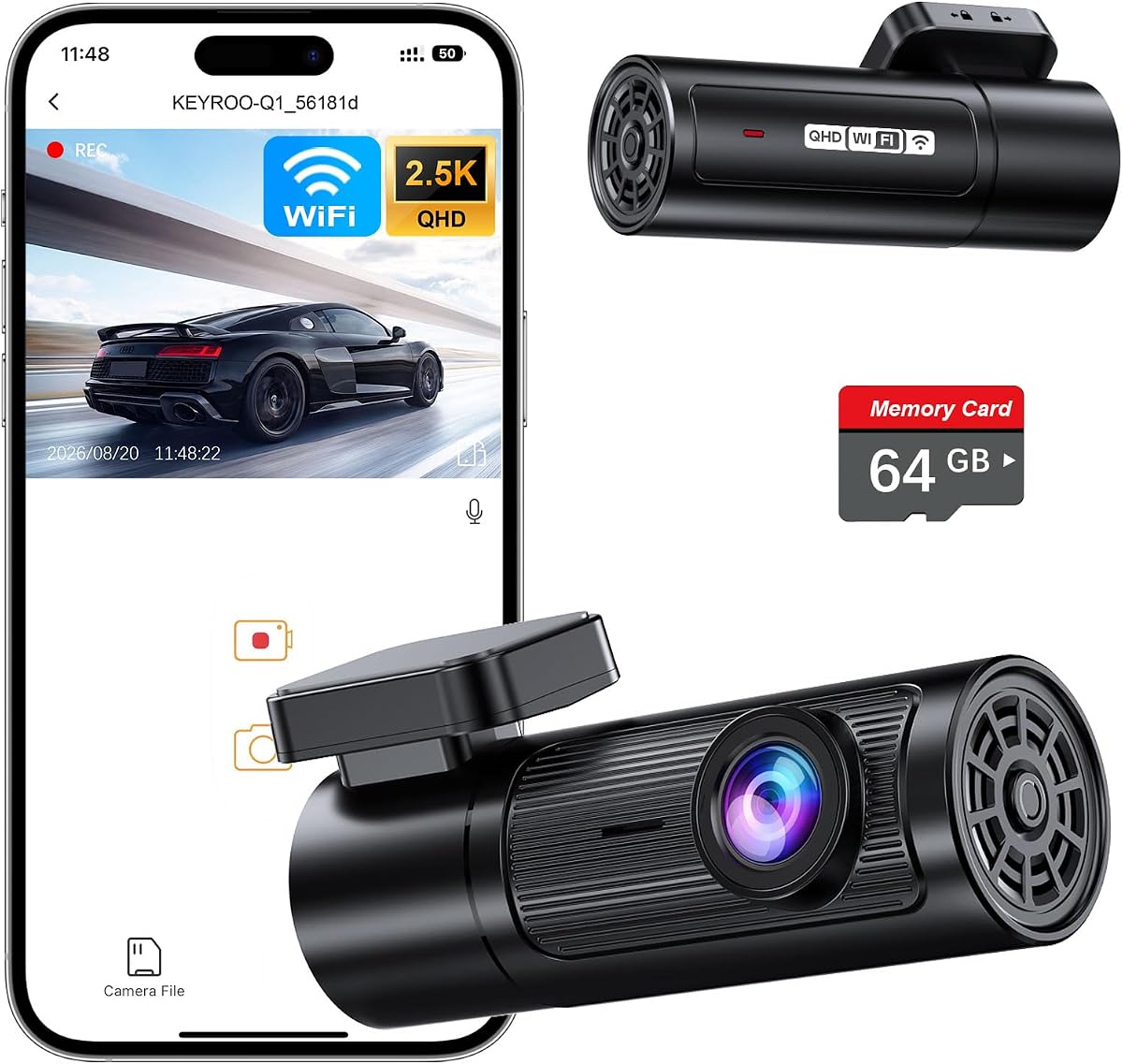
KEYROO Q1 2.5K Dash Cam
5.0Editor score
Screen-free compact design
2.5K front recording
Included 64GB card
Smartphone WiFi app
Discover the best Easy to Use Dash CAM options, comparing front, rear, and three-channel models for simple installation, clear footage, smart features, and
An easy to use dash cam should mount quickly, begin recording without fuss, and make important footage simple to review. The most useful models combine a compact design with clear instructions, dependable low-light performance, intuitive phone apps, and automatic event protection. These qualities matter most for drivers who want coverage without a complicated setup.
We compared all ten cameras by considering installation, front, rear, and cabin coverage, resolution, viewing angles, night visibility, storage support, wireless transfers, parking modes, and G-sensor protection. The list includes screen-free mini models, dual-camera systems, three-channel recorders, and compact units designed to remain discreet on the windshield.
Each review identifies the reason a model earns its place and explains the compromises that buyers should understand. The top selections stand out for especially approachable operation, strong image capture, or a particularly advanced feature set. Product availability and pricing can change, so confirm the current details before making a purchase.
5.0Editor score

4.8Editor score

4.3Editor score
The comparison below shows how these dash cams balance resolution, channel count, night performance, wireless connectivity, storage, and parking protection. It is designed to make the differences clear without overlooking the setup requirements that affect everyday convenience.


The ROVE R2-4K Dual is a well-rounded front-and-rear camera system with a 4.5 rating. It combines a compact front unit, a separate rear camera, a 3-inch IPS display, built-in GPS, and dual-band WiFi. That combination makes it approachable for drivers who want useful evidence and phone-based control without navigating a complicated interface.
We may earn a commission when you buy through this link, at no additional cost to you.
Its Sony STARVIS 2 IMX675 front sensor, wide F1.5 aperture, HDR, and super night vision improve visibility after dark and in tunnels. The front camera records at 2.5K and upscales to 4K, while the rear records at 1080p. Dual-band 5.8GHz and 2.4GHz WiFi supports transfers stated at up to 20MB/s, and GPS stamps routes, speed, and location onto the footage.
The most important caveat is that the advertised 4K front image is upscaled rather than native 4K. Buyers who need maximum native detail may prefer a true 4K model. Parking mode also requires a separately purchased hardwire kit. Even so, the included memory card, rear camera, parking choices, emergency locking, and clearly organized accessories make the package generous for regular use.
Choose the ROVE R2-4K Dual if you want a natural balance of image quality, compact hardware, GPS, and fast wireless access. It is particularly suitable for commuters who appreciate having a small screen for quick checks but also want the flexibility of reviewing clips on a phone. It is our strongest all-around option when straightforward operation and comprehensive features matter more than native 4K.
The STARVIS 2 front sensor and wide aperture are designed to preserve useful detail in dim conditions, while the rear camera adds evidence from behind the vehicle. Together, the two channels provide a balanced view for everyday driving and incident review.
Dual-band WiFi makes it easier to move large recordings to a compatible smartphone, while built-in GPS adds speed, route, and direction information. These features help give recorded footage useful context without requiring the memory card to be removed.
We may earn a commission when you buy through this link, at no additional cost to you.
The galphi 4K Mini is a straightforward front-camera option with a 4.4 rating. Its screen-free body is deliberately compact, reducing windshield clutter and avoiding the temptation to fiddle with a display while driving. A preinstalled 32GB memory card and a simple mobile-app workflow make it a practical choice for new owners.
We may earn a commission when you buy through this link, at no additional cost to you.
The camera records 4K UHD through a 160-degree wide-angle lens and uses an F1.6 aperture with WDR to balance exposure in rain, snow, night, and high-contrast scenes. Its 5GHz WiFi supports download speeds stated at up to 8MB/s. Seamless loop recording manages storage automatically, while the G-sensor protects clips associated with sudden movement or a collision.
Its main limitation is the single-camera format: the galphi does not record the rear or cabin of the vehicle. The parking feature also requires a Type-C hardwire kit that is not included. Prospective buyers should account for that extra accessory and recognize that a 32GB card will provide less recording time than the larger cards bundled with many dual-camera systems.
This model makes sense for drivers who value a clean windshield, straightforward controls, and front-facing evidence more than multi-angle coverage. It is easy to recommend as a simple first dash cam, particularly for daily commuters who want 4K capture, phone downloads, and automatic incident locking without a large display.
The screen-free design keeps the camera small and visually unobtrusive. That makes it easier to mount near the rearview mirror without sacrificing a useful portion of the driver's forward view.
Connecting through 5GHz WiFi lets supported phones preview, download, and manage clips without removing the card. The faster band is particularly helpful when reviewing 4K files on a daily basis.
We may earn a commission when you buy through this link, at no additional cost to you.
The REDTIGER F7NP is a dual-camera model offering 4K recording at the front and 1080p at the rear. Its 4.1 rating places it behind several newer options, but the underlying feature set remains capable. The STARVIS 2 sensor, large F1.5 aperture, WDR, HDR, and optical lens target the details that can be difficult to see at night.
We may earn a commission when you buy through this link, at no additional cost to you.
Wide viewing angles of 170 degrees at the front and 140 degrees at the rear provide broad coverage, while built-in 5.8GHz WiFi supports app-based transfers stated at up to 20MB/s. The Redtiger Cam app provides preview, replay, settings management, and GPS data for route, speed, and location review. Loop recording runs continuously, and the G-sensor locks event clips.
A supercapacitor replaces the type of internal lithium battery used in many dash cams, improving heat resistance and long-term reliability. Parking protection offers both time-lapse and collision-detection modes, though a hardwire kit must be purchased separately. The included memory card helps with immediate setup, but buyers should still confirm its capacity and format the device correctly before relying on it.
The F7NP is worth considering for drivers who prioritize a native 4K front image, a capable night sensor, and rear coverage. It is less compelling for buyers seeking a highly integrated app ecosystem or extensive included storage, but its core camera features are strong. Install it with the supplied accessories and follow the manual to maintain stable power and mounting.
The front camera records 4K with a 170-degree field of view, offering considerable detail and coverage of adjacent lanes. The rear camera adds 1080p recording through a 140-degree lens for a complete two-angle setup.
The supercapacitor is a meaningful advantage in hot climates. It supports the camera's parking and incident-recording functions while avoiding the heat concerns associated with conventional lithium-based dash cam batteries.
We may earn a commission when you buy through this link, at no additional cost to you.
The REDTIGER F7N TOUCH is designed for drivers who want direct access to camera functions without reaching for a phone. Its 4.3 rating reflects a balanced feature set, while the touchscreen allows users to lock emergency footage, toggle WiFi, and trigger a scenery capture with a tap.
We may earn a commission when you buy through this link, at no additional cost to you.
Video quality comes from a STARVIS 2-equipped 4K front camera and a 1080p rear camera. The front covers 170 degrees and the rear 140 degrees, with WDR and HDR supporting visibility across bright and dark portions of a scene. Voice control provides another hands-free method for managing recordings, reducing the need to interact with the screen while the vehicle is moving.
The unit includes a 128GB memory card and supports both loop recording and G-sensor event locking. Built-in GPS stores location, speed, and route information, while 5.8GHz WiFi enables transfers stated at up to 20MB/s through the Redtiger Cam app. Parking monitoring supports collision detection and time-lapse modes, but it requires a separate hardwire kit.
This F7N TOUCH is a good fit for drivers who appreciate a large control surface and voice commands but do not need three-camera coverage. The screen may be less discreet than a screen-free design, so mounting it where it does not block visibility is important. Otherwise, the controls, storage, GPS, and dual recording make setup and daily use approachable.
Voice commands and touchscreen shortcuts reduce the need to navigate complex menus. This is useful when the priority is saving an incident promptly or toggling wireless access without searching through several settings.
Integrated GPS adds speed, direction, and route information to the recording. Those details can make a clip more useful when reviewing a route or presenting context that a basic forward-facing camera would not preserve.
We may earn a commission when you buy through this link, at no additional cost to you.
The AProX 3-Channel is the most complete conventional setup in this guide, earning a 4.8 rating and the Editor's Choice distinction. It records true 4K footage from the front and rear cameras and 1080p from the cabin camera. That combination gives drivers a clear record of the road, traffic behind them, and the interior of the vehicle.
We may earn a commission when you buy through this link, at no additional cost to you.
Its wide angles reach 170 degrees at the front, 150 degrees at the rear, and 150 degrees in the cabin, helping minimize blind areas. AProX HD night vision and WDR support difficult lighting, while four IR lights help the cabin camera record in darkness. The 3.18-inch laminated screen reduces reflections, and its screen saver can keep the display from becoming distracting.
Dual-band WiFi 6 supports transfers stated at up to 20MB/s through the TERUNSOUL app, and the included 128GB card makes immediate recording possible. Loop recording manages storage, the G-sensor protects event files, GPS records speed and location, and parking monitoring offers time-lapse and collision detection. The complexity of three cameras and their cables is the main drawback, and parking use requires a separate hardwire kit.
This is the most appealing model for rideshare drivers, families, and anyone who wants broad evidence from all directions. Installation takes more care than a single-camera mini, but the three-camera layout remains clearly described and straightforward once mounted. It is our top pick because it combines a high rating, true 4K dual recording, useful cabin visibility, strong wireless performance, and ample included storage.
Most dash cams record only forward, but this system adds both rearward and interior views. That wider context is valuable for documenting vehicle behavior, passenger activity, parking incidents, and events unfolding behind the driver.
AProX HD night vision, WDR, and infrared cabin illumination help preserve usable images after dark. The cabin lighting is especially useful for rideshare and family-use applications where interior events may matter.
We may earn a commission when you buy through this link, at no additional cost to you.
The KEYROO Q1 is a compact 2.5K front camera with a 5.0 rating, the highest listed score in this roundup. It focuses on the fundamentals that make a dash cam useful: a discreet body, a wide field of view, low-light image balancing, phone connectivity, and immediate readiness with a preinstalled 64GB high-endurance card.
We may earn a commission when you buy through this link, at no additional cost to you.
The camera records 2560 by 1440 at 30 frames per second through a six-layer, 160-degree lens. Its super night vision approach, wide aperture, and exposure balancing are intended to retain detail in low light and high-contrast scenes. WiFi provides access to preview, download, replay, and settings through a compatible iOS or Android app, removing the need to retrieve the memory card each time.
The screen-free mini design fits neatly behind or beside the rearview mirror. A 360-degree rotatable lens makes it possible to redirect the view toward the cabin, which broadens its usefulness for rideshare drivers. Seamless loop recording and G-sensor event locking handle storage and incident preservation. Continuous parking mode and time-lapse require a separately purchased professional hardwire kit.
The Q1 is our Best Budget pick because it combines an approachable installation, a useful app, 2.5K recording, and unusually generous included storage in a compact package. It does not provide rear coverage and is not true 4K, but those limitations are reasonable for a front-only camera. It is a strong choice for new drivers, commuters, and anyone who wants simple protection without a large display.
A high-endurance 64GB card arrives preinstalled, removing the most common extra purchase. The card supports up to 256GB, so owners can expand storage later if their recording needs change.
The rotatable lens and detachable bracket make it easy to refine the viewing angle after installation. That flexibility is especially valuable in vehicles with different windshield shapes and mounting positions.
We may earn a commission when you buy through this link, at no additional cost to you.
The AProX Dual 4K offers true 4K UHD recording from both the front and rear cameras, with a 4.5 rating. It delivers a high-resolution alternative to systems that combine 4K at the front with 1080p at the rear. The front camera has a 170-degree view, while AProX HD night vision and wide apertures support low-light recording.
We may earn a commission when you buy through this link, at no additional cost to you.
The front uses an F1.5 aperture and the rear an F1.8 aperture to admit more light. Built-in dual-band WiFi 6 supports transfers stated at up to 20MB/s through the dedicated app, with over-the-air firmware updates available. GPS records speed and location directly into videos, adding context that can help when reviewing a journey or incident.
A free 128GB card is included, and the system supports cards up to 512GB. Loop recording overwrites older files, while the G-sensor locks accident footage. Parking monitoring includes low-power time-lapse and collision detection, but a hardwire kit is sold separately. Compared with the three-channel AProX model, this dual version does not include a dedicated cabin camera.
Choose the AProX Dual 4K when true high-resolution footage at both ends of the vehicle is the priority. It is a good middle ground between a simpler front-only camera and a more wiring-intensive three-channel system. The included storage, fast app transfers, GPS, and easy installation make it one of the strongest dual-camera choices.
True 4K capture from the front and rear gives users more pixels than a conventional 4K-plus-1080p arrangement. The extra detail can be valuable when the subject is small, distant, or moving through the frame.
WiFi 6 and the included 128GB card make large recordings easier to manage. Users can transfer files through the app, adjust settings, and apply firmware updates without repeatedly handling the memory card.
We may earn a commission when you buy through this link, at no additional cost to you.
The Garmin Dash Cam Mini 3 prioritizes a tiny footprint, simple operation, and a polished app experience. Its 4.0 rating is the lowest among the cameras reviewed, but it serves a distinct purpose for drivers who want an unobtrusive recorder with convenient voice commands. The key-sized camera records 1080p HD video across a 140-degree field of view.
We may earn a commission when you buy through this link, at no additional cost to you.
A built-in Garmin Clarity polarizer reduces windshield glare, helping important details remain visible in bright conditions. The camera automatically records and saves incident video with date and time. Voice control allows drivers to save clips and start or stop audio recording using spoken commands in several supported languages, reducing the need to handle the device while moving.
The Garmin Drive app and online Vault workflow can store important clips, while the app can display synchronized footage from as many as four separately sold cameras. Live remote viewing and parking notifications require a paid Vault subscription, an active WiFi connection, constant power, and the compatible phone app. These service dependencies may discourage buyers who want every feature to work without a subscription.
This is a good choice for drivers who prioritize a tiny camera, reduced glare, voice control, and a streamlined mobile ecosystem. It is less suitable for people seeking 4K detail, multiple bundled cameras, or no recurring service costs. Among front-only compact models, its 1080p specification is modest, but its physical simplicity is difficult to overlook.
The ultracompact body mounts close to the windshield and takes up very little visible space. That makes it especially attractive to drivers who dislike a large camera hanging below the rearview mirror.
The integrated polarizer helps reduce reflections caused by sunlight on the windshield. This can improve the visibility of vehicles, signs, and road details during bright daytime conditions.
We may earn a commission when you buy through this link, at no additional cost to you.
The REDTIGER F17 is a flexible three-channel system with a 4.4 rating. Its STARVIS 2 IMX675 front sensor can record 4K, while the cabin and rear cameras record 1080p. The three views cover 150 degrees at the front, 160 degrees in the cabin, and 155 degrees at the rear, providing broad awareness for daily drivers and family travel.
We may earn a commission when you buy through this link, at no additional cost to you.
WDR and HDR improve dynamic range, and the larger sensor pixels are designed to produce brighter footage with less noise and motion blur in dim conditions. The upgrade to 5GHz and 2.4GHz WiFi supports quick access to clips, three-channel replay, route information, and real-time GPS data through the Redtiger Cam app. A 64GB memory card is included for immediate use.
The F17 supports two different recording arrangements. Drivers can choose 2.5K across the front and rear channels, or disable the cabin camera to retain 4K at the front and 1080p at the rear. This flexibility is useful, but it requires an understanding of the relationship between active channels and output resolution. Parking monitoring uses time-lapse and collision detection and requires an extra hardwire kit.
The F17 is a strong option for drivers who want three perspectives but also value control over recording quality. It falls short of the AProX 3-Channel's true 4K rear capture, yet it can deliver 4K front footage when the cabin channel is off. For a balanced combination of coverage, night performance, and app features, it remains a convincing all-around choice.
The ability to favor 4K front resolution or simultaneous higher-quality dual-channel recording gives owners flexibility. This is useful when front detail is the priority or when interior and rear coverage must remain active.
The STARVIS 2 sensor, HDR, and WDR work together to improve detail and tonal balance. They are especially relevant for nighttime highways, dim residential streets, and rapidly changing exterior light.
We may earn a commission when you buy through this link, at no additional cost to you.
The VIOFO A229 Plus is the premium option in this guide, with a 4.3 rating and a strong focus on image quality. It is the first front-and-rear system listed here with two Sony STARVIS 2 IMX675 sensors, giving both cameras improved light sensitivity, dynamic range, and reduced noise and motion blur compared with the earlier STARVIS generation.
We may earn a commission when you buy through this link, at no additional cost to you.
Both channels record at 1440p, and the front can reach 60 frames per second for smoother footage of fast-moving subjects. Dual-channel HDR improves detail in challenging light, though the front camera's 1440p at 60fps mode is unavailable when HDR is enabled. Twelve voice commands cover actions such as taking a photo, locking video, toggling WiFi, and switching camera views.
A quad-mode GPS module supports GPS, BEIDOU, GALILEO, and GLONASS to record location, speed, and time data. Upgraded 5GHz WiFi supports previewing, downloading, sharing, and adjusting settings through the VIOFO app. Three parking options cover buffered event detection, time-lapse, and low-bitrate recording. The HK4 hardwire cable and a suitable high-endurance microSD card are both purchased separately.
Choose the A229 Plus for drivers willing to add the necessary storage and hardwire accessories to obtain a refined dual-camera system. It is especially compelling for people who value sensor quality, HDR, GPS precision, voice control, and flexible parking behavior. The absence of included storage prevents it from being the easiest all-in-one purchase, but its core imaging technology makes it the most premium-oriented choice.
Using STARVIS 2 sensors at both ends avoids a common weakness in dual-camera systems, where the rear image is considerably weaker than the front. The result is more consistent detail and exposure across the vehicle's two main viewpoints.
Buffered event recording retains a short period before and after a detected event, while time-lapse and low-bitrate modes offer alternatives for long parking periods. This range lets drivers select a recording strategy that suits their storage and monitoring needs.
We may earn a commission when you buy through this link, at no additional cost to you.
The easiest dash cam is not necessarily the one with the most features. It is the camera whose installation, controls, storage requirements, and mobile workflow fit your vehicle and driving habits without creating unnecessary maintenance.
A front-only camera is the simplest option and places fewer demands on wiring, windshield space, and installation. Dual-channel systems add a rear view for evidence of what happens behind the vehicle, while three-channel systems also record inside the cabin. Rideshare drivers, families, and frequent highway commuters may benefit from interior coverage, but every extra camera adds cables, mounting decisions, storage consumption, and points where installation quality can affect reliability.
Resolution alone does not determine image quality. Sensor size, aperture, HDR, WDR, lens construction, and low-light processing all influence whether a recording remains useful. Native 4K preserves more pixel detail than an upscaled 4K image, while 2K can still be highly effective with a strong sensor. Frame rate also matters: 30fps is suitable for general evidence, and 60fps can make fast-moving vehicles easier to examine. Buyers should consider the entire output rather than chasing a single headline specification.
Night recording is a major reason to own a dash cam, but advertised night vision can be difficult to interpret. Look for a capable image sensor, a reasonably wide aperture, HDR or WDR, and clear information about how the rear camera performs. A front camera that captures bright detail while the rear remains dark provides incomplete protection. Cabin cameras for nighttime use may also benefit from infrared illumination, particularly for rideshare or security applications.
A phone app is valuable when it reduces friction. Dual-band or 5GHz WiFi can make large 4K files much faster to download than a 2.4GHz connection, while GPS, preview, settings, and firmware controls should be easy to find. Consider whether the app requires a paid subscription for features you expect to use, and confirm that your phone model is compatible. Dash cam users should never handle the device or app while the vehicle is moving.
Dash cams write continuously, so storage capacity directly affects how much footage remains available. Cameras that include a card offer more convenient setup, but buyers should still verify the capacity and confirm that it is suitable for continuous video recording. A higher-resolution multi-camera setup fills a card faster than a front-only camera. Choose a durable, high-endurance microSD card of an appropriate speed class and use the manufacturer's formatting guidance whenever replacing or upgrading storage.
Parking surveillance commonly needs constant power, which means most vehicles require a hardwire kit. The kit is not included with several of the cameras in this guide. Time-lapse reduces storage use, collision detection starts or saves a clip after movement or impact, and buffered recording may preserve footage from before an event. Installation quality, parking-mode compatibility, and the vehicle's electrical system are as important as the camera's advertised features.
A compact camera is easier to integrate into a vehicle with a busy dashboard, while a larger screen can make menus and status checks convenient. Consider the camera's viewing angle, adhesive or suction mounting, cable routing, rear-camera placement, and whether the unit blocks a sensor, driver's view, or state inspection area. Screen-free models are the least distracting, while touchscreens and physical buttons offer quicker direct control.
Reliable support, firmware updates, and a clear warranty can be as important as the initial hardware. Dash cams are exposed to heat, vibration, power fluctuations, and constant recording, so durable construction and thermal management matter. Supercapacitor-based models can be preferable for long parking use because they avoid heat-sensitive lithium batteries. Check whether the manufacturer offers clear setup documentation, replacement accessories, and useful long-term support.
Begin by reading the model's manual and inspecting the included power cable, mounts, and memory card. Format the card in the dash cam if instructed, insert it in the correct orientation, and confirm that the camera displays a normal status. Mount the front unit in a clean portion of the windshield, keep it below the obstruction line, and aim the lens carefully. Connect the rear and cabin cameras before routing their cables along the headliner and pillar trim.
Power the system with the supplied or manufacturer-approved adapter, verify that recording begins, and test the app connection. Walk through the live preview, download a short clip, adjust exposure or resolution as needed, and test the save or lock command. If using parking mode, install a compatible hardwire kit according to its instructions and test the parking trigger before relying on it. Avoid interacting with the camera or phone while driving.
Check the lens regularly for dust, glare, bugs, and fingerprints, and clean it with a safe microfiber approach. Review the memory card and cable connections periodically, particularly after hot weather or a collision. Use the proper storage format recommended by the manufacturer, and replace damaged or unsuitable cables. Do not expose the camera to extreme heat beyond its intended operating conditions, and disconnect it if it becomes unusually hot.
A compact, front-only camera is generally the easiest to install because it requires one main unit and one power connection. The galphi 4K Mini and KEYROO Q1 are particularly approachable, with small bodies and included memory cards. Models with rear or cabin cameras take more time because their cables must be routed and hidden. The correct mounting position also depends on the vehicle and local visibility rules.
A screen-free design can be less distracting because there is no illuminated display to glance at or interact with while driving. It also allows the camera to be mounted more discreetly near the rearview mirror. However, models with screens can be convenient for checking status and using voice, button, or touch controls. The best choice depends on whether direct hardware interaction or a minimal windshield footprint matters more to the driver.
A rear camera is helpful when a collision or road event occurs behind the vehicle, when another driver changes lanes into your vehicle, or when you need to monitor a parked car. A front-only camera remains sufficient for basic forward-facing evidence and is easier to install. Dual-camera systems provide broader protection but require additional wiring and use more storage.
Most parking modes require continuous power because a normal accessory socket turns off when the ignition is switched off. A compatible hardwire kit connects the camera safely to a constant power source and often includes a voltage cutoff for battery protection. The kit must match the vehicle and dash cam, and installation should follow the manufacturer's instructions. Several cameras in this guide list parking mode but do not include the necessary kit.
No. Dash cams require cards capable of sustained continuous writing, and using an unsuitable card can cause dropped frames, corrupted files, or recording failures. Follow the camera's stated speed-class, capacity, and format requirements. A high-endurance card designed for continuous video is generally more appropriate than a card optimized mainly for large file transfers. Format the card as directed and avoid buying questionable or previously damaged cards.
No. Resolution is only one part of image quality. Sensor capability, aperture, HDR, WDR, lens quality, exposure balance, and compression all influence the result. A native 4K camera with a capable sensor may produce more usable detail than an upscaled model, but a strong 2K system can still be effective. Consider whether the advertised resolution applies to the front, rear, and cabin channels simultaneously.
Check that recording is working regularly, particularly after a firmware update, card replacement, or unusual event. Reviewing a short recent clip can confirm that the date, time, lens angle, and image quality are correct. Also inspect the card for recording errors and verify that incident files are being locked. Do not wait until an accident to discover that the camera stopped recording weeks earlier.
They are not strictly necessary, but they can make setup and evidence review much easier. A good app allows footage preview, downloads, settings changes, and file sharing without removing the memory card. Faster 5GHz or dual-band WiFi is especially useful for high-resolution files. Before purchasing, check app compatibility, subscription requirements, and whether essential features work without a paid service.
The AProX 3-Channel is the most complete choice for buyers who want true 4K front and rear footage, a 1080p cabin camera, fast WiFi 6 transfers, parking protection, and a generous included card. The KEYROO Q1 is the easiest compact option for front-only coverage, while the VIOFO A229 Plus provides the most premium sensor-focused configuration with dual STARVIS 2 cameras and refined GPS and parking features.
Prioritize the qualities you will use every day. A front-only mini is easiest to install, a dual camera offers stronger evidence coverage, and a three-channel system is most useful for rideshare, family, and interior-monitoring needs. Confirm the memory card, hardwire kit, app compatibility, and power requirements before ordering, because these omissions can make an otherwise capable camera less convenient.
Specifications and product availability can change, and current pricing should be checked on the linked product pages. Review the current package contents, warranty terms, parking-mode requirements, and setup instructions before making your final decision. The right easy-to-use dash cam is the one that provides the needed coverage without adding avoidable installation or maintenance complications.