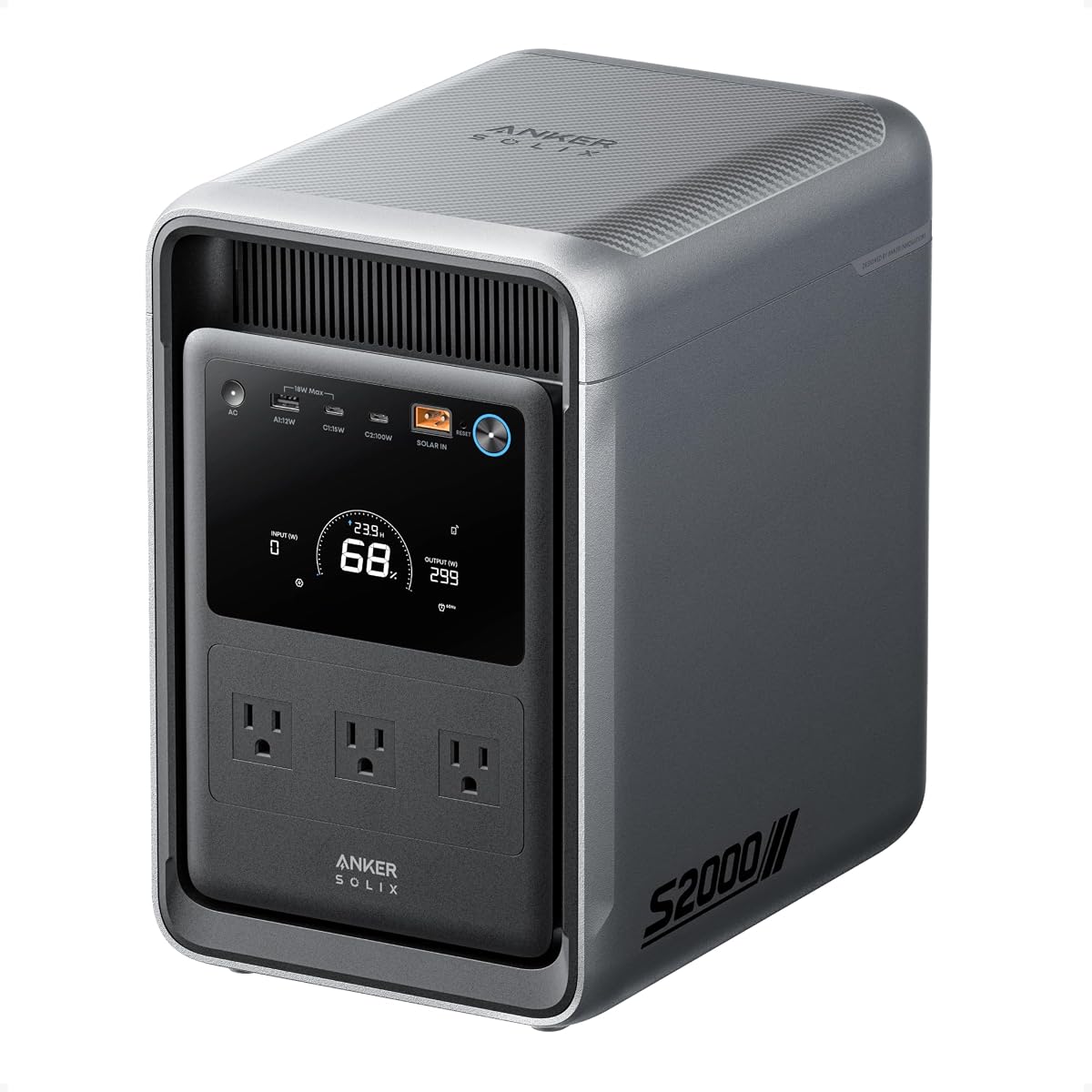
Anker SOLIX S2000
4.7Editor score
2,010Wh battery capacity
1,500W continuous output
10,000-cycle battery design
Anker Power Stations compared by capacity, output, charging speed, portability, and backup features to help you choose the right model for home, RV, or camping.
Anker power stations combine rechargeable battery storage with AC, USB, and vehicle outlets, making them useful for outages, camping, remote work, and off-grid activities. A capable model should provide enough runtime for essential equipment, recharge quickly, and remain portable enough for the environments in which you plan to use it.
This guide compares ten models from the Anker SOLIX range using their stated capacity, continuous and surge output, port selection, charging options, battery technology, expansion capabilities, and portability. It covers compact units for travel through high-capacity systems designed to keep an entire home running for extended periods.
Each review explains who the model suits, what makes it stand out, and where compromises appear. Ratings and specifications reflect the supplied product information, while practical considerations such as portability, input limits, and outlet type are emphasized. Prices and promotions can change, so check the current listing before buying.
4.7Editor score
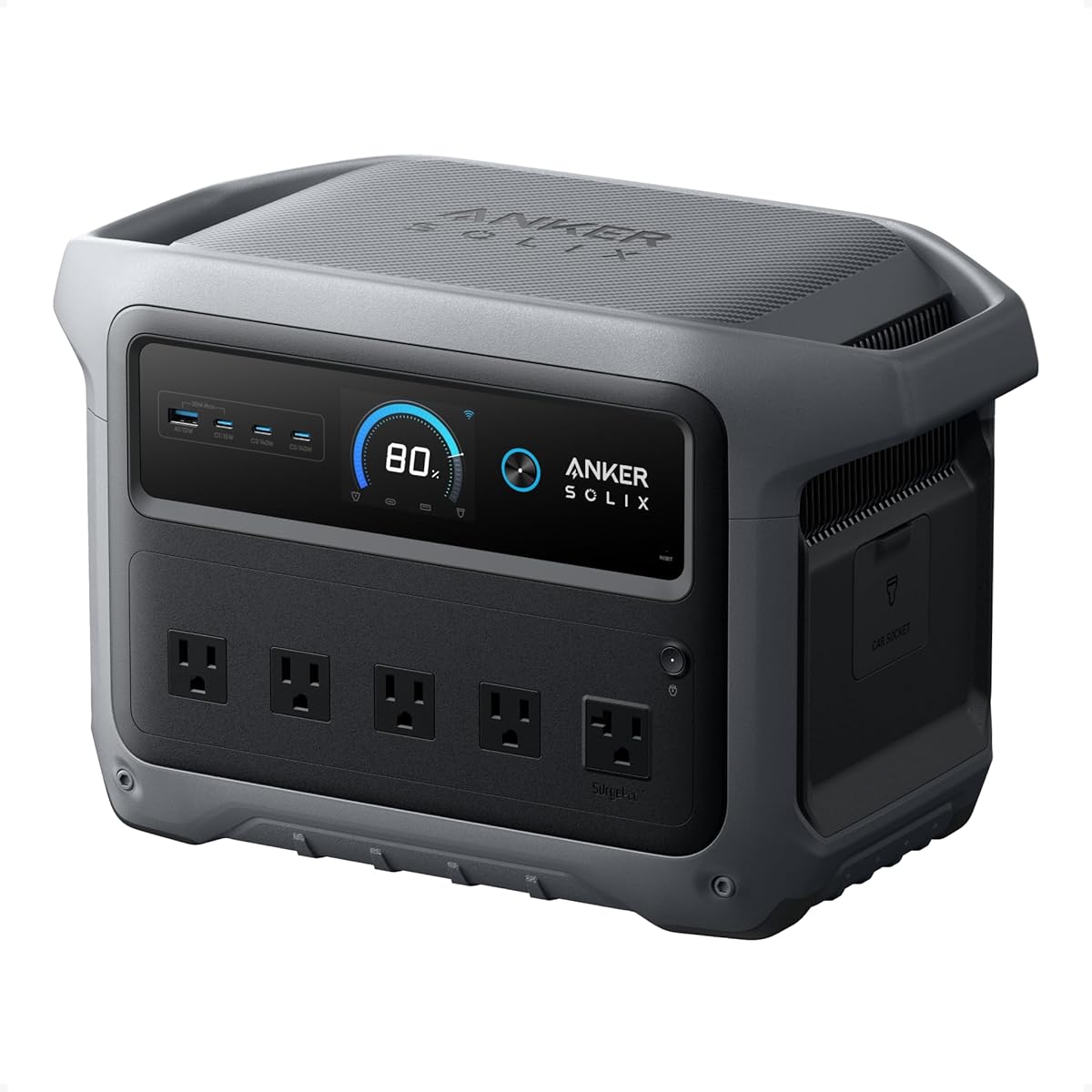
4.7Editor score

4.6Editor score
The table below compares all ten Anker SOLIX models by energy capacity, output, charging flexibility, and practical scale, making it easier to identify the right system for travel, backup power, RV use, or whole-home resilience.


The Anker SOLIX C1000 Gen 2 is a broadly capable portable power station with a 4.7 rating, 1,024Wh of capacity, 2,000W of continuous output, and ten output ports. Its strongest feature is the balance it strikes between energy storage, output, recharge speed, and physical size, making it a practical center of the range for many buyers.
We may earn a commission when you buy through this link, at no additional cost to you.
Its 1,600W AC input can fully recharge the unit in about 49 minutes when HyperFlash is enabled in the Anker app. Ten ports reduce the need for adapters, while 2,000W continuous and 3,000W peak output can cover many portable appliances and electronics. The supplied information also highlights 600W solar recharging in approximately 1.8 hours and a switchover time under 10 milliseconds for compatible UPS use.
The main limitation is that this is still fundamentally a portable 1kWh-class system. A refrigerator, space heater, or other high-draw appliance may consume its usable energy quickly, and the stated 2,000W maximum output is lower than the 6,000W offered by the larger F-series models. Solar input is also more modest, so buyers planning an extensive array of panels should examine the F3000 or F3800 Plus instead.
Overall, the C1000 Gen 2 is the strongest all-purpose recommendation for home backup, RV use, remote work, and camping. It is especially attractive for users who value quick wall charging, broad port selection, and a relatively compact format without needing the weight and expense of a high-capacity home system.
The 1,600W AC input and stated 49-minute full recharge reduce downtime when the unit is being prepared for a trip or storm. Solar input adds another useful option, although owners needing maximum solar collection speed should consider a higher-input F-series model.
With a sub-10-millisecond UPS switchover, the C1000 Gen 2 can keep compatible laptops, networking equipment, and medical devices such as CPAP machines operating during a power interruption. Confirm device compatibility and required power levels before relying on it for any critical equipment.
We may earn a commission when you buy through this link, at no additional cost to you.
The Anker SOLIX S2000 combines a 4.7 rating with 2,010Wh of capacity and 1,500W of continuous output. It is positioned as a compact two-kWh system for extended backup, and its headline efficiency figures are particularly attractive for users who want to keep a refrigerator and other essentials running longer than a small portable unit would allow.
We may earn a commission when you buy through this link, at no additional cost to you.
Anker states that a 6W idle draw and 10% higher efficiency allow the S2000 to run 20% longer than other 2kWh systems, with a stated refrigerator runtime of up to 35 hours. Actual results depend on the refrigerator, ambient temperature, and usage. The 314Ah LFP battery is described as equivalent to 10,000 cycles over a 15-year lifespan, providing a strong long-term durability proposition.
Its stated dimensions of 8.2 by 11.1 by 12.7 inches and weight of 35.7 pounds make it lighter and smaller than the stated industry average for 2kWh systems, though it is still a substantial stationary unit. There is no 12V DC port, which may disappoint users with legacy camping accessories, and its 1,500W continuous output is lower than the C1000 Gen 2 despite offering nearly twice the capacity.
The S2000 is best for households that need more runtime than a compact power station can provide but do not require 6,000W output. Its dual-sided outlet arrangement, low idle consumption, flexible recharging, and long-cycle battery design make it a premium choice for refrigerators, networking equipment, and extended outages.
The stated 6W idle draw is designed to preserve stored energy when the S2000 is not actively powering a large load. That makes it more appropriate for prolonged refrigerator backup than many similarly sized systems with greater standby consumption.
The 314Ah LFP cell design and advertised 10,000-cycle equivalent life position the S2000 for regular use over many years. Actual longevity varies with temperature, charge practices, depth of discharge, and maintenance.
We may earn a commission when you buy through this link, at no additional cost to you.
The Anker SOLIX C300 is a travel-focused 288Wh power station with a 4.6 rating, 300W continuous output, and eight output ports. It delivers enough capacity for phones, cameras, laptops, small appliances, and essential camping electronics while remaining substantially easier to carry than the larger SOLIX models.
We may earn a commission when you buy through this link, at no additional cost to you.
Two USB-C ports support up to 140W each, and the port mix also includes three AC outlets sharing 300W total, a 120W car socket, another 15W USB-C port, and a 12W USB-A port. It can reach 80% charge in about 50 minutes through a wall outlet and supports solar, car, and PD 3.1 USB-C recharging. A 25dB operating level makes it suitable for quiet campsites.
The 300W output is the main constraint. It can handle many small electronics, but it is not intended for the demands of a full-size refrigerator, space heater, or other high-surge appliance. The shoulder strap is sold separately, and compatibility with several Anker solar panels is explicitly excluded, so the solar accessory should be chosen carefully.
This is the best budget pick for travelers who want a capable portable power hub without the weight of a 1kWh unit. It is particularly useful for charging phones and cameras, powering a laptop, running small camping appliances, or maintaining essential electronics during a short outage.
The combination of wall, solar, car, and USB-C recharge options gives the C300 flexibility away from a wall outlet. Its 50-minute stated recharge to 80% also makes it practical to replenish between outings.
At a stated 25dB from 3.3 feet away, the C300 is designed to operate with minimal noise in sleeping and working environments. Keep ventilation clear and avoid placing the unit inside a tent or enclosed vehicle.
We may earn a commission when you buy through this link, at no additional cost to you.
The Anker SOLIX F3000 is a high-output home backup system with a 4.5 rating, 3,072Wh of starting capacity, and 6,000W of continuous output. It is designed for households that need to run demanding appliances and essential equipment at the same time rather than merely top up a collection of small electronics.
We may earn a commission when you buy through this link, at no additional cost to you.
Its 3,600W pass-through charging allows the unit to recharge from a 120V generator while continuing to supply full power to connected appliances. Up to 2,400W of solar input is also supported through the stated 165V and 60V ports. Low idle consumption contributes to a claimed 125 hours of AC idle standby, while a 190W refrigerator is described as running for up to 42 hours.
The F3000 supports 120V output and can be paired with a second power station for 240V operation. Capacity can expand from 3kWh to as much as 24kWh with additional batteries, and combined generator and solar input can reach 6,000W. These are powerful features, but they also make the system a major infrastructure investment rather than a casual camping accessory.
This model is best suited to homeowners seeking substantial outage protection, high appliance loads, and flexible recharging. It may be unnecessary for occasional travel or light electronics use, but for extended residential backup, its capacity and 6,000W output are particularly compelling.
Pass-through charging lets the F3000 operate connected appliances while receiving power from a generator. This can reduce the need to alternate between recharging and using stored energy during long utility interruptions.
Expansion to 24kWh allows buyers to match stored capacity to a larger outage plan. The added batteries and compatible equipment increase both installation complexity and the amount of space required.
We may earn a commission when you buy through this link, at no additional cost to you.
The Anker SOLIX F3800 is a 3,840Wh portable power station rated 4.5, combining 6,000W of output with extensive expansion and whole-home power features. It sits at the top of the range for users who want one system to support household essentials, RV travel, electric-vehicle charging, and extended periods without utility power.
We may earn a commission when you buy through this link, at no additional cost to you.
Up to six expansion batteries raise the stated capacity to 26.9kWh. Pairing two F3800 units can provide up to 12,000W of maximum AC output, while 120V and 240V support allows compatible high-draw appliances to operate. The NEMA 14-50 port can charge an electric vehicle at up to 6,000W, and the same connection type can support RV power inlet charging.
The F3800 is not a lightweight travel product. Its major strengths are scale, flexibility, and the ability to integrate with different power sources. An app supports Wi-Fi or Bluetooth monitoring and control, while a Smart Generator 5500 can add automatic start-stop behavior. Buyers should account for the floor space, ventilation, and electrical installation needs of a system at this level.
The F3800 is a strong recommendation for prepared households, RV owners seeking substantial onboard capacity, and users who want the option to scale over time. It is less appropriate for light camping or emergency use where a smaller portable unit would be easier to manage.
Six compatible battery packs can expand the F3800 to 26.9kWh, allowing users to increase energy reserves as their needs grow. More capacity also requires careful planning for charging schedules, device placement, and safe ventilation.
The NEMA 14-50 EV charging connection provides a path to substantial vehicle charging when conditions and compatible equipment allow it. RV owners can also recharge through NEMA 14-50 or L14-30 connections, depending on their vehicle and setup.
We may earn a commission when you buy through this link, at no additional cost to you.
The Anker SOLIX C300 DC is a compact 288Wh power station with a 4.5 rating and 300W output. Unlike the standard C300, it focuses on USB-C and USB-A charging rather than including household AC outlets, making it especially appropriate for travelers carrying laptops, phones, cameras, and other modern USB-powered equipment.
We may earn a commission when you buy through this link, at no additional cost to you.
Two USB-C ports deliver up to 140W each, with additional 100W, 15W, and USB-A connections alongside a 120W car socket. The unit can reach 80% charge in about an hour through its dual PD 3.1 USB-C input, and it also supports solar and car recharging. This concentration on high-speed USB-C makes fast device replenishment the central benefit.
First activation has a specific requirement: the unit must be recharged with an 18W or higher USB-C wall charger, and only USB-C2 or USB-C3 may be used for that initial charging. There is no standard AC output, so buyers who need to run a conventional appliance should choose the regular C300 or another SOLIX model instead.
The C300 DC is an attractive option for digital nomads, weekend campers, and international travelers who prefer several high-wattage USB-C ports over AC sockets. Its 30% smaller design is easy to carry, and the three-year battery guarantee adds reassurance, though normal charging practices remain important.
A 140W USB-C port can serve demanding compatible laptops, while the second 140W connection allows two modern devices to charge rapidly. Actual charging speed depends on each device, its cable, and the power profile it requests.
The DC version saves space by omitting standard wall outlets. That simplification makes the unit easier to pack, but it narrows the range of equipment it can operate directly.
We may earn a commission when you buy through this link, at no additional cost to you.
The original Anker SOLIX C1000 pairs a 4.7 rating with 1,056Wh of capacity, a 2,400W SurgePad output claim, and eleven ports. It remains a versatile option for RV travel, camping, and home backup, particularly for buyers who value a large number of connections and a compact enclosure.
We may earn a commission when you buy through this link, at no additional cost to you.
Its UltraFast technology is stated to restore 80% of capacity in 43 minutes through AC input, provided the operating temperature is between 68 and 122 degrees Fahrenheit and the feature is enabled in the Anker app with a smartphone. Solar recharging can reach a full charge in about 1.8 hours with a 600W panel. The app also provides live statistics and customizable charging speeds.
The 2,400W figure is a surge output claim, so buyers should check the continuous operating limits of the devices they intend to run. This is also the earlier C1000 generation rather than the C1000 Gen 2, which offers updated 2,000W continuous output, ten ports, and a stated 1,600W AC input. The two models can appear similar, making the generation and specifications important during comparison.
The C1000 is a worthwhile choice for users who want many ports, rapid charging, and portable 1kWh capacity. It is particularly convenient for RVs because a car charging cable is included, although the newer C1000 Gen 2 offers a stronger stated continuous-output and input specification for many buyers.
Eleven ports allow several families of devices to remain connected without carrying a large collection of wall adapters. Users should still check the individual port limits because the aggregate output may be shared.
UltraFast charging offers a convenient way to prepare the C1000 before travel or an outage. Enabling it requires the Anker app and a smartphone, and the stated charging performance depends on the specified temperature range.
We may earn a commission when you buy through this link, at no additional cost to you.
The Anker SOLIX F3800 Plus is a high-capacity home energy system with a 4.3 rating, 3,840Wh of starting capacity, and 6,000W of output. Its defining advantage is a stated 3,200W solar input, the highest listed in this guide, making it particularly relevant to households that want to recharge primarily through an extensive solar array.
We may earn a commission when you buy through this link, at no additional cost to you.
It can be recharged through solar, a gas generator, a home power panel, or an AC outlet. The supplied information states that a combined solar and generator setup can restore 80% in about 63 minutes, while a 240V generator can use a 6,000W bypass. Capacity can expand to 26.9kWh with six batteries, and pairing two units can raise maximum AC output to 12,000W.
The F3800 Plus shares the core strengths of the standard F3800, including 120V and 240V support, high-draw appliance capability, EV-grade LFP batteries, and a stated lifespan of more than a decade under everyday use. Its 4.3 rating is lower than those of several compact models, so buyers should consider the range of reviews and their own requirements carefully.
This model is ideal for solar-oriented households that need more input speed than the standard F3800 offers. For occasional backup users or people seeking easier portability, its size, complexity, and feature set will be unnecessary.
The 3,200W solar input can move energy into the unit faster than the 2,400W F3000 or the 600W-input C-series models. Real charging time still depends on panel size, sunlight, temperature, cable limitations, and the unit's operating state.
Solar, generator, home-panel, and AC recharging give users several ways to restore power. Combining sources can reduce outage downtime, while generator bypass supports continuity when a suitable generator is available.
We may earn a commission when you buy through this link, at no additional cost to you.
The Anker SOLIX F2600 is a 2,560Wh portable power station with a 4.4 rating, 2,400W continuous output, and 3,600W surge power. It fills the middle ground between compact camping systems and high-output home backup units, offering enough energy for a group of travelers and enough power for several substantial appliances.
We may earn a commission when you buy through this link, at no additional cost to you.
The unit can recharge to 80% in about 1 hour and 40 minutes with HyperFlash, or in two hours using solar. Bluetooth and Wi-Fi app controls include low-battery alerts, discharge-limit settings, and recharging-speed customization. This makes it easier to tune the system for a trip, conserve energy during a blackout, or limit the draw from a sensitive appliance.
Its LFP battery, smart temperature controls, industrial-grade components, and impact-resistant construction are designed for regular use over a stated decade. The trade-off is weight: a 2.56kWh system is far less convenient to carry than the 288Wh C300 and C300 DC, even if it is more manageable than a fixed home system.
The F2600 is a good fit for RV travel, car camping, tailgating, and outages where medium-size appliances must run. It is less compelling for hikers or travelers who need minimum weight, and buyers focused on rapid solar collection may favor the F3800 Plus.
The 2,560Wh capacity offers more room for multiple phones, laptops, lights, coolers, and other camping loads than a compact SOLIX C-series unit. Planning around each device's consumption will help avoid unexpectedly depleting the battery.
Custom discharge limits, low-battery alerts, and charging controls give the F2600 a high degree of flexibility. These settings can improve energy management but require a compatible phone and a clear understanding of how the unit is being used.
We may earn a commission when you buy through this link, at no additional cost to you.
The Anker SOLIX F1500 is a 1,536Wh portable power station rated 4.3, with 1,800W of output and support for as many as thirteen device connections. It offers a generous port mix for home backup, travel, and camping, making it a practical middle-capacity option for households that need more than a compact power bank but less than a full home system.
We may earn a commission when you buy through this link, at no additional cost to you.
Six AC outlets, four USB-A ports, and a car outlet create a broad selection of connection options. With a 600W solar panel and HyperFlash technology, the F1500 can recharge to 80% in about 1.4 hours. Its LiFePO4 battery and stated decade-long lifespan target regular use, while the included five-year full-device warranty provides added protection.
A 1,800W output limit means some high-wattage appliances cannot be operated, and the 600W solar input is much lower than the F3000 or F3800 Plus. The 1,536Wh capacity can still be depleted quickly if several AC appliances run at the same time, so it is best treated as a versatile mid-size system rather than a substitute for a home installation.
The F1500 is a sensible choice for users who want many ports and moderate-to-high capacity in one device. It is especially attractive for RV users, campers, and households seeking a substantial backup unit without moving to a 3kWh or larger F-series platform.
Thirteen supported device connections reduce adapter clutter and make it easier to maintain laptops, phones, lights, and smaller household electronics. Check aggregate limits before operating multiple high-power devices simultaneously.
The stated 1.4-hour recharge to 80% assumes use with a 600W panel under suitable conditions. Smaller or less efficient panels will take longer, so realistic solar plans should account for available sunlight and environmental factors.
We may earn a commission when you buy through this link, at no additional cost to you.
The right Anker power station depends on the devices you need to power, how long they must remain online, how quickly you can recharge, and whether portability or home installation matters more than capacity.
Capacity is the amount of energy a unit can store, expressed here in watt-hours. A larger number can support more devices for longer, but it also adds weight, size, charging time, and often cost. Compact models such as the C300 and C300 DC hold 288Wh, while the F3800 family starts at 3,840Wh and supports substantial expansion. To estimate runtime, divide the power station's usable capacity by the combined average draw of your devices, then account for conversion losses, temperature, and battery age. A 300W appliance drawing continuously for one hour would consume approximately 300Wh before system losses, so a 1,024Wh unit would not sustain that load for the full stated capacity.
Continuous output is the level a unit should sustain during normal operation, while surge output is intended for brief startup demands. A unit advertised for 2,000W may still have a lower continuous rating depending on the model and function. Match output to the most demanding item you intend to run. A laptop and router need far less than a refrigerator, space heater, dryer, or power tool. Review startup requirements, especially for motors and compressors, and do not rely on peak output as though it were a continuous rating. High-output F-series systems provide more flexibility for household loads, whereas 300W C-series units are better suited to electronics and small portable appliances.
Fast charging matters when you have a short window between uses or need the unit ready before a storm. AC input is usually the quickest option at home, while solar offers independence from the grid and car charging is convenient on the road. The C1000 Gen 2 advertises 1,600W AC input and a 49-minute full recharge, whereas the F3000 supports 2,400W solar input and the F3800 Plus reaches 3,200W. Some fast modes require the Anker app, a compatible charger, or a particular operating temperature. Compare both input rating and the stated target, since reaching 80% and reaching 100% can take very different amounts of time.
The number of ports tells only part of the story; their types and power levels determine what can be connected. AC outlets support conventional appliances, USB-C ports are ideal for modern laptops and phones, and a 12V car socket serves compatible camping equipment. The C300 provides eight outputs, the C1000 has eleven, and the F1500 supports thirteen devices. High-wattage USB-C ports can be excellent for laptops, but actual charging speed depends on the device's protocol and cable. The C300 DC omits AC outlets entirely, making it a specialist travel model rather than a general-purpose power station.
Capacity, output, and convenience often involve trade-offs in weight and size. The C300 is described as 15% smaller than similar designs, and the C300 DC as 30% smaller, making them more suitable for active travel. The S2000 is positioned as 30% smaller and 25% lighter than the stated industry average for 2kWh systems, though it still weighs 35.7 pounds. F3000, F3800, and F3800 Plus models are better understood as stationary home systems. Consider the weight you can safely lift, the space needed for ventilation, and whether the product will live in a vehicle, storage room, garage, or installed utility area.
LFP chemistry is used throughout this range and is associated with a cycle-life design intended for regular use. The C300 and C1000 state 3,000-cycle designs, the C1000 Gen 2 states at least 80% capacity after 4,000 cycles, and the S2000 is described as equivalent to 10,000 cycles. Advertised lifespan figures are not guarantees for every owner because temperature, charging habits, storage, and depth of discharge affect results. Look for smart temperature management, impact resistance, warranty coverage, and realistic maintenance guidance. A longer rated cycle life is useful only if the product is maintained and used within appropriate conditions.
UPS support can keep sensitive electronics running during brief interruptions, but switchover time alone does not guarantee compatibility. The C1000 Gen 2 and S2000 advertise under 10ms switching, while the C1000 offers 2,400W SurgePad output. For extended outages, expansion can be more important than a second portable unit. The F3000 expands to 24kWh, while the F3800 and F3800 Plus reach 26.9kWh and can be paired for greater output. These systems also support generator or solar recharging and dual-voltage output, making them suitable for household resilience, though installation and electrical safety require careful attention.
The Anker app can provide battery monitoring, real-time power statistics, charging controls, discharge limits, low-battery alerts, and scheduling features such as time-of-use optimization. These tools are valuable for people who want active control over their system, but they should supplement rather than replace sound planning. Keep the app updated, maintain the phone connection when required, and learn the difference between displayed input, output, stored charge, and estimated runtime. Users who prefer a completely offline setup may place less value on smart features than on straightforward controls and dependable outlet options.
Before first use, read the included quick start guide, safety information, and warranty card. For the C300 DC, perform the specified first activation by connecting an 18W or higher USB-C wall charger to USB-C2 or USB-C3. For other units, confirm the correct input and output connectors, and use the Anker app to enable UltraFast charging where the product documentation requires it. Do not use damaged cables, incompatible solar panels, or adapters that exceed the unit's electrical limits.
Plan the load before an outage by identifying essential devices, their continuous and startup power, and the number of hours they need to operate. Connect heavier appliances one at a time to reduce inrush, keep air vents unobstructed, and avoid operating the unit in a sealed space. For UPS applications, test every connected device before relying on the system. Do not assume a surge rating permits a high-wattage appliance to run continuously.
Maintain the battery by keeping it within the manufacturer's recommended temperature range, avoiding complete drainage for extended periods, and rechecking it periodically. Use the app to review energy use, update firmware when requested, and follow the applicable time-of-use or charging schedules. After severe weather, inspect the unit for physical damage and disconnect damaged accessories. Do not open the enclosure or attempt to repair internal cells, and contact Anker support when a safety, charging, or capacity issue arises.
The best model depends on the appliances you need to operate and how long you expect the outage to last. The C1000 Gen 2 suits essential electronics and medium loads, while the F3000, F3800, and F3800 Plus provide much higher capacity and 6,000W output for demanding household use. Calculate the combined load and required duration before choosing.
No. A larger station offers more energy and often more output, but it also weighs more, occupies more space, and takes longer to recharge. A 288Wh C300 may be ideal for a weekend camping trip, while a 3.84kWh F3800 makes more sense for extended home backup and expandable energy storage.
The C1000 Gen 2 has 1,024Wh of capacity, 2,000W continuous output, ten ports, and a stated 1,600W AC input. The original C1000 has 1,056Wh, 2,400W SurgePad output, eleven ports, and up to 600W solar input, with an 80% AC recharge stated at 43 minutes. Compare continuous output and input specifications rather than choosing only by model age.
Many models can, but the refrigerator's startup draw, running draw, ambient temperature, and duty cycle determine runtime. The S2000 advertises up to 35 hours for a refrigerator, while the F3000 cites 42 hours for a 190W refrigerator. These are model-specific estimates, so verify your appliance's label and allow margin for startup and environmental factors.
The F3800 and F3800 Plus support EV charging through a NEMA 14-50 connection, with the F3800 listing up to 6,000W. Actual charging speed depends on the vehicle, charger, battery state, compatible equipment, and site conditions. Smaller C-series models should not be assumed to support the same level of EV charging.
The appropriate panel depends on the power station's solar input limit and how quickly you want to recharge. The C300 recommends a 100W or 60W Anker panel, the C1000 and F1500 support up to 600W, and the F3800 Plus supports up to 3,200W. Never connect an unsupported panel, and note that sunlight, panel orientation, and heat affect real charging time.
Several models provide very fast switchover, including advertised sub-10-millisecond operation on the C1000 Gen 2 and S2000. Compatibility still depends on the connected equipment, its power requirements, and whether the output is within the unit's limits. Test the setup in advance because no UPS specification guarantees support for every device.
Store the unit in a dry, ventilated, temperature-appropriate location away from direct heat, flammable materials, and children's reach. Follow the manual's recommended charge state and perform periodic checks, especially before seasonal use. A unit left unused for long periods should not be left in a hot vehicle, exposed to moisture, or repeatedly charged without checking its condition.
The Anker SOLIX C1000 Gen 2 is the most balanced overall recommendation, combining 1,024Wh, 2,000W continuous output, ten ports, quick AC recharging, and sub-10-millisecond UPS switching. The S2000 is the premium choice for buyers wanting a compact 2kWh platform with long-term efficiency, while the C300 is the practical budget pick for travel and lighter camping loads.
Prioritize continuous output for the largest appliance, usable capacity for the desired runtime, and the recharge method you can realistically access. The F3000 and F3800 family offer greater power for home resilience, but they require more space and a more considered installation. Compact travelers should pay close attention to weight, port types, and whether AC outlets are necessary.
Finally, check the current listing, included accessories, compatibility details, warranty information, and latest price before ordering. Product configurations and promotions can change, and features such as fast charging may depend on the app, a compatible charger, operating temperature, or the inclusion of a Bi-Directional Inlet Box and Smart Meter.