
BroadCom BCM943228HMB BCM43228
5.0Editor score
Dual-band 802.11n connectivity
Integrated Bluetooth 4.0
Half-size Mini PCIe format
Broad legacy system support
Compare 10 Half Mini Pcie WiFi Bluetooth Card options for speed, Bluetooth, compatibility, installation, and everyday laptop upgrades in this expert guide.
A Half Mini Pcie WiFi Bluetooth Card can restore wireless connectivity, add Bluetooth, and modernize an aging laptop or compact computer. However, the useful choice depends heavily on the device’s slot, operating system, antenna arrangement, BIOS restrictions, and desired wireless standard rather than on the product name alone.
This guide compares ten half-size Mini PCIe cards using the supplied specifications, including WiFi generation, frequency bands, Bluetooth version, platform support, physical dimensions, and installation requirements. It covers older 802.11n options, dual-band 802.11ac cards, WiFi 6 designs, and a WiFi 7 upgrade for compatible systems.
Each review explains the card’s strongest benefits, practical limitations, and likely audience, while the comparison table provides a quick scan of key specifications. The shortlist highlights a budget option, an all-around performer, and a premium wireless standard; remember that product availability and prices can change.
5.0Editor score

4.5Editor score
4.6Editor score
The table below compares the ten cards by wireless generation, Bluetooth capability, operating-system support, and physical fit, making it easier to identify the option that matches a particular laptop or compact PC.

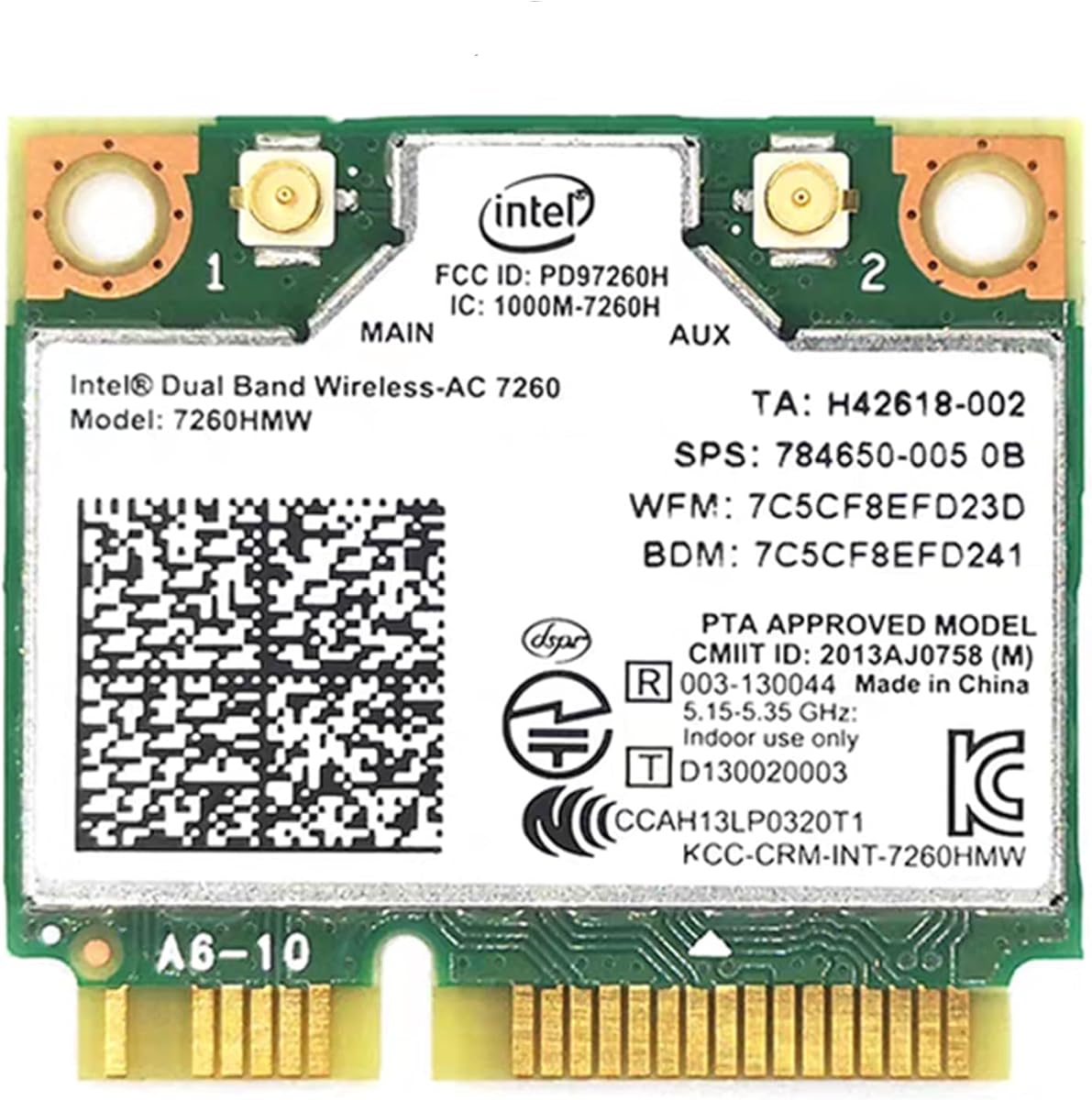


The 7260HMW Mini PCIe is a conventional dual-band upgrade for compatible laptops that need faster wireless performance and integrated Bluetooth. Its listed 4.6 rating reflects a generally favorable user impression, while the specifications position it as an 802.11ac card capable of 300Mbps on the 2.4GHz band and 867Mbps on 5GHz. That makes it a familiar middle ground for systems that need more capability than 802.11n provides.
We may earn a commission when you buy through this link, at no additional cost to you.
The principal advantage is straightforward dual-band operation. A 2.4GHz network can offer broader reach in crowded spaces, while the 5GHz band is better suited to high-bandwidth activities such as streaming, downloads, and online gaming where a cleaner spectrum is useful. Bluetooth 4.0 adds support for headsets, speakers, keyboards, mice, and other peripherals without requiring a separate USB adapter, which helps reclaim a valuable USB port.
Its age is the main trade-off. Bluetooth 4.0 lacks the speed, range, and energy-efficiency improvements associated with newer Bluetooth releases, and 802.11ac does not offer the multi-link, tri-band, or wider channel capabilities found in modern WiFi standards. Compatibility can also vary by laptop, so confirming the presence of a genuine half Mini PCIe slot and compatible antennas remains essential.
This card is most appropriate for an older Windows laptop that supports half Mini PCIe and where a reliable 802.11ac upgrade is more valuable than access to the latest wireless generation. It is a sensible choice for users who want dual-band WiFi and convenient Bluetooth without moving to a more demanding platform. For newer systems, consider an AX210HMW or BE200 option after confirming hardware support.
The ability to use both 2.4GHz and 5GHz networks gives this card more flexibility than a single-band adapter. Users can favor the 5GHz connection for speed or select 2.4GHz when distance and wall penetration matter more.
Integrated Bluetooth 4.0 is useful for peripherals that have no wired alternative. It is especially helpful in compact laptops where every USB port may be needed for charging, storage, or an external display.
We may earn a commission when you buy through this link, at no additional cost to you.
The MQUPIN 7260.HMW combines Intel-style 7260.HMW compatibility with dual-band 802.11ac operation and Bluetooth 4.0. Its 4.3 rating indicates a mixed but generally satisfactory reception. The card lists support for numerous 32-bit and 64-bit versions of Windows 7, 8, 8.1, and 10, as well as Linux kernel 4.2.0 or later, making it useful when an older operating system must be retained.
We may earn a commission when you buy through this link, at no additional cost to you.
The card can provide up to 867Mbps on 5GHz while offering a 300Mbps rate on 2.4GHz. It also lists 80MHz channel bonding, improved multi-user capacity, and better data-transmission efficiency than 802.11n. Its broad range of potential hosts includes laptops, desktop computers, small consoles, all-in-one systems, advertising machines, and other equipped devices, provided they have the required half Mini PCIe interface.
The most important installation caveat concerns Bluetooth. The supplied information says the Bluetooth function travels over a USB bus, so the motherboard must expose and enable that bus. Otherwise, Bluetooth hardware may not appear in Device Manager. Compatibility exclusions also apply to certain IBM, ThinkPad, Lenovo, and HP laptop implementations, so the seller should be contacted before purchase if the exact model is uncertain.
Buyers should choose this card when preserving support for older Windows or Linux systems matters more than obtaining current WiFi or Bluetooth capabilities. Its installation process is less predictable than the driver-focused AX210 alternatives because hardware and bus support vary. It remains a functional option for a compatible older computer, but careful model verification is essential.
Support extending from Windows 7 through Windows 10 and into Linux gives this card a wider legacy appeal than many newer models. It remains a practical choice when the host operating system cannot run current wireless drivers.
Bluetooth is not independent of the system’s internal wiring. Confirming that the relevant USB bus is exposed and enabled before buying can prevent the card’s WiFi side from working while its Bluetooth side remains unavailable.
We may earn a commission when you buy through this link, at no additional cost to you.
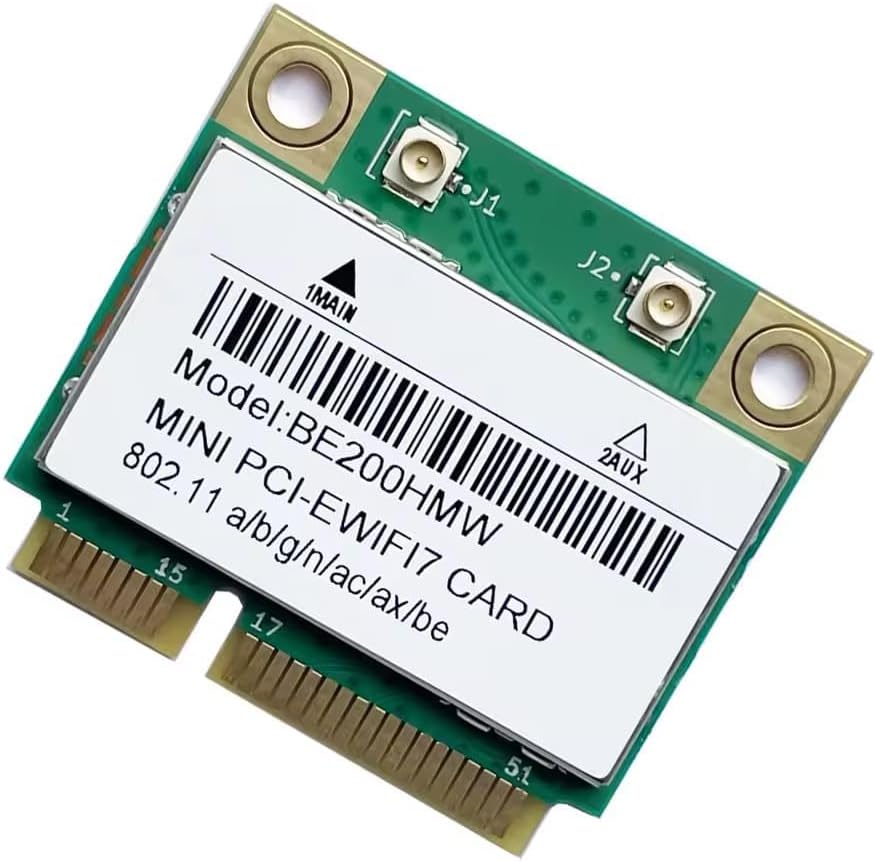
The Wireless BE200 Half Mini PCIe represents the premium end of this roundup, combining a stated throughput of up to 5.8 Gbps with Bluetooth 5.4. Its 4.6 rating is especially notable given the card’s high-end positioning. Unlike the older 7260 and AR5B22 options, this model targets the Wireless BE generation and is aimed at systems whose hardware and drivers can actually support that standard.
We may earn a commission when you buy through this link, at no additional cost to you.
Its headline capability is speed. The stated 5.8 Gbps figure makes it attractive for demanding downloads, smooth high-resolution streaming, low-latency online gaming, and busy networks handling several active clients. Bluetooth 5.4 expands support for low-energy accessories such as headsets, keyboards, mice, and printers. Security features include WPA, WPA2, and WPA3 encryption, while Intel Smart Connect and wireless display technologies add convenience to compatible hosts.
Compatibility is the decisive limitation. The card fits a half Mini PCIe slot, not an M.2 or CNVi slot, and the host must support the Wireless BE series. Antennas and mounting screws are not included, so buyers must reuse compatible existing antenna hardware or obtain the necessary parts separately. A high headline rate also does not guarantee that the connected router, internet connection, signal environment, and client device can realize the same performance.
This is the strongest recommendation for a compatible system that wants a long-lasting, high-speed wireless upgrade without abandoning the half Mini PCIe format. It is less suitable for an ordinary older laptop whose BIOS, chipset, drivers, or antennas cannot support Wireless BE. Confirm the slot and platform requirements before purchase, then treat the advertised rate as a theoretical maximum rather than a guaranteed everyday result.
A potential 5.8 Gbps makes this card suitable for users who routinely move large files, operate a crowded connected household, or want headroom for future network equipment. Actual performance will be governed by the router and client link.
WPA3 support improves the card’s appeal for current and future network environments. Bluetooth 5.4 also provides a better foundation for energy-conscious accessories than the older Bluetooth versions found in several other picks.
We may earn a commission when you buy through this link, at no additional cost to you.
The EDUP Intel AX210HMW is the most balanced all-around recommendation in this guide. It combines WiFi 6E tri-band operation, Bluetooth 5.3, and a maximum combined rate of 5400Mbps. Its 4.5 rating reflects a strong overall reception, while its support for Windows 10, Windows 11, and Linux kernel 5.10 or later makes it broadly relevant to modern upgrades.
We may earn a commission when you buy through this link, at no additional cost to you.
The AX210HMW operates across 2.4GHz, 5GHz, and 6GHz. Listed maximum rates are 574Mbps at 2.4GHz and 2400Mbps on each of the 5GHz and 6GHz bands. Uplink Multi-User MIMO helps serve several clients, making the card useful in busy homes and offices. Bluetooth 5.3 supports common accessories such as headsets, stereo equipment, keyboards, and mice without requiring a separate dongle.
The card is designed for compatible notebooks and mini PCs with half Mini PCIe interfaces. It lists a broad set of potential manufacturers, including Samsung, Dell, Sony, Acer, ASUS, MSI, Clevo, Terransforce, and Hasee, but excludes some IBM, ThinkPad, Lenovo, HP, and AMD motherboard implementations. Driver installation is required, and the seller provides a link for obtaining drivers from Intel or EDUP. Linux users may also need to compile support.
This is the best general choice for a compatible laptop that needs modern tri-band WiFi and current Bluetooth without moving to a full Wireless BE platform. It balances performance, operating-system relevance, and clear upgrade guidance better than the 802.11n and 802.11ac alternatives. Verify the host whitelist and slot first, prepare the drivers before removing the existing adapter, and keep the original antenna system in place.
The 6GHz band can provide additional channel capacity and reduced interference in suitable environments. Keeping all three bands available makes the adapter adaptable to different routers, distances, and congestion levels.
Uplink Multi-User MIMO is particularly relevant when several devices transmit at once. It can improve efficiency and make concurrent streaming, calling, downloading, and gaming more manageable.
Bluetooth 5.3 allows common peripherals to connect directly through the card. That is especially convenient for laptops that lack built-in Bluetooth and have limited USB ports.
We may earn a commission when you buy through this link, at no additional cost to you.
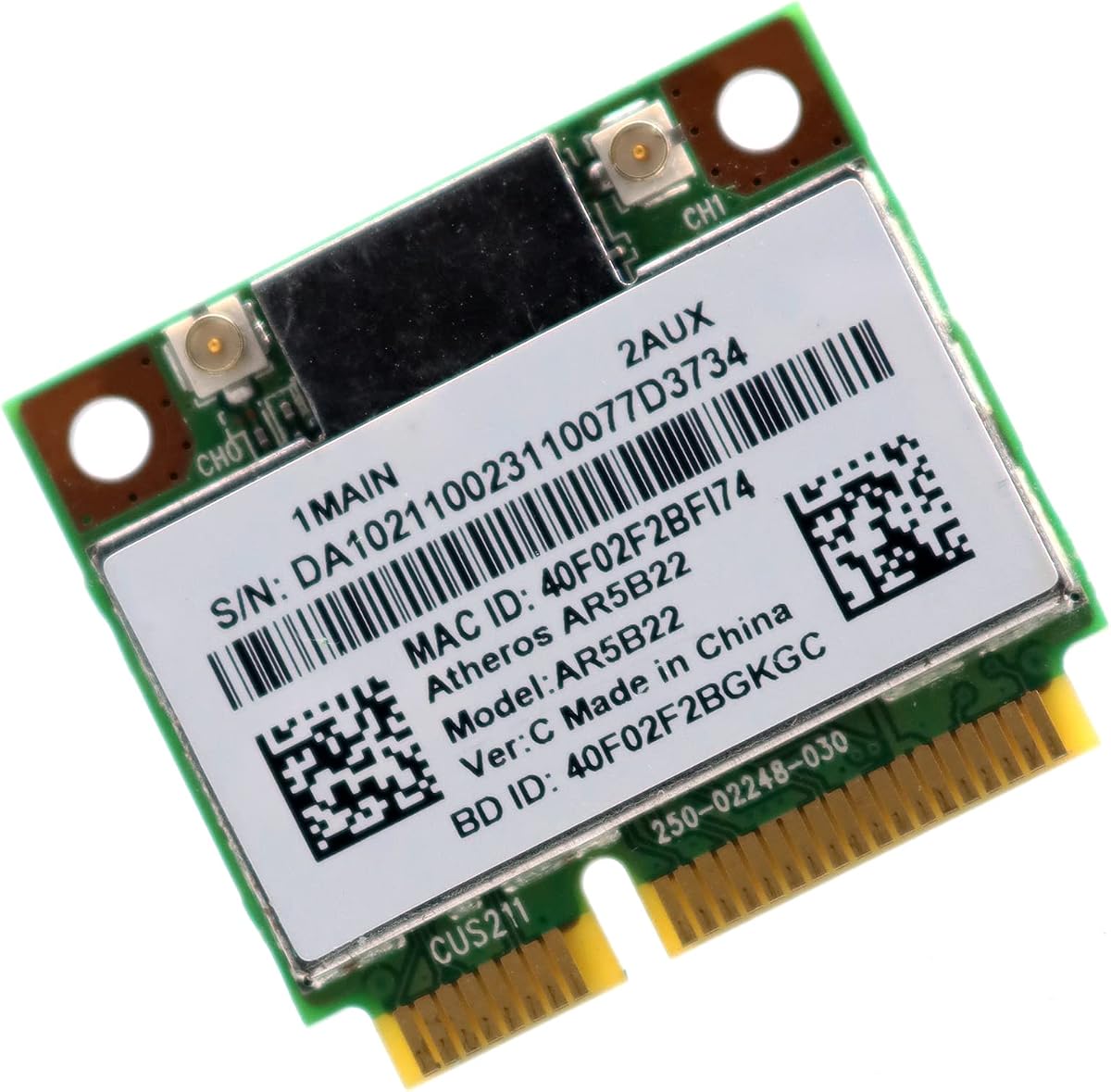
The Deal4GO AR5B22 is a legacy-focused 802.11n card with a strong 4.7 rating. It targets systems using the half Mini PCIe interface and provides dual-band WiFi plus Bluetooth 4.0. Its measured board dimensions of 26.8 by 30 by 2.4mm follow the half-size format, making physical fit more predictable for compatible laptops and industrial PCs.
We may earn a commission when you buy through this link, at no additional cost to you.
The adapter supports 2.4GHz and 5GHz IEEE 802.11a/b/g/n operation. Listed data rates reach 300Mbps on either band, with Bluetooth 4.0 available for peripheral connections. Two IPEX MHF4 connectors support separate main and auxiliary wireless paths. The package includes the card and two screws, which is useful when the original fasteners are missing.
The product explicitly does not support 802.11ac, and this limitation prevents it from taking full advantage of modern dual-band routers. Compatibility is also restricted for certain Lenovo, IBM, and HP laptops, which may require BIOS whitelist modification. Windows support is broad, extending through Windows 10 in 32-bit and 64-bit versions, including older releases such as XP.
Choose the AR5B22 when restoring dependable basic connectivity is more important than maximizing speed or using recent Bluetooth. It is well suited to an aging laptop, industrial computer, or older small-form-factor system that already uses the stated AR5B22 or AR9462 ecosystem. Users seeking WiFi 6E or 802.11ac should look at the AX210HMW or another modern option instead.
Broad operating-system support makes the AR5B22 useful for older machines whose wireless hardware has failed. Its standardized half-size board is easier to match against known-compatible systems than a current-generation module.
The two IPEX MHF4 connectors support main and auxiliary antenna paths. Existing compatible antennas can often be reused, but their connectors and placement should be checked before removing the old card.
We may earn a commission when you buy through this link, at no additional cost to you.
The WiFi 6E Mini PCIe Card combines tri-band operation, a stated combined rate of 5400Mbps, and Bluetooth 5.3. Its 4.6 rating places it among the strongest products in the comparison. It is aimed at reviving an older compatible laptop with a modern standard without requiring the more restrictive Wireless BE platform of the BE200.
We may earn a commission when you buy through this link, at no additional cost to you.
The card offers 2400Mbps on 5GHz and 2400Mbps on 6GHz, alongside lower-band operation on 2.4GHz. Support for 160MHz channels is central to the listed throughput, while the 6GHz band provides additional channels that can reduce interference from neighboring networks. Bluetooth 5.3 allows keyboards, mice, headsets, and game controllers to connect without a USB adapter.
Users need a WiFi 6E router to access the 6GHz benefits. The supplied information also states that Lenovo, HP, and IBM laptops are not compatible because of BIOS whitelisting, while several brands such as Dell, ASUS, Samsung, and Acer are supported. Windows 10 and 11 in 64-bit mode are the only stated operating systems. Drivers should be downloaded before the existing card is removed.
This model suits a compatible Windows laptop that regularly handles large transfers, streaming, gaming, or several simultaneous network tasks and has access to WiFi 6E equipment. It is less suitable for systems requiring Windows 7 or 8 support, brands with strict card whitelists, or users whose router supports only older standards. Confirm every restriction before ordering.
The 6GHz band adds channels that may be less congested than those in the 2.4GHz and 5GHz bands. Its practical value depends on router support, nearby interference, and the device’s distance from the access point.
Downloading the driver before removing the original adapter avoids the inconvenience of having a new card installed with no way to obtain its software. The card also indicates that compatible existing antennas can be reused.
We may earn a commission when you buy through this link, at no additional cost to you.
The MPE-AX3000H is a dual-band WiFi 6 option designed to modernize compatible laptops. Its 4.5 rating indicates a favorable overall reception, and the listed maximum rate of 2.4Gbps on 5GHz, plus 574Mbps on 2.4GHz, gives it a substantial capacity advantage over older 802.11n and many 802.11ac adapters.
We may earn a commission when you buy through this link, at no additional cost to you.
The card uses 160MHz channels and supports OFDMA, MU-MIMO, and WPA3. These technologies are valuable in busy networks where many devices share limited channels. Bluetooth 5.2 allows common headphones, speakers, keyboards, and mice to pair with the laptop. The product is positioned as an alternative to Intel 7260 or 7265 modules for systems that can accept a replacement half Mini PCIe card.
There are important restrictions. It fits Mini PCIe only and will not work in NGFF M.2 or CNVio slots. Most Lenovo systems, including ThinkPad models, IBM systems, and some HP laptops are excluded because of BIOS whitelists or hardware design. Windows 10 and 11 in 64-bit mode are required. Both WiFi and Bluetooth drivers must be downloaded manually, and the service manual should be consulted before purchase.
The MPE-AX3000H is a good option for a compatible Dell, Acer, ASUS, MSI, Clevo, or similar laptop that needs dual-band WiFi 6 and Bluetooth but does not need the extra 6GHz band of an AX210HMW. Its main appeal is efficient performance in crowded modern networks. Buyers should prioritize model-level compatibility and driver preparation over selecting on theoretical speed alone.
OFDMA and MU-MIMO allow the access point and adapter to manage multiple transmissions more efficiently. These features are particularly helpful when several people stream, call, game, or download at the same time.
The card is presented as a modern replacement for Intel 7260 and 7265 modules. That makes it worth examining when the intended laptop already has the antennas and physical clearance required for this form factor.
Bluetooth 5.2 provides a meaningful improvement over Bluetooth 4.x accessories while remaining suitable for standard keyboards, mice, and headsets. It also helps avoid dedicating a USB port to a wireless receiver.
We may earn a commission when you buy through this link, at no additional cost to you.
The BroadCom BCM943228HMB is the budget-oriented choice for repairing older laptops and compact systems. Its 5.0 rating is the highest listed among the products, and the card provides the basic combination of dual-band 802.11n WiFi, Bluetooth 4.0, and a half-size Mini PCIe interface. It is most relevant when restoring functionality matters more than accessing modern high-speed bands.
We may earn a commission when you buy through this link, at no additional cost to you.
The adapter supports 2.4GHz and 5GHz operation under IEEE 802.11a/b/g/n, with a listed maximum rate of 300Mbps. Its half-size Mini PCI Express format fits compatible slots, and the supplied information cites numerous HP and Compaq models as well as laptops from Samsung, Dell, Sony, Acer, ASUS, MSI, Clevo, Terransforce, and Hasee. Technical support is also advertised by the seller.
Its limitations are inherent in the older design. It does not offer the throughput, channel width, multi-user features, or security progression of WiFi 6E and WiFi 7 products. IBM, ThinkPad, and Lenovo laptops are specifically excluded. Compatibility with Windows 2000, XP, Vista, 7, and 10 in both 32-bit and 64-bit forms is useful for legacy equipment, but actual driver availability should be confirmed for the intended machine.
Choose the BCM943228HMB for a compatible aging laptop that only needs dependable 2.4GHz and 5GHz wireless access, or for a system whose architecture and drivers make current AX-series modules unsuitable. It can be a practical way to restore a failed connection without pursuing the newest standard. For a newer computer, an AX210HMW or BE200 card offers far more future-facing capability.
This card’s broad legacy operating-system support is valuable for systems that predate current driver packages. It can provide basic connectivity where the original wireless hardware has failed and the physical platform remains compatible.
The listing identifies HP part numbers 718449-001 and 718451-001 and names several HP and Compaq laptop families. Those references can help buyers match the card to systems that used the same original module.
We may earn a commission when you buy through this link, at no additional cost to you.
The Intel Dual Band Wireless-AC 7260 Half Mini Card is a recognizable upgrade option for systems originally designed around the Intel 7260 platform. It carries a 4.3 rating and is listed under the familiar half Mini PCIe format. The concise product information identifies it as an Intel dual-band wireless-ac adapter with Bluetooth capability.
We may earn a commission when you buy through this link, at no additional cost to you.
The appeal of this card comes largely from platform familiarity. Many older laptops and compact PCs used 7260-family modules, so buyers may already understand the card dimensions, antenna arrangement, driver expectations, and installation procedure. Its established identity can also make it easier to match against an original part number or equivalent hardware than with a less familiar modern module.
The supplied data is limited, however, and does not state detailed band rates, supported operating-system versions, antenna connector types, or compatibility exclusions. That makes model verification especially important. Buyers should not infer that every older laptop supports this card simply because it uses the half Mini PCIe form factor. BIOS whitelists, antenna connectors, chassis clearance, and driver support can still prevent a successful installation.
This option is best for a compatible laptop that previously used an Intel 7260 module or another confirmed 7260-compatible card. It offers a familiar way to restore dual-band 802.11ac connectivity and Bluetooth without moving to a newer driver ecosystem. For users who can access more complete specifications, one of the AX210HMW or BE200 choices may offer a clearer long-term upgrade path.
The 7260 name has long been associated with half Mini PCIe laptop upgrades. Buyers replacing the same general module family can benefit from an installation process that may closely resemble their previous repair.
Half Mini PCIe describes physical size, not guaranteed compatibility. Before buying, check the exact laptop model, original part number, antenna connectors, BIOS behavior, and available operating-system drivers.
We may earn a commission when you buy through this link, at no additional cost to you.
The Intel 7260HMW BN is a specific replacement option for certain HP laptops rather than a general recommendation for every half Mini PCIe computer. Its 4.2 rating is the lowest listed in the guide, but the product’s relevance depends on whether its 7260HMW BN hardware and referenced part numbers match the failed card in the target laptop.
We may earn a commission when you buy through this link, at no additional cost to you.
The listing identifies 802.11b/g/n WiFi, Bluetooth, half Mini PCI Express construction, and HP references 717384 and 710661-001. Those details can help owners of matching systems identify a direct replacement. A combo adapter is convenient when the original module handled both wireless networking and Bluetooth, particularly in an HP laptop that lacks a built-in Bluetooth option.
The product information does not provide a detailed band-rate breakdown, operating-system list, antenna connector information, or a broad model-compatibility chart. As a result, buyers should verify the original card label and part number rather than relying only on the general Intel 7260HMW name. A visually similar card can still differ in antenna layout, Bluetooth routing, or firmware behavior.
This is the most appropriate pick for someone repairing an explicitly compatible HP laptop and seeking the closest match to the identified module. It is not a compelling choice for a general-purpose modern upgrade because its 802.11n generation lacks the performance and features of the AX210HMW and BE200 alternatives. Confirming the machine’s service manual and existing part number should come before ordering.
The listed HP part numbers provide the most useful starting point for identification. Compare them with the label on the failed adapter and use the laptop service manual to confirm the required form factor and antenna arrangement.
A combo card can restore both network access and Bluetooth in one replacement. This is useful when the original half Mini PCIe module handled both functions and the laptop has no separate internal Bluetooth solution.
We may earn a commission when you buy through this link, at no additional cost to you.
A useful purchase decision starts with the host computer rather than the advertised link rate. Confirm the physical slot, hardware restrictions, antenna arrangement, operating system, and router capabilities before comparing wireless standards.
Half Mini PCIe, full Mini PCIe, M.2, and CNVi are different interfaces with different dimensions, electrical behavior, and system support. A card may have a similar shape while failing to fit or operate correctly. Identify the slot in the laptop or compact computer, check the service manual, and compare the module dimensions rather than relying on a broad listing description. The Deal4GO AR5B22, for example, explicitly measures 26.8 by 30 by 2.4mm and does not fit M.2 NGFF slots.
Many business-oriented laptops restrict third-party wireless modules through BIOS whitelisting. Several products in this guide specifically warn that Lenovo, ThinkPad, IBM, and some HP models may reject the card. The restriction applies even when the physical card fits. Look for the exact laptop model in the manufacturer’s support material, check whether the BIOS contains a wireless allowlist, and confirm whether the option can be enabled or removed only by a technician familiar with that restriction.
Older 802.11n cards are adequate for basic browsing and legacy equipment, while 802.11ac provides faster dual-band links and broader support for current routers. WiFi 6 models add efficiency and wider channels, while WiFi 6E introduces the 6GHz band and WiFi 7 raises the potential throughput further. Choose based on the host’s drivers and the user’s router rather than assuming that a faster card improves every connection. A modern card in an old operating system may not receive suitable drivers.
Bluetooth 4.0 supports standard peripherals such as headsets, speakers, keyboards, and mice, while Bluetooth 5.2, 5.3, and 5.4 provide improvements in speed, range, energy efficiency, and modern accessory support. The newest listed Bluetooth version does not guarantee that every newer accessory function is available on the host. Also check how Bluetooth is routed. The MQUPIN 7260.HMW explicitly requires the motherboard to expose a USB bus, and a card may install successfully for WiFi while leaving Bluetooth unavailable.
Wireless rates are maximum theoretical values under favorable conditions, not guaranteed application speeds. The router must support the same standard and band, signal quality must be good, and the internet connection must be fast enough to use additional capacity. The BE200 card lists up to 5.8 Gbps, while the AX210HMW and WiFi 6E AX210 option list 5400Mbps combined. The 7260HMW reaches 867Mbps on 5GHz, and older 802.11n cards list much lower maximum rates. For ordinary browsing, the practical difference may be smaller than the headline figures suggest.
Wireless cards depend on external antennas, and a module may not include them. The BE200 listing explicitly excludes antennas and screws, while the Deal4GO AR5B22 includes two screws and identifies two IPEX MHF4 connectors. Check which connector type the laptop uses, where the antenna leads terminate, and whether cable routing and adhesive pads remain available after opening the chassis. Reusing a compatible original antenna setup is generally preferable to improvising with hardware that has not been matched to the card.
Wireless cards depend on compatible drivers, and support can differ substantially between operating systems. The 7260HMW lists Windows 7 through 10, the AR5B22 supports older Windows releases, and the AX210HMW requires Windows 10 or 11 in 64-bit mode plus driver installation. Linux compatibility also varies, with some products requiring kernel support or source compilation. Download the driver before removing the working card so the computer remains network-accessible during the change.
The best card cannot create features the network does not provide. A WiFi 6E card needs a WiFi 6E router to use the 6GHz band, while a WiFi 7 card needs compatible Wireless BE equipment for its full potential. Older routers may allow the card to connect but negotiate a lower standard. Check the router’s bands, channel width, security mode, and management settings. In crowded environments, 6GHz availability or a capable WiFi 6 router can matter more than the card’s headline maximum rate.
Begin by documenting the current wireless card, antenna connections, part numbers, and computer model. Remove the laptop from power, open the chassis according to the manufacturer’s procedure, and disconnect the antenna leads carefully rather than pulling on the wires. Compare the replacement card with the original module and verify that the slot type, screw holes, connector positions, and clearance all align before inserting anything.
Install the new card at a shallow, even angle so it does not force against the connector or underside of the chassis. Reconnect the appropriate antenna leads, secure the module with the correct fasteners, and reassemble the computer. Power it on and install the WiFi and Bluetooth drivers before attempting to configure a network. If the adapter does not appear, revisit the BIOS whitelist, USB bus, antenna arrangement, and driver architecture before assuming the card has failed.
After installation, connect the computer to the intended WiFi network and confirm that the link rate, signal strength, and activity look normal. Pair Bluetooth accessories through the operating system’s device manager or settings screen, and test both short-range and longer-range connections where appropriate. Keep the card seated securely, preserve the original antenna layout, and avoid repeated chassis work when a software or driver update can resolve the issue.
Half Mini PCIe and M.2 are physically and electrically different interfaces. Half Mini PCIe cards are generally about half the length of a full Mini PCIe module and use a distinct connector layout, while M.2 comes in several lengths and key configurations. A card that fits an M.2 slot may still not work in a Mini PCIe slot, and vice versa. Check the computer’s service manual and the exact slot before purchasing.
It can if the desktop motherboard or add-in card provides a compatible half Mini PCIe slot with the correct electrical connections and antennas. Some small-form-factor PCs, industrial systems, and all-in-one computers use this interface, but many desktop boards do not. Bluetooth may also require access to internal USB connections. Confirm both the physical slot and the Bluetooth wiring requirements before buying.
The operating system may have installed the card but not completed driver setup, or the computer may be restricting third-party adapters through its BIOS. A weak or disconnected antenna can also prevent a usable link even when the card is recognized. Check Device Manager for driver errors, verify the antenna connectors, inspect BIOS security settings, and confirm that the correct driver version supports the installed operating system.
Bluetooth on some half Mini PCIe cards depends on an internal USB bus. If the motherboard does not expose or enable that bus, the WiFi side may work while Bluetooth does not appear as a device. The MQUPIN listing specifically highlights this requirement. Inspect the device manager for missing USB or Bluetooth hardware, verify the internal cable connections, and contact the computer manufacturer before replacing the card.
It can, provided the laptop supports the AX210HMW or a comparable module, the operating system has suitable drivers, and the router operates on WiFi 6E networks. The 6GHz band can provide additional channel capacity and reduce congestion in suitable locations. If the router only offers older bands, the card will connect using the best mutually supported standard and may not deliver the advertised aggregate rate.
They are theoretical maximum link rates rather than guaranteed file-transfer or internet speeds. Real performance depends on the router, distance, walls, interference, antenna placement, operating system, and network provider. Older 802.11n cards listed at 300Mbps, for example, may still handle ordinary browsing and local transfers well, while newer cards offer more capacity in busy or high-speed environments.
Some models can accept compatible cards, but the products in this guide repeatedly warn that BIOS whitelisting or special hardware designs may block third-party modules. The risk varies by manufacturer and exact model. Search the laptop’s service information, identify its original card part number, and check the BIOS for a wireless whitelist before ordering. Avoid assuming that a matching physical slot guarantees acceptance.
That depends on the card and the computer. The BE200 listing states that antennas and screws are not included, while the AR5B22 package includes two screws and the computer’s existing antennas may be reusable. Check connector types and cable lengths before disassembly. If the original antenna hardware is missing or incompatible, obtain the correct parts in advance rather than attempting to install the module without them.
The BroadCom BCM943228HMB is the budget choice for restoring basic dual-band connectivity in a compatible legacy computer. The EDUP Intel AX210HMW is the strongest all-around recommendation because it combines tri-band WiFi 6E, Bluetooth 5.3, useful operating-system guidance, and modern multi-user features. At the premium end, the Wireless BE200 Half Mini offers the greatest stated throughput and newest wireless generation, but only when the computer, drivers, antennas, and router can support it.
For most buyers, compatibility should drive the decision more than maximum speed. Confirm the half Mini PCIe slot, laptop model, BIOS restrictions, antenna connectors, operating system, and Bluetooth routing before ordering. Once those checks pass, choose the card whose wireless standard matches the network and the tasks at hand. Older systems may benefit more from dependable 802.11n or 802.11ac connectivity, while a current high-performance computer may justify WiFi 6E or WiFi 7.
Finally, compare current product availability, warranty terms, included accessories, and prices at the time of purchase, because they can change. Download the appropriate drivers before removing the installed adapter and keep the original card available in case the new module proves incompatible. With those precautions, the right half Mini PCIe card can extend the useful life of a compatible laptop while adding faster WiFi and convenient Bluetooth.