
SJoyBring 7-Inch QLED Stereo
4.3Editor score
Wireless CarPlay and Android Auto
Seven-inch QLED touchscreen
Included rear-view camera
Android Double Din car stereos can modernize an older dashboard with smartphone navigation, wireless calling, app access, improved audio, and camera-assisted parking. The best model for your vehicle depends on screen size, connection method, sound controls, installation requirements, and whether you need a native Android operating system rather than a conventional radio with Android Auto.
We compared all ten receivers across connectivity, display quality, audio adjustment, camera support, amplifier capability, installation considerations, and practical feature sets. The guide includes both Android Auto-compatible head units and full Android systems, helping readers distinguish between vehicle displays, open app platforms, and dedicated navigation receivers.
Each review explains the strongest reasons to consider a particular model, along with limitations that could affect compatibility or daily use. Ratings and product details can change over time, and current prices, promotions, and availability also fluctuate, so shoppers should verify the latest listing and vehicle fit before purchasing.
4.3Editor score

4.4Editor score

4.4Editor score
As an Amazon Associate we earn from qualifying purchases.
The table below compares display size, smartphone connectivity, audio flexibility, and camera readiness across all ten models, revealing the key differences between conventional Android Auto receivers and full Android head units.
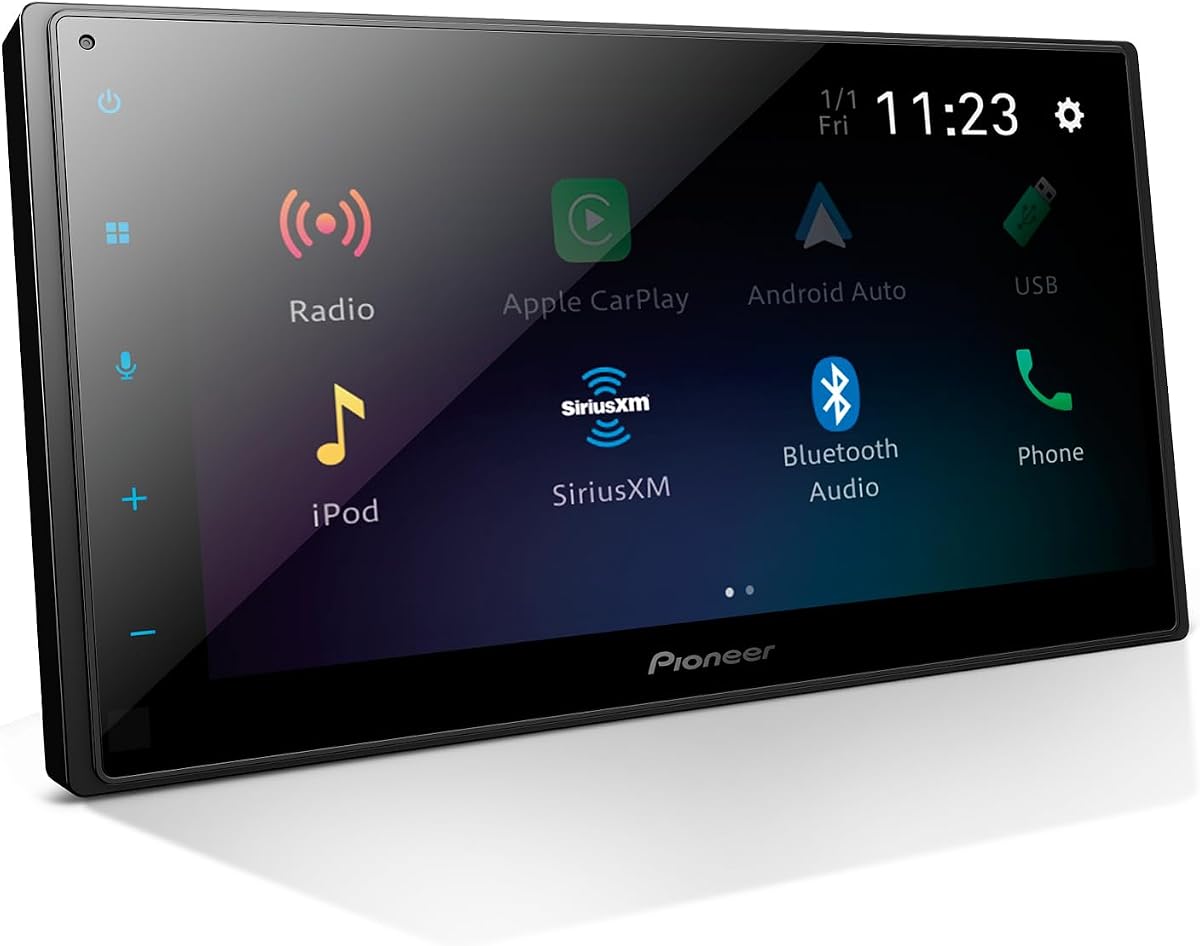


The SJoyBring 7-Inch QLED Stereo holds a 4.3 rating and stands out as a feature-rich budget upgrade for vehicles with a suitable double-DIN opening. Its headline combination is wireless Apple CarPlay and Android Auto, a seven-inch 1280 by 720 QLED screen, 4.2-channel audio, steering-wheel-control support, and an included rear-view camera. That broad bundle makes it unusually useful straight out of the box.
We may earn a commission when you buy through this link, at no additional cost to you.
The display is one of the main reasons to consider this model. Its stated 1280 by 720 resolution and support for 1080p video playback should make maps, app icons, and camera imagery more detailed than on lower-resolution displays. Wireless phone integration reduces the need to connect a cable every time you enter the vehicle, while Bluetooth voice commands provide a more convenient way to manage music, navigation, and messages.
Audio flexibility is another strength. The head unit provides front and rear speaker outputs along with two subwoofer outputs, and its custom equalizer settings allow basic tuning for different vehicles. The included rear camera can automatically appear when reverse is selected, while front-camera support adds installation flexibility. Steering-wheel control is supported, although the necessary additional interface is not included.
The main caveat is installation compatibility. The stated faceplate size is 6.69 by 3.81 inches, so buyers must confirm their dashboard opening and may need a separate dash kit, wire-harness adapter, or radio-antenna adapter. It also does not support a Wi-Fi hotspot connection. Despite those caveats, this is the most compelling budget choice for someone seeking modern connectivity, a sizable screen, and a supplied parking camera.
The seven-inch QLED display gives maps, messages, and music artwork a generous canvas, while the listed resolution should keep text and icons relatively crisp. It is particularly useful for drivers who rely on visual navigation but still want a smaller footprint than many large-screen head units.
Four speaker outputs and dedicated subwoofer connections provide room for a conventional upgraded sound system, while the included rear camera removes one common purchase from the installation equation. Front-camera support broadens its usefulness for forward visibility and recording setups as well.
We may earn a commission when you buy through this link, at no additional cost to you.
The Pioneer DMH-1600NEX has a 4.1 rating and offers a conventional, focused approach to dashboard upgrading. It combines a 6.8-inch WVGA capacitive touchscreen with wired Apple CarPlay and Android Auto, Bluetooth hands-free calling, a 13-band equalizer, and a dedicated rear-camera input. It is a sensible choice for buyers who prioritize dependable phone integration and sound adjustment over a full Android app platform.
We may earn a commission when you buy through this link, at no additional cost to you.
Its customizable audio is a major strength. The 13-band equalizer can be adjusted to account for different speaker sizes, factory or aftermarket speaker placement, and the acoustics of the cabin. Multiple EQ presets also make it easier to move between spoken content, music, and other sources without spending time on complex manual adjustments.
The receiver includes parking-guide features and customizable lines that can be displayed with a compatible backup camera. A full-screen camera view is also available, which can make reversing easier when the camera image is obstructed by cargo or poor lighting. Bluetooth calling uses the included external microphone, giving the unit a more conventional in-car communications setup.
Smartphone connectivity is limited to wired operation, which may disappoint drivers accustomed to cable-free phone pairing. In return, the product avoids the more demanding configuration requirements often associated with wireless integration. Professional installation is recommended, and vehicle-specific wiring or dashboard accessories may be necessary. For a straightforward 2-DIN receiver with serious equalization, it remains a well-balanced option.
The 13-band equalizer gives this conventional receiver more in-depth control than a basic factory-style radio. It is especially valuable for vehicles receiving new speakers, an amplifier, or a subwoofer because it allows the installer to shape the output around the cabin and equipment.
Wired CarPlay and Android Auto provide familiar navigation, calling, messaging, and media interfaces. A permanent cable route may be less convenient, but it offers a simple connection and can reduce uncertainty during a drive.
We may earn a commission when you buy through this link, at no additional cost to you.
The Pioneer DMH-W2770NEX carries a 4.0 rating and distinguishes itself through wireless Apple CarPlay and Android Auto, a 6.8-inch capacitive touchscreen, and Amazon Alexa support. It is designed for drivers who want a polished multimedia receiver with voice assistance and a broad set of smartphone functions, without moving into a full standalone Android head unit.
We may earn a commission when you buy through this link, at no additional cost to you.
Smartphone integration supports Maps, Music, Messages, Phone, Podcasts, and voice commands through the connected interface. Bluetooth adds hands-free calling and wireless audio streaming, giving the receiver a useful role even when a phone is not actively running CarPlay or Android Auto. The screen provides enough room for a modern dashboard layout without approaching oversized full-tablet dimensions.
Amazon Alexa functionality is delivered through the Vozsis smartphone app together with the Weblink app. This two-app arrangement makes the feature less immediate than a dedicated voice button, but it broadens the kinds of questions and commands drivers can access while traveling. A backup camera can also be installed to improve visibility and simplify reversing.
The listing does not highlight a detailed equalizer specification, so sound-focused buyers may want to confirm the receiver's exact controls before ordering. Its stated chassis dimensions are 7 inches wide, 3-7/8 inches deep, and 4-7/8 inches tall, making dashboard-fit verification important. Overall, this model is attractive for wireless convenience and Alexa integration, especially for compatible iPhone and Android users.
The receiver keeps the smartphone as the source of navigation, communication, and media rather than running a separate app ecosystem. That makes it easier to maintain than a full Android installation, while wireless pairing removes the need to plug in a cable on every journey.
Vozsis and Weblink bring Alexa into the vehicle through the phone, allowing compatible questions and commands beyond the standard phone-assistant environment. Setup takes an extra step, but the result can be useful for drivers who already rely on Alexa elsewhere.
We may earn a commission when you buy through this link, at no additional cost to you.
The BOSS Audio Systems BV9358B has a 4.1 rating and offers a broad collection of connectivity and expansion options. It has a seven-inch touchscreen, Apple CarPlay, Android Auto, USB and audio/video inputs, front and rear camera connections, Bluetooth, an external microphone connection, and steering-wheel-control compatibility.
We may earn a commission when you buy through this link, at no additional cost to you.
Its 80-watt-by-four-channel rated output is noteworthy for a head unit designed to drive multiple speakers. Front, rear, and subwoofer preamp outputs are also listed, giving installers several paths for building a more capable audio system. The included feature set therefore extends beyond basic phone mirroring and into meaningful vehicle customization.
Camera readiness is a major advantage. Separate front and rear inputs allow the unit to display both forward and backward views, which can support parking, monitoring, and recording needs. Steering-wheel-control operation can reduce the temptation to touch the screen, although the required interface module is sold separately and the Metra ASWC-1 is recommended.
The screen uses an 800-by-480 widescreen resolution, which is lower than the 1280-by-720 display offered by some competing models. It remains functional for maps and menus, but owners who place a high value on fine text and detailed graphics may find newer or higher-resolution units more satisfying. Professional installation is strongly encouraged, yet the expansive connection set makes this an attractive choice for feature-oriented drivers.
Front and rear camera inputs, USB, audio/video, microphone, speaker preouts, and subwoofer preouts make this receiver easy to incorporate into a broader system. The number of connections is unusually useful for installers who want to add cameras or powered audio components later.
Both major smartphone platforms provide access to navigation, communication, radio, music, podcasts, and supported third-party applications. Voice activation through Siri or Google Assistant helps keep interaction focused when hands are occupied.
We may earn a commission when you buy through this link, at no additional cost to you.
The BOSS Audio Systems BVCP9700A has a 4.1 rating and is a straightforward seven-inch receiver centered on Apple CarPlay and Bluetooth. The supplied information highlights a touchscreen interface, Siri activation, hands-free calling, wireless audio streaming, and support for services such as Spotify, Pandora, iTunes, and Apple Music subscriptions.
We may earn a commission when you buy through this link, at no additional cost to you.
Its strongest appeal is accessibility for iPhone drivers. CarPlay puts familiar icons and functions on the larger display, allowing calls, navigation, messages, and media to be accessed by touch or through Siri. Bluetooth expands the utility when the phone is not running CarPlay, particularly for basic hands-free calls and streamed music.
For someone who does not need a full Android operating system, the emphasis on one well-known phone ecosystem can be a feature rather than a limitation. A simplified interface may also be easier to learn than a more complex open platform. However, the available product information does not detail equalization, camera inputs, amplifier power, or Android Auto compatibility.
That limited specification makes this model best approached as a CarPlay-focused purchase rather than a complete multimedia head unit. Buyers who need extensive camera support, advanced sound tuning, or confirmed Android Auto functionality should compare a more fully documented receiver. For the defined use case, however, its large display, Siri integration, and familiar media features make it a clean choice.
CarPlay provides a recognizable set of navigation, communication, and entertainment functions without requiring extensive learning. That familiarity is especially valuable for drivers who want a modern dashboard without adopting a separate full Android ecosystem.
Hands-free calls and streaming from major music services cover the most common reasons to connect a phone to a head unit. It is a practical complement to the primary CarPlay experience rather than an attempt to duplicate every smartphone function.
We may earn a commission when you buy through this link, at no additional cost to you.
The Alpine iLX-W670 holds a 4.3 rating and is aimed at drivers who want a refined multimedia interface with serious audio control. It pairs a vibrant seven-inch double-DIN touchscreen with wired Apple CarPlay and Android Auto, Bluetooth hands-free calling, a customizable home screen, SiriusXM readiness, and 13-band graphic equalization.
We may earn a commission when you buy through this link, at no additional cost to you.
Its Sound Boost menu goes beyond a basic tone control. Bass and mid-bass boost, subwoofer adjustments, Lighting Link control for compatible Alpine PrismaLink subwoofer enclosures, and versatile crossover settings give installers and enthusiasts a broad set of options. The inclusion of six-channel time correction is especially useful for aligning sound across front and rear speakers.
PowerStack capability is a significant enthusiast-oriented feature because it allows compatible Alpine power amplifiers to mount directly behind the receiver, simplifying a compact and tidy installation. The unit also supports a custom background image, five-color key illumination, and a polished digital interface. These details can make an older cabin feel more contemporary without replacing the entire dashboard.
The tradeoff is wired-only smartphone connectivity, which may be less convenient for drivers accustomed to wireless pairing. SiriusXM also requires the appropriate tuner. Professional installation is advisable for a receiver with this level of integration, but for buyers planning a serious audio build, the iLX-W670 delivers one of the most compelling feature combinations in this roundup.
The combination of a 13-band EQ, six-channel time correction, adjustable crossovers, subwoofer controls, and Alpine-specific amplifier integration provides unusually deep control. It is a strong foundation for drivers planning multiple speakers, separate tweeters, or a dedicated subwoofer.
The seven-inch digital screen, customizable home image, key illumination, and Lighting Link compatibility improve the visual experience as well as the audio. These finishing touches help the receiver integrate with a carefully designed cabin rather than simply replacing the factory unit.
We may earn a commission when you buy through this link, at no additional cost to you.
The ATOTO A5L carries a 3.9 rating and represents a different category from conventional Android Auto receivers. It is a full Android head unit with 2GB of RAM, 32GB of storage, a seven-inch 1280 by 720 QLED touchscreen, and access to a large app catalog. Buyers who want more freedom than CarPlay and Android Auto provide will find that distinction important.
We may earn a commission when you buy through this link, at no additional cost to you.
The A5L supports wired and wireless CarPlay and Android Auto, along with MirrorLink for compatible content. It also offers three ways to reach the internet: Wi-Fi hotspot, Bluetooth tethering, and USB tethering. That flexibility is valuable for drivers who want navigation, entertainment, vehicle utilities, or other Android applications beyond the standard phone projection interfaces.
Its integrated amplifier is listed at 4x45W peak and 4x24W RMS, providing meaningful power for ordinary cabin speakers. A 24-band equalizer with nine presets and a digital signal processor offer more adjustment than many similarly priced conventional head units. Multi-device Bluetooth connectivity can pair a phone with third-party equipment such as OBD-II scanners or TPMS devices at the same time.
The 3.9 rating is the lowest among these ten products, and the 2GB RAM plus 32GB storage configuration is modest for an expansive Android platform. App performance and available storage may therefore be less generous than on higher-memory systems. Still, the A5L offers an unusually broad feature set and a clear path for owners who specifically want a standalone Android experience.
Unlike a conventional receiver that merely projects selected phone functions, the A5L can run compatible Android apps directly. That makes it better suited to owners who want navigation utilities, entertainment applications, or vehicle tools that do not appear within CarPlay or Android Auto.
Three internet methods, multi-device Bluetooth, a 24-band EQ, and a 4x24W RMS amplifier make the unit adaptable to different phones and speaker systems. It is a broad package for an entry-level native Android receiver, even if its memory is limited.
We may earn a commission when you buy through this link, at no additional cost to you.
The ATOTO S8L has a 4.1 rating and is the most technically elaborate native Android receiver in the list. It runs Android 15 with 4GB of RAM and 64GB of storage, supports wireless CarPlay and Android Auto, includes built-in 4G LTE, and includes a Bluetooth OBD scanner. The combination makes it much more than a conventional infotainment screen.
We may earn a commission when you buy through this link, at no additional cost to you.
Its 4G capability addresses a common problem in Android head units: wireless phone projection can occupy the Wi-Fi connection needed for online access. With a compatible SIM card, the S8L can maintain an independent internet connection, while USB tethering remains available as a backup. This supports standalone apps, streaming services, and online navigation without requiring a phone hotspot at all times.
Audio is another major strength. The DSP supports six assignable channels, custom 5.1-channel tuning, 32-band EQ, time alignment, adjustable crossovers, and a 24-bit DAC. Built-in output is listed at 4x45W peak and 4x25W RMS, while 3V RCA, optical S/PDIF, and subwoofer connections leave room for future system expansion.
The included Bluetooth OBD scanner can display vehicle data and support functions such as fault-code reading, TPMS monitoring, and airbag information through compatible applications. The screen uses a 550-nit dual-layer QLED panel with a 178-degree viewing angle, and the split-screen mode can place navigation and media side by side. The included diagnostic tool and 4G support distinguish it clearly, although camera accessories remain separate purchases.
Built-in 4G LTE lets the head unit remain online even when wireless CarPlay or Android Auto is using the phone's Wi-Fi connection. For long trips or areas with weak phone service, a compatible SIM-based connection can be a significant convenience.
The included Bluetooth OBD scanner can expose supported vehicle data and diagnostic information through the head unit and applications such as Torque. It adds a practical maintenance tool for drivers who want more than entertainment and navigation from an Android receiver.
We may earn a commission when you buy through this link, at no additional cost to you.
The Pioneer DMH-1800NEX holds a 4.4 rating and stands out as a refined conventional receiver for drivers who prefer a stable wired connection. It combines a 6.8-inch WVGA capacitive touchscreen with Apple CarPlay, Android Auto, Bluetooth hands-free calling, a 13-band equalizer, and a rear-camera input with parking guides.
We may earn a commission when you buy through this link, at no additional cost to you.
The 13-band equalizer is the core attraction for audio-conscious buyers. Drivers can tailor output to the vehicle's speakers, cabin, and any aftermarket equipment, while multiple presets provide faster starting points for different types of content. The included external microphone is designed for clearer hands-free communication through the integrated Bluetooth calling function.
The camera connection supports both customizable parking lines and a full-screen view, helping the driver evaluate the area behind the car. This is a practical safety and convenience feature, although the camera itself is not stated to be included. The receiver's standard 2-DIN design is intended to fit a wide range of vehicle dashboards, but professional installation is recommended unless the installer understands vehicle wiring.
Unlike some adjacent Pioneer models in this roundup, the DMH-1800NEX does not advertise wireless CarPlay or Android Auto. That is the main limitation for anyone who wants to leave the phone in a pocket or bag. In return, it provides a streamlined receiver design, strong sound customization, and one of the highest customer ratings among the products compared.
A 13-band EQ can correct speaker shortcomings, compensate for cabin reflections, and adapt the system as more audio equipment is added. It is the feature most likely to remain useful after the initial dashboard upgrade is complete.
Wired phone integration, an external microphone, a capacitive display, and parking-guide support cover the essential functions without the complexity of a full Android platform. It is a focused choice for drivers who value consistency and sound quality.
We may earn a commission when you buy through this link, at no additional cost to you.
The KENWOOD DMX709S eXcelon has a 4.4 rating and is the most well-rounded conventional receiver here. Its six-point-95-inch capacitive touchscreen, CarPlay, Android Auto, Bluetooth, HD Radio, USB playback, three camera inputs, 13-band graphic EQ, Time Alignment, and SiriusXM readiness create a broad feature set for a standard double-DIN installation.
We may earn a commission when you buy through this link, at no additional cost to you.
Connectivity is a major strength. Apple CarPlay supports navigation, calling, messaging, voicemail, Apple Music, and third-party streaming services, while Android Auto provides voice-controlled access to Google Maps, Waze, and compatible phone functions. Android USB mirroring is also listed for select devices, offering another route for displaying compatible smartphone content.
The three-camera arrangement is notably flexible. Rear-view input with adjustable parking guidelines supports conventional reversing, while the additional inputs allow more extensive front, rear, or auxiliary camera configurations. A 13-band graphic EQ and Time Alignment help create a more coherent soundstage by adjusting frequency response and the arrival time of sound from different speakers.
Media options are extensive. The USB port supports video, high-resolution FLAC, and compatible music files, while AM/FM includes HD Radio and SiriusXM-ready functionality. The SiriusXM tuner and cameras are optional purchases, so buyers should account for those extras if needed. Even with those considerations, the combination of rating, display, sound controls, camera flexibility, and broad platform support makes the DMX709S eXcelon the strongest all-purpose choice in the guide.
Unlike most conventional receivers with a single camera input, this model supports three. That creates room for a rear camera, front camera, and another auxiliary camera, making it useful for parking aids, monitoring, or recording-oriented builds.
Capacitive touch, a high-contrast LED-backlit screen, HD Radio, multiple media formats, smartphone platforms, and a flexible equalizer cover nearly every core dashboard need. The result is a versatile receiver that can serve as a daily driver or the center of a larger vehicle electronics setup.
We may earn a commission when you buy through this link, at no additional cost to you.
A useful Android Double Din car stereo should fit the dashboard, suit your phone, and provide the audio and camera connections you actually need. Comparing these factors before ordering can prevent an expensive mismatch between the head unit, vehicle wiring, speakers, and intended daily use.
Double-DIN describes a general installation format, but it does not guarantee that every receiver will fit every dashboard opening. Measure the available space, compare it with the unit's faceplate and chassis dimensions, and check whether the surrounding trim, climate controls, or factory display creates an obstruction. Some vehicles also require a model-specific faceplate, dash kit, harness, antenna adapter, or other installation hardware that is not included.
Choose the head unit only after confirming the physical opening and required accessories. A receiver with excellent features has little value if it cannot sit flush or connect safely to the vehicle.
Android Auto and CarPlay are phone-projection systems that reproduce selected apps and functions on the head-unit display. A native Android receiver instead runs its own operating system, often with access to a larger app catalog, multiple internet-connection methods, and features that do not appear inside Android Auto. Native systems can be more flexible, but they also involve more setup, storage management, and app compatibility questions.
Choose Android Auto or CarPlay for a familiar, phone-centered experience. Choose a native Android system when offline navigation, specialized vehicle utilities, or a broader application ecosystem is important.
Wireless CarPlay and Android Auto are more convenient because the phone can remain in a pocket or bag, while wired versions provide a constant physical link and sometimes a more predictable connection. Native Android units may support several networking methods, including Wi-Fi, Bluetooth tethering, USB tethering, and cellular service. Check both your phone's compatibility and the receiver's operating requirements before choosing.
If you dislike connecting a cable every day, prioritize wireless support. If consistency matters more, a wired system may be preferable, especially for shorter daily commutes.
Screen size affects map visibility, menu readability, and the visual balance of the dashboard. Seven-inch displays are common in this category, while the Pioneer models use slightly smaller 6.8-inch panels and the KENWOOD offers approximately 6.95 inches. Resolution also matters: the SJoyBring and ATOTO A5L specify 1280 by 720, whereas the BOSS BV9358B lists 800 by 480. Brightness, viewing angle, anti-glare construction, and night behavior can be just as influential as raw size.
Prioritize a readable, responsive display over the largest possible screen. Check that the layout does not overwhelm the dashboard or block essential climate controls.
A head unit's advertised wattage can help gauge its ability to drive standard speakers, but the cleanest result depends on the speakers, wiring, and system design. Look for useful equalization bands, presets, time alignment, crossover controls, RCA preouts, and dedicated subwoofer connections. Alpine's PowerStack capability, the ATOTO units' multi-channel DSP tools, and the Pioneer receivers' 13-band equalizers are especially relevant to drivers planning an upgraded audio system.
Match the receiver to the speakers you actually have now and may add later. Avoid choosing on wattage alone, and confirm the number and type of outputs before installation.
A compatible backup camera can make reversing easier by providing a clear view and adjustable parking guidelines. Some head units support only one camera, while the KENWOOD DMX709S supports three. The SJoyBring includes a rear camera and supports both front and rear views, whereas most other units require a compatible camera to be purchased separately. Confirm video format, connector type, guide-line behavior, and whether the camera is actually included.
Choose a one-camera receiver for ordinary reversing needs. Select a multi-camera model only when you have a specific front, auxiliary, or recording setup planned.
Steering-wheel control, external microphones, camera harnesses, radio antennas, USB cables, dash kits, and satellite-radio tuners are not uniformly included. The SJoyBring requires an additional interface for steering-wheel controls, the BOSS BV9358B also lists its interface separately, and the KENwood is SiriusXM-ready without including the tuner. Native Android systems may also require SIM plans, app purchases, or subscriptions for certain connected services.
Create a checklist of the accessories your car and listening habits require. Treat those accessories as part of the complete system cost and installation plan, not as optional details discovered afterward.
Begin by reading the receiver's manual and vehicle-specific wiring information before connecting anything. Confirm the dash opening, power connections, speaker-wire colors, antenna adapter, steering-wheel-control interface, and camera wiring. Professional installation is recommended for models that require complex integration, and it is especially sensible when the factory system includes vehicle-specific power, data, or camera lines.
Complete the initial setup while the vehicle is safely parked. Pair Bluetooth, establish the preferred Android Auto or CarPlay connection, choose audio and display settings, and calibrate the equalizer gradually at normal listening levels. For native Android receivers, create an administrator account, review app permissions, install only trusted vehicle-compatible software, and set up any required SIM card or tethering connection.
Maintain the system by keeping the screen and lens free of dust, using a soft microfiber cloth, and avoiding harsh cleaners on displays or camera glass. Review equalizer settings after changing speakers, check firmware or operating-system updates when instructed by the manufacturer, and keep the phone's operating system current for the best compatibility. Protect stored applications, downloaded media, and account information with a secure screen lock.
Android Auto projects selected functions and compatible apps from a connected phone onto the head-unit display. A native Android head unit runs its own operating system, downloads apps locally, and may support additional vehicle utilities, standalone navigation, cellular service, or internet connections that Android Auto does not provide. Native Android systems generally require more setup and storage management, while Android Auto is usually simpler and closely tied to the phone.
No. The double-DIN label describes a broad chassis and faceplate format, but dashboard openings, trim pieces, climate controls, and factory displays vary by vehicle. Measure the opening and check the receiver's dimensions before ordering. You may need a vehicle-specific dash kit, wiring harness, radio-antenna adapter, or other hardware, and some vehicles require modification for a clean fit.
Wireless pairing is usually more convenient because the phone does not need to be physically connected on every trip. A wired connection can be simpler, steadier, and easier to maintain with a permanently routed cable, depending on the phone and receiver. Check the compatibility list for the specific phone model and operating-system version, and confirm whether the receiver supports both wired and wireless operation.
The SJoyBring 7-Inch QLED Stereo includes a rear-view camera and also supports front-camera input. Most other listed receivers are camera-ready but require a compatible camera to be purchased separately. The KENWOOD DMX709S supports three camera inputs, while several Pioneer and BOSS models list a single rear-camera input. Verify the camera's connector, format, and included accessories before installation.
Many of the listed models provide preamp outputs or dedicated subwoofer connections, and the SJoyBring and ATOTO units include built-in amplifier channels. The Alpine iLX-W670 supports PowerStack mounting with compatible Alpine amplifiers, while the ATOTO S8L offers RCA, optical, and subwoofer outputs for future expansion. Check output type, voltage, channel count, and whether the included amplifier remains active when an external amplifier is added.
That depends on the head unit and vehicle. The SJoyBring supports steering-wheel controls but states that an additional interface is required, and the BOSS BV9358B also lists the interface as a separate purchase. Some vehicles have resistance-based controls, while others use a data bus that requires a vehicle-specific adapter. A compatible interface preserves volume, track, call, and voice-assistant functions when the installation is otherwise complete.
The ATOTO A5L uses 2GB of RAM and 32GB of storage, while the ATOTO S8L offers 4GB of RAM and 64GB of storage. More memory can improve app responsiveness, while more storage matters for downloaded maps, media, and offline tools. Buyers should also consider whether essential navigation apps are available and whether the manufacturer continues to provide operating-system updates.
Experienced installers may handle some straightforward installations, but professional installation is recommended whenever the vehicle uses complex wiring, steering-wheel controls, a factory camera, or a complex amplifier. Incorrect power, ground, speaker, or data connections can cause poor performance or damage. Even with a straightforward dashboard opening, following the manual and checking every connector before powering the unit is essential.
The SJoyBring 7-Inch QLED Stereo is the standout budget option because it combines wireless phone integration, a high-resolution seven-inch display, 4.2-channel output, and an included rear camera. The Alpine iLX-W670 is the strongest premium choice for detailed sound tuning and amplifier expansion, while the KENWOOD DMX709S eXcelon is the most balanced connected receiver with a high customer rating, three camera inputs, and broad media support.
Prioritize the features that will be used every day rather than the longest specification list. Confirm dashboard fitment first, then choose between phone projection and native Android based on navigation, app, and connectivity needs. After that, compare sound controls, amplifier connections, camera requirements, steering-wheel interfaces, and the installation hardware your vehicle actually needs.
Customer ratings and product information can change, while current prices, promotions, and availability fluctuate over time. Before ordering, verify the latest listing, warranty terms, compatibility details, accessory requirements, and return policy for your particular vehicle.