
Windtrace Automatic Pill Dispenser for Elderly with Alarm
4.0Editor score
Six programmable dosage rings
Loud audio and light alerts
28-compartment removable tray
Discover the best automatic pill dispenser options in 2026, with clear comparisons of capacity, alerts, locks, connectivity, and ease of use for seniors.
An automatic pill dispenser can make a complicated medication routine more predictable by storing doses in advance, signaling when medication is due, and helping prevent missed or duplicated doses. The right model should also be easy to fill, simple to operate, and appropriate for the number of medications taken each day.
This guide compares ten automatic pill dispensers based on capacity, alert options, locking features, app connectivity, moisture protection, dosage flexibility, and accessibility. It covers carousel, sliding-tray, and rising-pod designs so readers can compare practical features rather than judge by appearance alone.
Each review explains the strongest reasons to consider a particular model, along with its limitations and ideal user. Ratings and product details reflect the supplied information, while prices and availability may change, so readers should verify current listings and confirm compatibility with their medication schedule before purchasing.
4.0Editor score

4.5Editor score

4.2Editor score
The comparison below highlights the major differences among ten automatic pill dispensers, including their storage formats, reminder systems, locking mechanisms, and connectivity. It is designed to make it easier to identify the model that matches a specific medication schedule and level of caregiver oversight.

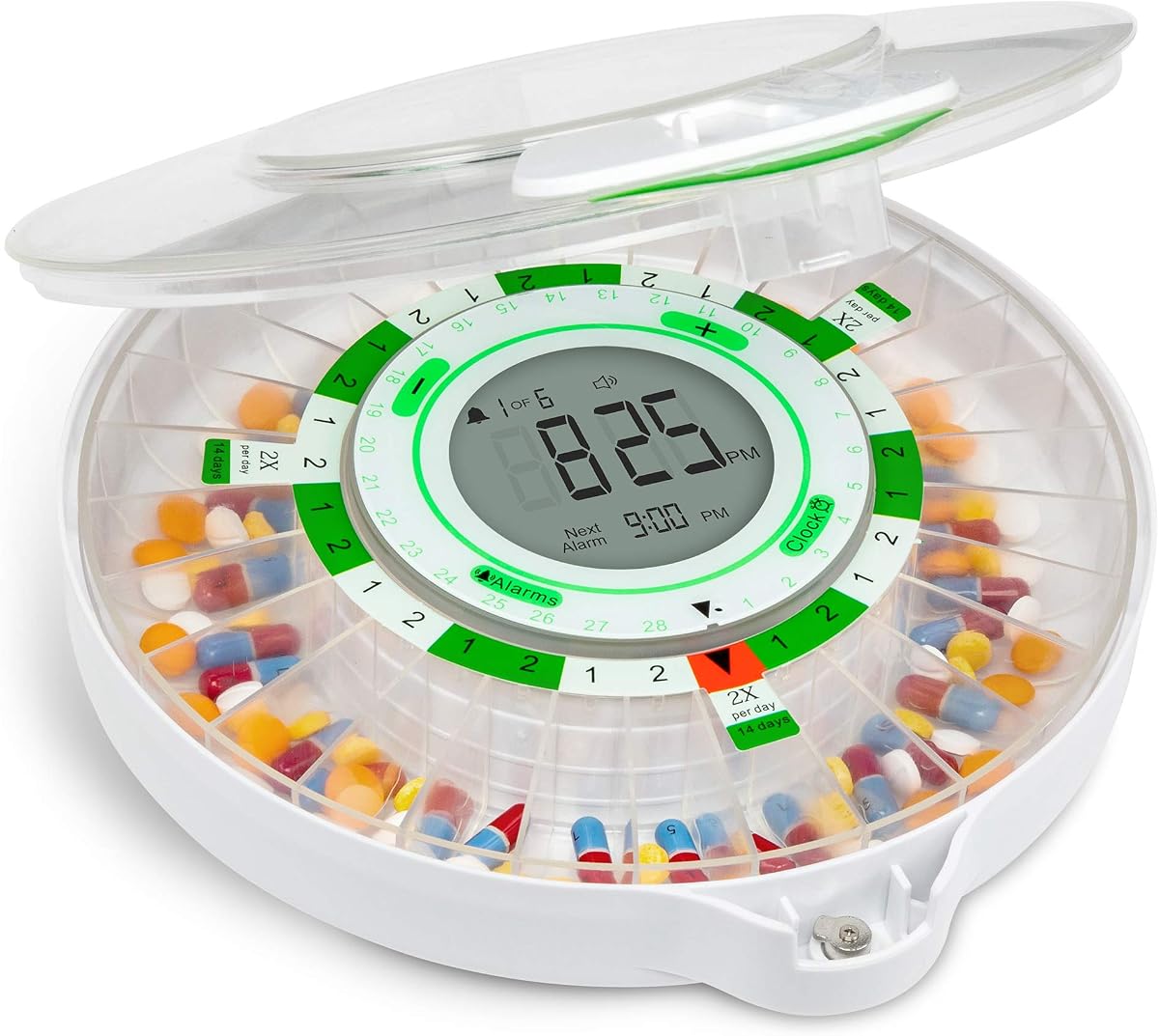

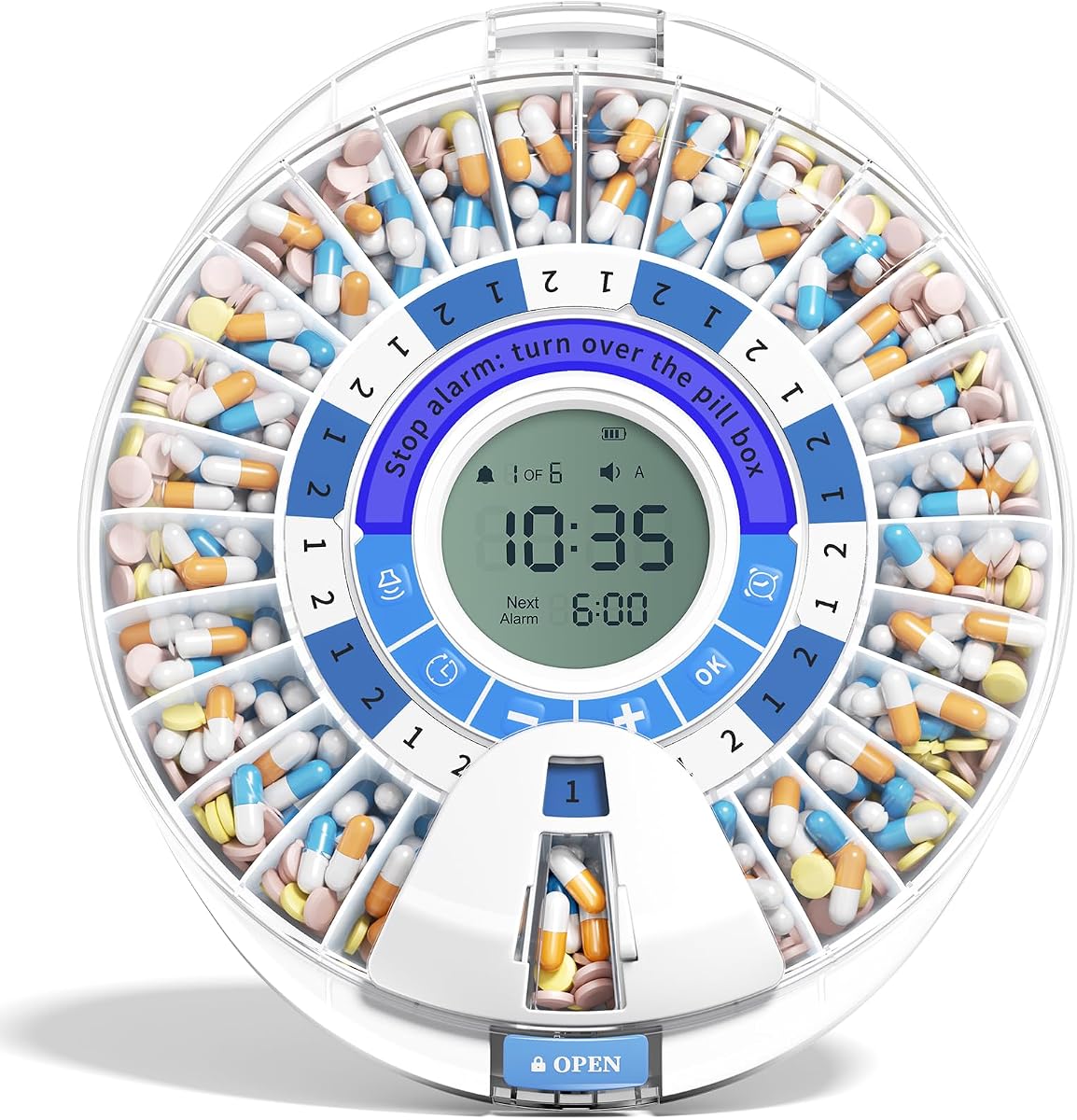


The 28-Day (1X) Automatic Pill Dispenser is a straightforward option for people who take a single organized dose each day and want an alarm without smartphone complexity. Its 4.2 rating reflects a balance of approachable controls, 28 daily compartments, audible and visual reminders, and moisture-conscious storage. The defining feature is its one-press release mechanism, which sends the current dose into a cup without requiring the user to lift or rotate a traditional carousel.
We may earn a commission when you buy through this link, at no additional cost to you.
The dispensing system is especially relevant for seniors, people with weak grip strength, and anyone who finds conventional rotating pill boxes difficult. A timing window permits a dose to be taken 15 minutes early or 30 minutes late, offering some flexibility without turning the machine into an unrestricted medication cabinet. Users can choose sound only, light only, or combined sound and light alerts, making it easier to match the reminder to hearing, vision, or household conditions.
Storage receives careful attention through a water-resistant lid, sealing silicone structure, and two desiccant slots. The 28 compartments can hold common tablets, vitamins, and capsules in the quantities listed for the product, although gummy-style capsules are not recommended because they may stick. There is no app, remote caregiver access, or adherence record, so the appeal lies in dependable local reminders rather than connected monitoring. The listed package also focuses on one dispensing time, with no support for add-on trays.
This is a strong choice for a senior who takes one daily dose, lives at home, and prefers physical controls to an app. It may be less suitable for people taking medication at several times of day or for caregivers who want remote reminders and intake records. For those priorities, the design delivers an unusually direct routine: fill the compartments, program the reminder, and use one button to access the current dose.
Rather than asking the user to turn a carousel or retrieve tablets by hand, the slide-door tray releases the prepared dose into a cup. That straightforward interaction makes the dispenser more approachable for older adults and anyone who benefits from reduced fine-motor effort.
A sealed lid, silicone structure, and dual desiccant compartments help protect medication from humidity. This is particularly useful in warm climates or bathrooms, although users should still follow the storage requirements of their individual prescriptions.
We may earn a commission when you buy through this link, at no additional cost to you.
The Windtrace Automatic Pill Dispenser for Elderly with Alarm is a budget-minded choice for households that need more than one reminder without a connected subscription or app. It carries a 4.0 rating and combines six dosage rings, a 28-compartment removable tray, a readable LCD display, and a loud alarm paired with a flashing blue light. It can serve as a monthly, weekly, or daily organizer depending on the selected schedule.
We may earn a commission when you buy through this link, at no additional cost to you.
The six dosage rings are the most important flexible feature. They allow the user to organize medication for different daily patterns, with reminders offered from once to six times per day. The bright visual signal and audible alarm provide two ways to notice a dose, while the large LCD makes the current time easier to read. The tray is made from food-grade materials and has a transparent lid that allows visual monitoring of the remaining medication.
Its accessible design includes an easy-to-use lid mechanism for refilling and a smooth sliding retrieval window. These features are useful for seniors, people with arthritis, and anyone who has limited dexterity. The package includes the automatic dispenser, six dosage rings, an instruction manual, and four AA batteries. Compared with app-equipped models, however, it cannot send remote missed-dose notices or maintain a digital intake history.
The Windtrace is best for individuals who need several reminder times, prefer a local alarm, and want to avoid smartphone-based setup. It is a practical entry point for independent users and family members providing nearby assistance. Those who need remote monitoring or digital lock control should look toward one of the connected models, but for core scheduling and accessibility, this model covers the essentials clearly.
The interchangeable dosage rings let the user select a reminder pattern that reflects the number of daily doses. This makes the dispenser more versatile than a fixed single-time model while keeping programming and management entirely local.
A loud alarm and flashing blue light give users two ways to recognize a scheduled dose. The readable LCD adds another point of orientation, helping make the current time and routine easier to follow.
We may earn a commission when you buy through this link, at no additional cost to you.
The LiveFine Automatic Pill Dispenser for Elderly, 28-Day Supply, Clear Lid is a versatile carousel model for users who may take several medications throughout the day. It has a 4.2 rating and supports up to nine daily reminders through nine interchangeable dosage rings. A jumbo LCD, easy-fill carousel, locking cover, and sliding retrieval window combine accessibility with secure local storage.
We may earn a commission when you buy through this link, at no additional cost to you.
Alert customization is a clear advantage. Users can choose among three volume levels and three beeping patterns, allowing the reminder to fit different hearing needs and household environments. The carousel supports up to nine doses per day, making it a better fit for complicated schedules than a one-time daily model. Multiple pills can be placed in each slot, which is useful for people taking several tablets, vitamins, or capsules at the same time.
The manual-key lock helps prevent unauthorized access, while the smooth sliding window allows medication to be removed without opening the entire lid. Setup uses simple buttons rather than a connected app, and the clear lid lets the user visually check what remains. The trade-off is that caregivers cannot remotely review adherence or change settings from elsewhere, so another person must physically program and fill the unit.
This LiveFine model is a strong fit for someone with a busy medication schedule who wants local alarms, granular alert settings, and physical access control without smartphone management. It is less attractive for families that specifically need remote monitoring or emergency unlocking. For independent daily organization, however, the nine-ring system and easy-fill carousel provide a capable, well-rounded solution.
The nine interchangeable rings can be configured for as many as nine reminders per day. That flexibility is valuable for people who divide medications among morning, afternoon, evening, and additional times.
The jumbo display, simple buttons, and sliding retrieval window reduce the learning curve. The lockable cover adds security without requiring an account, network connection, or remote app.
We may earn a commission when you buy through this link, at no additional cost to you.
The 42-Day(1X) Automatic Pill Dispenser with three expandable trays is the most feature-rich connected model in this guide. It has a 4.2 rating and brings together app-based caregiver management, voice-guided on-device setup, a digital lock, remote emergency dispensing, and adherence history. Its primary advantage is the ability to combine user independence with supervision by a family member who may not live in the same home.
We may earn a commission when you buy through this link, at no additional cost to you.
The three-tray configuration is unusually flexible. Each of the three trays contains 14 pill slots, with each slot representing one dose. The stated capacity is 42 days for once-daily dosing, 14 days for twice-daily dosing, and 14 days for three daily doses. This makes the system more than a basic calendar: families can select a structure that matches the user's actual medication frequency while avoiding the ring replacement required by some carousel models.
Family members can use the app to set dosing times, check whether pills were taken, review adherence trends, and receive missed-dose alerts. The app requires no subscription and includes automatic software updates. Seniors can instead configure the machine through on-device buttons and voice prompts, preserving a degree of independence. A digital lock, remote unlock, and emergency dispensing add another layer of control, while LED, voice, buzzer, and melody alerts accommodate different sensory preferences.
The sealed lid and built-in desiccant pack help manage humidity, and the LCD provides on-device information. This model is best for families seeking detailed remote oversight rather than only a local alarm. It is more involved than a straightforward carousel and must be used in a home or non-institutional setting; the product information specifically warns against use in nursing homes and other regulated facilities.
The companion app lets family members view intake records, monitor missed doses, and adjust settings from a distance. Because no subscription is required, the connected features do not depend on a recurring paid service.
Three separate 14-slot trays can serve different portions of the day. This provides 42 days of once-daily storage or 14 days at higher daily frequencies, depending on how the trays are assigned.
We may earn a commission when you buy through this link, at no additional cost to you.
The 28-Day(1X) Automatic Pill Dispenser with two expandable trays brings connected medication management to a more compact configuration. It carries a 4.2 rating and includes a free companion app, on-device voice guidance, a digital lock, remote access, and a 28-day once-daily capacity. The product is intended primarily for home use, with explicit warnings against regulated facilities.
We may earn a commission when you buy through this link, at no additional cost to you.
Each of the two trays contains 14 slots, and one slot corresponds to one dose. The stated arrangements provide 28 days of storage for once-daily medication and 14 days for twice-daily medication. Rather than replacing physical dosage rings, the user fills the appropriate tray sections and leaves the machine to manage the schedule. This arrangement is especially useful for people with two distinct medication times, such as morning and evening.
Family members can configure dose times remotely, review intake history and adherence trends, control the lid, and perform emergency dispensing when needed. Seniors can use on-device buttons with voice prompts if they prefer to set the machine themselves. Alert choices include an LED light, spoken notification, buzzer, and melody, while the sealed lid and built-in desiccant pack protect stored medication from moisture.
This model is a strong fit for a family that wants remote monitoring and emergency controls but does not need the three-tray model's extra capacity. Its tradeoff is simpler storage rather than fewer features. It may also be less intuitive for someone entirely uncomfortable with app-based configuration, although voice-guided local setup provides an alternative.
Two trays can be assigned to separate portions of the day, accommodating once- or twice-daily schedules. The removable, clearly divided format also makes filling and weekly planning more direct.
The app-controlled digital lock can be managed by a family member, and emergency dispensing is available when needed. These functions add useful oversight without requiring the user to depend on another person for every routine task.
We may earn a commission when you buy through this link, at no additional cost to you.
The Windtrace Automatic Pill Dispenser for Elderly with Alarm is a locally operated organizer for people who need a flexible number of daily reminders. Its 4.0 rating reflects a solid feature set built around six dosage rings, a 28-compartment food-grade tray, a loud alarm, a flashing blue light, and an easy-to-read LCD. It is designed to be programmed in minutes and used without an app.
We may earn a commission when you buy through this link, at no additional cost to you.
The removable tray contains 28 large compartments and can be used as a monthly, weekly, or daily organizer. A transparent lid makes it possible to check supplies at a glance, while multiple compartments allow several pills to be grouped for one dose. The smooth sliding retrieval window supports easier access for seniors and people with arthritis, and the lid mechanism simplifies refilling.
The package includes the automatic pill reminder, six dosage rings, three black keys, an instruction manual, and four AA batteries. Keys add a layer of control over access, although they also mean the user must keep the key accessible. Unlike connected dispensers, this model does not provide remote monitoring, digital intake history, or family notifications, and its scheduling is handled through physical dosage rings.
The Windtrace is a good option for someone who values an alarm, visible controls, and multi-dose organization without smartphone dependency. It is especially practical when a family member can refill it regularly but does not need remote access. Users who need caregiver notifications or records should choose a connected design, while those prioritizing straightforward local operation will find this model approachable.
The six rings let the medication pattern remain visible inside the machine. A user or nearby caregiver can quickly understand the selected schedule without navigating menus or connecting a phone.
Instead of requiring users to tip pills into their hand, the sliding window provides direct access to the prepared compartment. This is a meaningful convenience for users with arthritis or reduced grip strength.
We may earn a commission when you buy through this link, at no additional cost to you.
The Retekess TH017 Automatic Pill Dispenser is the strongest overall choice in this guide based on its 4.5 rating, the highest listed rating among the ten products. It combines 21 individual compartments with personalized dose times, three sound levels, dual reminders, mechanical locks, and power-off memory. The result is a capable local dispenser that emphasizes both routine continuity and controlled access.
We may earn a commission when you buy through this link, at no additional cost to you.
At the scheduled time, the lid opens automatically and the alarm stops once the pill cup is removed. Voice alerts and bright light signals give users two ways to notice a dose, while the three-level volume adjustment helps balance clarity with household disruption. The LCD displays medication information, and both 12-hour and 24-hour formats are supported for users with different time preferences.
Storage receives added protection from a dual-layer sealing structure and a light-resistant upper cover intended to block ultraviolet rays. Dual mechanical locks help restrict access, while power-off memory preserves the programmed medication schedule after a power interruption. The 21 independent compartments organize a week of morning, afternoon, and evening doses and can each hold multiple pills.
This model is best for users who want more alert customization and reliable schedule memory than a basic carousel offers. It is not intended to replace a medical device or professional monitoring, and its 21-compartment layout is shorter than the 28-day models. Even so, its combination of clear reminders, retained settings, and mechanical access control makes it a particularly well-rounded choice for independent daily use.
The memory function retains the configured schedule after a power interruption. This helps a user avoid rebuilding the entire medication plan following an unexpected outage.
Users can set specific times, choose the preferred clock format, and adjust the alarm across three levels. Combined voice and light reminders make the schedule easier to notice under different household conditions.
We may earn a commission when you buy through this link, at no additional cost to you.
The LiveFine Automatic Pill Dispenser for Elderly, 28-Day Supply, Locking Lid combines a 28-day carousel with flexible scheduling and a portable form factor. It has a 4.1 rating and offers nine interchangeable dosage rings, audio and visual alerts, a jumbo LCD, three volume levels, and an intuitive three-button interface. These features make it approachable for local users who want frequent reminders without connected monitoring.
We may earn a commission when you buy through this link, at no additional cost to you.
The medication timer can be configured as frequently as every 30 minutes, while the nine rings support as many as nine doses per day. Each slot can accommodate up to 18 pills, which makes the carousel useful for people with numerous supplements or a large number of tablets assigned to one time. The sliding retrieval window provides direct access and is designed to remain convenient for users with limited dexterity.
The locking cover uses a manual key to prevent unauthorized access. The unit is battery-operated and portable, making it suitable for home use or travel where a secure, organized option is useful. The trade-off is that it cannot share adherence data with a caregiver or accept remote changes. It also depends on batteries, so the user or caregiver should keep an eye on power readiness.
This LiveFine model suits users who want frequent alarm options, generous slot capacity, and a lockable design that can travel. People who require remote oversight should select a connected tray or Bluetooth model. For a self-contained organizer with flexible local timing, the clear controls and 28-day structure remain the main advantages.
Alarms may be set as often as every 30 minutes, and the nine rings accommodate numerous daily doses. This is helpful for medication plans that do not fit neatly into morning, noon, and evening blocks.
Battery operation avoids a requirement for a nearby outlet, supporting travel and flexible placement. A manual key protects the medication while preserving a straightforward physical interface.
We may earn a commission when you buy through this link, at no additional cost to you.
The Live Fine Automatic Pill Dispenser, 28 Day Medication Organizer, Clear Lid offers a familiar monthly carousel with customizable reminders and secure storage. It has a 4.1 rating, a jumbo LCD, a transparent lid, a sliding retrieval window, and a manual-key lock. It is aimed at users who want to see their remaining doses at a glance while receiving local audio and visual reminders.
We may earn a commission when you buy through this link, at no additional cost to you.
The rotating organizer holds 28 days of medication and can accommodate up to 18 pills per slot, making it generous enough for users with several supplements or tablets in a single dose. The clear lid allows visual monitoring without opening the machine. Customizable reminders can be set for as many as nine times daily, providing flexibility for schedules that include more than one medication period.
The smooth retrieval window and manual key lock combine convenient access with protection against unauthorized opening. This makes the dispenser suitable for people who appreciate physical organization but do not need an app or remote caregiver connection. The limitation is that records and settings remain on the device, and programming must be completed manually.
This Live Fine model is a good fit for a senior who values a clear monthly overview, abundant per-slot capacity, and strong local reminders. It is less suitable for a distant family member who needs adherence reports or emergency controls. Its strengths are visibility, simple access, and secure storage in a conventional rotating format.
The transparent cover makes it possible to see how much medication remains without opening the carousel. This helps users and nearby caregivers identify when a refill is approaching.
Capacity for up to 18 pills per slot allows related tablets and supplements to be grouped together. That reduces the number of separate items a user must sort during filling.
We may earn a commission when you buy through this link, at no additional cost to you.
The 21-Day Bluetooth Automatic Pill Dispenser with individual rising pods combines connected monitoring with a distinctive pod-based dispensing system. It carries a 4.2 rating and supports eight alarms and eight dosage rings over a 21-day period. The clear lid, Bluetooth 5.0 connection, app records, key lock, and automatically extending cups distinguish it from traditional carousel models.
We may earn a commission when you buy through this link, at no additional cost to you.
Instead of requiring a user to lift, tip, or retrieve medication manually, the medicine cups extend at the programmed time. Individual removable pods offer compartmentalized moisture protection and storage, and the package includes three additional pods as backups. Each pod can hold 12 capsules or fish-oil softgels, along with other tablets and vitamins according to the supplied information.
The app allows caregivers and users to organize medication, set reminders, monitor intake, and review medication records for the previous 14 days. Bluetooth 5.0 permits wireless synchronization with a phone, while both 12- and 24-hour time formats are supported. A loud alarm and flashing light provide local notification, and the key lock helps discourage unintended access or double dosing.
Power is flexible: the unit can run on batteries for more than two months or operate while plugged in, and low-battery alerts are included. This makes it a good option for a household wanting app visibility and easier pod access, though it is less suitable for anyone unwilling or unable to manage a compatible phone. Its 21-day cycle is shorter than a 28-day organizer, but the rising-pod format offers a more tactile retrieval experience.
The individual cups extend automatically when a reminder activates, bringing the dose toward the user. This can reduce the need to tip, lift, or handle loose medication.
The app stores medication records for the previous 14 days and supports remote organization of doses. Local alarms and lights remain important even when a caregiver is not physically present.
We may earn a commission when you buy through this link, at no additional cost to you.
The right automatic pill dispenser should match the user's medication frequency, accessibility needs, and desired level of caregiver involvement. Capacity, alarm behavior, lock design, connectivity, and ease of refilling are the most important factors to compare before buying.
Capacity must reflect both the number of days between refills and the number of doses taken each day. A 28-day model with one daily slot may not suit someone taking medication three times daily, while a multi-tray system can divide morning, noon, and evening doses. Rising-pod and carousel designs commonly use programmable rings to support varying schedules.
Compare daily slots with total calendar capacity. Choose enough organization for a realistic refill cycle without overloading the machine.
Audible alarms are useful when the user is nearby, but a light, spoken message, or flashing signal can be easier to notice for someone with hearing difficulty. The best models offer multiple alert choices and adjustable volume. A large LCD is also valuable for confirming the current time and scheduled dose at a glance.
Select alerts that work in the intended environment. Consider hearing, vision, distance from the machine, and nighttime use.
Connected dispensers can send family members missed-dose alerts, display intake history, and allow remote schedule or lock changes. This is useful when a senior lives independently and a caregiver is not nearby. App setup, phone compatibility, and software support should be considered before selecting a connected model.
Connectivity is valuable for oversight, but it is not automatically better. A local alarm may be simpler and more reliable for daily use.
A lock can prevent accidental opening, unauthorized access, or double dosing. Manual keys offer a physical safeguard without an account, while digital locks may support remote management and emergency dispensing. Consider whether the key can be kept accessible to the user and whether emergency access needs to be available to a caregiver.
Choose a lock that balances security with daily usability. A system that is too difficult to open can undermine independence.
A removable tray, easy-fill carousel, smooth sliding window, or extending pod can make a large difference for someone with arthritis or reduced grip strength. Look for a retrieval method that directs medication into a cup or accessible compartment rather than requiring the user to tip pills into a hand.
Test the physical workflow conceptually using the product images and instructions. Prioritize a mechanism that can be understood and repeated.
Some dispensers group many pills into a single compartment, while others are designed for a smaller number of tablets, capsules, or supplements. The Retekess model provides 21 individual compartments, several LiveFine models accommodate multiple pills per slot, and the first listing lists specific tablet, vitamin, and capsule quantities. Gummy-style capsules are not recommended for that model because they may stick.
Match compartment space to the physical size and number of pills used. Measure unusual capsules or supplements before loading a dispenser.
A sealed lid, desiccant chamber, light-resistant cover, and removable pods can help protect medication from humidity or light exposure. These features are especially relevant in warm climates, bathrooms, or homes with changing conditions. No organizer can replace the storage instructions printed on a medication or supplement.
Look for multiple protective measures, but also follow the manufacturer's guidance. Proper room temperature and original containers remain important.
Battery-operated models are convenient and portable, while plug-in operation can reduce concern about interruptions. Some products include low-battery alerts or power-off memory, and the Retekess model is specifically described as retaining its schedule after power loss. Compare power requirements with the location where the dispenser will be used.
Choose a power arrangement that suits the household routine. Reminders are only helpful if the machine is ready when the dose is due.
Begin by reading the included manual and identifying the dosage ring, tray, or pod configuration that matches the medication schedule. If a connected model is selected, install the companion app and confirm that the phone can synchronize with the dispenser. Family members can then assist with remote setup, while the senior user can learn the on-device voice prompts or physical button sequence.
Fill the machine according to its instructions, keeping each dose in the designated slot and avoiding the incompatible gummy-style capsules noted for the first product. Program the appropriate reminder times, alert type, clock format, and volume. Before relying on the system, test the scheduled alert and medication retrieval to confirm that the correct compartment opens and that the dose is easy to collect.
For care, remove the tray, carousel, or individual pods as directed and wipe compatible surfaces with a mild cleaner appropriate for the materials. Allow parts to dry before reassembly, keep the unit away from excessive moisture, and replace the batteries according to the manual. Recheck the schedule after a power interruption, firmware update, or physical move, and consult a pharmacist or prescribing clinician if the medication type, timing, or storage needs are uncertain.
They can be useful for some people with dementia because scheduled alarms, controlled access, and clear compartments add structure to a medication routine. Suitability depends on the person's ability to understand the alarm and retrieve the dose. A connected model with caregiver monitoring may offer additional support, but the product information for several models states that they are intended only for home or non-institutional use.
No. Several models, including the 28-Day no-app dispenser and the Windtrace models, provide local physical controls, alarms, and programmable schedules. App-equipped models add remote monitoring, missed-dose notices, intake logs, and sometimes remote lock controls. Choose connectivity only when that level of caregiver oversight is genuinely useful.
The right cycle depends on how often the user takes medication and how frequently a caregiver can refill the device. A 28-day model may suit once-daily medication, while two- or three-tray systems can divide several doses across the day. Rising-pod and multi-ring designs offer different combinations of storage days and daily reminders, so both factors should be compared.
Yes, the listed dispensers are intended for medications, vitamins, and supplements, provided each item fits the specified compartment. Some models list capsule, tablet, and vitamin capacities, while others state that a slot can hold multiple pills. Check the size of softgels, unusual capsules, and supplements before filling, and remove any product explicitly marked as incompatible.
The result varies by model. The Retekess TH017 includes power-off memory that is intended to preserve the programmed schedule, while other models may require the user to recheck or reprogram settings after an interruption. Models that can operate while plugged in may offer another layer of continuity, but users should still verify the battery and schedule regularly.
They are not strictly necessary for every household, but they can prevent accidental access and reduce the chance of double dosing. Manual-key models offer straightforward local security, while digital locks may allow remote management and emergency dispensing. The best choice depends on whether the user can safely manage the key or lock without becoming frustrated during daily use.
Sound alerts are effective when the dispenser is nearby and the user can hear them, while light signals can help in a bright or noisy household. Models with voice prompts, flashing lights, buzzers, melodies, and adjustable volume provide more ways to notice a reminder. The ideal setup uses multiple alert types so a missed sound does not result in a missed dose.
No dispenser can guarantee ideal storage conditions for every medication. Some models use sealed lids, desiccant packs, moisture-resistant structures, and light-resistant covers to improve protection, but users should follow the storage directions on the original medication package. A dispenser should be kept in a suitable location and not used as a substitute for a pharmacy-labeled container.
The Windtrace models offer the most budget-friendly way to obtain multiple local reminders, while the Retekess TH017 stands out for its 4.5 rating, personalized alerts, mechanical locks, and power-off memory. For families that need connected oversight, the 42-day three-tray model provides the broadest remote and storage features, with the two-tray version offering a more compact alternative.
Before choosing, prioritize the number of daily doses, the user's dexterity, the usefulness of each alert, and whether remote monitoring is truly necessary. Physical accessibility, refill frequency, lock behavior, and power reliability often affect daily satisfaction more than additional advanced features. Match the machine to the medication routine and the person's ability to use it independently.
Finally, check the current product listing, package contents, dimensions, setup instructions, and availability before purchasing. Prices, ratings, software behavior, and promotional details can change, and medication requirements are personal. Confirm that the selected dispenser accommodates the exact pills and schedule involved, and consult a pharmacist or prescribing clinician when any storage or dosage question remains.