
HelloBaby 4.3-Inch Video Monitor
4.4Editor score
4.3-inch IPS display
Up to 30-hour ECO mode
Remote pan, tilt, and zoom
A Bluetooth baby monitor can combine the immediacy of a dedicated nursery camera with convenient wireless control, but the category includes very different designs. Some products use a private screen-and-camera connection, while others rely on a home network, an app, or Bluetooth-assisted setup. A useful monitor should make checking on a baby easier without adding unnecessary complexity or privacy concerns.
The products in this guide were compared using the specifications and feature descriptions provided for each listing. We considered display size, connection method, night vision, battery life, camera movement, two-way audio, sound alerts, temperature monitoring, and multi-camera support. The list includes dedicated no-WiFi systems, a dual-camera option, and an app-based camera for shoppers with different household needs.
Each review explains where a particular monitor is strongest, where its design requires compromise, and which type of parent may prefer it. The top selections represent our strongest overall, budget, and premium options, but nursery layout and personal priorities may lead to a different choice. Product specifications, ratings, availability, and prices can change, so confirm current details before purchasing.
4.4Editor score

4.5Editor score
4.6Editor score
As an Amazon Associate we earn from qualifying purchases.
This side-by-side comparison focuses on the features that most affect everyday nursery monitoring, including connection privacy, display size, battery endurance, camera movement, audio functions, and multi-camera flexibility.


The HelloBaby HB6550 is a balanced, feature-rich baby monitor with a 4.5 rating. It combines a five-inch color screen with remote pan and tilt, two-way audio, automatic infrared night vision, and a private 2.4GHz FHSS connection. That combination makes it a practical choice for parents who want dependable nursery monitoring without managing a WiFi network, mobile application, or cloud account.
We may earn a commission when you buy through this link, at no additional cost to you.
Camera movement is one of its strongest features. The camera pans 355 degrees horizontally and tilts 120 degrees vertically, while 2x zoom helps bring smaller details into view. The screen also supports eight lullabies, a room temperature monitor and alert, a sound-level LED indicator, a date and time display, and tabletop or wall mounting. A dedicated audio-only power-saving mode can be useful when continuous video is unnecessary.
Its most important advantage is the private, app-free connection. Video travels directly between the camera and parent unit over encrypted 2.4GHz FHSS technology, so it does not depend on household internet or cloud services. Multi-camera expansion up to four cameras adds flexibility, although extra camera units are not included with every configuration. The five-inch display is also smaller than the six-inch screens available on several competing models.
This is our top overall recommendation because it balances display size, reliable room coverage, night viewing, sound awareness, and nursery controls without turning setup into a technical project. It is well suited to a first nursery, travel use, and homes where the parent unit is kept within the private signal range. Choose it over a larger model if you value proven core features more than a bigger screen.
The direct 2.4GHz FHSS system keeps setup simple and avoids reliance on an internet connection. It is a particularly useful design for travel, grandparents, and homes with inconsistent broadband.
Remote 355-degree pan, 120-degree tilt, and 2x zoom make the camera practical for cribs, sleep spaces, and wider nursery layouts. Temperature alerts, lullabies, and sound indicators add useful everyday functions.
We may earn a commission when you buy through this link, at no additional cost to you.
The HelloBaby HB6560 stands out with a six-inch IPS display and a 4.4 rating. It is designed for parents who want a generous viewing area while retaining the convenience of a dedicated no-WiFi system. Automatic infrared night vision, two-way radio, eight lullabies, room temperature alerts, and a feeding timer make it a well-rounded monitor for overnight nursery care.
We may earn a commission when you buy through this link, at no additional cost to you.
The wide-angle camera pans 355 degrees and tilts 120 degrees, reducing the need to reposition the unit manually. Its stated battery endurance ranges from 16 to 30 hours depending on use, and VOX or ECO audio-only operation can conserve power during quiet periods. Bright sound-level indicators give parents a visual indication of crying, which is especially helpful when the parent unit is muted or out of immediate hearing range.
Setup is straightforward because the camera and screen pair automatically without WiFi, an application, or an account. The private 2.4GHz FHSS link also keeps the feed away from the internet. The trade-offs are a maximum of two cameras in split-screen mode and a larger unit that may take up more space than a compact four-inch system. A six-inch display can still be convenient for a fixed nursery location.
Choose the HB6560 if screen size and an expanded set of nursery tools matter more than maximum multi-camera expansion. It is a particularly good option for grandparents, travelers who want fewer app-related tasks, and caregivers who prefer a large parent unit. The HB6550 remains more flexible for homes expecting to add as many as four cameras.
The six-inch IPS panel provides a broad viewing angle and a larger image than common compact monitors. It is useful in a bedside or armchair setup where a parent wants to observe the entire room at a glance.
Automatic night vision, a feeding timer, temperature alerts, eight lullabies, and VOX operation reduce the need to enter the nursery during quiet periods.
We may earn a commission when you buy through this link, at no additional cost to you.
The HelloBaby 4.3-Inch Video Monitor is a straightforward, budget-minded option with a 4.4 rating. Its IPS screen, private 2.4GHz FHSS connection, and automatic infrared night vision provide the essential functions of a dedicated baby monitor without requiring a phone, app, or internet connection. It is a sensible first choice for a single nursery or occasional travel use.
We may earn a commission when you buy through this link, at no additional cost to you.
Its 3500mAh battery is listed as providing up to 30 hours in ECO mode and 16 hours outside ECO mode. The screen can turn off when the nursery is quiet and reactivate when sound is detected. Remote pan, tilt, and press-and-hold zoom help cover the room, while two-way talk, eight lullabies, temperature monitoring, and feeding alarms round out the feature set.
The main limitation is scale. A 4.3-inch display gives parents less visual detail than the five- and six-inch alternatives, and this model does not offer the same multi-camera flexibility. Some listed features also depend on enabling ECO behavior, meaning the longest runtime and the always-on video experience are not identical. Buyers should consider those trade-offs against the simpler design and lower cost.
This is the best budget recommendation for a parent who wants reliable local monitoring without paying for a large display or multiple camera zones. It offers a good balance of battery life, room coverage, privacy, and convenience. If you need to monitor twins or two separate rooms regularly, one of the dual-camera systems may deliver a better long-term experience.
The private local connection, automatic night vision, and two-way talk cover the core needs of a nursery monitor. No account or app is needed, reducing both setup time and ongoing administration.
The sound-activated ECO mode can extend battery life while keeping the screen dark during silence. It is most useful in stable rooms where the parent unit stays within range.
We may earn a commission when you buy through this link, at no additional cost to you.
The HelloBaby HB6550-2 is a dual-camera monitor aimed at families monitoring twins, siblings, or two separate rooms. Its 4.5 rating reflects a useful combination of a five-inch IPS display, pre-paired cameras, automatic infrared night vision, and a private 2.4GHz FHSS connection. One-tap switching keeps the selected camera large on the screen instead of shrinking both feeds into small split-screen tiles.
We may earn a commission when you buy through this link, at no additional cost to you.
Both cameras support remote pan, tilt, and zoom, allowing each unit to cover a different nursery or playroom. Parents can manually select a camera or use Auto Scan to rotate among rooms. The system can expand to as many as four cameras, while the stated top signal strength of 1,000 feet is described as an outdoor figure and may differ substantially through walls indoors.
Its sound-activated ECO mode can provide up to 30 hours of operation, and the display reactivates when nursery sound exceeds the set threshold. A three-level sound indicator, two-way talk, eight lullabies, and room temperature monitoring add useful functionality. The requirement to position and power two cameras makes setup more involved than a single-camera system, but pre-pairing reduces the technical burden.
This is a strong choice for families with two children or anyone who wants nursery and playroom coverage from one parent unit. It combines clearer single-camera viewing with more expansion potential than the two-camera six-inch HB6560-2. The primary question is whether you truly need simultaneous coverage of two spaces; if not, the standard HB6550 is the more focused purchase.
Pre-paired cameras and one-tap switching make it simple to move between two sleeping or play areas. Full-size views preserve more detail than a conventional split screen.
Expansion to four cameras gives the system more longevity than models capped at two units. The parent unit can continue serving as a central monitoring hub as family needs change.
We may earn a commission when you buy through this link, at no additional cost to you.
The HelloBaby HB6550Plus combines a six-inch IPS display with a stated 18-to-33-hour battery range. Its 4.5 rating and broad feature set make it an appealing option for parents seeking a large dedicated screen without the network requirements of a smartphone-based camera. Automatic infrared night vision, two-way audio, and remote camera movement cover the central monitoring needs.
We may earn a commission when you buy through this link, at no additional cost to you.
The camera pans 355 degrees and tilts 120 degrees, while a wide-angle lens broadens room coverage. The parent unit supports split-screen viewing for up to two cameras, and VOX or audio-only ECO mode can conserve power when continuous video is not needed. A room temperature sensor, alerts, eight lullabies, sound-level indicators, a feeding timer, and mounting options make it useful beyond basic video viewing.
As with other local monitors, the biggest compromises concern modularity and physical size. It supports two cameras rather than the four-camera maximum offered by the HB6550-2, and the six-inch display may be less convenient to carry around. The listed battery maximum is mode-dependent, so owners should understand how continuous video, night vision, and sound activation affect actual runtime.
Choose the HB6550Plus when a large display, flexible night monitoring, and useful caregiver features are your top priorities. It sits between the compact 4.3-inch model and the dual-camera HB6560-2. For a single primary nursery, it provides an effective balance of visibility and convenience; for two rooms, the HB6560-2 offers a more integrated side-by-side design.
The six-inch panel offers a clear overview from a bedside table, couch, or doorway. Its larger footprint is most appropriate when the parent unit has a permanent home.
VOX and audio-only operation can preserve battery capacity during quiet periods. The stated maximum runtime is reached under the most favorable operating conditions rather than continuous use.
We may earn a commission when you buy through this link, at no additional cost to you.
The VTech VM819 is a compact, dedicated monitor with a 4.5 rating and a 2.8-inch LCD. It uses an encrypted 2.4GHz FHSS connection directly between the camera and parent unit, avoiding WiFi, internet access, and cloud services. That makes it a familiar choice for families who prefer a self-contained system that works independently of their home network.
We may earn a commission when you buy through this link, at no additional cost to you.
Automatic infrared night vision provides visibility in dark rooms, and 2x digital zoom offers some close-detail inspection. The sound-activated screen keeps the parent unit dark and quiet until nursery sound is detected, with adjustable VOX sensitivity and a three-level sound indicator. The 2600mAh battery is listed for up to 19 hours of continuous video or as many as 29 hours in audio-only monitoring.
The camera can play two lullabies and two ambient sounds, including white noise and a trickling stream. Two-way talkback allows a parent to speak to the baby, and a nursery temperature sensor sends an alert when conditions may need attention. Compared with the larger HelloBaby models, the compact display provides less visual detail, and 2x zoom is more limited than the interchangeable lens approach of the DXR-8 PRO.
Choose the VM819 if you value a small parent unit, straightforward local operation, and a familiar sound-focused monitoring experience. It is suitable for a single nursery and travel, provided the compact screen meets your viewing needs. Parents who want to inspect more visual detail or operate multiple camera locations may prefer a larger display or lens system.
Encrypted 2.4GHz FHSS keeps the signal between the camera and parent unit. The system remains usable without broadband, an app, or a cloud account.
Adjustable sound activation, visual sound levels, two-way talk, and audio-only battery mode focus on alerts while reducing unnecessary screen use.
We may earn a commission when you buy through this link, at no additional cost to you.
The GNCC 2K WiFi Camera is different from most products in this guide because it is a camera-only, app-based system rather than a package with a dedicated parent screen. It supports dual-band 2.4GHz and 5GHz WiFi, Bluetooth-assisted pairing, and live viewing through the Osaio app. Its 3.8 rating reflects a useful smartphone ecosystem, but it requires more setup than a self-contained monitor.
We may earn a commission when you buy through this link, at no additional cost to you.
Image specifications include 2K Ultra HD resolution and built-in infrared night vision with a stated viewing distance of 10 meters. The camera pans 340 degrees and tilts 80 degrees, and AI motion tracking is intended to follow movement around the nursery. Cry, sound, and motion alerts can be sent through the app, with customizable zones that help reduce irrelevant notifications.
Two-way audio supports remote communication, while stated Alexa and Google Assistant compatibility adds hands-free control. Cloud storage requires a subscription after the included trial period, and local SD-card recording is supported, although the card is not included. Multi-screen viewing and device sharing let relatives access selected cameras. Most importantly for buyers, this listing does not include a monitor, so a phone or tablet is required.
Choose the GNCC camera if remote access, notifications, recording, and smart-home integration matter more than a dedicated display. It is a good fit for parents who regularly travel or want relatives to check the nursery remotely. The trade-offs are network dependence, app administration, storage decisions, and a lower listed rating than the dedicated local systems in this comparison.
App access allows caregivers and relatives to view supported cameras remotely. Sharing controls make it easier to grant limited access without giving everyone the same administrative permissions.
Cry, sound, motion, and custom-zone detection can improve alert relevance. Cloud and SD-card options provide different approaches to storing footage, but subscription and card costs should be considered.
We may earn a commission when you buy through this link, at no additional cost to you.
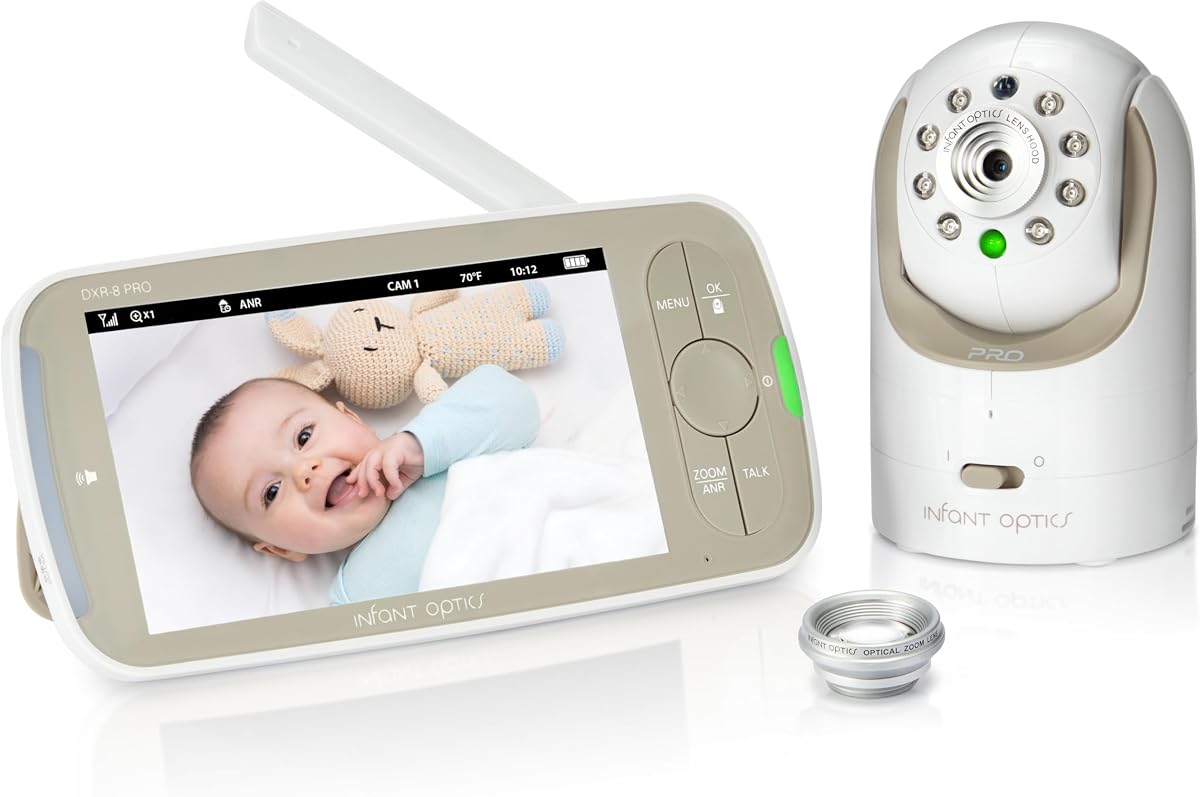
The Infant Optics DXR-8 PRO earns the highest listed rating in this guide at 4.6. It is a five-inch HD monitor built around three distinctive features: active noise reduction, interchangeable camera lenses, and a user-replaceable battery. The direct 2.4GHz FHSS connection avoids WiFi, apps, cloud services, and router dependencies, giving it a focused and private operating model.
We may earn a commission when you buy through this link, at no additional cost to you.
Its patented Active Noise Reduction is designed to filter steady background noise from fans, air purifiers, heaters, and air conditioners so the audio feed is easier to interpret. The camera also supports remote pan, tilt, and zoom, with automatic night vision for dark rooms. The included standard and zoom lenses can be swapped quickly, while a separate wide-angle lens can extend the field of view for larger rooms.
Battery longevity is another differentiator. Rather than forcing a complete unit replacement when the battery ages, the design allows the user to replace the battery and restore portability and runtime. This potentially lowers long-term ownership friction, although buyers should verify battery availability and compatibility when purchasing. The monitor is also focused on a single-camera experience, which makes it less convenient for families seeking immediate dual-room coverage.
Choose the DXR-8 PRO when audio clarity, optical viewing options, and long-term serviceability justify a premium dedicated monitor. It is especially suitable for nurseries with distracting household equipment or parents who want to change lens perspectives without buying another camera. Buyers who need two rooms immediately or prefer a smartphone app should select a dual-camera or app-based alternative instead.
Active Noise Reduction targets continuous mechanical sounds that can obscure a baby or caregiver on the audio feed. This can make the monitor more practical in active homes.
Interchangeable lenses adapt the camera to different viewing needs, while a user-replaceable battery helps extend the useful life of the parent unit.
We may earn a commission when you buy through this link, at no additional cost to you.
The HelloBaby HB6550-2 Two Cameras is a 4.3-rated dual-camera system built around a five-inch IPS parent unit. It is intended for families that need to watch two sleeping spaces, two children, or a nursery and playroom. The two cameras are pre-paired, allowing one-tap or automatic switching without a complicated network setup.
We may earn a commission when you buy through this link, at no additional cost to you.
Each camera offers 355-degree pan, 120-degree tilt, and zoom, while the parent unit displays one camera at a time rather than dividing the screen into two small tiles. The system can expand to four cameras, and the stated 1,000-foot top signal strength applies outdoors. Indoor performance depends on walls, room layout, and antenna position, so the figure should not be treated as a guaranteed indoor distance.
Sound activation can turn the screen back on after it has been muted or placed in ECO mode. A three-level sound indicator gives visual warnings, while two-way talk, eight lullabies, room temperature alerts, and infrared night vision cover common nursery needs. The trade-off is that this listing has a lower rating than the newer HB6550-2 and requires powering and positioning two separate camera units.
Choose this model if you want a two-camera package and prefer switching between large single-camera views. It is a good starter system for twins or two rooms and can grow to four cameras later. Those who want side-by-side views should examine the HB6560-2, while those prioritizing the newest dual-camera design should compare the newer HB6550-2 listing.
Switching between full-screen feeds avoids the tiny tiles and mixed audio that can make a split screen difficult to use. The design is especially helpful when one room needs closer attention.
Two included cameras remove the need to purchase a separate starter unit. Pre-pairing and four-camera expansion provide a simple path from one to multiple monitored spaces.
We may earn a commission when you buy through this link, at no additional cost to you.
The HelloBaby HB6560-2 is designed for parents who want to see two rooms simultaneously rather than switch between them. Its six-inch IPS display, 4.4 rating, and true split-screen presentation distinguish it from systems that alternate between full-screen cameras. It remains a private no-WiFi monitor using a 2.4GHz FHSS connection.
We may earn a commission when you buy through this link, at no additional cost to you.
Both cameras pan 355 degrees and tilt 120 degrees, so each can be aimed across its assigned room. Automatic infrared night vision and two-way radio support overnight monitoring, while the 16-to-30-hour stated battery range varies with operating mode. VOX and audio-only ECO operation conserve power during quiet periods, and a sound-level LED indicator gives a visual warning of nursery activity.
The system also includes eight lullabies, room temperature monitoring and alerts, a time display, a feeding timer, and tabletop or wall-mount options. The main limitation is the two-camera cap, which makes it less flexible than HB6550-2 systems that support four cameras. A split screen also gives each feed less display area, although seeing both rooms at once can still be the more useful arrangement.
Choose the HB6560-2 for twins, two children, or a nursery and playroom where simultaneous awareness matters. It is a particularly good option for caregivers who do not want to keep tapping between camera feeds. If future camera expansion or the largest possible individual view is more important, consider the five-inch HB6550-2 instead.
The side-by-side layout gives parents immediate awareness of both monitored spaces. It reduces the chance of missing movement in a room that is not currently selected.
The local FHSS link avoids cloud accounts and internet dependence. Automatic night vision, temperature alerts, and a feeding timer support routine overnight care.
We may earn a commission when you buy through this link, at no additional cost to you.
The right Bluetooth baby monitor depends on your nursery, privacy preferences, number of children, and tolerance for app-based setup. Evaluate connection methods, display size, audio quality, battery life, camera movement, and expansion options before choosing.
A dedicated system includes a camera and parent unit that communicate directly, usually over 2.4GHz FHSS. It generally requires less setup, keeps the feed off the internet, and avoids reliance on a phone remaining charged. An app-based camera is more flexible for travel and remote viewing, but it depends on a stable network, compatible devices, and the continued operation of its application and cloud services.
Choose a dedicated system if privacy and simplicity are priorities. Choose an app-based camera only if remote access, recording, smart-home compatibility, or sharing with distant relatives outweigh the added setup requirements.
Display size affects how easily a parent can interpret posture, blankets, and small movements. The products in this guide range from a compact 2.8-inch LCD to six-inch IPS panels. Larger screens are easier to watch from across a room, while smaller units are more portable. A parent keeping the receiver in a nursery, bedroom, or kitchen may benefit from the larger panel.
Prioritize a display that fits your available space and viewing distance. Do not assume a larger screen improves camera resolution, and check whether split-screen mode reduces each image further.
Most dedicated monitors transmit directly between the camera and parent unit using encrypted 2.4GHz FHSS technology. Because the feed does not pass through a router, it remains operational when internet service fails and is less exposed to broader network access. Published range figures often represent ideal outdoor conditions, so indoor walls, floors, appliances, and antenna placement can materially affect performance.
A private local connection is the safest general choice for a stationary nursery. Test reception in the rooms where the parent unit will be used, and avoid assuming a maximum range figure will hold through every wall.
A useful baby monitor must provide a recognizable image after lights are turned down. Automatic infrared night vision is standard across the dedicated systems here and allows the camera to switch without manual intervention. The GNCC app camera also offers infrared night vision with a stated viewing distance of 10 meters. Image clarity depends on lens angle, room darkness, display size, and the camera's position rather than night vision alone.
Position the camera where it can see the crib without pointing directly into a window or strong light. If the monitor will be used in a particularly dark room, prioritize a larger display and a camera that can zoom or change lenses.
Monitor battery claims commonly distinguish continuous video from standby or audio-only operation. The listed maximums of 18 to 33 hours depend on features such as ECO, VOX, screen activation, night vision, and video use. A parent who only needs to know when the baby is stirring may value sound-activated operation more than a large uninterrupted video feed. Plug-in use can eliminate charging concerns if the parent unit remains beside a bed.
Compare real operating modes rather than only the longest advertised runtime. For overnight monitoring, choose a system that can remain connected without requiring a recharge and that clearly displays the battery level.
Remote pan, tilt, and zoom let a stationary camera cover a wider nursery without repeatedly entering the room to reposition it. The HelloBaby cameras generally pan about 355 degrees and tilt 120 degrees, while the GNCC camera provides 340-degree pan and 80-degree tilt. Lens choice also matters: the DXR-8 PRO includes standard and zoom lenses and supports an optional wide-angle lens for broad rooms.
Check the room's corners and obstacles before buying. Wide movement is useful for a crib against one wall, but a very wide room may still benefit from a second camera or a broader lens.
Two-way talk lets a parent soothe a baby without walking into the nursery, while sound activation can darken the parent screen during quiet periods. Adjustable VOX sensitivity helps balance timely alerts against false triggers from fans, heaters, or other household equipment. The DXR-8 PRO differentiates itself with active noise reduction, while several HelloBaby systems use a visual sound-level indicator.
Look for adjustable sensitivity and a visual alert if you plan to mute the receiver. Test the camera's microphone in the actual nursery because furniture, walls, and ambient noise influence how clearly a baby can hear a caregiver.
Single-camera systems are simplest, while dual-camera packages suit twins or families monitoring a nursery and playroom. Some HB6550-2 configurations support expansion to four cameras, while the HB6560 and HB6550Plus are limited to two. App-based systems may support multiple live feeds, and the GNCC model can record continuously to an SD card or use cloud storage. Local recording avoids subscription dependence, although the card is not included.
Choose based on likely household changes. Expandability offers value if more rooms may need coverage, but each extra camera requires its own power and a suitable mounting location.
Begin by placing the camera on a stable surface or a secure wall mount where it has a clear view of the sleep area. Keep the camera and any power cables outside the baby's reach, and avoid positioning the lens directly toward a window or strong light source. Pair the camera and parent unit according to the product instructions, then move the receiver through the house to identify where signal reception becomes unreliable.
Test the system before relying on it overnight. Confirm that the image remains clear with night vision enabled, two-way audio is audible from the camera, and the sound alert activates at a sensitivity that suits the nursery. If using a temperature sensor, compare its reading with a separate room thermometer. For app-based models, also test remote access, notifications, storage, and account sharing on the devices caregivers intend to use.
Clean the camera and display gently with a soft, dry or lightly damp cloth, and avoid spraying liquid directly onto either device. Keep vents unobstructed, inspect cords for damage, and replace damaged power adapters promptly. Charge the parent unit regularly, use battery-saving modes when appropriate, and update app-based system software when prompted. Periodically retest the connection because batteries, firmware, and household layout can change performance over time.
Neither type is automatically safer in every situation. Dedicated monitors that use a private local connection avoid the internet and do not depend on a home router, while app-based cameras offer convenient remote access but introduce accounts, software, and cloud-storage considerations. The most important factors are encryption, a strong connection, regular software updates, and secure account credentials.
No. Most models in this guide include a dedicated screen, but the GNCC 2K WiFi Camera listing does not include a monitor. It is viewed through the Osaio app on a compatible phone or tablet. Confirm the package contents carefully if you want a system that works without a smartphone.
A larger screen can make it easier to observe posture, blankets, and small movements from across a room. It is especially useful for fixed nursery setups and shared caregiving. Smaller screens are more portable, but they provide less detail. The right size depends on where you keep the parent unit and how often you view it from a distance.
Yes, if the model supports multiple cameras and you purchase the necessary camera units. The HB6550-2 family can cover two rooms and expand to four cameras, while the HB6560-2 displays two rooms side by side. Placement and power are the main limitations because each camera must be installed in the room it will monitor.
No. Most products reviewed here use a dedicated 2.4GHz FHSS connection that works without WiFi, an app, or an internet account. The GNCC camera is the exception and uses dual-band WiFi with Bluetooth-assisted pairing. A non-WiFi monitor can be especially useful in homes with unreliable internet or while traveling.
Runtime depends heavily on whether the unit is streaming continuous video, operating in audio-only mode, or using sound activation. Listed maximums in this guide range from 18 to 33 hours under favorable conditions. A system used for continuous overnight video may require more frequent charging than the headline standby figure suggests.
The listed monitors use automatic infrared illumination when the nursery becomes dark, and these products are intended for observing babies without entering the room. Camera placement still matters: keep the unit stable, out of reach, and directed at the sleep area. Follow the manufacturer's guidance and discontinue use if the device shows damage or unusual behavior.
Choose a local monitor for straightforward bedroom use, independent operation, and minimal account management. Choose a smartphone-based system when you need remote viewing, shared caregiver access, smart-home control, or recorded history. App-based options also require a reliable network and careful attention to storage subscriptions, passwords, and sharing permissions.
The HelloBaby HB6550 is the strongest all-around recommendation because it combines a five-inch display, wide camera movement, two-way audio, night vision, temperature alerts, and four-camera expansion without requiring WiFi. The HelloBaby 4.3-Inch Video Monitor is the best budget option for a smaller, simpler setup, while the Infant Optics DXR-8 PRO is the premium choice for active noise reduction, interchangeable lenses, and a replaceable battery.
For two children or two rooms, the HB6550-2 family emphasizes full-size switching and expansion, while the HB6560-2 is better for simultaneous side-by-side views. The HB6560 and HB6550Plus favor a larger fixed display. If remote smartphone access and smart alerts are central priorities, the GNCC camera offers greater flexibility but requires network setup and does not include a parent screen.
Before buying, verify the current package contents, signal performance in your home, camera placement needs, and storage terms for an app-based model. Ratings, features, availability, and prices change over time, so check the latest listing and retailer information before making your final selection.