
DaierTek Battery Voltage Meter
4.4Editor score
Wide 8–48V measurement range
Bright blue LED display
Waterproof panel-mount design
Includes mounting hardware
Digital Battery Gauge guide compares 10 models for voltage, state-of-charge, temperature, current, power, and marine-use monitoring for everyday use.
A digital battery gauge turns an otherwise difficult electrical task into a quick, readable check of voltage, state of charge, temperature, current, or power flow. The right model depends on battery chemistry, system voltage, mounting location, exposure to water, and whether you need basic voltage information or detailed energy monitoring.
We compared the ten products in this guide using their stated ranges, display functions, installation methods, protection features, alarms, and supported applications. The list covers compact panel meters, multifunction battery monitors, temperature alarms, high-current shunt systems, and a professional-grade monitor for connected battery management.
Each review explains the standout benefits, practical limitations, and ideal installation environment. Ratings reflect the supplied customer feedback, while availability and pricing can change over time, so readers should confirm the current listing and specifications before purchasing.
4.4Editor score

4.5Editor score

4.9Editor score
The comparison below highlights each gauge's supported voltage range, principal measurements, protection features, and best-fit environment, making it easier to match a monitor to a vehicle, boat, golf cart, RV, or stationary battery system.



The DROK 48V Golf Cart Battery Meter is a versatile LCD monitor designed for 10–100V systems, including common 12V, 24V, 36V, 48V, and 60V configurations. It supports lithium, lead-acid, lithium iron phosphate, and NiMH batteries, giving it broader utility than a meter limited to a single 12V electrical system.
We may earn a commission when you buy through this link, at no additional cost to you.
Its most useful feature is the ability to program the displayed percentage against a corresponding voltage. That makes it practical for owners who want more than a raw voltage number, particularly in golf carts, RVs, cars, and marine installations where a quick estimate of remaining charge is useful. The LCD also presents temperature in Fahrenheit, although the reading reflects the monitor's internal temperature rather than ambient air or battery temperature.
The main trade-off is that the percentage display depends on correct programming for the battery type and operating conditions. Voltage-based estimates can also vary with battery age, load, and chemistry. The internal temperature reading should not be treated as a remote battery probe, and the 48V lead-acid configuration is the stated default.
This monitor is a strong choice for DIY installers who need one model to cover several voltage classes and battery types. It is especially appropriate for golf cart projects, but the absence of a remote temperature sensor and the need for initial calibration make it less specialized than dedicated energy-management systems.
The broad chemistry and voltage compatibility makes the DROK useful when a workshop, RV owner, or cart enthusiast operates equipment at different electrical levels. Verify the selected battery mode before relying on the percentage indication.
The Fahrenheit display describes the meter's internal operating temperature, not the battery or surrounding air. It can help indicate a warm enclosure but should not replace a dedicated battery-temperature sensor when thermal protection is essential.
We may earn a commission when you buy through this link, at no additional cost to you.
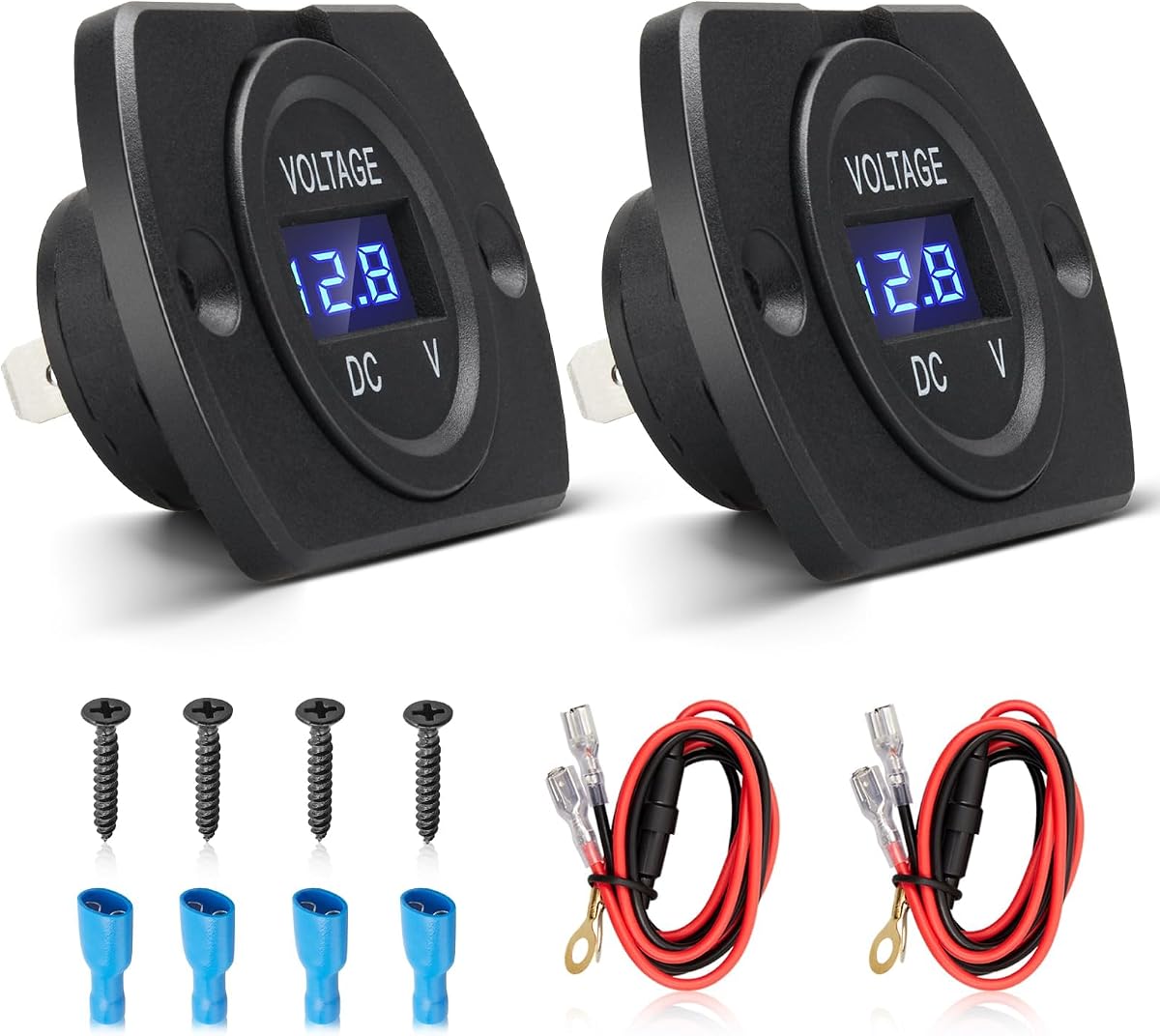
The DaierTek Battery Voltage Meter focuses on the essential job of showing DC voltage in a clear, panel-mounted format. Its three-digit blue LED display, 8–48V range, and stated 0.1V accuracy make it an appealing option for cars, motorcycles, trucks, RVs, boats, and other 12V or 24V systems.
We may earn a commission when you buy through this link, at no additional cost to you.
Installation flexibility is a major strength. The round meter can be fitted into a 29mm mounting hole or attached to the supplied panel with the included nylon nut. Wires, mounting screws, and the panel are included, reducing the need for extra hardware. A waterproof construction also suits damp marine environments better than an exposed dashboard meter.
The limitation is its narrow focus. It provides voltage but not current, energy consumption, temperature, or a calculated state-of-charge percentage. This makes it a diagnostic and awareness tool rather than a complete energy-management system. Users who need more parameters will have to add another instrument.
For a straightforward voltage display in a boat, vehicle, or off-road machine, the DaierTek is hard to overlook. It is a particularly good choice for buyers who prioritize readable digits, weather resistance, and simple installation over advanced calculations or connectivity.
The blue backlit display remains easy to identify in dark cabins and is presented as readable in sunlight as well. A fixed round panel gauge is especially convenient when a driver or operator wants one consistent electrical reference.
The waterproof housing and sealed panel-mount arrangement suit locations exposed to spray or moisture. Correctly sealing the wiring entry and following the manufacturer's connection instructions remain important in harsh environments.
We may earn a commission when you buy through this link, at no additional cost to you.
The BM280 Digital Battery Gauge is built around the needs of electric vehicles and golf carts, with selectable settings for 12V, 24V, 36V, 48V, 60V, and 72V systems. It supports lithium and lead-acid batteries and is specifically presented as compatible with EZGO and Club Car carts, as well as broader vehicle applications.
We may earn a commission when you buy through this link, at no additional cost to you.
Installation is unusually flexible. The unit supports a 37 by 25mm embedded cutout and a direct plug-in arrangement compatible with key switches. A mounting template is included, while the controls use a straightforward sequence of short and long presses for selecting a level and saving the configuration.
The display combines real-time voltage and remaining-power percentage information on a backlit high-definition LCD. Separate color indicators distinguish battery power and voltage status. Reverse-connection, overvoltage, and low-power protections add practical safeguards, while the IP65 housing and PVC screen protector target outdoor use.
The BM280 is a good match for a golf cart owner who wants percentage information and an integrated appearance. As with any voltage-based estimator, configuration and battery condition affect the displayed state of charge. Buyers should also confirm the dimensions, key-switch arrangement, and voltage platform on their specific cart before installation.
The embedded and plug-in mounting choices let users select the approach that best fits the dashboard. The included template helps reduce the chance of an incorrect cutout during a do-it-yourself installation.
Voltage and battery percentage appear on a high-definition backlit screen, while color indicators separate the two status categories. This gives operators more information than a bare voltage reading without adding a separate temperature probe.
We may earn a commission when you buy through this link, at no additional cost to you.
The HiLetgo Digital Ammeter Voltmeter is one of the most functionally complete options in this roundup. It measures voltage, current, power, and energy across a 6.5–100V range, with current measurement up to 20A. The built-in shunt is especially convenient for users who want one instrument instead of a separate voltmeter and ammeter.
We may earn a commission when you buy through this link, at no additional cost to you.
A large LCD can present voltage, current, power, and energy together, while a manually controlled blue backlight improves visibility. The voltage alarm can use adjustable overvoltage thresholds, with flashing prompts intended to draw attention to an abnormal condition. Energy information can remain stored when power is removed and may be reset when needed.
Its main constraint is the 20A current ceiling. That is suitable for many monitoring applications, but it does not cover high-output systems that require a larger shunt. Installation also demands more care than a simple two-wire voltage panel, and users must understand the relationship between the meter, shunt, power leads, and measured circuit.
The HiLetgo is an excellent general-purpose diagnostic meter for a workshop, camper, solar setup, or vehicle where seeing power consumption is as important as seeing voltage. It is the strongest choice in this group for users who want broad electrical visibility without buying separate instruments.
Showing voltage, current, power, and energy together makes the meter useful for diagnosing both battery condition and load behavior. This is more informative than a voltage-only gauge when accessories, converters, or charging equipment are active.
Adjustable voltage thresholds can flag an abnormal condition, while the blue backlight supports nighttime visibility. Energy retention after shutdown preserves a running total, although regular resets may be appropriate when beginning a new monitoring cycle.
We may earn a commission when you buy through this link, at no additional cost to you.
The IPX7 Waterproof Battery Monitor combines a wide 7–100V range with temperature monitoring and audible alarms. It supports systems at 12V, 24V, 36V, 48V, 60V, 72V, and 84V, along with ternary lithium, lead-acid, AGM, and LiFePO4 battery types.
We may earn a commission when you buy through this link, at no additional cost to you.
Its defining benefit is protection against both low- and high-voltage conditions through configurable buzzer alerts. The M key switches between voltage and temperature displays, and the Celsius readout adds useful context for batteries operated in varied weather. A fully closed protective shell provides an IPX7 waterproof rating for indoor or outdoor installations.
The product includes a mounting bracket, adhesive, screws, and approximately 23.62-inch leads, making it adaptable to different layouts. Reverse-connection protection and power-off memory help guard against common installation errors and repeated configuration. The stated default is 12V lead-acid, so users of other systems must adjust the settings.
This monitor is a strong option for motorcycles, golf carts, boats, RVs, and other equipment where an audible warning could prevent a surprise shutdown. It is less convenient for users who want immediate readings without setup, because the manufacturer explicitly instructs buyers to make initial settings for a meaningful percentage display.
Configurable low- and high-voltage buzzer thresholds provide an early warning in unattended or mobile installations. Choosing meaningful thresholds for the battery chemistry and system voltage is essential for the alerts to be useful.
The closed housing and IPX7 rating make the monitor suitable for wet, dusty, or exposed locations. A mounting bracket and adhesive allow positioning where the display remains visible without leaving the electrical connections exposed.
We may earn a commission when you buy through this link, at no additional cost to you.
The Universal Capacity Indicator supports a broad 12–84V input range and accommodates lead-acid systems from 3S through 26S as well as ternary lithium, polymer, lithium-ion, and storage batteries. Its green-backlit LCD can show either a battery symbol with percentage or a battery symbol with a voltage reading.
We may earn a commission when you buy through this link, at no additional cost to you.
Two front controls provide access to a useful set of operating options. The right switch cycles through voltmeter mode, battery-percentage mode, and off, while the left setting key handles display functions, backlight control, black-screen mode, sleep behavior, and battery-type selection. A built-in approximately 30cm power cable simplifies connection.
Its percentage is useful for quick assessments, but users should select the proper battery configuration and understand that a calculated state of charge is not a laboratory measurement. The product is lightweight, portable, and described as waterproof, with a protective PVC film over its surface. Reverse-connection protection reduces the risk of damage if polarity is mistaken.
This indicator offers an appealing balance of measurement range, display modes, and compactness. It is well suited to a mixed workshop or for owners of golf carts, RVs, and other systems who want both voltage and an approximate charge level in one unit.
The gauge can emphasize a numeric voltage reading for electrical diagnosis or a percentage for everyday charge awareness. Having both modes available is helpful because the two answer different practical questions.
Compatibility with several lithium and lead-acid formats expands its usefulness beyond one vehicle. The correct selection remains important because the percentage calculation relies on the configured battery profile.
We may earn a commission when you buy through this link, at no additional cost to you.
The Victron Energy BMV-702 is the most sophisticated monitor in this guide, offering detailed information across a 6.5–95VDC range. Its display includes state of charge, voltage, current, energy or time remaining, and other parameters, making it appropriate for owners who want more than a basic voltage reading.
We may earn a commission when you buy through this link, at no additional cost to you.
A programmable auxiliary input can be assigned to battery temperature, midpoint voltage, or the voltage of a second battery. A programmable relay can also control other devices. For connected monitoring, the BMV-702 can work with a separately sold VE.Direct Bluetooth Smart dongle or a VE.Direct connection to a GX device and VRM platform.
This connectivity and configurability distinguish it from simple panel meters. However, the package does not include every accessory needed for remote monitoring, and incorrect installation can be hazardous. The shunt is housed in a special enclosure because of the high-voltage application, but licensed-professional guidance and compliance with applicable electrical codes may be necessary.
The BMV-702 is the premium pick for serious RV, marine, off-grid, or stationary systems where accurate information and remote visibility justify a more involved installation. It is less appropriate for a basic 12V car battery check, where a compact plug-in meter would be simpler and more economical.
Assigning the auxiliary input to temperature, midpoint voltage, or a second battery enables more meaningful diagnostics. Each configuration helps identify problems that a single voltage reading cannot explain.
VE.Direct support allows the BMV-702 to feed data into compatible devices and remote monitoring services. This is valuable for installations that need historical visibility or supervision away from the battery compartment.
We may earn a commission when you buy through this link, at no additional cost to you.
The Minn Kota MK-BM-1D is a straightforward battery meter for any 12V battery. Its LED display reports the current voltage, while additional state-of-charge indicators divide the battery's condition into zero, one-third, two-thirds, or fully charged for quick interpretation.
We may earn a commission when you buy through this link, at no additional cost to you.
Operation requires only touching the positive and negative leads to the relevant battery terminals. There is no dashboard hole to cut, no shunt to route, and no permanent wiring. That simplicity makes it especially useful in a boat, workshop, garage, or roadside toolkit where a fixed panel meter would be inconvenient.
The compact, durable design emphasizes portability rather than advanced telemetry. It does not provide current, power, temperature, or remote monitoring. The four-category state-of-charge display is also a simplified estimate rather than a detailed battery-management algorithm, which is appropriate for its intended basic role.
The Minn Kota is a strong choice for a boater or technician who wants an uncomplicated way to check a 12V battery. It is particularly convenient for occasional checks because there is no installation, while users with larger systems or more complex monitoring needs should choose a broader meter.
The touch-probe format makes the meter ideal for a toolbox, storage compartment, or emergency kit. Users can obtain a voltage and basic charge status without cutting a panel or modifying the electrical system.
The four broad status categories make the display approachable for nontechnical users. It offers a quick indication of whether attention is needed, although it does not expose the detailed measurements found in a shunt-based monitor.
We may earn a commission when you buy through this link, at no additional cost to you.
The Anina 2-Pack includes two round panel-mount voltmeters, making it convenient to monitor separate 12V or 24V batteries in a vehicle, boat, truck, motorcycle, ATV, or UTV. Both units provide a constant digital voltage readout across an 8–48V range.
We may earn a commission when you buy through this link, at no additional cost to you.
The blue LED digits are designed to remain visible in daylight and darkness. Stated accuracy ranges from 0.1 to 0.2V, providing a useful level of precision for checking onboard battery voltage and estimating whether loads are placing excessive demand on a system.
Each meter is designed for a standard 29mm dashboard opening and can also be attached to the supplied panel. Waterproof construction supports use in environments exposed to rain, splash, or off-road conditions. The package format is practical when one location is insufficient or when a spare is useful.
The Anina set is a straightforward choice for users who need two visible voltage references. It does not calculate state of charge, temperature, current, or power, so owners seeking a complete battery-management picture should choose a more advanced monitor. For basic electrical awareness, however, the dual-pack arrangement is convenient.
Two gauges make it easier to compare a main and auxiliary battery or to place a display in more than one operating area. This is useful in recreational vehicles and boats where electrical systems may be distributed.
The standard 29mm opening and included panel support a clean dashboard installation. A blue illuminated display provides a consistent reference without requiring a separate phone, computer, or external reader.
We may earn a commission when you buy through this link, at no additional cost to you.
The DC 8–100A Amp Meter Voltmeter is designed for larger electrical demands, supporting 8–100V, 0–100A, up to 10kW of power, and energy totals as high as 9999kWh. It uses an included 100A shunt, making it a more capable option for substantial loads than a conventional panel voltmeter.
We may earn a commission when you buy through this link, at no additional cost to you.
Its large LCD displays voltage, current, active power, and energy simultaneously. A manually controlled blue backlight improves visibility, and an overload alarm flashes the backlight and power value when active power crosses the configured threshold. Energy readings can remain stored after the system powers down and can be reset for a new measurement period.
The package includes only the display and shunt, not wiring or other installation accessories. That means users must source suitable cable, connections, fusing, and enclosure components as needed. The shunt also has to be installed in the correct part of the circuit for accurate results, so the product is better suited to technically confident installers.
This monitor is a good candidate for high-current RV systems, larger battery banks, boats, industrial equipment, or renewable-energy installations where power consumption matters. It is excessive for a basic starter-battery check, but valuable when tracking meaningful current and cumulative energy is the priority.
Showing active power alongside voltage and current makes it possible to identify demanding loads, while the energy counter records consumption over time. Together they support better decisions about charging and battery sizing.
The 100A shunt expands the meter's relevance to demanding systems. Proper shunt placement, electrical protection, and sound connection practices remain essential for dependable measurements and safe operation.
We may earn a commission when you buy through this link, at no additional cost to you.
The right digital battery gauge depends on the electrical system, installation environment, and depth of information you need. Comparing voltage range, supported chemistry, measurement functions, protection, and display visibility helps prevent an expensive mismatch.
Choose a range with headroom above the normal operating voltage, and confirm that the selected battery type is available. Correct configuration is essential when using a calculated percentage rather than a raw voltage display.
Prioritize clear voltage readings for occasional checks. Choose current and power data for diagnosing loads, sizing energy storage, or understanding alternator and charger performance.
Check the stated cutout dimensions before buying. Also assess glare, nighttime readability, viewing distance, and whether the display remains legible from the normal operating position.
Use a weather-resistant model for exposed installations. Confirm the enclosure rating and protect connections according to the manufacturer's wiring instructions.
Choose alarms when unattended operation or mission-critical equipment makes a surprise shutdown costly. Verify whether temperature is measured internally or through a dedicated external sensor.
Size the current rating above the expected maximum. For substantial loads, choose a high-current design and allow space for properly protected wiring and a correctly placed shunt.
Choose a display with the information you use most and controls you can understand. Test the viewing angle and menu complexity before finalizing the installation.
Prioritize connectivity when remote visibility or historical data has practical value. Otherwise, choose a simpler monitor and spend attention on reliable wiring and environmental protection.
Begin by identifying the battery's nominal voltage, chemistry, and normal operating state. Select the corresponding mode on the gauge before connecting it, and consult the instructions for your battery type. For a panel installation, switch off the relevant circuit, verify polarity, use suitable wire, and make sure the enclosure can be sealed around any cable entry. For a shunt model, place the shunt where all measured current must pass through it and follow the diagram supplied with the product.
Read the display only after it has stabilized and compare the result with the system's known condition. A battery at rest may show a higher voltage than one carrying a large load, while a charging battery may show a different value entirely. Use percentage information as an estimate rather than a substitute for load testing or battery analysis. Configure buzzer limits according to the manufacturer's guidance and avoid setting thresholds that create false alarms during normal charging or high-load operation.
For care, keep the display clean and dry, inspect seals periodically, and confirm that buttons remain responsive. Recalibrate or reconfigure the gauge if the battery type, voltage level, or installation changes. Low-current or unused vehicles should have their batteries checked periodically, while connected systems benefit from regular reviews of voltage, current, temperature, and energy trends. If readings become erratic, check connections and settings before replacing the meter.
A digital battery gauge can estimate state of charge, but accuracy depends on the battery type, calibration, resting voltage, age, and load. Lead-acid, lithium, and LiFePO4 systems have different voltage curves, so selecting the correct chemistry is important. For precision, use a quality battery-management system and interpret the percentage alongside voltage, current, and temperature.
Many golf carts use 36V or 48V systems, but newer configurations may use 60V or 72V batteries. Choose a monitor rated for the cart's highest normal operating voltage and verify whether its percentage programming supports the installed chemistry. A model with a wider range can also be useful when a charger or converter operates at a different voltage.
A waterproof or water-resistant model is preferable in a boat because condensation, spray, and rain are common. Check the stated ingress rating and ensure the display and any wiring connections are suitably protected. A panel-mounted sealed gauge is convenient, while a shunt-based system may be needed if you also want to monitor current draw.
Yes. Accurate current measurement generally requires a shunt placed in series with the circuit, unless the battery management system uses another specialized current-sensing method. A voltage-only gauge cannot reveal how much current an accessory or charger is using. For moderate loads, a built-in shunt is convenient; for larger systems, a properly rated external shunt is more appropriate.
The most common cause is an incorrect voltage or battery-type setting. Percentage estimates also change with battery age, recent charging, and high electrical loads. Reconfigure the monitor for the installed system, let the battery settle when appropriate, and compare the result with a direct voltage reading. If it remains inaccurate, verify the connections and battery condition.
Only if the meter's stated input range includes 24V. Applying excessive voltage can damage the gauge and may create a safety problem. Choose a model explicitly rated for the battery bank's full charging voltage and operating range. This caution is especially important for lithium systems, whose maximum voltage can exceed the nominal battery voltage.
Temperature is useful because heat accelerates battery aging and cold can temporarily reduce available power. A gauge with a true external battery-temperature input provides more value than one reporting only its own internal temperature. If temperature monitoring is important, check whether the sensor is remote and confirm how its readings influence alarms or battery-management functions.
A voltmeter primarily displays the voltage across a battery or circuit. A battery monitor may add state-of-charge estimation, current, power, energy, temperature, alarms, and programmable inputs. The more complete monitor is useful for system management, while a simple voltmeter is often adequate for quick checks on a standard 12V vehicle battery.
The DaierTek Battery Voltage Meter is the best budget choice for a visible, waterproof voltage display, while the HiLetgo Digital Ammeter Voltmeter is the most versatile option for users who need current, power, and energy data. The Victron Energy BMV-702 stands above the group for sophisticated monitoring, programmable inputs, and remote connectivity.
Prioritize voltage range, battery chemistry, correct measurement needs, environmental exposure, and installation complexity before comparing features. A simple panel voltmeter may be ideal for a 12V car, while a golf cart, marine system, or large battery bank benefits from percentage display, temperature alarms, current sensing, or a shunt-based design.
Finally, confirm the current product details, accessories, compatibility, and installation requirements before ordering. Product availability and pricing can change, and a gauge is only accurate when its voltage, chemistry, sensor, and wiring configuration matches the battery system it serves.