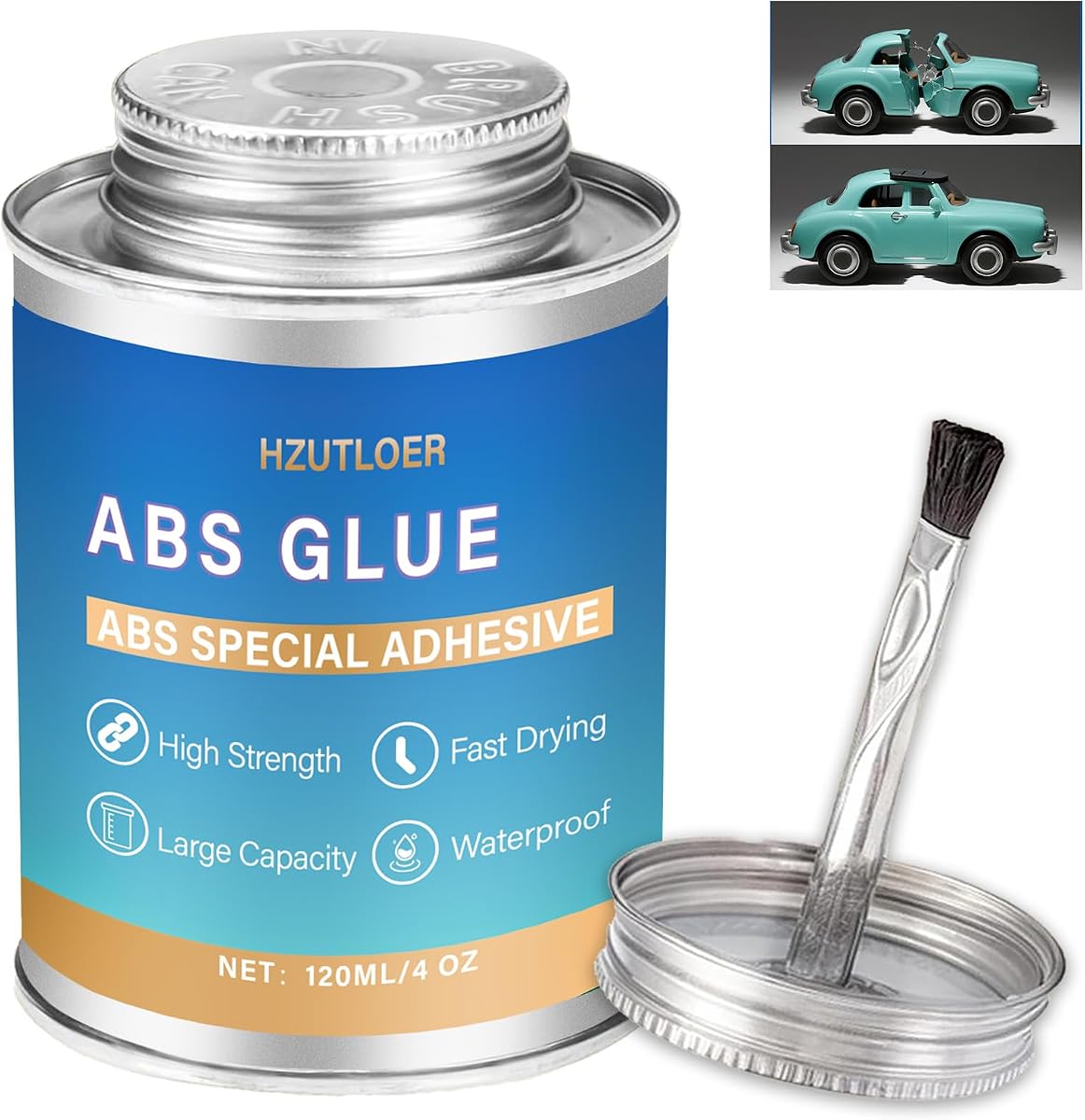
ABS Super Glue 120ML,Clear Strong Adhesive with Built-in Brush,Waterproof Heat Resistant Glue for ABS PVC PS AS PP & Model Craft,Daily Repair
4.3Editor score
Built-in precision brush
Clear 120ML formula
Broad rigid-plastic compatibility
Our expert guide compares glue for ABS plastic, including super glue, epoxy putty, solvent cement, and 3D-printing adhesives for precise repair projects.
Choosing glue for ABS plastic requires more than finding a general-purpose adhesive. ABS is a rigid, durable thermoplastic, but its smooth surface can make weak products fail quickly. The most suitable options range from fast-setting super glue and gap-filling epoxy to solvent cement and thick 3D-printing gels, depending on the joint and repair.
We compared all ten products by examining their stated material compatibility, application method, cure time, bonding strength, temperature resistance, and suitability for small models, printed parts, pipes, trim, and household repairs. The guide includes products designed expressly for ABS as well as multipurpose adhesives that explicitly support ABS bonding.
Each review explains the standout features, practical limitations, and best uses of its product so you can match the adhesive to the job. Ratings reflect the supplied customer feedback, while the specifications come from the product descriptions. Product availability and retail prices can change, so confirm the current listing before purchasing.
4.3Editor score

4.7Editor score
4.6Editor score
The comparison below organizes all ten adhesives by their primary bonding format, ABS compatibility, application style, and intended repair environment, making it easier to identify the right option before buying.


This clear ABS super glue has a 4.3 rating and combines fast adhesion with a built-in brush for controlled application. Its 120ML capacity is notably generous, while the transparent formula is designed to minimize visible residue after bonding. It is explicitly formulated for ABS and AS, with additional compatibility claimed for rigid PVC and PS.
We may earn a commission when you buy through this link, at no additional cost to you.
The built-in brush is the product's most practical feature for model craft, household repairs, and larger flat surfaces. Fine bristles help distribute the adhesive over the bond area without requiring a separate applicator. The description also identifies the glue as waterproof and heat resistant, making it more broadly useful than a basic household cyanoacrylate when the joint may encounter environmental exposure.
The principal limitation is that this remains a liquid super glue. It is best suited to close-fitting surfaces rather than joints with substantial gaps, and careful application is necessary to avoid squeeze-out or visible buildup. The larger 120ML container can also remain open longer between uses, so responsible storage matters when the brush is attached directly to the bottle.
This is a strong recommendation for a maker who wants one clear adhesive for multiple rigid plastics and values the convenience of an integrated brush. Choose it for model parts, AS and ABS components, rigid PVC, and PS repairs where a discreet bond line and generous working capacity are priorities.
The integrated fine-bristle brush makes the adhesive easier to place directly onto a prepared joint. That control is particularly helpful around model details, narrow housing seams, and flat plastic panels where an uncontrolled drop could spread beyond the intended area.
Because the cured glue is transparent, it is less likely to obscure colors or fine details than an opaque product. Its stated compatibility makes it a practical all-purpose option for projects that mix ABS with AS, rigid PVC, or PS components.
We may earn a commission when you buy through this link, at no additional cost to you.
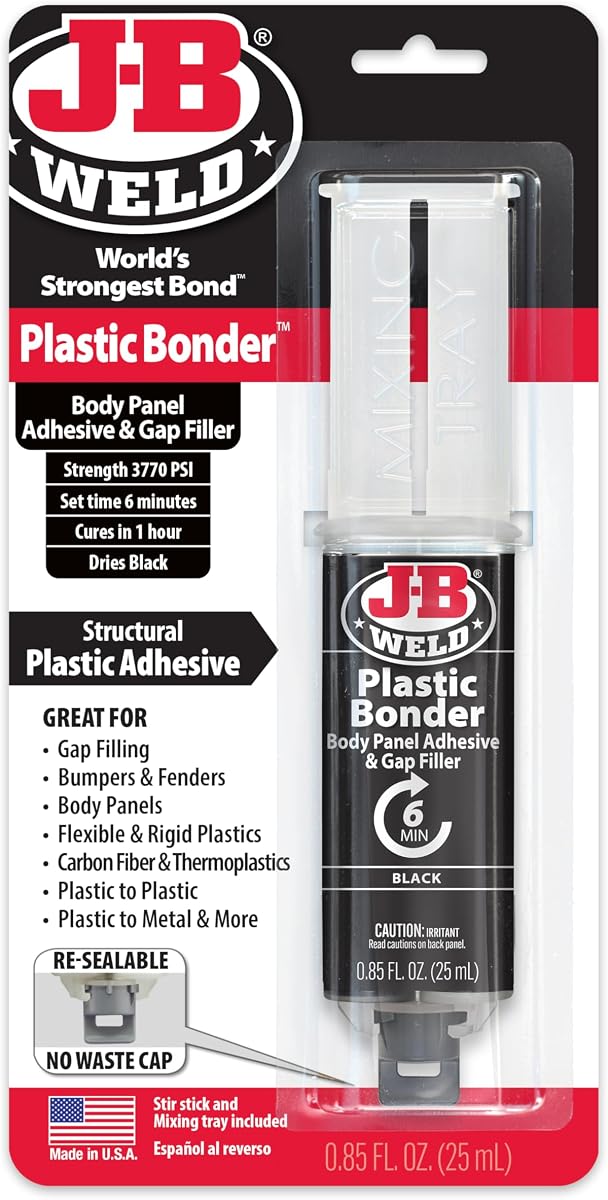
J-B Weld Plastic Bonder carries a 4.6 rating and is a two-part urethane adhesive designed for demanding repairs, including gap filling. Its listed 3770 PSI tensile strength, indoor and outdoor suitability, and ability to bond thermoplastics make it the most structurally substantial option in this group.
We may earn a commission when you buy through this link, at no additional cost to you.
The product distinguishes itself from ordinary super glue through a 1:1 mixing ratio and controlled curing process. It sets in approximately 15 minutes and can be sanded after 30 minutes, allowing a repair to progress from assembly to finishing work without waiting for a full day. It also works with coated metals, concrete, composites, and other substrates beyond ABS.
This is a two-component system, so correct mixing and careful application are more involved than using a single-bottle adhesive. Its black color is appropriate for body panels, trim, and functional parts but may stand out on clear or decorative models. A syringe format helps dispense material, although cleanup remains essential to prevent residue around the nozzle.
Choose Plastic Bonder when a repair must carry meaningful load, bridge a minor gap, or withstand indoor and outdoor conditions. It is a particularly suitable premium option for ABS body panels, vehicle components, composite assemblies, and workshop projects, provided the user is comfortable measuring and mixing the two-part formula.
A stated tensile strength of 3770 PSI makes this adhesive appropriate for joints that need more structural support than a light-duty model repair. The finished bond cures to a hard, permanent form and is positioned for demanding indoor or outdoor assemblies.
The product's gap-filling role reduces the need for a separate filler in moderately imperfect joints. After the initial set, the cured material can be sanded, helping the repair move closer to a finished surface.
We may earn a commission when you buy through this link, at no additional cost to you.
This 3D Printing Super Glue Gel has the highest supplied rating at 4.7 and is tailored to filament-based repairs. It supports ABS, PLA, PETG, TPU, ASA, and nylon, while its no-drip gel formula is intended to remain where placed on vertical seams, complex joints, and support structures.
We may earn a commission when you buy through this link, at no additional cost to you.
The thick consistency is the key advantage. Instead of racing across a vertical surface, the gel forms a controlled bead that can bridge uneven edges and support functional printed components. A precision tip with an anti-clog needle regulates flow, and the 1.76-ounce tube is advertised as providing substantially more material than a standard bottle for labs, print farms, and frequent prototyping.
Its heat and moisture resistance make it a stronger option for RC components, mechanical fits, and outdoor-printed parts than an ordinary lightweight super glue. The gel consistency does mean it is not the natural choice for a hairline seam that needs capillary penetration, and a small bead is generally more appropriate than a broad application.
This is our top all-around pick for makers because it combines precise dispensing, high customer feedback, broad filament compatibility, and a generous container. Choose it for ABS printed parts, post-processing, layer repairs, vertical assemblies, and prototypes where controlled placement and durability matter.
The no-drip formula is especially valuable on upright walls and complicated printed structures. It stays near the application point, making it easier to control when adding strength to a repaired layer or a loose mechanical fit.
The large tube and anti-clog needle reflect a focus on frequent repairs, prototyping, and higher-volume work. That combination is particularly useful for users who would otherwise repeatedly consume small single-use adhesive containers.
We may earn a commission when you buy through this link, at no additional cost to you.
J-B Weld PlasticWeld is a hand-mixable, two-part epoxy putty with a 4.3 rating. Unlike a thin liquid adhesive, it can rebuild and reshape damaged ABS components, making it useful when a crack has become a missing section or when a part needs reinforcement.
We may earn a commission when you buy through this link, at no additional cost to you.
The putty is compatible with ABS, PVC, CPVC, and various rigid and semi-flexible plastics. After kneading, it sets in 25 minutes and cures in three hours. Once cured, it can be molded, shaped, sanded, drilled, and cut, which gives the user much more freedom than a fast-setting clear glue that forms a thin bond line.
Its listed 600 PSI lap shear strength is substantial, though the lower figure compared with Plastic Bonder reflects that this is a putty designed as much for repair and rebuilding as fine assembly. The off-white cured color can contrast with dark plastic, and manual kneading requires cleanup to keep the work area clean.
Choose PlasticWeld for cracked ABS pipes, auto bumpers and trim, marine components, fiberglass parts, water tanks, and other rigid or semi-flexible plastic repairs. It is also useful when molded or shaped reinforcement is needed, making it one of the most versatile repair formats in the guide.
Epoxy putty can stand in for missing material around a damaged ABS edge, not merely connect two intact surfaces. After curing, that added material can be shaped to match the original component and finished through sanding or cutting.
The cured putty is stated to withstand continuous temperatures up to 250°F and intermittent temperatures up to 300°F. These figures make it a candidate for automotive, plumbing, and outdoor repair applications where ordinary household glue may be inadequate.
We may earn a commission when you buy through this link, at no additional cost to you.
Rectorseal 647L is a medium-body solvent cement with a 4.6 rating, specializing in ABS pipe and socket-type fittings. Unlike general-purpose glues, it is formulated around the professional assembly of plastic pipe, with reduced run-off and better gap-filling characteristics.
We may earn a commission when you buy through this link, at no additional cost to you.
The black color is designed to blend with black ABS pipe, giving completed joints a more professional appearance. The product is low VOC, NSF approved for potable-water systems, and stated to exceed ASTM D2535 specifications. These qualifications make it a more specialized choice for plumbing and pipe applications than the model-focused products in this list.
Its narrow use case is the main trade-off. Solvent cement is not the right format for detailed miniatures, visible model seams, or general household repairs. Users should also follow the standard pipe-assembly process, including preparing and fitting the joint properly so the cement can create the intended bond.
Choose Rectorseal 647L when the job specifically involves joining ABS pipe to socket-type fittings, especially where a professional black finish and potable-water suitability are important. It is a specialist procurement rather than a universal ABS glue, but it directly addresses the applications for which solvent cement is designed.
The medium-body formula is intended to fill gaps in ABS pipe connections while limiting unwanted run-off. It is a more relevant choice for plumbing assemblies than a general super glue or visible-detail model adhesive.
Matching the cement to black ABS pipe helps the joint maintain a consistent appearance. This is useful when appearance matters alongside a properly specified and certified pipe connection.
We may earn a commission when you buy through this link, at no additional cost to you.
ALECPEA Plastic Glue has a 4.5 rating and uses a thin cyanoacrylate formula designed to enter close-fitting cracks and seams by capillary action. It is intended for ABS, PVC, PS, and other common rigid plastics, making it well suited to small toys, model cars, miniatures, and narrow housing seams.
We may earn a commission when you buy through this link, at no additional cost to you.
The low-viscosity formula is a meaningful advantage when a crack only appears superficially closed but remains weakly connected underneath. Instead of leaving a bulky ridge, the adhesive spreads through the joint and supports a cleaner-looking repair. Three included dropper tips provide more precise delivery around detailed parts and confined spaces.
Material identification remains essential. The manufacturer notes that blends and coatings vary, recommends testing an inconspicuous area, and states that the glue is not intended for PE, PP, PTFE, silicone, or highly flexible parts without confirming compatibility. The initial 15-second set should also not be confused with the stated 12-hour full cure.
Choose ALECPEA when restoring a narrow ABS crack, joining close-fitting model parts, or keeping adhesive away from a visible finish. It is a precise everyday repair option, particularly for small household plastics, display pieces, toys, and miniature projects where a thin, discreet bond is preferable.
A thin crack can appear closed while remaining vulnerable underneath. The low-viscosity adhesive is designed to wick into tight seams, helping the repair reach the full contact area rather than remaining on the visible surface.
Precision dropper tips make it easier to place a small amount in a narrow joint without coating surrounding surfaces. The compact 30g container also supports controlled storage and repeated hobby or household use.
We may earn a commission when you buy through this link, at no additional cost to you.
WoldoClean Super Glue for Plastic has a 4.4 rating and offers a versatile clear cyanoacrylate for ABS, PVC, acrylic, plexiglass, vinyl, rubber, nylon, and polystyrene. It is also designed to bond plastic to metal, wood, ceramic, glass, stone, and concrete.
We may earn a commission when you buy through this link, at no additional cost to you.
The 50g bottle and precise nozzle suit controlled, one-drop application. After joining the parts, the product sets in about 30 seconds, making it useful for quick household repairs, model kits, miniatures, RC parts, building bricks, toys, eyeglass frames, garden furniture, and 3D-printed components.
Its broad compatibility should not be interpreted as permission to ignore material testing. Bond performance varies with surface condition, plastic formulation, joint design, and environmental exposure. The anti-clog cap should be replaced after use because a thin cyanoacrylate can otherwise dry inside the nozzle.
This glue is a good general workshop choice when an ABS repair also involves another material. It is particularly useful for small parts and quick assemblies, while heavier structural work or close-fitting plumbing applications may call for a more specialized epoxy, gel, or solvent cement.
The ability to join ABS with wood, metal, ceramic, glass, rubber, and other materials expands its usefulness beyond plastic-to-plastic repairs. That makes it convenient for household and hobby benches with varied project requirements.
A single thin drop and approximately 30 seconds of pressing time keep routine repairs straightforward. The nozzle and anti-clog cap support repeatable application when the bottle is closed correctly between uses.
We may earn a commission when you buy through this link, at no additional cost to you.
This 3D Print Glue has a 4.5 rating and uses a high-viscosity cyanoacrylate formula for PLA, ABS, PETG, TPU, and resin. It is specifically positioned for printed parts with warped edges, rough layer lines, and joints that do not sit completely flush.
We may earn a commission when you buy through this link, at no additional cost to you.
Its thicker body remains between uneven surfaces and bridges small gaps that a thin adhesive might leave open. The controlled bead is also helpful on vertical walls, angled joints, broad edges, and loose assemblies. Three precision tips support delicate work involving figure limbs, model bases, prototypes, and hard-to-reach locations.
The stated positioning time is 45 seconds, while full cure takes 24 hours. That distinction matters if the repaired part will be washed, loaded, or placed under meaningful stress soon after assembly. The manufacturer specifically advises against using it on hinges or joints that are repeatedly flexed.
Choose this adhesive for a cracked or separated ABS print that needs controlled filler-like application and a relatively discreet finish. It is less suitable for a hairline seam that requires capillary penetration, but better suited to a visibly uneven joint that needs the adhesive to remain in the gap.
Printed parts often have small irregularities that prevent full surface contact. The viscous formula stays in the affected area and bridges those gaps, supporting a more complete join than a fast-running thin liquid.
The gel-like body resists racing down a vertical model and can be placed as a controlled bead. This helps protect nearby details, panel lines, and textures during post-processing.
We may earn a commission when you buy through this link, at no additional cost to you.
ABS Glue 120ML has a 3.5 rating and is developed specifically for rigid plastics such as ABS and AS. Its bonding claims extend to ABS-to-ABS, ABS-to-PC, and ABS-to-acrylic assemblies, with a transparent cured layer designed to preserve the appearance of the workpiece.
We may earn a commission when you buy through this link, at no additional cost to you.
The built-in brush supports smooth, even distribution and reduces waste and hand contamination. Its larger 120ML capacity and transparent appearance make it potentially useful for visible models, housings, and repair work where the glue line should not significantly alter the surface color.
This adhesive has a longer and less conventional application process than instant super glue. The instructions call for applying cement to one or both surfaces, waiting 10 minutes, pressing firmly for tight contact, and allowing up to 24 hours for maximum bonding strength. The supplied 3.5 rating is also lower than the rest of this selection, warranting careful consideration for critical assemblies.
Choose ABS Glue 120ML for rigid ABS models and mixed ABS assemblies where maximum strength and a clear appearance are the main priorities. Users who need an immediate repair should instead consider a fast-setting cyanoacrylate, while structural gap filling may be better served by epoxy or urethane products.
The adhesive is developed around rigid ABS and AS rather than merely listing plastic as a general use. It is also presented as suitable for ABS paired with polycarbonate or acrylic in applications that benefit from a strong, transparent bond line.
The cured layer is colorless and is described as producing no noticeable whitening at the joint. This makes the product relevant to display models and decorative parts where an obvious residue would reduce the visual result.
We may earn a commission when you buy through this link, at no additional cost to you.
Plastic Glue 100g has a 4.4 rating and is designed for repairing and assembling rigid plastic parts. It supports ABS, PLA, PVC, and acrylic, making it a broad option for 3D-printed pieces, model cars, miniatures, crafts, and household plastic repairs.
We may earn a commission when you buy through this link, at no additional cost to you.
The standout feature is the set of six precision micro-tips. They improve access in tight gaps, corners, and detailed assemblies while reducing the likelihood of over-applying adhesive to a small repair. The 100g container provides more capacity than a typical precision-hobby bottle without requiring a separate applicator accessory.
Its fast-setting formula is convenient for broken, split, or separated components, but the product remains focused on small-part work. It does not offer the structural specifications of a two-part urethane, the rebuildability of epoxy putty, or the certification and joint design of pipe solvent cement.
Choose Plastic Glue 100g for model cars, miniatures, building-block repairs, detailed craft assembly, and 3D-print repairs. It is especially convenient for users who want rapid bonding, a clear-looking result, and multiple fine tips for reaching confined areas.
Multiple micro-tips make it easier to approach a joint from different angles and place adhesive into confined spaces. That control is valuable when repairing thin limbs, narrow housings, or tightly assembled model components.
The quick-setting formula suits small fractures and separated components in ABS, PLA, PVC, and acrylic. It provides a convenient general option for hobby benches and household plastic maintenance without a mixing step.
We may earn a commission when you buy through this link, at no additional cost to you.
The best adhesive for ABS depends on the geometry of the joint, the importance of appearance, the load it must carry, and the working environment. Use the following factors to narrow the field before selecting a product.
Start by checking whether the product explicitly names ABS or ABS-compatible materials. This matters because ABS is part of a broad plastics category, and an adhesive that works on one plastic may perform poorly on another. Some options in this guide also support AS, ASA, PVC, PS, acrylic, and common 3D-printing filaments, giving them more flexibility for mixed-material assemblies. Always identify the exact plastic grade and surface coating when possible, since blends, primers, and textured finishes can alter adhesion.
Close-fitting seams and hairline cracks benefit from a thin adhesive that can flow into the interface by capillary action. Uneven printed edges or slightly open joints need a thicker gel or gap-filling formula that remains between the surfaces. Two-part epoxy and urethane products are better for rebuilding missing sections or carrying substantial loads. Pipe applications require a solvent cement designed around socket fits and proper drainage rather than a general model glue.
A fast cyanoacrylate is useful for light household and hobby repairs, but its thin bond line may not suit a heavily loaded joint. The guide includes a urethane adhesive with a stated 3770 PSI tensile strength and an epoxy putty with 600 PSI lap shear strength for more demanding applications. Compare the published strength with the forces the component will encounter, including flexing, impact, heat, and the weight of attached pieces. A stronger adhesive also requires careful mixing, clamping, and cure time.
ABS repairs used near engines, heated devices, outdoor equipment, or plumbing can encounter conditions beyond a dry indoor bench. Products in this selection state different levels of heat and moisture resistance, including up to 110°C for the 3D-printing gel, continuous temperature limits for PlasticWeld, and waterproof behavior after curing for selected super glues. Choose a product whose stated performance covers the most demanding part of the repair, not merely the initial application conditions.
The delivery system can determine whether a repair looks neat. Brushes suit broad, even coverage on models and panels, while droppers and micro-tips are valuable for narrow seams and detailed miniatures. A no-drip gel remains in place on vertical surfaces, whereas a thin liquid may travel into gaps or lock adjacent moving pieces. Choose based on the size and visibility of the joint, and avoid applying more adhesive than needed to maintain a clean bond line.
Set time is not the same as full cure. Some cyanoacrylates handle light handling quickly, while products requiring 12, 20, 24, or several hours may need more time before washing, loading, sanding, or exposing the repair to stress. Epoxy and urethane systems generally involve mixing and firm clamping. Putty can be shaped after curing, and liquid cement may need sanding or trimming to integrate with a finished part. Build enough time into the project for the adhesive to reach its intended final condition.
For visible models, toys, and decorative housings, residue and whitening can be as important as bond strength. Clear and colorless products are preferable when the joint may remain exposed. A thin capillary formula can disappear into a tight seam, while a thick formula may create a raised line. Test an inconspicuous area first, use the minimum effective amount, and keep uncured adhesive away from surfaces that might stain, fog, or become brittle.
Some applications call for standards that general-purpose hobby glues do not address. Rectorseal 647L is NSF approved for potable-water systems and stated to exceed ASTM D2535, while PlasticWeld is also certified by NSF for potable-water contact. These claims should influence a plumbing decision, but certification does not turn a product into a universal adhesive. Confirm that the specific product, joint design, and intended use are appropriate for the regulated application.
Begin by identifying the plastic and choosing an adhesive that explicitly supports it. Clean both bonding surfaces with a suitable method, remove oil, dust, loose plastic, and release residue, and allow the parts to dry completely. If the component is unknown, test a small, inconspicuous area and wait for the stated cure period before judging the result. For printed parts, remove excess material and identify whether the joint is tight, uneven, or missing a section.
Apply the smallest effective amount using the product's intended method. Thin liquids and dropper tips suit hairline seams, brush heads suit even coating over a defined area, and thick gels should be placed as a controlled bead. Align the parts immediately, press them firmly together, and avoid moving them during the stated set period. Clamping is especially important for two-part epoxy and urethane systems. Remove excess squeeze-out only while working carefully so the adhesive does not mark the surrounding finish.
After the initial set, allow the joint to reach full cure before washing, loading, sanding, or placing it under stress. Store liquid super glue upright with its cap or anti-clog closure fitted, and keep solvent cement and cyanoacrylates away from children, pets, food surfaces, and incompatible plastics. For occasional models, precision tips should be wiped and closed promptly; for repeatable workshop use, a larger controlled bottle can reduce the need for frequent replacement.
The best choice depends on the repair. J-B Weld Plastic Bonder suits strong, gap-filling assemblies, while the 3D Printing Super Glue Gel is especially useful for controlled ABS 3D-print repairs. ALECPEA Plastic Glue is better for narrow seams, and Rectorseal 647L is specialized for ABS pipe and socket fittings. Consider joint design, appearance, strength, and cure time before deciding.
Yes, when the product explicitly lists ABS and the joint is close-fitting. Cyanoacrylate formulas can form strong bonds quickly, but their thin consistency makes them less suitable for large gaps. A thick gel or gap-filling epoxy is more appropriate when surfaces do not sit flush, while a brush-applied ABS cement may be better for broader model surfaces.
Not necessarily. Although some multipurpose adhesives support both ABS and PVC, solvent cements can be formulated for a specific plastic and fitting system. Rectorseal 647L is specifically a medium-body ABS solvent cement for pipe and socket-type fittings. Always check the listed substrates and the manufacturer’s instructions rather than assuming one plastic cement works identically on another.
It depends on the adhesive and the strength required. Some cyanoacrylates set in seconds but need longer for full cure, while the products in this guide list full-cure periods ranging from about 12 to 24 hours for selected liquid and gel formulas. Epoxy putty and urethane systems also have separate set and cure stages. Avoid stressing the repair until its stated full-cure period has passed.
Yes, provided the filament and glue are compatible. The 3D Printing Super Glue Gel supports ABS, PLA, PETG, TPU, ASA, and nylon, while the thicker 3D Print Glue is also designed for resin and other printed materials. Printed surfaces may have layer lines or gaps, so a gel that remains in place is often more useful than a very thin liquid that runs away from the joint.
Work in a ventilated area, keep adhesive away from eyes and skin, and follow the product instructions. Use only the amount needed, avoid touching uncured material, and let the parts cure before handling. Solvent cement and cyanoacrylate products require particular care around ignition sources and incompatible materials, while mixing ratios for two-part products should be measured accurately.
That depends on the adhesive and the completed joint. Some products state that they are waterproof and heat resistant after curing, while others list specific maximum temperatures. Choose based on the most demanding operating condition, allow full cure, and avoid assuming a general model adhesive is suitable for hot pipes, outdoor vehicles, or continuously heated components.
Test an inconspicuous area first, especially on painted, coated, translucent, or blended plastics. Use a fine applicator and the minimum amount needed to wet the seam, then align the parts without spreading excess adhesive. A thin capillary formula is usually best for hairline cracks, while a clear gel or colorless cement can help preserve the appearance of visible models and housings.
The strongest all-around option for makers is the 3D Printing Super Glue Gel because its no-drip formula, precision needle, broad filament compatibility, and heat and moisture resistance suit common ABS post-processing work. For the highest structural specification in the group, J-B Weld Plastic Bonder offers a two-part urethane system with gap filling and a stated 3770 PSI tensile strength. The brush-applied ABS Super Glue 120ML stands out as a practical general repair option with a generous capacity and clear finish.
Your priorities should determine the final choice. Choose a thin cyanoacrylate for tight seams, a thick gel for uneven printed joints, epoxy putty for rebuilding broken sections, solvent cement for ABS pipe, and a two-part system for load-bearing repairs. Always confirm material compatibility, understand the difference between set and full cure, and test coated or unfamiliar plastics before committing the entire repair.
Finally, check the current product listing and application instructions before purchasing, since formulations and availability can change. A successful ABS repair depends as much on clean surfaces, controlled application, firm assembly, and adequate curing as it does on the adhesive itself.