
VTech SN5147
4.0Editor score
Corded and cordless design
50dB audio assist
90dB adjustable ringer
Photo speed-dial buttons
Our hearing impaired landline phone guide compares ten accessible phones, comparing captioning, amplification, loud ringers, controls, answering machines, and
A hearing impaired landline phone should make ordinary conversations easier without adding complexity to everyday calling. Important considerations include powerful amplification, loud ringers, visual alerts, readable displays, large controls, speech-enhancing features, and—in some models—real-time captions. The right choice depends on hearing level, dexterity, vision, mobility, and the user’s home setup.
We compared ten phones using the supplied specifications, focusing on the features that materially improve accessibility. The list covers captioned and amplified corded phones, cordless systems, hybrids, photo-button models, and phones with answering machines. We considered audio clarity, alert visibility, ease of operation, connectivity, and whether the design suits seniors or users with limited dexterity.
Each pick reveals what a different approach can offer: the CapTel leads in captioning, the Panasonic models emphasize advanced audio controls, and the Clarity and AT&T options favor straightforward amplified calling. The Uvital and SWISSVOICE models prioritize large controls and photo dialing. Product ratings and availability can change, and current prices should be checked before purchase.
4.0Editor score

4.3Editor score
4.3Editor score
The table below places the ten phones side by side, highlighting their connection style, strongest accessibility features, visual alerting, and primary calling benefits.




The Hamilton CapTel 2400iSPNBT is the standout choice in this guide because it goes beyond simple amplification and makes conversation itself visible. It carries a 4.3 rating, and its defining feature is a large touchscreen that displays real-time captions while the user listens to the caller. This is especially valuable when words are difficult to follow, the environment is noisy, or the user relies on lip reading as a complement to hearing.
We may earn a commission when you buy through this link, at no additional cost to you.
Sound customization is another major strength. The telephone supports amplification up to 40dB, adjustable tone control, and customizable caption size. Users can choose fully automated captions or assisted captions with live operator support. Both incoming and outgoing calls are captioned, while the built-in answering machine presents voicemail captions on the screen, extending accessibility beyond live conversations.
There are meaningful requirements and limitations. The telephone needs a Wi-Fi-capable high-speed internet connection, standard electrical power, and potentially telephone service. Captioning service is available only to US residents with hearing loss, and registration is required. Those conditions make it less convenient as a universal phone, but they are reasonable for an eligible buyer who wants visual access to conversations.
This is the most complete accessibility solution in the group for users who qualify for the service. It combines captions, amplification, a large display, and captioned voicemail in one dedicated device. Anyone seeking a general amplified phone without service requirements should look toward the Panasonic or VTech models, but for the intended user, the CapTel 2400iSPNBT is the strongest all-around recommendation.
The real-time caption display is the defining benefit. It allows the user to follow the written conversation while still listening, providing a second way to understand what the other party is saying.
Captioned voicemail turns missed messages into readable text, which is valuable for reviewing communications later and avoiding the extra effort of repeatedly listening to a recording.
We may earn a commission when you buy through this link, at no additional cost to you.
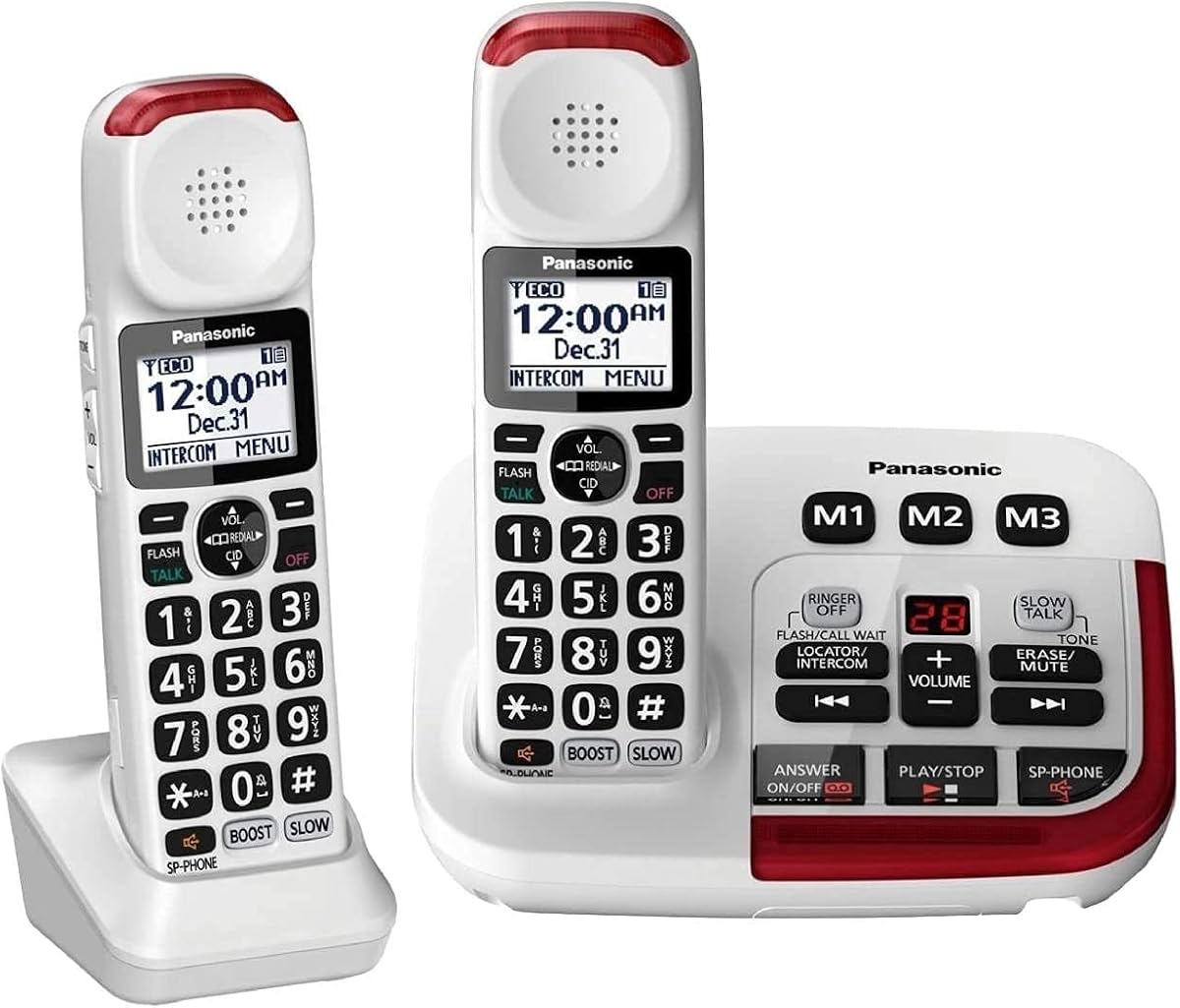
The Panasonic KX-TGM420W package is the premium pick in this roundup, combining two handsets with one of the more sophisticated audio tool sets among the listed phones. Its 4.3 rating reflects a generally favorable reception, while the combination of Volume Boost, six tone settings, Noise Reduction, and Slow Talk offers several ways to improve difficult conversations.
We may earn a commission when you buy through this link, at no additional cost to you.
The Volume Boost control raises amplified caller-voice volume by as much as 40dB. Tone settings can make speech more intelligible, while Noise Reduction is intended to suppress background interference. Slow Talk slows speech in real time and when checking voicemail. Together, these controls are useful for listeners who need more than a simple volume increase, particularly when callers have different voices or unusual speech patterns.
Visibility and household convenience are handled well. A large white backlit LCD, enlarged dial keys, bright red visual ringers, a loud base ringer, a power backup, speakerphone, talking caller ID, talking keypad, and phonebook support easier operation. The system includes a digital answering machine, nine speed dials, a 250-number call block, intercom capability, and expansion to as many as six handsets.
Its main drawback is complexity. A user who wants a basic amplified phone may find this feature set excessive, and the included handsets are cordless and therefore require charging. Even so, it offers an unusually balanced feature set for a household that wants better incoming speech, slower conversations, multiple extension points, and a reliable backup during power interruptions.
Volume Boost, tone adjustment, Noise Reduction, and Slow Talk address different listening problems. This gives users more control than a model that only makes incoming audio louder.
Two included handsets, visual ringers, a loud base ringer, call blocking, speakerphone, and an answering system make the package practical for a shared home.
We may earn a commission when you buy through this link, at no additional cost to you.
The Panasonic KX-TGM450S is a one-handset cordless model built around high amplification and a very loud visual ringer. It has a 4.3 rating and raises caller voice volume by as much as 50dB. The headline specification is among the strongest in the guide, although users should still confirm that the boost level suits their hearing needs and equipment.
We may earn a commission when you buy through this link, at no additional cost to you.
The phone also provides six voice tone settings, Noise Reduction, and Slow Talk. Those controls address fast or difficult speech more comprehensively than maximum volume alone. A large white backlit LCD, enlarged memory dial buttons, and a bright red LED visual ringer improve visibility, while hearing aid compatibility gives qualified users another connection option to consider.
Standard convenience features remain comprehensive for a single-handset system. The package includes power backup, speakerphone, talking caller ID, talking keypad and phonebook, nine speed dials, 250-number call block, intercom, and accessories. It can expand to six handsets, and the 1.8-inch LCD provides a readable but relatively compact display.
This model is best for someone who values a high boost level, slow-speech controls, and one of the loudest listed visual ringers, but does not need two handsets immediately. Compared with the KX-TGM420W bundle, it provides more listed amplification and a louder ringer specification while offering fewer included handsets.
The combination of 50dB caller volume boost and six tone settings allows users to tune incoming speech rather than relying on a single volume control.
The 112dB visual ringer and bright red LED indicator help a user notice incoming calls when an audible ringer is ineffective or disruptive.
We may earn a commission when you buy through this link, at no additional cost to you.
The VTech SN5147 earns the budget recommendation by combining a dependable corded base with a cordless handset and a broad set of senior-focused features. It has a 4.0 rating and is designed specifically for seniors and users with hearing loss. Its 50dB one-touch audio assist and 90dB extra-loud ringer form the core of the accessibility proposition.
We may earn a commission when you buy through this link, at no additional cost to you.
The hybrid layout offers practical resilience. The corded base can continue working during power outages, while the cordless handset provides mobility around the home. A full-duplex speakerphone is available on both base and handset, and flashing visual indicators supplement the loud ringer. Oversized high-contrast buttons and an extra-large display support people with limited vision or dexterity.
The phone also includes thoughtful calling and message features. It can block up to 1,000 robocalls and unwanted numbers, offers four one-touch photo speed-dial slots, and includes a 22-minute digital answering machine with remote access and slow playback. Spoken caller ID, a visual ring indicator, and expansion to as many as four handsets add further utility.
The VTech is a strong choice for a household seeking major amplification without moving into a more complicated multi-handset system. Its four photo-dial slots are limited, but the combination of outage-friendly corded operation, high contrast, visual alerts, and slow message playback makes it especially approachable for older users.
The corded base remains tied to the wall connection and does not depend on the same rechargeable power used by the cordless handset, adding useful continuity during outages.
Oversized buttons, a large high-contrast display, photo speed dials, a speakerphone, and a flashing ringer reduce barriers to routine calling.
We may earn a commission when you buy through this link, at no additional cost to you.
The Clarity P300 is a straightforward amplified corded phone for users with mild to moderate hearing loss. Its 4.0 rating reflects a well-regarded basic design, and the most important feature is up to 26dB amplification of incoming sound. While that figure is lower than the maximum boost offered by several Panasonic models, it may still provide an effective degree of additional support.
We may earn a commission when you buy through this link, at no additional cost to you.
Customization is concentrated in the areas that matter for hearing. Adjustable ringer pitch allows users to select an alert that is easier to identify, and separate ringer volume control makes it possible to tune the ringtone for the home. Large buttons and an enlarged handset are intended to help seniors and people with limited dexterity or vision.
The wired design keeps the feature list focused. It uses a standard phone jack, needs no batteries or wireless signal, and is supplied with a 25-foot telephone line cord and user guide. That simplicity is an advantage for anyone who wants an uncomplicated telephone without setup complexity.
The P300 is best for a user who primarily needs stronger incoming sound, a more recognizable ringer, and large physical controls. It does not include an answering machine, caller ID display, cordless mobility, captions, or advanced speech controls, so buyers wanting those features should select a more specialized model.
Adjustable ringer pitch can make an incoming call easier to notice for someone who hears high or low frequencies better than others.
The standard jack connection, included line cord, and lack of battery requirements make this a practical choice where simplicity and dependable wired operation matter most.
We may earn a commission when you buy through this link, at no additional cost to you.
The Uvital Big Button Phone is a basic corded landline designed around exceptionally loud alerts and simple access to frequently called contacts. It has a 4.1 rating. Its most striking specifications are a ringtone that reaches up to 120dB and earpiece volume up to 90dB, accompanied by three independent volume settings.
We may earn a commission when you buy through this link, at no additional cost to you.
Daily calling is made easier with eight one-touch speed-dial buttons. Users can customize the buttons with family and friends’ photographs, which may help seniors with memory loss, poor vision, or cognitive impairment identify the intended contact. A separate SOS emergency button and a bright red flashing LED provide additional ways to initiate or notice calls.
The phone also supports one-touch hands-free calling, allowing a user to speak without holding the handset. This can be useful for people with limited mobility. The set requires only an RJ11 telephone-line connection and no batteries or external power, which simplifies placement near a conventional landline service.
Its limitations are significant but clearly defined. It is designed for PSTN landline service and does not support internet calling, answering machines, voicemail, caller ID, or a display screen. Wall mounting is not recommended. Choose it for loudness, large photo buttons, and dependable corded use rather than advanced call management.
The 120dB ringtone and flashing LED provide both audible and visual call alerts, offering useful flexibility across different environments and hearing needs.
Photo-programmable buttons reduce reliance on remembered numbers, which is particularly helpful for users experiencing memory, vision, or cognitive difficulties.
We may earn a commission when you buy through this link, at no additional cost to you.
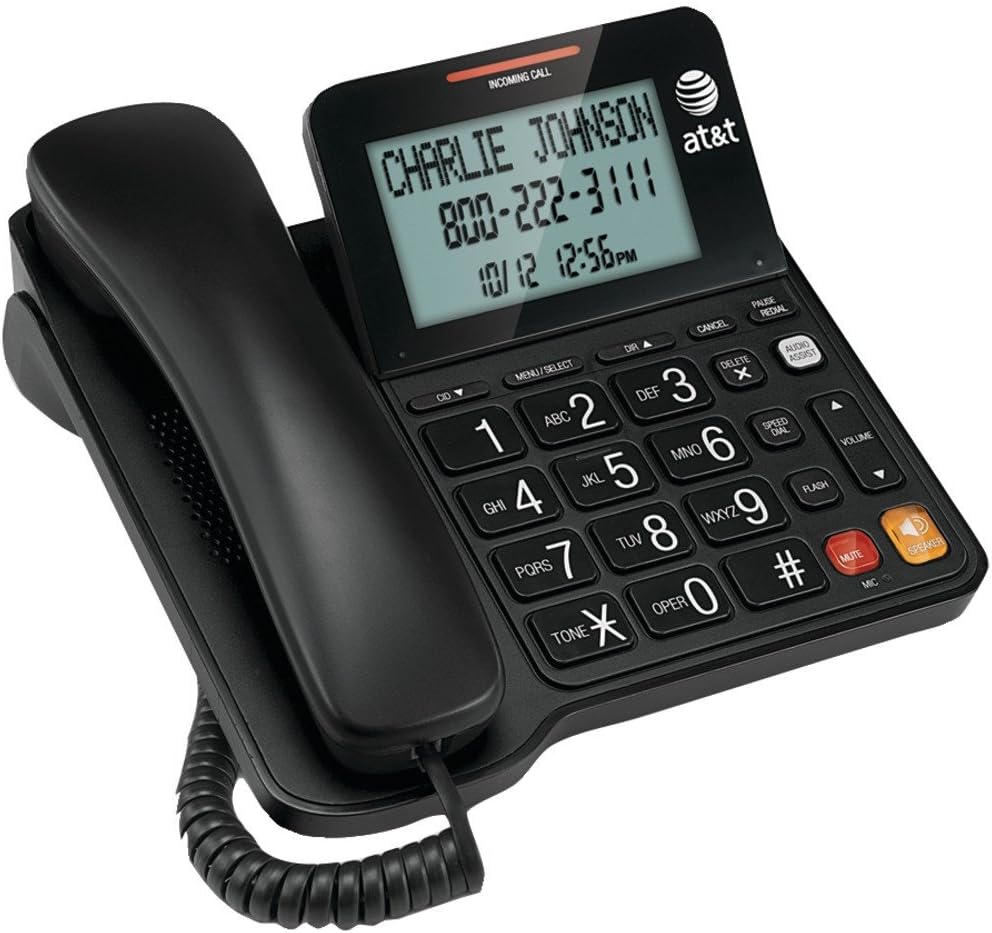
The AT&T CL2940 combines familiar corded-phone operation with a few accessibility features. It has a 4.2 rating, an adjustable extra-loud ringer, Audio Assist volume boost, extra-large buttons, and a tiltable display. It is a sensible middle ground for someone who wants stronger incoming sound and easier dialing without moving to a specialized captioning service.
We may earn a commission when you buy through this link, at no additional cost to you.
The display can show caller names and numbers and stores a history of up to 50 entries. Call Waiting support adds another familiar convenience, while the speakerphone allows users to talk without holding the receiver. The tiltable screen is positioned for easier viewing, and the oversized buttons help users dial accurately.
The wired design also has a useful emergency characteristic. Basic calling can operate without AC power, although Caller ID requires four AA batteries that are not included. That distinction matters for buyers who want the telephone itself to remain usable during an outage but also need the display to retain caller information.
The CL2940 is best for a senior or hearing-impaired user who values a familiar telephone, visible caller information, and stronger audio without needing captions, photo speed dials, or a cordless system. It does not include an answering machine, so users who need message recording should choose the VTech, SWISSVOICE, or another model with that feature.
The tiltable display and 50-entry history make it easier to identify incoming callers before answering, while extra-large keys reduce dialing errors.
Basic calling works without AC power, adding resilience during outages, although the caller-ID display has separate battery requirements.
We may earn a commission when you buy through this link, at no additional cost to you.
The Clarity XLC3.4+ is a DECT 6.0 amplified cordless phone with a 4.3 rating as a specialized product. Its core appeal is mobility: users can carry the handset around the home without remaining beside a fixed base. It also includes an extra-loud ringer, big buttons, talking caller ID, and a dual power battery arrangement.
We may earn a commission when you buy through this link, at no additional cost to you.
DECT 6.0 operating at 1.9GHz is designed to provide interference-free operation and a wide range. The listing also states that the system offers 30% more battery life. Digital Clarity Power technology supports clearer sound handling, while the extra-loud ringer provides a stronger incoming-call alert.
This model is less fully described than several alternatives in the roundup, and its listed rating of 3.7 is the lowest among the ten products. The available data does not provide a precise amplification figure, answering-machine capacity, or detailed visual-alert specification, so buyers should confirm those requirements before ordering.
It is best for a household that prioritizes cordless mobility, DECT technology, and a loud ringer over detailed captioning, photo dialing, or extensive senior controls. Its lower rating warrants more careful comparison, especially against the Panasonic and VTech models, whose feature specifications are more clearly documented.
DECT 6.0 lets the handset communicate with its base while allowing users to move through the home, without requiring an internet-based calling service.
Digital Clarity Power and talking caller ID support clearer sound and make incoming caller information available through speech as well as the handset.
We may earn a commission when you buy through this link, at no additional cost to you.
The SWISSVOICE Premium 3355 combines an answering machine, photo memory buttons, and a corded-and-cordless configuration. It has a 3.4 rating, the lowest listed in this comparison, but its design is clearly focused on accessibility. Four large photo memory buttons, including an SOS button, help users identify intended contacts without memorizing numbers.
We may earn a commission when you buy through this link, at no additional cost to you.
The telephone uses extra-large buttons and includes a corded base with an additional cordless handset. Its adjustable ringer can reach up to 90dB, providing a strong audible alert, while hearing aid compatibility offers compatibility with users who rely on those devices. A built-in call-block function helps manage unwanted calls.
The answer machine adds practical message handling to a phone otherwise centered on large controls and simple contact access. The corded handset provides a fixed option, while the additional cordless unit allows calls to be taken away from the base. Each base is described as compatible with up to three additional handsets.
The deciding factor is the lower rating. Buyers should evaluate user feedback and confirm desired details before purchase. Even so, for a household seeking photo buttons, a very loud ringer, hearing aid compatibility, an answering machine, and both wired and cordless options, the Premium 3355 covers several important accessibility needs in one package.
Large photo memory buttons let a user recognize the person they intend to call, reducing reliance on written names and remembered numbers.
A corded base and additional cordless handset let users choose between a stationary receiver and the freedom to move around the home.
We may earn a commission when you buy through this link, at no additional cost to you.
The Clarity E814CC is an amplified corded-and-cordless combo with an answering machine, dual-SIM functionality, and a dual-keypad arrangement. It carries a 4.1 rating. Its main attraction is flexibility: a corded base can serve as a stationary telephone while a cordless handset adds mobility around the home.
We may earn a commission when you buy through this link, at no additional cost to you.
The integrated answering machine provides message handling without requiring a separate device. Dual-SIM functionality may also be useful for users with more than one line or service arrangement, although the available product data does not explain the precise operating configuration. The dual-keypad design adds a second control area for dialing and call management.
The supplied specifications are limited compared with the detailed descriptions available for most products in this roundup. The listing provides the model number as 53727.000 and physical dimensions of 8.90 by 5.50 by 7.50, but it does not state an exact amplification level, ringer output, visual-alert capability, or telephone-service requirements.
As a result, the E814CC is best viewed as a versatile all-in-one option for someone who specifically wants a corded base, a cordless handset, an answering machine, and multiple keypad or SIM functionality. Buyers should confirm that those features match their service and accessibility needs, particularly if exact sound levels or hearing aid compatibility are priorities.
The combination supports both a fixed receiver and a portable handset, giving different household members or moments in the day more than one way to answer.
The answering machine, dual-SIM capability, and dual-keypad setup bring several communication functions together instead of requiring separate household equipment.
We may earn a commission when you buy through this link, at no additional cost to you.
The most useful accessible phone is not necessarily the one with the largest specification on the box. Hearing level, speech clarity, visual needs, mobility, dexterity, local service, and the user’s ability to manage a more advanced interface should guide the decision.
Amplification is a central feature for many hearing-impaired users, but maximum output is only one part of intelligibility. Models in this guide range from the Clarity P300’s 26dB incoming amplification to the Panasonic KX-TGM450S’s stated 50dB caller-voice boost, with several products offering intermediate levels. A higher figure may be useful, but it should be considered alongside tone adjustment, noise reduction, and slow-speech controls. Users who find certain voices difficult to understand often benefit more from a combination of controls than from maximum volume alone.
A loud ringer helps one user while disturbing everyone else in the home, making visual alerts an important alternative. The Panasonic KX-TGM450S has a listed 112dB visual ringer, the Uvital reaches a listed 120dB ringtone and includes a flashing LED, and the VTech combines a 90dB ringer with a flashing visual indicator. Buyers should think about the hearing of every household member, not only the intended user, and choose a system that allows the audible ringer to remain comfortable.
Captioning offers a different solution from making speech louder because the conversation appears as text. The Hamilton CapTel 2400iSPNBT supports automatic and assisted captions for incoming and outgoing calls, customizable caption sizing, and captioned voicemail. It requires a Wi-Fi-capable high-speed internet connection, electrical power, registration, and eligibility as a US resident with hearing loss. A captioned telephone is most appropriate for someone who benefits from visual access or needs assistance understanding words that remain unclear through amplification alone.
Connection style affects reliability, mobility, and outage performance. A corded phone stays beside the wall jack and can make basic calls without AC power, as noted for the AT&T CL2940 and Uvital models. Cordless systems provide freedom to move around the home, while hybrids combine both approaches. The VTech SN5147 and SWISSVOICE Premium 3355 use a corded base with a cordless handset, and the Clarity E814CC follows a similar combo concept. Users should consider where the phone is used, whether another person can answer, and how important mobility is during an outage.
Many users with hearing loss also experience reduced vision or limited dexterity, so a good telephone should not force one accessibility challenge onto another. Large high-contrast buttons, enlarged dial keys, a tiltable display, and a clear backlit screen can improve daily usability. The AT&T CL2940 and VTech SN5147 emphasize large buttons and readable displays, while the CapTel relies on a large touchscreen. The right control style depends on familiarity: a dedicated-button layout may be easier for some users, while a touchscreen can provide clearer information when visual acuity permits.
Photo-programmable speed dials can reduce the need to remember names, numbers, and the order of button presses. The Uvital offers eight one-touch photo buttons and an SOS button, the VTech provides four photo speed-dial slots, and the SWISSVOICE has four large photo memory buttons. These are particularly relevant for seniors experiencing memory loss, poor vision, or cognitive impairment. Family members can label the buttons during setup, turning the telephone into a familiar communication board rather than a purely numeric device.
Hands-free calling can make a conversation more comfortable for a user who has difficulty holding a handset, while Slow Talk gives both parties more time to process fast speech. The Panasonic models combine speakerphone with Slow Talk, and the Uvital includes one-touch hands-free operation. Noise Reduction is another helpful feature in the Panasonic systems. These functions are not substitutes for captions, but they can make everyday communication more comfortable when the user can follow the speaker’s words yet needs a little extra processing time.
An answering machine adds a record of missed calls, but its usefulness depends on playback accessibility. The VTech includes a 22-minute digital answering machine with remote access and slow playback, while the Panasonic KX-TGM420W bundle includes a digital answering machine. The SWISSVOICE Premium 3355 and Clarity E814CC also include answering machines. For users who struggle with rapid speech, slow playback is especially important. The CapTel goes further by displaying voicemail captions directly on its screen, which is a meaningful benefit for users who cannot reliably understand recorded speech.
Begin by placing the phone where the intended user can hear or see it, reach its controls comfortably, and avoid hiding the handset or ringer. Connect a corded base to the appropriate telephone jack, connect a cordless handset to its base, and allow all rechargeable batteries to charge fully. For a captioned model, complete registration, connect the required internet service, test Wi-Fi, and make several calls to confirm that captions, tones, volume, and voicemail are working as intended.
Program the most important contacts before the user begins relying on the phone. Label photo buttons clearly and position each image consistently. Adjust the ringer pitch, ringer volume, conversation volume, tone, and visual alert in different rooms and at different times of day. Users who benefit from Slow Talk should explain the feature to callers, while CapTel users should choose a caption size that remains legible without crowding the screen.
Care for the system according to its connection type. Keep corded handsets, photo buttons, and controls clean and dry, inspect the line cord for damage, and avoid placing a corded phone where wall mounting is not recommended. Charge cordless handsets regularly and keep the base away from moisture and excessive heat. Test the ringer, visual alert, speakerphone, emergency buttons, caller information, and answering machine periodically so a depleted battery or failed connection does not go unnoticed.
The best choice depends on how the user communicates and what they can reliably perceive. A highly amplified cordless model such as the Panasonic KX-TGM450S may help with caller volume, while the Hamilton CapTel 2400iSPNBT adds visual captions for users who need to see the words. A candid assessment of hearing, vision, internet access, and service eligibility is more useful than relying on a single amplification figure.
Some corded models can make basic calls without AC power, including the AT&T CL2940 and the Uvital phone. A cordless handset will not operate when its base loses power unless it has a backup source, and a captioned phone such as the CapTel requires electrical power and internet service. Check the specific model’s outage capabilities before relying on it for emergency calling.
An amplified phone increases incoming sound and may add tone, noise-reduction, or slow-speech controls. A captioned phone also displays a written version of the conversation, which can make speech easier to follow or allow the user to rely more heavily on visual information. The Hamilton CapTel 2400iSPNBT is the only captioned model in this guide and requires eligible registration and service.
They can be. Large buttons containing a familiar face reduce the need to remember a name, number, or button sequence. The Uvital, VTech SN5147, and SWISSVOICE Premium 3355 all offer photo memory or photo speed-dial functions. Family members should set up and label the buttons, while leaving the emergency or SOS function clearly identifiable and easy to reach.
A corded phone is simple, stays connected to the wall line, and can support basic calling without power in some models. A cordless phone offers mobility but requires charging and a functioning base. A hybrid system is often the most flexible, allowing users to answer from a fixed handset or move around the home with a portable one.
Slow Talk reduces the speed of the other speaker’s voice during a live conversation and when checking voice messages. It can help a listener process speech that is audible but too fast or complex. It is available in the Panasonic KX-TGM420W and KX-TGM450S models, while the VTech answering machine offers slow playback for recorded messages.
A visual ringer is still useful because amplification primarily helps users perceive speech and alerts, but it does not guarantee that every ring will be noticed. Distance, background noise, nighttime, or the need to lower the ringer can interfere with detection. Phones such as the Uvital, Panasonic, VTech, and Clarity XLC3.4+ provide prominent visual alert options that complement their audible ringers.
Consider hearing level, vision, dexterity, mobility, memory, and the user’s ability to operate electronic controls. Then verify amplification, tone controls, ringer loudness, visual alerts, button size, display readability, cord length, power requirements, and service compatibility. If captions are important, verify internet access, registration requirements, and geographic eligibility before ordering.
The Hamilton CapTel 2400iSPNBT is the strongest overall option because it combines real-time captions, amplification, a large touchscreen, and captioned voicemail. The VTech SN5147 stands out as the budget-conscious choice with 50dB audio assist, a very loud ringer, a corded base, a cordless handset, and senior-friendly controls. For a more advanced cordless system, the Panasonic KX-TGM420W package offers two handsets, a digital answering machine, tone controls, Noise Reduction, and Slow Talk.
The right comparison should prioritize the user’s actual communication barriers. Someone who needs to see conversation text should begin with a captioned service. A user who understands speech but struggles in noise may benefit more from tone adjustment, Noise Reduction, and Slow Talk. Those who need visible call alerts or easier dialing should compare ringer output, flashing indicators, large buttons, and photo speed dials before considering extra functions.
Ratings, features, service terms, and prices can change, so check the current listing and confirm compatibility before purchasing. In particular, verify internet and registration requirements for the CapTel, telephone-line compatibility for basic corded models, expansion options for cordless systems, and the exact handset bundle included with any hybrid phone.