
LIDER No Neutral Wire Humidity Sensor Switch
4.9Editor score
Five humidity sensitivity levels
Five fan delay options
Fresh air timed mode
Discover the best humidity sensor switch options for bathrooms, laundry rooms, and basements, compared for sensing, wiring, fan control, and installation.
A humidity sensor switch can automate bathroom ventilation, reduce lingering condensation, and make exhaust fans more responsive to real moisture levels. The right model should combine reliable sensing with compatible wiring, useful delay settings, safe fan-load ratings, and controls that remain understandable after installation.
This guide compares ten humidity sensor switches based on the information supplied for each product, including control modes, adjustable humidity levels, wiring requirements, electrical limits, installation considerations, and supported applications. It covers fan-only, combination-switch, digital-display, motion-sensing, and traditional mechanical designs.
Each pick reveals which type of homeowner or renovation project it best suits, from simple fan automation to combined humidity and lighting control. Product features and marketplace availability can change, so buyers should confirm current specifications, wall-box compatibility, and local electrical-code requirements before purchasing.
4.9Editor score

4.5Editor score

4.0Editor score
The comparison below highlights the major differences among fan-only, combination, digital, and dual-sensor switches, with particular attention to wiring, controls, timing, and fan compatibility.




The Lutron Humidity Sensor Switch earns a 4.5 rating and stands out as a polished, straightforward option for automatically operating an exhaust fan when humidity changes. Its strongest attraction is the combination of humidity sensing, fan control, and a programmable light timer in a conventional single-pole format, while the absence of a neutral-wire requirement broadens its potential use in existing homes.
We may earn a commission when you buy through this link, at no additional cost to you.
The supplied information emphasizes accurate responses to actual moisture changes rather than unnecessary triggers. This matters in bathrooms and other damp spaces, where a sensor that runs the fan too frequently can be noisy and disruptive. The light timer can be set to 1, 5, 15, or 30 minutes, allowing the switch to support a mirror light or nearby fixture without requiring a separate timer.
Its 3-amp single-pole fan rating is the main limitation. It should not be assumed to drive a quarter-horsepower exhaust fan, which several competing models expressly support. Lutron also states that the device meets Title 24 and IECC 2021 standards and can be installed without a neutral wire, though buyers still need to confirm that the existing switch box and wiring meet the requirements for their project.
This is a strong recommendation for a homeowner who wants elegant, uncomplicated humidity automation and values the added light timer. It is particularly appropriate where the existing fan is within the 3-amp limit and the goal is to replace a single-pole switch without adding a neutral conductor. For larger fans, however, a quarter-horsepower model is the safer choice.
Automatic fan operation removes the need to remember a bathroom fan after a shower. The sensor’s reported ability to respond to real moisture changes should make ventilation more targeted, while a manual override remains useful when air should be moved immediately.
The programmable light timer gives the switch value beyond humidity control. It can turn a connected light off after a selected interval, reducing the need for a separate countdown device in frequently used rooms.
We may earn a commission when you buy through this link, at no additional cost to you.
The Leviton DHS05-1LW carries a 4.5 rating and offers one of the cleanest approaches to automatic bathroom ventilation. It automatically turns a bath or ventilation fan on and off, supports up to a quarter-horsepower fan, and can be installed with or without a neutral wire, making it a broadly compatible choice for renovation and replacement work.
We may earn a commission when you buy through this link, at no additional cost to you.
The slim profile is designed to fit most wall boxes, which helps when space is limited. Settings can be adjusted without tools or removing the faceplate and wall plate, a meaningful convenience for users who expect to fine-tune humidity behavior after living with the device. The same core functions apply in bathrooms, basements, laundry rooms, and spas.
This model is limited to fan control rather than combining it with a separate light switch or an occupancy sensor. Homeowners who want a coordinated fan-and-light control may prefer the DHD05-1LW, while anyone who wants a visible humidity reading may find the Ortis display model more informative. Those differences should be weighed against the DHS05-1LW’s straightforward operation and broad fan compatibility.
The Leviton DHS05-1LW is a strong all-around recommendation for a standard exhaust-fan project. It is particularly attractive when a quarter-horsepower fan must be supported, a neutral wire is unavailable, and the installer values simple adjustments without removing wall plates.
Supporting a quarter-horsepower fan makes this switch suitable for a wider range of common exhaust equipment. Confirming the fan’s electrical rating before installation remains essential.
Tool-free adjustment makes the sensor easier to tune as room conditions change. Users can reach the settings without dismantling the switch, reducing maintenance friction.
We may earn a commission when you buy through this link, at no additional cost to you.
The Ortis Digital Sensor Switch receives a 4.0 rating and distinguishes itself with an LCD that displays real-time humidity. It combines digital sensing with microprocessor control, giving users a more informative alternative to basic dial-based humidity switches and making it easier to understand why a fan is running or stopped.
We may earn a commission when you buy through this link, at no additional cost to you.
Its minimum run time can be configured from 1 to 60 minutes, while automatic and manual modes provide different ways to operate the exhaust fan. The switch also includes a humidification function for dry conditions, an overnight operating period adjustable from roughly 4 to 16 hours, and a lock that helps prevent accidental button presses.
The requirement for a neutral wire is the clearest practical disadvantage. It may also offer more complexity than some users want, particularly for a basic bathroom installation where the primary goal is straightforward shower-triggered ventilation. Buyers should confirm support for their local electrical system and ensure that the connected humidifier or fan loads remain within the device’s specifications.
The Ortis model is a compelling recommendation for users who value visibility, granular timing, and multiple operating modes. It fits a renovation with an available neutral conductor and for someone who wants to monitor the room’s moisture level directly rather than relying entirely on indirect sensor behavior.
The LCD provides immediate feedback on current room conditions. That visibility can make threshold selection more intuitive and helps users distinguish an active dehumidification cycle from a temporarily dry room.
Automatic, manual, overnight, and humidification functions make the switch adaptable to changing conditions. The broad one-to-60-minute run-time range also allows ventilation to continue long enough to clear residual moisture.
We may earn a commission when you buy through this link, at no additional cost to you.
The Leviton DHD05-1LW earns a 4.3 rating and offers a more integrated solution than a fan-only humidity switch. It combines a humidity-controlled bathroom exhaust fan with a separate light switch, allowing a mirror light, shower light, towel warmer, or heater to operate independently while the sensor manages moisture removal.
We may earn a commission when you buy through this link, at no additional cost to you.
The switch supports a quarter-horsepower fan and includes generous light-load ratings across LED, CFL, incandescent, halogen, magnetic low-voltage, electronic low-voltage, and resistive categories. Its fan and light conductors are separately identified, which can simplify wiring compared with combining unrelated functions in one conductor.
A ground wire is required even though a neutral wire is optional. That makes the DHD05-1LW less suitable for very old boxes with limited grounding, but it can still accommodate either wiring configuration when a proper ground is present. Unlike a PIR-based model, it does not automatically detect occupancy, so the light remains a conventional manual control.
This is a strong choice for a bathroom remodel where one device must manage both ventilation and lighting. It offers a balanced combination of flexible wiring, useful load support, and separate controls, making it more versatile than a basic humidity switch without introducing the complexity of a full digital interface.
Keeping the light independent means occupants can illuminate a mirror without unnecessarily starting the exhaust fan. At the same time, the humidity sensor can activate ventilation automatically.
The documented limits cover several common lighting technologies and wattages. This gives the switch flexibility in homes using LED, CFL, incandescent, halogen, or low-voltage fixtures.
We may earn a commission when you buy through this link, at no additional cost to you.
The TOPGREENER Humidity Sensor Fan Switch has a 4.0 rating and focuses on a predictable operating model. It detects excess humidity, starts the ventilation fan, and runs it for a fixed 20-minute cycle. If humidity remains high after that interval, it pauses for five minutes and begins another cycle, reducing the risk of continuous motor operation.
We may earn a commission when you buy through this link, at no additional cost to you.
Three adjustment gears cover a 45 to 80 percent relative-humidity range. A manual ON/OFF control is also included: manual ON follows the same 20-minute cycle, while manual OFF stops the fan immediately and pauses sensing until the user resets the switch.
That reset behavior is useful for people who do not want repeated nighttime activation, but it can also require deliberate reactivation later. The switch supports 120-volt single-pole installations with a maximum 3-amp fan and requires a neutral wire. It is described as compliant with California Title 24 and IECC 2021, with a three-year warranty and UL listing.
The TOPGREENER is a good recommendation for buyers who prefer a defined cycle rather than a large menu of modes. Its compact feature set is easy to understand, although users seeking visible readings, minute-by-minute timing, or more elaborate scheduling should look to the digital or multi-mode alternatives.
The fixed 20-minute run and five-minute pause create a repeatable cycle. This can be beneficial when consistent post-shower ventilation is more important than precisely matching fan duration to rapidly changing humidity.
Manual control allows immediate ventilation or shutdown regardless of the sensor. Pausing detection after manual shutdown gives users direct control over nuisance activation.
We may earn a commission when you buy through this link, at no additional cost to you.
The ELEGRP Humidity Sensor Switch receives a 4.4 rating and provides a versatile selection of operating modes. Its bath mode, air-cycle mode, and humidistat mode let users choose different fan behaviors for shower activity, scheduled ventilation, or direct humidity-threshold management.
We may earn a commission when you buy through this link, at no additional cost to you.
A microprocessor-controlled digital sensor drives automatic activation when moisture exceeds the selected threshold and turns the fan off after humidity returns to normal. Users can adjust four humidity levels and three operating modes through a built-in toggle without removing the wall plate or using tools.
The device can be installed with or without a neutral wire, but it must have a ground wire. It supports exhaust fans up to a quarter horsepower and is ETL listed, with stated compatibility with ASHRAE 62.2, California Title 24, and CALGreen Part II requirements. A wall plate is included.
The ELEGRP is a strong recommendation for someone who wants several control strategies in one device or who expects to adjust the fan’s behavior as different household routines emerge. Its multiple modes add flexibility, although buyers who prefer one simple automatic cycle may find the standard fan-only switch easier to operate.
Bath, air-cycle, and humidistat modes address different ventilation needs. That flexibility can help a single switch serve both temporary moisture removal and broader indoor-air circulation.
Tool-free controls make threshold and mode changes more convenient. Owners can tune the device as they learn how their bathroom responds to showers, ventilation, and seasonal humidity.
We may earn a commission when you buy through this link, at no additional cost to you.
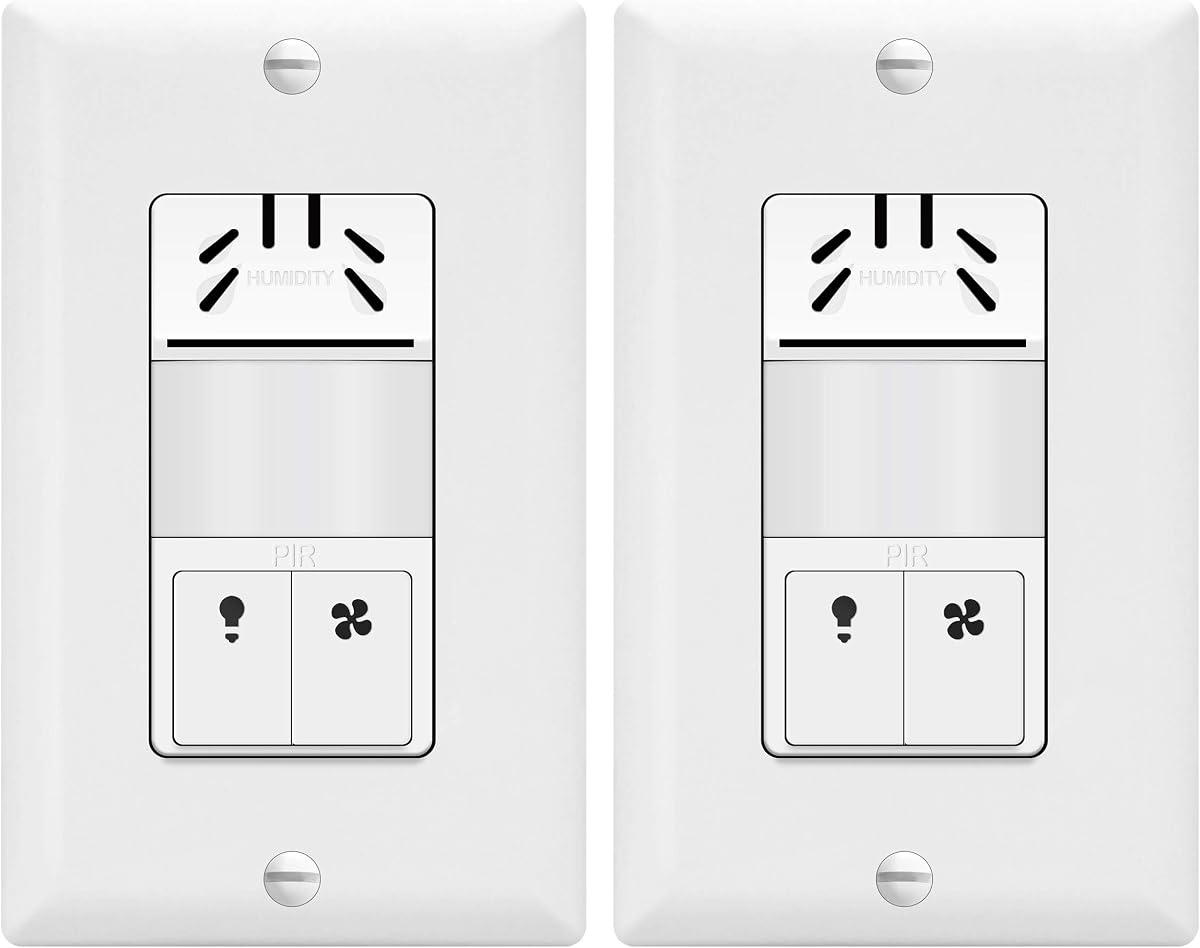
The TOPGREENER Humidity Sensor Switch for Bathroom Fan and Light has a 4.2 rating and uniquely combines passive infrared motion detection with humidity sensing. It can automate both the exhaust fan and room light, making it a strong option for bathrooms that need two kinds of environmental control in one wall-mounted device.
We may earn a commission when you buy through this link, at no additional cost to you.
Occupancy Mode automatically turns the light and fan on and off according to detected motion, while Vacancy Mode provides manual light operation with automatic fan control. Both modes offer adjustable humidity levels and time delays. Four delay settings range from 15 seconds to 30 minutes, allowing users to choose how quickly the light and fan should shut down.
Two single-pole relays handle the fan and light separately, and compatibility with LED bulbs broadens its practical use. The documented coverage extends to 600 square feet with a 180-degree field of view. A neutral wire is required, however, and the package contains two switches, which may be more than a single-room installation needs.
This model is recommended for users who want ventilation based on both occupancy and moisture rather than humidity alone. It is less appropriate for older wiring without a neutral, but in a suitable bathroom it can reduce unnecessary operation while providing responsive whole-room controls.
Motion detection and humidity sensing complement one another. The motion sensor can manage light and fan activity around occupancy, while humidity sensing ensures ventilation responds to moisture even when the room is temporarily empty.
Occupancy and vacancy modes let the homeowner decide whether the light should be fully automatic or conventionally switched. Both retain humidity-responsive fan control and adjustable timing.
We may earn a commission when you buy through this link, at no additional cost to you.
The LIDER No Neutral Wire Required Humidity Sensor Switch has the highest listed rating in the group at 4.9. It combines a distinctive matte gold finish with a screwless matching wall plate, making it appealing for renovations where the switch should blend into a coordinated decorative scheme.
We may earn a commission when you buy through this link, at no additional cost to you.
The humidity dial offers high, medium, and low sensitivity settings, while the fan delay can be selected across five intervals from 5 to 45 minutes. Two operating modes are provided: automatic humidity detection, which starts and stops the fan according to the threshold, and fresh-air mode, which runs the fan on a specified hourly delay to promote routine circulation.
Manual override options are included, and the device is UL listed for 120-volt, 60-hertz, single-pole operation with a quarter-horsepower motor limit. It requires a ground wire but not a neutral wire. The trade-off is that adjustments require removal of the face cover with a flathead screwdriver, so settings are less convenient to change than tool-free controls.
The LIDER is a strong recommendation for design-conscious buyers who want refined styling and broad adjustment without needing a neutral conductor. It is also a sensible choice when the fan must continue running for a chosen period after the humidity threshold is no longer reached.
The included matte gold screwless wall plate creates a matched set rather than requiring the buyer to coordinate the switch with a separate plate. This is especially relevant to visible bathrooms and recently renovated spaces.
Five delay intervals and three sensitivity positions give users meaningful control over how long the fan runs and how readily it reacts. These adjustments can help balance ventilation effectiveness against unwanted nighttime operation.
We may earn a commission when you buy through this link, at no additional cost to you.
The Eaton HDFS3P1-W-L has a 4.0 rating and provides a relatively straightforward way to automate a bathroom exhaust fan. It replaces a single-pole switch, turns the fan on and off according to a preset humidity level, and includes manual control for immediate ventilation.
We may earn a commission when you buy through this link, at no additional cost to you.
Its humidity range spans 45 to 80 percent relative humidity, and the fan delay is fixed at 30 minutes. Maximum fan load is one-quarter horsepower and 3 amps. The listed applications include bathrooms, basements, laundry rooms, and home spas, making it more broadly useful than a switch marketed exclusively for shower ventilation.
Compared with models offering digital displays, multiple operation modes, or tool-free selectors, the Eaton offers fewer adjustment options. The fixed delay may be adequate for many installations, but users who want to select a different duration or view the current humidity reading may find the controls limiting.
The Eaton is a compelling recommendation for a straightforward retrofit that prioritizes dependable automation over advanced features. It is particularly appropriate for someone who wants the fan to run after the humidity threshold is reached, needs manual ventilation on demand, and prefers a familiar single-pole replacement.
A preset humidity level and automatic fan operation remove the need for repeated manual switching. This is a useful core function in bathrooms and other spaces that regularly collect moisture.
Manual control is valuable when moisture is present but the threshold has not been reached, or when fresh air is wanted for comfort. It provides direct control without changing the sensor’s automatic setting.
We may earn a commission when you buy through this link, at no additional cost to you.
The Leviton IPHS5-1LW earns a 4.2 rating and uses microprocessor and digital sensing technology to monitor humidity continuously. When excess moisture is detected, it activates a ventilation fan to help lessen condensation, reducing the need to remember the fan after bathing or other damp activities.
We may earn a commission when you buy through this link, at no additional cost to you.
The switch can replace a single-pole control for a ventilation fan or a fan-and-light combination. It supports 600 watts of incandescent lighting, 150 watts of LED or CFL lighting, 4 amps of inductive or ballast loads, 400VA magnetic low-voltage loads, and motor ratings listed up to 1/6 horsepower with a 3-amp fan limit.
Its requirement for a neutral wire is the main installation constraint. It also has a lower listed motor capacity than the quarter-horsepower models in this comparison, so the connected fan must be checked carefully. It fits a standard wall box, which simplifies physical replacement when the electrical configuration is suitable.
The Leviton IPHS5-1LW is a good recommendation for users who prefer established digital sensing and Decora styling, especially in homes that already have neutral wiring. It is less suitable for older electrical boxes without a neutral or for exhaust fans above its documented motor rating.
The microprocessor-based digital sensor continuously evaluates room conditions. Automatic activation can therefore respond to rising moisture rather than relying on a user noticing condensation or humidity buildup.
Beyond motor control, the switch supports several lighting and inductive load categories. That makes it relevant for installations where the wall box includes a fan and light arrangement, provided the loads fall within the stated limits.
We may earn a commission when you buy through this link, at no additional cost to you.
The best humidity sensor switch depends on wiring, fan size, control preferences, room type, and the amount of automation desired. Review these factors before comparing models.
Neutral-wire requirements can determine whether a switch suits an existing wall box. The Lutron, Leviton DHS05-1LW, Leviton DHD05-1LW, ELEGRP, and LIDER models state that they can work without a neutral wire, while the Ortis, TOPGREENER fan-only, TOPGREENER motion model, and Leviton IPHS5-1LW require one. Ground wiring is still important: the ELEGRP, Leviton DHD05-1LW, and LIDER explicitly require a ground wire. Buyers should inspect the box before selecting a model rather than assuming all modern-looking devices have the same wiring needs.
The switch must support the electrical load of the connected exhaust fan. Several models support one-quarter horsepower, including the Leviton DHS05-1LW and DHD05-1LW, ELEGRP, LIDER, and Eaton. The Lutron and TOPGREENER fan-only models list a 3-amp maximum, while the Leviton IPHS5-1LW lists a lower motor limit of 1/6 horsepower. A compatible control switch is important because an overloaded fan motor can create unsafe or unreliable operation.
Humidity setpoints determine when the fan reacts. Most products cover a broad relative-humidity range: the TOPGREENER and Eaton use 45 to 80 percent, while the LIDER spans 40 to 80 percent. Other switches provide multiple sensitivity levels or operating modes rather than one stated range. Buyers should consider normal room conditions, seasonal variation, and how quickly the space dries after ventilation begins.
A fan delay prevents ventilation from stopping the instant humidity falls below the trigger point. Delay options range from a fixed 20 minutes on the TOPGREENER fan-only switch and 30 minutes on the Eaton to one-to-60-minute programming on the Ortis and five-to-45-minute intervals on the LIDER. Longer delays can clear residual moisture, while shorter settings may be preferable in already well-ventilated rooms.
Basic models usually automate the fan and provide a manual setting. More advanced options add fresh-air cycles, humidification, overnight behavior, occupancy control, or tool-free selectors. The ELEGRP includes bath, air-cycle, and humidistat modes; the LIDER adds a fresh-air function; and the TOPGREENER motion model supports occupancy and vacancy modes. Manual override remains important across the category so users can start or stop ventilation immediately.
A fan-only switch is appropriate when ventilation is the only required function. Combination devices add a separate light, motion sensing, or both. The Leviton DHD05-1LW uses one wall device for a fan and an independent light, while the TOPGREENER motion switch adds PIR detection and separate relays. Combination controls can reduce wall clutter but may have more demanding wiring and load requirements than a dedicated fan switch.
A digital display can make real-time humidity easier to observe and help users set thresholds with greater confidence. The Ortis model includes an LCD, lockable controls, and adjustable minimum runtime. Simpler units may offer dials, gears, or toggles instead. Consider how often settings will need changing and whether other people using the room will understand the interface.
Ventilation controls can be subject to local building and energy codes. The Lutron states compliance with Title 24 and IECC 2021; the TOPGREENER fan-only switch makes similar claims; and the ELEGRP cites ASHRAE 62.2, California Title 24, and CALGreen Part II. Several products also carry safety listings such as UL or ETL. These claims should still be verified against the exact model, local jurisdiction, and complete installation.
Begin by identifying which load wires the new switch will replace and recording their functions. Follow the model’s wiring diagram, disconnect power at the appropriate breaker, and confirm the circuit is de-energized before touching any conductors. A qualified electrician should handle wiring when the installation is uncertain or the existing box lacks a required ground or neutral conductor.
After installation, restore power and use manual controls to confirm that the fan and any connected light operate correctly. Then activate automatic mode and observe the behavior through a shower or other moisture-producing activity. Fine-tune the humidity threshold and fan delay according to the room’s size, ventilation, climate, and how quickly it normally dries.
For care, keep the faceplate and sensor area free of dust, paint, condensation, and cleaning residue. Do not spray liquid directly into the switch, and avoid using the humidity control as a substitute for a correctly sized or properly operating exhaust fan. Periodically test the manual controls and inspect whether moisture is clearing as expected.
It depends on the model. Several switches in this guide work without a neutral wire, while the Ortis, both TOPGREENER options, and the Leviton IPHS5-1LW explicitly require one. A ground wire may still be required even when a neutral is optional. Inspect the existing box and follow the manufacturer’s wiring diagram before purchasing or installing a switch.
Often, yes, because most of these products are designed to replace a single-pole switch. The replacement must match the existing wiring arrangement, fit the wall box, and support the connected fan’s electrical rating. If the existing location has no fan or light, or if the wiring includes unusual configurations, consult an electrician.
A humidity sensor switch responds to measured moisture, often starting the fan when a threshold is crossed and then using a delay before shutdown. A timer switch runs for a predetermined period regardless of current humidity. The Ortis model also offers humidification capability, while several others focus specifically on exhaust-fan control.
The appropriate duration depends on the bathroom, fan airflow, humidity level, and local code. The products here offer delays ranging from five minutes to an hour, with some using a fixed 20- or 30-minute cycle. Start with a moderate setting and adjust according to how well the room dries and whether the fan remains uncomfortably audible.
The Leviton DHD05-1LW lists specific LED, CFL, incandescent, halogen, low-voltage, and resistive light limits. The TOPGREENER motion-control model is also compatible with LED bulbs and includes a 150-watt CFL or LED rating. Always confirm the light’s wattage and the switch’s stated load category before connecting it.
The room may still be above the selected threshold, or the switch may be completing its minimum runtime or delay. Other causes include a humidifier, cooking moisture, inadequate airflow, or a sensor that needs cleaning. Use manual operation if necessary, but avoid repeatedly resetting the sensor without checking the underlying moisture source.
Yes, several products are specifically listed for bathrooms, basements, laundry rooms, spas, and similar damp locations. A suitable room should also have an exhaust fan rated for the space. In a basement, verify that the device’s approved applications and local ventilation requirements align with the installation.
Experienced homeowners may be able to complete a straightforward replacement when the wiring matches the instructions, the box has the required conductors, and the fan falls within the switch’s limits. Shut off and verify the circuit before handling wires. Electrical work should be performed by a qualified professional when instructions, code requirements, or wiring conditions are unclear.
The Lutron Humidity Sensor Switch is the most versatile overall choice because it combines humidity-triggered fan control, a programmable light timer, and no-neutral installation support. The LIDER model is the standout premium option for its high rating, matching decorative plate, granular settings, and fresh-air mode, while the Eaton HDFS3P1-W-L delivers a focused and budget-conscious fan-control experience.
Prioritize the requirements that cannot be compromised: neutral and ground wiring, fan motor rating, electrical-load compatibility, and local code acceptance. After addressing those essentials, choose the control style that fits the household. A digital display and multiple modes suit users who want frequent adjustment, while a simpler dial or fixed-cycle device is usually easier to maintain.
Finally, review the current manufacturer instructions, listing details, wall-box requirements, and product availability before ordering. Because electrical specifications and marketplace listings can change, confirming the exact model’s latest documentation helps ensure that the chosen humidity sensor switch fits both the project and the installed fan.
