
Hydrogen Water Bottle Generator Inhaler
3.9Editor score
3000+ ppb in five minutes
Dual water and inhalation modes
Compact rechargeable bottle design
OLED display and test kit
Our Hydrogen Inhalation Machine guide compares flow rates, purity, portability, safety features, and output options to help you choose a model with confidence.
Hydrogen inhalation machines range from compact personal water bottles to multi-user systems designed for home, travel, or professional environments. A useful model should balance dependable gas output, clear safety controls, understandable operation, and the specific delivery format you actually need.
We compared all ten products using their stated flow rates, hydrogen purity, output configurations, tank sizes, noise levels, portability, safety features, and included accessories. The list covers portable bottles, three-in-one systems, dedicated generators, and multi-port machines across a wide range of capabilities.
Each pick highlights a different practical advantage, from compact hydrogen-water production to high-flow output and simultaneous gas options. Product details and availability can change, so readers should verify the current specifications, included accessories, and seller information before making a final purchase.
3.9Editor score

3.9Editor score

The table below compares the ten machines by flow rate, purity, delivery method, and practical features, making it easier to identify the right format for home use, travel, water generation, or multi-user operation.
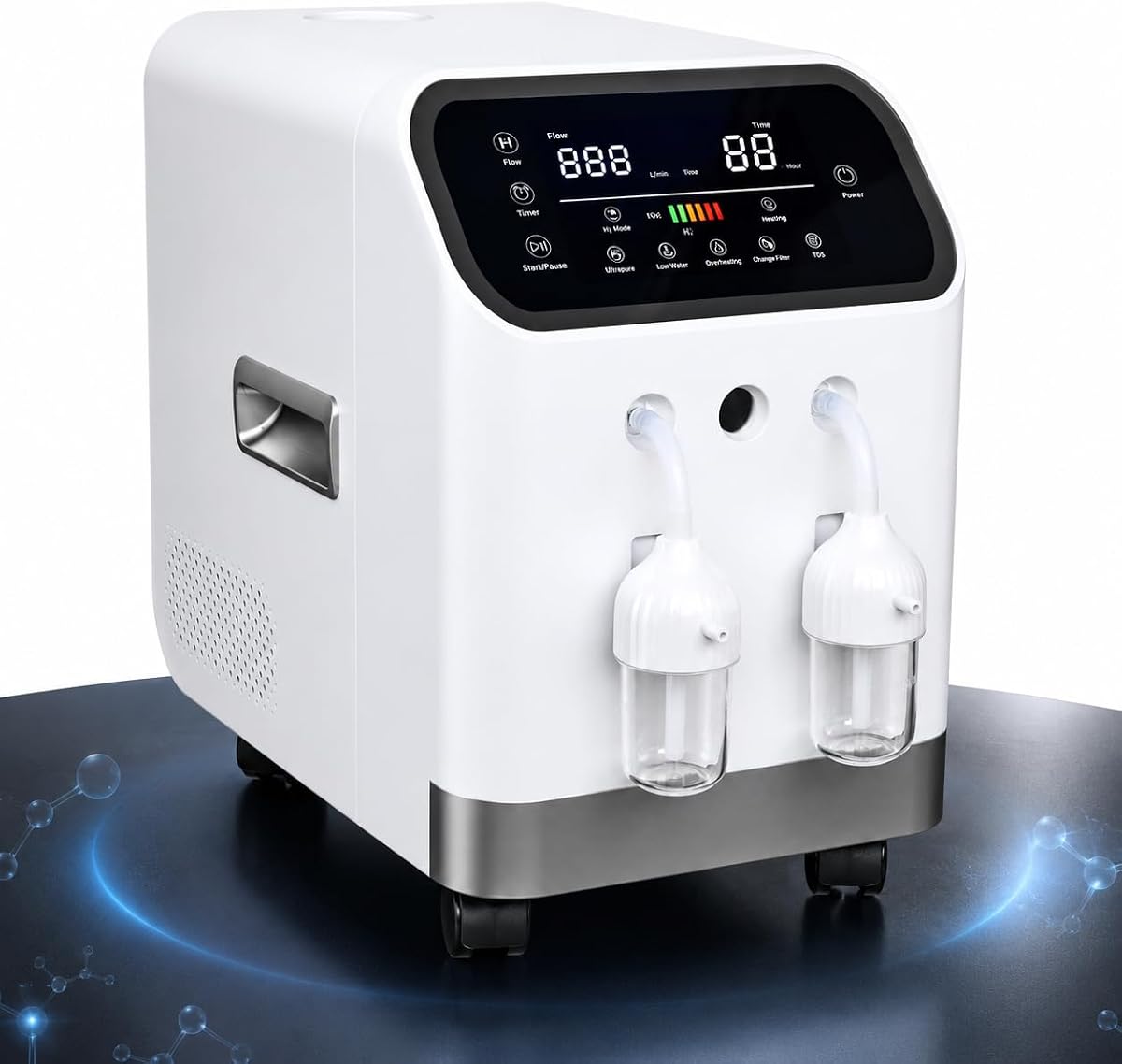




This 3-in-1 machine combines hydrogen inhalation, hydrogen-water generation, and infusion into beverages or other liquids. It carries a 3.9 rating and stands out for a stated 99.996% hydrogen purity, 240 mL/min total flow, and support for both molecular hydrogen and Brown's gas. The result is a flexible device for users who want more than one way to use hydrogen at home or while traveling.
We may earn a commission when you buy through this link, at no additional cost to you.
Its SPE/PEM ionizer uses platinum electrodes and a DuPont Nafion N117 membrane. According to the supplied product information, the nano diffuser rod can infuse hydrogen into water, cola, beer, or other liquids and reach a stated 1600 ppb in one to five minutes. Independent output channels allow users to select how the machine operates, while the touch display, car adapter, test kits, and four-hour night mode add convenience for different environments.
The main limitation is its relatively modest total flow compared with larger dedicated generators. Its 500 mL tank also requires more frequent filling than a 2600 mL system. The supplied rating is not among the strongest in this list, so buyers should examine recent customer feedback carefully, especially comments about consistency, noise, and ease of changing between modes.
This model is best for buyers who want a single machine that can handle inhalation, water generation, and beverage infusion without committing to a large stationary setup. It is particularly convenient for home, car, and travel use, where a compact footprint, quiet operation, and a long night mode matter. For someone whose priority is the highest possible flow or simultaneous use by several people, a larger multi-output system may be a better fit.
The three-in-one design is the central advantage. It supports direct inhalation, hydrogen-water generation, and infusion into compatible beverages, giving the device a broader role than a basic water bottle while remaining much smaller than a high-flow floor unit.
A four-hour night mode, low-noise operation, a 24V-style portable format, and an included car adapter make the system practical for bedrooms, offices, vehicles, and travel. The touch display also helps users monitor settings without navigating a complicated control panel.
We may earn a commission when you buy through this link, at no additional cost to you.
This dual-channel hydrogen machine offers selectable 500 or 1000 mL/min total flow and combines hydrogen generation with water production. Its defining advantage is the balance between adjustable output and a substantial 2600 mL tank. The product information describes SPE/PEM technology, a DuPont Nafion N117 membrane, platinum electrodes, and stated hydrogen purity of 99.996%.
We may earn a commission when you buy through this link, at no additional cost to you.
The nano micro-porous diffuser rod is designed to dissolve hydrogen into water and reach a stated 1600 ppb within approximately one to five minutes. Multi-stage filtration, a metal housing, and a claimed service life exceeding 10,000 hours suggest a design intended for regular use rather than occasional demonstrations. A touch panel, adjustable timing up to four hours, and two gas outlets simplify operation and give the user more control over output routing.
There is no supplied customer rating for this model, so its real-world consistency cannot be judged from the available rating data. It is also bulkier than bottle-form products and may be less suitable for people who need a machine for air travel or car use. The 1000 mL/min setting remains below the output of the largest systems in this guide, although it is a meaningful step above compact 240 mL/min models.
This generator is a strong candidate for home users who want more capacity and adjustable flow without moving to a 2 L/min or 4200 mL/min system. The large tank should reduce refill interruptions, while the relatively low stated noise level makes it suitable for a dedicated wellness area or office. Buyers should review current documents to confirm outlet configuration, footprint, and compatibility with their preferred inhalation accessories.
Offering 500 and 1000 mL/min settings lets users match output to their routine rather than relying on one fixed rate. The two-channel construction and dual outlets also provide more routing flexibility than simpler single-output generators.
The 2600 mL reservoir is one of the largest tanks among the compact home generators reviewed. Combined with a four-hour timer and filtration system, it is intended to support extended sessions with fewer manual refills.
We may earn a commission when you buy through this link, at no additional cost to you.
The Qlife H2 Respire 1000 is a multi-output system designed to produce pure molecular hydrogen, Brown's gas, and pure oxygen through three separate outlets. It has a 4.4 rating and offers a stated 1000 mL/min Brown's gas output. Its most distinctive feature is the ability to support up to three people simultaneously, making it more versatile than conventional single-user machines.
We may earn a commission when you buy through this link, at no additional cost to you.
The system uses German SPE/PEM ionic membranes and is described as supporting up to eight consecutive operating cycles. Built-in water and tilt sensors are included to alert the user when water needs attention or the machine is not positioned correctly. A large 4.4-inch touch display and purpose-designed humidifier bottles add to its equipment-oriented design, while the supplied information also identifies it as a hydrogen-water generator.
The complexity and size of this system are meaningful trade-offs. A product with three gas types, three outlets, sensors, humidifier bottles, and water-generation functions is less convenient for casual travel than a compact bottle. Pure oxygen and Brown's gas are different from molecular hydrogen, so prospective buyers should understand exactly which output they intend to use and review the included instructions and accessories carefully.
This model is best suited to a home wellness setup, shared-use environment, or user who values separate output paths and multi-person capacity. Its 4.4 rating is the second-highest numerical rating among products with a published score in this guide. It is less compelling for a traveler who only needs a quiet personal bottle, but more capable for someone who wants several delivery options from one dedicated platform.
Pure hydrogen, Brown's gas, and pure oxygen are generated through three distinct outlets. That separation allows the user to select an appropriate output without mixing the gases in a single line, provided the unit is operated according to its instructions.
Support for up to three simultaneous users differentiates this system from most portable models. The larger display, humidifier bottles, and water and tilt sensors reinforce that it is designed as a centralized installation rather than an on-the-go accessory.
We may earn a commission when you buy through this link, at no additional cost to you.
The Protium 3rd Generation Hydrogen Generator focuses on one clear priority: a continuous hydrogen supply at 2 liters per minute. That flow is well above the compact 240 mL/min and 500/1000 mL/min models in the guide, making it relevant to users who prioritize steady output. It is presented as compact and lightweight despite belonging to the higher-output category.
We may earn a commission when you buy through this link, at no additional cost to you.
Operation is described as straightforward, with a simple user interface, intuitive controls, and no complicated setup. The included safety features are automatic shutoff and overheating protection, which provide two practical safeguards for continuous use. Unlike many competing models, the supplied product information focuses on gas generation rather than emphasizing hydrogen-water concentration, infusion time, or a large water reservoir.
A customer rating is not provided, so buyers cannot compare its satisfaction score with the rated products in this roundup. The product description also provides fewer details about noise level, gas outlet configuration, water requirements, and included accessories than most competing listings. Those omissions make it especially important to examine the current manual and seller documentation before assuming it can replace a multi-function water generator.
This generator is a sensible option for a dedicated home or office installation where continuous, high-volume hydrogen output is more important than portability or beverage infusion. Its straightforward controls and protective shutoff features may appeal to users who do not want to manage a complex multi-gas system. Those seeking several output types, water generation, or a battery-powered travel format should look elsewhere in the list.
The stated 2 L/min flow is the second-highest clearly rated output among the dedicated generators reviewed. It offers meaningful capacity for users who want a steady stream without choosing the largest three-port system.
Automatic shutoff and overheating protection add basic protection around the generator's core operation. The straightforward interface reduces the learning curve for first-time users compared with systems offering several gases and multiple outlet modes.
We may earn a commission when you buy through this link, at no additional cost to you.
This portable 3-in-1 hydrogen machine combines inhalation, hydrogen-water generation, and rapid infusion into beverages or juice. Its stated output is 240 mL/min at up to 99.996% purity, and it carries a 3.5 rating. Although that rating is the lowest numerical score among the rated products here, the machine's specification list is unusually detailed for a compact unit.
We may earn a commission when you buy through this link, at no additional cost to you.
The dual-channel design permits independent or combined output, while a DuPont Nafion N117 membrane and platinum electrodes support the stated purity and chlorine- and ozone-free output. Its 500 mL BPA-free reservoir is advertised to support as much as 60 hours of hydrogen production with 8.5 mL per hour of water consumption. The 16 × 16 × 21 cm body includes a handle, reinforced structure, and car adapter, while the low-noise specification is listed below 40 dB.
Safety features include water-quality detection, overpressure and overheat control, overcurrent monitoring, and a filter-replacement reminder. The supplied accessory kit contains inhalation components, a nano diffuser rod, TDS and hydrogen test kits, and a car adapter. These additions are useful, but the 3.5 rating and limited published feedback make real-world performance harder to assess than for more highly rated products.
This machine is intended for buyers who value portability, transparent safety monitoring, and several output functions in a relatively small package. It fits home, office, outdoor, car, and RV use better than a large stationary generator. Those whose main priority is multi-user capacity or maximum flow should move up to a higher-output model, while personal users may appreciate the compact footprint and car-ready power system.
Water-quality detection, overpressure control, overheat control, and overcurrent monitoring give this portable model a detailed safety framework. A filter reminder is also included, helping owners stay attentive to maintenance needs.
The compact dimensions, integrated handle, reinforced shell, and 24V DC car adapter make the unit easier to move than a desktop generator. A four-hour night mode and stated sub-40 dB operation suit bedrooms, offices, and vehicles.
We may earn a commission when you buy through this link, at no additional cost to you.
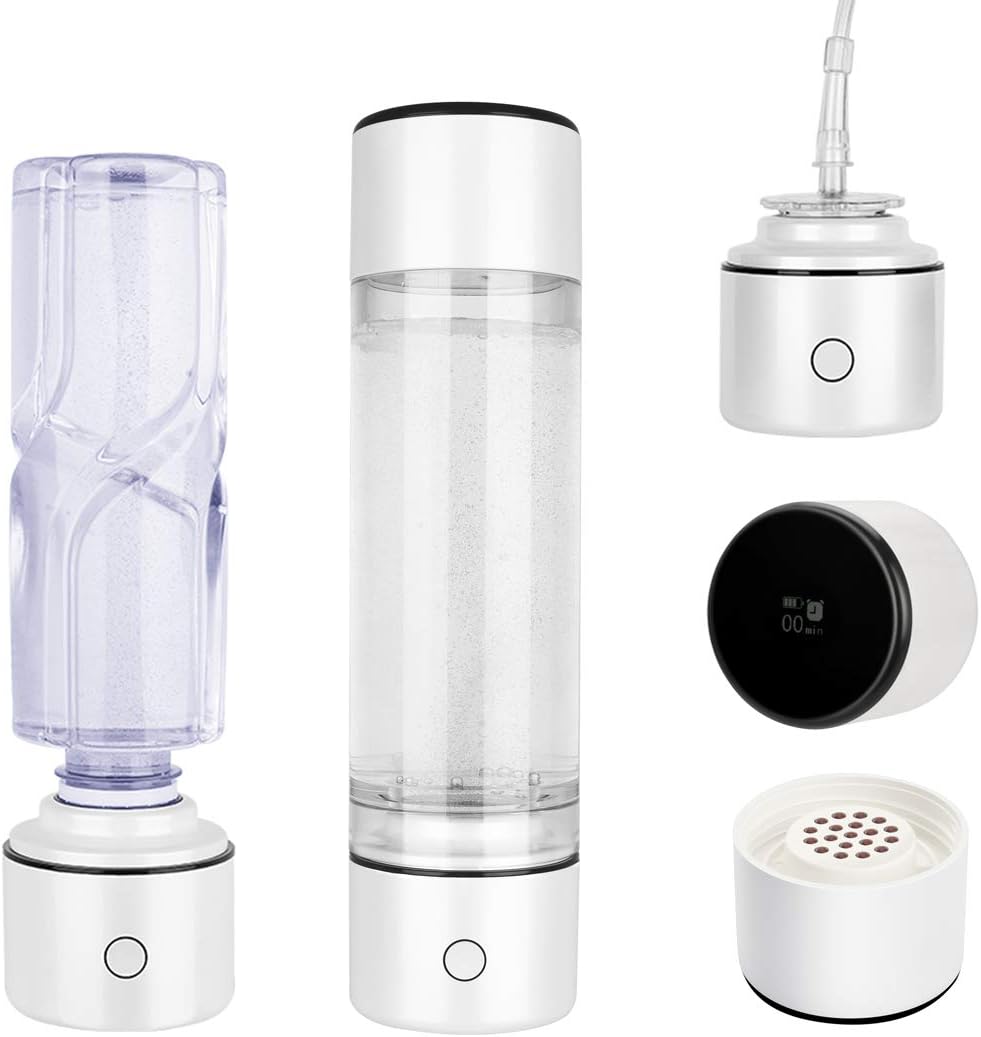
This bottle-format generator brings hydrogen-water production and low-flow inhalation into one compact device. It has a 3.9 rating and is positioned as the most affordable option in the guide without sacrificing key conveniences such as an OLED display, rechargeable battery, and included test kit. The product information states that it produces more than 3000 ppb in five minutes and more than 5000 ppb in ten minutes.
We may earn a commission when you buy through this link, at no additional cost to you.
The fifth-generation PEM system uses micro-nano bubbles and a platinum-plated electrode, with stated hydrogen purity of 99.996%. Its metal body is described as BPA-free, 6 mm thick, and pressure resistant to 0.55 MPa. A detachable base allows the generator to work with bottled water, while the 1650 mAh battery and waterproof Type-C charging port support use away from a wall outlet.
The compromises are inherent to a personal bottle format. It cannot provide the continuous flow of the Protium or three-output machine, and its small form is not designed for simultaneous users. The stated ppb figures and purity should also be distinguished from total gas output: concentrated hydrogen water and a high-volume inhalation stream are different performance measures.
This is the best pick for a buyer who wants a simple, portable device for making hydrogen-rich water with an optional low-flow inhalation mode. It is easier to carry and less demanding to operate than a desktop system with multiple outlets, tanks, and humidifiers. It also suits users who want to test hydrogen-water routines before committing to a larger installation.
The ability to exceed a stated 3000 ppb in five minutes makes this bottle practical for quick daily water preparation. Its detachable base and bottled-water compatibility make it more adaptable than a fixed-tank tabletop generator.
A 1650 mAh battery, waterproof Type-C port, and compact metal construction support use at work or while traveling. The OLED display provides a straightforward way to monitor operating status and timing.
We may earn a commission when you buy through this link, at no additional cost to you.
This three-output hydrogen inhalation device offers the highest stated flow in the roundup at 4200 mL/min. It supports H2, oxygen, and H+O modes through a three-port design and states hydrogen purity of up to 99.99%. That combination of throughput and selectable outputs makes it the most technically ambitious machine in the list, though it is not a lightweight personal device.
We may earn a commission when you buy through this link, at no additional cost to you.
A seven-stage steam-water separation system is designed to remove the need for a separate external collector. Automatic water filling and drainage simplify operation, and a visible generation window lets users observe the process. The high-definition touch screen adjusts timing and flow with a one-click interface, while an intelligent fan is intended to support quieter bedroom use.
No customer rating is supplied, so there is no numerical satisfaction signal to compare with the 4.6-rated cup or the 4.4-rated Qlife system. The use of three outputs also requires more operator attention than a single-output device. Buyers should review the instructions, gas compatibility, required ventilation, and included accessories carefully, especially if they plan to use more than one person or output mode.
This machine is best for a dedicated, high-output installation where multiple users, selectable gas paths, and automatic water handling are priorities. It is the premium choice in this guide because of its stated 4200 mL/min capacity, 99.99% purity, and extensive water-management design. Buyers who need a discreet desktop unit or portable bottle will find smaller models easier to accommodate.
The three output modes—H2, oxygen, and H+O—provide more flexibility than a standard single-gas generator. A stated 4200 mL/min flow rate makes this model the natural choice among the list for high-volume or shared installations.
Seven-stage separation, automatic filling, and automatic drainage reduce the amount of manual liquid handling. The internal design is aimed at convenience, while the visible window and touchscreen provide clear status and control information.
We may earn a commission when you buy through this link, at no additional cost to you.
The 7.8Hz Quantum Hydrogen Cup has the highest published numerical rating in the guide at 4.6. It combines three operating formats: hydrogen-water preparation in the cup, use with an external mineral-water bottle, and a compact inhalation mode. Its portability and flexible water formats make it appealing for personal routines rather than fixed home installations.
We may earn a commission when you buy through this link, at no additional cost to you.
The supplied information describes low-frequency molecular resonance technology alongside nano-hydrogen production. It states a maximum dissolved concentration of 4–5 ppb and approximately ten hours of hydrogen storage in water. The SPE production system uses a DuPont Nafion N117 membrane and seven layers of platinum plating, with stated gas purity of 99.9%. A large OLED screen, touch control, 1600 mAh battery, waterproof Type-C port, and drinking-water voice reminder cover everyday operation.
The concentration terminology deserves careful attention. A 4–5 ppb figure is much lower than the several-thousand-ppb figures listed for several competing bottle generators, even though all are describing dissolved hydrogen in different ways. Buyers should compare the products using the same measurement basis and understand that stored ppb, generated ppb, and inhalation flow are not interchangeable specifications.
This cup is best for personal use, especially for someone who wants one portable device that can serve a beverage cup, a compatible external bottle, and a small inhalation setup. Its 4.6 rating and polished OLED interface are strong selling points, but the stated concentration is modest. Users seeking a high measured dissolved-hydrogen level should examine the bottle models with higher published ppb specifications.
The ability to move among cup-based water generation, external-bottle use, and inhalation gives this device unusual flexibility. That makes it useful for travel or a minimal desktop setup where carrying multiple hydrogen accessories would be inconvenient.
The large OLED touch display, drinking-water reminder, waterproof charging port, and rechargeable battery support routine use. These details are more typical of premium personal electronics than basic hydrogen accessories.
We may earn a commission when you buy through this link, at no additional cost to you.
The YPMart Performance Molecular Hydrogen Water Generator is built around hydrogen-rich water production while also including an inhalation configuration. It uses a dual-chamber SPE and PEM ionizer and states hydrogen purity of 99.99%. In its ideal laboratory test condition, the product information lists a concentration of up to 5000 ppb after two nine-minute electrolysis cycles.
We may earn a commission when you buy through this link, at no additional cost to you.
The unit is compatible with mineral, purified, distilled, cold-boiled, and warm-boiled water, provided the water temperature remains below 60 degrees. Its waste-gas arrangement separates oxygen, chlorine, and ozone and vents them separately. The silver model includes inhalation components, making it more versatile than a strictly single-purpose water bottle, although the supplied listing provides few details about the exact delivery accessories.
The available information does not include a customer rating, sound level, battery capacity, or total operating endurance. It also frames several broad health and beauty benefits, but those claims should not substitute for independent evidence or advice from a qualified healthcare professional. The useful purchase details are its concentration, cycle length, compatibility, purity, and chamber construction.
This generator is best for buyers whose priority is producing concentrated hydrogen-rich water from several common water types. The two-cycle operating pattern and dual chamber design make it a focused alternative to general-purpose desktop machines. Prospective buyers should confirm the included inhalation arrangement, cleaning requirements, and actual operating workflow in the current documentation.
A stated 5000 ppb maximum in the ideal laboratory condition and two nine-minute cycles position this product as a high-concentration water generator. It is more relevant for water preparation than for high-volume inhalation output.
The generator is designed for mineral, purified, distilled, cold-boiled, and warm-boiled water under the stated temperature limit. This flexibility can reduce the need to keep a specific type of bottled water on hand.
We may earn a commission when you buy through this link, at no additional cost to you.
The 350 mL Portable Hydrogen Rich Water Bottle is the most travel-oriented full-size bottle in the group. It is designed to make hydrogen-rich water with a stated concentration of up to 1500–3000 ppb and can also operate as a small absorption device with a nasal tube. Its dual-use design gives it more flexibility than a conventional drinking bottle while remaining simpler than a desktop generator.
We may earn a commission when you buy through this link, at no additional cost to you.
The generator uses PEM and SPE technology with a multilayer composite proton membrane, platinum titanium electrolytic mesh, and a hydrogen-oxygen separation membrane. A one-button lock lid, sealing ring, impact-resistant clear body, and bottom vent are intended to improve portability and handling. Unlike several rechargeable models in the guide, the supplied information does not clearly identify a battery or charging system, which is an important point to confirm before purchase.
No customer rating is provided, and the stated concentration range does not provide a precise laboratory result for every batch. The 350 mL capacity is also more appropriate for one serving than for preparing a large family quantity. Buyers should confirm whether the nasal-tube inhalation components are included, how the unit is powered, and what cleaning is required for regular use.
This bottle is best for commuters, travelers, and solo users who want a lightweight second function beyond ordinary water. It is easier to pack than the 500 mL desktop-style models and should be more convenient for travel than the stationary high-flow systems. Those needing a large reservoir, continuous flow, or multi-user capacity should choose a larger generator.
The compact 350 mL format suits a personal bottle, while the optional inhalation mode adds a second use without moving to a desktop machine. Its portability is the clearest reason to choose it over larger systems.
A locking lid, rubber sealing ring, impact-resistant body, and bottom vent address common portability concerns. These features are especially useful when the cup is carried in a bag or used during travel.
We may earn a commission when you buy through this link, at no additional cost to you.
The right hydrogen machine depends on whether you prioritize continuous gas flow, dissolved-hydrogen concentration, portability, shared use, or a combination of inhalation and water generation. These factors help separate machines that look similar in listings but serve very different routines.
Flow rate indicates how much hydrogen gas a machine can deliver over a set period, making it one of the clearest distinctions between compact personal units and dedicated generators. The products in this guide range from 240 mL/min to a stated 4200 mL/min. Higher output may suit long sessions or multiple users, while lower flow can be adequate for a personal, portable setup. Flow should be considered alongside the intended accessories because a machine's gas rate does not necessarily describe its dissolved-water concentration.
Stated purity ranges from 99.9% to 99.996% and 99.99% among the products reviewed. Purity is an important technical specification because it describes the gas leaving the electrolysis system. However, manufacturers may test different gas samples under different laboratory conditions, so comparing a purity claim alone does not reveal overall performance. Buyers should also examine the membrane, electrodes, separation design, and any included test equipment.
Some machines are primarily gas generators, while others combine direct inhalation, hydrogen-water generation, and infusion into beverages. Dual-purpose systems are convenient when you want one device for several routines. A dedicated water generator may offer stronger concentration specifications, while a high-flow machine may focus on continuous delivery. Decide which outputs you will actually use before paying attention to secondary functions.
Portability depends on more than size. Consider the product's weight, water reservoir, power source, included car adapter, battery life, charging method, and whether it can operate without a wall outlet. Bottle models are naturally suited to travel, while larger systems may be better kept in a fixed room. The most travel-ready options in the guide use rechargeable batteries or support vehicle power.
Water capacity determines how often the machine must be refilled and can influence the length of uninterrupted use. The group ranges from 350 mL and 500 mL portable tanks to a 2600 mL home reservoir. Larger tanks reduce interruptions but require more space and more water. Portable systems may instead emphasize bottled-water compatibility, detachable bases, or automatic filling and drainage to simplify everyday handling.
Useful safeguards include automatic shutoff, overheating protection, overpressure control, overcurrent monitoring, water-quality detection, tilt alerts, and filter reminders. The presence of multiple protections is especially relevant to a device that electrolyzes water and handles a combustible gas. Buyers should also follow the supplied manual, use only compatible accessories, and ensure the operating environment is ventilated as directed.
A machine intended for a bedroom, office, or car should be quiet enough for its setting. Some products state operating levels below 40 dB or 45 dB, and two compact machines provide a dedicated four-hour night mode. Fan design, pump movement, and control feedback can all affect the perceived sound level. Always verify the claimed noise specification under normal operating conditions, as a low figure may refer only to a particular mode.
The usefulness of a hydrogen machine depends on whether it includes the hoses, nasal cannula, diffuser, humidifier, adapters, and test kits needed for the intended routine. Touch displays, timing controls, visible generation windows, and voice reminders can make operation easier, especially for older users. A complete accessory package may eliminate the need for separate purchases, but buyers should confirm that the included components match their chosen output mode.
Before first use, read the complete manual and identify the correct gas outlet, water reservoir, filter, and accessory for your chosen mode. Verify that the machine is assembled according to the manufacturer, the water is appropriate for the stated specifications, and all protective parts are clean and correctly fitted. Place the unit on a stable, dry surface with ventilation and enough clearance around its vents.
Fill the reservoir with compatible water, attach the intended inhalation or diffuser accessory, and select the recommended flow and timer. Do not improvise hoses or seals, and do not operate the device if the water-quality alert, tilt sensor, overpressure protection, or another diagnostic indicates a problem. For water generation, use the stated cycle and inspect the result with the recommended test method rather than relying only on the display.
After each session, disconnect power, release pressure as directed, empty water that will not be stored, and clean the humidifier, diffuser, and other washable accessories with the specified method. Replace filters when reminded, inspect seals for wear, and keep the charging port dry. If you notice unusual noise, leakage, odor, condensation, or damaged components, stop using the machine and contact the seller or manufacturer for guidance.
The appropriate flow depends on session length, the accessories you use, and whether more than one person will be connected. Compact personal machines in this guide offer 240 mL/min, while larger systems reach 1000 mL/min, 2 L/min, or a stated 4200 mL/min. Use the manufacturer's recommended setting for the included inhalation components rather than assuming that the highest flow is always better.
Not necessarily, because ppb normally describes dissolved molecular hydrogen in liquid, while inhalation performance depends on gas delivery and flow. A high ppb water generator and a high-flow inhalation machine optimize different things. Compare gas output, purity, and concentration separately, and consider whether your priority is drinking hydrogen-rich water or receiving a steady inhalation stream.
Molecular hydrogen is the H2 gas produced by electrolysis, while Brown's gas is an oxyhydrogen mixture containing hydrogen and oxygen. The products with multiple outlets let the user select different outputs, but those gases should not be treated as interchangeable. Follow the instructions for the specific outlet and never modify the gas path or connect accessories that the manufacturer has not specified.
Several models in the guide are specifically designed for portability, with compact bodies, rechargeable batteries, external-bottle compatibility, or car adapters. The best travel choice depends on whether you want a battery-powered personal unit, a vehicle-ready desktop machine, or a simple bottle. Check airline and venue rules, transport limitations for lithium batteries, and the manufacturer's guidance for storage before traveling by air.
Maintenance frequency depends on the model, water quality, and how often it is used. At minimum, clean the humidifier, diffuser, tubing, and other washable parts according to the manual, empty the reservoir when directed, and allow all components to dry. Replace filters and consumables at the stated interval, and investigate leaks, corrosion, unusual odor, or changing performance instead of continuing normal operation.
Several models support multiple water types, including mineral, purified, and distilled water. The YPMart generator specifically lists several of these types and a below-60-degree temperature limit, while other products may have different guidance. Always check the manual for the selected model because mineral content and temperature can affect electrolysis performance and the useful life of the membrane or electrodes.
No. Some units are dedicated gas generators, while others combine direct inhalation with water generation or beverage infusion. The Qlife, Protium, and 350 mL bottle, for example, emphasize different combinations of outputs. Before buying, identify whether you want inhalation only, hydrogen-rich water only, or a dual-purpose device, then verify the included hoses, diffuser, and accessories.
Treat the stated purity as one specification rather than a complete performance guarantee. Membrane and electrode materials, gas separation, operating conditions, water quality, and maintenance can all affect the delivered gas. Review independent customer feedback, inspect the included test kit, and follow the manufacturer's calibration and testing instructions when verifying purity or dissolved-hydrogen levels.
The 3-in-1 Hydrogen Inhalation Machine is the most versatile editorial choice, combining direct inhalation, water generation, infusion, Brown's gas, and travel-friendly features. The Hydrogen Water Bottle Generator stands out as the best budget option for personal portability, while the Three-Output Hydrogen Inhalation Device offers the highest stated throughput and the most advanced multi-port configuration.
Prioritize the capability you will use most often: choose a compact bottle for travel and hydrogen-rich water, a 500/1000 mL unit for adjustable home output, or a high-flow system for dedicated or shared use. Purity, safety controls, tank capacity, noise, and the completeness of the included accessories are just as important as the headline flow or ppb figure.
Specifications, ratings, included accessories, and product availability can change over time, and sellers may update listings without notice. Before ordering, verify the current manufacturer description, warranty terms, return policy, dimensions, power requirements, and safety instructions on the linked product page.
