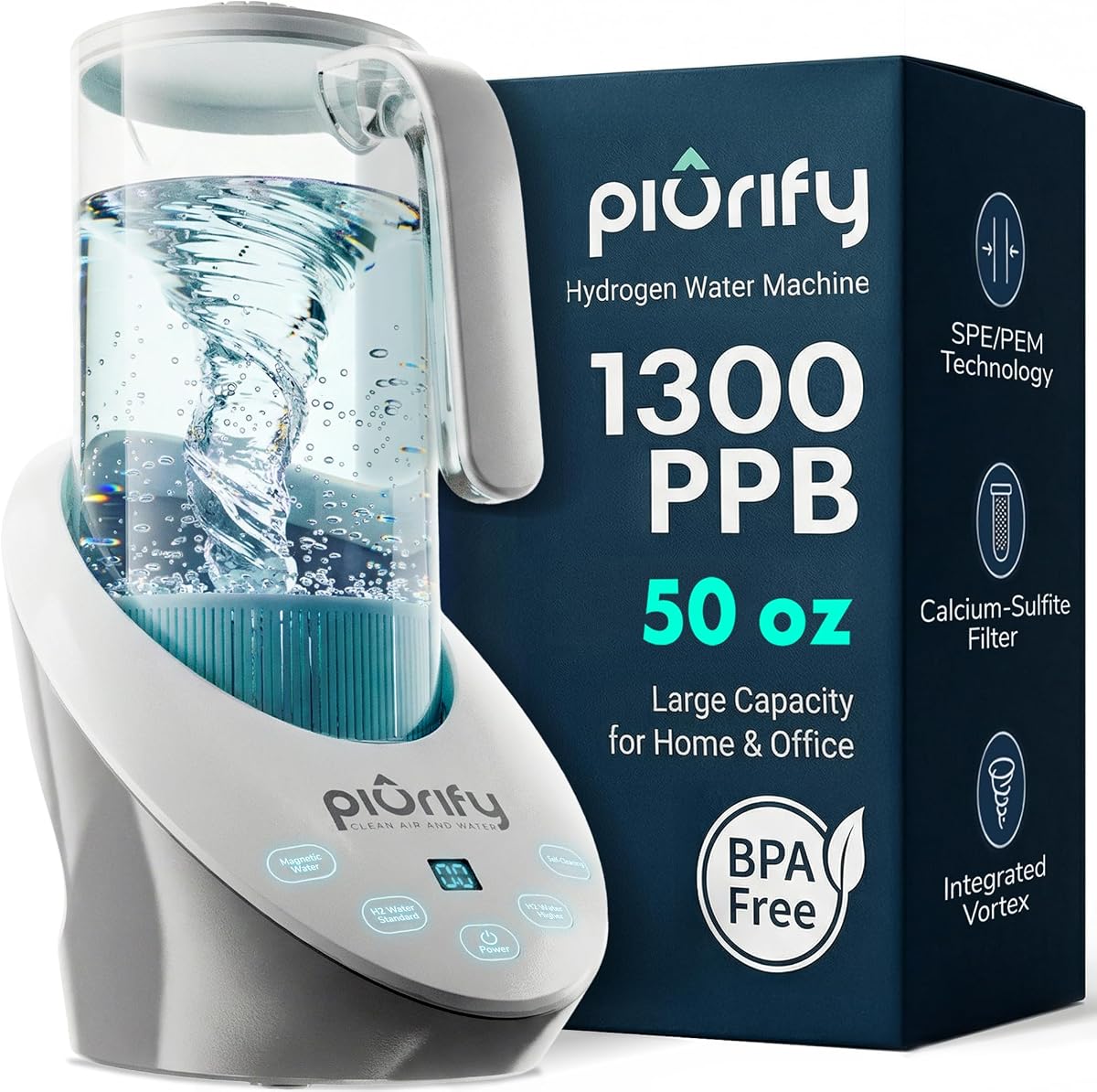
PIURIFY 3 in 1 Hydrogen Water Machine
4.4Editor score
Hydrogen, vortex, and filtration
50-ounce Tritan pitcher
Up to 1,300 PPB hydrogen
Eight-hour hydrogen retention
Hydrogen Water Machine guide comparing filtration, concentration, capacity, portability, hydrogen output, safety features, and ease of use.
Hydrogen water machines turn regular drinking water into hydrogen-enriched water using electrolysis, combining dissolved molecular hydrogen with filtration, mineralization, or UV disinfection depending on the model. The best unit balances hydrogen concentration, water quality, capacity, ease of cleaning, and practical features such as portability, displays, and battery life.
We compared ten hydrogen water machines using only the supplied product information, focusing on SPE/PEM technology, stated hydrogen output, container materials, cycle times, filtration, safety functions, cleaning features, and everyday usability. The list covers large pitchers, portable bottles, a multipurpose inhalation and water generator, and models designed for travel or home use.
Each review identifies the product’s strongest benefit, along with its limitations and the buyer it suits best. Hydrogen concentration figures and technical claims reflect the manufacturer information provided for each model, while ratings indicate the listed customer feedback. Product prices change frequently, so check the current listing before making a final purchase.
4.4Editor score

5.0Editor score
3.9Editor score
The table below compares all ten models by their stated hydrogen performance, physical format, filtration or disinfection features, and intended use. It makes it easier to distinguish a full-size home pitcher from a portable bottle, multipurpose generator, or budget-oriented glass model.




The Hydrogen Water Filter Pitcher is the most complete all-around choice in this guide, combining hydrogen generation, multiple filtration layers, UV disinfection, and a generous 3.6-liter capacity. It carries a 5.0 rating and uses SPE/PEM electrolysis with dual iridium-platinum electrodes. The stated hydrogen output reaches up to 1,300 PPB, while the manufacturer also describes the system as separating ozone and chlorine byproducts.
We may earn a commission when you buy through this link, at no additional cost to you.
Its main advantage is the number of functions handled by one countertop appliance. The pitcher is described as removing fluoride, chlorine, lead, dirt, harmful metals, odors, microplastics, and PFAS, although buyers should review the complete filtration documentation to understand what each stage does and whether replacement components are required. A UV bulb adds another layer of disinfection by targeting the nucleic acids and proteins of microorganisms. The large reservoir makes it practical for households that want several glasses available without repeatedly running the machine.
Portability is less impressive than it is for the bottle-style competitors. Even so, the 9,000mAh battery and cordless design provide flexibility around a kitchen, office, or refrigerator. Its minimalist pitcher format is also more suitable for sharing than a narrow travel bottle. One consideration is that its maximum stated hydrogen concentration is lower than several models in the comparison, so buyers prioritizing the highest headline PPB figure should look elsewhere.
This is the best hydrogen water machine for buyers who want hydrogen enrichment and substantial water filtration in one vessel. It is especially suitable for home use, shared kitchens, or offices where capacity and convenience matter more than pocket-sized portability. The combination of a 5.0 rating, large format, UV disinfection, and cordless operation makes it our leading overall recommendation.
The product description distinguishes this model from basic hydrogen bottles by adding multiple filtration layers, ultrafiltration, and UV disinfection. That makes it worth considering for buyers who want more than hydrogen infusion, although replacement-filter availability and ongoing upkeep should be confirmed before purchase.
The 3.6-liter reservoir can serve multiple people, and the 9,000mAh battery removes the need to keep the pitcher tethered to a outlet. Refrigeration and countertop placement are both supported by the stated cordless design.
We may earn a commission when you buy through this link, at no additional cost to you.
The PIURIFY 3 in 1 Hydrogen Water Machine combines hydrogen infusion, a magnetic vortex pre-step, and calcium-sulfite filtration in one 50-ounce pitcher. Its 4.4 rating reflects a solid balance of customer reception and feature depth. Unlike many simple bottle generators, it provides two timed hydrogenation cycles: an eight-minute option at a stated 700–900 PPB and a 13-minute option reaching up to 1,300 PPB.
We may earn a commission when you buy through this link, at no additional cost to you.
The magnetic pre-step is designed to swirl and condition the water before hydrogenation. According to the manufacturer, this structured-water process helps hydrogen molecules remain dissolved for up to three times longer, while the product information claims retention for as long as eight hours. The calcium-sulfite filter removes chlorine during the magnetic cycle, producing what the brand describes as crisp, fresh-tasting water. A quick-swap filter and built-in cleaning mode simplify maintenance.
It is important to understand what the machine is and is not. The listing explicitly says it enriches already safe drinking water with dissolved hydrogen and is not a heavy-duty filter. Buyers needing advanced purification should use a dedicated filtration system. Another drawback is that the unit is large, uses several technologies, and requires the appropriate consumable filter, making it less convenient than a basic portable bottle.
The PIURIFY 3 in 1 is the best hydrogen water machine for a buyer who wants a premium, multi-feature home appliance rather than a basic generator. The large Tritan pitcher, touch controls, self-cleaning mode, two cycle lengths, and stated lifetime warranty justify considering it when overall versatility matters. It is our premium recommendation and a strong alternative to the more filtration-focused top-ranked pitcher.
A magnetic vortex step precedes electrolysis, and the calcium-sulfite filter handles chlorine removal during that process. This integrated workflow offers more control than a one-button hydrogen bottle while preserving a simple touch-panel experience.
Users can select a shorter everyday cycle or a longer hydrogenation cycle. The listed figures show 700–900 PPB for eight minutes and up to 1,300 PPB for 13 minutes, with manufacturer-stated retention of up to eight hours.
We may earn a commission when you buy through this link, at no additional cost to you.
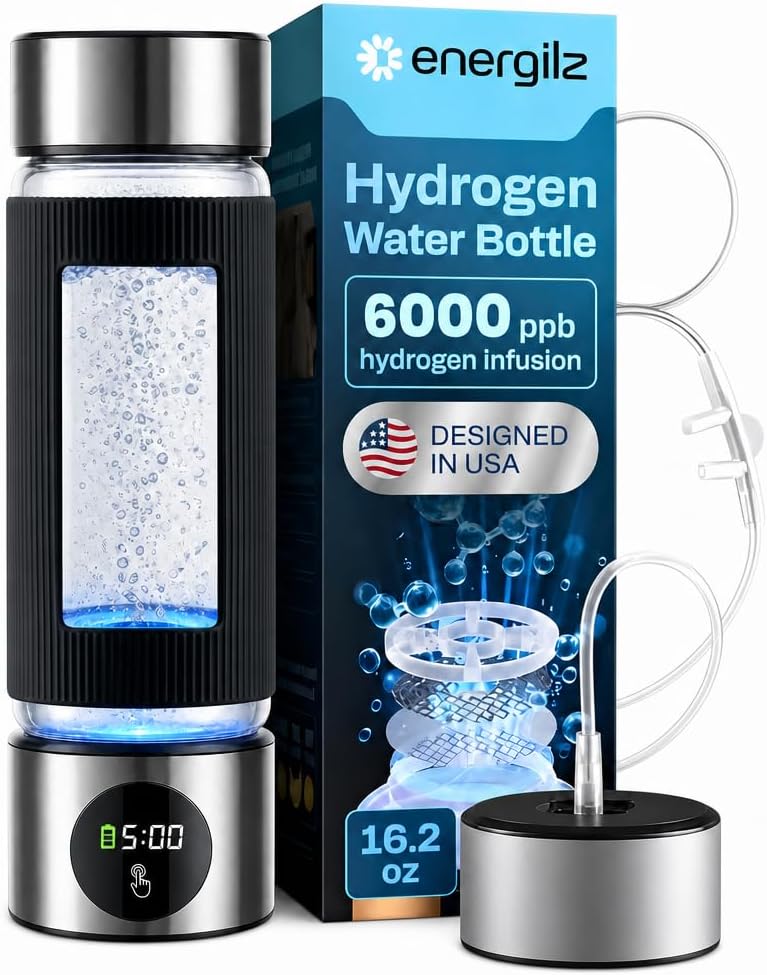
This 6000 PPB Hydrogen Bottle delivers a striking concentration claim in a reusable 16.2-ounce format. It uses SPE/PEM electrolysis and is listed at a 4.2 rating. The manufacturer states that the bottle can reach 6,000 PPB in ten minutes and provide up to 1.44 mg of molecular hydrogen in a serving. Those figures make it a compelling middle ground between compact hydration bottles and larger high-concentration models.
We may earn a commission when you buy through this link, at no additional cost to you.
Its 480ml capacity is large enough for a substantial drink without becoming as cumbersome as a full pitcher. The 1,200mAh battery reportedly supports up to 30 cycles, and the silicone cover with dual-sided openings is intended to make drinking more convenient. This makes the bottle relevant for office desks, workouts, and travel, provided it fits the buyer’s bag or cup holder.
The main limitation is battery capacity compared with the 9,000mAh model in the guide. Its listed feature set also does not mention a self-cleaning program, pressure display, integrated water filtration, or a separate filter replacement process. Buyers who want to track concentration live may need to rely on the stated cycle output rather than an on-device meter.
This hydrogen water machine best suits a buyer who wants a step up from sub-2,000-PPB bottles without moving to the largest pitcher formats. It balances useful capacity, portable construction, and a high stated concentration in a comparatively conventional bottle design.
The stated 6,000 PPB output is much higher than several other portable entries, yet the product keeps a familiar bottle footprint. That balance makes it useful for active users who want a meaningful hydrogen cycle without carrying a large jug.
A claimed 30 cycles per charge provides reasonable freedom from a wall outlet for routine use. The smaller battery also helps control overall weight, though buyers should expect to recharge more frequently than the largest-battery pitcher.
We may earn a commission when you buy through this link, at no additional cost to you.
The 3-in-1 Hydrogen Inhalation Machine and Water Generator is the most unconventional product in the guide. Rather than focusing only on drinking water, it combines gas generation, optional Brown’s Gas output, and water infusion. Its 3.9 rating is tied for the lowest listed score, but the broader feature set gives it a distinct place among the ten choices.
We may earn a commission when you buy through this link, at no additional cost to you.
The manufacturer states a total flow rate of 240 mL per minute and 99.996% ultra-pure hydrogen output. SPE/PEM technology, DuPont Nafion N117 membrane material, and platinum electrodes are used for separation. A nano diffuser rod can infuse hydrogen into beverages such as cola or beer at a stated 1,600 PPB within one to five minutes. That versatility extends the machine well beyond a basic countertop water generator.
It includes a 500ml BPA-free tank, a four-hour night mode, a touch display, safety alarms, test kits, a car adapter, and detailed guides. Those extras add convenience but also make the machine more complex than a simple bottle. Buyers should pay particular attention to the supplied instructions, especially when using inhalation functions, and should not treat a general product listing as a substitute for operating guidance.
This is the best hydrogen water machine for a technically minded buyer interested in hydrogen inhalation as well as water enrichment. Its stated purity and multiple operating methods offer more flexibility, while the lower customer rating and broader learning curve make it less obvious for someone who only wants to fill and drink one bottle of water.
The core distinction is the ability to serve hydrogen gas and infuse liquids with the same system. This broadens its use beyond hydration but also makes careful instruction-following more important than it would be for a conventional drinking-water bottle.
Platinum electrodes, Nafion membrane material, and a stated 99.996% purity level target high gas quality. The included test kits can help users check output, while the nano diffuser supports rapid infusion into compatible beverages.
We may earn a commission when you buy through this link, at no additional cost to you.
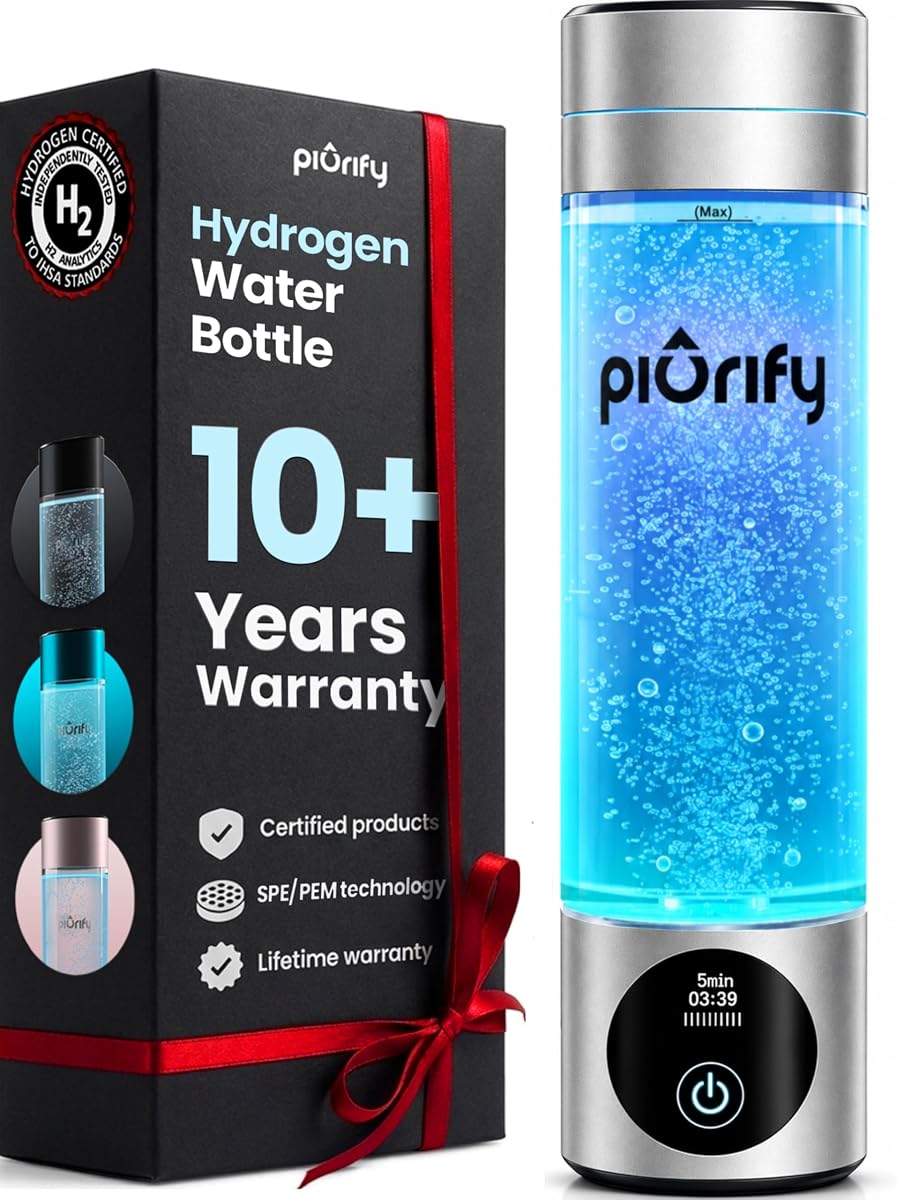
The PIURIFY 6300+ PPB Bottle offers a transparent way to understand how its output builds across repeated cycles. It has a 4.1 rating, uses food-grade PC, and provides five- and ten-minute modes. The product information lists 2,550 PPB after five minutes and 4,100+ PPB after ten minutes, with higher figures reached through consecutive ten-minute cycles.
We may earn a commission when you buy through this link, at no additional cost to you.
The manufacturer cites third-party certification by H2 Analytics and H2Hubb and reports a lab-tested range of 2.58–6.30 mg/L dissolved molecular hydrogen. It also states that unwanted byproducts such as chlorine, ozone, and hydrogen peroxide are expelled. These details make this model more transparent than products that provide only a maximum concentration without explaining the cycle sequence.
A tradeoff is that reaching the highest stated figure requires either two or three ten-minute runs. That may be less convenient than a model that claims maximum output in one short cycle. The supplied information also lacks a detailed description of a conventional water filter, so this should be understood as a hydrogen enrichment bottle rather than a comprehensive purifier.
This PIURIFY is best suited to users who value documented concentration and certification over a large serving size. The simple fill, press, and drink process, combined with the absence of tablets or refill subscriptions, makes it convenient for home, office, or gym routines.
The manufacturer explains how concentration changes with each cycle rather than relying on one maximum figure. This transparency helps buyers set realistic expectations and choose between quick personal use and longer sessions aimed at the stated 6,310 PPB level.
The bottle uses food-grade PC rather than glass because the generator creates internal gas and pressure. The brand explicitly warns that glass can crack, making material selection an important consideration among portable hydrogen bottles.
We may earn a commission when you buy through this link, at no additional cost to you.
The Mirtade 10000+ PPB Bottle combines one of the guide’s strongest customer ratings with the second-highest stated hydrogen output. It holds a 5.0 rating and is built around SPE/PEM electrolysis, a DuPont membrane, and a titanium-platinum alloy electrolytic sheet. Its two modes claim 7,800+ PPB in five minutes and more than 10,000 PPB in ten minutes.
We may earn a commission when you buy through this link, at no additional cost to you.
This model pays close attention to physical construction. The body is described as 316 stainless steel, with a matching stainless steel drinking spout, while the manufacturer says it withstands pressure above six atmospheres and addresses leakage concerns. An integrated handle fits the palm and can be attached to a backpack or sports bag. A smart LED display reports concentration, countdown time, and battery status, providing more feedback than most competing bottles.
Its 12-ounce capacity is modest compared with the 16.2-ounce, 420ml, and 420ml-class bottles elsewhere in the guide. The robust metal construction may also add weight. Battery performance is more clearly defined: a two-hour recharge is stated to provide 125 minutes of operation, equal to 25 five-minute cycles or 12 ten-minute cycles. A self-cleaning mode reduces routine maintenance.
This is the best hydrogen water machine for buyers who want a compact bottle with a display, high stated output, and an emphasis on leak resistance. It works particularly well for commuting, workouts, camping, and travel, provided its smaller serving size and metal weight meet your preferences.
The LED screen presents hydrogen concentration, a countdown timer, and battery status. These readings make operation more transparent and help users distinguish quick five-minute cycles from the longer ten-minute mode.
The stated six-atmosphere pressure tolerance, leak-proof design, ergonomic handle, and two cycle modes form a practical travel package. The steel spout is also designed to be durable, easy to clean, and more resistant to trapped odors than some plastic alternatives.
We may earn a commission when you buy through this link, at no additional cost to you.
This PIURIFY Hydrogen Water Bottle Generator appears as another listing in a family of models with the same 6,300+ PPB positioning and third-party certification claims. Its customer rating is 4.2, slightly above the similarly described PIURIFY entry earlier in the ranking. The core appeal is an uncomplicated bottle that can build substantial hydrogen concentration over repeated cycles.
We may earn a commission when you buy through this link, at no additional cost to you.
The five-minute mode is listed at 2,550 PPB, while the ten-minute mode provides 4,100+ PPB. Running two ten-minute cycles raises the stated level to 5,810 PPB, and three cycles can reach up to 6,310 PPB. The manufacturer cites H2 Analytics and H2Hubb certification and a lab-tested range of 2.58–6.30 mg/L. It also states that chlorine, ozone, and hydrogen peroxide are expelled.
Because the peak figure requires multiple cycles, users seeking a quick drink may prefer the shorter mode. The supplied product data does not state the bottle’s exact capacity, so that specification should be confirmed on the live listing. It also does not provide a detailed filtration-stage breakdown, limiting its appeal to buyers who need comprehensive purification.
This is a good hydrogen water machine for someone who values a straightforward routine, verifiable output claims, and a bottle rather than a pitcher. It suits office, gym, travel, and home use, particularly for buyers who do not want recurring tablets, powders, or refill subscriptions.
The stated figures give each operating stage a clear role. This makes it easier to estimate what a five-minute session provides compared with repeated ten-minute sessions designed to approach the maximum concentration.
The machine creates molecular hydrogen on demand, avoiding tablets, residue, and recurring consumables. A detailed guide and nasal cannula are included according to the product information, although users should follow the manual for all included accessories.
We may earn a commission when you buy through this link, at no additional cost to you.
The Tritan Hydrogen Bottle Generator has the highest stated hydrogen concentration in this group: up to 12,000 PPB after 18 minutes. It can also reach 2,000 PPB in three minutes, making it possible to choose between a quick drink and a longer concentration session. No customer rating was supplied for this listing, so its reception cannot be evaluated here.
We may earn a commission when you buy through this link, at no additional cost to you.
Its touchscreen is one of the most informative in the guide. The display tracks live hydrogen concentration, countdown time, and oxidation-reduction potential. The body is made from Tritan with a scratch-resistant coating, and the sealed square lid doubles as storage for small items. A pressure valve is included to make the lid easier to open after a generation cycle.
The product information advises against repeatedly generating hydrogen without opening the lid and also warns not to operate the unit without liquid. Those instructions matter because the electrolytic cell and internal pressure require correct use. A 350ml capacity is smaller than many competitors, and reaching 12,000 PPB takes 18 minutes, so the model favors deliberate use over quick multitasking.
This is the best hydrogen water machine for technology-oriented users who value real-time measurements and flexible cycle timing. Its smart display, strong claimed output, and durable Tritan construction are compelling, but the absence of a listed rating and the need for careful maintenance make it a more considered purchase than the higher-rated alternatives.
The display reports concentration, countdown, and ORP in addition to offering selectable generation times. That level of feedback can help users establish a repeatable routine, though ORP readings should be interpreted according to the manufacturer’s guidance.
A three-minute mode reaches a stated 2,000 PPB, while an 18-minute mode produces up to 12,000 PPB. This range gives users more control than models offering only one standard cycle.
We may earn a commission when you buy through this link, at no additional cost to you.
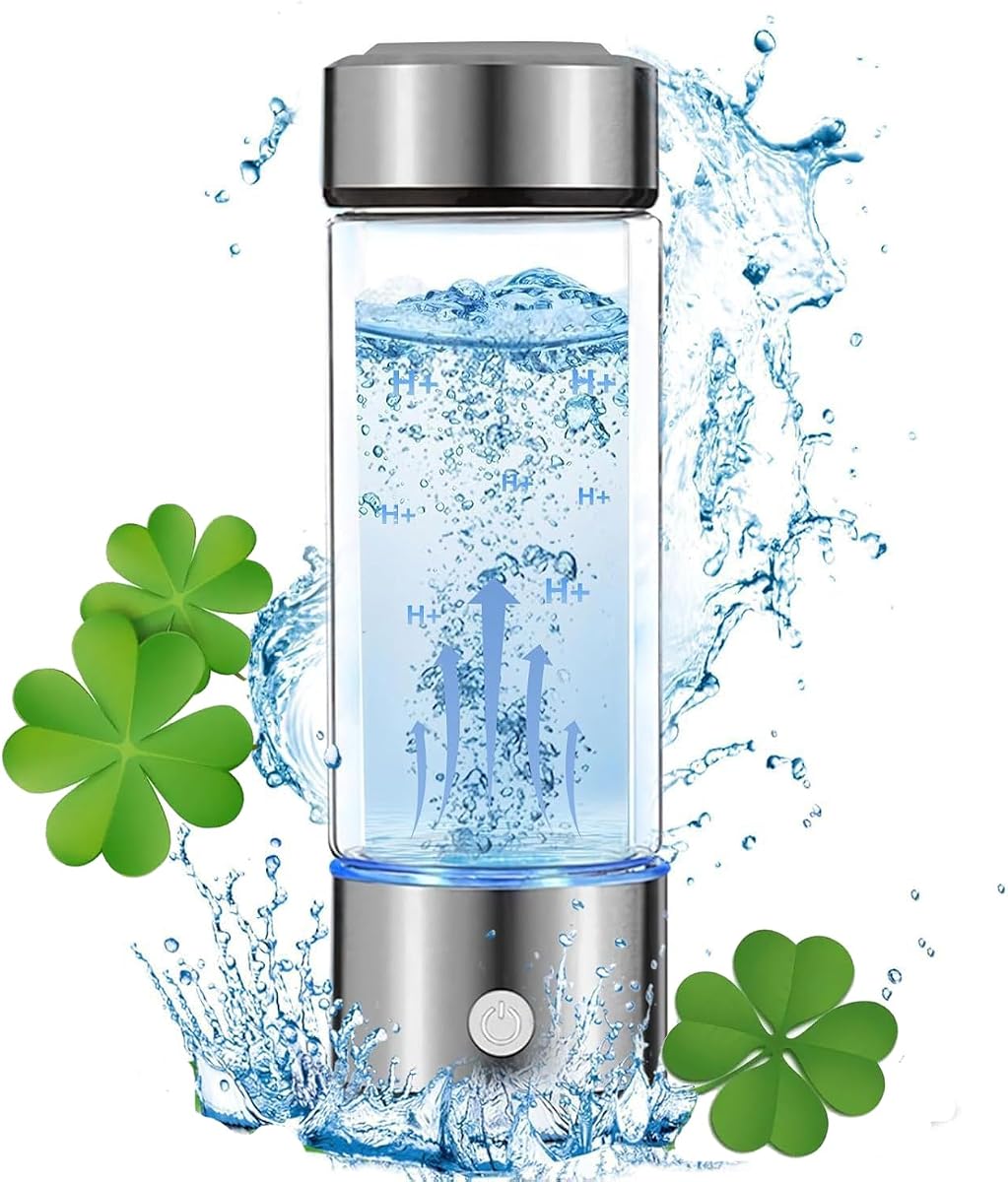
The 420ml Portable Hydrogen Generator is the value-oriented choice in this guide, with a 3.9 rating and a straightforward rechargeable glass design. It uses SPE and PEM ion-membrane technology and states that it can produce 1,000–1,600 PPB in three minutes. The automatic cycle, one-button activation, and indicator lights make it especially approachable for older users or anyone who dislikes complex menus.
We may earn a commission when you buy through this link, at no additional cost to you.
Its 420ml food-grade borosilicate-glass body has removable ends for cleaning, a silicone-like base for grip, and a sealing ring at the opening. The product claims an IPX7 waterproof rating and military-grade shock resistance, making it well suited to camping, hiking, cycling, and other outdoor activities. Up to 30 cycles per charge provide convenient use away from an outlet.
There are two important caveats. First, the product information contains conflicting guidance about water compatibility: one section says pure and distilled water can be electrolyzed, while a warm tip says the bottle is not suitable for pure water. Users should follow the current manual and customer-support guidance. Second, the 3.9 rating suggests less customer consensus than the top-rated models, and the stated 1,600 PPB output is modest compared with high-output alternatives.
This is the best hydrogen water machine for buyers seeking an affordable, uncomplicated hydrogen bottle with good portability. It offers a useful capacity, quick three-minute operation, and simple maintenance, but those advantages come with lower stated concentration and documentation that requires closer attention.
A single button starts the process, and a light changes from blue to green when the automatic three-minute cycle ends. This straightforward operation removes menu complexity and makes the bottle approachable for a wide range of users.
The glass body, removable components, sealed mouth, slip-resistant base, and stated waterproof rating align well with travel. Buyers should still tighten the base and lid as directed because the listing specifically notes that doing so helps prevent leakage.
We may earn a commission when you buy through this link, at no additional cost to you.
This PIURIFY 6300+ PPB Bottle offers the same documented multi-cycle approach as the brand’s other listed generators. It has a 4.2 rating, food-grade PC construction, and a maximum stated output of 6,310 PPB. The five-minute setting produces about 2,550 PPB, while the ten-minute setting starts above 4,100 PPB before further cycles increase the concentration.
We may earn a commission when you buy through this link, at no additional cost to you.
Manufacturer information cites certification by H2 Analytics and H2Hubb, with lab testing reported at 2.58–6.30 mg/L. It says the generator expels chlorine, ozone, and hydrogen peroxide during operation. The bottle also avoids recurring tablet expenses and requires only water, a button press, and a short wait. Included items include a hydrogen generator bottle, nasal cannula, and detailed guide.
The principal drawback is that the maximum figure needs multiple ten-minute cycles, which takes more time than a quick three-minute bottle cycle. The supplied data does not give the exact capacity, and there is no detailed description of additional water-filtration stages. It is therefore best considered an enrichment bottle with documented output rather than a complete purification system.
This is a practical hydrogen water machine for home, office, or gym use when portability and measurable concentration are priorities. It is easy to recommend as a no-tablet alternative, although the identical PIURIFY listings mean buyers should compare availability, included accessories, warranty terms, and current product details before choosing one over another.
Third-party certification references and a stated lab-tested concentration range provide useful context for a product category where maximum figures can vary. Buyers can use the included test resources and the manufacturer’s documentation to check their own results.
Generating hydrogen on demand removes powders, residue, and subscription refills from the routine. The tradeoff is that reaching the highest stated concentration takes repeated cycles rather than one maximum-output session.
We may earn a commission when you buy through this link, at no additional cost to you.
The right hydrogen water machine depends on how much water you need, how often you want to carry it, whether filtration matters, and how important concentration figures are. Comparing the following factors helps narrow a large field of bottle, pitcher, and multipurpose options.
Capacity should match your drinking routine and the number of people who will share the machine. The pitchers in this guide hold 3.6 liters or 50 ounces, making them suitable for kitchens and offices, while the portable bottles range from 11.8 fluid ounces to 16.2 ounces. A larger reservoir reduces refills but is heavier and less convenient in a bag. A smaller bottle is better for commuting and exercise but may need multiple cycles when you want to share or drink more than one serving.
Higher concentration figures are not automatically better for every routine, so compare the measurement conditions as well as the maximum. Listed outputs range from roughly 1,000–1,600 PPB for quick bottle cycles to 6,310, 10,000, or 12,000 PPB in higher-output models. Some products reach their maximum only after repeated ten-minute cycles. Check the time required, the amount of water used, whether concentration is measured after treatment, and whether a display provides live readings.
SPE/PEM systems separate hydrogen and oxygen through membrane-based electrolysis and are common among the products here. The manufacturer descriptions also mention iridium-platinum electrodes, titanium-platinum alloy electrolytic sheets, platinum electrodes, or DuPont Nafion membrane material. These details can indicate a more advanced separation system, but they do not replace independent performance verification. Look for clear by-product claims, certification references, test instructions, and safety guidance.
Hydrogen enrichment and purification are different functions. The PIURIFY 3 in 1 uses a calcium-sulfite filter for chlorine, while the top-ranked pitcher combines several filtration layers with UV disinfection. Some bottles provide no conventional filtration details at all. If your water requires treatment beyond chlorine reduction, choose a dedicated filter and use the hydrogen machine only on already safe drinking water. Confirm which contaminants each stage addresses and how often replacement elements are needed.
Portable generators build internal pressure, which makes container material important. Food-grade PC is used by the PIURIFY bottles because the brand warns that glass can crack during gas generation. Other options use Tritan or borosilicate glass. The Mirtade bottle uses 316 stainless steel and claims pressure resistance above six atmospheres. Review the manufacturer instructions, lid system, pressure valve, and cleaning guidance before use, and never operate a unit without liquid when the manual prohibits it.
Rechargeable operation is useful when a countertop outlet is inconvenient. Battery figures vary widely: one bottle claims up to 30 cycles, another supports 25 short or 12 long cycles, and the large pitcher includes a 9,000mAh battery. Consider charging time, active cycle length, standby behavior, and the weight of the full container. A handle, car adapter, or IPX7 claim may matter more for travel than a higher headline concentration.
A one-button machine is easy to use but offers limited control. Touch panels can provide separate cycle lengths, while smart displays may report concentration, countdown, battery status, and ORP. Cleaning is another important feature: some pitchers include a self-cleaning mode, and the 420ml glass model has removable ends for manual washing. Choose a level of automation that matches your comfort with routine maintenance and follow the manual when choosing cleaning agents.
Customer support and warranty terms can be meaningful for electrical appliances with replaceable parts. PIURIFY states a lifetime warranty and daily human support for its products, while Mirtade lists a one-year warranty and lifetime technical support. The top-ranked pitcher states that support answers within 24 hours. Before purchasing, verify the warranty for the exact listing, check regional support, and save the manual and product registration details.
Begin by reading the manual for your specific model, removing any maintenance cover as instructed, and washing the container and removable components with suitable mild soap. Fill only with fresh, safe drinking water and do not exceed the maximum fill line. Confirm that the lid, base, seals, and electrodes are properly positioned before starting a cycle.
Choose the cycle that matches your intended routine. Quick cycles offer greater convenience, while longer cycles are used for the higher concentration figures stated by several manufacturers. Keep the unit stable, follow any guidance for opening the lid after pressure builds, and avoid adding juice, milk, tea, or other substances unless the manufacturer explicitly permits them. Do not generate hydrogen without liquid, and do not repeatedly cycle a sealed unit unless the manual allows it.
After use, open the lid as directed and rinse the container according to the manual. Run a cleaning cycle if the model includes one, and use the self-cleaning feature or removable components for manual cleaning as appropriate. Allow all parts to dry, inspect seals for damage, and store the machine away from heat and direct sunlight. Replace filters or other designated consumables on the manufacturer’s schedule and contact support if the device shows unusual leakage, odor, discoloration, or error indications.
A hydrogen water machine uses electrolysis to separate hydrogen and oxygen, then dissolves molecular hydrogen into drinking water. Depending on the model, it may also filter chlorine, disinfect with UV, create a magnetic vortex, display concentration, or provide hydrogen gas. It should not automatically be treated as a replacement for certified drinking-water filtration.
Not necessarily. A higher maximum may require longer or repeated cycles, while other features such as filtration, capacity, cleaning, display controls, and safety design may better match your needs. Compare PPB with cycle time, water volume, measurement method, and independent verification rather than evaluating the headline number by itself.
Pitchers suit households, offices, and shared use because they hold more water and often include more filtration or maintenance features. Bottles are lighter and easier to carry to the gym, office, or outdoors. Your decision should reflect serving size, portability, filtration requirements, and how often you plan to share the machine.
No. Many devices enrich already safe drinking water rather than removing a broad range of contaminants. The PIURIFY 3 in 1 explicitly states that it is not a heavy-duty filter, and most bottle listings do not describe comprehensive purification. Use certified filtration for unsafe water and apply the hydrogen machine only when its manual says the input is suitable.
Both terms are used for proton-exchange-membrane technology, with SPE referring to a solid polymer electrolyte and PEM to a proton-exchange membrane. These systems use membrane-based electrolysis to separate hydrogen and oxygen. The products in this guide also vary in electrode and membrane materials, so output claims should be evaluated alongside by-product handling and certification information.
Clean the container after each use or at least according to the manufacturer’s recommended schedule, especially when switching between hydrogen generation and other beverages. Pitchers with a self-cleaning mode can follow the supplied cleaning-cycle instructions, while bottles with removable parts may need more thorough hand washing. Never immerse an electrical base unless the manual expressly permits it.
Hydrogen generation creates gas and internal pressure, and the PIURIFY listing warns that glass can crack under those conditions. Food-grade PC is used in those bottles as a lighter alternative, while other products use Tritan, borosilicate glass, or stainless steel. Match the material to the manufacturer’s safety guidance and avoid using a cracked or damaged container.
There is no single serving amount or cycle that applies to every product or person. Follow the machine’s instructions, begin with the manufacturer’s recommended cycle, and avoid repeatedly running additional cycles solely to chase a higher number without understanding the stated output. Anyone with a medical condition, pregnant, or managing an ongoing health concern should consult a qualified healthcare professional.
The Hydrogen Water Filter Pitcher is the strongest overall choice because it combines a roomy 3.6-liter format, hydrogen generation, multifiltration, UV disinfection, cordless operation, and a 5.0 rating. For buyers seeking a more advanced home system, the PIURIFY 3 in 1 offers magnetic vortex processing, chlorine filtration, two cycle options, touch controls, and self-cleaning functionality.
Portable users have several strong alternatives. The Mirtade bottle emphasizes a 10,000+ PPB stated output, real-time display, stainless steel construction, and leak-conscious design. PIURIFY bottle options prioritize documented concentration and certification, while the 420ml glass model offers the simplest and most budget-oriented route. Prioritize the format, filtration requirements, control features, and maintenance burden that fit your routine.
Technical specifications and customer ratings can change as brands update products, and promotions vary over time. Before buying, confirm the current listing, included accessories, warranty, filter requirements, operating instructions, and actual concentration details. Checking the current price and available support will help ensure that the selected hydrogen water machine remains a good fit at the time of purchase.