
Ancable 300 Ohm FM Antenna
4.5Editor score
Simple T-shaped construction
Five-point-nine-foot coaxial cable
Spade terminal connection
Compare the 10 best dipole antenna for FM radio options, including connectors, cable lengths, impedance, compatibility, reception features, setup, receiver fit.
A dipole antenna can give an FM receiver a meaningful reception upgrade, especially when a built-in antenna is damaged, poorly positioned, or overwhelmed by household interference. The right model should match your receiver’s connector, impedance, placement options, and the surrounding radio environment.
We compared ten indoor FM dipole antennas using the supplied specifications, customer ratings, included accessories, cable lengths, impedance, mounting methods, and stated compatibility. The list covers 75-ohm coaxial designs, 300-ohm wire antennas, multipack options, matching adapters, and combinations that also include an AM loop.
Each review explains what makes the antenna distinctive, where it fits best, and which compromises buyers should consider. Ratings reflect the supplied customer feedback, while practical outcomes still depend on station distance, building materials, electronics, antenna height, and correct installation. Product details and availability can change.
4.5Editor score

4.3Editor score

4.1Editor score
The table below compares all ten antennas by connection type, impedance, cable configuration, included hardware, and practical installation features. It is designed to help you identify a model that fits your receiver without guessing about the required socket.
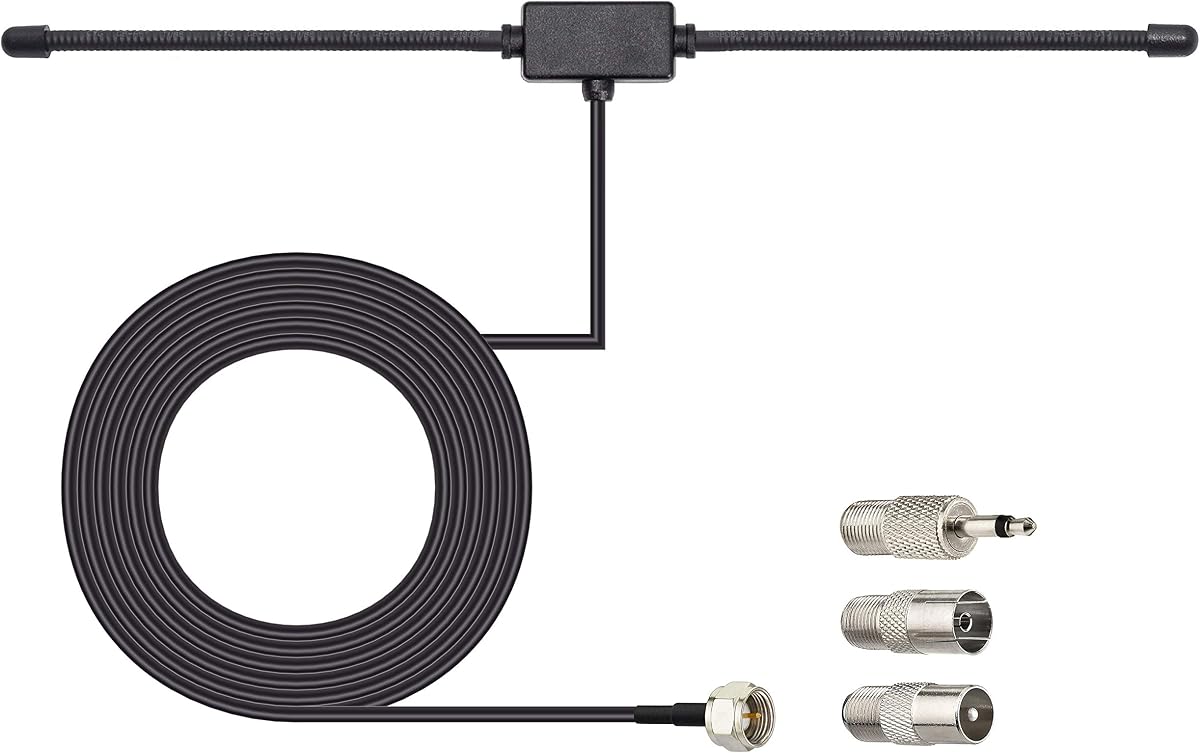


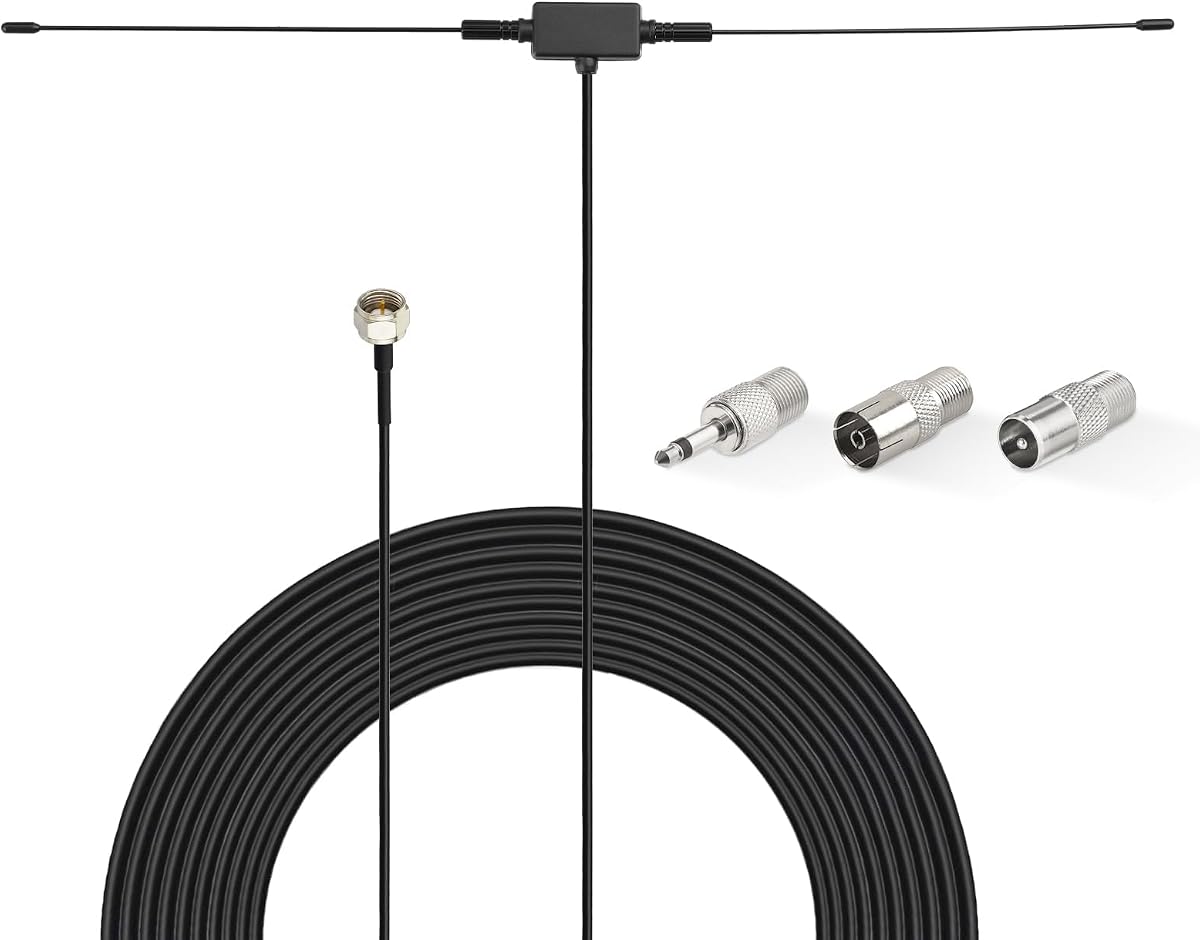


The Bingfu FM Radio Dipole Antenna is a 75-ohm unbalanced indoor antenna built around a ten-foot, or three-meter, coaxial extension. Its most useful feature is the accessory package: an F-type plug interface is accompanied by TV female, 3.5mm audio, and TV male connector adapters. That range makes it a practical option when the receiver’s antenna input is not a standard F-type female socket.
We may earn a commission when you buy through this link, at no additional cost to you.
The supplied information identifies compatibility with Yamaha, Sherwood, Pioneer, Panasonic, Onkyo, Sony, and Bose indoor receivers and music systems. The adhesive mounting design also provides more installation freedom than a permanently attached wire. Because the cable can be routed away from a receiver, a power amplifier, or a wall crowded with electronics, users can place the actual radiating element in a less obstructed area.
No indoor antenna can eliminate interference caused by every possible environment, and reception will still be affected by terrain, buildings, weather, and nearby electrical equipment. The included guidance recognizes these limitations and recommends repositioning the antenna, keeping it away from electronics, and trying a window location. Buyers should also tighten every coaxial connection and power-cycle the receiver after installation to clear any internal interference or software glitches.
This antenna is a strong fit for owners of a home stereo or AV receiver who want more placement flexibility than a short built-in wire. It is less attractive for someone who wants the absolute minimum number of parts or already has a known 300-ohm spade terminal connection. For most receiver owners, however, the adapters and mounting method make it a well-rounded indoor upgrade.
The ten-foot coaxial lead lets you separate the antenna element from the receiver and nearby electronics. Extend the dipole arms, use a T shape, and experiment with higher or window-side placement for more useful reception.
The included TV female, 3.5mm audio, and TV male adapters cover several common antenna ports. Confirm the receiver’s connector before ordering and select only the appropriate adapter.
We may earn a commission when you buy through this link, at no additional cost to you.
The Ancable 300 Ohm FM Antenna is a straightforward T-shaped dipole for receivers that use a clip or spade-style terminal rather than a coaxial F-type connector. It includes a 300-ohm antenna, a 5.9-foot coaxial lead, and a spade terminal, making it one of the simplest options in this guide for buyers who already know their receiver connection type.
We may earn a commission when you buy through this link, at no additional cost to you.
Installation requires no tools. The antenna can be placed on a tabletop, shelf, or other surface, with its element stretched as far as practical from the receiver. The product information suggests using it in homes, offices, garages, basements, and other indoor locations. Its main appeal is uncomplicated signal reception without a complicated network of adapters or transformers.
The important trade-off is specificity. It is designed for receivers with a clip or terminal FM socket matching the supplied connection, so it will not directly fit a receiver that requires an F-type coaxial plug. Its cable is also shorter than the ten- and sixteen-foot options elsewhere in the list, which may limit placement flexibility in larger rooms or around substantial sources of interference.
The Ancable antenna is best for a simple indoor stereo setup with a compatible 300-ohm spade connection. It offers an approachable, uncomplicated upgrade for replacing a damaged or ineffective wire. Buyers should inspect the back of the receiver first; if the antenna socket does not match, one of the coaxial or adapter-equipped models will be a more sensible choice.
The T-shaped element and spade terminal provide a direct alternative to a receiver’s short factory antenna. This keeps setup quick and makes the antenna suitable for several indoor listening locations.
Stretch the antenna away from the receiver and avoid hiding it behind metal objects or electronics. Even a simple dipole benefits from an unobstructed, higher position.
We may earn a commission when you buy through this link, at no additional cost to you.
The Superbat FM Antenna Dipole Antenna is a compact 75-ohm indoor model with a two-meter coaxial cable, an F-type male connector, and an approximately 70-centimeter dipole section on each side. The package also includes a PAL female-to-F female RF coaxial adapter, expanding compatibility with receivers that use a PAL-style antenna socket.
We may earn a commission when you buy through this link, at no additional cost to you.
The stated applications include Yamaha, Sherwood, Pioneer, Denon, Panasonic, Onkyo, and Sony audio systems, as well as tabletop stereos and radios. Because the main connector is F-type, this model may offer a more direct connection than the 300-ohm spade-terminal designs. The supplied recommendation to stretch both arms away from the device is important for getting a useful, symmetrical T shape.
Its two-meter lead is shorter than the three- and five-meter coaxial options in this roundup. That can be beneficial if the goal is a tidy installation close to the receiver, but it may be limiting in a room where the best signal appears only near a window or at a higher location. Compatibility still depends on the receiver’s socket and regional connector standard.
This Superbat model suits buyers who want a conventional 75-ohm indoor dipole without several adapters. It is particularly compelling for a receiver with an F-type input and potentially for a PAL-equipped system. Check the antenna jack, select the correct adapter if needed, and purchase it when a shorter cable and compact installation are preferable to maximum placement distance.
The 75-ohm unbalanced design and F-type plug suit many home stereo and AV receiver antenna terminals. A direct connector reduces setup uncertainty when the receiver uses a matching socket.
The included PAL female-to-F female adapter supports systems with a PAL socket. It is a useful inclusion, though buyers outside PAL regions may never need it.
We may earn a commission when you buy through this link, at no additional cost to you.
The Universal FM Radio Dipole Antenna stands apart with a 16-foot, or five-meter, coaxial extension and a 75-ohm-to-300-ohm matching transformer converter. Those features make it the most flexible premium-style option for users who can move the antenna around a room or need to reach a higher, less obstructed position.
We may earn a commission when you buy through this link, at no additional cost to you.
The antenna is listed for Yamaha, Marantz, Onkyo, Panasonic, Sony, Bose, and Pioneer desktop home stereo receivers, as well as AV receivers, stereo receivers, speaker selectors, Bluetooth music systems, and power amplifier systems. The matching transformer broadens the range of receiver connections, while the tool-free setup keeps the process approachable.
The main drawback is physical. A five-meter cable requires more available space than a short T-shaped antenna, and the matching transformer adds a component that must be connected correctly. A longer lead is useful only if the antenna element is ultimately placed well; routing excess cable behind equipment or in a tight cabinet may not improve reception. The antenna should still be oriented and extended according to good FM practice.
This is a compelling choice for a large listening area, a receiver positioned in an unfavorable location, or a home system with nearby interference sources. It is also sensible for anyone who wants one indoor antenna package to cover several receiver types. Buyers should verify the transformer and connector arrangement against their system before installation, but the extra reach is the standout benefit.
The extended coaxial cable can reach a window, higher shelf, or area away from a receiver’s power supply. This separation is particularly valuable when the electronics rack is not the best RF location.
The included 75-ohm-to-300-ohm converter allows the antenna to serve setups using either impedance arrangement. It makes the package more versatile than a fixed-connector model.
We may earn a commission when you buy through this link, at no additional cost to you.
The Bingfu 300 Ohm FM Dipole is a compact T-shaped antenna for receivers with a two-pin bare-wire FM connection. Its 1.6-meter cable and approximately 75-centimeter dipole sections make it easy to arrange on a tabletop, shelf, office desk, or other nearby surface without the complexity of a longer coaxial system.
We may earn a commission when you buy through this link, at no additional cost to you.
The product is advertised for Yamaha, Pioneer, Panasonic, Onkyo, Sony, Sherwood, and other home stereo receivers, as well as radio tuners and speakers. Its 300-ohm construction is useful for users familiar with traditional twin-lead FM connections, and the package contains one complete dipole antenna without separate adapters.
Connection compatibility is the decisive point. The two bare wires must match the receiver’s two-pin FM socket, and the product information specifically asks buyers to confirm that socket before ordering. The relatively short lead also means there is less freedom to move the element away from a large metal receiver, television, power amplifier, or wall-mounted power strip.
This antenna is a practical option for a modest indoor system whose receiver has the specified socket. It can serve as a tidy replacement for a missing or damaged factory antenna, especially where desk space is limited. For a more flexible installation, buyers should instead consider a coaxial model with a longer lead and multiple adapters.
The short lead and extended T element fit comfortably on a shelf or entertainment unit. The antenna can improve reception without requiring a large wall-mounted assembly.
The two-pin bare-wire plug is intended for matching FM antenna sockets. Inspect the receiver before purchase to avoid buying a model that requires a different connection.
We may earn a commission when you buy through this link, at no additional cost to you.
The FM Radio Dipole Antenna for Stereo Receiver offers the strongest all-around balance in this guide. It combines 75-ohm unbalanced construction, a ten-foot coaxial lead, a wall-mounting base, and three adapters for TV female, 3.5mm audio, and TV male connections. The package is especially useful when replacing a lost or broken original antenna.
We may earn a commission when you buy through this link, at no additional cost to you.
Compatibility extends across Pioneer, Onkyo, Yamaha, Marantz, Sony, Denon, Bose, Philips, JVC, Panasonic, Sangean, Tivoli Audio, Grundig, and many other home stereo receivers, AV receivers, tuners, and tabletop radios. The three included adapters are intended to address most common variations between coaxial antenna ports and the connector used by the product.
The supplied performance guidance recommends extending the dipole arms fully, retaining a T shape, and trying a position near a window or above other equipment. It also notes that FM reception is generally line-of-sight, which makes height valuable. A longer antenna does not overcome every source of interference, but the ten-foot lead provides enough movement to find a meaningfully better location.
This is the strongest recommendation for a buyer who wants one adaptable antenna for a mixed home audio setup. The combination of connectors, mounting hardware, and cable length reduces the chance that the antenna will be unusable after it arrives. Check the receiver socket, select the right adapter, and allow time to test several positions before judging the result.
The F-type, TV, and 3.5mm options reduce the need for a separate adapter purchase. This broadens practical compatibility across stereo and compact music systems.
The adhesive base keeps the antenna off a crowded shelf and makes it easier to raise the element. A clean, higher location can also help separate it from electronics that generate interference.
We may earn a commission when you buy through this link, at no additional cost to you.
The Bingfu FM and AM Antenna combines a 75-ohm FM dipole with a separate AM loop, making it useful for receivers where both bands need external antennas. The FM antenna connects through an F-type female interface, which is compatible with many Pioneer, Onkyo, Yamaha, Marantz, Panasonic, Sangean, Sherwood, and other home stereo systems.
We may earn a commission when you buy through this link, at no additional cost to you.
The package is also listed for indoor HD Radio receivers, Bluetooth-capable home theater receivers, stereo receivers, power systems, and music systems. Installation is described as straightforward: connect the appropriate antenna to the corresponding port on the back of the receiver. The included AM loop also allows users to improve AM reception without sourcing a second antenna.
This set is less minimal than an FM-only model because it includes hardware for a band that some listeners never use. The fixed F-type interface may also be unsuitable for a receiver expecting a 300-ohm spade or two-pin connection, so connector verification remains essential. FM performance still depends on proper extension, placement, and avoidance of interference sources.
The Bingfu set is a good fit for an older or versatile receiver that has separate FM and AM antenna terminals. It is especially attractive when the original AM loop has been lost or degraded. If FM is the only requirement and the receiver uses a non-F-type socket, choose a more directly compatible dipole instead.
The included loop gives the setup a dedicated AM element. It restores a second band without requiring buyers to search for a compatible replacement separately.
The F-type female FM interface suits many stereo systems from the listed brands. Confirm the receiver’s socket and band requirements before installation.
We may earn a commission when you buy through this link, at no additional cost to you.
The Superbat Adhesive Mount FM Antenna is a 75-ohm indoor dipole centered on convenient placement. It uses a ten-foot, three-meter coaxial extension and includes TV female, 3.5mm audio, and TV male adapters. The adhesive mounting system lets users position the antenna on a wall without screws or permanent tools.
We may earn a commission when you buy through this link, at no additional cost to you.
It is listed for Yamaha, Sherwood, Pioneer, Panasonic, Onkyo, Sony, Marantz, Bose, and Wave indoor sound systems, including home stereo, music system, AV, and home theater receivers. The product information describes the antenna as intended to improve FM clarity, reduce interference, and provide more stable broadcasts, subject to the usual influence of placement and nearby electronics.
The adhesive approach is convenient, but it places limits on where the antenna can be installed. Wall surfaces, paint condition, heat, and the weight of the cable can affect how securely it holds, and the receiver may not sit close to the best window-side position. Buyers may need removable mounting hardware of their own if a permanent adhesive mark is undesirable.
This model is best for a receiver located near a suitable wall or an area where raising the antenna can help. It offers the same useful combination of a longer lead and multiple adapters as other premium indoor kits, but it has the lowest supplied customer rating in the group. Confirm compatibility, test adhesive placement carefully, and keep alternative mounting options in mind.
The supplied mounting strip supports a quick installation without drilling. It is useful when the antenna needs to sit higher than the receiver or farther from surrounding electronics.
A wall is only a good location if the antenna is not pressed close to metal, power supplies, or cables. Keep the dipole extended and test a window-side alternative if reception remains noisy.
We may earn a commission when you buy through this link, at no additional cost to you.
The Two-Pack 300 Ohm FM Antenna is the highest-rated product in the supplied group and includes two T-shaped 300-ohm dipole antennas. Each has a 5.9-foot coaxial cable and bare-wire connection, making the package useful for two receivers or for keeping a spare on hand. The antennas are intended for indoor stereo reception in homes, offices, garages, basements, and similar spaces.
We may earn a commission when you buy through this link, at no additional cost to you.
The simple construction supports quick installation without a transformer or multi-adapter kit. Buyers can place one antenna near a bedroom stereo and another beside a main living-room receiver, or compare two locations to determine which produces cleaner reception. The product information recommends extending the element away from the device for the best result.
Compatibility remains the central limitation. The bare-wire connector must match the receiver’s FM terminal, and the supplied title references common home stereo and home theater equipment without promising every possible socket. The 5.9-foot lead is also shorter than the extended coaxial antennas, so there is less opportunity to route the element around obstacles. Two antennas do not automatically overcome a very noisy electrical environment.
This multipack is a strong choice for households with more than one FM system, or for buyers who want a straightforward spare. It is also appealing for testing different rooms before settling on a permanent position. Verify that both receivers use compatible terminals, and choose a longer coaxial model if placement flexibility is the main priority.
Two complete antennas can serve separate stereo systems or provide a backup. This is more versatile than a single-antenna package when several rooms need FM reception support.
Install or position each antenna in a different area to compare signal quality. The result can reveal whether one room has a clearer path to local transmitters.
We may earn a commission when you buy through this link, at no additional cost to you.
The FM Antenna Dipole and AM Loop Antenna is a multi-band indoor package centered on a 300-to-75-ohm balun and an F-type connection. It also includes an AM loop with a standard two-pin tin-plated bare-wire connector, allowing a receiver with separate FM and AM terminals to use the appropriate element for each band.
We may earn a commission when you buy through this link, at no additional cost to you.
The supplied information emphasizes enhanced AM signal stability and clarity, while also describing the FM and AM dipole arrangement as supporting crisp, clear audio. Installation is presented as tool-free: the antenna connects to the appropriate receiver jack, and the loop is used on the AM terminal. This makes the package relevant to home stereo and natural-sound theater systems that still rely on external antennas.
The potential drawback is complexity. Buyers must understand which lead belongs to which band, identify the receiver’s terminal style, and connect the balun correctly. The listing does not provide a specific cable length, making placement planning less predictable than with the models that state their lead measurements. Reception still depends on keeping the antenna away from interference and placing it as high as practical.
This antenna set is a good match for a receiver with both FM and AM antenna inputs and a need for a 300-ohm-style dipole connection. It may be especially valuable when an original AM loop is missing. For an FM-only system with a clearly defined F-type input, a simpler dedicated coaxial antenna may be easier to install.
The included loop supplies a proper AM element rather than relying on a receiver’s internal wire. It can reduce instability and interference in suitable indoor locations.
The 300-to-75-ohm balun helps reconcile the dipole with a 75-ohm receiver connection. Correct orientation and secure fittings remain important for dependable performance.
We may earn a commission when you buy through this link, at no additional cost to you.
The most important choices are connector type, impedance, cable length, mounting method, and the physical location of your receiver. A technically suitable antenna can still underperform if it is compressed, hidden, or installed beside noisy electronics.
Start by inspecting the antenna terminals on the back of the receiver. Some systems use an F-type female socket, while others use a 300-ohm spade terminal or a two-pin bare-wire connection. The connector must match the antenna or the supplied adapter set; a physically similar plug does not guarantee correct fit or impedance compatibility. Models with several adapters, such as the Bingfu 10-foot kit and the 10-foot FM Radio Dipole for Stereo Receiver, offer useful flexibility, while dedicated bare-wire models are best for receivers with the same connection.
In short, check the socket before choosing an antenna, then confirm that the supplied connector or adapter matches it exactly.
Impedance describes how the antenna and receiver are electrically matched. This guide includes 75-ohm unbalanced antennas, 300-ohm antennas, and a matching transformer that bridges both arrangements. A properly matched system can transfer the FM signal efficiently and reduce reflected losses. Using the wrong connection without an appropriate converter may produce weak reception, distorted audio, or inconsistent results. The universal 75-ohm model with its included 75-to-300-ohm matching transformer is especially useful when the connection requirements are not immediately clear.
In short, prefer a native impedance match or use a proper matching adapter rather than forcing an incompatible connector.
Cable length determines how far the antenna element can be separated from the receiver. The five-meter universal antenna offers the greatest positioning freedom, while the three-meter models provide a useful compromise between reach and manageable installation. The 1.8-meter 300-ohm bare-wire antenna and 2-meter Superbat model are better suited to compact arrangements. More cable is not automatically better; the useful goal is to move the radiating element away from electronics, metal objects, and poor signal paths without leaving excess cable bunched in one place.
In short, select a lead long enough to reach a better location, but avoid choosing a model that will create unnecessary clutter.
A tabletop T-shaped antenna can work well when the receiver is already near a window or other favorable area. Adhesive wall mounting is more useful when the best reception requires a higher position or greater separation from the receiver. Check the surface before applying adhesive, and do not place the element directly against metal trim, entertainment cabinets, or power supplies. The long-coaxial models are also easy to route temporarily, allowing buyers to test several positions before making a permanent choice.
In short, match the mounting method to the receiver’s location, the available surface, and the desire for a tidy permanent installation.
Accessories can make the difference between a usable upgrade and an antenna that sits in a drawer. The strongest all-around packages include F-type, TV female, TV male, and 3.5mm adapters. Other useful additions include PAL-to-F adapters, 75-to-300-ohm matching transformers, AM loops, and adhesive mounting strips. The two-pack provides a second antenna rather than more connection hardware, which is beneficial for multiple systems or location testing. Review the package list against your receiver before ordering to avoid discovering a missing interface after delivery.
In short, prioritize the exact connector adapter or matching transformer needed by your system rather than assuming every antenna is interchangeable.
Indoor FM reception is shaped by building materials, room layout, nearby electronics, station transmitter distance, and radio-frequency conditions. A dipole performs best when extended symmetrically, kept away from large metal objects, and positioned as high as practical. Power supplies, LED lighting, computer equipment, and poorly connected cables can all contribute to noise in a listening area. An antenna cannot fix a transmitter that is weak at the property, but it can often improve an otherwise noisy system by providing a cleaner signal path.
In short, optimize placement and reduce nearby interference before assuming a more expensive or complex antenna is required.
Some receivers still include an AM band, and a dedicated loop can improve stability and clarity. If you regularly listen to AM, choose a package with a matching AM loop and confirm the receiver’s AM terminal. If AM is irrelevant, a dedicated FM antenna avoids carrying hardware that will not be used. The combined Bingfu and Superbat-style kits are practical when both bands are part of the listening setup, while the single-purpose models are simpler for FM-only users.
In short, include an AM loop only when the receiver and your listening habits make the AM band genuinely useful.
The best antenna for a small bedroom stereo may not suit a large basement system filled with structural metal and electrical equipment. A basement, garage, office, attic, or home theater may benefit from a longer cable and wall mounting, while a tabletop receiver near a window may work well with a compact model. Consider where you listen, how far the receiver sits from the intended antenna position, and whether the room contains metal shelving. The multipack is especially useful when testing more than one room.
In short, choose the antenna around the real listening space and signal obstacles rather than by appearance or connector alone.
Before connecting the antenna, switch off and unplug the receiver. Identify the FM antenna terminal, select the correct native connector or included adapter, and make sure the connection is oriented as intended by the terminal markings. Secure every coaxial fitting by hand, attach the dipole element, and keep the two arms extended in a T shape rather than coiling them together. For models with a separate AM loop, connect it only to the AM terminal and keep it away from the FM dipole if the manufacturer’s layout suggests separation.
Next, power on the receiver and power-cycle it after the antenna is connected. This can help clear internal interference or software-related reception issues. Tune through the available stations, note whether stations appear, and listen for stable stereo, low static, and minimal background noise. If reception is poor, move the antenna rather than immediately assuming the product is defective. Try a higher position, a window, a different wall, or a location farther from televisions, computers, power supplies, and metal furniture.
For adhesive-mounted models, install the base on a clean, dry, smooth surface and allow it to set as directed. Do not place the element against metal or route the cable through a tight cabinet. Periodically inspect the connectors for looseness and check that the cable has not been sharply bent. With two-pin or spade connections, confirm that the terminals remain firmly attached without exposed conductor creating a short. Proper placement and maintenance matter more often than any minor difference between similarly rated indoor antennas.
No. It can substantially improve a weak or noisy receiver setup, particularly when the factory antenna is damaged, poorly positioned, or obstructed. It cannot create a strong signal where local transmitters are weak or blocked by severe interference. Antenna height, nearby electronics, building materials, and correct connector matching all influence the result.
Only when the system includes a proper matching adapter or transformer. A 75-ohm antenna and 300-ohm antenna have different electrical characteristics, and forcing an incorrect connection may lead to poor transfer efficiency. The Universal FM Radio Dipole Antenna includes a 75-to-300-ohm matching transformer, while the 300-ohm models are intended for suitable spade or bare-wire terminals.
Start near a window and keep the antenna higher than the receiver if possible. Extend the two arms fully in a T shape, and keep the element away from metal furniture, television cabinets, power supplies, and bundled cables. Try several locations because small changes can reduce noise or improve stereo stability.
That depends on the receiver. An F-type male plug can connect directly to an F-type female socket, but some receivers use TV-style or 3.5mm antenna terminals. Several products in this guide include adapters for these common arrangements. Confirm the receiver socket before ordering and use the adapter that exactly matches it.
No, but it provides more freedom to find a better antenna position. A longer lead is helpful when the receiver sits near electronics, metal furniture, or a low cabinet. The element itself must still be extended and placed in open space, and excess cable should not be tightly coiled because that can create an unfavorable installation.
Some listings explicitly support indoor HD Radio systems, and an improved FM signal can also support HD Radio reception where the receiver obtains its underlying FM signal through the same antenna terminal. The antenna does not add an HD Radio tuner or convert an FM-only receiver. Compatibility with the receiver and the correct connector remain essential.
Only if you want to improve the receiver’s AM band. An FM dipole handles FM stations, while the included loops provide a separate element for AM reception. If your receiver includes an AM terminal and you listen to AM broadcasts, the combined packages are more useful than an FM-only antenna.
The antenna may be connected incorrectly, partially extended, placed beside interference sources, or mounted too low. Tighten the connectors, confirm the impedance and terminal, fully extend both arms, and power-cycle the receiver. Then test near a window or at a higher location before concluding that the antenna has failed.
The FM Radio Dipole Antenna for Stereo Receiver is the strongest all-around choice because it combines a ten-foot lead, an adhesive mounting base, and adapters for several common connections. The Ancable 300 Ohm FM Antenna is a simpler option for compatible spade-terminal systems, while the Universal FM Radio Dipole Antenna offers maximum reach through its five-meter cable and matching transformer.
Prioritize the receiver connection first, then consider impedance, cable length, and where the antenna can be placed. A compact T-shaped model may be sufficient for a nearby window and tabletop stereo, but a longer coaxial cable is valuable for separating the antenna from an electronics rack. For multiple receivers, the two-pack provides convenient options for separate rooms or location testing.
Finally, check the current product details, connector information, included accessories, and customer feedback before purchasing. Radio reception depends on both the antenna and the environment, so allow time to test multiple placements and reconnect every fitting securely. The right dipole can restore clarity, improve stereo stability, and make an existing home receiver feel considerably more capable.