
Hisense 10,000 BTU Inverter Window Air Conditioner
4.8Editor score
Cools spaces up to 450 square feet
ConnectLife smartphone app
Advanced inverter cooling
Washable maintenance filter
Compare 10 low profile air conditioner options for room size, slim design, quiet operation, smart controls, efficiency, and easy installation at home.
A low profile air conditioner can cool a room without creating the bulky, obstructive appearance associated with conventional window units. The best models balance slim dimensions, effective cooling, manageable noise, straightforward installation, and enough control options for bedrooms, offices, living spaces, and other regularly occupied rooms.
This guide compares ten window, built-in, and vehicle-oriented air conditioner options using the supplied specifications, features, room capacities, installation details, and customer ratings. It considers cooling output, physical depth, noise-related design, smart connectivity, operating modes, maintenance needs, and how each unit fits into a particular space.
Each review explains the strongest reasons to consider a model, along with its practical limitations and ideal buyer. The selections range from compact mechanical units for small rooms to inverter-driven smart models and a low profile rooftop option for tall vehicles; prices and availability can change at any time.
4.8Editor score
4.3Editor score

4.4Editor score
The comparison below places all ten options side by side, emphasizing cooling capacity, intended installation type, physical design, controls, and the practical circumstances that make each low profile air conditioner a useful choice.


The Hisense 8,000 BTU Smart Inverter Window Air Conditioner is a slim, feature-rich option for rooms up to 350 square feet. It carries a 4.0 rating and stands out for its ultra-slim profile, 4-way airflow, three fan speeds, and ConnectLife app compatibility. Its 700-watt power rating also makes it suitable for consumers who want meaningful cooling capacity without moving to the largest window model.
We may earn a commission when you buy through this link, at no additional cost to you.
This unit combines Cooling, Fan, Dry, Eco, and Sleep modes, giving it more flexibility than a basic mechanical window air conditioner. The 235 CFM airflow rating and adjustable air direction are intended to distribute air evenly rather than concentrate it in one area. A washable filter, clean-filter alert, and included installation bracket make routine ownership relatively straightforward.
The main caveat is that this model is sold as renewed. That designation can make it less appealing to buyers who prioritize cosmetic condition or the reassurance associated with a completely new unit. Installation also depends on a compatible window measuring 25 to 38.6 inches wide and at least 15.2 inches high, with the chassis measuring 20.5 inches long, 20.3 inches wide, and 14.6 inches high.
This Hisense is a sensible pick for a bedroom, apartment, home office, or living room where preserving the window's appearance matters. It is especially attractive to buyers who want app-based controls and multiple operating modes in an ultra-slim design. For anyone uneasy about renewed condition, the standard Hisense 8,000 BTU model offers a similar slim concept without that designation.
Four-way air direction, three fan speeds, and several operating modes make this unit adaptable to different room layouts. The ConnectLife app adds another layer of convenience by allowing settings to be changed through a compatible smartphone.
Its 8,000 BTU output targets rooms up to 350 square feet while keeping the housing visually slimmer than many conventional window units. Buyers should still compare the listed dimensions with their window opening before installation.
We may earn a commission when you buy through this link, at no additional cost to you.
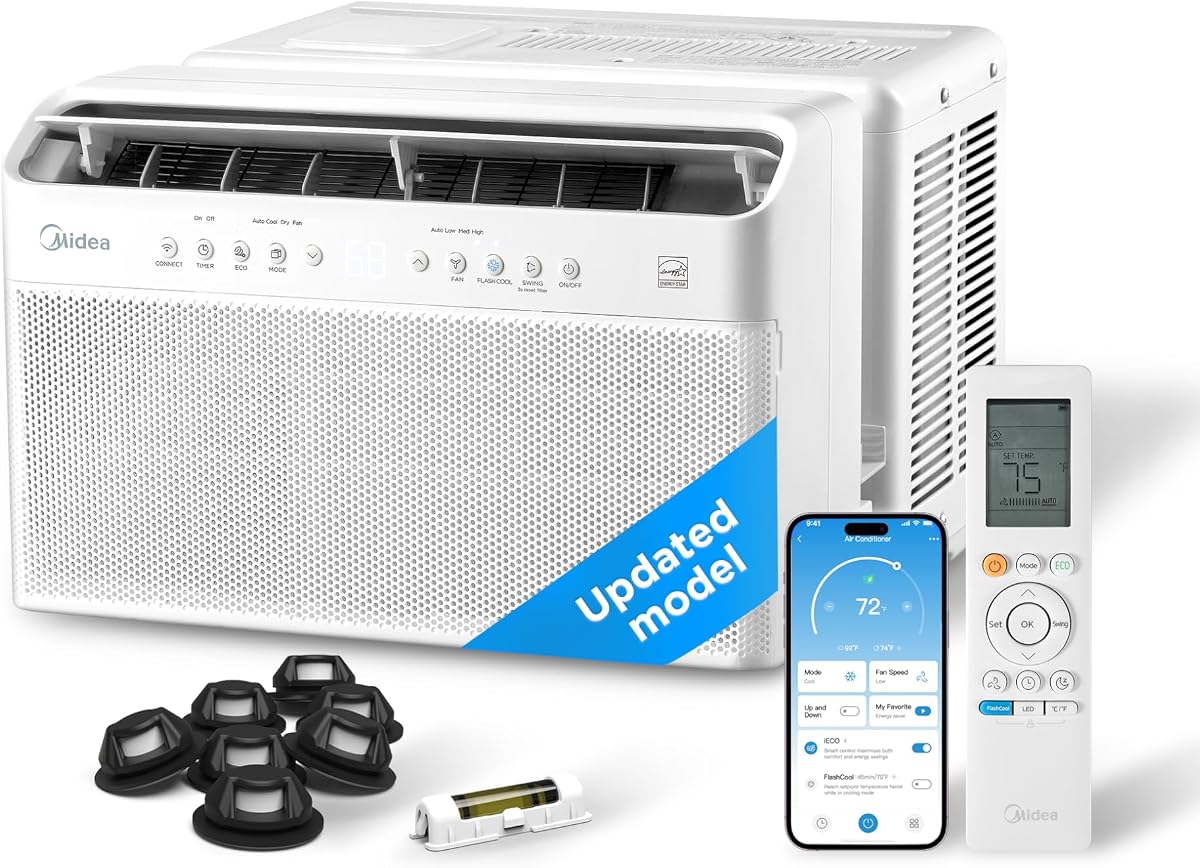
The Midea 6,000 BTU U-Shaped Window Air Conditioner brings a distinctive approach to low profile cooling. Rated 4.3, it is designed for rooms up to 250 square feet and keeps the window available for partial opening. Its U-shaped housing uses the window area to help block outside noise, while Midea's inverter system operates as quietly as 32 dBA.
We may earn a commission when you buy through this link, at no additional cost to you.
Smart control is a major strength. The Midea SmartHome app works with smartphones and smartwatches, while compatibility with Alexa, Google Assistant, and Matter broadens its usefulness within a connected home. A remote control is included for people who prefer direct access, and the listed energy efficiency features support more consistent temperature management with less on-off cycling.
The trade-off is capacity. At 6,000 BTU, it is best suited to a smaller bedroom, office, apartment, or other modest room rather than a large, open living area. It also requires a compatible single- or double-hung window between 24 and 36 inches wide with a minimum opening height of 14.5 inches. The included flat sill adapter and built-in gradienter simplify leveling.
This model is a particularly good fit for anyone who wants the window open while maintaining cooling, values quiet operation, or wants a less conventional appearance than a standard box-shaped unit. The Jet Black finish is another differentiator, reducing visible glare and blending with darker frames. It is one of the strongest choices for small rooms with frequent use.
The U-shaped chassis preserves the ability to open the window, allowing fresh air without abandoning the cooling function entirely. This makes the model especially practical for bedrooms where a completely closed window feels restrictive.
A stated low of 32 dBA makes the unit attractive for remote workers, light sleepers, and families. App, smartwatch, Alexa, Google Assistant, Matter, and remote-control support provide several ways to manage it.
We may earn a commission when you buy through this link, at no additional cost to you.
The Hisense 8,000 BTU Inverter Window Air Conditioner is a balanced choice for buyers who want a slim profile, connected controls, and modern temperature management. It has a 4.3 rating, and its defining attraction is the UltraSlim design, which seeks to preserve the appearance of a living space while delivering 8,000 BTU of cooling.
We may earn a commission when you buy through this link, at no additional cost to you.
Inverter technology continuously varies the unit's output rather than relying only on full-on, full-off cycles. According to the supplied information, this supports lower noise and more efficient operation than conventional systems. Buyers can use the ConnectLife app to change settings, switch modes, and manage the unit from a smartphone, while a washable filter simplifies ongoing care.
The included installation bracket is intended to hold the chassis securely in place and make setup more straightforward. The trade-off is that the supplied specifications do not provide an exact room-size coverage figure for this particular listing, so buyers should not substitute a figure from a similar Hisense model. Its 8,000 BTU output also places it below the larger 10,000 and 12,000 BTU selections in this guide.
This Hisense is well suited to a medium bedroom, office, apartment, or compact living area where an understated exterior and smart controls matter. It may be especially useful for users who want the more refined operation of an inverter model without stepping up to a 10,000 BTU installation. Confirming the physical fit and expected room load before purchase is essential.
The UltraSlim housing reduces visual bulk, but the unit remains equipped with app-based control and inverter operation. That makes it a useful middle ground between a compact mechanical model and a larger smart unit.
A washable filter allows routine cleaning without a disposable replacement. The supplied easy-install bracket is also designed to improve stability and reduce the complexity of putting the unit in its operating position.
We may earn a commission when you buy through this link, at no additional cost to you.
The Midea 10,000 BTU U-Shaped Smart Inverter Window AC is the most complete all-around model in this guide. It has a 4.3 rating, cools rooms up to 450 square feet, and combines a 10,000 BTU inverter system with a low-profile U-shaped chassis. Its stated operation as low as 32 dBA makes it especially appealing where normal room noise would be disruptive.
We may earn a commission when you buy through this link, at no additional cost to you.
The model's design goes beyond reducing visual depth. Its U shape uses the window as an additional noise barrier, allows partial window opening, and preserves more of the outdoor view. When the window is closed, an anti-theft mechanism locks it. Smart control through the Midea SmartHome app is supported on iOS and Android, as are Alexa and Google Assistant, making the unit easy to incorporate into a connected home.
Efficiency is another major strength. The advanced DC inverter system is described as delivering more than 35% energy savings compared with traditional units, and the listing identifies the appliance as the first window air conditioner to receive ENERGY STAR certification. Its 890-watt cooling input, 9.97 rated cooling amps, and R32 refrigerant provide useful technical context. Installation requires a compatible window between 22 and 36 inches wide with a minimum opening height of 13.75 inches.
The trade-off is that this is a more involved installation than a compact mechanical model, and the included quick-snap bracket and sidearms must be positioned carefully. Buyers with large rooms, active households, or a need for low noise will receive the most value. For many people, the balance of capacity, quiet operation, flexible window use, and smart control makes this the most well-rounded low profile air conditioner in the roundup.
A 10,000 BTU output targets rooms up to 450 square feet, while the U-shaped layout preserves window access and visual openness. This makes the model useful in larger rooms than most compact window units without adopting the appearance of a conventional large chassis.
The stated 32 dBA low, DC inverter operation, Wi-Fi app, and voice-assistant compatibility create a strong comfort package. It is well matched to bedrooms, home offices, living rooms, and apartments where low noise and convenient control are priorities.
We may earn a commission when you buy through this link, at no additional cost to you.
The GE AJCQ10ACH AJCQ10ACH9 Built-in Cool-Only Room Air Conditioner takes a different approach to the low profile category. Rather than sitting in a window, it uses a true built-in design in which the sleeve and chassis integrate for a clean fit without visible gaps. Its slim room front and metallic silver accent make it one of the most visually polished products in the guide.
We may earn a commission when you buy through this link, at no additional cost to you.
The control presentation is unusually refined. Electronic cap-touch controls sit alongside a large white LCD that automatically dims for nighttime use, while an included slim remote allows convenient adjustment from across the room. Eco mode cycles the fan off during cooling intervals, dry mode supports dehumidification in humid environments, and auto mode monitors room temperature to select the appropriate fan speed.
The principal limitation is that a built-in appliance calls for more installation planning than a window unit. A listing without a customer rating gives buyers less information about real-world experiences, and the supplied specifications do not state the unit's BTU rating or exact room coverage. It is also described as cool-only, so buyers should not expect it to provide heating.
This GE model is best for homeowners undertaking a larger renovation or building a room where a built-in system is more appropriate than a window appliance. It offers the strongest architectural integration in this roundup and rewards buyers who value a finished, furniture-like appearance over portable placement. Verify all sleeve, electrical, and opening requirements with installation professionals before committing.
The integrated sleeve and chassis create a more seamless result than a window-mounted appliance. Its narrow front face, soft gray color, and metallic accent support a built-in look that works well in finished interiors.
Eco, dry, and automatic modes address efficiency, humidity, and temperature management. The auto-dimming display is particularly considerate for bedrooms where a bright control panel could interfere with nighttime comfort.
We may earn a commission when you buy through this link, at no additional cost to you.
The Hisense 10,000 BTU Inverter Window Air Conditioner combines a 10,000 BTU output with coverage for rooms up to 450 square feet. Its 4.8 rating is the highest among the ten products, and the model stands out for stable inverter cooling, reduced operational noise, and the ability to manage settings through the ConnectLife app.
We may earn a commission when you buy through this link, at no additional cost to you.
The slim aesthetic helps separate it from larger traditional window units. Inverter technology adjusts output to maintain the selected temperature more continuously, which can make room comfort feel more consistent. Buyers can change settings, switch modes, and monitor the unit from a smartphone, while a washable filter and included installation bracket keep ownership and setup relatively convenient.
The main limitation is that the supplied listing does not state the required window width or minimum opening height. That makes physical verification more important than it would be for a model with fully published dimensions. Connectivity also means the most convenient control experience depends on a compatible phone, network, and the ConnectLife app being set up properly.
This is an attractive premium selection for a larger bedroom, apartment living area, home office, or family room where substantial cooling and smart controls are worth prioritizing. The 4.8 rating is encouraging, although ratings should not be treated as a substitute for checking room size, window compatibility, and electrical requirements. Among the listed slim smart models, it offers a strong balance of capacity and refined operation.
The unit is intended for rooms up to 450 square feet, offering more cooling reach than the 5,000, 6,000, and 8,000 BTU models. That makes it a practical middle-to-large selection for spaces with moderate heat gain.
Rather than operating only at full output, the inverter system varies its performance to maintain the chosen setting. The supplied information links this approach with lower noise and more efficient operation compared with conventional systems.
We may earn a commission when you buy through this link, at no additional cost to you.
The Midea 12,000 BTU U-Shaped Smart Inverter Window Air Conditioner offers the largest stated room coverage in the guide, reaching up to 550 square feet. It carries a 4.3 rating and is aimed at larger rooms that need more cooling than a 5,000, 6,000, 8,000, or 10,000 BTU window unit can reasonably provide.
We may earn a commission when you buy through this link, at no additional cost to you.
Its U-shaped chassis retains the ability to open the window partly, helping block outside and compressor noise while preserving ventilation. Operation is stated as quiet as 32 dBA, supported by an efficient DC inverter system. The MSmartHome app works with iOS and Android devices, while Alexa and Google Assistant enable voice control. A clean-filter indicator light provides a useful maintenance reminder.
The renewed status is the main caveat. Some buyers will welcome the opportunity to obtain a higher-capacity model, while others will prefer a new unit because of its cosmetic condition, packaging, accessories, or warranty considerations. Its 1,140-watt cooling input and 12.17 rated cooling amps also represent a greater installation load than the smaller models, so electrical capacity should be checked.
This is a strong option for a large living room, wide bedroom, open apartment area, or other space approaching 550 square feet that still benefits from the window's partial opening. The required window dimensions are 22 to 36 inches wide with a minimum height of 13.75 inches. Among high-capacity window options, it remains one of the most compact and quiet-oriented designs.
A 12,000 BTU capacity gives this model a clear advantage in larger rooms. It is a better fit for buyers who need meaningful cooling reach but still want a window appliance rather than a permanently installed system.
The 32 dBA low and window-assisted noise blocking make the unit appealing for sleeping and working environments. Smart controls let users start or adjust cooling without walking directly to the unit.
We may earn a commission when you buy through this link, at no additional cost to you.
The GE Profile ClearView Inverter Window Air Conditioner is built around preserving the usable window. Rated 3.5, it delivers 10,300 BTU of cooling for spaces up to 450 square feet while allowing the sash to open and close after installation. That feature distinguishes it from conventional window units that permanently block much of the opening.
We may earn a commission when you buy through this link, at no additional cost to you.
The industry's flex-depth design expands to accommodate walls measuring from 4.5 to 13.75 inches thick, providing useful adjustment when standard brackets do not suit a particular sill. Its inverter system operates at varying levels, and the listing describes it as 34% more efficient. Operation can reach 40 dB, making it quieter than many traditional units but not as quiet as the stated 32 dBA lows of the Midea models.
The 3.5 rating is the lowest listed among the rated products and should be considered carefully. Buyers may also need to navigate the unit's depth and its position relative to the window opening. On the positive side, built-in Wi-Fi, SmartHQ app support, Alexa and Google Assistant compatibility, and an included remote provide flexible control choices.
The ClearView is most compelling for buyers whose priority is preserving a full window view and accommodating an unusual sill depth. It suits rooms up to 450 square feet and is a solid choice where the window is visually or functionally important. However, those wanting the quietest available operation may prefer a Midea U-shaped model, while cautious buyers should review the lower customer rating before deciding.
The ClearView design is intended to allow natural light and continued window operation after installation. That makes it useful in rooms where blocking the window would be inconvenient or visually undesirable.
The adjustable flex-depth chassis can expand for walls between 4.5 and 13.75 inches thick. This flexibility is helpful in older homes where window recesses and sills vary from one opening to another.
We may earn a commission when you buy through this link, at no additional cost to you.
The 15K BTU Low-Profile Mechanical Air Conditioner by Dometic is a specialized option for tall vehicles. Its 10.5-inch height is the defining advantage, allowing it to sit lower on a rooftop than many conventional vehicle air conditioners. That reduced profile can help minimize the visual bulk and aerodynamic profile of the installation.
We may earn a commission when you buy through this link, at no additional cost to you.
The unit uses a single-motor, fixed-speed design and includes a built-in hard-start kit for smooth startup. An upgraded motor and optimized blower system are intended to reduce noise, while a steel-reinforced base and UV-resistant shroud support durability in outdoor rooftop conditions. Its 15K BTU rating provides substantial cooling capacity for compatible vehicle cabins.
This is not a room window air conditioner, so it should not be compared directly with the residential models in terms of placement, electrical requirements, or installation procedure. The fixed-speed mechanical design also lacks the app-based controls and variable inverter operation found in many smart residential selections. No customer rating is provided, leaving less information about long-term user experiences.
The Dometic is a strong candidate for RV owners, overlanding enthusiasts, or tall-vehicle travelers whose priority is a shallow rooftop profile. It is less relevant to apartment or house occupants looking for a window unit. Installation should be handled according to the manufacturer's vehicle-specific instructions, particularly with respect to rooftop penetration, securement, and power requirements.
The 10.5-inch housing directly addresses the visual and spatial limitations of taller rooftop equipment. It is particularly relevant to vehicles where headroom, exterior proportions, or storage considerations influence equipment choice.
The upgraded motor, optimized blower, hard-start kit, reinforced base, and UV-resistant shroud focus on dependable operation. Fixed-speed controls are straightforward, though they do not offer the convenience of residential smart-home integration.
We may earn a commission when you buy through this link, at no additional cost to you.
The Midea 5,000 BTU EasyCool is the most straightforward and approachable selection in the guide. It carries a 4.4 rating, cools spaces up to 150 square feet, and uses familiar mechanical controls rather than an app or complicated control panel. It is a practical low profile air conditioner for buyers who need targeted cooling without paying for inverter and smart-home features.
We may earn a commission when you buy through this link, at no additional cost to you.
Seven temperature settings, two cooling speeds, two fan-only speeds, and two-way air direction give users a useful range of manual control. The CEER of 11.0 supports better efficiency, while the removable reusable filter makes routine cleaning easier. Its operation is described as quieter than a household refrigerator, making it reasonable for a small bedroom, office, apartment, or personal space.
The limitation is cooling reach. A 5,000 BTU unit is best for a room up to 150 square feet and should not be expected to handle large, open areas or heavy heat gain. There is also no Wi-Fi, app, or voice-assistant support, so remote management is not available. The unit fits windows between 23 and 36 inches wide with a minimum height of 13 inches, and a screwdriver is required but not included.
This Midea is an excellent choice for a budget-conscious buyer furnishing a small room, guest space, or home office. It avoids the complexity of connected models while providing enough settings and fan speeds for everyday comfort. For a larger room, a 6,000, 8,000, or 10,000 BTU option would be more appropriate, but for its stated coverage area, the EasyCool delivers a clear and uncomplicated solution.
Mechanical temperature, timer, mode, and fan controls are immediately understandable and work without a phone or network. Multiple settings still provide enough control for a small personal room.
The 5,000 BTU output is tailored to rooms up to 150 square feet. A CEER of 11.0 and reusable filter help keep operating and maintenance considerations manageable.
We may earn a commission when you buy through this link, at no additional cost to you.
Choosing a low profile air conditioner requires balancing the shape and installation location against cooling capacity, noise, controls, and maintenance. The most important first step is identifying whether the space needs a window, built-in, or vehicle rooftop unit.
Begin with the room's square footage and then adjust for heat gain. Larger rooms, broad windows, direct sunlight, upper floors, and spaces with several electronic devices can require more cooling than the nominal room area alone suggests. Among the residential models here, stated capacities range from 5,000 BTU for up to 150 square feet to 12,000 BTU for up to 550 square feet. A 6,000 BTU unit targets up to 250 square feet, while 8,000 BTU options generally sit between smaller and medium rooms. The 10,000 and 10,300 BTU models are presented for rooms approaching 450 square feet.
Choose a unit whose stated room coverage comfortably matches the intended space, rather than relying on the highest possible capacity. Oversizing can create short cycling and comfort inconsistencies, while undersizing may leave the room unable to reach the set temperature.
Most low profile air conditioners in this guide are window units, but the GE AJCQ10ACH is a true built-in room appliance and the Dometic model is designed for a vehicle rooftop. These formats are not interchangeable. Window products require compatible sash dimensions, adequate sill support, proper extension, and a safe electrical arrangement. Built-in systems need a prepared sleeve and integration with the room. Vehicle units must meet roof-clearance, securement, power, and weather-exposure requirements.
Read the installation instructions and measure the opening before ordering. Also consider whether a partially open window, a fixed architectural opening, or a vehicle roof is the correct application for the product you are considering.
Slim appearance is valuable, but the chassis must still fit the opening and extend safely as intended. The Midea U-shaped models are designed with window flexibility in mind, while the GE Profile ClearView uses an adjustable flex-depth chassis to accommodate walls between 4.5 and 13.75 inches thick. The first Hisense renewed model measures 20.5 inches long, 20.3 inches wide, and 14.6 inches high and requires a window 25 to 38.6 inches wide.
Check width, minimum opening height, sill depth, outward extension, and nearby obstructions. A product that looks narrow but blocks the window or cannot be secured correctly is not a practical low profile solution.
Noise can determine whether a cooling appliance is comfortable in a bedroom or office. The Midea U-shaped models list operation as low as 32 dBA, partly using the window and U-shaped housing to reduce outside and compressor noise. The GE Profile ClearView states a low of 40 dB, while the Hisense inverter models emphasize quieter operation through variable compressor output. The mechanical Dometic model uses an upgraded motor and optimized blower, and the compact Midea EasyCool is described as quieter than a household refrigerator.
Look for low stated sound levels, inverter behavior, vibration control, and a chassis design that does not transmit excessive movement into the frame. Actual noise varies with installation quality, operating mode, and room acoustics.
Smart controls are most valuable when you want to start cooling before arriving, change settings from bed, or integrate the unit with a larger home system. Midea models provide app and voice-assistant compatibility, with Matter support highlighted on the 6,000 BTU version. Hisense units use ConnectLife, while the GE Profile ClearView uses SmartHQ and works with Alexa and Google Assistant. These features provide genuine convenience but depend on compatible devices and network setup.
Mechanical controls have their own merits. The Midea EasyCool avoids app setup and complexity, and its physical controls remain easy to understand. Choose smart functionality if it will save real effort; otherwise, a simpler interface may be preferable.
Efficiency claims should be considered alongside comfort features. Inverter models continuously adjust output, which can reduce abrupt on-off cycling and support lower energy use. Midea claims more than 35% energy savings for its 10,000 and 12,000 BTU smart U-shaped models, while the GE Profile ClearView is described as 34% more efficient. The compact Midea EasyCool has a listed CEER of 11.0. Modes such as Sleep, Eco, Dry, Fan, and Auto can also help match operation to the room's needs.
Understand what each mode does rather than assuming every setting uses the same energy level. Dry mode addresses humidity, fan mode circulates air without cooling, and sleep or eco functions are intended to moderate output when conditions permit.
A washable or removable reusable filter keeps routine care manageable and supports long-term convenience. Both Hisense selections and all three Midea U-shaped models describe washable filters, while the Midea EasyCool uses a removable reusable filter. The renewed Hisense includes a clean-filter alert, and the renewed Midea 12,000 BTU model has a clean-filter indicator light. These reminders can be useful because restricted airflow reduces performance and places unnecessary strain on the system.
Choose a model whose filter can be reached without awkward removal of the entire unit, and confirm where you can dry it before reinstalling. Budget regular cleaning time rather than treating the filter as a set-and-forget component.
Convenient installation depends on more than the presence of a bracket. The Hisense units include easy installation brackets, and the Midea U-shaped models include quick-snap brackets, sidearms, and in some cases a flat sill adapter or built-in gradienter. The GE Profile ClearView uses an adjustable-depth approach. The Midea EasyCool includes mounting accessories but still requires a screwdriver, which is not included.
Confirm whether the installation is a one-person project or requires professional assistance. Built-in room units and vehicle rooftop products call for more specialized installation than a standard residential window appliance. Review electrical, support, drainage, and safety instructions rather than relying only on included hardware.
Install the unit exactly as directed, beginning with a complete measurement of the window or prepared opening. Place the chassis on a stable surface, attach the bracket or sidearms, secure the window as specified, and confirm that the required clearance around the unit is unobstructed. Check that the drain path or condensate management works as intended and that the power cord reaches a suitable outlet without creating a trip hazard.
Once installed, select the appropriate mode and temperature rather than operating the cooling continuously at its lowest setting. Allow the room to stabilize, adjust the fan direction, and use sleep, eco, dry, or automatic functions when they match the conditions. For smart models, complete the app and voice-assistant setup, name the device clearly, and test remote commands before relying on them overnight.
Clean the reusable filter regularly according to the manufacturer's instructions, especially during periods of heavy use. Keep the intake and discharge areas clear, wipe accessible surfaces without pushing moisture into the unit, and avoid blocking the drain. Inspect brackets and seals periodically, and have a qualified technician address persistent vibration, unusual noise, leaks, or electrical concerns.
The Midea 5,000 BTU EasyCool is a strong option for a small bedroom because it is rated to cool up to 150 square feet and offers simple mechanical controls. The Midea 6,000 BTU U-Shaped model is another good option when quiet operation, app control, and partial window opening are more important. Room size, window dimensions, and desired features should guide the final choice.
The U-shaped Midea models in this guide are designed to use the window to help block outside and compressor noise. Their stated low is 32 dBA, compared with 40 dB for the GE Profile ClearView. Actual sound levels depend on operating mode, installation quality, room acoustics, and how close the listener is to the unit.
An inverter model is beneficial if you want steadier temperature control, variable output, and potentially quieter operation than a conventional on-off compressor. A mechanical model can still provide effective cooling in a small room and may be easier to operate. The best choice depends on capacity, controls, usage patterns, and the features you actually value.
Measure the window's usable width at the top, middle, and bottom, then compare those numbers with the manufacturer's minimum and maximum requirements. Also check opening height, sill depth, outward extension space, and nearby obstructions. Never rely only on the room square footage, because the physical opening determines whether the chassis can be installed safely.
The Midea U-shaped 6,000, 10,000, and 12,000 BTU models are specifically designed to allow partial window opening. The GE Profile ClearView also aims to preserve full window operation after installation. Traditional window units may require the sash to remain closed, so verify this feature before choosing a model if ventilation is important.
A built-in unit can provide a cleaner, more integrated appearance and may suit renovations or spaces where a window appliance is impractical. It generally involves more involved installation and less flexibility for relocating the equipment. A window unit is easier to install, move, and replace, making it more practical for renters and temporary cooling needs.
They can be worthwhile when remote control, scheduling, energy monitoring, or voice-assistant integration makes daily use easier. Midea, Hisense, and GE Profile options provide app connectivity, although setup and compatible devices add some complexity. Buyers who only need basic cooling may find a mechanical model simpler and more economical to operate.
Cleaning frequency depends on use, dust, pets, and how quickly the filter becomes dirty, but regular inspection is important. A clogged filter can restrict airflow and reduce cooling performance. Remove and clean the reusable filter according to the manual, allow it to dry fully, and reinstall it correctly before operating the unit.
The Midea 10,000 BTU U-Shaped Smart Inverter stands out as the most complete residential option, combining 450-square-foot coverage, 32 dBA operation, window flexibility, smart controls, and inverter efficiency. The Hisense 10,000 BTU Inverter is a premium alternative with the highest listed rating, while the Midea 5,000 BTU EasyCool delivers uncomplicated cooling for rooms up to 150 square feet.
Prioritize a correct physical fit, adequate room capacity, and the installation format that suits your space. Noise matters most in bedrooms and offices, while connectivity is valuable when remote adjustment saves time. Larger U-shaped models suit broader rooms, the built-in GE serves finished-room projects, and the Dometic serves a very different tall-vehicle rooftop use case.
Review the latest manufacturer specifications, window measurements, electrical requirements, warranty details, and current product condition before purchasing. Prices and availability change, and the same model can differ in condition or included accessories, so the final listing remains the most important source for up-to-date information.