
Akai Professional LPK25
4.7Editor score
Lightweight 25-key controller
Velocity-sensitive mini keys
Eight programmable preset slots
Mac and PC plug-and-play
Portable MIDI Keyboard for Travel guide comparing 10 compact keyboards for build quality, connectivity, key feel, portability, and music-making features.
A portable MIDI keyboard for travel should make creating music practical away from a permanent studio. The right model balances a compact footprint, reliable computer or mobile connectivity, playable keys, useful controls, and enough battery or power options for long journeys. It should also fit comfortably into a carry-on, hotel room, rehearsal space, or temporary home setup.
The ten products in this guide range from ultra-compact 25-key controllers to folding 61-key instruments and a 49-key model with full-size keys. We compared their stated key configurations, control layouts, connection options, bundled software, learning resources, portability features, and practical appeal for songwriting, beat making, practice, recording, and mobile performance.
Each pick reveals a different way to travel with music, from minimalist controllers that connect directly to a laptop to standalone instruments that can make sound without one. Ratings reflect the available customer feedback, while product details and availability can change over time. Always confirm the current specifications, accessories, compatibility, and price directly with the retailer before purchasing.
4.7Editor score

4.7Editor score

4.6Editor score
The comparison covers key count and feel, control options, power and connection methods, included creative tools, and suitability for mobile music production. It highlights the important difference between slim MIDI controllers, compact standalone instruments, full-key instruments, and folding travel pianos.


The Akai Professional MPK Mini IV combines a genuinely compact 25-key format with an unusually complete set of production controls. Its 4.6 customer rating reflects broad appeal, particularly among users who want more than a basic piano-shaped MIDI input. The full-color screen, push-and-turn encoder, eight assignable knobs, and eight RGB pads make it easy to shape a project without repeatedly reaching for a mouse.
We may earn a commission when you buy through this link, at no additional cost to you.
Its musical features go well beyond note entry. Velocity-sensitive keys support expressive piano, synth, and sample work, while the arpeggiator includes pattern, freeze, mutate, chord, and scale functions. The pads are both velocity- and pressure-sensitive, which is valuable for finger-drumming and triggering samples. USB-C operation, plug-and-play support for Mac, PC, and mobile setups, and a full-size MIDI output also make the controller more adaptable than a purely USB-bound device.
The main compromise is the compact keybed. Twenty-five mini keys are highly portable, but players accustomed to full-size piano keys may find the spacing and reach limiting for extended performances. Some of the included learning and content benefits also require registration, and users should account for the need to carry a suitable computer or mobile device when relying on software instruments. Despite those points, the breadth of hardware functionality is exceptional for the category.
This is the strongest premium choice for a traveler who wants a capable beat-making and writing controller without a large footprint. It works particularly well for songwriters, mobile producers, livestreamers, and performers who rely on hands-on DAW control. Choose it over simpler 25-key models when pad performance, screen navigation, MIDI output, and extensive sound-creation tools matter more than full-size keys.
The screen, encoder, knobs, pads, and dedicated performance modes reduce dependence on software menus. That means more of the session can remain focused on playing and arranging, particularly when the controller is used away from a permanent studio.
USB-C and full-size MIDI output provide a useful combination for modern computers, mobile devices, synths, and other compatible hardware. The included DAW mapping and pre-mapped support for popular platforms further streamline setup.
We may earn a commission when you buy through this link, at no additional cost to you.
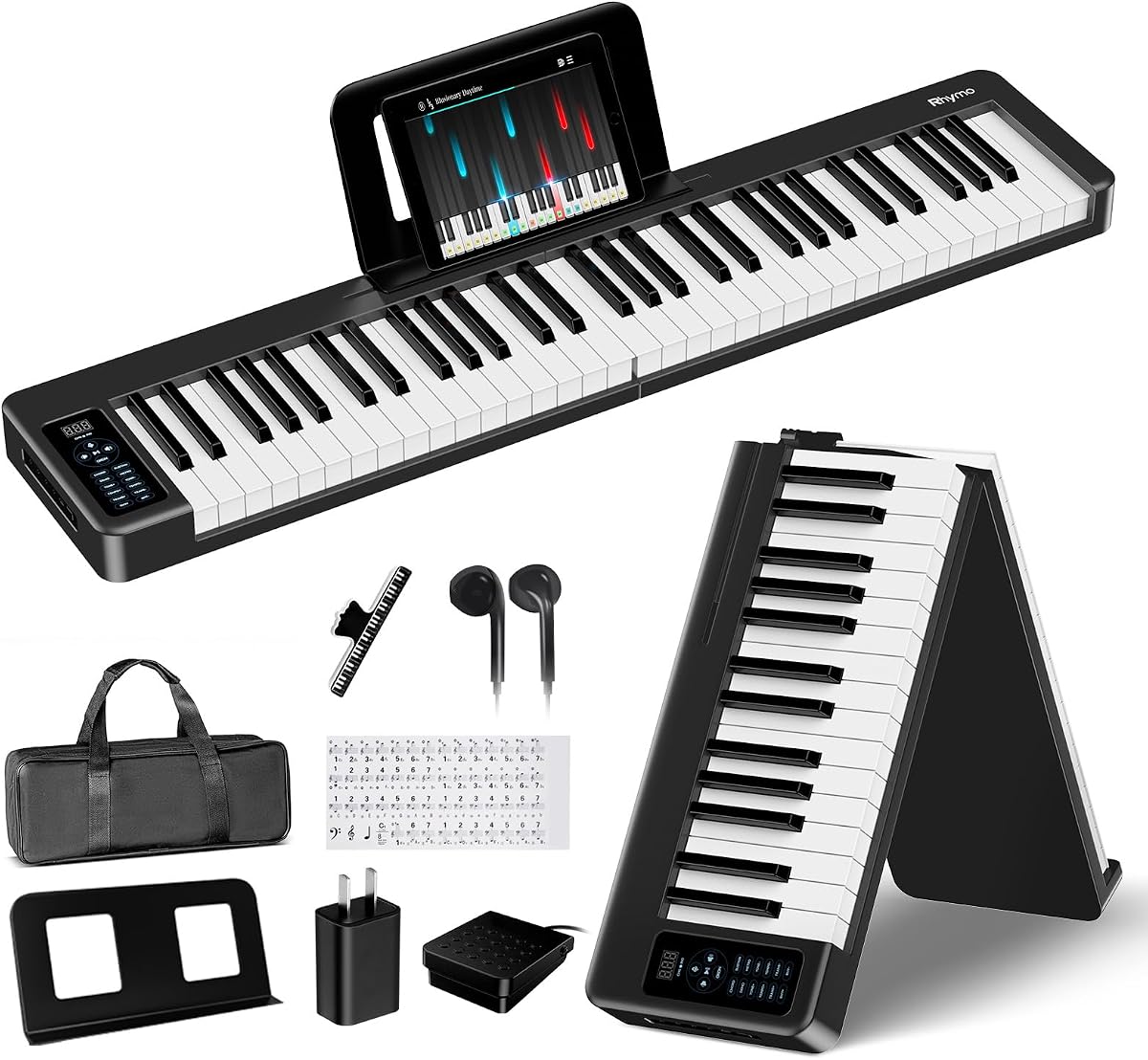
The Rhymo Folding Piano is the most substantial traditional keyboard in this group, with 61 sensitive keys that unfold to standard keyboard dimensions. Its 4.3 rating reflects a balance of useful travel design and instrument-like playing capability. Unlike a typical mini controller, it has its own sound engine, built-in timbres, an LCD, and Bluetooth MIDI, allowing it to serve as both a standalone instrument and a wireless controller.
We may earn a commission when you buy through this link, at no additional cost to you.
The weighted action and 2.2-centimeter key width are important for users who want the visual and physical layout of a full-size piano. The stated sound engine supports 128-note polyphony and 128 built-in timbres, while the display provides feedback for chord progressions, sustain, metronome synchronization, and transposition. These features make it a practical choice for practice, composition, small performances, and travelers who do not want to rely entirely on a computer.
Portability comes from the folding structure, a stated weight of 2.3 kilograms, and an included padded gig bag. The folded dimensions are listed as 45 by 11 by 19 centimeters, which is more substantial than a 25-key controller but still suited to luggage, a guest room, or a rehearsal location. Its stated ten-hour battery life and ability to charge while playing through USB-C make it more suitable for cordless use than many conventional USB controllers.
Pick this model if your travel priority is preserving a large playing surface. It is especially compelling for pianists moving between temporary accommodations, students who need a complete 61-note range, and musicians who want Bluetooth MIDI rather than a permanently tethered setup. Those wanting pads, extensive assignable hardware controls, or an extremely small bag should favor a dedicated MIDI controller instead.
The 61-key arrangement and listed key width offer a more familiar piano layout than mini controllers. The folding action preserves that range while allowing the instrument to occupy a smaller storage footprint when it is not being played.
Bluetooth MIDI and the stated battery endurance make the Rhymo useful for practicing or recording without a cable to a computer. USB-C charging while playing adds flexibility for longer sessions.
We may earn a commission when you buy through this link, at no additional cost to you.
The Akai Professional LPK25 delivers the essential ingredients of a travel MIDI controller without a large collection of specialized hardware. Its 4.7 rating is among the highest in the guide, making it a convincing choice for beginners, writers, and mobile musicians who want an uncomplicated path from unpacking to playing. The body has 25 responsive keys, octave controls, sustain, an arpeggiator, and a clock.
We may earn a commission when you buy through this link, at no additional cost to you.
Its most useful travel feature is straightforward USB operation. Power comes through the USB connection, and the stated plug-and-play compatibility for Mac and PC means there is no need for an external power supply. The product also works with a broad selection of music applications, including GarageBand, Logic Pro, Studio One, Cubase, Ableton Live, Pro Tools, FL Studio, Digital Performer, and Adobe Audition.
Eight programmable preset slots provide a practical way to recall mappings for different software instruments and DAWs. The built-in arpeggiator and clock can accelerate melodic ideas and keep timing-related experiments moving. Compared with more elaborate controllers, however, the LPK25 does not offer a display, performance pads, multiple encoders, or extensive standalone sounds. Its value lies in focused utility rather than feature abundance.
The LPK25 is best for a traveler who wants a dependable first controller or a small addition to a larger setup. It is also suitable for anyone who prefers straightforward operation over deep hardware customization. The limited number of keys makes it best for melodies, bass lines, short phrases, and beat sketches rather than complete two-handed arrangements, but it remains an efficient travel writing tool.
USB power, plug-and-play operation, and broad application support reduce the technical barriers to getting started. The user can spend more time composing and less time troubleshooting connections.
Octave buttons, sustain, a clock, and an arpeggiator cover several common creative tasks. Preset slots add convenience without turning the controller into a dense production console.
We may earn a commission when you buy through this link, at no additional cost to you.
The M-Audio Keystation Mini 32 MK3 offers a middle ground between tiny 25-key controllers and larger instruments. It includes 32 miniature piano-style, velocity-sensitive keys and holds a 4.2 customer rating. The additional range makes it useful for melodies and simple two-hand ideas, while its still-compact proportions remain appropriate for a travel bag, small desk, or shared rehearsal space.
We may earn a commission when you buy through this link, at no additional cost to you.
A major strength is the selectable velocity curve. Players can choose a response suited to traditional piano technique, synthesizer playing, or key-based beat production. Pitch bend and modulation buttons add expression, while octave controls, a volume knob, and sustain provide the controls expected from a basic controller. No separate drivers or external power supply are required for compatible Mac or Windows laptops.
The product includes MPC Beats software and access to interactive Melodics lessons, which is especially helpful for new users. Against those benefits, the controller has no built-in display, drum pads, standalone sound engine, or extensive bank of onboard controls. It is therefore better viewed as a focused writing and learning tool than a complete mobile production station.
The Keystation Mini 32 is a strong choice for a student, beginner, or songwriter who wants more playable range than a 25-key model without carrying a full-size controller. Choose it when education, straightforward MIDI control, and adjustable key response matter more than pad triggering or onboard music. More experienced producers may prefer the deeper feature sets of the Akai or Arturia options.
Selectable velocity curves let the player adapt the keybed to different software instruments and techniques. This makes the controller useful for both melodic playing and rhythm-oriented software control.
The included MPC Beats package gives new users access to production tools, while Melodics offers guided lessons. Together, they can shorten the path from basic setup to an active practice routine.
We may earn a commission when you buy through this link, at no additional cost to you.
This Rhymo Folding Piano shares the core design of the other 61-key folding model, combining a full-size musical layout with a foldable body and wireless capabilities. Its 4.3 rating makes it a solid choice for travelers who need a broad key range and an internal sound engine. The listed 128-note polyphony and 128 built-in timbres provide more internal variety than a conventional MIDI controller.
We may earn a commission when you buy through this link, at no additional cost to you.
Its weighted action and listed 2.2-centimeter key width help it feel and function more like an electric piano. An LCD supplies information about chord progressions, sustain, metronome synchronization, and transposition. Those built-in functions make the keyboard useful even when a computer is unavailable, while Bluetooth MIDI adds a route for sending and receiving MIDI data with compatible electronic devices.
The folding design, 2.3-kilogram listed weight, and padded gig bag support transport, but travelers with strict luggage limits should measure before packing. It is also less naturally suited than an Akai MPK model to finger-drumming, sample triggering, and knob-based sound design. The 61-key instrument prioritizes melodic playing and standalone practice.
Choose this model for wireless practice, temporary home piano use, and performance or recording setups that benefit from a complete key range. It may be especially useful to a musician who wants Bluetooth MIDI and a built-in sound engine but dislikes the layout of mini keys. Dedicated pad controllers and ultra-compact writing tools serve different creative priorities.
The internal sound engine, metronome-related display functions, and transposition support make standalone practice possible. Bluetooth MIDI then adds creative control when a compatible device is present.
The keybed unfolds to a standard 61-note layout while the body folds for storage. It offers a meaningful compromise for users who value range over a controller's minimal footprint.
We may earn a commission when you buy through this link, at no additional cost to you.
The Arturia MiniLab 37 is the most complete general-purpose travel controller in this guide. Its 4.7 rating, 37-key layout, DAW-integrated pads and faders, and real-time display provide a strong combination of range, portability, and control. Twelve additional signature slim keys expand the playing area beyond what a conventional 25-key mini controller can offer.
We may earn a commission when you buy through this link, at no additional cost to you.
Its controls support both writing and performance. The two-by-four pad arrangement is intended for finger drumming and clip launching, while the fader and display provide immediate feedback and control over software. A built-in arpeggiator, chord mode, transposition, and custom DAW mappings reduce the need to browse through software menus when ideas are moving quickly.
The compromise is the slim key style. Although the 37 keys cover more musical territory than compact 25-key models, they do not recreate the feel of a 49-key controller with full-size piano keys. The device also has fewer broad performance features than the MPK Mini IV, such as a smaller set of dedicated knobs and no listed pressure-sensitive pad specification. Custom mappings and DAW control take time to learn.
This is the best overall pick for someone who wants one travel controller capable of melodic writing, beat triggering, software navigation, and compact live performance. It fits programmers, producers, and content creators who want more range than a mini keyboard without the footprint of a full-size instrument. It is especially attractive for users who value pads and a display equally with the keyboard.
The arpeggiator, chord mode, transposition, and customizable mappings shorten common steps in a songwriting session. These features encourage quick musical experiments without requiring extensive mouse navigation.
The stacked pad layout supports both finger drumming and clip launching. Its reduced hand movement is particularly useful when working in a confined hotel or rehearsal environment.
We may earn a commission when you buy through this link, at no additional cost to you.
The Akai Professional MPK Mini MK3 remains a compelling portable beat-making controller because it combines 25 velocity-sensitive keys with eight backlit MPC-style pads. Its 4.6 rating indicates strong user reception, particularly among producers who want a hardware surface for drums, samples, and virtual instruments. The layout is compact, but the available controls extend well beyond basic note entry.
We may earn a commission when you buy through this link, at no additional cost to you.
A four-way thumbstick supplies dynamic pitch and modulation control, while the arpeggiator offers adjustable resolution, range, and modes. The eight 360-degree knobs can be assigned to plugins for mixing and sound design. Note Repeat and Full Level pad functions add familiar MPC-style workflow tools, and Native Kontrol Standard integration allows access to supported Native Instruments presets and sound libraries.
The package includes MPC Beats, three virtual instruments, and two gigabytes of sound content, along with two months of Splice access. That is a broad creative ecosystem, although some benefits require registration and redemption. The lack of a display makes navigation less visual than on the MPK Mini IV or MiniLab 37, and the 25-key range remains better for patterns and short melodies than extended arrangements.
This model is best for a beat maker who prioritizes drum-pad response, sample triggering, and knob-based parameter changes. It remains useful for songwriting, but its pad-centric design makes it especially attractive to producers who build rhythms in software. Travelers should assess the included software and ensure the controller matches the DAW and virtual instruments they already use.
The eight backlit pads, Note Repeat, and Full Level functions support a familiar finger-drumming workflow. They are useful for launching clips, triggering samples, and performing programmed patterns.
MPC Beats, virtual instruments, and substantial sound content provide a substantial starting point. NKS integration and the Splice inclusion can broaden the available palette further.
We may earn a commission when you buy through this link, at no additional cost to you.
The M-Audio Keystation 49 MK3 is ideal for travelers who need a familiar piano layout but do not want a full 61-key instrument. Its 49 full-size, velocity-sensitive keys offer enough range for extended melodies and two-handed work, while the 4.6 rating reflects a generally favorable response. It is less compact than the 25- and 37-key models, yet considerably more accommodating to players who dislike mini keys.
We may earn a commission when you buy through this link, at no additional cost to you.
The controller includes a volume fader, transport and directional buttons, octave controls, sustain pedal input, and dedicated pitch and modulation wheels. These physical controls make it well suited to software instruments and DAW navigation. It connects by USB to Mac or PC without requiring drivers or an external power supply, and the listed compatibility includes iOS through a separately sold Apple to USB Camera Adapter.
The software package includes MPC Beats, Ableton Live Lite, Velvet, XPand2, Mini Grand, and Touch Loops. Online Skoove lessons and more than 60 app-based Melodics lessons add educational value. On the downside, there is no onboard sound engine, so the keyboard requires a connected device for sound. There is also no display, which can make some software navigation less immediate.
Choose the Keystation 49 when full-size keys are the deciding factor and your travel setup can accommodate its larger body. It is particularly appropriate for pianists, composers, and performers who want wheel-based expression and a broad musical range. If maximum packability, battery operation, or standalone playing is the priority, consider a smaller controller or the Rhymo folding piano.
The 49 full-size keys preserve the spacing and response geometry associated with larger keyboards. That makes the model more approachable for pianists and for writing parts that require two hands.
Pitch and modulation wheels, sustain input, and a volume fader provide familiar expression and mixing controls. Transport buttons also help a musician operate recording software without relying entirely on a mouse.
We may earn a commission when you buy through this link, at no additional cost to you.
The Akai MPK Mini Play MK3 stands apart from conventional controllers by including a built-in speaker and more than 100 internal drum and instrument sounds. Its 4.5 rating indicates a positive balance of standalone capability and portability. For someone traveling without a dependable computer, it can provide melodies, rhythms, and sound demonstrations directly from the hardware.
We may earn a commission when you buy through this link, at no additional cost to you.
The 25-key Gen 2 dynamic keybed sits alongside an OLED display, eight velocity-sensitive backlit MPC pads, four encoder knobs, an arpeggiator, and note repeat. Internal sounds include acoustic and electric pianos, synth leads, pads, and drums. This combination is particularly engaging for spontaneous writing, teaching, rehearsing ideas, or creating a quick demonstration where portability is more important than a large key count.
Power can come from batteries or a USB mains connection through the included cable, although batteries are not included. The standalone sounds and speaker make this more versatile away from a desk than a basic controller, but the dynamic mini keys still limit sustained repertoire. The OLED is small, and four knobs provide less extensive direct control than the eight-knob Akai controllers.
This is the best fit for a traveler who wants music to work without a computer. It suits songwriters who catch ideas in hotels, teachers demonstrating concepts, and performers carrying a compact instrument to a jam. Users focused on conventional DAW control may prefer the LPK25, while those wanting more pads and assignable controls should consider the larger Akai MPK models.
The internal sound library and integrated speaker allow the keyboard to produce music by itself. This removes the computer from the equation during practice, demonstrations, or spontaneous writing sessions.
The OLED, four encoders, backlit pads, and note repeat provide more performance options than a basic keyboard. Battery operation adds freedom, though travelers need to supply their own batteries.
We may earn a commission when you buy through this link, at no additional cost to you.
The Akai MPK Mini Plus is the most hardware-oriented controller in the guide, combining a 37-key dynamic keybed with MIDI input and output, CV/Gate, eight RGB MPC-style pads, eight assignable knobs, and a 64-step sequencer. Its 4.5 rating makes it an attractive option for producers who want to work with modular systems, external sound modules, synths, or a DAW from one compact surface.
We may earn a commission when you buy through this link, at no additional cost to you.
The sequencer includes separate tracks for drums and melodic material or chords, with up to eight notes per track, and allows recording and composition without a computer. A dedicated transport section helps with recording and playback navigation. The keyboard also includes chord and scale modes, making it useful for sketching ideas and presenting them more clearly to a collaborator.
Its many options create a steeper learning curve. The mini keys, endless knobs, transport controls, pads, sequencer, and multiple connection standards demand deliberate setup, particularly in a temporary travel environment. It also has no listed onboard speaker or large internal sound library, so it remains primarily a controller rather than a self-contained sounding instrument.
Choose the MPK Mini Plus when modular connectivity and a hardware sequencer are central to your creative process and luggage space is limited. It can serve as a compact centerpiece for a mobile rig, allowing external instruments and production software to be controlled without changing devices. For simpler travel writing, the LPK25 or MiniLab 37 is easier to manage.
The built-in 64-step sequencer supports separate drum and melodic or chord tracks. It can capture musical ideas independently of a computer and function as a practical sketching tool on the road.
CV/Gate and MIDI input and output expand the controller beyond conventional DAW use. Those connections allow compatible synths, modules, and production equipment to be incorporated into a mobile setup.
We may earn a commission when you buy through this link, at no additional cost to you.
Travel suitability depends on more than the number of keys. Consider the complete journey: how the instrument is carried, powered, connected, played in temporary spaces, and integrated with the software or hardware already in your creative setup.
Key count determines the musical range available without octave shifting, while key size affects comfort, technique, and the kinds of repertoire you can realistically play. A 25-key controller is exceptionally easy to carry and works well for riffs, bass lines, short melodies, and software-instrument control. A 32- or 37-key model gives more room for complete ideas, especially if the instrument includes performance pads or hardware sequencing. The 49-key M-Audio model uses full-size keys, which will feel more familiar to pianists but requires a larger bag. The 61-key Rhymo offers the broadest conventional piano range, yet its unfolded body is still larger than a slim controller.
The advertised dimensions are only part of the travel equation. A keyboard with a narrow profile, shallow depth, and modest weight can still become awkward if it requires a rigid case. The folding Rhymo models address this through a 45-centimeter folded length and included padded bag, while the mini controllers fit more easily into backpacks and standard instrument cases. A larger 49-key controller may need a dedicated gig bag and more room at a hotel or rehearsal venue. Before buying, compare the complete product with the size of your luggage, desk, and available storage.
USB-powered controllers are simple to use at a desk because a compatible computer supplies power, but their travel flexibility depends on the available port and battery situation. The Rhymo folding piano offers a stated ten-hour battery life, Bluetooth operation, and charging while playing through USB-C. The MPK Mini Play can also operate from batteries, although batteries are not included, and can use USB mains power. Users of standard USB controllers should allow for a laptop, power bank, or compatible USB power source, and should check whether their travel setup supports the required connection.
Travel music production often means using a laptop, tablet, phone, or an unfamiliar rehearsal computer. Plug-and-play operation for Mac and Windows is common among the smaller controllers, while the MPK Mini IV adds USB-C and a full-size MIDI output, and the MPK Mini Plus includes MIDI input and output plus CV/Gate. The Rhymo adds Bluetooth MIDI for wireless work with compatible devices. Connection type alone does not guarantee compatibility, so verify the ports and adapters used by the intended computer, mobile device, software, and external hardware before departure.
Pads can make a compact keyboard much more useful for beat makers, clip launching, sample triggering, and finger drumming. Rotary knobs or encoders allow hands-on adjustment of virtual instruments, effects, and mix parameters. A display helps users navigate software and understand the current control assignment, while an arpeggiator can generate patterns quickly. The LPK25 and Keystation Mini 32 favor simplicity, whereas the MPK Mini IV, MK3, MiniLab 37, and MPK Mini Plus provide deeper hardware control. Select features based on how you create rather than on the number of buttons alone.
A controller becomes a self-contained instrument when it includes internal sounds and a way to monitor them. The MPK Mini Play has a built-in speaker, more than 100 internal sounds, and can run on batteries, making it especially practical when no computer is available. The Rhymo offers 128 built-in timbres, Bluetooth MIDI, and its own sound engine, giving it similar standalone value alongside a full-size keybed. Standard controllers generally require connected software and separate monitoring, which may be fine for a producer but unsuitable for spontaneous practice in an unfamiliar room.
The difference between a bare controller and a complete creative package can be substantial for a new user. Included offerings across this guide include MPC Beats, Ableton Live Lite, virtual instruments, Melodics lessons, Skoove instruction, Native Instruments integration, and access to Splice. These resources can provide ready-made sounds and guided learning, but users should check download requirements, registration, redemption periods, operating-system compatibility, and whether included content is a trial, bundle, or permanent entitlement.
Portable instruments are repeatedly packed, carried, placed on tables, and exposed to changes in temperature and humidity. The MPK Mini IV is described as lightweight and durable, while the folding Rhymo includes a padded gig bag. Regardless of those stated qualities, use a protective case, avoid leaving a device in a vehicle or an unheated storage area, and clean the surface gently. Check the power and connection hardware before every trip, and keep spare cables or the correct adapter accessible when the destination does not offer the connection you expect.
Begin with a simple connection test before leaving home. Update the chosen computer or mobile device, install the required music software, connect the keyboard by its recommended cable or wireless method, and confirm that the application recognizes incoming notes and controller messages. Learn the octave, sustain, velocity, and any pad or knob assignments before relying on them during a rehearsal or recording. This prevents a portable setup from becoming frustrating when there is limited time to troubleshoot.
Create a compact template for common travel situations. In a DAW, prepare a basic project with a software instrument, a drum source, a recording track, and the controller mappings used most often. Save presets for different sounds or applications on controllers that support them, and label the files clearly. For the folding piano and standalone models, test the internal sounds, metronome, transposition, Bluetooth pairing, and battery level before departing.
Transport and maintain the instrument with care. Use a padded case or a suitable rigid case, keep the keybed and controls free of debris, and do not place heavy objects on the keyboard. Follow the manufacturer's charging and battery guidance, especially for the model supplied without batteries. When cleaning, use a soft, lightly dampened cloth rather than abrasive cleaners, and allow every surface to dry before packing the unit away.
The most portable option depends on how much playing range you need. The Akai LPK25 is exceptionally compact with 25 mini keys, while the MPK Mini IV adds more controls in a similarly small format. A traveler who prefers a complete 61-note layout may find the folding Rhymo more practical despite its larger folded dimensions. Consider weight, case size, and playing style together.
Only models with their own sound engine can produce sound without an external computer. The MPK Mini Play includes a built-in speaker and more than 100 internal sounds, while the Rhymo folding piano provides 128 built-in timbres and can also operate wirelessly. Most other options in this guide are controllers and require compatible software, a sound module, or another sound source.
Mini keys can be useful for learning basic notes, scales, and software-instrument control because they are portable and affordable. They are less suitable for developing traditional piano technique or playing demanding repertoire because their shorter size and spacing differ from a full-size keyboard. A traveler taking lessons should ask the teacher whether the keybed will meet their practice needs.
Bluetooth MIDI can remove cable clutter and makes standalone practice more convenient, but compatibility and latency should be checked in advance. Confirm that the destination computer, tablet, or phone supports the relevant Bluetooth MIDI behavior and that the keyboard is compatible with it. For critical recording sessions, carry a tested USB connection as a dependable alternative.
A 25-key controller is easiest to carry and adequate for riffs, bass lines, short melodies, and many pad-based workflows. A 37-key controller offers a more useful melodic range and is often better for complete phrases and two-handed composition. The LPK25 and MPK Mini IV emphasize compactness, while the MiniLab 37 and MPK Mini Plus add more keys and broader control features.
Prioritize the packed size, connection method, power requirements, key feel, and compatibility with your usual software. Pads matter for beat makers, knobs and displays help with sound shaping, and onboard sounds are valuable if you will practice without a computer. Also verify included software terms, accessories, and whether the supplied carrying case fits your luggage.
Some models explicitly support mobile setups, including the MPK Mini IV, while others require the appropriate adapter and compatible mobile audio or MIDI software. A 25-key controller is particularly convenient for limited screen space, but a 37- or 49-key model can still be practical. Test the complete connection before traveling because operating-system and application support can vary.
Test every connection, update the computer and music software, save essential controller presets, and confirm that the required cables and adapters are packed. For wireless models, verify pairing and bring a wired backup if the session is important. Charge the device fully, protect it in a suitable case, and keep spare batteries available for models that use them.
The Arturia MiniLab 37 is the strongest all-around travel controller, balancing 37 keys with pads, a display, faders, and creative modes. The Akai LPK25 is the most straightforward budget pick, offering essential note control, octave shifting, an arpeggiator, and simple USB operation. For a premium feature set, the MPK Mini IV stands out with its screen, encoders, RGB pads, extensive software, and broad connectivity.
Travel priorities should determine the winner. Choose the Rhymo when a 61-note range, internal sounds, Bluetooth MIDI, and battery operation matter most. Select the MPK Mini Play for standalone playing, the M-Audio Keystation 49 for full-size keys, and the MPK Mini Plus for modular control and hardware sequencing. The mini Akai models remain well suited to beat makers who want pads in a small package.
Before ordering, verify the current specifications, computer compatibility, included accessories, and software redemption terms with the retailer. Product features and customer feedback evolve, and prices can change, so a careful final check is essential. Whichever model you choose, test it with your actual travel setup before the trip and carry the connection method you know will work.