
Spektrum A6380 High Torque Servo
4.6Editor score
High-voltage 8.4-volt operation
Strong 11.5 kg-cm torque
Metal gears and dual bearings
Discover the best servos for RC planes with expert comparisons of torque, speed, voltage, gearing, size, and installation features for every model.
Servos for RC planes must balance enough torque to move a control surface with low weight, quick response, and dependable centering. The right choice depends on aircraft size, control layout, receiver voltage, and the loads placed on the ailerons, elevator, rudder, and flaps.
This guide compares ten micro, standard, and high-voltage digital servos using the specifications available for each product. It covers torque, operating speed, voltage, gear construction, rotation range, dimensions, wiring, and the project types each servo is designed to support.
The selections show the range of available options, from lightweight 9g units for small planes to higher-capacity servos for larger sport aircraft. Each review explains the practical advantages, limitations, and ideal use case, while current prices and availability should be checked before purchase.
4.6Editor score

4.6Editor score

4.5Editor score
The table below places all ten servos side by side, highlighting the differences that matter most when matching a servo to an RC plane's weight, voltage system, and control demands.




The Miuzei MG90S is a compact digital micro servo developed for small RC aircraft, drones, robots, and other lightweight mechanisms. It carries a 4.5 rating and stands out for combining a 2.0 kg-cm stall torque with a fast stated speed of 0.08 seconds per 60 degrees at 6.0V. That combination makes it more capable than the lightest general-purpose micro servos without moving into the weight class of a standard aircraft unit.
We may earn a commission when you buy through this link, at no additional cost to you.
The aluminum metal teeth are the defining mechanical upgrade. Compared with an all-plastic gear train, a metal gear is better suited to repeated movement, sudden load changes, and the shock produced by a landing or an abrupt control input. The coreless motor supports fast, relatively quiet operation, while the 180-degree travel provides useful positioning freedom for elevator, rudder, aileron, and small control mechanisms.
Its primary limitation is electrical rather than mechanical. The operating range is 4.8–6.0V, and the manufacturer specifically recommends a stable 5V supply for smooth, reliable performance. A multi-servo installation should use a separate power source with enough current to prevent voltage drops. Trying to power several high-moving servos directly from a receiver or a weak source can cause hesitation, resets, or erratic control behavior.
This is a strong general recommendation for small and medium lightweight planes that need more torque than a basic plastic-gear SG90. The two-unit pack suits a two- or three-control-surface model, while builders needing a complete installation can purchase another set. It is also a useful option for a robot arm, boat, crawler, or quadcopter mechanism that fits within the stated electrical and mechanical limits.
The 2.0 kg-cm stall rating gives the MG90S a useful margin for small control surfaces. That makes it more appropriate for aircraft with moderately large hinges or somewhat heavier linkages than the minimum-weight plastic servo options.
Aluminum gear teeth improve resistance to wear and tooth damage. They are particularly helpful on planes that experience repeated corrections, hard landings, or fluctuating aerodynamic loads.
We may earn a commission when you buy through this link, at no additional cost to you.
This ten-piece Smraza SG90 kit is a practical choice for a complete RC plane installation because it provides enough servos to cover multiple control surfaces, additional aircraft, or several small projects at once. The 4.4 rating reflects a well-established package centered on the familiar 9g SG90 format, with an upgraded metal pinion gear and shaft for better resistance to breakage and heat deformation.
We may earn a commission when you buy through this link, at no additional cost to you.
The listed operating performance is 0.08 seconds per 60 degrees and 1.9 kg-cm of stall torque over a 180-degree range. Its improved 5-microsecond deadband supports a more precise response than a servo with a wider dead zone, which can be valuable when maintaining consistent surface position. The kit also includes servo arms and 24.5 mm leads, giving builders the basic hardware needed for compact installations.
Electrical planning is essential. The servo requires a continuous PWM signal and a supply capable of more than 1A of starting current. A ten-servo model may create a substantial simultaneous load, so the receiver, battery, and power source should be matched to the installation. The 4.8–6.0V operating range is common for small aircraft, but it does not provide the high-voltage flexibility offered by the larger standard servos in this guide.
For a builder equipping a fixed-wing model, glider, or compact KT plane with several channels, this kit offers a convenient way to standardize the hardware. It is also attractive for STEM projects because ten matching servos simplify programming and replacement. The trade-off is that a large installation needs careful wiring and a capable supply, and a plane with large surfaces may eventually need a higher-torque standard servo.
Ten matching units simplify installation across ailerons, elevators, rudder, flaps, and other channels. Spare units also reduce delays when one servo needs replacement or adjustment.
The metal pinion gear and shaft address a familiar weakness of inexpensive plastic micro servos. They are a sensible improvement for aircraft that place changing loads on the control linkage.
We may earn a commission when you buy through this link, at no additional cost to you.
The four-piece SG90 package earns a 4.6 rating and offers one of the strongest combinations of speed, precision, and compactness in the list. Each 9g digital servo has a 1.9 kg-cm stall torque, a stated operating speed of 0.08 seconds per 60 degrees, and a 180-degree range across a 4.8–6.0V supply.
We may earn a commission when you buy through this link, at no additional cost to you.
Its most notable feature is the 5-microsecond deadband, described as 40 percent tighter than the 7-microsecond range of a standard servo. In practical terms, the tighter dead zone can reduce the amount of receiver signal required before the output begins moving, supporting steadier positioning and more consistent corrections. The listed noise level below 40 dB also makes the servos appealing for classroom robotics and quiet indoor flying.
Durability comes from the metal pinion gear and shaft, which are designed to resist tooth breakage and bending under sudden torque. The package includes four servo arms and 24.5 mm leads. Its standard three-pin PWM connection works with Arduino and Raspberry Pi systems and is familiar enough to fit many entry-level aircraft projects without requiring a specialized interface.
The main constraint is physical capacity. A 1.9 kg-cm micro servo is best suited to small control surfaces and light linkages rather than large flaps, heavy elevator surfaces, or high-load mechanisms. The four-unit count also makes it a less comprehensive kit than the ten- or twenty-piece Smraza bundles. Even so, it is a balanced choice for a four-channel small plane or a compact experimental aircraft where low weight, precise response, and quiet operation matter most.
A 5-microsecond deadband helps the output react consistently to receiver commands. This can be especially noticeable in small aircraft where the servo must make frequent, modest corrections.
The stated operation below 40 dB suits indoor flight, classroom demonstrations, and robotics projects. Low acoustic output can make repeated testing and learning activities less distracting.
We may earn a commission when you buy through this link, at no additional cost to you.
The Hosyond MG90S five-pack provides a balanced set of micro servos for small fixed-wing aircraft, helicopters, boats, robot cars, and mechanical-arm experiments. Its 4.3 rating places it behind the strongest-rated selections, but the package offers useful construction details: each servo weighs 13.5 grams, measures 22.8 by 12.2 by 28.5 millimeters, and includes a 26 cm lead.
We may earn a commission when you buy through this link, at no additional cost to you.
The all-metal gearing is intended to improve durability and rotational accuracy. Speed is specified at 0.1 second per 60 degrees at 4.8V and 0.08 second at 6.0V, with approximately 90 degrees of travel in each direction. Those figures make the servos appropriate for small aircraft that need responsive control surfaces without the physical bulk of a standard servo.
One point requiring careful attention is the absence of a listed stall-torque value. Although the 9g format and dimensions suggest a micro servo, torque should be checked against the aircraft's control surface size, hinge friction, and linkage geometry. A 90-degree movement in each direction also provides broad positioning, but actual usable travel may be limited by the aircraft's linkage stops and receiver settings.
This set is a sensible choice for a five-control installation or a builder who wants a common replacement stock. It supports Arduino and common RC toy applications, while the supplied arms and fixing screws simplify assembly. It is less attractive for a plane with large, heavily loaded surfaces because the product data does not establish a precise torque rating, and for those projects a servo with published torque and voltage figures may be easier to size confidently.
Five servos cover several common aircraft channels while leaving room for an additional mechanism. Matching units also simplify troubleshooting and future replacement.
The 13.5g size and all-metal gears balance low weight with stronger mechanical construction. This combination suits small airframes where every gram matters.
We may earn a commission when you buy through this link, at no additional cost to you.
The six-piece Smraza SG90 package is a balanced middle ground for an RC plane that needs several channels without carrying a much larger multi-pack. It shares the Smraza design's 1.9 kg-cm stall torque, 0.08-second speed at 6.0V, 180-degree travel, and improved 5-microsecond deadband, earning a 4.4 rating.
We may earn a commission when you buy through this link, at no additional cost to you.
The upgraded metal pinion gear and shaft help the units resist tooth breakage and heat deformation compared with plastic-gear micro servos. That makes the set suitable for fixed-wing and KT planes, gliders, small boats, micro robots, and compact mechanisms. The included arms and 24.5 mm leads make the package ready for common 3-pin installations using standard PWM control signals.
As with the other Smraza SG90 kits, the electrical requirement is significant. A supply must handle more than 1A of starting current, and the system needs a continuous PWM signal. When several servos move simultaneously, using an appropriate receiver or external regulator is important. A power source that collapses under load can create visible twitching even though the individual servos are mechanically capable.
This six-unit configuration is a good fit for a plane with four primary channels plus a secondary control or accessory. It gives the builder a small matching spares allowance and is more convenient than purchasing unrelated units individually. Its limitation is the familiar micro-servo capacity: large flaps, large elevator surfaces, or linkages with substantial friction should be checked against the 1.9 kg-cm rating or assigned to a higher-torque servo.
The pack works well for typical multi-control aircraft while maintaining the small size of a 9g servo. It is easier to wire and organize than a mixed collection of unrelated servo types.
The stated 5-microsecond deadband supports consistent movement around the commanded position. That can improve the feel of small aircraft where minor corrections are frequent.
We may earn a commission when you buy through this link, at no additional cost to you.
This eight-piece SG90 set is the lightest and most basic construction in the guide, built around 9g digital servos with plastic gears. It has a 3.7 rating, lower than the ratings assigned to the other products, and that distinction is important. The servos are intended for small aircraft, gliders, KT models, small boats, robots, and other compact mechanisms rather than demanding control surfaces.
We may earn a commission when you buy through this link, at no additional cost to you.
Performance remains responsive for its size. The listed no-load speed is 0.09 seconds per 60 degrees at 4.8V and 0.08 seconds at 6.0V. A 7-microsecond deadband reduces signal lag and jitter relative to a wider-band setup, while full 180-degree travel gives the linkage broad adjustment potential. Compatibility includes JR and Futaba radio control interfaces along with Arduino and Raspberry Pi projects.
The main limitation is the 1.0 kg-cm stall torque, the lowest figure among the selections. This is enough for light, small surfaces, but it leaves less margin for hinge friction, larger control surfaces, or rough operating conditions. The plastic gear train also lacks the tooth strength offered by the metal-gear alternatives. Builders should therefore avoid selecting this set by speed alone and consider the actual load at each hinge.
The package is useful when eight inexpensive micro servos are needed for training, classroom models, or a project with many small mechanisms. A larger installation should use a supply that can provide the stated greater-than-1A starting current, and the servos must receive a continuous control signal. For a lightweight model with modest control loads, the set can work well, but a metal-gear option provides a more convincing margin for regular flying.
The 9g format is suitable for trainers, gliders, and compact aircraft where minimizing mass is essential. It also allows several servos to be installed without adding substantial weight.
The 0.08-second speed is attractive, but the 1.0 kg-cm torque rating limits the loads it can handle. Small, lightly linked control surfaces are the most appropriate application.
We may earn a commission when you buy through this link, at no additional cost to you.
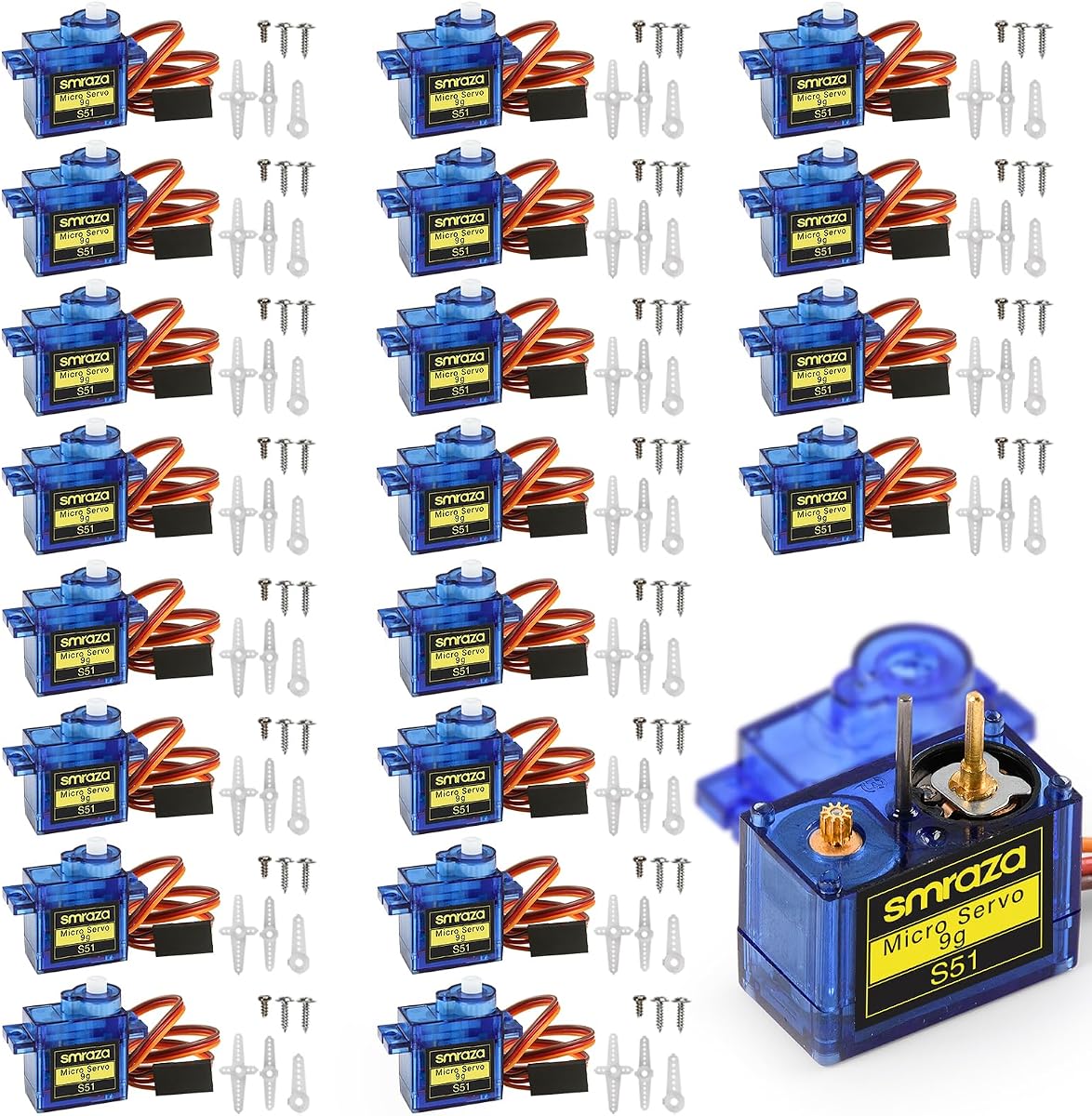
The twenty-piece Smraza SG90 bundle is intended for builders who regularly construct aircraft, run educational programs, or need a substantial stock of matching micro servos. Its 4.4 rating aligns with the other Smraza sets, and it preserves the familiar 1.9 kg-cm torque, 0.08-second operating speed, 180-degree range, and 5-microsecond deadband.
We may earn a commission when you buy through this link, at no additional cost to you.
Every unit uses an upgraded metal pinion gear and shaft, making the package mechanically stronger than an all-plastic SG90 set. The standard 3-pin PWM configuration is compatible with JR and Futaba receivers, Arduino, and Raspberry Pi systems. Servo arms and 24.5 mm leads are included, which helps maintain a consistent installation across a fleet of small aircraft.
Twenty servos create the most substantial electrical challenge in the micro-servo category. The product requires more than 1A of starting current for the servo itself, and a model that moves many units at once may demand a substantially more capable supply. Power routing should use an appropriately rated receiver or regulator, and the installation should be checked for voltage drop rather than relying on a single weak output.
For a small plane with only three or four control channels, this is more than necessary, but it offers attractive flexibility for training fleets, multiple airframes, robotics classrooms, and projects involving ailerons, elevators, rudder, flaps, and secondary mechanisms. Its 1.9 kg-cm torque still makes it best for small and light control surfaces. Larger aircraft or heavily loaded surfaces are better served by the MG995 or Spektrum options.
Matching servos simplify maintenance and allow identical control behavior across multiple aircraft. Twenty units are particularly useful for schools, clubs, and frequent builders.
The quantity of servos makes receiver and battery capability especially important. A robust dedicated supply reduces the chance of a low-voltage event when several outputs move together.
We may earn a commission when you buy through this link, at no additional cost to you.
The MG995 four-pack is the standard-size high-torque option in this guide, intended for aircraft and mechanisms that need substantially more force than a 9g micro servo. Its 3.8 rating is modest compared with the leading products, but the specifications identify a very different class of hardware: 9.4 kg-cm stall torque at 4.8V, rising to 12–13 kg-cm at 6.0V.
We may earn a commission when you buy through this link, at no additional cost to you.
The mechanical design includes an all-metal gear train, a double coreless motor, ball-bearing construction, and a shockproof structure. No-load speed is listed at 0.17 seconds per 60 degrees at 4.8V and 0.13 seconds at 6.0V. Those speeds are not as quick as the micro servos, but the much higher torque makes the unit better suited to large elevator surfaces, big rudders, heavy flaps, or demanding ground mechanisms.
Its 4.8–7.2V operating range provides more flexibility than the 4.8–6.0V micro options. However, the product recommends an external adapter with sufficient current, such as a 5–6V source rated at 1–2A. Even one MG995 can place a meaningful load on a small receiver's power rail, and the current demand should be considered carefully when several are installed.
This set is a good candidate for a larger sport plane or a high-load RC mechanism where micro servos would be underpowered. The 300 mm connector wire also gives builders room to route cables neatly. The trade-off is weight and installation space compared with the 9g products, along with the lower user rating. It is best chosen for torque requirements rather than minimum aircraft weight.
The 9.4–13 kg-cm range creates a substantial operating margin. It is much more appropriate for large surfaces and linkages that would overload a micro servo.
An all-metal gear train, double motor, and ball-bearing output support durability under heavy loads. The construction is also useful for vibration-heavy ground vehicles and robots.
We may earn a commission when you buy through this link, at no additional cost to you.
The Spektrum A6380 is the most purpose-specific aircraft servo in the guide, with a 4.6 rating and a high-voltage design aimed at RC sport planes. Unlike general-purpose micro units, it is marketed around aircraft use, combining a digital construction, durable metal gears, dual-bearing output support, and smooth coreless motor operation.
We may earn a commission when you buy through this link, at no additional cost to you.
Its voltage range is 6.0–8.4V, making it suitable for a 2S LiPo-powered system when the rest of the receiver and control equipment supports the same range. At 6.0V, the listed speed is 0.17 seconds per 60 degrees and stall torque is 102 oz-in, equivalent to 7.3 kg-cm. At 8.4V, speed improves to 0.13 seconds and torque rises to 160 oz-in, or 11.5 kg-cm.
This combination of increased torque and faster response at higher voltage is particularly useful for sport aircraft that need crisp corrections, reliable centering, and enough force for moderately large control surfaces. The digital servo should provide consistent behavior under changing loads, while the coreless motor and dual-bearing arrangement contribute to smooth movement and reduced wear.
The tradeoff is compatibility. A pilot with a standard 4.8–6.0V system cannot exploit the full 8.4V capability, and a 6V receiver may not be appropriate for this high-voltage unit. Its standard form also adds weight compared with a micro servo. Within a compatible high-voltage aircraft setup, however, the A6380 offers the most specialized and persuasive balance of torque, speed, and aircraft-focused construction.
The A6380 is designed specifically for RC aircraft rather than general electronics projects. That focus is reflected in its high-voltage operation, metal gearing, and strong torque figures.
At 8.4V, the servo reaches 11.5 kg-cm torque and a 0.13-second speed. These upgraded figures make it suitable for aircraft seeking firm, responsive control authority.
We may earn a commission when you buy through this link, at no additional cost to you.
The four-piece MG90S set combines a 2.0 kg-cm micro servo with refined centering and low-noise operation. It carries a 4.3 rating and positions itself as a durable, drop-in-style option for small RC planes, Arduino projects, and RC cars. At 6.0V, the listed speed is 0.08 seconds per 60 degrees; at 4.8V, the output is listed at 1.8 kg-cm and 0.11 seconds.
We may earn a commission when you buy through this link, at no additional cost to you.
The ±5-microsecond deadband is designed to minimize drift around the commanded position. That characteristic is particularly useful for aircraft control surfaces because the servo should hold its neutral or trimmed position without repeatedly wandering. The digital motor is also stated to operate quietly below 40 dB, making the units suitable for indoor flight, classroom use, and projects where motor noise could interfere with demonstrations.
Mechanically, the copper-aluminum metal gears are specified to resist wear, and the listed backlash is no more than 3 degrees. Dual bearings support the output shaft and help produce smooth movement under load. A three-pin PWM connection is compatible with Futaba-style equipment as well as Arduino and Raspberry Pi systems, and the 250 mm cable provides useful installation length.
Four servos provide a straightforward package for a small four-channel plane, while the 180-degree rotation offers broad trim range. The limitation is electrical and mechanical scale: the 4.8–6.0V range and micro dimensions are not appropriate for high-voltage systems or large control surfaces. Within the lightweight aircraft category, this set offers a convincing blend of torque, centering accuracy, low noise, and durable gearing.
The ±5-microsecond deadband is designed to minimize drift around neutral. It helps maintain a consistent surface position between or during control inputs.
Operation below 40 dB can make the servo easier to use around other people. It is particularly suitable for indoor aircraft and instructional robotics environments.
We may earn a commission when you buy through this link, at no additional cost to you.
Choosing an RC plane servo requires matching physical capacity and electrical requirements to the aircraft. Weight, torque, speed, gearing, voltage, connector type, and control-system compatibility should be considered together rather than in isolation.
Every servo adds mass near the center of gravity, where it can affect balance and control response. A 9g micro servo is generally appropriate for small trainers, gliders, micro aircraft, and small control surfaces, while a standard servo may be necessary as the aircraft grows or if the builder prefers a stronger mechanical margin. A useful method is to list every installed component and check the completed weight against the aircraft's design target. Servo placement also matters because excessive mass far from the center can make an otherwise light model feel unstable.
Torque determines the load a servo can move before stalling. A 1.0 kg-cm micro servo is best for very small, lightly linked surfaces, while 1.9–2.0 kg-cm units provide more margin for ordinary small-aircraft linkages. Large flaps, broad elevators, high-friction hinges, and long control rods may require a standard servo with much higher torque. Stall torque is a maximum rather than a recommended continuous operating point, so a servo should normally operate well below that limit. Aircraft geometry, hinge friction, balance, and aerodynamic pressure all influence the real demand.
Operating speed is stated as the time required to rotate through 60 degrees, usually without load. A faster servo can make rapid corrections and may feel more immediate, but speed alone does not guarantee better flight control. A servo that is too fast for a light aircraft can create nervous behavior, while one that is too slow may feel sluggish during aggressive maneuvers. Compare speed at the same voltage, because figures at 4.8V, 6.0V, and 8.4V are not directly equivalent. Torque, centering, gearing, and the aircraft's control setup are equally important.
Voltage compatibility starts with the receiver and battery system. Most 9g micro servos in this guide operate from 4.8–6.0V, while the MG995 supports 4.8–7.2V and the Spektrum A6380 requires 6.0–8.4V. A high-voltage servo should only be installed when the receiver, battery, wiring, and other control components are designed for that voltage. A nominal 2-cell LiPo system commonly reaches 8.4V when fully charged, so its peak voltage must be considered. Mixing incompatible servos can damage electronics or cause unreliable operation.
Metal gear sets offer better resistance to tooth wear, impact, and heat deformation than plastic gears. This matters in aircraft because landings, turbulence, and abrupt corrections can place shock loads on the output. The MG90S and upgraded SG90 options use metal gearing, while the basic eight-piece SG90 set uses plastic gears. Metal gearing does not make a servo indestructible, however, and it cannot compensate for excessive load, misalignment, or poor linkage design. A properly sized and securely mounted servo remains the foundation of reliable control.
Deadband is the amount of signal change around the commanded position before the output begins moving. A narrower deadband can support steadier control-surface positioning, although it may also respond more noticeably to small signal variations. The four-piece SG90 and Smraza sets specify a 5-microsecond deadband, while the plastic-gear eight-piece set uses 7 microseconds. The MG90S four-pack also advertises ±5-microsecond no-drift centering. For a trainer's primary control surfaces, consistent centering and smooth correction are often more valuable than an extreme top-speed specification.
The products use common three-pin PWM servo connections, and several are explicitly compatible with JR and Futaba receiver interfaces. The standard arrangement normally consists of a signal, power, and ground lead, but pin order and connector style should still be checked before installation. Some modern receivers provide dedicated servo ports, while others use a combined battery and signal connector. The cable length also matters in cramped airframes because a short lead can force awkward routing, while an excessively long cable adds weight and may become vulnerable to entanglement.
Starting current can be much higher than the current a servo draws while holding a light position. Several products specifically require more than 1A of starting capacity, and the MG995 recommends a 5–6V external adapter rated at 1–2A. A weak power source can cause the receiver to reset, the servo to twitch, or commands to become intermittent under load. For multi-servo aircraft, use a receiver or regulator designed for the total installation and route power appropriately. A continuous PWM signal is also required for the SG90 micro servos, so the selected control system must support that output.
Begin by confirming that the servo voltage, connector, and control system match the aircraft. Test each servo on the bench before installing it, checking that it moves smoothly through its intended range without binding. Attach the appropriate servo arm, align it with the neutral position, and install the servo firmly so the output spline and linkage are not under visible strain. Tighten mounting screws evenly rather than overtightening one side and twisting the servo body.
Keep the control linkage free of rubbing, excessive slack, and sharp bends in the leads. Large differential movement can twist the servo horn beyond the intended range or place unnecessary strain on the output spline. Use the receiver's servo configuration to set the travel limits, center position, and usable direction for each control surface. After the first setup, confirm that the aircraft's surfaces are level at neutral and that the linkages do not approach their mechanical stops.
Inspect the servos periodically for damaged horns, loose mounting screws, frayed wires, heat discoloration, buzzing, or irregular movement. Do not operate a servo that stalls against a binding linkage because sustained stall current can stress the motor, gears, and power system. Keep the receiver and battery connections secure during flight, and use a suitable supply for multi-servo installations. Before each major flight, perform a full-range control check in a safe area and confirm that no surface is binding or moving beyond its intended travel.
A 9g micro servo is commonly suitable for small trainers, gliders, and lightweight aircraft with small control surfaces. The listed MG90S and upgraded SG90 products provide more torque than the basic plastic-gear set while preserving a compact format. Before choosing, check the control surface size, hinge friction, linkage resistance, aircraft weight, and receiver voltage.
Metal gears generally resist wear, impact, and heat deformation better than plastic gears, which can be valuable during regular flying and rough landings. They do not make an undersized servo automatically suitable for a heavy aircraft. The servo still needs adequate stall torque, secure mounting, smooth linkages, and appropriate electrical supply.
No, not unless the servo explicitly supports the higher voltage. Most of the micro servos listed here are rated for 4.8–6.0V, and connecting them to a fully charged 2-cell LiPo could exceed their rating. Use only servos whose stated range covers the battery's maximum voltage, and confirm that the receiver and other electronics are compatible as well.
A faster servo can respond quickly to control inputs, but speed is only one part of handling. Torque, centering, backlash, gear strength, and the aircraft's aerodynamic balance determine how the control surfaces behave. An overly sensitive setup can feel twitchy, so travel limits and expo may be needed to create a comfortable and stable response.
A basic three-channel trainer commonly uses two aileron servos and one elevator servo, while a conventional six-channel model may also require a rudder servo and additional control functions. A glider may need several aileron servos, and a retract or flap system can add more. Choose the pack quantity based on the actual channel and mechanism plan rather than simply buying the largest available set.
Multiple servos can draw significant current, particularly during startup or simultaneous movement. A weak supply may experience a voltage drop that causes twitching, resets, or interrupted commands. A suitably rated receiver, regulator, or external adapter helps maintain stable voltage under load, while the signal connection still comes from the receiver or flight controller.
A 9g servo is smaller, lighter, and generally intended for light control surfaces and compact models. A standard servo is larger and typically offers substantially more torque for broad surfaces or demanding mechanisms. The correct choice depends on the aircraft's weight and control loads rather than the size label alone.
Both are 9g micro formats with broadly similar voltage and rotation characteristics, but their torque and gearing differ. The MG90S options in this guide generally provide around 2.0 kg-cm of torque, while the upgraded SG90 sets are listed at 1.9 kg-cm and use a metal pinion. Physical fit, connector arrangement, arm style, and control-surface load should all be verified before substitution.
The four-piece SG90 with metal pinion gears stands out for its 4.6 rating, 5-microsecond deadband, quiet operation, and strong overall specification balance. The Spektrum A6380 is the premium choice for a compatible high-voltage sport plane, while the Miuzei MG90S is a versatile micro option with 2.0 kg-cm of torque and metal gears.
Prioritize the requirements of the aircraft over any single headline specification. Match servo weight and torque to the airframe, confirm the voltage range, ensure the receiver and power system can handle the installation, and verify connector compatibility before ordering. Larger aircraft with demanding surfaces are better served by the MG995 or Spektrum, while lightweight models benefit from the 9g choices reviewed here.
Specifications and customer ratings can change as sellers update listings or new versions reach the market. Check the current product details, included accessories, compatibility notes, and price directly on the listing before purchasing, especially when upgrading an existing aircraft or replacing a servo with a different electrical rating.