
Tapo Smart Water Leak Detector
4.6Editor score
Rapid one-second detection
Adjustable 90 dB alarm
Hub required for operation
Smart Water Leak Detector Sensor guide comparing 10 top options for detection, connectivity, alerts, installation, battery life, and whole-home protection.
A smart water leak detector sensor can provide early warning when a pipe, appliance, sink, or plumbing connection begins leaking. The most useful systems combine sensitive probes, audible alarms, mobile notifications, and dependable connectivity, while features such as hub requirements and wireless range determine how easily they fit into your home.
This guide compares ten water leak detectors across detection methods, alarm strength, app support, network requirements, power options, environmental resistance, installation needs, and whole-home scalability. It includes Wi-Fi, Zigbee, Bluetooth, and Thread options for homeowners with different smart-home ecosystems and monitoring needs.
The selections show which products suit compact installations, larger homes, quiet spaces, shared access, or appliance protection, and clarify when a hub is required. Product ratings reflect the supplied marketplace information, while prices and availability can change, so readers should verify current listings before purchasing.
4.6Editor score
4.5Editor score

4.6Editor score
The table below compares all ten detectors by sensing method, connectivity, alert coverage, and practical installation considerations. It highlights the differences between stand-alone sensors, hub-based systems, gateway kits, and cable-based monitors.


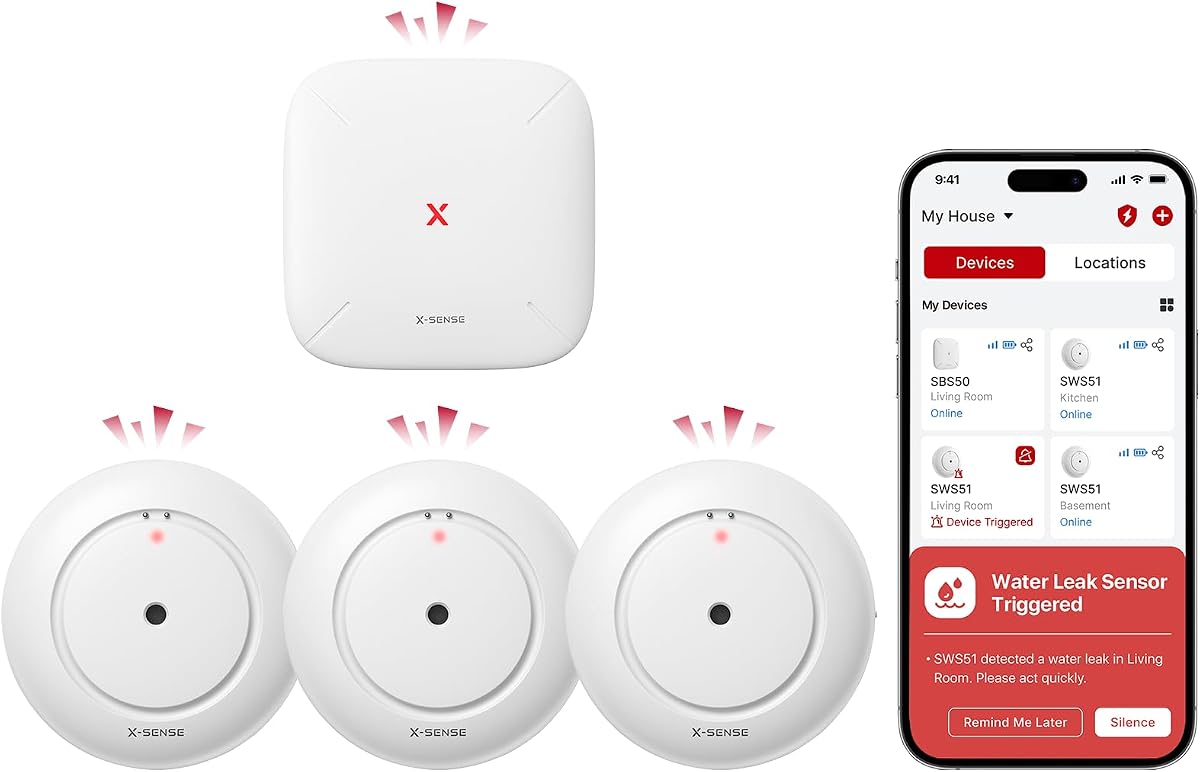
The X-Sense Wi-Fi Water Leak Detector Kit, SWS54, combines three sensors, a dedicated base station, dual 120 dB alarms, and app-based monitoring in one coordinated system. Its 4.5 rating reflects a strong balance of detection sensitivity, flexible placement, and household convenience, making it the most complete general-purpose option in this guide.
We may earn a commission when you buy through this link, at no additional cost to you.
Each sensor uses two upper probes to identify dripping water and four lower probes to sense pooled water as shallow as 0.4 mm. The sensor and base station sound together, improving audibility in basements, garages, laundry rooms, and other areas where a local alarm might otherwise be missed. Real-time phone notifications, shared access for as many as 12 users, and reminder intervals from 10 minutes to 12 hours make the system practical for families and landlords.
The main trade-off is its reliance on a 2.4 GHz Wi-Fi network, with no support for 5 GHz. The base also needs to be positioned where its alarm can be heard, and users should account for walls and floors when judging the advertised 1,804-foot open-area range. Despite those limitations, the combination of three sensors, strong alarms, and useful reminder controls makes this kit well suited to broad household coverage.
This is the option to choose for a multi-room installation without assembling several unrelated devices. It is particularly appealing for homes with basements, utility areas, kitchens, bathrooms, and laundry rooms monitored at the same time. Buyers should confirm 2.4 GHz Wi-Fi availability, download the required app, and place the base where its siren can be heard throughout the property.
The six-probe arrangement checks both dripping and pooling water, reducing the chance that a small leak will be missed from only one direction. This makes each sensor useful near appliances, plumbing fixtures, and exposed water lines.
Combining local siren output with base-station alarms, flashing or audible cues, phone notifications, and shared access creates several layers of awareness. Temporary reminders also help users track an unresolved alert without leaving the alarm active indefinitely.
We may earn a commission when you buy through this link, at no additional cost to you.
The Tapo T300 is a focused smart water leak detector with a 4.6 rating and a concise feature set. It can trigger its built-in alarm in as little as one second, detect both drips and pooled water through top-and-bottom probes, and send immediate app notifications when moisture or a low battery is detected.
We may earn a commission when you buy through this link, at no additional cost to you.
Its adjustable 90 dB alarm provides a useful balance of audible coverage and compactness. After locating a leak, a single press silences the sensor, and the detector can also activate a compatible Tapo Hub alarm for broader household coverage. The replaceable AAA batteries are rated for up to three years under TP-Link laboratory conditions, although actual life depends on operating conditions and usage.
The essential trade-off is that the T300 requires a Tapo Hub, which may already be part of an existing smart-home setup but represents an added requirement for a new user. The package also includes only one detector, so covering several rooms means purchasing additional units. Its IP67 rating provides strong resistance to water and dust in humid and dusty environments.
The T300 is a sensible pick for a targeted location such as under a sink, beside a toilet, behind a washing machine, or near a water heater. It is especially attractive for Tapo users who want quick notifications and a local siren without a separate Wi-Fi connection for each sensor. For those without a Tapo Hub, one of the direct-Wi-Fi alternatives may be easier.
The stated one-second response gives the T300 an advantage when a leak begins as a fast drip or a growing pool. Six probes increase coverage by checking both overhead drips and moisture touching the base.
Replaceable AAA batteries, low-battery notifications, and an IP67-rated housing simplify ongoing ownership. Users can address maintenance before the sensor becomes silent for a low-battery condition.
We may earn a commission when you buy through this link, at no additional cost to you.
The Moen Flo Detector three-pack is built for moisture monitoring and integration with the broader Moen water-management ecosystem. Its 3.6 rating is the lowest among these selections, but its standout capability is the included 48-inch remote sensing extension, which can reach beneath appliances or into confined spaces.
We may earn a commission when you buy through this link, at no additional cost to you.
Each detector can operate as a standalone monitor or connect with the Flo Smart Water Monitor and Shutoff, sold separately. The Smart Water Network App provides real-time moisture notifications, while the ability to connect multiple detectors supports whole-home expansion. These features make the set more compelling to users who may later add automatic water control.
Moen Flo and the optional shutoff hardware are separate purchases, and buyers should not expect this three-pack to provide automatic valve control by itself. The rating also suggests a less consistently favorable marketplace experience than the products above it, so checking recent customer feedback and current app compatibility is advisable. Remote sensing adds installation options, but it can also complicate placement if the disc is not positioned beside the actual moisture source.
This system is best for a homeowner who values a defined water-management platform, needs sensors beneath large appliances, or expects to add the Flo shutoff later. It is less convenient for someone seeking a fully self-contained Wi-Fi package. Prospective buyers should confirm that their plumbing arrangement and planned shutoff integration align with the separate Moen equipment before installing the sensors.
The 48-inch remote sensing disc extends the detection point beyond the sensor body. This is useful behind washing machines, near water heaters, and inside other areas where a compact puck cannot physically sit.
The detectors can work independently today or connect to a separately purchased Flo Smart Water Monitor and Shutoff. That compatibility makes them relevant for buyers planning a broader automatic water-control setup.
We may earn a commission when you buy through this link, at no additional cost to you.
The X-Sense Ultra-Slim SWS0A41 stands out for installation in narrow locations where a conventional puck-shaped sensor may not fit. It measures only 0.7 inches thick and 3 inches in diameter, yet the package includes four sensors, a base station, app controls, and an advertised open-area connection range of up to 1,700 feet.
We may earn a commission when you buy through this link, at no additional cost to you.
The sensors combine two top probes for dripping water with four bottom probes for water as shallow as 0.4 mm. A flashing red light appears on the detector, the base station sounds an alarm up to 100 dB, and the app provides phone notifications. Users can change alarm volume, mute alerts, review alarm history, test the system, receive low-battery notices, and share sensor access.
Compared with the SWS54 kit, this model supplies one more sensor but has a lower maximum base-station alarm output. Its slim form is exceptionally useful beneath cabinets or beside narrow appliance edges, yet a sensor still needs direct contact with water to trigger. Walls and floors can reduce practical range, and smart-home buyers should also verify that the base is compatible with their network.
This is the best fit for properties where cabinet gaps, appliance clearances, or utility-room geometry make sensor thickness important. Its four-pack and 1,700-foot open-area range also suit larger homes. It remains a strong general recommendation, particularly for users who prioritize placement flexibility and detailed app history over maximum siren output.
The 0.7-inch profile can fit where thicker sensors are inconvenient, including tight cabinet spaces and around appliance edges. Compact dimensions do not reduce the six-probe detection layout.
Alarm history, testing, battery warnings, volume adjustment, muting, and temporary reminders are managed in the app. These controls help users respond to alerts without constantly approaching each sensor.
We may earn a commission when you buy through this link, at no additional cost to you.
This three-pack combines water sensors with a gateway and offers a practical middle ground between a small sensor package and a larger coordinated system. Its 4.5 rating reflects a useful combination of a 120 dB local alarm, Tuya Smart app notifications, adjustable volume, flexible timers, and support for as many as 24 sensors on one gateway.
We may earn a commission when you buy through this link, at no additional cost to you.
Two upper probes detect dripping water while four lower probes look for pooling moisture. At least two bottom probes must be triggered to reduce false alarms, and a visual indicator helps users identify a sensor in darkness. The sensors use AAA batteries, have an IP66-rated housing, and can be reused after drying. The gateway reaches up to 328 feet in open areas, with typical indoor coverage listed around 150 feet.
The main limitation is the much shorter advertised range than the X-Sense systems, especially in homes with substantial masonry or multiple floors. SMS and telephone notifications are handled by a third-party Tuya publisher and may carry separate charges, while app push notifications are free. Users must also connect through 2.4 GHz Wi-Fi rather than 5 GHz.
This kit is a strong choice for households wanting several monitored locations and the ability to expand over time without changing the gateway. It works well for apartments, townhouses, and conventional homes where sensors remain reasonably near the gateway. Buyers should map the planned sensor locations, confirm their distance and obstacles, and decide whether app-only alerts are sufficient.
A single gateway can support up to 24 compatible sensors, making this a practical foundation for a larger monitoring network. Users can expand coverage without replacing the existing gateway.
Requiring at least two lower probes to activate helps limit nuisance triggers from isolated moisture. The local alarm, visual indicator, and app notification provide several ways to confirm an event.
We may earn a commission when you buy through this link, at no additional cost to you.
The Aeotec SmartThings Water Leak Sensor is designed for users who already operate a compatible Zigbee or SmartThings ecosystem. It carries a 4.5 rating and adds useful functionality beyond simple moisture detection, including temperature monitoring and the ability to program connected devices to shut off water flow or electronics after an abnormal condition.
We may earn a commission when you buy through this link, at no additional cost to you.
The sensor detects excess water or moisture under sinks, refrigerators, washing machines, and similar locations. Users can choose light or siren alerts for abnormal moisture and temperature conditions. It works with the SmartThings app, an Aeotec Smart Home Hub, a Samsung SmartThings Hub Gen 3, or other compatible Zigbee hubs, giving existing smart-home users meaningful flexibility.
A hub is mandatory, and the stated Zigbee range of 50 to 130 feet varies with home construction. The sensor is intended for indoor use only, and it operates from 32 to 104 degrees. Those constraints make it less suitable for outdoor monitoring, very large homes without mesh coverage, or users who want a completely stand-alone Wi-Fi sensor.
This is the strongest choice for smart-home builders who want leak detection to trigger broader automations, such as shutting down connected equipment during a moisture event. It also suits users who already prefer Zigbee and want temperature monitoring. Buyers should verify hub compatibility, available hub placement, and network construction before installing multiple units.
Moisture and temperature alerts can be used to trigger shutdown routines for connected water or electrical systems. That makes the detector useful as one part of a broader home-protection strategy.
The sensor supports SmartThings hubs and other compatible Zigbee devices. Existing ecosystem users can often add it without introducing another standalone network or app.
We may earn a commission when you buy through this link, at no additional cost to you.
The TECKNET WiFi Water Leak Detector is a straightforward two-sensor package for people who want mobile alerts without a separate hub. Its 4.2 rating is solid, and the product combines direct 2.4 GHz Wi-Fi connectivity, a 120 dB adjustable alarm, six sensing probes, app notifications, and an IP67-rated housing.
We may earn a commission when you buy through this link, at no additional cost to you.
Two top probes identify dripping water and four bottom probes check for pooled moisture from multiple directions. The sensors connect to the Tuya Smart app, which provides low-battery reminders and leak notifications. Each unit uses two AAA batteries, with stated battery life of up to two years, and the package includes the sensors and batteries needed for installation.
This product supports only 2.4 GHz Wi-Fi, not 5 GHz, so a compatible network must be available. SMS and phone-call alerts require a third-party subscription service, while the core app notification is the simpler option. Because the two sensors connect directly to Wi-Fi rather than through a dedicated gateway, buyers should confirm that both intended locations have dependable signal.
The TECKNET package is a practical pick for a two-location installation such as a kitchen sink and laundry room. It avoids hub expense and makes shared monitoring through the Tuya ecosystem relatively straightforward. It is less attractive for larger homes where direct Wi-Fi coverage may be inconsistent or for users who want a single gateway to coordinate dozens of sensors.
Connecting directly to a 2.4 GHz network removes the need for a proprietary hub. That simplicity makes the two-sensor set approachable for a first smart-home installation.
The adjustable 120 dB siren is designed to be noticed in active household spaces. An IP67 housing adds resistance to water and dust in basements, laundry rooms, kitchens, and near water heaters.
We may earn a commission when you buy through this link, at no additional cost to you.
WaterWatcher takes a different approach from app-centered monitors. It is a water sensor alarm designed to detect water and automatically turn off a connected appliance, earning a 4.6 rating for its specialized protective function. The product is made in the USA and includes a five-year warranty.
We may earn a commission when you buy through this link, at no additional cost to you.
Its enhanced sensor is designed to pinpoint small traces of water, including small amounts associated with dehumidifiers. Once moisture is detected, the appliance remains off until the user manually resets the device. This behavior prioritizes a conservative response: even if water briefly disappears, the system does not automatically restart the protected appliance.
The sensor is compatible with dehumidifiers, aquariums, hydroponics, washing machines, well pumps, and other appliances. Its primary advantage is automatic shutdown, while the main limitation is the lack of a stated smartphone app or remote-notification feature. Users must be physically present to hear the alarm, inspect the area, and reset the system.
This is the best fit for someone who wants an appliance protected even when nobody is actively monitoring an app. It is especially relevant to dehumidifier and well-pump setups where continued operation after a detected leak could worsen damage. Buyers should confirm the connection method and appliance compatibility before installation and be comfortable with the manual reset requirement.
Unlike systems focused mainly on remote alerts, WaterWatcher can stop the connected appliance as soon as it detects water. That action limits the opportunity for a small leak to become a larger incident.
Keeping the appliance off until a manual reset prevents it from restarting while a leak may still be unresolved. The trade-off is that the owner must investigate and reset the unit after every alert.
We may earn a commission when you buy through this link, at no additional cost to you.
The Smart WiFi Water Leak Detector has a 5.0 rating and pairs two compact sensors with a Wi-Fi gateway. Its main attraction is an adjustable alarm reaching up to 110 dB, supported by app push notifications, six-direction probing, and an IP66-rated housing for kitchens, basements, sinks, laundry rooms, and similar spaces.
We may earn a commission when you buy through this link, at no additional cost to you.
The sensors use two stainless steel strips at the front to detect drips from pipes or drains and four underside probes to identify standing water on floors. Their compact, wiring-free design makes placement flexible. The gateway connects to a 2.4 GHz network and binds with the Tuya Smart app, after which the main units are associated automatically following the initial connection.
Users can adjust the volume for daytime or nighttime conditions and mute an alarm from the app. The product supports 5 GHz networks only through a separate compatible gateway, so the 2.4 GHz limitation is important. The listed package contains two sensors and one gateway despite the product title referring to three water sensors and a Wi-Fi gateway, so buyers should review the package contents carefully before ordering.
This detector is appealing for buyers who want a strong but adjustable alarm and already operate the Tuya Smart ecosystem. Its 5.0 rating is encouraging, though the inconsistent package description is a reason to verify exactly what will arrive. It is a good fit for two high-priority locations connected through a central gateway, especially in homes with reliable 2.4 GHz coverage.
An alarm reaching 110 dB can be adjusted to suit a busy kitchen, a basement, or a quieter living area. App-based muting helps users investigate after hearing the alert without leaving the sensor active indefinitely.
Front strips detect dripping from pipes and drains, while four bottom probes catch floor moisture. The rust-resistant, IP66-rated construction is suitable for extended use in humid areas and allows reuse after drying.
We may earn a commission when you buy through this link, at no additional cost to you.
The Eve Water Guard is a premium cable-based leak detector for Apple HomeKit users. Its 4.6 rating reflects a distinctive design: a 6.5-foot sensing cable can cover a broad area, while a 100 dB siren, red flashing light, and notifications to an iPhone, iPad, or Apple Watch make a detected leak difficult to overlook.
We may earn a commission when you buy through this link, at no additional cost to you.
The cable serves as a full-length sensor and can be extended to as much as 490 feet, offering much broader placement flexibility than a compact puck. It is intended for bathrooms, utility rooms, basements, beneath sinks, and near water pipes. This makes it particularly useful when a leak can travel along a floor or across several connected surfaces.
Eve supports Bluetooth and Thread and joins a Thread network automatically, while a router-node role can improve the reach and stability of a compatible smart-home network. It requires a recent iPhone or iPad with the latest iOS or iPadOS. The product uses local intelligence and direct communication without a bridge, cloud registration, or tracking, which distinguishes it from cloud-dependent monitors.
This is the strongest choice for an Apple-centered smart home that needs extended linear coverage. It is less suitable for Android-only households or buyers seeking a confirmed water- and dust-resistance rating. Installation requires careful routing of the sensing cable across likely leak paths, and the entire extended length should be considered when positioning the main unit.
A six-and-a-half-foot cable can be routed beneath a sink, along a utility-room floor, or beside a pipe run. Extension capability scales this coverage to 490 feet when the installation calls for it.
Eve uses local intelligence and direct communication without requiring a cloud account, bridge, registration, or tracking. Apple HomeKit and Thread support keep the device within a privacy-focused smart-home workflow.
We may earn a commission when you buy through this link, at no additional cost to you.
The right leak detector depends on where water may appear, how the sensor will connect, and the actions you want after an alert. Review sensing coverage, network requirements, alert methods, and maintenance needs before choosing.
Top-and-bottom probes help a sensor identify both drips from above and pooled water underneath. Some systems can detect water as shallow as 0.4 mm, while others use a full-length cable for broad linear coverage. Choose according to the most likely failure point: compact probes suit sinks and appliance edges, whereas cables or remote discs can reach confined and wide areas.
Prioritize sensors that check both surfaces and directions.
Direct Wi-Fi systems can be simpler for a small installation, but many support only 2.4 GHz rather than 5 GHz. Hub-based Zigbee sensors integrate well with existing smart homes, while Bluetooth and Thread devices may suit Apple HomeKit users. Compare the required hub, app, network band, and account requirements before buying multiple units.
Confirm compatibility with your existing network first.
A local siren is essential when nobody is near the sensor, while app notifications are useful for monitoring from elsewhere. Adjustable volume allows a loud alarm in a basement without making bedrooms equally disruptive. Visual indicators can also help users identify the affected sensor in a dark utility area.
Select multiple alert channels for complete coverage.
Advertised wireless ranges usually describe open-area conditions, and walls, floors, masonry, and appliances can reduce actual reach. Hub-based systems may extend through a mesh network, while gateway systems need sensors within reliable radio distance. Map intended locations, account for construction, and favor a system with sufficient margin rather than relying on a maximum number alone.
Treat maximum range as an open-area estimate.
A slim profile is valuable under cabinets, beside washing machines, and in other narrow gaps. Cable-based monitors are better where water may spread along a floor or pipe run. Also consider sensor thickness, drying requirements, and whether the device can sit exactly where moisture is likely to collect.
Measure the installation area before ordering.
Replaceable batteries are convenient for remote locations, while battery reminders help prevent an unnoticed power loss. IP66 and IP67 ratings indicate stronger resistance to splashes, moisture, and dust than an unrated indoor device. Check the stated operating temperature, indoor or outdoor restriction, and whether the sensor can be reused after drying.
Match the enclosure to the installation environment.
Some sensors can trigger connected water shutoff equipment, power changes, or other routines, turning a warning into an automatic response. Other systems support many sensors through one gateway or shared household access. Consider how many leak-prone areas need coverage and whether future expansion should be possible.
Plan for both present and future monitoring points.
Begin by downloading the required app and confirming that your Wi-Fi network, hub, or smart-home ecosystem is compatible. Charge or install the specified batteries, connect the sensor, and complete the app's pairing process. Position each unit directly beside or beneath the likely source of water rather than relying on general room coverage.
Test the system after installation using the device or app test function. Confirm that local alarms, phone notifications, shared access, and any connected water or electrical shutdown routines work as intended. Record each sensor's location so family members or household staff can identify the affected area quickly when an alert arrives.
Inspect batteries on the schedule suggested by the app and periodically verify that sensors remain dry, clean, and firmly placed. If a sensor is wet, disconnect or remove it as appropriate, allow it to dry, and confirm that its waterproof construction supports reuse. Never ignore a repeated alarm until the underlying leak has been inspected and corrected.
It depends on the model. The X-Sense, TECKNET, and Moen Flo products use Wi-Fi or can provide app connectivity, while Tapo and Aeotec require compatible hubs. The Eve Water Guard uses Bluetooth and Thread within an Apple HomeKit setup. Always check both the network band and required accessories before purchase.
Many of the selected systems use top probes specifically to identify dripping water, while lower probes detect pooled moisture. The X-Sense kits can sense water as shallow as 0.4 mm, and the T300 is designed to respond in as little as one second. Installation still matters because the sensor must encounter the moisture.
Good locations include under sinks, behind washing machines, beside dishwashers, near water heaters, next to toilets, and along exposed plumbing. Basements, laundry rooms, garages, and utility areas are also common targets. Place the sensor where a small leak would naturally collect rather than in an inaccessible location.
A single unit can monitor its immediate surroundings, but whole-home protection usually requires several sensors. Systems such as the Moen Flo set, X-Sense kits, and gateway packages support multiple units. Larger homes should also consider open-area range, hub placement, and wireless obstacles.
Some can integrate with automatic controls. The Moen Flo Detector can connect to the separately sold Flo Smart Water Monitor and Shutoff, while the Aeotec SmartThings sensor can program connected devices to shut off water or electronics. The other products primarily focus on detection, alarms, and notifications rather than automatic valve control.
Both ratings indicate strong protection against dust and water, but IP67 also specifies temporary immersion protection while IP66 focuses on protection against powerful water jets. Neither rating means a sensor can remain underwater indefinitely. Buyers should still follow placement instructions and avoid submerging a device beyond its specified limits.
A hub provides the network connection, app communication, and sometimes broader alarm integration required by the sensor. Hub-based systems can fit neatly into an existing Zigbee, SmartThings, Tapo, or Apple HomeKit ecosystem. If you do not already own compatible equipment, a direct Wi-Fi model may reduce setup complexity.
Check the affected area promptly and shut off the relevant water supply or appliance if it is safe to do so. Contact a plumber or the appliance service provider when the source is not immediately clear. Afterward, dry the sensor, verify that it remains operational, and reset or reactivate it according to the manufacturer's instructions.
The X-Sense SWS54 is the strongest all-around choice for households wanting three sensors, powerful local alarms, app notifications, shared access, and broad open-area range. The Tapo T300 is a focused and economical option for existing Tapo users, while the Eve Water Guard stands apart for Apple HomeKit integration and its extendable cable-based coverage.
Prioritize the sensing method and installation location first, then verify hub or network requirements. A direct Wi-Fi model may be simplest, a Zigbee sensor may better support automation, and a cable system may be necessary where leaks can spread across a wide surface. Battery reminders, alarm volume, environmental ratings, and expansion capacity deserve equal attention.
Ratings, product availability, and prices can change, so verify the current listing, package contents, and compatibility information before buying. A careful match between the detector's sensing design and the home's real leak risks will provide the most useful protection.