
Samsung B-Series HW-B400F
4.0Editor score
Built-in subwoofer for balanced sound
Automatic dialogue amplification
Night listening reduces disruptive bass
Discover the best soundbar for dialogue and voice clarity, with ten options compared for speech intelligibility, bass, connectivity, features, and ease of use.
A soundbar can transform ordinary television speakers into a much more engaging home-theater system, but improving dialogue is a more specific goal than simply making everything louder. The best models preserve vocal detail, reduce masking effects, and remain intelligible during action scenes, quiet rooms, and nighttime viewing.
This guide compares ten soundbars based on dedicated dialogue tools, center-channel performance, acoustic design, connectivity, room adaptation, gaming features, and overall value. The list includes compact all-in-one systems, models with wireless subwoofers, surround bundles, and premium Dolby Atmos options for different budgets and room sizes.
Each pick highlights a different path to clearer speech, from dedicated center speakers to automatic voice enhancement and room calibration. Ratings, features, and availability can change over time, and prices fluctuate frequently, so readers should confirm current listings and compatibility before making a final purchase.
4.0Editor score

4.4Editor score

4.2Editor score
The table below compares all ten soundbars by their dialogue-focused hardware, channel design, bass configuration, and principal connectivity features, making it easier to identify the model that best matches your television, room, and viewing habits.




The Samsung S60D is an unusually complete all-in-one soundbar for viewers who want precise vocal intelligibility without assembling separate surround speakers. Its 4.4 rating reflects a strong feature set, particularly Active Voice Analyzer, which separates room noise from onscreen voices, and Adaptive Sound, which analyzes scenes in real time. The result is speech that remains easier to follow during movies, sports, and crowded dialogue sequences.
We may earn a commission when you buy through this link, at no additional cost to you.
Its five-channel architecture and built-in subwoofers provide more spatial separation than a conventional two-channel bar without the visual clutter of a separate woofer. Active Voice Analyzer works with Adaptive Sound to identify important vocal information, while SpaceFit Sound Pro analyzes the room and adjusts the output for the environment. Q-Symphony can also coordinate the S60D with compatible Samsung televisions so their speakers operate as a unified system.
The main limitation is ecosystem dependence. Q-Symphony is designed for Samsung televisions, while Wireless Dolby Atmos also depends on compatible television functionality. The bar includes built-in Alexa, Chromecast, and AirPlay 2, so it remains flexible for everyday streaming, but buyers should verify their television model before expecting every smart integration to work as described.
This is the strongest recommendation for someone who places dialogue clarity above nearly everything else and already owns, or plans to buy, a recent Samsung television. It combines voice analysis, scene adaptation, room calibration, and powerful all-in-one construction. For other television brands, its Active Voice Analyzer still offers a compelling reason to consider it, provided the available connection methods are acceptable.
Active Voice Analyzer breaks down ambient room noise so dialogue and commentary can be optimized. That focus is particularly valuable when an action scene places explosions, music, and effects around the voices of the characters.
SpaceFit Sound Pro calibrates the output to the room, while the five-channel layout and upward-firing elements add height effects. The all-in-one design also avoids requiring a separate subwoofer for a fuller presentation.
We may earn a commission when you buy through this link, at no additional cost to you.
The Bose Smart Dolby Atmos Soundbar combines a compact footprint with serious spatial processing, earning a 4.1 rating among buyers. Its AI Dialogue Mode is the defining feature for this category because it balances voices against the surrounding sound field. Instead of simply raising the center volume, the mode gives speech greater prominence while preserving the wider cinematic presentation.
We may earn a commission when you buy through this link, at no additional cost to you.
Five transducers, including two upward-firing units, create a more dimensional image than a basic two-speaker soundbar. Bose TrueSpace analyzes non-Dolby Atmos sources, including stereo and 5.1 material, and upmixes them into a multichannel presentation. This makes the bar useful not only for native Atmos content but also for conventional broadcasts and older movie files.
It is not as specialized as some larger systems, and the spatial effects are compressed into one enclosure rather than distributed through rear speakers. The personal surround option also requires Bose Ultra Open Earbuds, sold separately. However, that reflects a deliberate all-in-one design intended to keep the main unit simple and relatively unobtrusive.
Choose this model for a smaller or medium room where a large home-theater system would be impractical, especially if the priority is intelligible dialogue with a polished, room-filling sound. Its compactness, upward-firing design, extensive wireless platform support, and AI-assisted voice balancing make it an excellent generalist for modern television viewing.
AI Dialogue Mode separates the tonal emphasis given to voices from the broader surround presentation. It can make late-night films and spoken content easier to follow without requiring the entire soundbar to be turned up.
Bluetooth, Apple AirPlay 2, Spotify Connect, and built-in Chromecast cover most major listening habits. Compatible Bose Ultra Open Earbuds can also extend the presentation to personal rear-surround listening.
We may earn a commission when you buy through this link, at no additional cost to you.
The Bose Smart Ultra Dolby Atmos Soundbar is the premium spatial option in this roundup, with a 4.2 rating and an emphasis on premium sound reproduction. Its AI Dialogue Mode is central to the shopping case, balancing vocals against surround effects so viewers can follow characters without sacrificing the cinematic presentation. The included optical and HDMI eARC cables simplify initial setup.
We may earn a commission when you buy through this link, at no additional cost to you.
Six transducers, including two custom-engineered upward-firing dipole speakers, produce sound from multiple directions, including overhead. Dolby Atmos works with Bose TrueSpace technology to separate and position sounds within the room. The same emphasis on spatial precision makes voices sound distinct rather than buried inside an undifferentiated field of effects.
Its compact enclosure cannot reproduce the exact scale of a multi-component home theater, and the richest spatial effects depend on the source. The AI Dialogue Mode also has less granular control than systems offering a dedicated center channel. Even so, the combination of premium processing, upward-firing hardware, and discreet design is difficult to match among all-in-one bars.
This soundbar is best for a discerning viewer who wants flagship-style sound, clear voices, and Atmos immersion without a visible receiver or separate satellite speakers. It also suits those who want to alternate between watching, gaming, and private listening through compatible Bose headphones or grouped Bluetooth speakers.
Six transducers, including dedicated upward-firing elements, create a sound field with height and directional movement. Dolby Atmos and TrueSpace work together to organize effects around the center of the presentation.
SimpleSync lets compatible Bose headphones join the soundtrack, while other Bose Bluetooth speakers can be grouped. These options are useful for late-night viewing or music without abandoning the main system.
We may earn a commission when you buy through this link, at no additional cost to you.
The Bose TV Speaker is a straightforward way to improve television audio, and its 4.3 rating is among the strongest in this group. Rather than attempting elaborate home-theater effects, it focuses on making speech clearer and more natural. Two angled full-range drivers provide a wider image than a single built-in television speaker, while a dedicated dialogue mode on the included remote can further enhance speech.
We may earn a commission when you buy through this link, at no additional cost to you.
Its most compelling quality is restraint. The enclosure is just over two inches tall, making it easy to place in front of a television without blocking the screen or infrared sensor. HDMI, optical, and AUX inputs cover common source and legacy-device connections, while Bluetooth allows music and podcast streaming from a phone.
The compact design naturally limits cinematic scale. It does not include upward-firing speakers, a bundled subwoofer, or advanced room calibration. An HDMI cable is also sold separately, and adding a Bose Bass Module 500 or 700 requires a separate connection cable, so buyers should budget for accessories if deeper bass matters.
This model is an excellent choice for a modest television, apartment, bedroom, or secondary room where clear speech matters more than cinematic height effects. Its simple controls, compact body, and strong emphasis on pronunciation make it a low-friction upgrade from thin built-in speakers.
The remote's dialogue mode is designed to clarify and elevate vocals. This focused approach is useful for news, documentaries, talk shows, and anyone who regularly finds television dialogue difficult to follow.
At only a little over two inches tall, the speaker fits beneath many televisions or can be wall mounted with separate brackets. Three device inputs and automatic first-device selection keep operation uncomplicated.
We may earn a commission when you buy through this link, at no additional cost to you.
The Samsung HW-B630F earns the highest rating in this comparison at 4.5, and its dedicated built-in center channel gives dialogue-focused buyers a clear reason to consider it. The speaker is specifically intended to make voices stand out, giving movies, television programs, and games a more distinct vocal anchor than a standard 2.1 system.
We may earn a commission when you buy through this link, at no additional cost to you.
Its 3.1 channel arrangement combines left and right channels with a center speaker, while the included wireless subwoofer supplies low-frequency impact. DTS Virtual:X expands the presentation without requiring rear satellite speakers. Adaptive Sound recognizes the type of content and adjusts settings to favor clear voices alongside detailed effects.
Because the rear effects are virtual, the soundstage is not identical to a system with physical surround speakers. Some of the gaming functionality, including cross-talk cancellation and synchronized Game Mode behavior, also depends on compatible television features. The separate subwoofer, although wireless, still needs placement and adds a component to the room.
For buyers who want a hardware-centered approach to speech intelligibility rather than relying only on software, the HW-B630F is an excellent choice. The center speaker, included wireless bass, scene adaptation, and two-device Bluetooth switching give it a balanced feature set for modern homes.
The dedicated center channel is the key advantage. By reproducing dialogue from its own speaker, the system can maintain vocal presence even when music and action effects occupy the left and right channels.
Adaptive Sound identifies the content and adjusts the mix toward clear voices and detailed effects. This makes the mode useful across movies, news, sports, and games without requiring repeated manual rebalancing.
We may earn a commission when you buy through this link, at no additional cost to you.
The Samsung HW-B400F is a practical entry into dedicated home-theater audio, with a 4.0 rating and a built-in subwoofer that avoids requiring a separate bass unit. Its dialogue feature automatically amplifies voices so they are less likely to disappear beneath music, effects, or background noise during broadcasts and films.
We may earn a commission when you buy through this link, at no additional cost to you.
Surround Sound Expansion projects audio across the listening area, giving the two-channel system a broader presentation than it might otherwise have. Samsung TV remote compatibility is a practical convenience, allowing viewers to handle key soundbar functions such as power, volume, and sound effects with the remote they already use.
This is not a dedicated center-channel system, and its two-channel architecture cannot create the same level of precise spatial separation as a 3.1 or 5.1 model. The broad sound field also may not provide a consistently defined voice anchor in every room or source. Its appeal lies in simplicity rather than advanced channel separation.
Choose the B400F when the main goals are clearer television voices, stronger bass than a small built-in speaker, and uncomplicated setup. Its compact two-channel layout, automatic voice enhancement, and night mode make it especially useful for apartments, bedrooms, and value-conscious buyers.
The voice enhancement feature raises dialogue without requiring the listener to locate a separate speech control. It is a straightforward way to improve news, reality television, and conventional broadcasts where voices can be mixed at inconsistent levels.
The integrated woofer provides low-end weight in a single main unit. That makes placement easier for renters and anyone who does not want a separate subwoofer connected by a cable.
We may earn a commission when you buy through this link, at no additional cost to you.
The Samsung HW-B550F delivers a useful middle ground between a basic television upgrade and a full surround system. Its 4.3 rating reflects a balanced feature set, with automatic dialogue enhancement, Adaptive Sound, Bass Boost, and a wireless subwoofer. The result is a system that can make speech more prominent while still delivering the impact needed for films and sports.
We may earn a commission when you buy through this link, at no additional cost to you.
Its 2.1 design uses left and right channels with bass handled by the included wireless subwoofer. DTS Virtual:X creates a wider impression of sound without separate rear units. The dialogue tool amplifies voices automatically, helping them stand out, while Adaptive Sound modifies the mix according to the type of content on screen.
Optional rear speakers can be connected wirelessly for a more traditional surround presentation, and additional modes include Private Rear Sound and Sound Grouping. These are worthwhile upgrade paths, but they are not required for the core experience. As with other virtual-surround models, the presentation will not perfectly reproduce a discrete multichannel mix.
The B550F is a strong all-around choice for a living room where viewers want clearer voices and satisfying bass but do not need a premium Atmos system. It also suits users who appreciate the option to add rear speakers later as their setup or room changes.
Automatically amplified dialogue helps speech stand out, while Adaptive Sound responds to content type. The combination reduces the need to adjust settings whenever a program changes between a quiet conversation and a loud action sequence.
The included wireless subwoofer supplies substantial bass, while optional compatible rear speakers can create true surround expansion. The system can therefore serve as a flexible starting point rather than a fixed endpoint.
We may earn a commission when you buy through this link, at no additional cost to you.
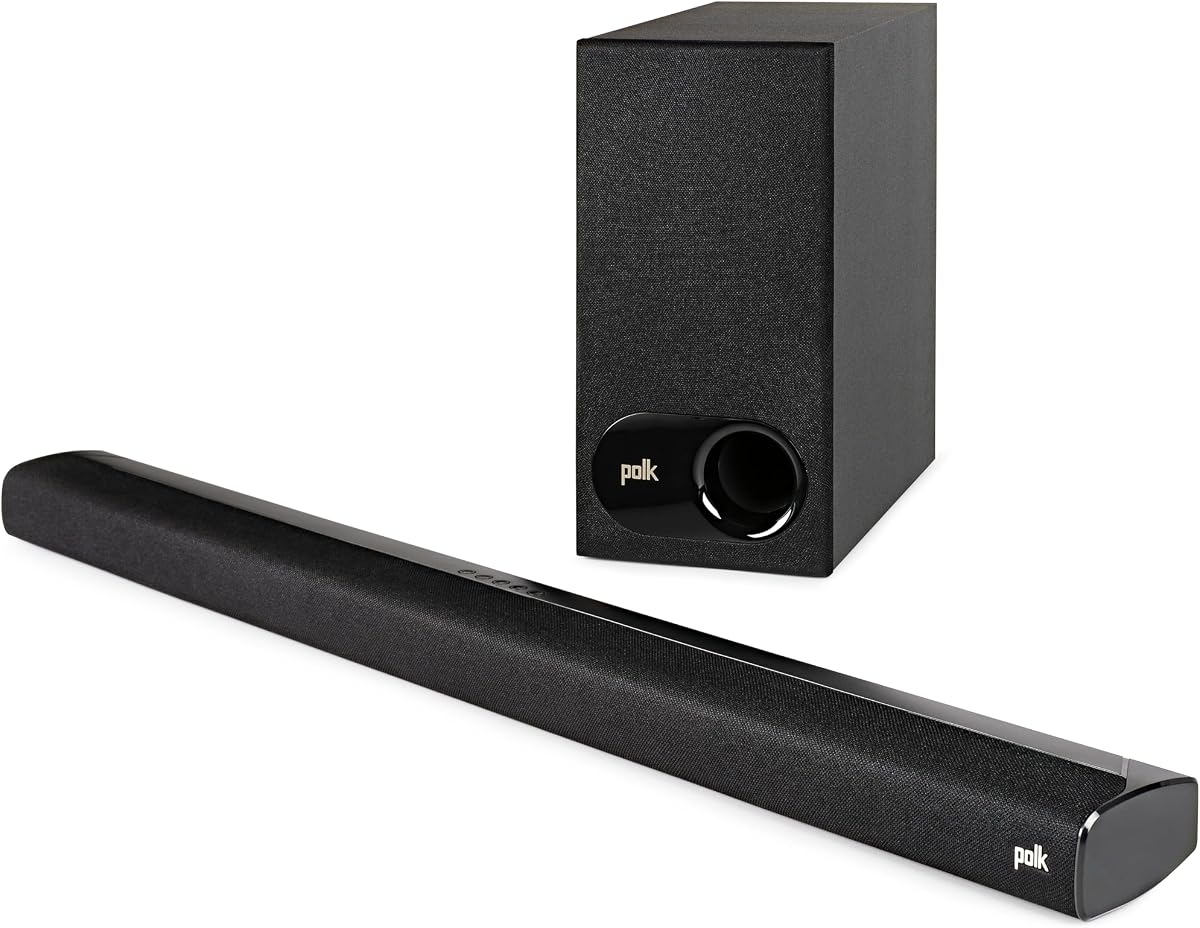
The Polk Audio Signa S2 combines a high 4.4 rating with one of the most distinctive dialogue tools in the group: Polk VoiceAdjust. The technology is designed to maximize clarity and reduce perceived voice delays, making this a practical soundbar for viewers who often struggle to understand speech on television.
We may earn a commission when you buy through this link, at no additional cost to you.
Five full-range drivers and Dolby Digital decoding support the voice-focused output, while the included wireless subwoofer handles bass. Despite its soundbar name, the product listing describes the package as including a soundbar for TV with subwoofer, so buyers should consider the complete boxed system and its physical footprint.
The main body is just over two inches tall and can sit in front of a television or be mounted on a wall. That slim profile reduces visual clutter and helps avoid blocking the television's lower edge or infrared sensor. It lacks a more advanced height-speaker array and does not focus on modern gaming-specific processing.
The Signa S2 is ideal for a living room where a low-profile bar and clear, adjustable voices take priority over complex Atmos. Its included bass, slim enclosure, and multiple connection options make it especially suitable for upgrading a wall-mounted television without creating a crowded media console.
VoiceAdjust is designed to improve vocal clarity and reduce voice delay, with Dolby Digital decoding supporting a controlled television presentation. It offers a more speech-focused approach than relying entirely on a general surround preset.
The soundbar's low profile suits compact and wall-mounted setups, while the included wireless subwoofer supplies the low end. Its understated design also avoids occupying the same visual space as a large television.
We may earn a commission when you buy through this link, at no additional cost to you.
The TCL S65K S Series is the most complete physical surround package in the roundup, with a 4.4 rating and a 5.1-channel system. For dialogue, the most important element is its built-in center channel, which gives voices a dedicated path and helps them remain clear during action-heavy scenes.
We may earn a commission when you buy through this link, at no additional cost to you.
The package includes a soundbar, wireless subwoofer, and wireless surround speakers. The subwoofer uses a 6.5-inch driver with Bass Boost, while the satellites extend effects behind the viewing area. Dolby Atmos, DTS:X, Ray Danz technology, and a built-in center tweeter provide a broad, high-frequency-capable soundstage.
Unlike a compact all-in-one bar, this system requires room for a subwoofer and two rear speakers. Those additional units can create a more convincing surround presentation, but placement matters, and the bundled system may be more than a small apartment or bedroom requires. Auto Room Calibration helps optimize the result once the components are positioned.
Choose the S65K when you want a complete cinema-style system rather than a compact upgrade. Its dedicated center channel, wireless surround speakers, large subwoofer, and automatic room analysis make it a strong option for larger rooms and viewers who want dialogue to coexist with a genuinely enveloping soundtrack.
The built-in center speaker and center tweeter keep voices distinct while the satellite speakers carry effects to the sides and rear. This separation reduces the likelihood that music and explosions will completely mask dialogue.
AI Sonic Auto Room Calibration tailors the system to its environment. The feature is particularly useful in a complete 5.1 package because speaker and subwoofer placement can materially affect balance, bass response, and perceived clarity.
We may earn a commission when you buy through this link, at no additional cost to you.
The Detachable 80W Soundbar stands apart with a two-in-one physical design and a 4.1 rating. Its two sections can be arranged in several ways, giving users a way to adapt the speakers to a television, computer, gaming setup, or projector. This flexibility may be especially useful in rooms where one conventional long soundbar is inconvenient.
We may earn a commission when you buy through this link, at no additional cost to you.
Four high-performance drivers deliver the stated 80W output, while automatic volume boost aims to make faint material more noticeable. The equalizer includes movie, music, and news presets. The news mode is the most relevant for this roundup because it tailors the output toward clearer dialogue without requiring detailed equalization controls.
Bluetooth 5.0, ARC, optical, and AUX connections provide broad source compatibility, and ARC mode supports television-remote control. The product does not list a specifically named center speaker, advanced voice isolation, or room calibration, so its speech improvements are more preset-driven than those found in premium models.
This soundbar is worth considering for renters, students, and small-room users who value placement flexibility and a simple news-focused preset. It is also a practical option for spaces where splitting the system into two compact speakers can provide a better fit than a single long bar.
The detachable sections may be positioned horizontally, vertically, together on a tabletop, or mounted to a wall. That flexibility can improve the fit around furniture and help listeners position the sound more evenly throughout a room.
The dedicated news equalizer emphasizes clear speech for talk programs, current events, and other content where intelligibility matters most. Automatic volume boost offers additional support when source levels are inconsistent.
We may earn a commission when you buy through this link, at no additional cost to you.
The most useful soundbar is not automatically the one with the most channels. Start with how people watch, the room's size, the television's connections, and the specific tools that improve speech before deciding which system deserves the space and budget.
Look for a named dialogue, voice, or speech-enhancement feature rather than assuming that increasing overall volume will solve the problem. These modes generally rebalance the mix so vocal information receives more attention. The Bose Smart and Smart Ultra models use AI Dialogue Mode to balance voices with surround effects, while the B-Series Samsung models automatically amplify dialogue. Samsung's S60D adds Active Voice Analyzer, which is designed to separate onscreen voices from room noise, and Polk uses VoiceAdjust for vocal clarity and reduced voice delay.
Choose models that adapt automatically when a program shifts between quiet conversation and loud action. Adaptive Sound, scene recognition, and dedicated center speakers can make manual adjustments less frequent. Pay attention to the type of content you watch most: news and talk programs benefit from strong speech emphasis, whereas films also need enough environmental detail to avoid an unnaturally isolated dialogue track.
A dedicated center speaker is one of the strongest hardware indicators of dialogue performance. It reproduces the vocal channel independently of music and effects, creating a clear acoustic location. The Samsung HW-B630F includes a built-in center channel, and the TCL S65K uses a center channel and center tweeter. By comparison, compact all-in-one bars can create the illusion of a center image through processing, but they cannot provide the same physical separation.
Look for angled drivers and upward-firing elements as indicators of a wider soundstage. These features do not guarantee clearer speech by themselves, but they help the soundbar distribute vocal and spatial information across the room. The Bose TV Speaker uses two angled full-range drivers, while the premium Bose bars add upward-firing transducers. Choose a dedicated center design when dialogue is the primary concern and a general soundstage is secondary.
Channel count describes how the system separates content, but real surround speakers and virtual processing produce different results. A 5.1 bundle with a soundbar, subwoofer, and two wireless satellites can place effects behind the viewer, while a compact 5.0 all-in-one bar creates height and width from upward-firing drivers. Virtual systems such as DTS Virtual:X expand the soundstage but do not physically place sound behind the seating area.
For dialogue, a larger channel count is not automatically superior. A 3.1 system with a dedicated center channel can outperform a more complex package if voice placement is the central goal. Match the layout to the room: a compact bar suits apartments and secondary rooms, while a full surround system is most useful in a dedicated living room with flexible speaker placement.
Deep bass can make dialogue harder to understand when it masks nearby midrange frequencies, so subwoofer placement and level control deserve attention. A wireless subwoofer is useful because it can sit away from the television without a cable running across the room. The Samsung B400F and Samsung S60D take a different approach by integrating the bass source into the main enclosure.
Look for Bass Boost or bass controls so the subwoofer can be matched to dialogue level. Start with modest bass and increase it only after confirming that voices remain clear. Large-room systems such as the TCL S65K need more space for their 6.5-inch subwoofer, while a built-in woofer is simpler but cannot place low frequencies as independently.
Every room changes the apparent balance of a soundbar. Reflections from walls, furniture placement, television masking, and speaker distance can all affect intelligibility. Room-calibration features analyze the environment and adjust output accordingly. Samsung's SpaceFit Sound Pro and TCL's AI Sonic Auto Room Calibration are the clearest examples in this group, while the S60D's Adaptive Sound focuses specifically on identifying and optimizing different content scenes.
Calibration is especially valuable for complete surround systems because each component changes the acoustic result. Use the automatic process where available, then make small manual adjustments for listening position. If the main seating area is far off-center, moving the subwoofer or changing the soundbar position may be as valuable as engaging another processing preset.
Check the audio connection supported by both the television and soundbar. HDMI eARC can carry advanced formats and allows convenient television-remote operation, while optical audio remains a widely compatible fallback. ARC, optical, and AUX provide different levels of control and bandwidth. The Bose Smart Ultra includes an HDMI eARC cable, and several models support convenient control through a Samsung television remote.
Smart features also require compatibility. Q-Symphony on the Samsung S60D is designed to work with Samsung televisions, while Wireless Dolby Atmos depends on compatible television features. For music, Bluetooth is standard across most choices, but AirPlay 2, Spotify Connect, Chromecast, and Alexa support can make everyday use smoother. Verify these functions before purchasing if your ecosystem is important.
The best features are those that improve your actual routine. The Samsung S60D and B630F provide gaming-oriented processing, including filters intended to reduce distracting noise and more directional effects. Night mode on the HW-B400F lowers volume and minimizes bass, which can be useful when household members are sleeping. The B550F adds private rear-sound options for compatible setups.
Remote quality and one-remote operation deserve equal attention. A included remote with clearly labeled dialogue controls is valuable, while compatibility with an existing television remote can reduce clutter. For speakers in bedrooms or multipurpose rooms, auto volume boost, compact dimensions, and flexible placement may matter more than Dolby Atmos. Consider these daily-use details before prioritizing a headline channel specification.
Start with the correct connection. For a television, use HDMI eARC when both devices support it, or select optical digital audio for broad compatibility. Connect the subwoofer wirelessly if it has its own pairing control, and place it near a wall or corner to reinforce low bass without taking up an entire seating area. Power everything on before making software or television-remote settings.
Run the available room calibration or sound optimization after the system is in its final position. Then watch representative content, including a quiet conversation and a loud action sequence. Enable the dialogue, news, or voice-enhancement mode and adjust the overall level gradually. If voices become thin or exaggerated, reduce the speech setting before changing the master volume, since excessive processing can make dialogue sound unnaturally compressed.
Keep the main unit unobstructed and away from enclosed cabinets that trap heat. Clean the grille gently with a dry, soft cloth, and avoid sprays or liquid near the drivers. For wireless systems, follow the manufacturer's pairing instructions and update compatible television or soundbar software when prompted. Do not place the included subwoofer against a heat source, and leave enough clearance around wireless rear speakers for their intended coverage.
A dedicated center channel gives dialogue a physical speaker of its own, which can make voices easier to locate and separate from effects. A dialogue mode changes the mix electronically and can still be highly effective. The best choice depends on the system, but viewers who frequently struggle with action scenes may appreciate hardware-based separation as well as adjustable voice processing.
No soundbar can guarantee perfect intelligibility under every condition. Recording quality, mixing, compression, room reflections, and where the television is positioned all affect the result. A good dialogue feature, a dedicated center speaker, proper calibration, and sensible listening levels can make a substantial difference, especially when the original mix provides clean vocal content.
A subwoofer is not required for clear dialogue, and excessive bass can actually mask speech. It is useful for a more cinematic presentation and for reproducing low-frequency effects. If buying one, place it away from the seating position, begin with a moderate level, and confirm that voices remain distinct before increasing the bass.
The terms are not standardized across manufacturers, but both generally emphasize speech within the overall mix. Some systems simply raise vocal frequencies, while others use scene analysis, noise separation, or an AI-assisted balance between voices and effects. The exact behavior varies, so it is worth reading the manufacturer's description and using the mode with several types of content.
HDMI eARC is not necessary for voice enhancement, but it can provide a convenient connection and support more advanced audio formats. Optical audio remains suitable for many televisions and soundbars. The most important compatibility point is whether the chosen input carries the television's audio reliably and whether the system supports the formats the viewer wants to use.
Not always. Virtual processing can widen the apparent soundstage, but physical rear speakers create more direct separation around the listener. Dialogue quality also depends on the center channel, processing, room setup, and source mix. A system with a strong center speaker and a virtual surround layer may therefore provide better speech than a larger system with a weak vocal anchor.
Place the soundbar near the television's screen height and close to the center of the main seating area. Avoid enclosing it inside a cabinet where early reflections and restricted airflow can affect sound. For a system with a wireless subwoofer, place the subwoofer near a wall or corner, then reduce its level if it masks voices.
Begin with a moderate master level and use the dialogue mode to improve the balance between voices and effects. Increasing the overall volume raises dialogue, music, and explosions together, which can make fatigue and masking worse. If speech sounds unnaturally boosted, lower the dialogue setting rather than turning it up further.
The Samsung S60D stands out for intelligent voice analysis, automatic scene adaptation, room calibration, and all-in-one five-channel construction. The Bose Smart Ultra offers premium spatial processing with AI Dialogue Mode, while the Samsung HW-B400F provides the most accessible route to clearer speech and fuller bass without a separate subwoofer. Each serves a different room, television, and feature priority.
Prioritize the method of voice enhancement rather than a channel number alone. A dedicated center speaker is a strong reason to favor the HW-B630F or TCL S65K, while the S60D's Active Voice Analyzer is particularly sophisticated. Compact buyers may prefer the Bose models, and the Polk Signa S2 combines a slim enclosure with a dedicated VoiceAdjust control and included wireless bass.
Before purchasing, confirm television compatibility, connection options, room size, and the availability of accessories such as rear speakers or a separate subwoofer. Current prices and features can change, so check the latest product listing and retailer information. The right choice is the system that makes speech understandable at a comfortable level while fitting naturally into your room and viewing routine.