
Govee Indoor Hygrometer Thermometer H5075
4.5Editor score
Bluetooth app remote monitoring
Two-second measurement refresh
Readable three-inch LCD display
Twenty-day online graph storage
This guide compares the best temperature sensor for Android phone options by accuracy, range, alerts, storage, placement, and connectivity.
A temperature sensor for an Android phone can turn your handset into the center of a useful home-monitoring setup. The best options combine dependable readings, convenient app-based history, timely alerts, and flexible placement for rooms, refrigerators, greenhouses, basements, or other spaces that benefit from consistent climate tracking.
We compared ten Bluetooth and Wi-Fi temperature and humidity monitors using the information supplied for each model. The evaluation considers sensor accuracy, wireless range, refresh frequency, alert options, historical graphs, data export, power requirements, display readability, and how easily each device fits into an Android-centered routine.
Each pick reveals where it excels: compact Govee models suit everyday room monitoring, the MOCREO system handles remote and outdoor-oriented installations, and the X-Sense package supports broader household coverage. Product configurations and prices can change, so readers should verify current availability and specifications before purchasing.
4.5Editor score

4.3Editor score

4.6Editor score
The comparison below highlights the practical differences among all ten devices, including their connection methods, monitoring range, display style, alert functions, and intended placement environments.


The Govee H5075 is a compact indoor thermometer and hygrometer with a 4.5 rating. It combines a straightforward three-inch LCD with app-based remote access, making it a practical choice for anyone who wants to check a bedroom, nursery, basement, greenhouse, wine cellar, or similar space from an Android phone.
We may earn a commission when you buy through this link, at no additional cost to you.
Its Swiss-made smart hygrometer sensor is specified at up to plus or minus 0.54°F for temperature and plus or minus 3% RH for humidity. Readings refresh every two seconds, while the display presents large figures, maximum and minimum records, and dry, comfort, and wet indicators. The app adds preset range alerts, curve graphs, 20 days of online data, and CSV export for as much as two years of history.
Bluetooth is the main limitation. Its stated range is 164 feet, and the monitor must be within that connection distance for phone access. It is best understood as an indoor room monitor rather than a remote outdoor station. That limitation is acceptable for most household uses, particularly when the sensor is placed near the area you want to monitor and the phone is used primarily for short-range wireless communication.
This is our top budget recommendation because it balances readable hardware, responsive data, useful alerts, and meaningful history without introducing a complex hub. Choose it when you want a dedicated phone-connected climate sensor for a single indoor location and value straightforward operation.
Preset temperature and humidity ranges can produce notifications when conditions move outside your target. This is particularly helpful for a nursery, storage area, cellar, or plant room where you may not want to visit physically for every change.
Twenty-day curve graphs reveal patterns more effectively than isolated readings. Two years of CSV export adds value when you want to compare longer periods, review data outside the app, or retain a personal record.
We may earn a commission when you buy through this link, at no additional cost to you.
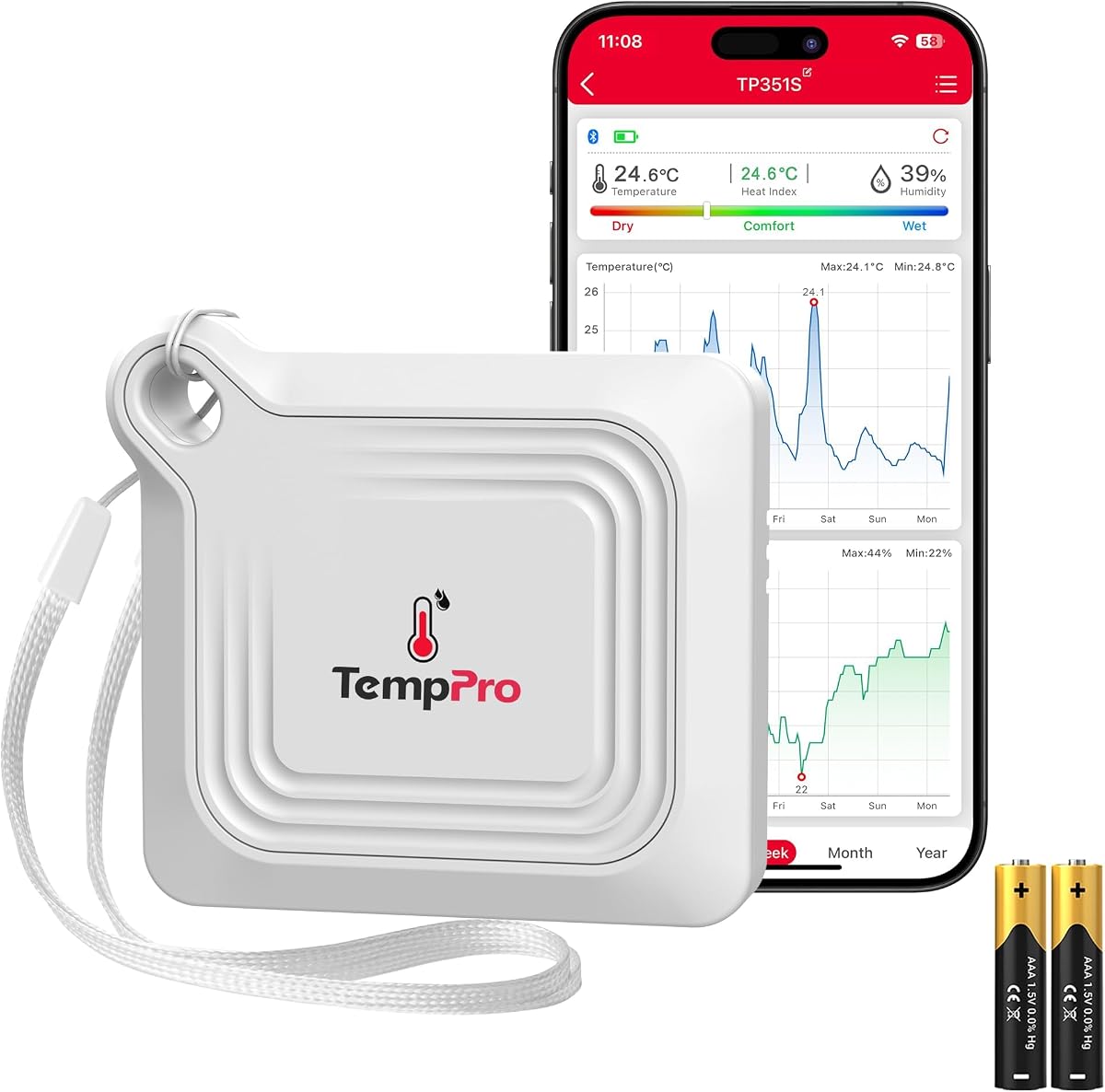
The TempPro TempAir is a portable Bluetooth thermometer hygrometer with a 4.3 rating and a stated connection distance of 260 feet. It suits Android users who need more reach than a standard room sensor, such as households monitoring a home office, guitar room, RV, cigar humidor, greenhouse, or compact nursery.
We may earn a commission when you buy through this link, at no additional cost to you.
The specified sensor accuracy reaches plus or minus 0.5°F and plus or minus 2% RH, which makes it appealing for users who prioritize measurement precision. Its 10-second refresh rate is fast enough for routine climate tracking, though it is less immediate than the two-second refresh offered by several Govee models. App features include alerts, a comfort index, one-year online charts, data export, and a battery indicator.
Its setup is designed to be approachable: install the included batteries, download the app, and allow the monitor to connect automatically. A hanging loop supports convenient placement, but the supplied facts do not describe a wall-mounting system, so the included accessories and physical setup should be considered when choosing a permanent location.
The TempAir is a strong pick for people who want a longer Bluetooth reach and high stated accuracy without setting up a hub. It is best suited to indoor monitoring and moderate-distance viewing rather than continuous internet-only remote access.
The 260-foot stated range gives this monitor an advantage over many compact Bluetooth hygrometers. That extra reach is useful in larger homes, but walls and other obstacles can still affect the practical connection distance.
The compact body and hanging loop make the TempAir easy to relocate. It can move between a room, cabinet, small enclosure, or portable setup without requiring a dedicated display station.
We may earn a commission when you buy through this link, at no additional cost to you.
The Govee H5179 is a Wi-Fi thermometer hygrometer with a 4.3 rating. It is designed for users who want to monitor conditions through an Android phone even when they are away from the sensor, making it more flexible than a Bluetooth-only indoor monitor.
We may earn a commission when you buy through this link, at no additional cost to you.
It supports both Wi-Fi and Bluetooth through the Govee Home app, though it does not support 5G Wi-Fi. The Swiss-made sensor is specified at plus or minus 0.54°F for temperature and plus or minus 3% RH for humidity, with readings refreshing every two seconds. A widget function, preset range alerts, 20 days of online graph storage, and two years of exportable data improve the software experience.
The supplied information includes an important clarification: the alert function is noted as supporting Bluetooth settings. Users who rely on notifications should verify how the current app and network configuration handle alerts before installation. The lanyard loop also makes placement straightforward, although the product is primarily intended for indoor environments rather than exposed outdoor use.
This is the general-purpose choice for users who want phone access, remote notifications, and detailed records without a separate hub. It is ideal for a basement, bedroom, wine cellar, or baby room where dependable remote awareness is more important than a larger sensor ecosystem.
Wi-Fi allows the phone to retrieve information from a different part of the home or while you are away. This makes the H5179 more suitable than a basic Bluetooth model for continuous awareness of a remote indoor environment.
The two-second refresh rate, app widget, and clear graphs make the sensor convenient for a quick daily check. Historical views help distinguish a temporary fluctuation from a recurring environmental pattern.
We may earn a commission when you buy through this link, at no additional cost to you.
The Govee H5075 3-Pack has a 4.5 rating and includes three H5075 monitors. It is a practical choice for Android users who want to compare conditions across a home, nursery, garage, wine cellar, basement, or another combination of monitored spaces.
We may earn a commission when you buy through this link, at no additional cost to you.
Each unit uses the same core feature set as the single-sensor H5075: a three-inch bright LCD, large temperature and humidity numbers, maximum and minimum records, dry, comfort, and wet indicators, and two-second refresh. A Swiss-made sensor is specified at plus or minus 0.54°F and plus or minus 3% RH. The package provides a 196-foot stated Bluetooth range.
The app supports preset range notifications, 20 days of online curve graphs, and export of the latest two years of data to CSV. Bluetooth remains the main constraint, so the full set works best when the phone can connect to the sensors individually. Placing all three in distant buildings or across large properties may be less convenient than using a network-based system.
Choose this pack when consistent hardware and app features across multiple rooms are your priority. It removes the need to compare unrelated sensor ecosystems and provides a simple way to identify which part of a home is hot, dry, wet, or outside your preferred range.
Three sensors allow a more useful picture of household conditions than one isolated reading. You can track differences between upstairs and downstairs rooms or compare a nursery with a basement or storage space.
Every unit has the same large display and comfort indicators. Family members can understand the conditions at a glance even when they do not open the Android app.
We may earn a commission when you buy through this link, at no additional cost to you.
The Govee H5074 is a mini Bluetooth temperature and humidity sensor with a 4.3 rating. Its compact, lightweight design makes it especially useful for smaller spaces and for users who want to move one sensor between several locations.
We may earn a commission when you buy through this link, at no additional cost to you.
The built-in Swiss-made sensor is specified at plus or minus 0.54°F for temperature and plus or minus 3% RH for humidity, updating every two seconds. It offers a stated 262-foot connection distance under the conditions stated in the product information, along with 20 days of on-device data storage, app curve graphs, and CSV export for the last two years.
The small form factor is a clear advantage for cabinets, shelves, enclosures, and other discreet placements. The tradeoff is visibility: unlike the larger H5075, it does not offer the same expansive three-inch screen. It also remains a Bluetooth-only product, so remote access depends on being within the practical wireless range.
Choose the H5074 for flexible, space-conscious monitoring rather than glanceable household displays. It is especially appropriate for a plant area, small storage cabinet, guitar room, or other location where a larger monitor would be inconvenient.
The mini enclosure and hanging hole allow the sensor to fit into areas that would be difficult to accommodate with a desktop-style gauge. This makes the H5074 useful for focused environmental tracking.
On-device storage helps preserve recent measurements between phone visits, while the app provides curve views and two years of export. You can review a pattern instead of relying solely on the latest reading.
We may earn a commission when you buy through this link, at no additional cost to you.
This Govee H5075 listing offers the same core product concept as the leading budget choice: a dedicated indoor display combined with Android app access. With a 4.5 rating, it appeals to users who want both a readable screen and remote environmental information.
We may earn a commission when you buy through this link, at no additional cost to you.
The Swiss-made sensor is specified at plus or minus 0.54°F and plus or minus 3% RH, with two-second refresh. The three-inch LCD shows live readings, maximum and minimum values, and three comfort levels. The Govee Home app adds preset alerts, 20 days of online data, curve graphs, and two years of CSV export.
The stated 164-foot Bluetooth range is adequate for many rooms and nearby areas, but it does not provide the same always-available remote access as a Wi-Fi model. The monitor is also designed for indoor use, so a protected, suitable location is important in a greenhouse, cellar, or similar environment.
This particular listing is a solid choice for shoppers who prioritize a large display, detailed app history, and alerts in a single indoor unit. It is easy to recommend because the hardware and app experience are clear, although users needing internet-level remote access should consider the H5179 instead.
Large numbers and simple comfort indicators make the H5075 useful for anyone who wants a quick local reading. The screen remains a practical alternative when checking a phone is inconvenient.
Curve graphs and CSV export make the sensor useful beyond instant alerts. A long history can help identify recurring changes in a room or support more deliberate humidity management.
We may earn a commission when you buy through this link, at no additional cost to you.
The X-Sense Smart Wi-Fi package includes three sensors and a base station, making it the most comprehensive whole-home option in this list. Its 4.5 rating reflects a system aimed at users who want scalable monitoring rather than one isolated room sensor.
We may earn a commission when you buy through this link, at no additional cost to you.
Temperature accuracy is specified at plus or minus 0.36°F, or plus or minus 0.2°C, while humidity accuracy reaches plus or minus 2% RH. Beyond basic readings, the system calculates dew point and vapor pressure deficit, which can be especially informative for plant care, wine storage, and other moisture-sensitive environments.
The base station can link up to 50 devices, including as many as ten thermo-hygrometers, with stated coverage up to 1700 feet. Historical graphs organize information by day, month, or year and allow export. Replaceable AAA batteries can last up to one year, with low-battery alerts sent through the app.
Choose this package when you value scalable household coverage and detailed environmental analysis enough to accept a hub-based setup. It is less necessary for one room, but well suited to monitoring a home, basement level, and multiple remote areas under one dashboard.
Dew point and VPD provide a more complete picture of atmospheric moisture than relative humidity alone. These calculations can help plant-focused users interpret conditions and identify meaningful changes.
The base station architecture supports a much larger sensor network than a single Bluetooth gauge. That scalability makes the package attractive for users who expect their monitoring needs to grow over time.
We may earn a commission when you buy through this link, at no additional cost to you.
The Govee H5103 is a Wi-Fi thermometer hygrometer with an electronic ink display and a 4.2 rating. Its low-power screen differentiates it from conventional LCD monitors, making it a good candidate for a visible location where you want information without frequent attention to the display.
We may earn a commission when you buy through this link, at no additional cost to you.
The Swiss-made sensor is specified at plus or minus 0.54°F and plus or minus 3% RH, with readings refreshing every two seconds. It connects through the Govee Home app over Wi-Fi and Bluetooth. Only 2.4GHz Wi-Fi networks are supported, so compatibility with the user's home router is essential.
Battery life is stated at about six months, with replacement using one 1.5-volt AA alkaline battery. App alerts cover preset temperature and humidity ranges, while the software provides 13 days of online data graphs and export of data over two years. Compared with the H5179, the H5103 trades a larger conventional display for the lower-power electronic ink format.
Choose the H5103 when discreet appearance, Wi-Fi access, and reduced charging or battery replacement frequency matter. It is particularly useful for a cellar, basement, or plant area where a clearly visible but low-power display is desirable.
The electronic ink display provides a persistent, readable presentation of conditions without the appearance of a conventional backlit screen. It works well when the sensor is placed for status viewing rather than constant interaction.
A stated six-month battery life reduces the frequency of replacements compared with many continuously refreshing displays. The sensor also supports straightforward app-based history and export.
We may earn a commission when you buy through this link, at no additional cost to you.
The MOCREO WiFi Remote Thermometer system has the highest listed rating at 4.6 and is the strongest choice for demanding remote installations. It includes an H5Pro digital monitoring hub and two LS1 wireless sensors for use around refrigerators, freezers, RVs, greenhouses, garages, kitchens, offices, pet shelters, and other locations.
We may earn a commission when you buy through this link, at no additional cost to you.
The sensors cover minus 4°F to 131°F with stated temperature accuracy of plus or minus 0.9°F. Their IP66 rating provides splash-proof protection for humid environments and suitable indoor or outdoor areas. The hub can communicate with up to 100 sensors at an open-air distance stated as 1640 feet, or one-third of a mile, and connects by Ethernet or 2.4GHz Wi-Fi.
Alerting is unusually flexible: users can receive app push notifications, email alerts, and a 95dB hub beep. A remote mute function lets the app dismiss the hub's beep, while additional settings cover power outages, Wi-Fi disconnection, low batteries, and false-alarm prevention. The hub also provides a dashboard for real-time readings, history, alarms, a clock, weather, and calendar information.
This is the premium recommendation for someone who needs long range, freezer protection, email delivery, audible local alarms, or compatibility with a larger MOCREO ecosystem. It is more complex than a single Bluetooth monitor, but the included hub makes that complexity purposeful. Fully enclosed metal structures can interfere with the wireless signal.
The broad measurement range and IP66 construction suit freezers, refrigerators, greenhouses, and damp utility areas. The system can help identify a door left open, a temperature drop, or a power-related risk before damage escalates.
Push notifications, email, and a loud hub beep provide useful redundancy. You can rely on a phone notification while away and an audible signal for people nearby, and the app can mute the local alarm after inspection.
We may earn a commission when you buy through this link, at no additional cost to you.
The Wireless Temperature and Humidity Sensor is a mini Bluetooth data logger with a 4.3 rating. It is built for users who value continuous records and flexible phone sharing, particularly for a refrigerator, freezer, reptile cage, greenhouse, or another monitored enclosure.
We may earn a commission when you buy through this link, at no additional cost to you.
It uses premium Swiss components and automatically records a new temperature and humidity reading every minute. The product information emphasizes accurate automatic operation, while the app supports alerts, interactive historical graphs, and CSV export of the entire record or selected portions. Exported files can be opened in Microsoft Excel or Google Sheets.
A stated connection distance of up to 330 feet provides ample reach for many homes, although walls reduce the effective distance. Each sensor can send alerts to multiple phones, and each phone can monitor multiple sensors. If the phone is out of range, the sensor retains up to 40 days of data for automatic synchronization later.
Choose this sensor for detailed logging rather than instant second-by-second change detection. Its one-minute interval and unlimited app history make it a strong companion for long-term documentation, while the offline synchronization feature improves reliability when the phone is not always nearby.
The 40-day offline sync history means a missed connection does not necessarily mean lost recent measurements. Data can transfer to the phone automatically the next time the sensor is within range.
Multiple phones can monitor the same sensor, and one phone can manage several sensors. CSV export adds flexibility for anyone who wants to analyze readings in a spreadsheet rather than relying exclusively on app graphs.
We may earn a commission when you buy through this link, at no additional cost to you.
The right sensor depends on where it will live, how far away your phone will be, and whether you need immediate alerts, continuous records, remote access, or simple local readings.
In short, choose Bluetooth for simplicity, Wi-Fi for remote visibility, and a hub system for scale or specialized coverage.
Prioritize tighter accuracy specifications for sensitive spaces, but always position the sensor where it can measure the conditions you actually care about.
For nearby rooms, Bluetooth may be enough; for separate buildings or outdoor areas, use a hub or long-range wireless system.
Choose alert channels that match how quickly and from where you need to respond to changing conditions.
Choose generous history and CSV export if you plan to analyze trends; a basic graph is enough for occasional awareness.
Pick a display and enclosure that suit the location, and place the sensor away from direct sources of heat, cold, moisture, or sunlight.
Compare battery life in the actual installation temperature and select a power method that you will genuinely maintain.
Verify the current Android app, phone requirements, and required network setup before finalizing your choice.
Begin by deciding what you want to monitor, selecting a representative location, and installing the batteries or charging the device. Download the manufacturer's app, create an account if required, and follow the pairing or base-station setup instructions. For Wi-Fi models, connect the sensor or hub to a 2.4GHz network and confirm that the Android phone can see the expected readings before moving the hardware into its final position.
Set realistic temperature and humidity ranges based on the monitored space rather than using the same limits everywhere. A wine cellar, plant nursery, bedroom, and refrigerator have different needs. After confirming that alerts work, use the app's graphs to learn the normal daily pattern and adjust thresholds only when a genuine change occurs, avoiding alerts that are too narrow to remain meaningful.
For the best results, place the sensor away from direct sunlight, heating and cooling vents, windows, exterior doors, and hot appliances. Clean the exterior with a dry or lightly damp cloth, avoid pushing liquid into openings, and follow the maker's battery guidance. Check the app for low-battery notices, review alert history periodically, and confirm that exported data opens correctly before you need it.
Yes. All ten products are described as app-compatible temperature and humidity monitors intended for phone-based management, including Android phones. Most use Bluetooth for local connection, while the Govee H5179, H5103, X-Sense system, and MOCREO system also support network-based remote monitoring. Check the current app requirements in the product listing before installation.
Bluetooth is simpler and usually sufficient for a sensor in the same room or nearby part of a home. It does not require a compatible router and can offer a practical connection distance of hundreds of feet, although walls reduce the effective range. Wi-Fi is preferable when you want to check a sensor remotely, receive continuous updates away from home, or avoid relying on the phone being nearby.
Yes, depending on the product. The MOCREO hub supports up to 100 compatible sensors, the X-Sense base station can link up to 50 devices including ten thermo-hygrometers, and the dedicated Wireless Temperature Humidity Sensor allows one phone to monitor multiple sensors. Bluetooth range and network placement can still affect which devices remain accessible at a given moment.
The MOCREO WiFi Remote System is the strongest specialized choice because it includes remote wireless probes, a broad minus 4°F to 131°F stated range, IP66 splash protection, and several alert methods. The dedicated Wireless Temperature Humidity Sensor also fits refrigerators and freezers and records every minute. The product guidance recommends avoiding fully enclosed metal containers because they can interfere with wireless signals.
Several models can be used in a greenhouse when the environment and placement are suitable. The MOCREO sensors have an IP66 splash-proof rating and are listed for indoor and outdoor areas, while the Govee and TempPro devices are commonly positioned in greenhouses and plant nurseries. Use suitable weather protection for devices not specifically rated for outdoor exposure, and place sensors away from direct sun and water entry.
Refresh rate describes how often the device updates its displayed measurement, while recording interval describes how often a value is logged for history. The Govee H5179, H5103, and H5075 refresh every two seconds, the TempPro refreshes every 10 seconds, and the dedicated Wireless Temperature Humidity Sensor records every minute. Faster updates are useful for immediate awareness, while scheduled logging is often better for long-term records.
Most products in this list support CSV export through their companion apps, with several allowing access to up to two years of data. The Govee H5179, H5075 models, and TempPro include export functions, while the MOCREO and dedicated logging products also support downloadable records. The dedicated logger can export the entire history or selected portions for use in spreadsheet software.
That depends on the connection type. A Wi-Fi sensor or hub can continue updating the service and sending alerts while your phone is elsewhere. Bluetooth devices depend on the phone being within practical range, although the dedicated Wireless Temperature Humidity Sensor stores up to 40 days of data for automatic synchronization after it reconnects.
The Govee H5075 stands out as the best balanced budget choice because it combines a large readable display, fast two-second updates, app alerts, and exportable history. The Govee H5179 is the most versatile general option for remote access through Wi-Fi and Bluetooth, while the MOCREO system is the clear premium choice for long-range monitoring, freezer applications, and redundant alert channels.
Prioritize the connection method first, then match the sensor's range and placement to the actual environment. A single-room Bluetooth gauge is often sufficient, while multiple rooms, separate buildings, or temperature-sensitive equipment justify a hub-based system. Accuracy, refresh rate, storage, alerts, and power requirements should then be weighed according to how you plan to use the data.
Features, package contents, app behavior, and prices can change over time. Before purchasing, verify the current product listing, Android app requirements, network compatibility, and included accessories, and compare the latest available options for the sensor that matches your monitoring plan.