
Multi-Battery LCD Checker
4.4Editor score
Exact voltage and level display
Real-load testing support
Dedicated testing slots
Bestbattery Tester for Household Batteries guide compares ten models for readings, compatibility, display clarity, rechargeable support, portability, and ease
A household battery tester helps you determine whether a battery is good, weak, or ready for replacement without relying on guesswork. The right device can help organize a mixed collection of AA, AAA, C, D, 9V, rechargeable, and button-cell batteries while reducing avoidable replacements and unnecessary charging.
We compared the ten featured testers using the information provided for each product. The evaluation considers supported battery formats, voltage or condition displays, rechargeable compatibility, portability, operating requirements, special contacts, construction, and the practical clarity of each testing workflow.
Each review explains the product's standout features, limitations, and ideal household use. Ratings and product details reflect the supplied listings, while availability and prices can change, so readers should confirm the current listing and specifications before making a purchase.
4.4Editor score

4.5Editor score
4.6Editor score
This side-by-side comparison highlights each tester's supported battery types, result display, rechargeable-battery capability, portability, and operating requirements. It is designed to help households identify the most practical option for their particular collection of batteries.


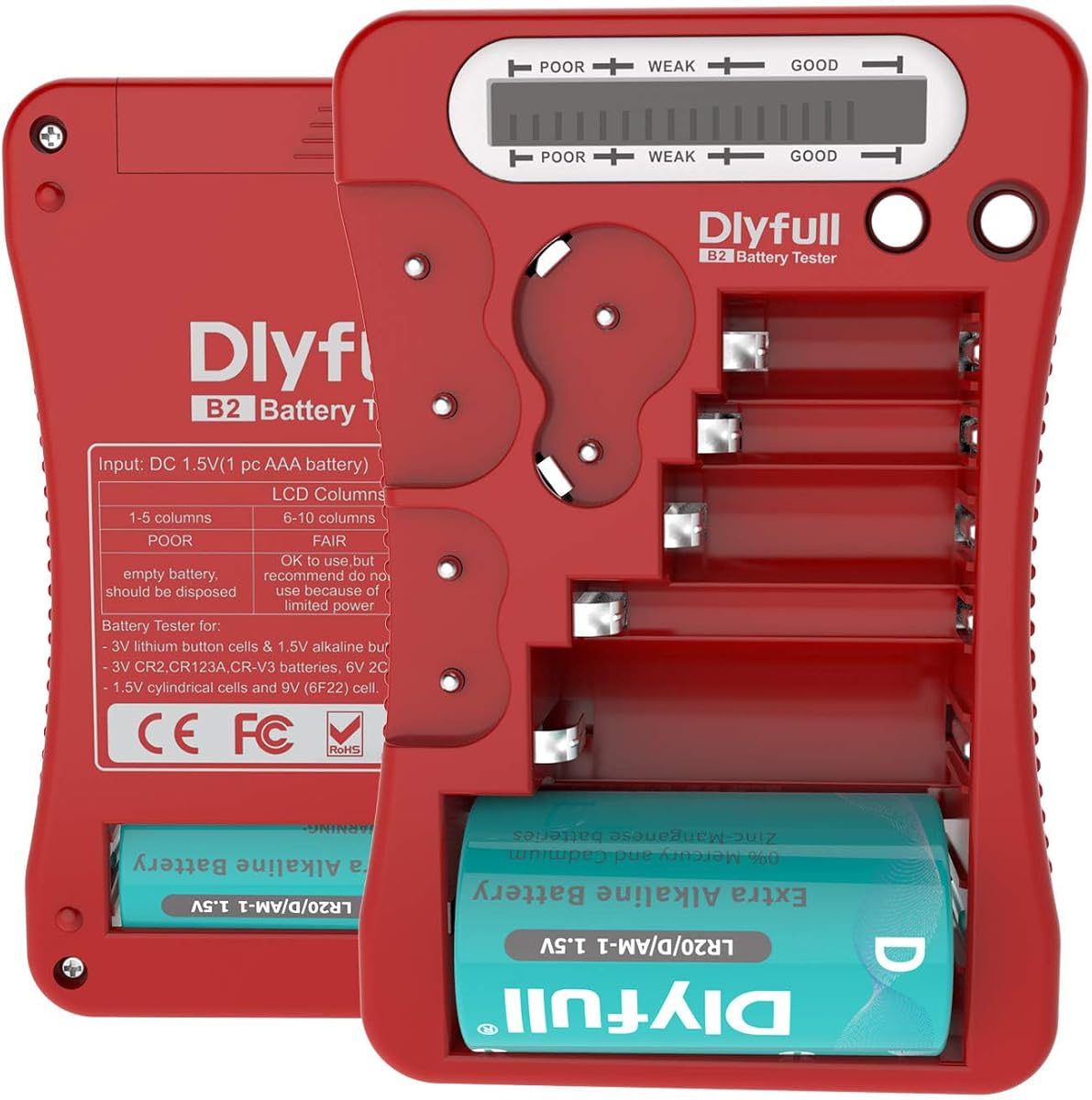
The Dlyfull Battery Tester for AA AAA C D 9V, Button Cell & Household Batteries is a strong all-around choice for homes that regularly keep several sizes in drawers, remotes, flashlights, and toy storage boxes. Its 4.5 rating reflects a generally positive user history, while the supplied feature set emphasizes broad compatibility, an uncomplicated LCD interface, and a compact body.
We may earn a commission when you buy through this link, at no additional cost to you.
Compatibility is the product's principal strength. It supports AA, AAA, C, D, 9V, N, CR123A, CR2, CRV3, 2CR5, and CR-P2 cylindrical cells, along with a wide assortment of button cells. Insert a battery, view the condition bars, and use the good, weak, or poor indication to decide whether it is suitable for continued service. The tester also includes one AAA battery, eliminating the need to find a separate power source immediately after unpacking.
There is an important limitation: the listing specifically says not to power the device with rechargeable batteries or use it to test rechargeable batteries. That makes it less appropriate for households whose collection is dominated by NiMH or other rechargeable cells. It also provides a qualitative condition display rather than an exact voltage number, so buyers who need a numeric measurement should consider a more specialized model.
This Dlyfull is best for households wanting one compact tester that covers common disposable formats and button cells without a complicated setup. Its small size, anti-slip finish, straightforward readings, included AAA battery, and 18-month warranty make it a practical first battery-checking tool for everyday use.
The supported range covers the formats most likely to appear in a general-purpose household battery bin. That versatility makes it easier to check a remote, flashlight, clock, toy, or small electronic accessory with one device.
The LCD bars translate voltage into easy-to-understand condition categories. Users do not need to interpret a precise voltage figure or select a complex testing mode before checking a battery.
We may earn a commission when you buy through this link, at no additional cost to you.
The Battery Tester for AA AAA C D 9V & Household Batteries Battery Checker is the most specification-rich digital model in this group. It earns a 4.4 rating and distinguishes itself through exact voltage readings, real-load testing, dedicated battery slots, and a display that combines numerical information with colored good, weak, and poor status indicators.
We may earn a commission when you buy through this link, at no additional cost to you.
Its compatibility list includes AA, AAA, AAAA, C, D, N, 9V, and numerous button-cell types such as CR1616, CR1632, CR2016, CR2025, CR2032, CR2450, CR3032, LR44, LR43, LR41, CR2, and CR123A. It also uniquely supports 1.2V rechargeable AA, AAA, and AAAA batteries. Real-load testing applies different discharge resistors depending on the battery category, giving users a more deliberate test than a simple open-circuit reading.
The trade-offs involve preparation and limits. It requires one AAA battery for operation, but that battery is not included. Lithium battery testing is not supported, and the screen is not backlit. Its listed accuracy is ±(1% of reading + 0.02V), while readings appear in approximately 0.1 second. The compact 4.7-by-2.8-inch body is portable, although the need to monitor its own power source is an added consideration.
This model is the best fit for technically attentive household users who want a numeric voltage reading alongside an intuitive status display. It is particularly useful when deciding among rechargeable cells, checking devices that demand reliable power, or maintaining a large and varied battery collection.
Rather than relying only on a passive voltage check, the tester uses category-specific discharge resistors. The supplied listing specifies approximately 75 mA for AA through D cells, 40 mA for 1.2V rechargeables, and lower loads for button cells and 9V batteries.
The LCD provides an exact voltage figure and a separate good, weak, or poor indicator. This combination helps users examine both the measurement and the practical condition recommendation without interpreting the scale themselves.
We may earn a commission when you buy through this link, at no additional cost to you.
The Dlyfull Battery Tester for AA AAA C D 9V 1.5V/3V Button, Batteries Checker combines a 4.6 rating with a remarkably simple workflow. It is especially appealing for users who want a dedicated household utility without navigating selectable ranges or complicated controls.
We may earn a commission when you buy through this link, at no additional cost to you.
The device handles AA, AAA, C, D, 9V, N, CR123A, CR2, CRV3, 2CR5, and CR-P2 cells, plus a broad range of button batteries. Its LCD indicates whether the tested cell is in poor, weak, or good condition through bars. The tester has an anti-slip finish, a compact chassis, and an included AAA battery, making it immediately usable and convenient to keep in a kitchen drawer or utility area.
As with the first-ranked Dlyfull, rechargeable batteries should neither power this model nor be tested with it. The absence of exact voltage and rechargeable support narrows its appeal for mixed-chemistry users. Even so, the features that remain—wide disposable-battery compatibility, quick results, clear condition categories, and a pocket-friendly design—cover the core needs of many households.
For shoppers seeking a straightforward tester backed by a strong rating and a generous warranty, this is a compelling selection. It is a natural choice for organizing loose disposable batteries, identifying weak cells before they cause interruptions, or keeping a small tester accessible around the home.
Place the cell in the appropriate position and interpret the condition bars. This quick procedure makes it practical to check several batteries at once and identify the ones that need attention.
The anti-slip housing supports a secure grip, while the compact body is easy to carry. It can remain in a drawer, travel bag, or toolbox without occupying much room.
We may earn a commission when you buy through this link, at no additional cost to you.
The D-FantiX BT-168 is a practical alternative for buyers who prefer an analog display and want a tester that does not require its own battery. It carries a 4.5 rating and uses a moving needle on a calibrated, color-coded scale to identify good, low, and replacement-or-recharge conditions.
We may earn a commission when you buy through this link, at no additional cost to you.
Its supported formats include AA, AAA, C, D, 1.5V, 9V, and button-type batteries. The listing also states that it works with standard and rechargeable household batteries. Because the battery being tested activates the device, there is no separate AAA cell to install and no low-power warning to manage. That makes the BT-168 appealing for occasional use, emergency preparation, or storage in a kit.
The analog scale is intuitive, but it provides less information than a digital display. It does not display exact voltage and will not directly determine precise remaining capacity. Instead, it gives a general indication intended to prevent usable batteries from being discarded prematurely or weak cells from being placed back into service.
The D-FantiX BT-168 is best for households that value simplicity, portability, and freedom from tester batteries. It also suits mixed collections containing rechargeable cells, although users who need exact voltage figures and rechargeable-specific settings should favor a digital model with explicit compatibility information.
The battery under test powers the check. This removes the inconvenience of replacing the tester's own power source and makes the device useful in an emergency kit.
Green, yellow, and red sections turn the needle position into an immediate good, low, or replace/recharge recommendation. The result can be understood without reading a fine numerical scale.
We may earn a commission when you buy through this link, at no additional cost to you.
The La Crosse 911-65557-INT Portable Digital Battery Tester is built around a simple three-step process: select the appropriate voltage range, insert the battery with correct polarity, and close the orange tray to activate the contacts. Its 4.6 rating and digital output make it an attractive option for households that test both alkaline and rechargeable batteries.
We may earn a commission when you buy through this link, at no additional cost to you.
The tester supports AAA, AA, C, D, N, and 9V batteries, as well as 3V lithium-ion button cells. Users choose 1.5V for alkaline AA, AAA, C, D, and N cells; 1.2V for rechargeable versions of those formats; or 3.0V for lithium button cells. The LED displays voltage and strength levels, while touch contacts on the left side handle 9V testing.
The necessary voltage selection adds a step compared with a fully automatic tester. Incorrect range selection could produce an inappropriate interpretation for the cell being checked, so the labels and instructions deserve attention. Button-cell support is tied specifically to the 3V setting rather than a broad range of coin cells.
This La Crosse model is ideal for mixed households where rechargeable AA and AAA cells are used frequently. It combines a numeric digital reading with strength levels, provides a straightforward procedure, and covers the most common remote-control, toy, flashlight, and household power formats.
Separate 1.5V and 1.2V ranges allow the same tester to evaluate alkaline and rechargeable household cells. This makes it more useful for users who regularly rotate between disposable and rechargeable batteries.
Side touch contacts provide a dedicated way to check 9V batteries. The feature simplifies a format that does not fit the standard cylindrical battery tray.
We may earn a commission when you buy through this link, at no additional cost to you.
The Two-Pack Universal Battery Tester stands out because it includes two complete testers rather than one. That arrangement is useful for households that want a backup device, a tester in each of two work areas, or a simple way to keep one unit with the batteries and another with household tools. Its 4.4 rating reflects solid performance within a straightforward category.
We may earn a commission when you buy through this link, at no additional cost to you.
Each tester supports AA, AAA, C, D, 9V, and 1.5V button-cell batteries. Indicator bars show the power level, allowing users to identify strong and weak batteries without interpreting a detailed numeric display. The package also includes an opaque storage bag, and the devices are described as lightweight and easy to carry.
One notable limitation is that the supplied information does not explicitly confirm rechargeable-battery testing. Because the device requires no operating battery, it also avoids the possibility of being disabled by a depleted internal power source. However, users who regularly work with rechargeable cells may prefer a model whose listing expressly states that capability.
This package is a practical choice for buyers who value readiness and redundancy. The two-unit format is particularly convenient for organizing multiple battery collections, while the simple indicator system makes the device approachable for occasional users.
Two units can be kept in separate drawers, rooms, kits, or vehicles. That flexibility reduces the need to carry a single tester whenever another battery collection needs attention.
The indicator bars are suited to quickly sorting cells into usable and questionable groups. This makes the tester useful for routine maintenance rather than detailed electrical analysis.
We may earn a commission when you buy through this link, at no additional cost to you.
The Tenergy T-333 is a well-regarded general-purpose battery checker with a 4.6 rating. Its LCD design, twelve-format compatibility, and included AAA battery make it a practical choice for households that want to evaluate common cells and several less frequently used button batteries with one device.
We may earn a commission when you buy through this link, at no additional cost to you.
Supported formats include AAA, AA, C, D, 9V, CR123A, CR2, CRV3, 2CR5, CR-P2, and additional button-cell varieties. It tests one battery at a time and presents status and health information on the LCD. The package contains the tester and one AAA battery, while its small footprint allows convenient storage beside other household tools.
The instructions emphasize testing only one cell at once and explain that the checker can reveal whether a device is malfunctioning or simply has a depleted battery. Its supplied listing contains considerable webpage formatting markup, but the underlying product description confirms its intended use, included battery, and compatibility. As with many universal testers, users should follow the battery-position and polarity guidance carefully.
The Tenergy T-333 is best for a broad household battery assortment, particularly when button-cell coverage matters. It offers an established user rating, clear digital output, and broad format support without the complexity of a model built primarily around rechargeable testing.
Coverage extends from everyday AA and AAA cells to 9V batteries and several cylindrical specialty formats. Additional button-cell support expands its usefulness for remotes, cameras, small appliances, and electronics.
Checking a battery can help distinguish a dead cell from a broken device. That practical diagnostic role extends the tester's value beyond simply deciding whether to replace a battery.
We may earn a commission when you buy through this link, at no additional cost to you.
The Gardner Bender GBT-500A is an analog tester built around broad range coverage and physical test leads. It carries a 4.6 rating and is designed to check common batteries to determine whether they are charged or need replacement. Its fourteen-range model is especially attractive to users who want access to less common battery formats.
We may earn a commission when you buy through this link, at no additional cost to you.
The listing identifies coverage for 1.5V button cells, 22.5V photo batteries, AA, AAA, 12V and 9V batteries, lantern cells, and more. Included leads make it possible to position contacts on the battery terminals without relying entirely on a fixed slot. This can help when checking batteries with unusual dimensions or terminals.
Unlike a screen-based model, the GBT-500A does not present an exact numerical voltage. Users read the position of an analog needle, which can be less precise but offers immediate visual feedback. The separate leads also make the device less pocket-friendly than compact slot-based models, although that is a minor trade-off for broader electrical flexibility.
This tester suits utility-minded households, workshop users, and anyone who wants to check several less common batteries. The included leads and 14-range coverage distinguish it from basic household models designed only around AA, AAA, and 9V formats.
Fourteen ranges allow the tester to address batteries beyond the usual remote-control formats. That breadth is useful for photo batteries, lantern cells, and other household power sources.
Test leads let the user control where each probe touches. This is helpful for batteries that do not sit naturally in a standardized slot.
We may earn a commission when you buy through this link, at no additional cost to you.
The Dlypow Magnetic Battery Tester differentiates itself through a built-in magnetic tip designed to grab and hold a battery securely. Its 4.6 rating reflects a favorable user response, while the magnetic contact and classic analog display offer a distinctive combination of simplicity and stability.
We may earn a commission when you buy through this link, at no additional cost to you.
The tester is compatible with AAA, AA, C, D, 9V, and button-cell batteries. Attaching a cell to the magnetic tip creates the intended contact, and the large analog display provides an immediate battery-status result. The listing describes a one-step process and emphasizes a design suitable for remotes, toys, flashlights, scales, and other everyday devices.
As with other analog models, the display does not provide an exact voltage value. Rechargeable compatibility is not explicitly stated in the supplied information, so users should not assume support merely because a rechargeable cell fits physically. The primary benefit of the magnetic design is steadier positioning and a more reliable connection during a quick check.
The Dlypow is a good choice for users who prefer a simple tool that keeps the battery in place while displaying its condition. Its 4.6 rating, broad common-cell compatibility, and magnetic contact make it especially convenient for frequent household battery sorting.
The built-in tip attracts and holds the battery in the intended position. That secure connection helps produce a stable signal while the analog display settles on a result.
A needle-style display is easy to interpret at a glance and avoids the need to power a screen. It is a straightforward option for quick sorting and general household diagnostics.
We may earn a commission when you buy through this link, at no additional cost to you.
The Dlyfull B4 Battery Tester is the most elaborate option in this comparison, with a 4.2 rating and a feature set built around detailed digital reporting. Its LCD shows voltage, a percentage, and a battery-level bar, making it useful for users who want more than a simple good, weak, or poor judgment.
We may earn a commission when you buy through this link, at no additional cost to you.
The listing describes compatibility with 12 battery types and multiple chemistries, including 1.2V Ni-MH, 1.45V zinc air, 1.5V alkaline, 3.0V lithium manganese, 3.2V LiFePO4, 3.7V lithium-ion, 6.0V, 9.0V, and 12.0V alkaline packs. It supports AAA, AA, C, SC, D, and N sizes, button cells, CR123A, CR-V3, 2CR5, 23A, 27A, and other formats. Cylindrical cells use a black negative pin, while button and combination batteries use dedicated slots.
A check button performs a self-test when held for three seconds, and the display indicates an error if that test cannot run. The tester includes two 1.5V AAA alkaline batteries and uses them for its own operation. Its 4.2 rating is the lowest in the group, so buyers should weigh the extensive feature set against a less emphatic overall score. The requirement to use two specified batteries is another practical consideration.
This Dlyfull B4 is best for advanced household battery management, extensive mixed-chemistry collections, and users who value percentage readings and self-testing. It also stands out as a strong choice for checking larger battery packs that many basic testers cannot accommodate.
Showing a percentage alongside voltage and bars provides multiple ways to understand condition. This is especially useful when tracking rechargeable cells or comparing several batteries from the same set.
Holding the check button for three seconds runs a self-test of the tester's own battery. The error indication helps alert users when the device is not ready for a reading.
We may earn a commission when you buy through this link, at no additional cost to you.
The best household battery tester depends on the formats you own, the level of detail you need, and how often you test. Compatibility, display style, rechargeable support, and operating requirements should be considered together rather than treating one specification as decisive.
Start by inventorying the batteries in your home. Most testers cover AA, AAA, C, D, and 9V, but button-cell coverage varies considerably. The Dlyfull models support several specialty cylindrical cells, the La Crosse supports 3V lithium-ion button cells, and the Tenergy covers numerous coin-cell formats. Verify that the exact battery type appears in the product listing rather than assuming that a similar diameter guarantees compatibility.
A tester that supports alkaline cells may not support rechargeable cells. The two Dlyfull compact LCD models specifically prohibit testing rechargeable batteries, while the D-FantiX lists household rechargeable support and the Multi-Battery LCD Checker supports 1.2V rechargeable AA, AAA, and AAAA cells. The La Crosse also provides a dedicated 1.2V range. Confirm both the chemistry and the nominal voltage before checking a rechargeable cell.
Analog displays use a needle and color-coded areas, making them intuitive but less precise. LCD models may show only condition bars, an exact voltage, or both voltage and percentage. The Multi-Battery LCD Checker combines numerical readings with good, weak, and poor indicators, while the Dlyfull B4 adds a percentage. Consider whether you want a quick household sorting tool or a more analytical diagnostic device.
A real-load tester applies a controlled discharge while evaluating a cell, which can provide a more practical indication than a passive voltage check alone. The Multi-Battery LCD Checker specifies different resistors and approximate currents for cylindrical cells, rechargeable cells, button cells, and 9V batteries. If your main goal is prioritizing batteries that will power a device consistently, this feature may outweigh a simpler analog display.
Some digital testers need their own power source, which can be convenient or inconvenient depending on the situation. The compact Dlyfull models include one AAA battery, the Tenergy includes one, the Dlyfull B4 includes two, and the Multi-Battery LCD Checker requires an AAA that is not included. The D-FantiX and two-pack analog-style testers require no operating battery. Consider how often you will use the device and whether it will remain accessible.
A household tester is more useful when it is easy to reach. Compact LCD units and the Dlypow magnetic model can live in small drawers, bags, or toolboxes. The Gardner Bender's test leads add flexibility for unusual batteries but make it bulkier than slot-based products. The two-pack option allows storage in separate locations, which can be valuable for large homes or multiple battery collections.
A household tool should be understandable without a learning curve. Color-coded analog scales and condition bars are fast for casual use, while exact voltage displays reward users who want records or more control. Rechargeable users should also look for a selectable voltage range that clearly distinguishes 1.2V and 1.5V cells, since choosing the correct mode is essential for a meaningful result.
Some designs solve a specific placement problem. The La Crosse uses side touch contacts for 9V batteries, the Dlypow employs a magnetic tip to hold cells securely, and the Dlyfull B4 provides a self-test and dedicated button or combination-cell slots. These features are useful when they match your testing habits, but they should complement rather than replace confirmation of basic battery compatibility.
Before testing, identify the battery chemistry and nominal voltage. Select the proper voltage range if your model has one, inspect the tester for damage, and check that its own power source is fresh when required. Read the polarity markings carefully and never force a battery into the wrong slot.
Insert one battery at a time unless the manufacturer explicitly states that multiple cells can be tested together. Maintain clean, firm contact between the battery terminals and the tester. For models with magnetic tips or leads, allow the display to settle before reading the voltage or condition, and remove the cell promptly when the test is complete.
Store the tester in a dry location away from extreme heat and direct sunlight. Remove batteries from the device if it will be stored for a long period, keep the contacts clean, and replace the tester's own AAA batteries as needed. Interpret the result according to the device instructions and the battery manufacturer's guidance rather than assuming every depleted reading means the product it powered is defective.
Only if the product explicitly supports both chemistries. Some compact Dlyfull models must not be used with rechargeable batteries, while the D-FantiX, La Crosse, and Multi-Battery LCD Checker list rechargeable support. Choose the correct voltage mode when required, and verify that the specific rechargeable size and chemistry are included in the compatibility information.
A model with automatic startup and condition bars is usually the easiest choice for casual sorting. The compact Dlyfull testers and the two-pack indicator-bar model require little more than inserting a battery and reading the display. Exact-voltage models are more informative but may require an operating battery, a voltage selection, or more careful interpretation.
Not necessarily. Most household testers provide a voltage-based condition estimate, and even the D-FantiX listing explicitly says it does not directly determine precise capacity. Real-load testing can provide a more practical indication, but battery age, chemistry, load, and temperature can all affect the result.
It can help narrow down the problem by showing whether the battery is healthy. A good battery paired with an unresponsive device suggests that the device or its connection may be faulty, although the tester itself cannot diagnose the device. Always follow the equipment manufacturer's troubleshooting guidance before replacing other components.
Digital displays and internal circuitry require power to start and process a reading. Some models include the required AAA cells, while others require the user to supply them. Battery-free analog models use the cell under test to activate the needle, which can be convenient for emergency kits and infrequent use.
It depends on your needs. Condition bars are faster for sorting good and weak cells, while exact voltage readings are better for tracking rechargeable batteries, comparing cells, and diagnosing device problems. The most useful tester is the one whose display supports the level of detail you will realistically use.
Some models support a wide range of coin cells, but others are limited to a particular voltage or battery family. The La Crosse lists 3V lithium-ion button cells, while the Dlyfull and Tenergy products include broader button-cell ranges. Confirm the exact battery designation before inserting it.
Testing before use helps identify weak cells before placing them in a device. Periodic checks are also helpful for batteries stored for long periods or used in infrequently operated equipment. Always remove batteries from a device before testing unless the product instructions explicitly allow otherwise.
The compact Dlyfull B07DPLD6KB stands out as the best overall household option because it combines broad disposable-battery compatibility, a clear LCD, an included AAA battery, and portable construction. The Multi-Battery LCD Checker is the strongest advanced choice for exact readings, real-load testing, and selected rechargeable cells, while the B08H7585P4 Dlyfull offers a highly rated, compact alternative.
Prioritize exact compatibility before considering any other feature. Households using many button cells need a model that names those formats, rechargeable users need explicit chemistry and voltage support, and people wanting numerical diagnostics should select a digital tester. Analog or bar-based models remain effective when fast, uncomplicated sorting is the main objective.
Product ratings, availability, and prices can change, so check the current listing before purchasing. Confirm the included accessories, operating requirements, supported formats, warranty, and latest specifications on the retailer page to ensure that the selected tester fits your battery collection and routine.
