
Rockville Atom P60
4.5Editor score
1200W RMS at two ohms
Fully adjustable crossover controls
Marine-resistant component construction
Compare the best 1200 Watt Marine Amplifiers for boats, vehicles, and outdoor audio systems, including power ratings, channel layouts, marine protection
A 1200-watt marine amplifier can transform a boat, powersports vehicle, RV, or off-road audio system by delivering enough power for powerful speakers and subwoofers. However, headline wattage does not tell the entire story. Channel configuration, RMS output, efficiency, corrosion resistance, crossover controls, and installation requirements all matter.
This guide compares ten amplifiers that meet the broad search criteria for high-output marine audio amplification. The evaluation considers the stated power configurations, channel layouts, enclosure design, marine-focused protection, signal inputs, crossover functions, and practical control features. Products labeled 1200 watts peak are compared alongside models that specify 1200 watts RMS.
Each review explains the amplifier's strongest qualities, limitations, and most natural application. The top selections include an affordable two-channel unit for flexible installations, a feature-rich five-channel system amplifier, and a premium two-channel marine model. Listing details and availability can change, so readers should verify current specifications before purchasing.
4.5Editor score

5.0Editor score
The table below compares all ten amplifiers by output configuration, channel design, marine protection, tuning features, and intended application, making it easier to distinguish true RMS power from peak-power marketing.


The Rockville Atom P60 is a two-channel amplifier rated at 1200 watts RMS, with 600 watts available to each channel at a four-ohm load. That genuine continuous-power specification gives it a more meaningful place in this guide than amplifiers whose 1200-watt headline is based only on peak output. Its 4.5 rating also suggests generally positive customer reception, although ratings alone cannot reveal every installation detail.
We may earn a commission when you buy through this link, at no additional cost to you.
Output is supported by adjustable 12dB-per-octave low-pass and high-pass filters covering 50Hz to 250Hz. That range is well suited to separating subwoofers from door speakers, though it may be less accommodating for extremely high-pass filtering of tiny marine tweeters. The unit is also bridgeable, making it a practical choice for a single high-power subwoofer or a conventional two-speaker marine installation.
Marine readiness comes from a rustproof stainless-steel heat sink, end panels, and hardware, along with a conformal-coated printed circuit board. Under- and over-voltage protection, soft-start behavior, and IC-controlled circuitry add safeguards during operation. The digital voltage display is useful for checking system electrical health, although the amplifier should still be installed with correctly sized power wiring, a proper ground, and suitable fusing.
The Atom P60 is best for buyers who want meaningful RMS power without moving to a premium marine specialist. Its strongest advantage is the combination of bridgeability, adjustable crossover controls, compact dimensions, and extensive protection. The main caveat is that the product is marketed for car and ATV use with marine-oriented durability features rather than a stated IP rating, so exposed installations still demand careful positioning and moisture management.
With two channels and bridgeable operation, the P60 can serve either separate speaker pairs or a single subwoofer. That versatility makes it easier to build a coherent marine audio system without committing to a dedicated mono amplifier before the final speaker configuration is known.
The combination of conformal coating, rust-resistant hardware, soft start, and voltage protection creates a useful foundation for mobile and outdoor use. It does not make the amplifier immune to water, but it adds safeguards when the unit is installed and maintained correctly.
We may earn a commission when you buy through this link, at no additional cost to you.
The KICKER 48KXMA12002 is a purpose-built two-channel marine boat amplifier with a 1200-watt headline output and Class D topology. It carries a 5.0 rating, the highest confirmed customer score among the products in this guide. More importantly, its marine-specific identity gives it a clear role: delivering concentrated power to a pair of speakers or a bridged subwoofer setup in a demanding boat environment.
We may earn a commission when you buy through this link, at no additional cost to you.
Class D amplification is a sensible foundation for a high-output marine installation because it emphasizes efficiency and reduced heat generation compared with less efficient conventional designs. The two-channel format offers flexibility for a straightforward entertainment system, and the KXMA1200.2 model designation makes it easy to distinguish from larger multichannel units. It is particularly relevant for boaters who want established marine-audio branding rather than a general-purpose amplifier adapted for wet conditions.
The supplied product information is limited, so buyers should consult the current listing, manual, and manufacturer documentation for exact RMS output by impedance, crossover settings, input configuration, protection details, and mounting dimensions. Those omissions make it especially important not to infer specifications from the 1200-watt headline alone. A properly matched speaker load and accurate manufacturer guidance remain essential.
This amplifier is a compelling choice for a premium two-speaker or subwoofer-focused boat system, particularly for buyers who prioritize a marine-specific product and the strongest confirmed rating in the group. It is not the better option when the goal is to power many cabin speakers and a subwoofer from one box, since its two-channel architecture is simpler than the five-channel AquaVibe Pro.
The dedicated marine boat format gives this model a clearer environmental purpose than a general car amplifier. It is designed for installations where dependable operation, efficient power delivery, and a straightforward two-channel layout are the main priorities.
Two channels concentrate the amplifier's capability around a small number of high-quality speakers or a bridged subwoofer. This focused layout can be easier to tune and install than a large multichannel system in a boat with limited mounting space.
We may earn a commission when you buy through this link, at no additional cost to you.
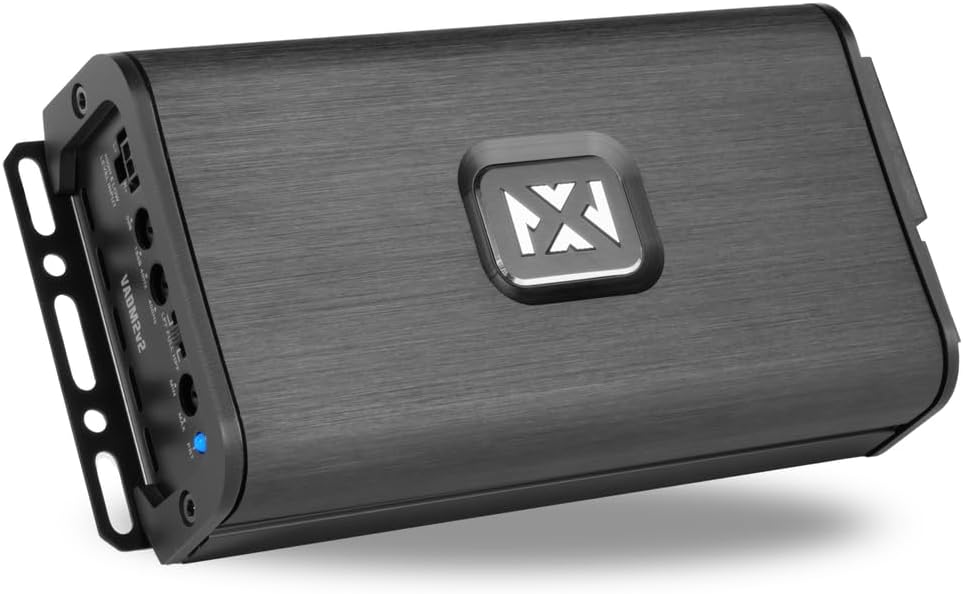
The NVX VADM2v2 is a compact two-channel Class D amplifier with 600 watts total RMS and a 1200-watt peak headline. It offers 200 watts per channel at four ohms, 300 watts per channel at two ohms, or 600 watts bridged into one four-ohm speaker. Its 4.3 rating places it among the stronger customer-rated options in the group.
We may earn a commission when you buy through this link, at no additional cost to you.
The amplifier's six-by-three-and-a-half-inch chassis is exceptionally compact for the output it provides. A conformally coated marine-grade circuit board helps resist moisture and salt, making the unit suitable for marine, powersports, and automotive applications when it is mounted appropriately. The circuit includes thermal, overload, speaker-short, and DC-offset protection, plus an LED power and protection indicator.
System integration is flexible. Balanced differential inputs help minimize noise, and the amplifier supports speaker-level input through an appropriate adapter. Crossover selection includes FULL, HPF, and LPF modes, with both filters adjustable from 40Hz to 400Hz. That wider range gives the VADM2v2 more flexibility than many compact two-channel marine amplifiers.
The VADM2v2 is a good match for installers who have limited space and need a bridgeable, multi-application Class D unit. It is less suitable for someone searching specifically for a true 1200-watt RMS amplifier, because its confirmed continuous rating is 600 watts. Nevertheless, its compactness, protection suite, and broad crossover range make it one of the more versatile products here.
Micro Class D technology delivers useful output from a chassis measuring only 6.49 by 3.3 by 1.48 inches. That dimensional efficiency is valuable in tight boat compartments and powersports installations where every available inch matters.
The amplifier can operate in conventional stereo, high-pass, low-pass, or bridged mono arrangements. That flexibility allows it to support full-range speakers, dedicated subwoofers, or a mixed system as the installation evolves.
We may earn a commission when you buy through this link, at no additional cost to you.
The JBL MA600 is a mono Class D marine amplifier built specifically for subwoofer power. It produces 350 watts RMS at four ohms and 600 watts RMS at two ohms, with a maximum output of 1200 watts. Its 5.0 rating makes it one of the highest-rated products in this comparison and a particularly attractive option for buyers focused on bass rather than full multichannel amplification.
We may earn a commission when you buy through this link, at no additional cost to you.
A low-profile chassis and small footprint help the MA600 fit into locations where larger amplifiers would be inconvenient. Both high-level and low-level inputs allow integration with factory or aftermarket marine stereos. The input-level control is unusually flexible, accepting low-level signals from 200mVrms to 4Vrms or high-level signals from 1Vrms to 22Vrms.
Tuning features include variable electronic crossovers and a bass-boost circuit. Balanced differential inputs are designed to reduce noise and distortion, particularly when high output levels could otherwise reveal interference from the vehicle or boat electrical environment. Protection circuits cover shorts, high temperature, overvoltage, and undervoltage, while an indicator LED communicates fault conditions.
This amplifier is best for a boat or outdoor system with a single subwoofer that needs dependable dedicated power. It cannot replace a multichannel amplifier for cabin speakers, but pairing it with a separate four-channel unit can produce a clean division of labor. Buyers should still confirm available enclosure volume, wiring needs, and the subwoofer manufacturer's recommended amplification range.
The MA600 devotes its Class D output to low-frequency amplification instead of splitting capacity among full-range channels. That focus can deliver more controlled bass performance while simplifying the signal path to a subwoofer.
High-level and low-level inputs make the amplifier compatible with factory marine stereos as well as aftermarket head units. Separate sensitivity ranges provide useful control across those source types.
We may earn a commission when you buy through this link, at no additional cost to you.
The Skar Audio RP-1200.1D is a monoblock Class D MOSFET amplifier that delivers 1200 watts RMS at one ohm and 1600 watts peak. That makes it the most direct match for a buyer searching specifically for a 1200-watt continuous-output model. Its 4.6 rating is also among the strongest confirmed customer ratings in the list.
We may earn a commission when you buy through this link, at no additional cost to you.
The amplifier is designed around low-frequency reproduction, with a stated frequency response of 20Hz to 250Hz. An onboard bass EQ can add either 6 or 12dB at 45Hz, giving installers a quick way to optimize low-end response for different subwoofer enclosures and vehicle acoustics. A wired remote subwoofer level control is included, allowing bass adjustment from the driver's position.
Power handling and installation hardware are serious. Four-way protection circuitry covers common operating faults, while four-gauge power and ground terminals support the current required by a stable one-ohm output. The high-efficiency heatsink is intended to manage heat while preserving performance and reliability.
The RP-1200.1D is a strong recommendation for a powerful subwoofer stage, especially when the speaker is designed to operate at one ohm. Its lack of an explicit marine certification means it is less obviously suited to exposed installations than the JBL MA600 or IP-rated options. In a protected boat compartment with careful wiring, it can still be considered for a dedicated bass system.
The included remote level controller makes it easy to adjust subwoofer output without reaching into the installation. This is particularly useful in a car or powersports vehicle where reflections and road noise can change how bass is perceived at different times.
One-ohm stability allows the amplifier to drive a lower-impedance subwoofer without relying on a bridged multichannel arrangement. That makes the design straightforward for installers who are building around a single dedicated bass channel.
We may earn a commission when you buy through this link, at no additional cost to you.
The Skar Audio RP-150.4ABM is a four-channel, full-range marine amplifier with a 1000-watt product designation. It supplies 250 watts RMS per channel at two ohms and 150 watts RMS per channel at four ohms. Although it does not deliver a documented 1200 watts RMS, its four-channel layout makes it one of the most practical options for powering a complete set of cabin speakers.
We may earn a commission when you buy through this link, at no additional cost to you.
Marine protection is explicit. The circuit board has a waterproof coating, and the mechanical case uses rust-resistant paint. User-adjustable gain, variable low-pass and high-pass filters, and a bass EQ switch provide the basic tools needed to integrate speakers with different output characteristics. Its listed 105dB signal-to-noise ratio and 20Hz-to-20kHz frequency response are well suited to full-range music.
The amplifier uses Class A/B technology rather than the more efficient Class D designs found among many competitors. In a vessel with limited electrical capacity, that distinction deserves attention because Class A/B amplifiers generally draw more power and produce more heat than comparable Class D models. Four-gauge power and ground terminals and four-way protection circuitry help support installation reliability.
Buyers seeking one amplifier for four cabin speakers should give the RP-150.4ABM serious consideration. It is less appropriate for someone whose main requirement is a literal 1200-watt RMS rating or a bridged high-power subwoofer channel. Its value instead lies in replacing a factory marine receiver while supplying four independent, adjustable speaker outputs in a protected, corrosion-conscious enclosure.
Four full-range outputs can cover bow, cockpit, and interior speakers without requiring separate compact amplifiers. Matching gain and crossover settings across those zones also gives the installer better control over the overall tonal balance.
A waterproof circuit-board coating and rust-resistant case finish directly address two persistent threats in marine installations. They should still be combined with sensible fuse placement, protected cable routing, and ventilation around the heat sink.
We may earn a commission when you buy through this link, at no additional cost to you.
The Magnadyne AquaVibe Pro AVP1200.5 is a five-channel Class D marine amplifier with 1200 watts total RMS power. Its four high-frequency channels provide 150 watts each at two ohms, while a separate subwoofer channel delivers 600 watts at one ohm. This architecture allows an entire boat audio system to run from one compact unit, making it one of the most complete solutions in the guide.
We may earn a commission when you buy through this link, at no additional cost to you.
The strongest differentiator is its IP67 wet-rated protection. That rating indicates resistance to dust and temporary water immersion under the applicable test conditions, offering stronger environmental assurance than a conventional coated circuit board alone. The chassis is also described as brushed-billet aluminum and measures 12.6 by 4.4 by 1.9 inches, allowing mounting under seats or within RV compartments where space is limited.
Tuning controls include variable crossovers, separate front and rear gain, bass boost, low-pass and high-pass filters, and a subsonic filter. A remote bass controller provides convenient subwoofer-level adjustment. Four-way protection circuitry is included for safer operation, while the dedicated subwoofer section simplifies the architecture of a mixed speaker-and-bass system.
The AVP1200.5 is the editor's choice because it most directly solves the challenge of building a complete 1200-watt RMS marine installation around one amplifier. It suits boats, motorcycles, RVs, and off-road systems where both multichannel speaker power and dedicated bass are required. The absence of a confirmed customer rating is the main reason it does not lead every category, so buyers should review current user feedback once available.
Four speaker channels and a separate subwoofer channel eliminate the need to pair a multichannel amplifier with a separate mono unit in many installations. Fewer boxes can mean easier cable routing, a cleaner setup, and a more unified tuning process.
The IP67 rating is especially relevant for marine and off-road use because it addresses enclosure protection against dust and water. Installation remains important, but the rating offers a clearer level of environmental assurance than general durability language.
We may earn a commission when you buy through this link, at no additional cost to you.
The NVX MVPA2 delivers 600 watts total RMS and up to 1200 watts peak through a bridgeable two-channel Class D design. It is intended for marine, powersports, and motorcycle use, and carries a 3.9 rating. Although that is the lowest confirmed score in the group, the amplifier's environmental rating and installation flexibility give it a distinct purpose.
We may earn a commission when you buy through this link, at no additional cost to you.
Its IPX67 waterproof rating is a major feature for exposed outdoor use. A conformal-coated circuit board adds another layer of protection, while the compact, ultra-mini enclosure makes the amplifier easier to place in tight spaces. Installation must still follow the manufacturer's mounting and wiring guidance because ingress protection depends on the complete enclosure and cable installation, not simply the internal board coating.
Signal options include auxiliary input and RCA connections, offering flexibility with different source arrangements. Top-tune controls and an included bass remote provide convenient system adjustment. Protection features cover short circuits, excessive temperature, and voltage problems, while LED indicators communicate operating and protection status.
Audio specifications include a frequency response of 20Hz to 20kHz, a 90dB signal-to-noise ratio, and 0.3% total harmonic distortion. The MVPA2 is best for a compact, weather-conscious two-speaker or bridged subwoofer installation. Its lower customer rating and peak-based headline mean buyers seeking stronger continuous output may prefer the VADM2v2 or a true 1200-watt RMS monoblock.
The small enclosure and IPX67 rating create a practical combination for marine and powersports installations where mounting space is at a premium. The rating also gives buyers more concrete environmental information than a general corrosion-resistant claim.
Auxiliary and RCA inputs allow the amplifier to work with more than one source configuration. A remote bass control adds everyday convenience when the amplifier is tucked into a compartment away from the operator.
We may earn a commission when you buy through this link, at no additional cost to you.
The Fusion Apollo Marine is a four-channel amplifier with a 1200-watt product designation and no confirmed customer rating in the supplied data. Its marine name and channel count make it a logical candidate for powering multiple speakers in a boat, but the absence of detailed specifications means buyers must evaluate the current manufacturer documentation carefully before deciding whether it fits a particular system.
We may earn a commission when you buy through this link, at no additional cost to you.
A four-channel amplifier is generally more useful for a complete boat installation than a two-channel model because it can support separate speaker zones without a second amplifier. Whether the Apollo distributes its stated output equally across four channels or uses a higher-output subwoofer section cannot be determined from the provided information, and buyers should not assume either arrangement.
The current listing image and product title identify the model as a marine amplifier, but the supplied data does not describe its class, RMS output by impedance, protection circuitry, input types, crossover controls, enclosure rating, or physical dimensions. Those missing details are important for preventing installation problems, particularly around speaker impedance, heat management, and cable routing.
The Fusion Apollo Marine may appeal to buyers seeking a branded four-channel marine option and should be investigated alongside the more fully specified four-channel Skar model. On the available evidence, it is not possible to recommend it confidently above models with documented RMS output and controls. Review the current instruction manual, verify terminal layout and speaker-load restrictions, and confirm compatibility with the rest of the planned system.
Four channels can serve several speaker groups from one amplifier, which is valuable in boats with bow, cockpit, and interior zones. The exact allocation of power must be confirmed because the supplied listing information does not break down the 1200-watt figure by channel.
The lack of detailed electrical and mechanical information makes the manufacturer's manual especially important. Confirm RMS power, supported impedance, input connections, protection behavior, and mounting clearances before connecting speakers or drawing power.
We may earn a commission when you buy through this link, at no additional cost to you.
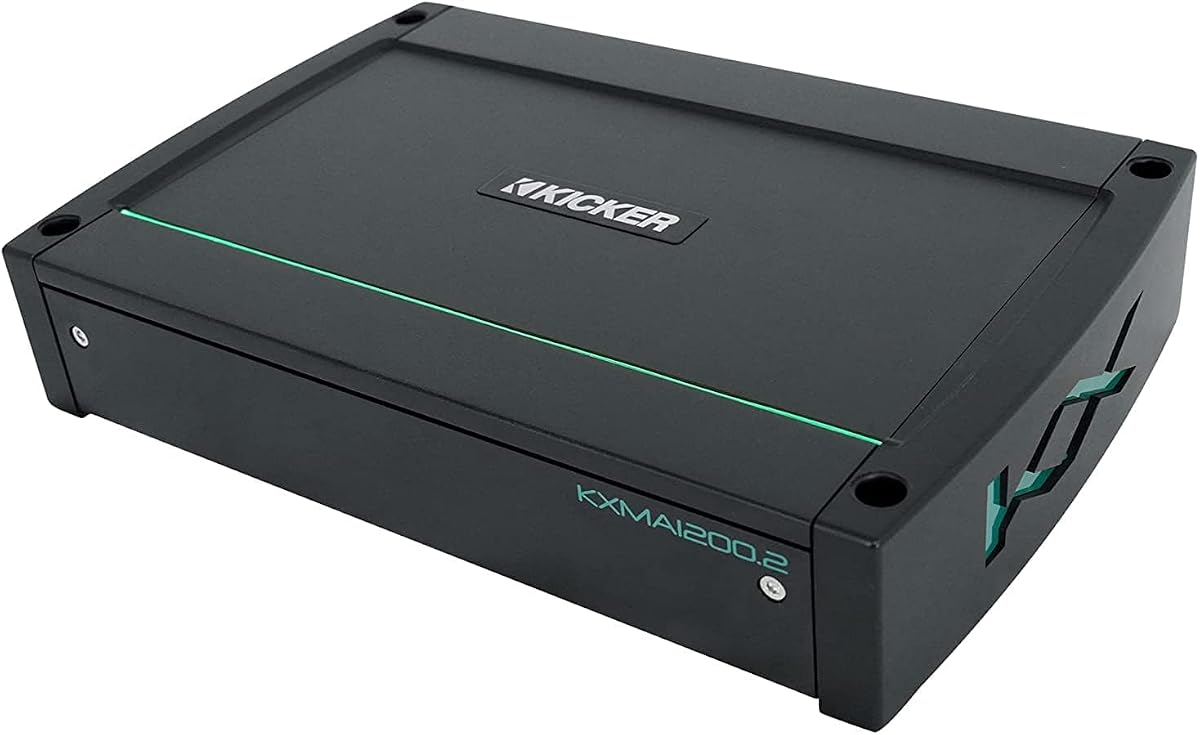
The Kicker KXMA1200.2 is a two-channel Class D marine amplifier rated in the product title at 600 watts per channel, or 1200 watts combined. Its 3.3 rating is the lowest confirmed customer score among the ten products, so it requires careful consideration rather than automatic acceptance. It remains relevant because the model is explicitly designed for marine use and offers a simple high-power channel arrangement.
We may earn a commission when you buy through this link, at no additional cost to you.
Two channels make the amplifier a natural match for a pair of full-range speakers or a bridged subwoofer configuration, assuming the manufacturer's bridge instructions are followed. Class D topology supports efficient operation, which can be beneficial in a boat where battery capacity, engine load, and heat management are important considerations.
The supplied data does not include detailed RMS power at different impedances, crossover controls, input configuration, protection circuitry, environmental rating, or dimensions. Buyers should consult the current manufacturer specifications and installation guide, especially because the listing title includes multiple model references. Speaker impedance, bridging requirements, and proper fuse selection should all be confirmed before installation.
The KXMA1200.2 is best considered for a buyer already familiar with the KXMA1200.2 platform who wants a dedicated marine two-channel unit. Its lower rating and limited supplied information place it behind the newer KICKER 48KXMA12002 in this comparison. Still, for a straightforward installation involving two channels and a trusted marine model name, it can remain a practical option once its exact specifications are verified.
A two-channel format keeps signal routing simple and makes the amplifier easy to pair with a conventional marine stereo. It can also be bridged for mono use when the manual permits, although users should confirm wiring and load requirements carefully.
Combining a marine application with Class D efficiency creates a logical foundation for mobile audio. Actual performance still depends on correct speaker matching, thermal clearance, electrical protection, and installation workmanship.
We may earn a commission when you buy through this link, at no additional cost to you.
The right marine amplifier depends on the number and type of speakers, enclosure space, electrical system, and exposure to moisture. Comparing continuous output, channel flexibility, protection, and installation requirements prevents a headline wattage figure from leading to the wrong purchase.
RMS power is the more useful figure for judging continuous output because it represents sustained performance under defined conditions. Peak power is a maximum short-term figure and should not be compared directly with another amplifier's continuous rating. In this guide, the Rockville Atom P60 and Skar RP-1200.1D are documented at 1200 watts RMS, while the NVX models and JBL MA600 reach 1200 watts through peak or maximum-output wording. Match the amplifier's RMS specification at the impedance of the intended speakers, not merely the largest number on the box.
Prioritize verified RMS output and, when available, per-channel or bridged output at the planned speaker impedance.
Choose the number of channels according to how the system is organized. A two-channel amplifier can power a pair of speakers or be bridged for one subwoofer, while a four-channel model can cover multiple cabin zones. The AquaVibe Pro's five-channel layout adds a specialized subwoofer section, allowing several speakers and a subwoofer to operate from one enclosure. Mono amplifiers such as the JBL MA600 and Skar RP-1200.1D are specialized choices for bass-heavy systems.
Select a channel count that matches the planned speaker layout without forcing unnecessary complexity into the installation.
Marine environments expose electronics to spray, humidity, salt, dust, vibration, and temperature changes. Look for conformal-coated circuit boards, rust-resistant hardware, sealed or protected enclosures, and a formal IP rating when the amplifier may encounter significant water exposure. The AquaVibe Pro carries an IP67 rating, while the NVX MVPA2 lists IPX67 protection. These markings provide clearer information than generic claims of weather resistance, but proper mounting, strain relief, fuse placement, and cable sealing remain necessary.
Choose the strongest environmental rating appropriate for the mounting location and maintain the amplifier according to its documentation.
A marine system often mixes full-range speakers with subwoofers, and crossover controls help keep each speaker in its appropriate frequency range. Variable high-pass and low-pass filters allow the installer to separate bass from cabin audio without relying on passive components. Other useful controls include selectable crossover modes, subsonic filtering, input sensitivity, gain, and bass boost. The VADM2v2 offers filters from 40Hz to 400Hz, while the Atom P60 uses a 50Hz-to-250Hz range. Match available adjustment to the speaker crossover recommendations.
Prefer an amplifier with the filters and input controls needed for the system rather than paying for unused multichannel flexibility.
Class D amplifiers are generally well suited to high-output marine use because they are efficient and generate less heat than conventional Class A/B designs. That advantage matters in sealed compartments where ventilation is limited and in boats with finite electrical capacity. A Class A/B model can still sound excellent and provide useful full-range output, as the Skar RP-150.4ABM illustrates, but it may require more electrical power and careful heat dissipation. Check amplifier dimensions, heat-sink clearance, enclosure ventilation, and the system's charging capacity.
Favor efficient topology and adequate thermal clearance, especially when the amplifier operates continuously in a confined compartment.
The correct inputs can simplify integration considerably. RCA low-level inputs suit aftermarket head units and processors, while high-level inputs allow connection to a factory marine stereo without a separate line-output converter. Balanced differential inputs can help reduce noise in electrically noisy installations. The JBL MA600 supports both high- and low-level sources, the NVX VADM2v2 accepts speaker-level input through an appropriate adapter, and the MVPA2 includes auxiliary and RCA options. Confirm source type, connector format, and ground-loop compatibility before installation.
Match the amplifier's input architecture to the stereo, processor, or factory system that will feed it.
Output power is only one part of the electrical equation. Use appropriately sized power and ground cables, an appropriately fused near the battery or power distribution point, secure chassis grounding, and correctly sized speaker wiring. Low-impedance loads demand careful attention to current draw and thermal load. Large terminal blocks are helpful on powerful monoblocks, but four-gauge terminals do not automatically guarantee safe operation if upstream wiring is undersized. A marine installer should also plan for condensation, drainage, corrosion, and service access.
Plan the complete power path and mounting location before ordering so the amplifier, cables, speakers, and protection all work together safely.
Remote bass controllers, digital voltage displays, LED status indicators, input-level selectors, and subsonic filters can improve usability, but extra features do not compensate for unsuitable power or protection. A simple amplifier that cleanly satisfies the speaker layout may be more valuable than a more elaborate model with controls the installer will never use. Review the protection circuitry, warranty information, manual availability, and manufacturer support alongside the feature list. These practical details often influence long-term ownership more than a secondary convenience feature.
Prioritize electrical fit, environmental protection, and clean installation over features that duplicate controls already available at the source.
Begin by planning the complete signal and power path. Confirm speaker impedance, amplifier channel configuration, crossover requirements, and the number of outputs needed before wiring anything. Connect the amplifier to a suitable power source through correctly sized cable and a properly placed fuse, then use a short, substantial ground connection to clean bare metal. Keep speaker and power cables organized, avoid passing sharp edges over unprotected conductors, and verify that every terminal is tightened according to the manufacturer's instructions.
Start with gain and crossover settings conservatively. Set the amplifier's gain as low as practical, use the source unit's volume control to establish a clean baseline, and adjust upward only as needed. For bridged mono operation, use the manufacturer's exact wiring diagram and remove the factory jumper if instructed. Listen for clipping, overheating, excessive noise, or unstable bass, and correct the cause rather than compensating with additional gain. Never operate a marine amplifier with unsealed terminal covers or exposed connections in a wet location.
During routine care, inspect the mounting area for moisture, corrosion, loose fasteners, cable abrasion, and blocked heat-sink fins. Salt deposits should be removed using fresh water and a soft cloth, followed by complete drying. Keep electrical connections clean and dry, check fuse condition, and listen for changes in output that could indicate overload, poor grounding, or an impedance mismatch. If the amplifier's protection indicator activates, stop using it at high output and verify the speaker load, ventilation, voltage, and wiring before resetting or operating it again.
It can be, but the important question is how much of that output is continuous RMS power at the subwoofer's impedance. A true 1200-watt RMS mono model can serve a powerful dedicated subwoofer, while a 1200-watt peak-rated two-channel amplifier may provide only half that figure. Always match the amplifier's rated load range to the speaker manufacturer and verify enclosure requirements.
A five-channel model may be able to power cabin speakers and a subwoofer from one unit. Four-channel amplifiers can also cover several speaker zones, while two-channel models often require a separate mono amplifier for bass. The number of speakers, their impedance, crossover needs, and desired output determine whether one amplifier is enough.
RMS power describes sustained output under standardized testing, while peak power represents a short-duration maximum. Comparing two peak ratings or comparing one amplifier's peak figure with another amplifier's RMS figure can be misleading. Use RMS specifications at the same impedance when comparing products.
They need an installation that prevents uncontrolled water from entering the enclosure and reaching the terminals. Environmental ratings help, but cable entries, covers, fuse holders, and mounting position also matter. Conformal coating protects internal circuitry rather than making exposed terminals safe, so seals, strain relief, and corrosion prevention remain necessary.
A protected, ventilated compartment is usually preferable because it reduces exposure to spray and direct weather while still allowing heat to escape. The amplifier must have clearance around its heat sink and should not be enclosed in a sealed box without adequate thermal planning. Follow the manufacturer's mounting and environmental requirements.
A general automotive amplifier may work in a very dry, protected compartment if its power, impedance, and signal requirements fit the system. It is not automatically equivalent to a marine amplifier in corrosion resistance, sealing, or connector protection. For exposed or humid installations, choose a unit with explicit marine construction or an appropriate IP rating.
The draw depends on efficiency, output level, and the amplifier's operating state. A powerful Class D amplifier may draw less current than a Class A/B amplifier while producing similar output, but heavy bass playback can still place significant load on the electrical system. Use proper cable, fusing, grounding, and battery or charging-system guidance sized for the installation.
The most useful features are accurate speaker-load support, appropriate crossover controls, reliable protection circuitry, corrosion-resistant construction, and input compatibility with the boat's stereo. Remote bass control and status indicators can add convenience, but they should not replace correct sizing, environmental protection, and sound system design.
The Rockville Atom P60 stands out as the best overall value because it combines documented 1200-watt RMS output with bridgeability, adjustable crossover controls, and substantial protection features. The Magnadyne AquaVibe Pro AVP1200.5 is the most complete single-box solution, with five channels, 1200 watts total RMS, an IP67 rating, and a dedicated subwoofer section. For a premium two-channel marine installation, the KICKER 48KXMA12002 combines marine positioning, Class D efficiency, and a perfect confirmed customer rating.
The rest of the field serves more specialized needs. The JBL MA600 and Skar RP-1200.1D suit dedicated subwoofer systems, while the Skar RP-150.4ABM is designed around four full-range cabin channels. The NVX VADM2v2 and MVPA2 emphasize compact Class D construction, and the Fusion Apollo Marine may appeal to buyers seeking another four-channel marine option after its detailed specifications are verified.
Before purchasing, compare continuous RMS output at the intended speaker impedance, confirm the channel and crossover requirements, and check the amplifier's environmental protection against the mounting location. Review the current product listing and manufacturer manual for specifications, dimensions, wiring details, and protection requirements. Availability and listing information can change, so confirming the current model details helps ensure that the selected amplifier fits both the audio system and the installation plan.