
400-HD Heavy-Duty Garage Door Lubricant
4.8Editor score
Three-way application nozzle
Rust and corrosion protection
Cold-temperature component release
Displaces moisture buildup
Compare 10 leading Garage Door Lubricant options for application, residue, protection, and opener compatibility to help you maintain smooth, quiet doors.
A garage door lubricant can restore smooth movement, quiet troublesome hinges, and protect metal components from corrosion. The right formula should reduce friction without attracting dust, leaving a sticky mess, or conflicting with the materials used in your door and opener system.
We compared the ten products below by examining their stated formulas, application methods, compatible components, residue behavior, environmental claims, and suitability for residential or commercial doors. The list covers aerosol sprays, multipurpose oils, silicone lubricants, heavy-duty options, and opener-specific rail lube.
Each review highlights a different reason to consider the product, from precise straw application to deep-penetrating lubrication and annual screw-drive maintenance. Ratings and product details reflect the supplied information, while prices and availability can change, so compare current listings before purchasing.
4.8Editor score

4.8Editor score

4.7Editor score
The comparison below evaluates each lubricant by its stated application method, formula, residue behavior, component coverage, and specialized maintenance purpose.


The 3-IN-ONE Garage Door Lubricant combines a 4.7 rating with a straightforward two-way smart straw, making it a strong all-around choice for routine garage door maintenance. It is designed to lubricate metal between moving parts, reduce friction, and help protect against corrosion without the slow cleanup associated with heavier grease products.
We may earn a commission when you buy through this link, at no additional cost to you.
Its standout feature is application control. The permanently attached straw can produce either a wide or narrow spray, letting the user cover larger sections such as tracks and rollers while placing concentrated lubricant around hinges, pulleys, and chains. The formula is quick-drying and non-sticky, so it is less likely to attract dirt and contaminants after application.
The product is also described as professional grade and suitable for heavy-duty commercial garage doors, giving it broader relevance than a product limited to light residential maintenance. It can be applied to hinges, tracks, chains, pulleys, rollers, and other moving metal parts. The same basic formula is also available in multipack configurations for frequent users.
The main trade-off is that this is an aerosol lubricant, so careful aiming matters. The smart straw helps with precision, but spraying too aggressively can still create overspray. It is also not designed for lubricating a screw-drive opener rail, where a purpose-specific formula may be more appropriate. Overall, it is an easy recommendation for anyone seeking broad component coverage and controlled application.
The attached smart straw switches between a narrow stream and a broader spray, helping users direct lubricant toward hinges, tracks, chains, and other components without immediately moving the can to a different nozzle.
Because the formula is advertised as quick-drying and non-sticky, it is a practical choice for exposed door hardware where a heavy residue could collect dust and create additional friction.
We may earn a commission when you buy through this link, at no additional cost to you.
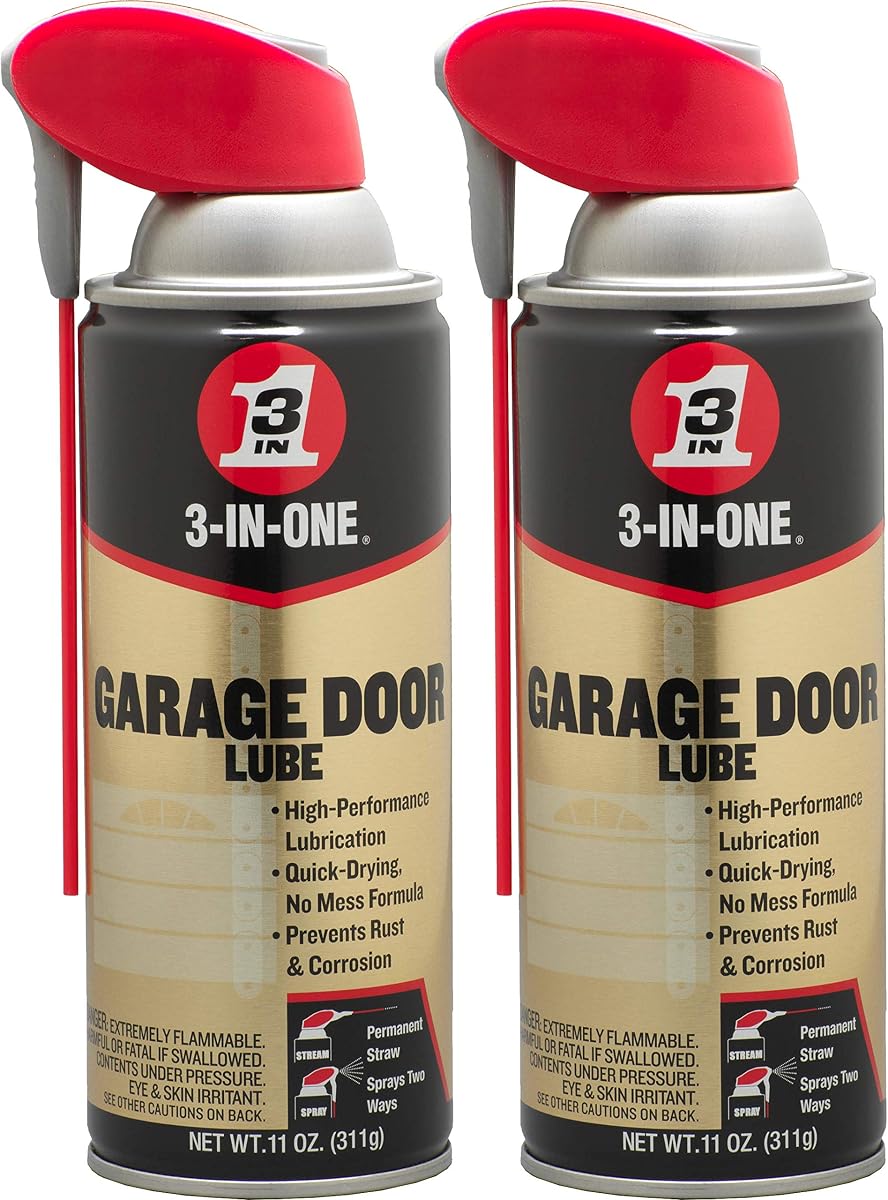
This two-pack of 3-IN-ONE Professional Garage Door Lubricant carries a 4.7 rating and preserves the key strengths of the single-can version: a smart straw, quick drying, and a non-sticky result. It is a practical choice for households with multiple doors, maintenance professionals, or anyone who prefers keeping replacement aerosol on hand.
We may earn a commission when you buy through this link, at no additional cost to you.
The formula targets the metal interfaces where friction, rust, corrosion, squeaking, and jamming can occur. Its stated applications include hinges, tracks, chains, pulleys, rollers, and other moving parts. The smart straw cannot be lost or misplaced, and both a precision stream and fan-shaped spray are available for different components or levels of coverage.
Compared with traditional aerosol grease, its selling point is cleanliness. The product is intended to lubricate and protect without leaving residue that attracts dirt and eventually contributes to friction. It is also marketed for heavy-duty commercial garage doors, giving it wider utility than a standard household spray.
The obvious consideration is that two cans may be more than a single residential door requires. However, aerosol products dry out or become less convenient to store over time, so having a second can can be useful for a garage, rental property, or workshop. For buyers who want the established 3-IN-ONE approach in a convenient two-can format, this is a strong option.
The two-can format suits households with more than one garage, property managers, and maintenance workers who want a second container available without repeatedly purchasing a single aerosol.
The formula is stated to work on the broad set of moving components that make up a garage door, including hinges, tracks, chains, pulleys, and rollers.
We may earn a commission when you buy through this link, at no additional cost to you.
Blaster Garage Dr Lube receives a 4.6 rating and is formulated as a cleaner alternative to messy aerosol grease products. Rather than focusing only on movement, it combines silicone-based lubrication with lasting protection and an extreme-pressure agent for demanding metal components.
We may earn a commission when you buy through this link, at no additional cost to you.
The product's most notable claim is that its proprietary formula leaves a tack-free film. That characteristic is important around garage doors because surfaces that remain sticky can collect dust and dirt, potentially undermining the cleaner operation the lubricant is intended to provide. The product description specifically emphasizes protection and cleanliness alongside lubrication.
It is sold as a pack of two 9.3-ounce containers. Buyers should note that the supplied product information is explicitly described as applying per pack, so users can avoid interpreting the two-container package as a single-can specification. The formula is positioned for users who want the penetration and film-forming characteristics associated with lubricants without handling the mess often associated with heavier aerosol greases.
This is a good selection for someone who values a clean finish and wants a two-can supply of a silicone-oriented garage lubricant. Its 4.6 rating is slightly below the highest-rated choices, and the supplied information gives less explicit detail about individual components than some competing descriptions. Even so, its focus on cleanliness, protection, and pressure tolerance makes it a credible maintenance option.
The tack-free film is intended to provide lasting lubrication while avoiding the sticky surface that can gather dust and grit around frequently moving hardware.
An extreme-pressure agent adds a performance consideration beyond basic lubrication, making the formula relevant to high-friction metal contact areas.
We may earn a commission when you buy through this link, at no additional cost to you.
B’Laster Garage Door Lubricant has a 4.7 rating and a clear product proposition: reduce friction, quiet noisy operation, and leave a clean surface that does not attract dust. Its dry silicone formula is intended for tracks, hinges, rollers, and other moving components that make up a garage door system.
We may earn a commission when you buy through this link, at no additional cost to you.
The product's claims focus on both immediate and protective benefits. It is advertised to silence squeaks and grinding while reducing friction, and the tack-free coating is designed to stay clear rather than sticky. That matters because a dirty, gritty film can make an otherwise lubricated mechanism noisy again over time.
It is also positioned as a general silicone spray and lubricant for chains, appliance components, and other moving household parts. The formula is stated to be safe for all garage door materials, while rust and wear protection are presented as additional benefits of consistent use. A targeted nozzle supports direct application without relying on a removable straw.
This package contains six 9.3-ounce cans, so it is primarily a bulk maintenance option. A homeowner with one standard door may not need a case, but a property manager, contractor, or workshop servicing several doors can benefit from the supply. For users who prioritize quiet operation and a dust-resistant finish, it is a strong specialist choice.
Tracks, hinges, and rollers are common sources of noise, and the formula directly targets those components to support smoother, quieter movement.
The non-sticky silicone finish is designed to resist collecting dust, helping preserve the cleanliness of visible and exposed moving parts.
We may earn a commission when you buy through this link, at no additional cost to you.
WD-40 Specialist Silicone Lubricant earns a 4.8 rating, making it one of the strongest-rated products in this guide. It offers a clean, general-purpose silicone lubricant that applies to garage door hardware while also serving tracks, guide rails, pulleys, valves, hinges, locks, and machine equipment.
We may earn a commission when you buy through this link, at no additional cost to you.
Its defining benefit is smooth, reliable lubrication without attracting dirt or debris. The formula dries to a clear finish and does not leave the messy or sticky residue associated with heavier lubricants. That makes it useful in areas where cleanliness matters as much as movement, including household guides, mechanisms, and equipment linkages.
Broad material compatibility is another reason it stands out. The supplied information states that it is designed for most metal, rubber, vinyl, plastic, and other non-metal surfaces without degrading them. The 13.3-ounce can also provides a larger format than most of the door-focused aerosols in this comparison.
Because it is designed for a wider range of applications, it may not be as narrowly specialized as a product explicitly formulated for garage doors or screw-drive rails. Users still need to follow the can's application guidance and avoid uncontrolled overspray. Even with that caveat, its high rating, clean finish, and material flexibility make it an excellent general selection for a garage or workshop.
The clear drying finish supports smooth movement while helping prevent the dust and debris buildup that can accompany heavy, sticky lubricants.
Compatibility with metal, rubber, vinyl, plastic, and other non-metal surfaces allows the same product to serve guide rails, pulleys, hinges, locks, and equipment.
We may earn a commission when you buy through this link, at no additional cost to you.
This six-pack of 3-IN-ONE Garage Door Lubricant is built for repeated maintenance. It retains the 4.7 rating associated with the product line and supplies six 11-ounce cans, making it more relevant to commercial operators, property managers, or households maintaining several garage doors.
We may earn a commission when you buy through this link, at no additional cost to you.
The formula is stated to minimize friction in residential and commercial systems. Hinges, tracks, chains, pulleys, sliding gate rollers, and other metal components can all be treated, while the quick-drying, no-mess application helps prevent contaminant accumulation. It is also advertised to inhibit sticking, squeaking, and corrosion.
Its permanently attached hinged straw offers both a precision stream and a fan-shaped spray. That dual pattern makes it easier to move between concentrated points and broader sections without changing accessories or losing a small removable cap. The same professional orientation appears throughout the supplied description.
The obvious downside is package size. A homeowner with one door and no other garage equipment may find six cans excessive, and aerosol lubricants require responsible storage. For a maintenance team or a large property portfolio, however, the bulk packaging can be highly convenient. It is a high-volume version of a well-rounded, low-residue formula.
The six-can format reduces the need for frequent replacement in a workshop, rental property, or commercial garage where multiple doors are maintained.
A precision stream reaches individual hinge and pulley points, while the fan pattern provides faster coverage along tracks and larger component sections.
We may earn a commission when you buy through this link, at no additional cost to you.
The 400-HD Heavy-Duty Garage Door Lubricant has a 4.8 rating and distinguishes itself with a three-way nozzle, rust prevention, cold-condition component release, and moisture displacement. It is the most explicitly heavy-duty product in this guide, especially for exposed hardware that encounters weather or seasonal moisture.
We may earn a commission when you buy through this link, at no additional cost to you.
Its special nozzle is designed to make precise application possible in hard-to-reach areas. This is particularly relevant to hinges, tracks, and other components mounted at different angles or recessed positions. The product is formulated to protect parts from rust and corrosion with an emphasis on long-lasting hinge and track protection.
Seasonal performance is another major strength. The formula is stated to free stuck or frozen components even in cold temperatures, while displacing moisture to reduce the risk of damage. It also reduces friction between moving parts, supporting smoother operation and helping extend component life.
This focused feature set makes it an excellent choice for garages exposed to damp, cold, or coastal conditions. It may feel like more than a basic lubricant, but that is precisely the advantage for buyers seeking deeper protection. Correct application and the right nozzle pattern remain important, and users should follow the can's directions. For difficult, exposed components, 400-HD provides a compelling premium maintenance solution.
The nozzle system is built to reach difficult locations and distribute lubricant accurately, which is useful around recessed hinges, roller areas, and track sections.
By displacing moisture and resisting rust and corrosion, the formula targets the conditions that can turn stiff hardware into noisy or difficult-to-operate components.
We may earn a commission when you buy through this link, at no additional cost to you.
DuPont White Lithium Grease has a 4.6 rating and offers a more traditional grease approach than the silicone and clean-film lubricants in this list. Its lithium complex formula is enhanced with Teflon and advertised to resist washing off, melting, freezing, and extreme heat.
We may earn a commission when you buy through this link, at no additional cost to you.
Environmental durability is the defining feature. Garage door hinges, rollers, and other exposed metal components face rain, temperature changes, and accumulated dirt. A formula designed to remain in place through washing and wide temperature conditions can be useful on stubborn pivot points and high-wear metal interfaces.
The product also has a clean, low-odor application profile, which is beneficial in enclosed garages. However, users should recognize that white lithium grease is not described as a door-specific, low-residue product. As with most greases, heavy application in areas where debris can collect may require more care than a quick-drying silicone formula.
This product is best suited to a homeowner or technician who values durable grease protection and environmental resistance over a dry finish. It can serve as a targeted option for exposed hardware that needs long-lasting metal care. For tracks or sensitive areas where a light, non-greasy film is preferred, one of the silicone products may be more appropriate.
The lithium complex formula and Teflon enhancement are intended to retain performance in demanding metal contact points where wash-off and temperature resistance matter.
Outdoor suitability makes the grease relevant for exposed hinges and components that encounter rain, dust, and seasonal temperature changes.
We may earn a commission when you buy through this link, at no additional cost to you.
Gear Hugger Multipurpose Lubricant has a 4.2 rating and stands apart through its plant-based, non-toxic, odorless, and biodegradable formulation. It is marketed for garage doors, sliding doors, cabinets, bicycle chains, motorcycle chains, fishing reels, power tools, plumbing joints, and other household or workshop applications.
We may earn a commission when you buy through this link, at no additional cost to you.
For garage door use, the formula is described as a deep-penetrating oil that resists rust, corrosion, and wear while loosening stiff or seized hardware. It is also positioned as a replacement for several conventional lubricant categories and claims to last longer than standard silicone and petroleum sprays. Those are notable manufacturer claims, though the supplied information does not include independent comparative testing data.
The two-way straw gives users a targeted stream for precise placement and a wider spray for larger surfaces. The product description emphasizes controlled application without drips, leaks, or overspray, while also stating that it does not leave sticky residue or attract dust and grit.
Its 4.2 rating is the lowest in the group, and that distinction matters when choosing among established garage door lubricants. Still, the product may appeal to users who prioritize plant-based chemistry, low odor, indoor use around children and pets, and broad household utility. It is a distinctive choice for shared spaces, but its comparative durability claims deserve careful consideration before relying on it in a demanding environment.
The non-toxic, odorless, and biodegradable attributes make the lubricant easier to consider around occupied indoor spaces, provided the label directions are followed.
Its stated uses range from garage door hinges to drawers, cabinets, chains, fishing reels, and power tools, reducing the need for several specialty lubricants.
We may earn a commission when you buy through this link, at no additional cost to you.
Genie Screw Drive Lube is a specialized maintenance product with a 4.6 rating. Unlike the aerosols in this guide, it is a 0.25-ounce lithium-grease tube formulated for the screw-drive rails of Genie garage door openers, where it is described as the only recommended lubricant.
We may earn a commission when you buy through this link, at no additional cost to you.
Its purpose is highly specific: reduce opener noise, support smooth operation, and help prolong the life of the screw-drive rail. The recommended method is to apply small one-inch dabs at three points along the rail once per year. One tube is described as enough to lubricate an entire screw drive, making the three-pack especially useful for future maintenance.
The tube format is also more controlled than an aerosol. A user can place a small amount at the recommended points instead of spraying a broad coating over the rail or nearby components. That precision is valuable for a mechanism where excess lubricant could create cleanup concerns or where the manufacturer has specified a particular maintenance product.
This is not a substitute for a broad garage door lubricant because it is not designed broadly for hinges, tracks, rollers, or other door hardware. It is the clear choice for a Genie screw-drive opener owner, while those with other opener systems should check their manufacturer guidance. Used as directed, it offers a simple and purpose-built annual maintenance routine.
Using the lubricant identified as recommended for Genie screw-drive rails can remove uncertainty about product compatibility and provides a manufacturer-aligned maintenance approach.
Three small dabs along the rail provide controlled placement, and the three-tube pack supports repeat annual maintenance without handling a large aerosol can.
We may earn a commission when you buy through this link, at no additional cost to you.
The right garage door lubricant depends on the components involved, the exposure to weather and dirt, the desired finish, and whether the opener requires a specific maintenance product.
Garage doors contain several distinct contact points. Hinges, rollers, tracks, chains, cables, pulleys, and moving fixtures can have different lubrication needs, while screw-drive opener rails require their own specific care. A broad silicone spray is useful for exposed moving hardware, but a heavy-duty penetrating formula may be better for seized components. An opener rail should always be serviced according to the opener manufacturer's instructions rather than treated with a generic aerosol.
Choose based on the component that needs attention, not only the product's garage door label.
Cleanliness matters because dust and grit can become embedded in sticky residue and increase friction. Silicone and dry-film products are especially attractive for tracks, rollers, and visible hardware when a non-sticky finish is important. Lithium grease and aerosol grease can provide more durable protection on selected metal pivots, but a heavier application may collect debris. Think about where the lubricant will be exposed and how often the area is likely to be cleaned.
Favor a dry, tack-free finish for exposed tracks and frequently moving parts.
A narrow stream is useful for placing lubricant exactly at a hinge pin, roller, pulley, or rail point. A fan spray covers broader sections more quickly, but it also requires more care to avoid overspray. Permanently attached straws are convenient because they cannot be misplaced, and multi-pattern nozzles can adapt to different parts of the system. For tubes, controlled placement may be preferable around sensitive opener hardware.
Use narrow application for precise points and wider spray only when coverage is appropriate.
Garage doors are frequently exposed to rain, humidity, temperature changes, and road salt. A lubricant that resists rust, corrosion, washing off, and extreme temperatures can be valuable for hinges and other exposed metal points. The 400-HD product emphasizes rust prevention and moisture displacement, while DuPont's lithium grease is marketed for resistance to washing off and temperature extremes. No coating can replace sensible maintenance, but formula choice can improve long-term protection.
Choose enhanced rust protection for damp, cold, or coastal environments.
A garage door may contain painted steel, galvanized components, plastic rollers, rubber weather seals, vinyl pieces, cables, and various fasteners. Some products are safe across several metal, rubber, vinyl, and plastic surfaces, while others focus on metal contact points. Confirm the product instructions and your door manufacturer's recommendations before applying a lubricant broadly. Compatibility is especially important if overspray reaches seals, decorative panels, or non-metal guide components.
Verify the label and door guidance before spraying every visible surface.
Single cans are appropriate for occasional maintenance, while multipacks help households with several doors and workshops that service multiple properties. Tubes offer excellent dose control and are convenient for annual opener-rail maintenance. Aerosols provide fast, broad access but require ventilation, careful storage, and controlled spraying. Consider how often you will use the product, where it will be stored, and whether you prefer broad coverage or precise placement.
Choose single cans for occasional care and multipacks for regular maintenance.
Traditional petroleum, silicone, white lithium grease, and plant-based oils differ in residue, odor, and intended performance. A plant-based, non-toxic, biodegradable formula may suit occupied indoor environments where odor and material considerations are important. Heavy-duty penetrating oils may be better for rusty or seized hardware, while dry silicone products are attractive for clean everyday maintenance. The most useful formula is one that meets both the mechanical problem and the location.
Compare odor, ingredients, residue, and environmental claims alongside performance needs.
Lubrication is not a permanent solution to damaged cables, misaligned tracks, worn rollers, or defective openers. A good product can reduce friction and slow wear, but it cannot correct mechanical faults. If the door continues to grind, bind, reverse, or travel unevenly, inspect the hardware and consult a qualified technician. Periodic cleaning and timely lubrication are most effective when paired with proper alignment and replacement of worn components.
Treat lubricant as preventive maintenance, not a repair for damaged door parts.
Begin with the opener disconnected or power removed according to the manufacturer's safety instructions, and close the garage door securely. Place a protective cloth beneath the moving components you will service. Remove old dirt, rust, and debris with a dry or lightly damp cloth so lubricant is applied to the contact surfaces rather than trapped beneath a layer of grime.
Select the narrowest practical spray or tube stream and apply a small amount directly to hinges, rollers, tracks, chains, pulleys, and other specified moving parts. Avoid soaking bearings, decorative panels, weather seals, and unrelated surfaces. Follow the can's directions, allow the product to form its stated dry or tack-free coating, and wipe away any obvious excess before operating the door.
For screw-drive opener rails, do not substitute a general garage door aerosol. If your opener is a Genie screw-drive model, apply the Genie Screw Drive Lube in the recommended one-inch dabs at three points along the rail once each year. Inspect the door periodically, clean moving parts, and repeat lubrication when noise, stiffness, or seasonal conditions suggest that maintenance is due.
A dry, non-sticky silicone or purpose-made garage door lubricant is usually a strong choice for squeaking hinges and rollers because it reduces friction without readily collecting dust. Apply it sparingly to the actual pivot or contact points and avoid flooding other components. If the noise continues, inspect alignment, worn rollers, and bent hardware because lubricant cannot correct a mechanical defect.
The door hardware and opener rail are separate systems and should not automatically receive the same product. Hinges, rollers, tracks, chains, and pulleys can use an appropriate general or garage door lubricant, while a screw-drive rail may require a specifically approved rail lubricant. Always consult the opener and door manufacturer instructions before applying a product to the rail.
It depends on the specific product. Some silicone lubricants are formulated for metal, rubber, vinyl, plastic, and other non-metal surfaces, but others are intended only for metal contact points. Check the label for compatible materials, and avoid spraying seals, rollers, or decorative parts unless the manufacturer confirms compatibility.
A general inspection every few months is sensible, with lubrication performed when hinges, rollers, or tracks begin to sound rough or show resistance. Seasonal changes can increase the need for attention. A Genie screw-drive rail has a more specific recommendation of one application per year at three points along the rail.
Not by itself. Uneven travel can result from misaligned tracks, damaged cables, worn rollers, bent hardware, or an opener problem. Lubrication may reduce friction in moving components, but persistent poor alignment or closing behavior requires inspection and potentially professional repair.
Some products are explicitly multipurpose, while others are narrowly formulated for garage doors. WD-40 Specialist Silicone Lubricant is listed for guide rails, pulleys, hinges, locks, and equipment, and Gear Hugger targets many household and workshop applications. Confirm compatibility and instructions before using a garage lubricant on an unfamiliar mechanism.
A heavy-duty formula may be better when the immediate problem is frozen, rusty, or seized hardware because penetrating products are designed to free stiff components. For routine maintenance and exposed tracks, a clean silicone formula may be more appropriate. If a hinge remains stuck, damaged or misaligned parts may need replacement rather than additional lubricant.
Overspray or prolonged contact could affect some finishes, particularly if a product is not intended for the surface. Apply a controlled amount to moving metal parts, test unusual materials according to the label, and keep aerosol overspray away from painted panels, seals, and decorations. Correct placement reduces both residue and finish risk.
The WD-40 Specialist Silicone Lubricant is the strongest all-around recommendation because of its 4.8 rating, clear drying finish, broad material compatibility, and usefulness beyond the garage. The 400-HD Heavy-Duty Lubricant stands out for rust protection, moisture displacement, cold-condition performance, and three-way nozzle control, while the 3-IN-ONE single can offers dependable value with a smart straw and broad garage hardware coverage.
Prioritize the finish and component match rather than choosing solely by rating. Dry silicone formulas suit clean everyday maintenance, heavy-duty options help with rust or seized hardware, and multipacks serve frequent users. For a Genie screw-drive opener, the purpose-specific Genie rail lube is the appropriate choice for the rail and should follow the stated annual application points.
Before buying, compare the current listing, package size, product instructions, and manufacturer recommendations for your specific door and opener. Ratings and product details can change, and prices and availability fluctuate. Choosing the right lubricant for the job—and applying it sparingly to the correct components—will help keep the door smoother, quieter, and cleaner over time.
