
NGTeco Standalone Time Clock
4.3Editor score
Fully standalone operation
500 user profile capacity
50,000 stored punch records
Ready-to-use Excel reports
Compare the best Biometric Fingerprint Scanner Time Clock options for 2026, including biometrics, payroll features, connectivity, accuracy, and ease of use.
A biometric fingerprint scanner time clock can replace slow paper-based attendance routines with faster, more consistent employee verification. The right system should accurately recognize registered users, calculate hours, support convenient clock-ins, and make attendance records easy for managers to review. Key considerations include fingerprint capacity, cloud connectivity, payroll compatibility, backup protection, and the number of authentication methods supported.
This guide compares ten time clocks and related fingerprint attendance devices according to the features and specifications listed in their product information. It covers standalone models for businesses wanting local operation, connected systems for remote administration, and multi-biometric units for workplaces that need face, palm, fingerprint, card, or PIN access. The comparison also considers reporting, shift handling, language support, user limits, warranty coverage, and ease of setup.
Each review highlights the strongest reason to consider a particular model, along with limitations that may affect another type of buyer. The leading choices range from a budget-friendly standalone unit to connected systems with remote apps and web reporting. Amazon availability, ratings, specifications, and product terms can change, so readers should confirm the latest listing details before making a purchase.
4.3Editor score

4.7Editor score

4.1Editor score
The table below compares authentication methods, connectivity, capacity, reporting, and other practical features to help identify the time clock that best matches your workplace and payroll process.



Biometric Time Clock + Online Reports is the most feature-rich option in this guide, offering face recognition, palm scanning, fingerprint authentication, RFID badge access, and PIN entry. Its 4.1 rating reflects a capable system aimed at managers who want more than a simple attendance terminal. The mix of authentication methods makes it particularly adaptable to workplaces where employees may have different preferences, accessibility requirements, or established identification methods.
We may earn a commission when you buy through this link, at no additional cost to you.
The clock connects through WiFi or LAN without requiring a conventional local software installation, while the accompanying mobile app supports remote monitoring. Its reporting features include real-time attendance information, job tracking, CSV exports, automated alerts for early, late, and approaching overtime punches, and employee kiosk options. GPS coordinates, geo-fencing, job transfers, and optional selfie images add more context for mobile or distributed teams.
The main trade-off is the subscription structure. The product information mentions a 30-day free trial followed by a convenient subscription plan, which may be less attractive than a permanently standalone or subscription-free device. Organizations must also decide whether the broader feature set justifies the added configuration and whether location features align with their workplace policies. Even so, the lifetime warranty and free replacements provide meaningful reassurance for a business investing in attendance infrastructure.
This is a strong recommendation for growing businesses that want centralized cloud reporting, multiple ways to clock in, and optional workforce-location tools. Choose it when remote management and authentication flexibility matter more than the simplicity of a fully local USB workflow. Before buying, review the current service terms and confirm that the reporting and mobile features fit the way your organization manages employees.
Supporting face, palm, fingerprint, badge, and PIN entry gives managers several ways to balance speed, security, and usability. PIN and badge access can provide a convenient fallback when a biometric scan is difficult because of dirty or dry fingers, changing conditions, or individual accessibility needs.
Cloud access and real-time reports can shorten the path from a missed or incorrect punch to a corrected timesheet. Job tracking, CSV exports, overtime alerts, and optional location data provide a more complete operational record than a simple clock-in and clock-out display.
We may earn a commission when you buy through this link, at no additional cost to you.
NGTeco Standalone Time Clock offers an appealing balance of affordability, capacity, and straightforward operation. Its 4.3 rating is the second-highest among the time-clock products in the guide, and its defining feature is true standalone use. It does not need WiFi, a wired network, or complex software installation, making it suitable for small businesses that want local attendance tracking without committing to a cloud service.
We may earn a commission when you buy through this link, at no additional cost to you.
The internal memory can hold up to 500 user profiles and 50,000 punch records, which gives it useful scale for a growing team. Attendance data can be exported through the included USB drive, and the product information specifically highlights ready-to-use Excel reports for payroll integration. An internal backup system is designed to preserve punches during unexpected power loss, reducing the risk of losing attendance information when electricity is interrupted.
Its limitations are mostly connected to the same simplicity that makes it attractive. There is no live cloud portal for checking attendance from another location, and managers must transfer data manually through USB. That is perfectly workable for a single site with a regular payroll routine, but it may be less suitable for distributed operations, rapid attendance corrections, or businesses that require live visibility across several locations.
Choose this model when straightforward local operation matters most. It is a particularly sensible budget-oriented recommendation for offices, warehouses, schools, retail counters, and healthcare facilities that want durable digital records without a network setup. Verify the included components and export workflow before purchase, and choose a connected model if real-time remote access is essential.
The included USB drive and Excel-compatible exports make attendance data easy to move into an existing payroll process. This approach keeps the terminal independent of internet availability and avoids requiring a dedicated computer to remain connected to the clock.
Support for 500 profiles and 50,000 punch records provides useful headroom for a small business. The limits are substantial enough for routine use, although managers with unusually large workforces should check the storage and retention requirements of their chosen payroll software.
We may earn a commission when you buy through this link, at no additional cost to you.
The uAttend JR2000 is a cloud-based attendance system designed for small businesses that want their time clock to participate in a broader payroll process. It supports fingerprint, RFID, and PIN authentication and carries a 3.7 rating. Its strongest appeal is the combination of real-time employee data access, automated cloud backups, and payroll-oriented service features in one package.
We may earn a commission when you buy through this link, at no additional cost to you.
According to the product information, uAttend can use time and attendance data to automate payroll tasks, handle tax filings, and simplify switching between systems. Managers can view and manage attendance from any device, while detailed reports illuminate attendance trends, productivity, and labor costs. Automatic backups keep records available and add resilience compared with relying only on a terminal's internal memory.
The principal downside is that the service is subscription-based. Its advanced remote access, reporting, and payroll capabilities are presented as premium cloud features rather than a completely self-contained purchase. A 3.7 rating also suggests that some buyers may have found the overall system less compelling than the higher-rated alternatives. Businesses should verify compatibility with their existing payroll process before committing.
This system makes the most sense for a small business that values cloud administration and payroll integration over completely offline operation. It is less compelling for managers seeking a low-complexity terminal with no recurring service. If uAttend's payroll tools align with your existing workflow, the JR2000 can serve as a practical bridge between employee attendance and compensation processing.
The product information distinguishes the JR2000 from a conventional punch clock by emphasizing payroll automation and tax-filing support. That focus may reduce manual reconciliation, but only when the organization's payroll requirements and software workflow align with the service.
Being able to review attendance from another device is useful for managers covering multiple locations or handling corrections away from the clock. Automatic cloud backups also make records easier to retrieve following terminal or power-related disruptions.
We may earn a commission when you buy through this link, at no additional cost to you.
NGTeco Time Clock for Small Business is the strongest all-around recommendation in this roundup, combining the highest listed rating, rapid fingerprint recognition, app-assisted administration, and flexible reporting. The 4.7 rating indicates particularly strong buyer satisfaction, and the product information identifies a 0.5-second recognition claim for wet or dry fingerprints. That emphasis on speed suits busy shifts where employees need to enter and leave the line quickly.
We may earn a commission when you buy through this link, at no additional cost to you.
The system supports fingerprint and PIN clock-ins, manages fixed and overnight schedules, and automatically calculates work hours. Real-time punch detection can help identify attendance issues as they occur, while mobile editing allows managers to correct punches in seconds. The same local network requirement applies to instant app synchronization, which should be considered before installing the terminal in an area with unreliable wireless coverage.
For payroll preparation, users can align tracked hours with weekly, biweekly, or monthly payroll cycles and export timesheets by email or USB. Integrated backup protection is designed to safeguard attendance records during outages. The trade-offs are modest for the intended buyer: there are only two listed authentication methods, and app editing and instant synchronization are not presented as internet-based cloud features. Larger organizations may also need more user capacity or multi-site controls.
This is the best general choice for a small or midsized business seeking quick biometric entry, easy corrections, and payroll-cycle flexibility without adopting the broadest enterprise feature set. It is particularly attractive where the clock and manager's device use the same local network. Confirm that this network arrangement fits your site and that fingerprint enrollment can be performed reliably for the entire workforce.
The stated 0.5-second recognition performance and support for wet or dry fingers address a common practical concern with fingerprint terminals. Fast, consistent authentication can reduce queues while PIN entry remains available as a fallback for users who cannot be recognized reliably.
Mobile punch editing can save administrative time when an employee forgets to clock out, enters the wrong department, or has a schedule adjustment. Because instant synchronization requires the same local network, businesses should plan device and WiFi coverage before rollout.
We may earn a commission when you buy through this link, at no additional cost to you.
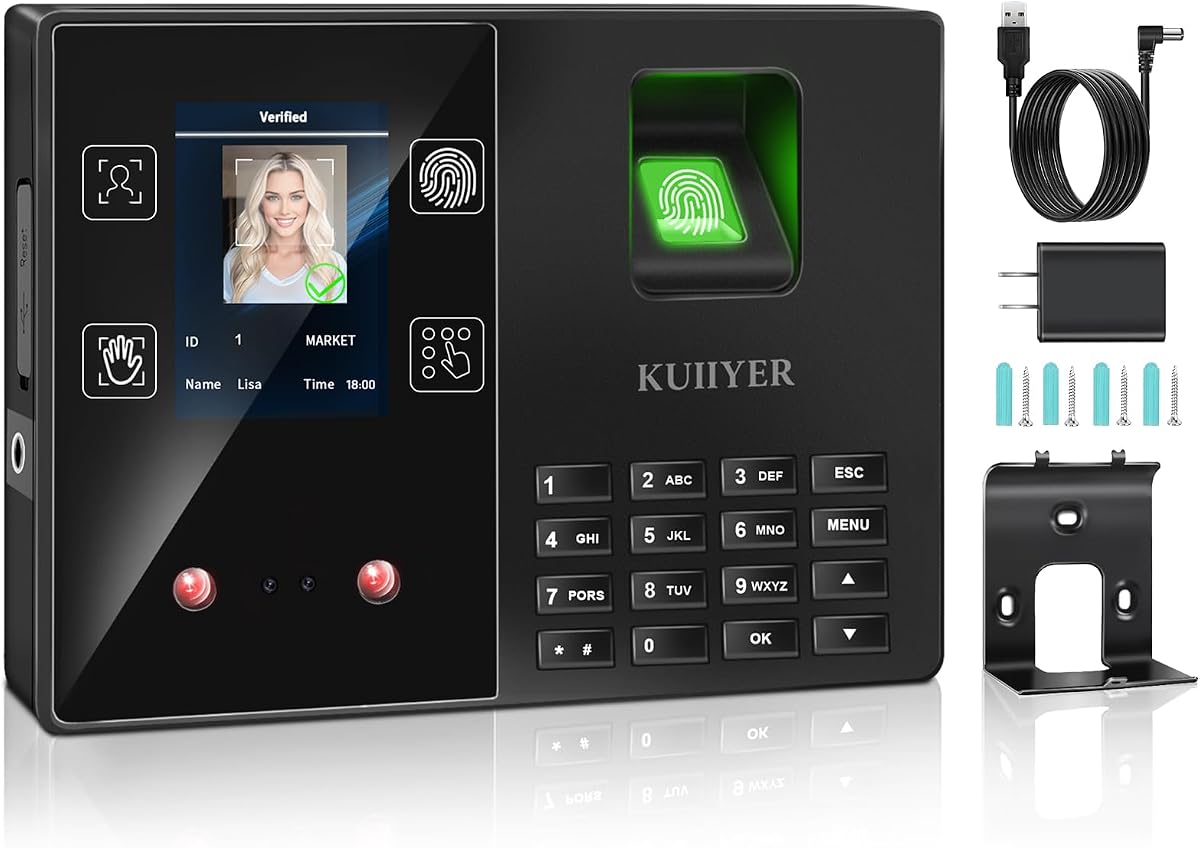
KUIIYER 4-in-1 Time Clock combines face recognition, palm-print recognition, fingerprint identification, and PIN entry in a standalone terminal. Its 3.7 rating places it in the middle of this list, but the breadth of authentication options and substantial stated capacity make it worth careful consideration. It is designed for small and medium businesses as well as organizations in offices, factories, hotels, schools, restaurants, supermarkets, and hospitals.
We may earn a commission when you buy through this link, at no additional cost to you.
The product information states that face and palm identification can complete in 0.6 seconds, while fingerprints can be recognized in 0.5 seconds. It supports 1,000 face profiles, 1,000 palm profiles, 3,000 fingerprints, and 1,000 PIN passwords. A 160,000-record capacity, 16 departments, 24 shifts, and bells extend its suitability beyond a very small team. Infrared cameras and a 2.8-inch color LCD make the interface more informative than a minimal display.
Data management is handled through USB without requiring an app or network, which helps keep attendance information local. A FAT32-formatted USB drive is recommended, though not included, and a 90-day return window plus a 24-month quality-issue promise provides added support. The 3.7 rating and the need to source an appropriate USB drive are the main reasons to pause before buying. Buyers should also validate biometric enrollment accuracy in their actual lighting and working environment.
This model is a good fit for organizations that want several authentication methods without a recurring subscription. It is especially useful where palm or face recognition could reduce contact or speed up attendance during busy periods. Ensure that the display, camera placement, and privacy practices meet the organization's requirements, and plan for the correct USB storage medium.
Face, palm, fingerprint, and PIN options let managers offer alternatives for different employee preferences and environmental conditions. The separate capacity figures for each method are useful details to compare with expected enrollment patterns rather than relying only on the headline user count.
Standalone USB management avoids network configuration and monthly fees. At the same time, the omitted USB drive and recommendation to use FAT32 formatting mean that setup requires a small amount of preparation and attention to file compatibility.
We may earn a commission when you buy through this link, at no additional cost to you.
This Fingerprint Time Clock Biometric Fingerprint Scanner USB Device is different from the complete time clocks in the guide. It is a compact biometric reader that connects to a computer through USB and is intended to support attendance or access-control software. It does not list an independent display, clock-in schedule, hours calculation, reporting interface, or standalone storage, so it should be considered a peripheral rather than an all-in-one time clock.
We may earn a commission when you buy through this link, at no additional cost to you.
Its main advantages are simplicity and flexibility. The USB interface supports straightforward setup, the advanced biometric algorithm supports multiple enrolled users, and the compact enclosure is suitable for an office desktop or portable access-control arrangement. Compatibility with attendance and access-control software could make it useful for businesses that already have a mature software ecosystem and only need a reader to complete the setup.
The important limitation is that the product listing does not confirm complete time-clock functions. A computer, suitable software, user enrollment process, reporting workflow, and likely a separate mechanism for clock-in and clock-out decisions may all be required. The listing also has no numerical customer rating, so there is no direct rating evidence to weigh alongside the feature set. Compatibility should therefore be checked in detail before purchase rather than assumed from the general description.
This device is best for a technical buyer who already operates compatible attendance or access-control software and specifically needs a USB fingerprint reader. It is not the right choice for a small business seeking a ready-to-use terminal with automatic hours calculation. Confirm the supported operating systems, software integrations, driver requirements, and whether the reader can operate as a fully independent attendance clock before ordering.
The supplied information identifies USB connectivity and software compatibility as the core functions. Because no integrated hours calculation, screen, or reporting system is described, buyers should treat this as an add-on device rather than a complete attendance station.
For organizations with established attendance or access-control software, a compact reader may fill a specific biometric input gap. The strongest case depends entirely on verified software and operating-system compatibility.
We may earn a commission when you buy through this link, at no additional cost to you.
H3 Standalone Biometric Clock delivers a practical local attendance system for businesses that want fingerprint tracking without a subscription or network dependency. It has a 4.1 rating and supports fingerprint authentication along with RFID cards, five of which are included. Automatic working-hours calculation reduces the need for manual totals, paper cards, and ink ribbons, while the device's standalone design keeps setup comparatively simple.
We may earn a commission when you buy through this link, at no additional cost to you.
No WiFi, software installation, or monthly fee is required. Managers transfer data locally through USB, which creates a clear separation between the clock's operation and the company's payroll process. The product supports English, Spanish, German, French, and Italian, and a step-by-step tutorial is available on YouTube. The listing also states that it can suit offices, factories, hotels, schools, restaurants, and teams of up to 1,000 employees.
Compared with a connected cloud model, the H3 does not offer live remote monitoring, mobile attendance editing, or browser-based reports. USB transfer is necessary whenever the company wants to extract attendance information. The included RFID cards add a useful alternative for users whose fingers are difficult to scan, but they also need to be managed as physical credentials and could be misplaced or shared.
This is a well-rounded recommendation for a single-location business prioritizing straightforward operation, no recurring service fees, and automatic hours calculations. It is particularly suitable for teams that are comfortable transferring files from a USB drive as part of their payroll routine. Managers needing continuous visibility from several devices should choose a cloud-connected model instead.
Keeping the terminal independent from the internet can simplify installation and make the operating model more predictable. USB exports give the business a controlled route into payroll without requiring a cloud account for every manager.
The five included RFID cards provide an alternate clock-in route when a fingerprint cannot be read reliably. Cards should be issued to specific employees and stored responsibly because possession may serve as the practical authentication method.
We may earn a commission when you buy through this link, at no additional cost to you.
NGTeco Cloud Time Clock is designed for businesses that need more sophisticated scheduling than a basic attendance terminal provides. Its 3.8 rating is moderate, yet the combination of four-in-1 authentication, customizable shifts, browser-based access, and cloud storage gives it a clear operational focus. It supports fixed, rotating, split-shift, and open schedules, making it useful for teams with part-time staff, multiple departments, or continuous operations.
We may earn a commission when you buy through this link, at no additional cost to you.
Overtime rules are highly configurable, including weekly overtime and dual OT1 and OT2 pay grades. The core service provides real-time punch access, automatic hour calculations, report generation, AWS-hosted storage, and basic management without subscription costs. A separate TimeEntrix subscription unlocks features such as GPS check-ins, real-time attendance reports, and intelligent reminders. The clock also captures punches offline and synchronizes them after connectivity returns, helping preserve continuity during an outage.
Capacity is the principal constraint: up to 200 users and 30,000 logs. This may be sufficient for a modest team but less appropriate for a rapidly expanding company with many clock-in events. Optional subscription features also complicate the otherwise attractive free core, and buyers should be clear about which management functions they actually need. The 3.8 rating reinforces the importance of checking the current software experience before committing.
Choose this model for a small business that values flexible scheduling and remote reporting more than a very large user capacity. The four-in-1 operation should appeal to mixed teams, while offline synchronization protects continuity in less reliable network environments. Review the free and subscribed feature boundaries, and compare storage limits against projected workforce and punch volume.
Fixed, rotating, split, and open shifts accommodate schedules that change across departments or employee roles. Custom weekly overtime and multiple overtime tiers can reduce manual payroll rule construction when configured to match the employer's compensation policy.
The clock can continue capturing punches when its network connection is unavailable and sync them after service returns. This design balances remote convenience with continuity, although the 30,000-log capacity still requires attention for high-volume operations.
We may earn a commission when you buy through this link, at no additional cost to you.
H1 Employee Hours Clock is a straightforward option for small businesses that mainly need reliable local clock-ins and automatic working-hours totals. Its 3.9 rating places it near the middle of the group, while the product information emphasizes ease of use, no WiFi requirement, and no monthly fees. It supports offices, restaurants, retail shops, schools, and other small or midsized workplaces.
We may earn a commission when you buy through this link, at no additional cost to you.
Employees can use the clock without an internet connection or network configuration, and managers export attendance records through USB. Working hours are totaled automatically, reducing the labor involved in manual calculations and replacing paper time cards and ink ribbons. The listed capacity reaches 1,000 employees, and a step-by-step video guide is intended to help new users begin tracking in under ten minutes.
The tradeoff is that a local USB workflow does not provide the same convenience as cloud administration. There is no described live remote dashboard, browser-based report access, or mobile punch editing. The 1,000-employee figure is also a maximum capacity rather than proof of suitability for every large deployment, so payroll processing and record retention at higher volumes should be evaluated carefully.
This clock is best for a business that wants a simple attendance record without a recurring fee and does not need real-time access from multiple locations. It can also appeal to organizations that prefer keeping attendance data under direct local control. For a business expecting more complex shifts, frequent corrections, or multi-location oversight, a connected model will likely provide a more suitable workflow.
Automatic totals address one of the most common burdens of paper attendance systems. Managers can focus on reviewing exceptions and transferring the resulting records rather than adding each employee's hours manually.
USB export keeps the operating process straightforward and avoids a required network or subscription. The trade-off is that data access and sharing occur through file transfers rather than a continuously available cloud interface.
We may earn a commission when you buy through this link, at no additional cost to you.
NGTeco Cloud Time Clock stands out for remote administration, flexible reporting, and strong network options. It carries a 4.2 rating and provides iOS and Android app access alongside a web portal, allowing managers to monitor clock-ins, track attendance, and generate detailed reports without being at the terminal. Automatic report generation is particularly useful for managers responsible for ongoing payroll preparation.
We may earn a commission when you buy through this link, at no additional cost to you.
Dual-band WiFi supports both 2.4GHz and 5GHz connections, offering more deployment flexibility than a single-band system. Shift configurations can be fixed, rotating, part-time, or department-specific, while weekly overtime and dual OT1 and OT2 rates provide detailed payroll-rule control. Attendance information is stored in AWS cloud environments on US servers with end-to-end encryption, and the app and software support eight languages.
A 2000mAh backup battery helps the clock remain operational during power cuts, reducing the risk of missed attendance events. It does not replace a fully charged or backup-powered installation, and owners should confirm the battery's charging and maintenance expectations. Advanced employee-app features require a separate TimeEntrix subscription, even though basic management features are free. The relatively modest 4.2 rating does not diminish the broad functionality, but it is a reason to verify current software compatibility.
This model is a strong recommendation for a small business that wants a connected terminal, mobile visibility, and detailed payroll-ready reports. It suits organizations with reliable dual-band WiFi and managers who work away from the attendance station. For a site that needs cloud access but has unstable internet, the offline synchronization model offered by the other NGTeco cloud clock may be worth comparing.
The combination of mobile and web access gives administrators more ways to review attendance than a standalone terminal. Real-time clock-in monitoring and automatic report generation can improve visibility, particularly for businesses with managers who are not permanently stationed near the clock.
Dual-band WiFi can provide a better connection in offices where either the 2.4GHz or 5GHz band performs more consistently. The 2000mAh battery adds continuity during outages, while encrypted cloud storage keeps attendance records available through the connected service.
We may earn a commission when you buy through this link, at no additional cost to you.
The right time clock depends on how your workplace handles enrollment, connectivity, shifts, payroll, and attendance administration. Comparing those workflows is more useful than focusing only on scan speed or the number of supported biometric methods.
A standalone clock keeps attendance records on the device and typically exports them through USB. This model is straightforward for one location and often avoids recurring service charges, but managers cannot review punches in real time from another device. A cloud time clock adds remote apps, browser access, and automatic synchronization, which can suit distributed teams or frequent corrections. Businesses should compare the payroll workflow rather than assuming cloud access is automatically better.
Fingerprint scanning is central to the category, but a useful terminal may also offer PIN, RFID, face, or palm recognition. Multiple methods can reduce bottlenecks and provide a fallback when a finger is wet, dirty, cut, or otherwise difficult to capture. They also add enrollment complexity and may raise privacy or workplace-policy questions. Look for a method mix that employees can use reliably rather than selecting the largest number of supported formats.
User-profile capacity and punch-record capacity are separate limits. A system can support many employees while retaining only a limited number of attendance events, or it can offer a generous user count with tighter historical storage. Compare both figures with the current workforce, shift frequency, and expected retention period. If attendance data must be transferred regularly for payroll, local storage needs may be less significant than they are for a remote archive.
Useful reports should make it easy to review hours, late punches, overtime, and schedule exceptions. Standalone systems may provide ready-to-use Excel files, while connected systems may generate browser-based reports and support payroll synchronization. Consider how your existing payroll process accepts time data, whether corrections can be made, and whether overtime rules must be configured. A polished report is valuable only when its format can be used efficiently.
Simple clock-in and clock-out systems work best for conventional schedules. Businesses with rotating, overnight, split, part-time, or department-specific shifts need automated work-hour calculation and flexible schedule configuration. Overtime rules are equally important because weekly thresholds and multiple overtime tiers may differ from a company's pay policy. Confirm that the device or cloud service can represent those rules before relying on automatic calculations.
Cloud-dependent terminals should have a dependable network connection, while remote app editing may require both devices to share a local network. Some systems capture punches offline and synchronize later, and others include internal backup or a rechargeable battery. Ask what happens to an in-progress punch during an outage and whether managers can retrieve records afterward. A backup feature is most valuable when it protects attendance without creating complicated recovery steps.
A multilingual interface can make enrollment and daily clock-ins easier for teams that do not share one primary language. Multi-language support varies across the guide, from five languages on some standalone clocks to seven or eight on connected NGTeco systems. Consider not only spoken prompts and screen labels but also written setup materials, the readability of the display, and whether alternate authentication methods provide accessibility for employees.
Some time clocks are self-contained, while others rely on apps, cloud services, subscriptions, or compatible third-party software. Confirm whether advanced features require a paid plan, what is included with the device, and whether support is local, extended during business hours, or available for the product's lifetime. Warranty length, replacement coverage, and access to setup assistance can materially affect long-term ownership, especially for first-time buyers.
Begin by identifying a stable, accessible mounting location and confirming the power and network arrangement appropriate for the selected model. Standalone clocks need little more than a suitable outlet, while cloud and app-controlled systems require compatible WiFi or LAN access. Before enrolling employees, create an accurate list of staff, departments, job assignments, and schedules so that identification records and shift rules begin with correct information.
Enroll each employee carefully and test the identification method they will use. Ask staff to place a clean, dry finger on the sensor as directed, confirm that the displayed identity and department are correct, and test a second clock-in or clock-out action. For face, palm, RFID, or PIN options, also check lighting, card assignment, PIN confidentiality, and fallback procedures. Keep administrator credentials and enrollment functions restricted to authorized staff.
Review punches regularly, especially during the first payroll cycle. Correct missed or incorrect entries through the approved app, web portal, or local editing process, and retain the original audit trail where the system provides one. Protect the scanner from dust, moisture, impact, and harsh cleaning chemicals, and clean it with a suitable soft, dry or lightly damp method. Export data at the required intervals, keep secure backups, and update the device or service software only as directed by the manufacturer.
Yes, if the capacity and reporting features match the business's size. A compact standalone system can work well for a small team with one location, while a cloud model may be better when managers need remote access. Check user capacity, record storage, authentication methods, and the expected payroll workflow before choosing.
Several models in this guide are fully standalone and transfer attendance data through USB. Others capture punches offline and synchronize them when the connection returns. Connected terminals still need suitable network access for remote administration, live reports, or some editing functions, so buyers should identify exactly which features work offline.
PIN, RFID, face, or palm options can provide alternatives when supported by the chosen model. If a device only accepts fingerprints, managers may need to follow its manual correction procedure. Enrolling a backup method for employees with reliable scanning issues can prevent delays at the start or end of a shift.
Only if the specific model supports the relevant schedule structure. Some units in this guide explicitly handle overnight, rotating, split, part-time, and open shifts. Automatic work-hour calculations can help, but managers should test sample schedules against their own overtime and shift-boundary rules.
Security depends on the operating model. Standalone systems require controlled physical access, responsible USB storage, and secure handling of exported files. Cloud systems add account controls and encrypted storage, but managers still need appropriate permissions and should review what each app or subscription stores. Sensitive location and image features also require a clear employee privacy policy.
Most complete units are designed for relatively simple setup, and several listings provide step-by-step video guidance. Standalone models mainly require enrollment and a USB export workflow, while connected models also need WiFi or LAN configuration and app setup. The separate USB fingerprint reader is less plug-and-play because it requires compatible attendance or access-control software.
User capacity is the number of people whose biometric or PIN profiles can be enrolled. Record capacity is the number of attendance events the device can retain before data must be transferred or removed. A business should examine both because a large employee limit does not necessarily mean extensive local history.
A standalone clock is usually easier to operate locally and may suit businesses with a simple, site-based payroll routine. A cloud clock offers live remote access, mobile reports, and easier correction workflows across locations. The better choice depends on staffing patterns, network reliability, privacy preferences, and how much administrative visibility the business actually needs.
The NGTeco App-Controlled Time Clock is the strongest all-around option, combining the highest rating with fast fingerprint recognition, convenient mobile editing, and flexible payroll-cycle exports. NGTeco Standalone Time Clock is the leading budget-oriented choice for businesses wanting genuine offline operation, while Biometric Time Clock + Online Reports takes the premium position for its five authentication methods and extensive cloud-based management.
Most buyers should prioritize the operating model that matches their actual workflow. Choose a standalone model when predictable local operation and simple USB exports are enough, but select a connected system when real-time access, remote correction, and browser-based reporting justify the added software layer. Authentication capacity, storage limits, shift complexity, and backup behavior are just as important as fingerprint speed.
Before ordering, verify the current Amazon listing, included accessories, subscription terms, software requirements, warranty, and support coverage. Specifications and availability can change, and current product information should be checked for the exact model. Comparing those final details against the needs identified in this guide will make the selection process more accurate and reduce the chance of choosing an incomplete workflow.
