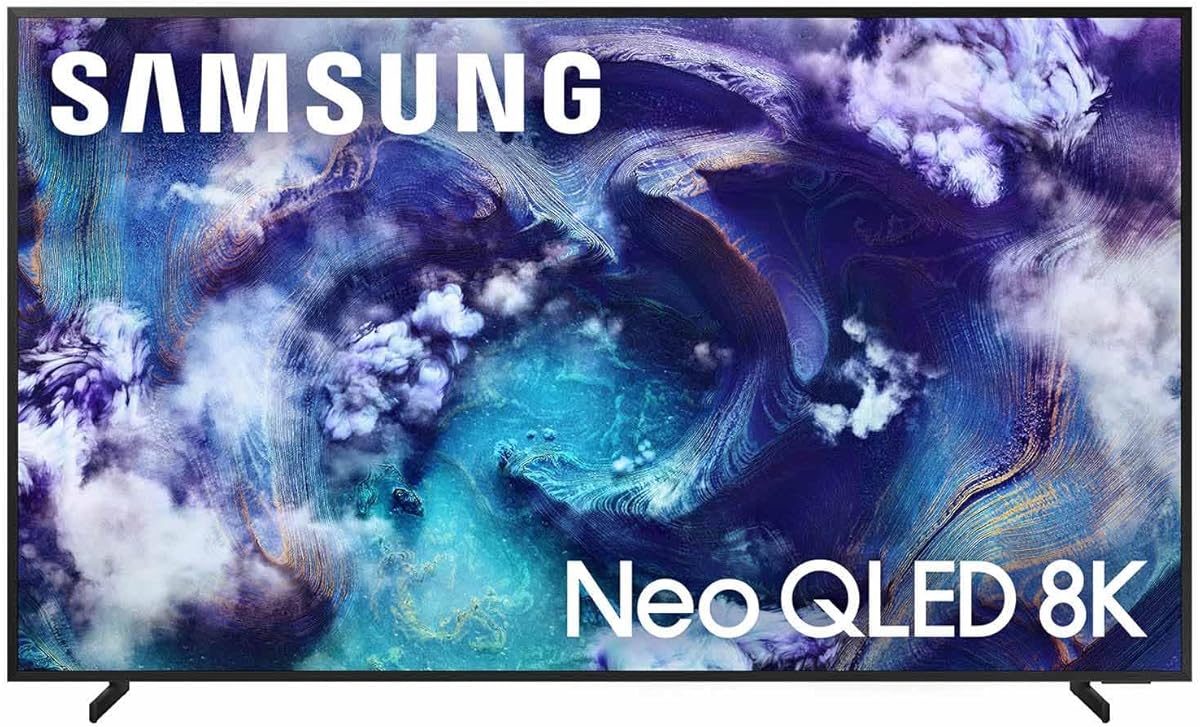
Samsung 75-Inch QN900F
4.5Editor score
4K 165Hz VRR gaming
256 AI neural networks
Anti-reflection flat screen
An 8K TV can give a PC gaming setup exceptional detail, but resolution alone does not guarantee a competitive or responsive experience. The best displays combine high refresh rates, variable refresh rate support, low input lag, precise dimming, strong HDR performance, and useful gaming controls across a suitably large screen.
This guide compares ten large-screen televisions using the supplied specifications, emphasizing resolution, panel and backlight technology, refresh capabilities, gaming features, HDR formats, audio, smart-platform functions, and design. It also identifies several strong 4K alternatives that may deliver more practical value than a costly native 8K model.
Each entry explains the standouts, compromises, and most suitable gamer for that television. Ratings and feature claims reflect the supplied product information rather than personal testing, while specifications and availability can change. Check current listings, pricing, port details, and console or PC compatibility before buying.
4.5Editor score

3.8Editor score

3.4Editor score
As an Amazon Associate we earn from qualifying purchases.
The comparison below highlights resolution, refresh rate, gaming support, and major picture features across all ten televisions, including native 8K models and carefully selected 4K alternatives.


The Sony Z9K is a native 8K Mini LED television with a supplied customer rating of 3.8. Its most compelling combination for PC gamers is 8K resolution, a 75-inch screen, HDMI 2.1 features, and low input lag of as little as 8.5 milliseconds. Sony's Cognitive Processor XR and XR Backlight Master Drive also target the contrast, brightness, and color control that HDR games require.
We may earn a commission when you buy through this link, at no additional cost to you.
Gaming support is particularly well considered. The television supports 4K at 120Hz, variable refresh rate, and automatic low-latency mode through HDMI 2.1. A consolidated Game Menu keeps gaming picture settings and assist functions in one location, reducing the need to move through several system menus. For PlayStation 5 owners, Auto HDR Tone Mapping and Auto Genre Picture Switch add further value, although PC gamers can still use the core VRR and high-refresh capabilities.
The Mini LED backlight uses thousands of LEDs controlled with fine precision, helping the Z9K produce deep blacks and bright highlights while retaining more control than a conventional edge-lit LED television. Dolby Vision, IMAX Enhanced, Netflix Adaptive Calibrated Mode, and XR Triluminos Pro broaden its appeal for mixed entertainment. The included BRAVIA CAM adds room-aware features, although PC gamers may not need it.
The main limitation is that a native 8K panel does not make the television ideal for every competitive PC game. The listed high-refresh gaming support is 4K at 120Hz rather than the 240Hz capability found on some Samsung rivals, and the supplied rating is modest relative to several competitors. It is still a strong choice for enthusiasts who value 8K clarity, Sony processing, strong HDR support, and a large screen more than maximum competitive performance.
The dedicated Game Menu gathers picture options and assist features into a single interface. That makes it easier to tune motion, HDR, and variable refresh behavior without repeatedly navigating unrelated television settings.
Auto HDR Tone Mapping and Auto Genre Picture Switch make the Z9K especially convenient for PlayStation 5 users. PC players still gain the important HDMI 2.1, VRR, and low-latency features.
We may earn a commission when you buy through this link, at no additional cost to you.
The Samsung QN990F 65-Inch is a native 8K Neo QLED Mini LED model built around speed and advanced processing. Its supplied rating is 3.5, but the specification sheet includes a major differentiator for PC gaming: VRR gaming at up to 4K 240Hz. That makes it a compelling option for high-end graphics cards, competitive shooters, racing games, and any setup designed around the fastest possible frame rates.
We may earn a commission when you buy through this link, at no additional cost to you.
Samsung's NQ8 AI Gen3 processor operates with 768 AI neural networks to enhance content toward 8K resolution. The supplied information also highlights smooth motion processing for fast-moving balls and text, reducing blur and flicker where possible. A 65-inch panel keeps pixel density relatively high for a television, which can make fine interface elements and text easier to read than on a much larger screen.
The Mini LED platform is intended to deliver strong brightness and controlled contrast, while the Glare Free surface helps limit distracting reflections in bright rooms. Wireless One Connect can keep the console, set-top box, and soundbar out of sight by transmitting their signal to the television through a separate connection box. That flexibility can make wall mounting and cable management considerably easier.
This is not the most compact television in the guide, but it is arguably the most performance-oriented native 8K option. Its 240Hz capability is particularly valuable when paired with a capable PC and display-port-to-HDMI setup. Buyers should confirm the full bandwidth configuration of their PC, cable, and television before assuming every title will run at the advertised maximum.
Support for VRR gaming at up to 4K 240Hz gives the QN990F a clear advantage for fast-paced games. It can display exceptionally high frame rates without requiring motion smoothing that may add latency.
Wireless One Connect reduces visual clutter by separating external device connections from the television. The arrangement is useful when the display is wall-mounted or mounted on a narrow console.
We may earn a commission when you buy through this link, at no additional cost to you.
This 75-inch Samsung QN990F bundle combines a native 8K Neo QLED display with the QN990F family's headline gaming capability. The supplied rating is 2.8, the lowest in this roundup, so prospective buyers should examine customer feedback and listing details carefully. The technical specification nevertheless includes 4K 240Hz VRR support, AI Upscaling Pro, Glare Free treatment, and Wireless One Connect.
We may earn a commission when you buy through this link, at no additional cost to you.
The larger 75-inch canvas gives PC games a more cinematic presentation, particularly for open-world environments, strategy titles, simulation games, and cooperative play. The 8K panel can preserve fine detail when a PC renders at a compatible high resolution, while AI Upscaling Pro attempts to improve lower-resolution content. The QN990F processor also optimizes scenes for movies, sports, and games.
This listing adds an extra year of Amber Protection to the included one-year manufacturer warranty and includes a non-ammonia, alcohol-free cleaning solution. The screen-care bundle may be useful for a large display, but it does not improve technical performance. More important to gamers are the high refresh capability, Neo QLED color, Mini LED contrast, and a relatively uncluttered installation.
The 75-inch format suits viewers who want to sit relatively close and experience a genuinely large desktop, while the 240Hz feature targets high-end PC hardware. Consider room size, viewing distance, and input latency together. Because the supplied rating is notably low and this is a specific bundle, confirm the exact warranty terms, included accessories, and current product condition before ordering.
At 75 inches, this television can function as a large computer display for strategy games, simulators, and multiplayer sessions. Its native 8K resolution offers more working detail than a conventional 4K television.
The model's 4K 240Hz VRR support is designed for PC graphics cards that can drive very high frame rates. It can provide a meaningful advantage in competitive games without relying on artificial frame generation.
We may earn a commission when you buy through this link, at no additional cost to you.
The Samsung QN900F 75-Inch earns the highest supplied rating in this group at 4.5. It is a native 8K Mini LED television that balances resolution, refresh capability, appearance, and smart features unusually well. For PC gamers, VRR at up to 4K 165Hz, a slim metal design, and Glare Free treatment form a particularly attractive package.
We may earn a commission when you buy through this link, at no additional cost to you.
Samsung's processor uses 256 AI neural networks to enhance content toward 8K resolution and improve sharpness and smoothness. The Neo Quantum HDR 8K Pro system targets wide contrast and color, while the Mini LED backlight helps preserve detail in both bright and dark scenes. For PC gaming, the 165Hz ceiling is lower than the 240Hz offered by the QN990F but still comfortably supports high-refresh competitive titles.
The nearly edgeless face and flat grooved metal back are designed to blend into a room or sit neatly against a wall. Art-mode access to works from institutions such as The Met and MoMA helps the television fit into a living space beyond gaming. Object Tracking Sound and Dolby Atmos add spatial audio, although PC users can also route game audio through a dedicated sound system for more precise positioning.
This is a strong all-around recommendation for a premium living-room gaming setup. Its combination of 8K detail, 165Hz VRR, anti-reflection treatment, attractive industrial design, and strong supplied rating makes it easier to justify than more specialized alternatives. Confirm that your graphics card, PC, and cable can negotiate the desired resolution and refresh combination before installation.
The 165Hz VRR ceiling comfortably supports fast PC games while the 8K panel provides extra detail for cinematic titles. It is a balanced choice for a television expected to handle gaming, streaming, sports, and everyday viewing.
The slim metal body and nearly edgeless front give the QN900F a refined appearance. Gallery art options add flexibility for rooms where a large gaming television might otherwise look out of place.
We may earn a commission when you buy through this link, at no additional cost to you.
The Samsung QN800D 65-Inch is a native 8K Mini LED model offering a practical combination of resolution and high-refresh gaming. Its supplied rating is 3.4. The important PC gaming specifications are 165Hz Motion Xcelerator support, AI upscaling through 512 neural networks, and a Neo Quantum HDR 8K+ picture system with detailed local dimming.
We may earn a commission when you buy through this link, at no additional cost to you.
Quantum Matrix Pro uses Mini LEDs with 1.5 times as many lighting zones as standard Quantum Matrix technology. The additional control is useful for revealing detail in dark environments, which matters in horror games, space simulations, and competitive shooters. Real Depth Enhancer Pro identifies the focal point in each frame, while the AI Motion Enhancer is designed to reduce stutter and sharpen small moving objects.
The 4K 165Hz mode should appeal to owners of modern high-end graphics cards who want a high refresh rate at 4K. It falls short of the 240Hz maximum available on the QN990F and QN900D, but many games still benefit from 120Hz or 165Hz. Dolby Atmos and Object Tracking Sound+ improve the built-in entertainment experience, although a gaming headset remains essential for directional competitive audio.
This television makes the most sense for a buyer who wants a relatively compact native 8K panel and values Mini LED contrast more than the absolute fastest gaming refresh rate. It is a 2024 model with an older processor generation, so current price comparisons matter. If the QN990F is close in cost, the newer model may offer a more advanced processor and higher refresh ceiling.
The expanded Quantum Matrix Pro lighting arrangement improves control over shadows and highlights. That makes dark games easier to read without losing the brightness required by HDR content.
Motion Xcelerator 165Hz supports fast frame delivery and smoother motion at 4K. It is a meaningful step above 60Hz and remains well suited to high-end PC graphics cards.
We may earn a commission when you buy through this link, at no additional cost to you.
The Samsung QN900D 65-Inch combines native 8K resolution with support for VRR gaming at up to 4K 240Hz. Its supplied rating is 4.1, making it one of the stronger-rated products here. It offers a more manageable screen size than the 75-inch alternatives while preserving the high-refresh capability that appeals to advanced PC gaming systems.
We may earn a commission when you buy through this link, at no additional cost to you.
The NQ8 AI Gen3 processor uses 512 neural networks to enhance scenes toward 8K, sharpen motion, and improve perceived depth. AI Motion Enhancer Pro targets smoother objects and text, which benefits both gameplay and live sports. Neo Quantum HDR 8K Pro and the Quantum Matrix Pro Mini LED backlight provide the brightness and contrast foundation required by demanding HDR titles.
Its Infinity Air design minimizes visible borders, allowing the image to occupy nearly the entire front. Object Tracking Sound Pro and Dolby Atmos create a more dimensional sound field than a conventional television's built-in speakers, though PC gamers may prefer a headset, surround system, or soundbar for precise positional cues. Auto HDR Remastering can also improve the presentation of supported non-HDR content.
This model is an attractive choice for a dedicated gaming room where maximum frame rate and native 8K detail matter. Its 240Hz capability is more future-facing than the 165Hz QN800D, and its 65-inch footprint can be easier to accommodate. Verify the PC connection, firmware, and game-specific support before purchase, especially if you intend to run at 240Hz.
Few consumer televisions combine native 8K with 240Hz support. That pairing makes the QN900D particularly attractive for PC owners with graphics hardware capable of producing very high frame rates.
The nearly invisible frame keeps attention on the game and preserves a clean wall-mounted appearance. It also makes a 65-inch display look larger than many conventional designs.
We may earn a commission when you buy through this link, at no additional cost to you.
The Hisense E7 85-Inch is not an 8K television, but its large 4K screen, native 144Hz panel, and gaming-oriented processing make it a serious alternative for PC players. The supplied rating of 4.4 is among the highest in this roundup. Its Hi-QLED Mini LED backlight uses thousands of lighting zones to improve contrast and reveal detail in dark and bright scenes.
We may earn a commission when you buy through this link, at no additional cost to you.
Native 144Hz provides ample headroom for modern PC gaming, including competitive shooters, racing titles, and action games. The supplied information also describes AI Smooth Motion with MEMC, which reduces blur and sharpens fast-moving scenes. Players should distinguish native refresh from motion interpolation because artificial frame generation can increase latency and produce less natural motion in games.
HDR support includes Dolby Vision IQ, HDR10+ Adaptive, HDR10, and HLG. Dolby Atmos adds cinematic sound, while the AI Picture system analyzes scenes and adjusts brightness, contrast, and color in real time. An ambient light sensor automatically changes backlight output to suit room conditions, and Filmmaker Mode preserves the creator's intended presentation when viewing content.
This television is best suited to a large, dedicated gaming space where screen scale matters as much as native resolution. It may provide more visible immersion and a higher refresh rate than some 8K sets for less investment, depending on current pricing. Check viewing distance carefully, because an 85-inch display can feel oversized in a compact room or when used mainly for desktop work.
A native 144Hz panel offers smooth movement and lower input lag than a standard 60Hz television. It is particularly attractive for PC games in which rapid turns and small targets demand a stable image.
The AI light sensor adjusts backlight output as ambient conditions change. This can preserve comfortable visibility and contrast in both daylight and nighttime gaming.
We may earn a commission when you buy through this link, at no additional cost to you.
The LG C6 83-Inch is an OLED television rather than an 8K Mini LED model, but it offers some of the strongest PC gaming fundamentals in the guide. Its supplied rating is 4.0. A 165Hz refresh rate, 0.1-millisecond response time, NVIDIA G-Sync support, and AMD FreeSync Premium make it particularly compelling for fast action and competitive play.
We may earn a commission when you buy through this link, at no additional cost to you.
The self-lit OLED panel provides perfect black and perfect color according to the supplied information. Over 8.3 million smart pixels produce detailed imagery, while Brightness Booster Pro and Brightness Booster are intended to improve visibility in well-lit rooms. That brightness capability is important because OLED picture quality can diminish under strong ambient light.
LG's a11 AI Processor and AI Director Processing, described as using the a9 AI Processor Gen8, support graphics and picture optimization. The television also supports Dolby Vision, Dolby Atmos, and Filmmaker Mode. webOS supplies streaming functions and Google Gemini, while OLED Care is included to help maintain the panel over time.
This is an excellent choice for gamers who prioritize response time, motion clarity, and cinematic contrast more than native 8K resolution. Its 83-inch format can provide an expansive image, but the 2.1-inch depth without the stand deserves attention during installation. Consider burn-in prevention, viewing habits, room brightness, and the content you expect to display before making a final decision.
A stated 0.1ms response time minimizes visible smearing during fast camera movement. This benefit is especially noticeable in competitive shooters, racing games, and action-heavy PC titles.
OLED pixels switch off individually, producing the deep black described by LG. That makes dark scenes feel more immersive and can improve the visibility of carefully designed PC graphics.
We may earn a commission when you buy through this link, at no additional cost to you.
The Sony BRAVIA 3 K-85S30 is a large 4K LED television with a supplied rating of 4.2. It is not native 8K and the supplied specifications do not state a high gaming refresh rate, so it is better suited to cinematic PC gaming than competitive play. Its scale, color processing, and PlayStation 5 optimization remain important strengths.
We may earn a commission when you buy through this link, at no additional cost to you.
Triluminos Pro is claimed to display more than a billion accurate colors, supporting vivid but controlled imagery across games, movies, and streaming. The Google TV platform provides familiar streaming access and Google Assistant voice control. Sony Pictures Core also adds a library of high-bitrate 4K UHD movies, making the television useful beyond PC gaming.
For console players, Auto HDR Tone Mapping and Auto Genre Picture Mode automatically adapt the picture to supported PlayStation 5 content. PC gamers can benefit from the large 4K canvas and Sony's image processing, but should verify whether the PC can drive the panel at an acceptable refresh rate through the television's available connectivity.
The supplied information recommends an ideal viewing distance of 15 feet, which indicates how the 85-inch format is intended to be used. In a room that large, cinematic PC gaming can feel unusually immersive, particularly in racing, flight simulation, and strategy games. It is less compelling for fast competitive play because no 120Hz, 144Hz, or 165Hz capability is stated.
Auto Genre Picture Mode and Auto HDR Tone Mapping simplify setup for supported PlayStation 5 games. PC users can still benefit from Sony's color processing, though manual tuning may be needed.
The 85-inch panel turns compatible PC games into a large-screen presentation. Its stated ideal viewing distance emphasizes that the design is best suited to a spacious room.
We may earn a commission when you buy through this link, at no additional cost to you.
The Hisense U8 85-Inch is a 4K Mini LED gaming television with a supplied rating of 4.3. Although it does not offer native 8K, its 165Hz native panel, variable refresh rate range, Game Booster 288, extensive local dimming, and detailed gaming dashboard make it one of the most technically ambitious options in the guide.
We may earn a commission when you buy through this link, at no additional cost to you.
The supplied specification lists a variable refresh rate from 48Hz to 165Hz, AMD FreeSync Premium Pro, Auto Low Latency Mode, and Low Latency MEMC. A Game Bar provides access to settings and gameplay information while a game is running. These features help PC players tune performance and understand frame-rate behavior more easily than with many conventional televisions.
Mini LED Pro backlighting can reach up to 5000 nits of peak brightness and use up to 5600 local dimming zones, according to the supplied information. Dolby Vision IQ, HDR10+ Adaptive, HDR10, HLG, and Advanced HDR by Technicolor provide broad HDR compatibility. Anti-Reflection Pro is designed to minimize interference from room lighting, an important benefit for an 85-inch panel.
The 4.1.2-channel audio system includes left and right speakers, surrounds, a built-in subwoofer, and up-firing speakers for Dolby Atmos. It creates a more cinematic presentation than ordinary television audio, although competitive gamers will still benefit from a headset. This model is ideal for a large entertainment room and gamers who prefer powerful gaming controls, HDR brightness, and high refresh over native 8K resolution.
The enhanced Game Bar places performance information and adjustable settings within easy reach during play. It can help users monitor frame rates and adapt the display without leaving the game.
Thousands of local dimming zones and high peak brightness support punchy highlights and controlled shadows. Anti-Reflection Pro helps preserve visible contrast in rooms with substantial ambient light.
The 4.1.2-channel arrangement adds surrounds, bass, and upward-firing sound to television audio. It provides a strong cinematic foundation while remaining less precise than a gaming headset for competitive direction.
We may earn a commission when you buy through this link, at no additional cost to you.
The right PC gaming television depends on resolution, latency, refresh range, HDR control, room conditions, and practical limits. Review these factors before choosing an 8K set or a high-performance 4K alternative.
Native 8K provides four times the pixel count of 4K, which can reveal finer textures, interface text, and distant scenery when a PC renders at a supported 8K resolution. However, many demanding games target 4K at high refresh rates, making a 4K panel with 144Hz or 165Hz more practical in many situations. AI upscaling can improve lower-resolution material, but it cannot manufacture source detail that was never captured or rendered.
Prioritize native 8K for a high-end PC, large viewing distance, and games that benefit from extra detail. Favor strong 4K performance when refresh rate, input responsiveness, or value matters more.
Refresh rate determines how many frames the television can display each second. PC gaming benefits greatly from 120Hz and above, while 144Hz and 165Hz can make fast movement and aiming feel more fluid. Variable refresh rate matches the display refresh to the frame rate delivered by the graphics card, reducing tearing. Native and maximum refresh capabilities should be considered separately because some televisions offer high rates only at 4K.
Choose at least 120Hz for serious PC gaming, and seek 144Hz or 165Hz for competitive play. Verify the complete resolution-and-refresh matrix before purchasing.
Low input lag helps a game respond immediately to mouse or keyboard input. The Sony Z9K lists input lag as low as 8.5 milliseconds, while the LG C6 advertises a 0.1-millisecond pixel response time; these measurements describe different aspects of responsiveness and should not be compared as identical metrics. For PCs, the television must also support the desired refresh rate through a compatible HDMI connection and a display adapter that can negotiate the full bandwidth.
Check HDMI 2.1 features, VRR support, and PC resolution limits. Use a certified cable for the target bandwidth and update television and graphics-card software after installation.
High dynamic range requires both bright highlights and controlled shadows. Mini LED local dimming divides the screen into numerous lighting zones, allowing dark areas to remain dark while highlights stay punchy. OLED displays can achieve perfect black because each pixel produces its own light. Bright-room performance also depends on anti-reflection treatment and peak brightness, not merely the number of dimming zones.
Prioritize strong local dimming, accurate HDR processing, and an anti-reflection surface. Avoid assuming a large zone count guarantees flawless dark detail without reading independent measurements.
An 85-inch television can provide an extraordinary PC desktop, but it is not automatically better than a 65-inch set. Large panels reveal fine 8K detail from farther away, yet they can overwhelm smaller rooms, make menu navigation cumbersome, and increase visual fatigue. The Sony BRAVIA 3 listing recommends an ideal viewing distance of 15 feet for its 85-inch screen, illustrating how room dimensions matter.
Measure the room and consider where the television will be mounted. For a couch-based console setup, 65 to 75 inches is often more manageable; a large desk may benefit from an 85-inch screen.
PC gaming benefits from automatic game-mode switching, accessible variable-refresh settings, motion controls, and a dashboard that exposes useful performance information. The Hisense U8 includes a Game Bar, while Sony consolidates gaming options into its Game Menu. HDR format support should also include the formats used by your games and streaming services, such as Dolby Vision or HDR10.
Look for useful controls rather than a long list of unfamiliar processing labels. After installation, disable unnecessary motion smoothing and calibrate the picture with the game running.
A television's operating system determines which streaming apps, assistants, and account features are immediately available. Sony uses Google TV, Samsung models use Tizen, the Hisense U8 uses Google TV, and the Hisense E7 uses Fire TV. Wireless One Connect can reduce cable clutter, while built-in Google Assistant, Alexa, or Gemini support offers convenient searching and control.
Check that important applications, casting methods, and your preferred voice assistant are supported. Verify how the PC, sound system, and any connection box must be connected.
Large-screen gaming benefits from object-tracking sound, Dolby Atmos, or a multi-channel system, but a headset remains better for positional competitive audio. Design also matters when a television must fit into a living room or sit flush against a wall. OLED models deserve consideration of OLED Care and long-term burn-in prevention, while Mini LED screens are generally comfortable for varied content.
Choose audio that matches your room and gaming style, and measure wall-mount clearance. Include panel care, software updates, and comfortable viewing distance in the final decision.
Begin by connecting the PC with a compatible HDMI adapter and certified cable, then enable the television's gaming mode. Install any required graphics-driver and television updates, select the correct input, and verify the active resolution and refresh rate through the PC display settings. Enable variable refresh rate only when the game, graphics card, and television support the same VRR range.
Calibrate the picture with a game that represents your normal content. Adjust brightness for the room rather than maximizing it, use the appropriate HDR setting for a supported title, and review color, contrast, and motion controls. Avoid aggressive motion enhancement during competitive play because it can create artificial frames or add lag. Save separate profiles for PC gaming, console gaming, movies, and everyday viewing when the television permits.
Keep the panel and ventilation areas clean with a soft microfiber cloth and the supplied screen-safe cleaner where applicable. Do not spray liquid directly onto the screen, and avoid aggressive scrubbing. Dust the rear connections regularly, manage cables safely, and leave adequate ventilation around the television. For OLED sets, use the available care features and avoid leaving static images onscreen for extended periods.
An 8K TV can be worthwhile when a high-end PC, large screen, and capable display adapter can drive 8K output or benefit from strong upscaling. It is less compelling when games are primarily played at 4K and competitive refresh rate matters more. A 144Hz or 165Hz 4K television may deliver a more noticeable gaming advantage in those circumstances.
At least 120Hz is strongly recommended, while 144Hz or 165Hz provides additional headroom for competitive and fast-paced games. The 240Hz models in this guide can be excellent with high-end graphics hardware, but they require compatible PC output, cables, games, and display settings. Confirm that the maximum rate applies at the resolution you intend to use.
VRR is useful because it synchronizes the television's refresh with the frame rate produced by the graphics card, reducing tearing without adding the latency associated with traditional synchronization methods. It is not essential for every game, but modern competitive titles and supporting PC graphics cards can benefit. Both the PC game and television must support compatible VRR behavior.
A high-performance 4K TV can be better when input lag, refresh rate, OLED response, or overall value is the priority. Native 8K offers finer detail and can make interface elements and distant textures look cleaner, but many games do not render at that resolution. The Hisense E7, LG C6, and other 4K models show how high-refresh 4K can remain highly competitive.
OLED is favored for response time, pixel-level black, and cinematic contrast, while Mini LED is favored for high brightness, local dimming, and avoidance of OLED burn-in concerns. The right choice depends on room lighting, content habits, viewing distance, and tolerance for each technology's limitations. A gaming headset can improve both experiences by providing precise positional audio.
The ideal distance depends on resolution, field of view, personal preference, and the type of PC use. An 85-inch panel can work as a large desktop but may feel overwhelming in a small room, while it can feel appropriately scaled from farther away in a media room. The supplied Sony BRAVIA 3 guidance recommends a 15-foot viewing distance for its 85-inch model.
Most of the native 8K models here support high-refresh gaming at 4K rather than 8K. Examples include 120Hz, 165Hz, and 240Hz modes. This is normal because the bandwidth required for 8K at very high refresh rates exceeds what current consumer connections commonly support.
Usually not for competitive play because motion interpolation can add latency and create visual artifacts around fine details. It may be useful for some slower console games or cinematic experiences where smoothness matters more than responsiveness. Test it in individual games and keep the setting off when it reduces clarity or responsiveness.
The Sony Z9K stands out for native 8K detail, Mini LED contrast, HDMI 2.1 gaming, and a low stated input lag. The Samsung QN900F offers a particularly balanced premium package, while the Samsung QN800D provides a more practical native 8K route with 165Hz support. For maximum refresh, the QN990F and QN900D stand out with 4K 240Hz capabilities.
Prioritize the combination your PC can actually use rather than resolution alone. High-refresh 4K options such as the Hisense U8, Hisense E7, and LG C6 may deliver better competitive performance, stronger value, faster response, or more practical screen sizes. Also consider HDR brightness, local dimming, reflection control, room dimensions, audio, and the software tools that help you monitor performance.
Specifications can vary by firmware, regional model, input configuration, and game, and prices and promotions change over time. Before purchasing, verify current listing details, port bandwidth, PC compatibility, warranty terms, and the display's active resolution and refresh rate. Those checks will help ensure the chosen television works as intended rather than merely carrying an attractive 8K or high-refresh label.