
Skar Audio RP-1500.1D
4.4Editor score
1500 watts RMS at one ohm
Selectable six or twelve dB boost
Remote subwoofer level control
Explore the best 1500 Watt Car Amp options, comparing power ratings, efficiency, filtering, protection, installation features, and overall value.
A 1500 watt car amplifier sits at the intersection of serious subwoofer output and practical vehicle installation. The right unit can deliver deep, controlled bass while remaining compatible with your electrical system, speaker impedance, enclosure design, and available mounting space. This guide examines ten options built around the 1500-watt class.
We compared the supplied specifications for power output, load stability, amplifier topology, filtering, bass controls, protection circuitry, connection methods, chassis dimensions, and installation convenience. The list includes dedicated monoblocks as well as two-channel amplifiers that can bridge into mono, giving shoppers distinct options for dedicated subwoofer systems and more flexible multi-speaker builds.
Each pick reveals how the amplifier can fit into a particular build through features such as compact enclosures, remote bass controls, selectable low-pass and subsonic filters, flexible inputs, speaker-level compatibility, or higher-end construction. Ratings and specifications can change with revisions, so readers should verify current product details and prices before making a final purchase decision.
4.4Editor score
4.5Editor score

4.9Editor score
The comparison below highlights each amplifier's power configuration, key control features, protection approach, and intended installation role, helping distinguish dedicated subwoofer monoblocks from flexible two-channel alternatives.


The Skar Audio RP-1500.1D is a dedicated Class D monoblock with a 4.4 rating and a headline output of 1500 watts RMS at a one-ohm load. Its most attractive quality is the combination of substantial rated power and installation convenience. It includes four-gauge power and ground terminals, an efficient heatsink, four-way protection circuitry, and a wired remote for controlling subwoofer level from the driver's seat.
We may earn a commission when you buy through this link, at no additional cost to you.
The amplifier is stable at one ohm, making it suitable for a properly configured single subwoofer or multiple subwoofers wired to a one-ohm final load. Its frequency response extends from 20 to 250 hertz, which covers the fundamental range required for most subwoofer enclosures. An on-board bass EQ switch provides either six or twelve decibels of boost at 45 hertz, offering a quick way to compensate for cabin gain without relying on extensive system tuning.
There are trade-offs. The available specification does not mention a continuously variable low-pass filter or subsonic control, so installers wanting precise cutoff and protection adjustments may need to consider a more configurable model. The selectable boost is also less granular than a continuously adjustable bass control. Nevertheless, the core package is focused: high current handling, stable one-ohm operation, remote level adjustment, and protection in a purpose-built monoblock.
This is a strong selection for a shopper who wants a straightforward 1500-watt-class subwoofer amplifier without paying for a large collection of specialized controls. It should appeal particularly to installers who value large terminals and a simple remote-controlled setup. As the best budget-focused choice in this list, it provides the essential power and safeguards for a strong daily-driver subwoofer system.
Class D efficiency helps the RP-1500.1D deliver strong output with less heat than a comparable conventional Class AB design. The stated one-ohm stability gives installers room to choose a suitable subwoofer configuration without relying on an unusually restrictive load.
The included remote level control makes daily bass adjustment more practical, while the two-position bass EQ offers quick boost choices. That simplicity can be helpful for installations that do not require extensive filter tuning.
We may earn a commission when you buy through this link, at no additional cost to you.
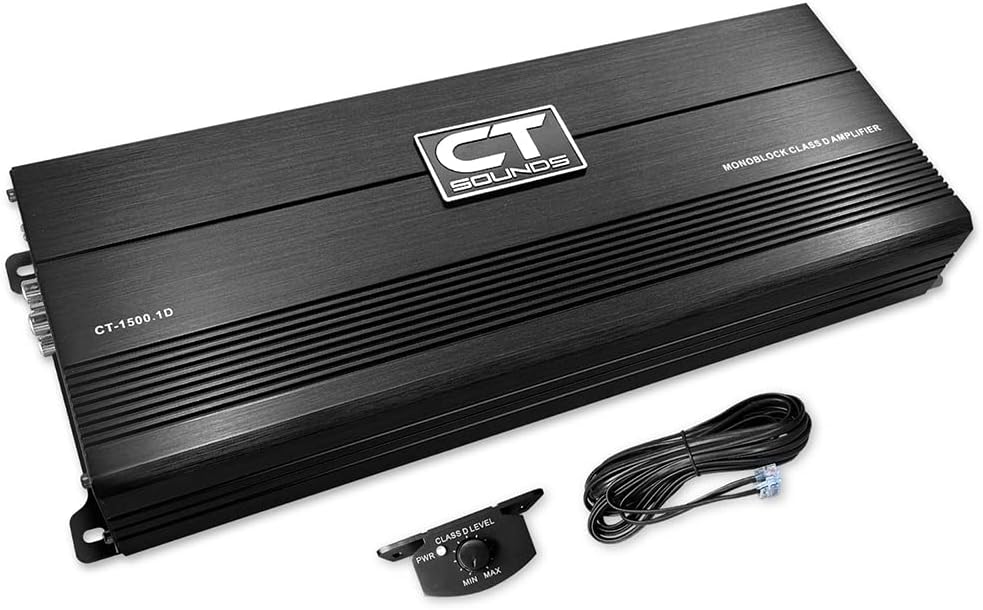
The CT Sounds CT-1500.1D combines a 4.5 rating with a clear 1500-watt RMS specification at one ohm. It stands out because its power ratings continue down across common loads: 850 watts RMS at two ohms and 450 watts RMS at four ohms, measured at 14.4 volts. This makes it easier for buyers to match amplifier output to a planned subwoofer load rather than focusing on a single headline number.
We may earn a commission when you buy through this link, at no additional cost to you.
The compact chassis is designed for practical vehicle installation, and the amplifier's Class D power supply and proprietary heat-dissipation design are intended to support efficient, cool operation. Protection circuitry covers high voltage, low voltage, overcurrent, and high temperature. Those four safeguards are especially important in a car environment, where electrical conditions, wiring resistance, and enclosure temperatures can change during operation.
The stated frequency response reaches 320 hertz, and a bass knob is included. That gives the installer some level control and a broad operating range for subwoofer applications, although the supplied information does not identify a variable low-pass filter, subsonic filter, or phase control. A shopper who expects a more elaborate tuning panel may find one of the filter-focused models more appropriate.
The CT-1500.1D is a strong all-around recommendation for a compact, dedicated monoblock. Its documented output across several impedances, efficient design, and four-way protection make it easy to recommend as the editor's choice. It suits a broad range of high-output subwoofer builds, particularly where space is limited and straightforward, dependable operation matters more than a crowded set of controls.
Publishing output at one, two, and four ohms gives system designers useful information for preventing an underpowered or poorly matched combination. It also allows a single amplifier to serve different subwoofer arrangements when their final impedances remain within the unit's operating limits.
The compact enclosure reduces the amount of space needed in a vehicle, while the stated heat-dissipation design addresses the thermal demands of high-output Class D amplification. This is useful when the amplifier is mounted in a tightly packed installation area.
We may earn a commission when you buy through this link, at no additional cost to you.
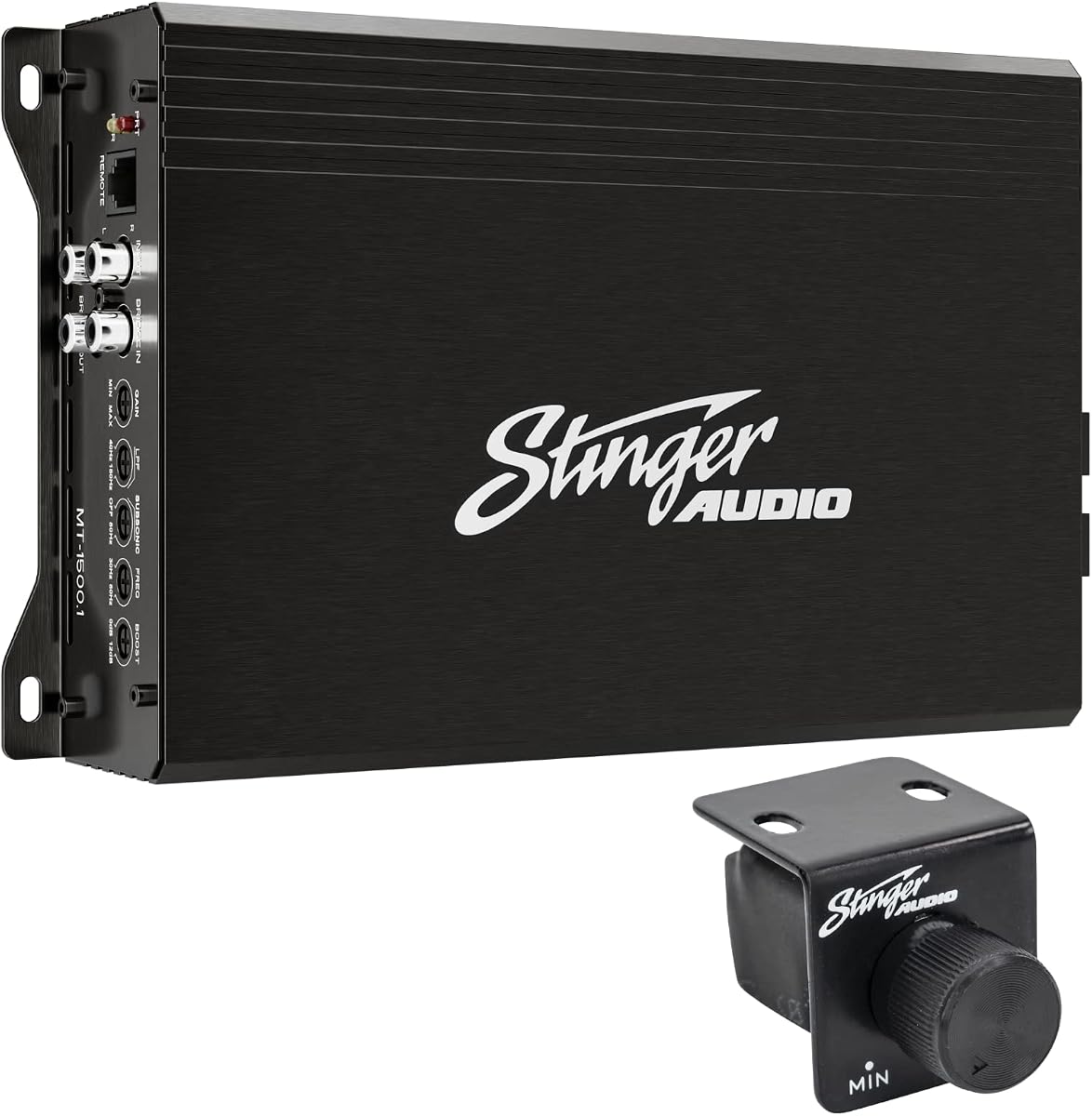
The Stinger Audio MT15001 is a compact Class D monoblock rated 4.2 stars. Its most distinctive trait is a dense feature set for a relatively small chassis measuring 6.10 inches long, 10.16 inches wide, and 2.09 inches high. It supports one-, two-, and four-ohm loads, includes an adjustable bass boost, and supplies a remote bass control that can be mounted on the dash or flush into a console.
We may earn a commission when you buy through this link, at no additional cost to you.
The listed output includes up to 1000 watts at two ohms and 550 watts at four ohms. Although the product name uses 1500 watts, buyers should carefully distinguish that headline figure from the documented RMS behavior at a given impedance. The amplifier also lists a very high bridged figure, but the unusual wording and value make it especially important to consult the current manual and manufacturer documentation before wiring a specific subwoofer configuration.
Its Class X2 aluminum zinc high-frequency capacitor, advanced processing, direct-insert power terminals, and PWM power supply are intended to improve switching performance, current handling, and reliability. The listed minus-93 dB signal-to-noise ratio provides useful context for system design. On the other hand, only one set of RCA line-level inputs is listed, so the amplifier may be less accommodating for elaborate multi-amplifier signal distribution.
The MT15001 is appealing when available space is tight but useful controls are still desired. It is particularly attractive to installers who want a dash-mounted bass knob and straightforward one-, two-, or four-ohm support. Its 4.2 rating is lower than several alternatives, so shoppers should assess the complete specification set and ensure the amplifier's continuous ratings align with their intended enclosure and wiring plan.
The stated dimensions make the MT15001 easier to consider in compact vehicles, trunks, and under-seat installations. Its remote control adds everyday convenience without requiring the main amplifier body to occupy a large portion of the available space.
Bass boost spans zero to twelve decibels, giving users a wider selection than a simple fixed switch. The included remote and the range of supported loads make the amplifier adaptable to a range of subwoofer and enclosure preferences.
We may earn a commission when you buy through this link, at no additional cost to you.
The Sundown Audio SFB-1500D carries a 4.5 rating and delivers documented output of 1500 watts RMS at one ohm, 1200 watts RMS at two ohms, and 650 watts RMS at four ohms. This gives it a particularly clear power curve, allowing an installer to estimate available power for several common subwoofer arrangements and avoid selecting an amplifier based on a single headline specification.
We may earn a commission when you buy through this link, at no additional cost to you.
Tuning is a major strength. A variable 12 dB per octave low-pass filter shapes how much of the signal reaches the subwoofer, while a high-pass filter provides additional system definition. Bass boost ranges from zero to 12 dB. For installers working with different enclosure characteristics, these controls are more useful than a fixed boost switch because they allow the crossover point and low-frequency emphasis to be adjusted rather than simply turned on.
Protection covers thermal, voltage, speaker-short, and DC-offset conditions. A smart three-speed cooling fan manages heat, while a dual MOS-FET PWM power supply, 140-amp fuse rating, and 100 dB signal-to-noise ratio complete a technically focused feature set. The trade-off is that the fan introduces a moving component and the listed chassis is not as compact as the smallest monoblocks in this comparison.
The SFB-1500D is a strong recommendation for a subwoofer system whose installer values comprehensive filtering and clear power specifications. It is particularly useful for builders who want to optimize the transition between the subwoofer and the rest of the system. The additional controls and active cooling make it a more specialized choice than the simplest one-knob monoblocks.
The variable low-pass and high-pass filters offer more precise control over the subwoofer's operating range than a fixed-frequency design. This is valuable when the enclosure, cabin acoustics, and front speakers create a transition that needs adjustment.
A three-speed cooling fan adjusts to the amplifier's thermal condition, providing active heat management during demanding use. The heavy-duty electrical design and documented protection suite reinforce the amplifier's suitability for high-output installations.
We may earn a commission when you buy through this link, at no additional cost to you.
The Crunch Ground Pounder GP-1500.2 is a two-channel amplifier with a 4.1 rating. Unlike dedicated monoblocks, it is rated at 750 watts per channel into two ohms and 325 watts per channel into four ohms. When bridged, one channel can produce 1500 watts into a four-ohm load, giving it a useful high-power mono configuration without changing the basic chassis.
We may earn a commission when you buy through this link, at no additional cost to you.
The amplifier can operate in stereo, bridged mono, or a combination of stereo and bridged mono. That flexibility makes it useful for a system with both front and rear speakers, or for a build that powers a pair of door speakers while also driving a subwoofer. Its variable 12 dB per octave electronic crossover adds basic frequency division between those sections of the system.
The key limitation is that a bridged two-channel amplifier does not offer the same installation simplicity or potentially stronger subwoofer-channel specification as a dedicated one-ohm-stable monoblock. The listed 1500-watt bridged output is specified at four ohms, so a one-ohm subwoofer arrangement should not be assumed to be supported. The product's 4.1 rating also places it below the more highly rated options, although the rating does not tell the entire story of system fit.
The GP-1500.2 makes the most sense for a build that needs one amplifier to cover both stereo speakers and a subwoofer. It is less compelling when the system is dedicated entirely to bass and the installer can devote a purpose-built monoblock to that job. For a flexible, entry-oriented multi-channel arrangement, though, the operating modes are unusually useful.
Stereo, bridged mono, and mixed operation allow the amplifier to support several system layouts. That flexibility can simplify wiring and reduce the number of separate units needed when a vehicle must power full-range speakers and a subwoofer.
The variable 12 dB per octave crossover helps separate bass from full-range outputs. While not as specialized as the filter controls on dedicated monoblocks, it adds useful system shaping for a multi-channel installation.
We may earn a commission when you buy through this link, at no additional cost to you.
The Audiobank P1502 is a bridgeable Class AB two-channel amplifier rated 4.0 stars. It can deliver up to 1500 watts maximum output and supports stereo, bridged mono, and tri-mode operation. Its two-ohm stability is useful for conventional component speakers, while its bridge mode creates an option for a higher-power subwoofer channel in a system that does not require a dedicated monoblock.
We may earn a commission when you buy through this link, at no additional cost to you.
Input flexibility is one of its strongest practical features. Both nickel-plated RCA and speaker-level inputs are provided, allowing the amplifier to work with aftermarket head units as well as factory-style audio sources. The continuously variable low-pass crossover spans 40 to 300 hertz, while the high-pass filter covers 80 hertz to 4 kHz. Input gain and zero-to-12 dB bass boost add further control over the system's response.
The stated 99 dB signal-to-noise ratio and 90 dB channel separation support clear, detailed playback and stereo imaging. A MOSFET pulse-width power supply is included, and the aluminum-alloy heatsink is intended to dissipate heat during extended listening. However, Class AB topology inherently dissipates more heat than Class D, and the 4.0 rating is the lowest among the ten products included here.
The P1502 stands out for mobile versatility. The supplied information identifies suitability for cars, trucks, motorcycles, RVs, ATVs, boats, and marine installations, making it a broad choice for unusual electrical environments. It is best suited to installers who prioritize flexible inputs, crossover access, and multi-vehicle use over the compact efficiency and deep one-ohm capability of a dedicated monoblock.
Speaker-level inputs are particularly valuable when a vehicle's factory audio system lacks convenient RCA connections. The RCA inputs preserve a straightforward option for aftermarket head units and signal processors.
The documented vehicle range extends well beyond passenger cars, which broadens the amplifier's appeal for powersports, marine, and recreational installations. Installers should still use appropriate wiring, grounding, and environmental protection for each application.
We may earn a commission when you buy through this link, at no additional cost to you.
The Skar Audio SA-1500.1D is a dedicated Class D monoblock with a 4.6 rating. It delivers 1550 watts RMS at one ohm and up to 2800 watts peak, placing it among the strongest conventional monoblocks in this list on documented low-impedance output. Its 10-to-250-hertz frequency response and one-ohm stability make it appropriate for serious subwoofer installations.
We may earn a commission when you buy through this link, at no additional cost to you.
Its control panel is more versatile than the RP-1500.1D. Adjustable bass gain, a subsonic filter, a low-pass filter, and bass boost give an installer more ways to shape the output. The subsonic filter is particularly valuable for sealed enclosures because it can restrict very low frequencies that are inefficient or potentially damaging under certain operating conditions. The quick-disconnect terminal plug can also simplify service and installation planning.
Auto remote turn-on, an LED status indicator, and four-AWG power and ground input size improve usability and current handling. The exact bass-boost range and other control ranges are not provided in the supplied specifications, so precise comparison with continuously variable models would require consulting the current manual. The product also does not list an included remote level knob, which may be a drawback for users who want convenient cockpit control.
The SA-1500.1D is a compelling all-around monoblock for buyers who want more tuning than the simpler Skar model without moving to a premium-priced platform. Its high rating, documented 1550-watt RMS output, subsonic filtering, and low-pass control should appeal to performance-oriented installers. It is a particularly good match for sealed or highly tuned enclosures where low-frequency cutoff control matters.
The subsonic and low-pass filters can help establish a more deliberate operating range for the subwoofer. This is especially useful in sealed systems where reducing excessive low-frequency excursion can improve both output quality and reliability.
Four-AWG power and ground inputs support efficient current delivery, while the quick-disconnect terminal plug simplifies connection and removal. The status indicator provides a visible way to confirm the amplifier's operating state during setup.
We may earn a commission when you buy through this link, at no additional cost to you.
The Rockford Fosgate Power T1500-1bdCP pairs a 4.7 rating with an emphasis on constant power. It is rated to deliver 1500 watts into either two ohms or one ohm, along with 1000 watts at four ohms. That approach is intended to provide more consistent output as speaker impedance changes, giving the amplifier a distinct identity among the monoblocks in this guide.
We may earn a commission when you buy through this link, at no additional cost to you.
Its highly efficient Class BD design is optimized for subwoofer applications in cars and trucks. Balanced differential RCA pass-through outputs are useful for adding another amplifier without an additional converter, while the on-board Punch EQ provides up to 18 dB of boost at 45 hertz. A 24 dB per octave Butterworth crossover provides a steep and deliberate frequency transition.
The trade-off is installation bulk. The listed full chassis dimensions are 2.14 by 8.14 by 14.91 inches, considerably longer than the compact dedicated monoblocks. Its sophistication also calls for careful wiring and setup, particularly when using the high boost range. Buyers who need a small amplifier for a constrained installation may find the footprint harder to accommodate.
The T1500-1bdCP is the premium recommendation in this group for a high-end subwoofer build where consistent power, robust construction, and refined filtering justify the larger footprint. It is also backed by a stated two-year parts-and-labor warranty, adding reassurance to a major installation. For a builder who values a premium electrical platform over minimum chassis size, it is a persuasive choice.
The Constant Power approach focuses on maintaining useful output across the amplifier's supported impedances. This can make system planning more predictable when comparing load-dependent alternatives that lose more power as resistance increases.
Balanced differential pass-through outputs, steep Butterworth filtering, and extensive low-frequency boost create a sophisticated control platform. The full chassis requires planning, but it gives an installer room to run a serious dedicated system.
We may earn a commission when you buy through this link, at no additional cost to you.
The Alpine R2-A150M holds the highest rating in this comparison at 4.9 stars. It is a dedicated R-Series mono amplifier designed to match the power handling of two 10-inch or 12-inch R-Series subwoofers, or even four 8-inch R-Series subs that combine for a 1200-watt two-ohm load. Its stated 1500-watt one-ohm capability makes it a natural match for larger or lower-impedance subwoofer configurations.
We may earn a commission when you buy through this link, at no additional cost to you.
The next-generation Class D amplifier circuit emphasizes sound quality and efficiency, aligning with the amplifier's Hi-Res certified positioning. Installation is well considered: all speaker connections are consolidated on one side, the gain and crossover controls sit on top beneath a removable plate, and integrated mounting brackets are included. This arrangement allows quick adjustments while keeping the chassis organized.
Compared with highly tunable monoblocks, the supplied specifications reveal fewer detailed filter and phase settings. The control panel's exact low-pass range, subsonic options, and bass boost range are not stated, so a buyer wanting extensive manual adjustment should consult the current documentation. Another consideration is that the product is positioned as a premium match for a particular R-Series ecosystem, which may offer less flexibility for a system built around unrelated subwoofers.
The R2-A150M is an excellent recommendation for a high-end, carefully matched Alpine subwoofer system. Its rating, Hi-Res certification, efficient Class D design, accessible controls, and integrated mounting hardware distinguish it from general-purpose monoblocks. For buyers creating a cohesive R-Series installation, the amplifier's specialized match may be more valuable than a larger catalog of adjustment controls.
The specified matching configurations make system sizing easier for shoppers building with Alpine R-Series drivers. One amplifier can support substantial subwoofer power while consolidating the installation around a single dedicated mono unit.
Locating gain and crossover controls beneath a removable top plate keeps the exterior clean while making adjustments accessible. Consolidated speaker connections further simplify cable routing and routine installation checks.
We may earn a commission when you buy through this link, at no additional cost to you.
The Sundown Audio SAEv4-1500D is a feature-rich Class D monoblock with a 4.5 rating. It delivers 1500 watts RMS at one ohm, 800 watts RMS at two ohms, and 450 watts RMS at four ohms. That documented progression gives installers useful information for matching the amplifier to a planned speaker load, while the dual MOS-FET PWM supply and heavy-duty aluminum heatsink support efficient, stable operation.
We may earn a commission when you buy through this link, at no additional cost to you.
Its most advanced feature is the 0-to-180-degree variable phase shift control. Phase adjustment can improve how a subwoofer integrates with front speakers, particularly when placement or enclosure characteristics create timing and frequency response issues. The amplifier also includes a 12 dB variable low-pass filter from 40 to 180 hertz and a 12 dB subsonic filter from 10 to 40 hertz, giving installers a complete tuning range for common subwoofer applications.
The included wired remote features a clipping indicator, making it easier to recognize excessive gain settings while driving the system. Protection circuitry addresses thermal, voltage, speaker-short, and DC-offset faults, while power, clipping, and protection indicators provide real-time status. The listed 12.48 by 6.3 by 2.75-inch chassis is larger than the most compact units, and the substantial decrease from 1500 watts at one ohm to 800 watts at two ohms deserves attention during load planning.
The SAEv4-1500D is a strong pick for an installer who prioritizes phase alignment, low-frequency control, and remote monitoring. It is less suitable for a buyer seeking the smallest possible enclosure or the highest power at a two-ohm load. For a carefully tuned subwoofer installation, however, its advanced filters and phase control make it one of the most complete options in the guide.
Variable phase control gives the installer another tool for aligning the subwoofer with the vehicle's full-range speakers. It can help refine low-frequency integration when timing changes around the listening position would otherwise produce an uneven response.
The remote's clipping indicator provides immediate feedback while the system is operating at normal levels. Correctly setting gain around that point helps reduce distortion and leaves a better margin between the amplifier and the subwoofer's demands.
We may earn a commission when you buy through this link, at no additional cost to you.
Choosing a 1500-watt car amplifier involves matching continuous output to the subwoofer load, selecting useful controls, planning electrical requirements, and confirming that the chassis and features suit the vehicle. The following factors are more important than a headline wattage figure alone.
A headline wattage number can refer to peak output, maximum bridged output, or continuous RMS power at a specific impedance. For reliable system planning, focus on the output at the final speaker load: one ohm, two ohms, or four ohms. Continuous RMS ratings indicate what the amplifier is designed to deliver under sustained operating conditions, while peak figures describe a short-duration ceiling. Compare like-for-like figures and verify the test voltage when it is published.
In summary, choose an amplifier whose continuous rating comfortably supports your subwoofer configuration without creating an unnecessarily difficult load for the electrical system.
The combined impedance of all subwoofers must fall within the amplifier's supported operating range. Parallel and series wiring changes that total load, so a pair of four-ohm subwoofers may appear as two ohms when wired in parallel or eight ohms in series. A dedicated one-ohm-stable monoblock provides more latitude for common subwoofer arrangements, while some two-channel amplifiers support only two ohms per channel in their normal configuration.
In summary, calculate the final wired impedance before choosing an amplifier and confirm both the load rating and any bridged-mode limitations.
A monoblock is optimized to drive a subwoofer, offering one channel, one filter set, and usually deeper one-ohm capability. A two-channel amplifier can power a pair of speakers in stereo or combine its channels in bridged mono, making it more versatile for full-system builds. Some two-channel models also support simultaneous stereo and bridged-mono operation. The right choice depends on whether the amplifier has a dedicated subwoofer role or must serve multiple speaker types.
In summary, use a monoblock for a bass-focused build and consider a two-channel model when one amplifier must also serve full-range speakers.
A variable low-pass filter sets the highest frequency sent to the subwoofer and helps it blend with the front speakers. A subsonic filter removes frequencies below the subwoofer's useful range, which can reduce waste and improve control in sealed or high-tuning enclosures. A steep slope, such as 12 or 24 dB per octave, can provide a more gradual transition. Phase control is another useful feature when the subwoofer needs to align with the rest of the system.
In summary, prioritize an adjustable low-pass filter for normal integration and a subsonic filter for tighter enclosure control, particularly in sealed boxes.
A high-current amplifier demands a properly sized power cable, appropriate fuse protection, a reliable ground connection, and a vehicle charging system that can support the load. The amplifier's power and ground terminal size is a useful clue about expected current, but it is not a substitute for correctly sizing the complete installation. Long cable runs increase voltage drop, so abbreviated runs and sound connection techniques help preserve the amplifier's rated output.
In summary, match the wiring, fuse, ground, and alternator capacity to the amplifier rather than relying on the amp's wattage label alone.
Compact dimensions can make an amplifier easier to mount in a vehicle, but space should be reserved for airflow and service access. Class D amplifiers are generally efficient, although substantial output still creates heat. Active cooling, a substantial heatsink, and a carefully chosen mounting location help maintain performance during extended use. The enclosure and subwoofer's thermal limits are equally important because both the voice coil and amplifier can be damaged by sustained operation beyond their limits.
In summary, leave room around the heatsink, avoid enclosed cavities without airflow, and set gain responsibly to reduce heat and distortion.
RCA inputs suit aftermarket head units and processors, while speaker-level inputs allow an amplifier to connect to a factory audio source. A wired remote bass knob improves daily usability, especially in a vehicle without an easy-to-access gain control. Automatic turn-on can simplify the installation, while indicators for clipping, power, and protection help with setup and troubleshooting. A quick-disconnect plug can also make servicing and terminal connections more convenient.
In summary, select the inputs and remote accessories that match the vehicle's source and make routine level changes practical.
Useful protection systems commonly cover overcurrent, undervoltage, overvoltage, thermal overload, speaker shorts, and DC offset. Their presence adds confidence, but proper installation remains equally important. Metal heatsinks, quality power supplies, direct-insert terminals, and well-organized connection layouts indicate attention to durability and serviceability. Warranty coverage and the availability of replacement parts can also matter for a long-term vehicle installation.
In summary, favor an amplifier with comprehensive protection, sturdy connections, effective cooling, and credible manufacturer support for long-term ownership.
Begin with the vehicle turned off and confirm the amplifier's wiring diagram. Connect the fused positive power cable to a suitable battery terminal, establish a short, clean ground connection, run the remote turn-on lead, and connect the audio input. Verify speaker polarity before energizing the system. Check that the amplifier's supported impedance and configured operating mode match the completed subwoofer or speaker wiring.
Set the amplifier's gain using a test tone or a familiar, distortion-free track, with the subsonic and low-pass filters established first. Begin with bass boost at its lowest setting, then increase gain cautiously while monitoring for clipping through the remote indicator, if provided. A conservative gain setting provides headroom and reduces distortion. If the amplifier has a clipping light, use it to identify the point at which the source or gain chain becomes overloaded.
After initial setup, let the system run at moderate volume and check the amplifier, wiring, and enclosure for heat, loose connections, or abnormal noise. Never block the heatsink or fan and avoid placing the unit where water or cargo can interfere with it. Periodically inspect the fuse, terminals, and grounds, and revisit gain and filter settings if the subwoofer enclosure, vehicle acoustics, or system configuration changes.
It can be enough if the subwoofer's power handling and impedance are compatible with the amplifier's continuous ratings. Many 1500-watt-class monoblocks produce their stated one-ohm output, while others are rated at two or four ohms. Check the exact RMS specification at the planned load and leave appropriate headroom rather than matching every headline number.
Yes, if their combined wired impedance remains within the amplifier's supported range. Two four-ohm subwoofers wired in parallel produce a two-ohm load, while four four-ohm subwoofers in parallel produce one ohm. Use the manufacturer's wiring diagram and confirm the amplifier's minimum stable impedance before connecting the speakers.
A monoblock is generally better for a dedicated subwoofer because it is designed around low-frequency output and often supports a one-ohm load. A bridged two-channel amplifier is more useful when one amp must also power full-range speakers or when the installation needs fewer boxes. Compare continuous ratings, filters, and supported bridge loads rather than choosing only by channel count.
Peak power describes a short-duration maximum, while RMS power describes continuous output that can be maintained under sustained conditions. For judging amplifier capability, the RMS figure at the intended speaker impedance is more useful. A peak-only 1500-watt claim should not be treated as equivalent to 1500 watts of continuous output.
A properly sized wiring kit is strongly recommended because high-output amplifiers can require substantial current and appropriate cable gauge. The kit should include correctly rated power and ground cable, an appropriate fuse, and quality terminals. Choose the cable length and gauge for the vehicle, amplifier location, and current demand rather than relying on a generic package.
Set the low-pass filter so the subwoofer handles low bass while the front speakers retain vocals and higher midrange frequencies. A starting point near 80 to 100 hertz is common, but the correct setting depends on the subwoofer, enclosure, front speakers, and listening position. Adjust gradually while checking for smooth blending rather than a noticeable frequency gap.
No. Bass boost increases a selected low-frequency range but does not limit frequencies below the subwoofer's useful operating range. A subsonic filter serves a different purpose by removing unwanted very low content. An enclosure that requires substantial boost may also be producing output in a region where the subwoofer cannot respond cleanly, so filters, gain, and enclosure tuning should be addressed together.
High power requires high current, and resistance in undersized power or ground cables reduces voltage available at the amplifier while generating heat. Adequate cable gauge, a short ground path, a proper fuse, and a compatible charging system help the amplifier deliver its rated output efficiently. These installation components are as important as the amplifier itself.
The Skar Audio RP-1500.1D stands out as the best budget-focused dedicated monoblock, while the CT Sounds CT-1500.1D offers a balanced combination of compact construction, clearly documented multi-load power, and four-way protection. The Alpine R2-A150M is the premium pick for a cohesive high-end R-Series system, combining a 4.9 rating with Hi-Res certification and installation-friendly physical design.
For buyers needing more tuning, the Sundown Audio SFB-1500D and SAEv4-1500D provide more detailed filtering, with the latter adding variable phase adjustment. The Crunch GP-1500.2 and Audiobank P1502 make more sense when one amplifier must serve full-range speakers as well as a subwoofer. In every case, the final load, continuous RMS rating, controls, wiring, and enclosure should be matched before purchase.
Ratings, specifications, availability, and prices can change, so shoppers should review the current listing and manufacturer documentation before ordering. Confirming the amplifier's supported impedance, exact RMS output, included accessories, and installation requirements will help prevent an expensive mismatch and keep the finished audio system operating as intended.
