
UltraPro Portable HD TV Antenna
4.3Editor score
Compact monopole design
Strong magnetic mounting base
Supports VHF and UHF signals
ATSC 3.0 compatible
Explore the best HDMI Antenna for TV options, comparing reception range, signal modes, cable length, mounting, compatibility, and setup ease for smart TVs.
An HDMI antenna for TV is commonly used to describe an indoor over-the-air television antenna that connects through a television’s coaxial input. The strongest choice depends less on marketing language and more on broadcast coverage, building materials, antenna placement, and whether you need amplified reception or a simple portable design.
We compared ten indoor and versatile TV antennas based on the supplied specifications, including supported broadcast formats, claimed reception range, signal controls, cable length, mounting options, compatibility, customer support, and practical setup guidance. The list includes amplified models, magnetic-base antennas, low-profile designs, and a compact option for travel.
Each review explains the most useful features and the compromises that shoppers should consider. Ratings and specifications can change over time, as can product availability and prices, so readers should verify the latest listing details and confirm local channel coverage before making a final purchasing decision.
4.3Editor score

4.2Editor score
4.2Editor score
The table below compares the ten antennas by their most decision-relevant features, including reception approach, included cable, mounting style, broadcast compatibility, and practical limitations. It is a quick overview rather than a substitute for checking whether the stations you want are actually available at your address.


The DAANT TV Antenna Indoor Long Range earns a 4.0 rating and offers a straightforward combination of a long coaxial lead, an upgraded smart IC chip, and support for digital television formats. Its stated capabilities include receiving local networks such as ABC, CBS, NBC, FOX, CW, and ION, subject to the signal coverage available where the antenna is installed.
We may earn a commission when you buy through this link, at no additional cost to you.
The included 16-foot cable provides meaningful placement flexibility, allowing the antenna to sit near a window while the television remains on a stand or entertainment unit. The product information also describes a solid center conductor, dielectric insulation, and three aluminum shielding layers. Its smart chip is designed to support reception of 4K, UHD, and 1080 HDTV broadcasts, although picture quality ultimately depends on the signal reaching the antenna.
The main limitation is the absence of a documented range selector or separate signal-booster control. Buyers therefore have fewer ways to tune reception than they would with the dual-mode model in second place. The antenna is also limited to digital and smart televisions, so owners of an older analog set would need a different solution. Even so, the generous cable and clear instructions make this a balanced option for conventional indoor viewing.
Choose the DAANT when you want a straightforward indoor antenna with ample cable length and broad digital-TV compatibility rather than multiple operating modes. It is best suited to homes where a window position is available and the available broadcast signal can be received without extensive adjustment. For shoppers seeking more signal controls, the second-ranked antenna may be a more flexible choice.
A 16-foot coaxial cable gives the antenna enough freedom to reach a higher or less obstructed position. Start near a window, then rescan channels after each meaningful move because a small change in location can materially affect reception.
The antenna is intended for digital and smart TVs and supports common HDTV formats. It is not designed for older analog televisions, making it a better fit for current sets than for legacy equipment.
We may earn a commission when you buy through this link, at no additional cost to you.
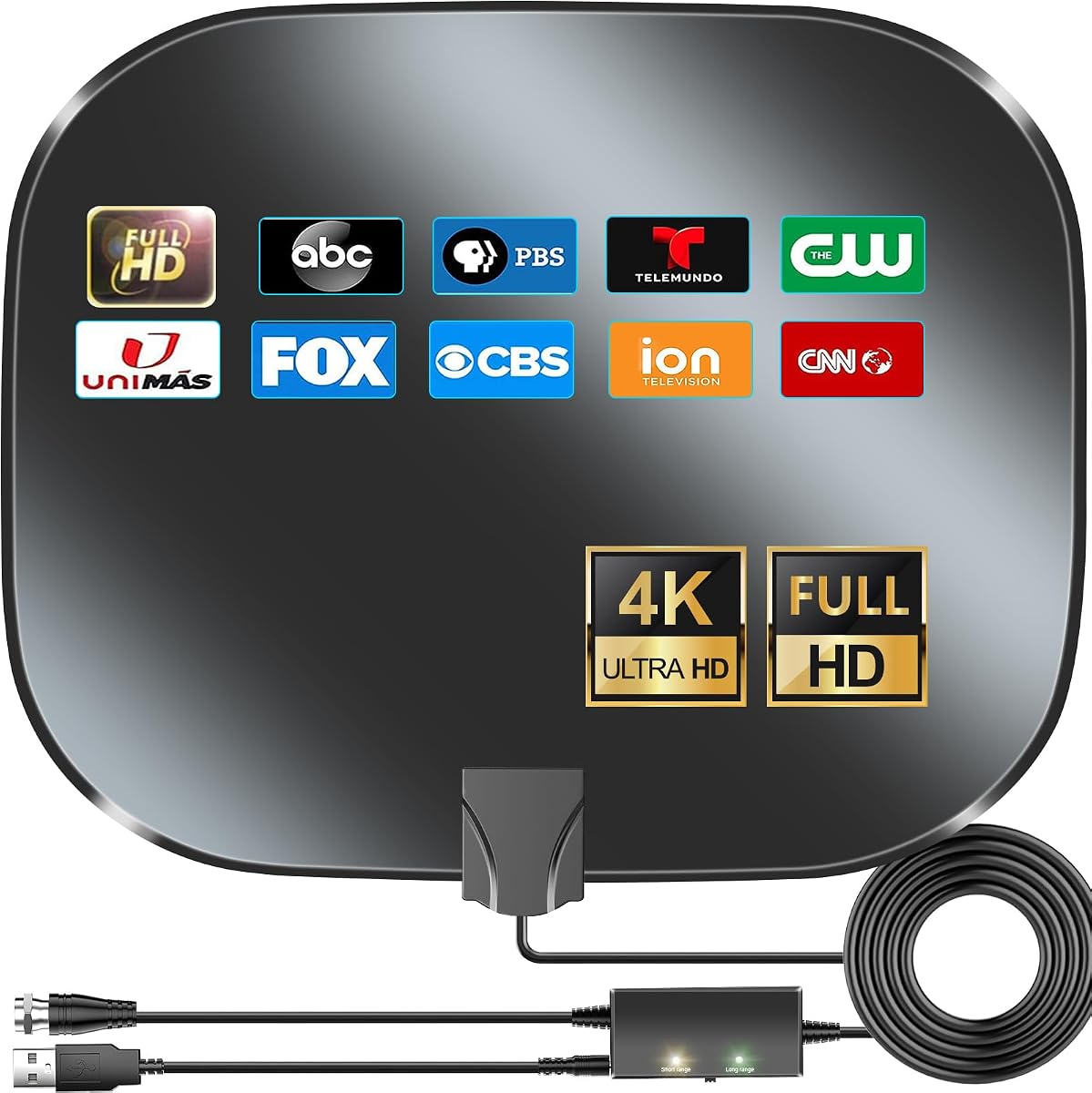
This TV Antenna for Smart TV Indoor earns a 4.2 rating and stands out for its two operating modes. Short-range mode is intended for viewers within 35 miles of a broadcast tower, while long-range mode is designed for locations between 35 and 250 miles. That distinction gives users a practical way to match the antenna to their approximate coverage area.
We may earn a commission when you buy through this link, at no additional cost to you.
The upgraded smart IC chip is described as filtering cellular and FM interference while supporting 4K, UHD, and 1080p broadcasts where available. The package includes a 16.5-foot cable, an amplifier, and a manual. Installation guidance is unusually thorough, recommending a high position near a window, avoiding metal and thick walls, and repeating the channel scan after every adjustment.
It would be misleading to suggest that amplification can create a signal where none exists. The product information specifically notes that the amplifier works best where the underlying signal is strong and may not produce noticeable improvement in weak-signal areas. The antenna supports UHF and high-VHF, but some low-VHF channels numbered 2 through 6 may require another compatible antenna.
This is the most flexible pick for a typical smart-TV household because it combines range selection, a long cable, and unusually clear troubleshooting advice. It is a strong recommendation for residents who know their approximate distance from broadcast towers. Those needing channels 2 through 6 should first confirm the stations available in their area and consider whether a separate low-VHF antenna will be necessary.
Choosing the correct mode can prevent a mismatch between the antenna and the user's location. Short-range mode is intended for nearby towers, while long-range mode is for more distant areas, and the listing recommends checking tower distance before scanning.
The instructions cover the common causes of poor results: low placement, metal obstructions, the wrong range mode, and missed rescans. This guidance makes the antenna more approachable for first-time over-the-air viewers.
We may earn a commission when you buy through this link, at no additional cost to you.
The 2026 Upgraded TV Antenna for Local Channels has a 4.2 rating and presents the most feature-forward specification set in this roundup. Its high-gain amplifier booster and upgraded smart IC chip are intended to strengthen weak signals and reduce cellular and radio-frequency interference, while its stated format support includes 4K and 8K HDR content.
We may earn a commission when you buy through this link, at no additional cost to you.
The 18-foot coaxial cable is the longest included cable listed among these ten products, giving users more freedom to place the antenna near a window, higher on a wall, or in another location with a clearer path to broadcast towers. The antenna is also suitable for indoor or outdoor installation, a useful distinction for viewers who may want to experiment with placement beyond a living room.
Signal claims should still be considered in the context of real-world coverage. The product description acknowledges that reception varies with location, terrain, and weather. A high-gain booster cannot replace a viable over-the-air signal, and users may still need to move the antenna or rescan after changing its position. The product also does not include the detailed low-VHF caveat found in the second-ranked model.
Pick this antenna if you want a long lead, an integrated booster, and the flexibility to try an outdoor position. It is especially attractive to viewers willing to optimize placement rather than leaving the antenna permanently behind a television. For households with nearby towers and a straightforward indoor setup, the dual-mode antenna may deliver a more guided experience.
The 18-foot cable lets the antenna remain connected to a television positioned away from the best reception point. A longer lead is particularly useful when the strongest available signal is near a window, wall, or higher shelf.
The high-gain booster is designed to help with weak or interference-affected signals. It remains a complement to good placement rather than a substitute for it, so moving and rescanning are still essential.
We may earn a commission when you buy through this link, at no additional cost to you.
The TV Antenna for Local Channels with an 18-foot cable earns a 4.0 rating and combines a thick coaxial lead, a magnetic base, and a switchable signal booster. It supports full HD channels such as ABC, CBS, NBC, PBS, and FOX, along with 4K and 1080p formats when those signals are available in the viewing area.
We may earn a commission when you buy through this link, at no additional cost to you.
Its magnetic base expands the available mounting options. The antenna can be placed on a metal frame, while the reinforced cable is described as more suitable for outdoor positioning than standard indoor leads. The booster may be turned on when the television is more than 35 miles from a tower, giving users a simple way to test two configurations.
The listing states a maximum reach of 180 miles, but actual reception depends on proximity to towers, terrain, obstructions, and nearby structures. It also makes clear that the channel scan should be repeated after moving the antenna or changing the range setting. As with every amplified antenna, the booster cannot create a broadcast signal that is entirely unavailable.
This is a good option for someone who wants to mount the antenna on a metal surface, experiment with a rooftop or other exterior position, or keep a generous distance between the antenna and television. Buyers should use the FCC channel map before purchase and treat the stated range as a maximum rather than a guaranteed result at every address.
A magnetic base is especially convenient for moving the antenna between metal surfaces. It can help users find a better position without tools, although the broadcast signal still depends on the direction and clarity of the path to the tower.
The on-off booster provides a simple comparison between amplified and unamplified reception. Scan with each setting and in each promising location, since a booster that helps in one position may not improve another.
We may earn a commission when you buy through this link, at no additional cost to you.
The Digital TV Antenna for Smart TV Indoor earns a 4.0 rating and focuses on quick, tool-free installation. Its magnetic base can attach to a television stand, the back of a television, a cabinet, or another metal surface, while the product description emphasizes that no internal power source or tools are required.
We may earn a commission when you buy through this link, at no additional cost to you.
The upgraded smart IC chip is advertised as receiving signals from all directions and filtering cellular and FM signals. The antenna supports broadcasts including 4K, UHD, and 1080p programming. Its copper-wired coaxial cable is claimed to reduce signal loss, and the listing offers a 120-mile reception radius as a maximum potential range.
That large range figure is a marketing claim rather than a guarantee. The product information itself advises trying different positions and rescanning whenever the antenna is moved. Indoor building materials, terrain, and distance from towers can reduce performance dramatically, so a 120-mile claim should never be treated as an expected result without checking local coverage.
This antenna is a compelling pick for anyone who wants installation without a power connection or permanent mounting hardware. Its magnetic base also makes repeated testing easy, which is valuable when the first location does not produce the expected channel list. Shoppers should focus on realistic placement and local coverage rather than relying on the largest published radius.
The magnetic base simplifies installation on a television or cabinet and allows the antenna to be moved without reconnecting anything. This makes it easy to compare locations and preserve the orientation that produces the best scan.
Because the antenna does not need an internal power source, it avoids a wall outlet and keeps the setup visually clean. It is particularly convenient for renters and users who do not want visible power equipment.
We may earn a commission when you buy through this link, at no additional cost to you.
The UltraPro Hover Digital TV Antenna Indoor has a 4.0 rating and distinguishes itself with a low-profile hover-style design. It attaches directly to the top of a television, swivels horizontally, and can also sit on a flat surface or mount to a wall with the included tape. A push-on coaxial connector helps keep setup quick.
We may earn a commission when you buy through this link, at no additional cost to you.
The antenna supports modern 4K and 8K televisions and is compatible with ATSC 3.0 where that next-generation broadcast standard is available. Its stated indoor reception range extends up to 40 miles, making it a practical option for viewers within a moderate distance of broadcast towers. It is also presented as a useful backup during cable, satellite, or internet outages.
Unlike several amplified models in the roundup, the product description does not emphasize a built-in booster. Reception therefore depends heavily on placement and local signal strength. The 40-mile figure also sets a more conservative expectation than the much larger ranges claimed by some competitors, although actual results still vary with terrain and obstructions.
Choose the UltraPro Hover if appearance and simple television mounting matter most. It offers a clean home-theater setup and the ability to change orientation without moving the entire unit. Viewers farther from towers or with known interference problems may prefer a model with explicit amplification and range controls.
The hover-style form reduces visual clutter and keeps the antenna close to the television. It is a good match for users who want over-the-air reception without a conspicuous tabletop device.
Horizontal swiveling makes it easier to aim the antenna toward a tower. Wall mounting with included tape provides an alternative when the top of the television is not the best available position.
We may earn a commission when you buy through this link, at no additional cost to you.
The TV Antennas for Smart TV Indoor has a 3.8 rating and offers a simple alternative for viewers who do not need a built-in amplifier. It supports 4K and 1080p HD channels, uses filter technology intended to reduce invalid signals and noise, and includes a 9.8-foot coaxial cable for placement in a bedroom, living room, or game room.
We may earn a commission when you buy through this link, at no additional cost to you.
Its understated black design can be hidden behind a television, attached near a window, or positioned on a wall. Installation follows the familiar process: connect the cable to the television's ANT/IN connector, place the antenna near the television, orient it horizontally or vertically as needed, and scan for available channels.
The absence of an amplifier is both a limitation and a useful simplification. It means there is no booster to switch on or off and no power cord to manage, but it also removes a potential aid for weak or interference-affected locations. The cable is shorter than those supplied with most competing models, so placement flexibility is more limited.
This antenna suits nearby towers, strong indoor signals, and buyers who prefer a minimal setup. It may be less suitable for distant stations, obstructed locations, or users who specifically want a long-range booster. Always check local station availability and perform a fresh scan after moving the antenna.
The amplifier-free design keeps the package simple and avoids power placement. It can be a sensible choice when a nearby broadcast signal is already strong and clear.
The 9.8-foot cable is sufficient for a nearby shelf, cabinet, or wall position, although it offers less freedom than the 16- to 18-foot leads offered by several other picks.
We may earn a commission when you buy through this link, at no additional cost to you.
The UltraPro Portable HD TV Antenna Indoor Digital Antenna has the highest listed rating in the roundup at 4.3. Its compact monopole design and strong magnetic base make it particularly versatile for homes, recreational vehicles, boats, vehicles, camping trips, and outdoor viewing events where conventional indoor antennas are inconvenient.
We may earn a commission when you buy through this link, at no additional cost to you.
The antenna works with all television brands and is designed to receive VHF and UHF channels. It supports 1080p high-definition broadcasts and is described as 4K and 8K Ultra HD-ready. Compatibility with ATSC 3.0 means it can also handle next-generation over-the-air broadcasting where that service is available in the local market.
The magnetic base keeps the unit stable on most metal surfaces, and the compact shape makes it easy to store in a drawer, glove box, or travel bag. The product information does not provide a specific cable length or a long-range dual-mode system, so buyers should not expect the same placement flexibility as the models with 16- to 18-foot leads.
This is the strongest budget-oriented portable pick in the group. It is particularly useful for people who want one antenna for several environments rather than a fixed indoor installation. Its 4.3 rating also makes it an attractive choice for nearby or moderately distant users, provided local over-the-air coverage is confirmed before purchase.
The small monopole design is easy to carry between a living room, camper, boat, car, or tailgating setup. Its magnetic base allows quick changes without permanent mounting hardware.
Support for VHF, UHF, and ATSC 3.0 makes this antenna relevant for both current and next-generation over-the-air standards. Availability of advanced features still depends on local broadcasters and television equipment.
We may earn a commission when you buy through this link, at no additional cost to you.
The Antenna for Smart TV earns a 4.0 rating and combines a magnetic base, flexible mounting options, and a coaxial connection designed for easy placement. It supports local high-definition channels associated with major networks, including ABC, CBS, NBC, PBS, FOX, CW, and Univision, when those stations are available through local over-the-air coverage.
We may earn a commission when you buy through this link, at no additional cost to you.
Its 360-degree reception claim allows the antenna to be positioned in different directions, and the magnetic base can attach to most metal surfaces or hide behind a television. The product information also describes wall, window, and roof installation, with horizontal or vertical positioning used to optimize results.
The copper-wired coaxial cable is claimed to reduce signal loss by 50 percent and support a reception radius of up to 120 miles. That is a maximum claim influenced by distance, terrain, and obstructions. Unlike the dual-mode antenna in second place, this model does not document a range selector, leaving placement as the primary adjustment method.
This is a good choice for users who want flexible placement and do not need multiple electronic modes. The magnetic base makes it easy to test several positions, while the stated money-back guarantee provides added reassurance for eligible buyers. Those in weak-signal areas should verify their channel map and local tower distances before expecting a successful installation.
The 360-degree design and horizontal or vertical orientation options allow the antenna to be adjusted as needed. This is useful when the best line of sight is not directly beside the television.
The listed 30-day money-back guarantee gives buyers a defined return option if the antenna does not meet expectations. The product is also positioned as a practical way to access local news, sports, weather, and family programming.
We may earn a commission when you buy through this link, at no additional cost to you.
The Vansky Digital Amplified Indoor HDTV Antenna has a 4.0 rating and is built around a useful idea: the external signal booster can be removed. That lets users scan once with the amplifier attached and again without it, allowing them to identify the configuration that produces the more stable result in their particular location.
We may earn a commission when you buy through this link, at no additional cost to you.
The antenna supports 720p, 1080i, 1080p, and 4K ATSC formats and receives VHF and UHF broadcasts. A 16.5-foot coaxial cable provides enough length to place the antenna near a window or wall while keeping the television in a convenient position. The detachable booster is intended to help viewers farther from broadcast towers.
This model requires a corded electric power source, which is less convenient than a power-free magnetic antenna. It is also engineered specifically for indoor use, limiting the placement experiments available to products that permit outdoor installation. The listing appropriately warns that thick walls, valleys, and high-rise buildings can affect reception.
Choose the Vansky if the ability to remove the amplifier is important and you are willing to manage a power lead. Its thorough coverage notes and flexible cable make it particularly suitable for testing different indoor positions. Nearby viewers with strong signals may achieve better results with the booster detached.
A detachable amplifier gives users a practical troubleshooting method. If reception is unstable with amplification, removing the booster and rescanning may produce a clearer set of channels.
The antenna supports common ATSC formats from 720p through 4K and uses a generous coaxial lead. Placing it near a window remains the most important installation step.
We may earn a commission when you buy through this link, at no additional cost to you.
Choosing an over-the-air television antenna starts with realistic expectations about local coverage. Range claims, amplification, and broadcast-format support are useful comparisons, but placement, terrain, building materials, and correct channel scanning ultimately determine which stations your television can receive.
Before comparing reception ranges, check the available stations and broadcast towers near your address using the FCC's DTV Maps or AntennaWeb. The same nominal range can produce completely different results across a city because terrain, buildings, and tower direction vary. A well-positioned indoor antenna may outperform an expensive model in a strong-coverage area, while a weak-signal location may require careful placement, a longer lead, amplification, or an outdoor-rated arrangement. Reviewing coverage first prevents the disappointment of expecting distant stations that are not reliably available over the air.
Range figures are best treated as maximum potential rather than guaranteed distances. Products in this roundup state limits ranging from 40 miles to 250 miles, but those numbers are not directly comparable because the designs, amplifiers, frequencies, and testing conditions differ. The practical range also depends on whether the antenna is indoors, close to a window, elevated, shielded by walls, or aimed toward a tower. Select a model whose installation style matches your home, then expect to test several positions rather than relying on the published number alone.
An amplifier can help preserve or strengthen a usable signal, especially over a longer cable run, but it cannot manufacture reception where no broadcast signal is available. It may also worsen reception if it amplifies noise or strong interference. Models with range switches or a detachable booster give you more control because you can compare configurations. If channels are plentiful and nearby, a non-amplified antenna may be simpler; if your local list is marginal, an adjustable amplified model offers more troubleshooting options.
Included cable length affects where you can place the antenna. Products with 16- to 18-foot leads offer more freedom to place the unit near a high window or wall while the television remains on a furniture piece. Shorter cables can be adequate for a nearby cabinet but may limit testing. The DAANT, dual-mode model, 18-foot magnetic-base model, and Vansky all emphasize generous leads. Whichever length you choose, position the antenna higher, keep it away from metal obstructions when possible, and rescan channels after every significant move.
Magnetic-base antennas are convenient because they attach to television frames, cabinets, metal frames, and some vehicle surfaces without permanent hardware. A hover-style antenna can sit discreetly on top of a television or use included wall tape, while screw-mounted options can be stable but less convenient to relocate. Consider aesthetics, the location of your television's ANT/IN port, nearby metal objects, and whether you will want to move the antenna. The most secure mount is not always the one that receives the best signal.
Most modern smart televisions include an ANT/IN or coaxial input for over-the-air channels, but compatibility should be confirmed before purchase. The DAANT model is limited to digital and smart TVs, while the other selections are also presented for current smart sets. Most support HD formats, and some explicitly mention 4K, 8K readiness, or ATSC 3.0. A television's resolution does not manufacture missing broadcast quality: the transmitted signal and reception conditions still determine the final picture.
Not every over-the-air antenna handles every broadcast band equally well. The dual-mode TV Antenna for Smart TV Indoor explicitly supports UHF and high-VHF and notes that some low-VHF channels numbered 2 through 6 may require an additional compatible antenna. Several other models state VHF and UHF support without making the same distinction. If your preferred stations appear on low-VHF channels, verify the station list and choose accordingly rather than assuming every indoor antenna will capture them.
Good instructions can make the difference between a successful scan and hours of frustration. Look for guidance that explains where to place the antenna, how to orient it, when to rescan, and when to change range or amplifier settings. The dual-mode model and DAANT model provide especially specific placement advice, while the Vansky clearly explains the benefit of testing with and without its booster. Customer support and warranty terms can also be useful when a product fails to receive expected local stations.
Begin by identifying the ANT/IN or coaxial input on the back of your television and connecting the antenna cable securely. Place the unit near a window or as high as practical, away from metal objects, thick walls, and other electronics. Turn the television on, open the menu, select the channel-search or antenna-scan option, and allow the scan to finish. The terminology varies by television brand, so consult the television's manual if the menu is not immediately obvious.
If few stations appear, move the antenna only a few inches at a time and rescan. Try both horizontal and vertical orientation, test different range settings or amplifier configurations, and check that the antenna is not crowded by furniture or electronic devices. High placements near a window often work better than positions behind the television. Continue to rescan after each adjustment because the television must rebuild its channel list using the new signal conditions.
For regular care, handle the antenna and cable gently and avoid sharply bending the coaxial connector. Keep the indoor unit away from moisture, excessive heat, and direct sunlight unless the manufacturer specifically states that it is suitable for outdoor use. When the antenna is not in use, store it in its original packaging or another dust-free location. Periodically rescan your television because broadcasters may update their channel lineup or technical configuration.
Most over-the-air television antennas connect to the television through a 75-ohm coaxial ANT/IN port, not an HDMI port. The coaxial cable carries the broadcast signal, while an HDMI cable is generally used to connect a tuner, converter, or other source device to the television. The exact connector arrangement depends on the antenna and television, so inspect the ports before purchasing.
No. Reception depends on distance, terrain, obstructions, antenna placement, and the broadcast frequency used by each station. Check the FCC DTV Maps or AntennaWeb for the channels available at your address, then position the antenna near a window and rescan. A large stated reception range is a maximum capability rather than a promise that every listed station will be available indoors.
Test both settings. Amplification can help preserve a weak but usable signal, especially over a longer cable run, but it may also increase noise or interference. Scan with the amplifier attached and then remove it or select the unamplified mode. Keep the configuration that produces the most stable reception rather than assuming one setting is always better.
A television channel scan evaluates the signal that is available during that scan. Moving or rotating the antenna can change signal strength, direction, and interference levels, so the previous channel list may no longer reflect the best available reception. Repeat the scan after every significant placement or orientation change.
It can provide free over-the-air broadcasts from stations available in your area, but it does not carry every channel included with a traditional cable package. Local network affiliates, public broadcasting stations, and some independent stations may be available, while cable-only networks require separate access. Compare the local broadcast list with the channels you regularly watch before making the switch.
No. An antenna's 4K or 8K-ready label generally indicates that it can carry the broadcast frequencies used by those high-definition formats without becoming the limiting component. The actual resolution still depends on the broadcaster's signal, local coverage, the television, and the quality of reception. A modern television cannot create 4K detail from a weak or low-resolution broadcast.
A high position near a window generally offers the clearest path to broadcast towers. Avoid hiding the antenna behind a television, inside a metal cabinet, or beside large electronics and metal objects. Try several positions, change orientation, and rescan after each move. If the included cable is too short for a promising location, a model with a longer lead may be more practical.
Not always, because a good indoor location and a carefully positioned antenna can work in many areas. If repeated indoor tests yield only a small number of unstable channels, however, an outdoor or more elevated installation may help. Only some products in this roundup are described as suitable for outdoor use, and outdoor placement still cannot overcome areas with genuinely inadequate broadcast coverage.
The TV Antenna for Smart TV Indoor is the strongest overall recommendation because its selectable range modes, long cable, and detailed troubleshooting give users several ways to improve reception. The UltraPro Portable HD TV Antenna stands out as the best budget and portable option, while the 2026 Upgraded TV Antenna offers the strongest premium feature set with amplification and an 18-foot cable.
Before buying, prioritize local channel availability, a placement style that suits your home, and realistic expectations about distance. Strong-signal areas may need only a simple non-amplified antenna, while marginal coverage benefits from a range switch, removable booster, longer cable, or careful window placement. Checking coverage and rescanning after every adjustment will usually matter more than the largest advertised range.
Product details, ratings, availability, and prices can change, so review the current listing before ordering. Compare the supplied specifications with your television connections and the stations available at your address, then choose the model that offers the most useful controls for your specific indoor or portable setup.