
DROK Waterproof DS18B20 Probes
4.9Editor score
±0.5°C measurement accuracy
Waterproof stainless steel probes
3.0–5.5V power operation
One-Wire data communication
Explore the best Arduino temperature sensor options, comparing accuracy, humidity sensing, interfaces, voltage, probe design, and project compatibility.
An Arduino temperature sensor can turn a simple microcontroller project into an intelligent monitor for rooms, greenhouses, aquariums, equipment, or industrial prototypes. A useful model must balance measurement accuracy, response characteristics, electrical compatibility, environmental durability, and the amount of wiring or code required.
This guide compares ten temperature sensor options spanning digital air sensors, high-precision I2C modules, and waterproof DS18B20 probes. The comparison considers stated measurement ranges, accuracy, operating voltage, interface type, included accessories, and practical distinctions between room monitoring and remote or submerged sensing.
Each selection highlights the characteristics that matter for a particular Arduino build, helping readers distinguish easy-to-use modules from more precise or rugged alternatives. Product prices and availability can change, so compare the current listing, accessory details, and technical specifications before making a final purchase decision.
4.9Editor score

5.0Editor score

4.7Editor score
The table below places the ten modules and probes side by side, emphasizing sensor type, communication method, measurement range, and other specifications that directly affect Arduino projects.


The HiLetgo DHT11 five-pack is a straightforward option for Arduino experiments that need both temperature and relative-humidity readings without a complex analog circuit. Its 4.5 rating reflects a generally practical combination of simple wiring, digital output, and multiple included modules. Each board incorporates the sensing element, a bypass capacitor, and a pull-up resistor, reducing the amount of setup required for a first build.
We may earn a commission when you buy through this link, at no additional cost to you.
The module communicates through a single digital bus, which keeps the Arduino sketch comparatively simple and eliminates the need for separate analog temperature and humidity inputs. Its stated operating range is 3.3 to 5.5 volts, making it suitable for common 5-volt Arduino boards and many 3.3-volt systems. The five-module pack is especially useful for classrooms, multi-location demonstrations, or projects that may eventually need more than one sensing point.
Its limitations come from the DHT11 sensor itself. The stated temperature accuracy is approximately ±2°C, the usable temperature range is 0 to 50°C, and humidity accuracy is approximately ±5%RH. These figures make it better for demonstrations, environmental alerts, and simple trend monitoring than for fine-grained temperature control or applications requiring readings below freezing.
This is a sensible choice for beginners, educators, and makers who value an accessible module and generous pack size. It is less appropriate when precision, extended range, or industrial-style repeatability is the central requirement. For those needs, move up to an AHT30, SHT31, DHT22, or a DS18B20 probe.
The integrated electronics, digital output, and included wires simplify assembly. A maker can devote more time to learning how readings are displayed or logged than to troubleshooting separate support components.
The 0–50°C range and ±2°C stated accuracy work for ordinary indoor demonstrations. Outdoor use in freezing conditions or precision control applications calls for a sensor with a broader operating range.
We may earn a commission when you buy through this link, at no additional cost to you.
The AHT30 two-pack is the strongest general-purpose choice in this guide for Arduino projects that value accuracy, compact digital communication, and a low-voltage operating range. Its 5.0 rating accompanies unusually useful stated specifications: ±0.3°C temperature accuracy, 0.01°C temperature resolution, and ±2%RH humidity accuracy at 25°C. That combination gives it a clear advantage over entry-level DHT11 modules.
We may earn a commission when you buy through this link, at no additional cost to you.
I2C communication allows the board to share wiring with other compatible peripherals, while the four-pin test lead makes connection to a breadboard or development board straightforward. A supply range beginning at 2.0 volts offers good compatibility with low-voltage logic systems, including many contemporary microcontroller environments. The stated measurement range of −40 to 85°C also makes the module suitable for considerably more varied conditions than a DHT11.
The main consideration is that I2C is a bus rather than a single-wire sensor protocol, so the sketch and wiring must identify the device address correctly. Humidity accuracy of ±2%RH is not as tight as the headline temperature specification might initially suggest, and readings near the limits of the operating range should be interpreted with the stated conditions in mind. The module measures the environment near its board rather than a remote location.
Choose the AHT30 when accuracy and flexible wiring matter more than the absolute lowest cost. It is a strong fit for home environmental monitors, smart ventilation prototypes, comparison logging, and room-control experiments. The two-module pack also makes it convenient to compare conditions in two locations or to keep a spare available.
The stated ±0.3°C accuracy and 0.01°C resolution are the module's defining advantages. These figures make it more appropriate for changing setpoints, comparative measurements, and temperature trend analysis.
I2C communication can reduce wiring demands when the Arduino project includes displays or other I2C devices. Confirm address settings and ensure the bus supports the voltage level used by the selected Arduino-compatible board.
We may earn a commission when you buy through this link, at no additional cost to you.
The Teyleten SHT31-D three-pack is the premium option here for projects that need a broad temperature range alongside dependable digital climate sensing. Its 4.7 rating reflects a strong overall specification set, including a −40 to 125°C temperature range, 0 to 100%RH humidity range, and ±0.3°C stated temperature accuracy. The operating range is particularly useful for environmental chambers, controlled equipment, and industrial prototypes.
We may earn a commission when you buy through this link, at no additional cost to you.
The I2C interface fits modern Arduino boards and makes it possible to place the sensor on a shared communication bus. A 2.4–5.5-volt supply range provides useful flexibility across common development platforms. With three sensor modules included, the pack is well suited to multi-point monitoring, environmental mapping, or comparative experiments where identical sensors help make results easier to interpret.
A wide specification range should not be mistaken for uniform accuracy at every extreme. Actual performance can vary with environmental conditions, installation location, self-heating, condensation, and exposure, so the module should be positioned in representative air and away from heat-producing components. The I2C address may also require attention when several identical modules share one bus, and humidity measurements in highly condensed environments deserve careful interpretation.
This is a compelling choice for experienced makers, laboratory-style monitoring, and projects that benefit from a wide operating envelope. For ordinary room sensing, the AHT30 may offer a more economical route with similarly strong temperature accuracy. Choose the SHT31-D when its broader range and three-module format justify the additional complexity and expense.
A −40 to 125°C range covers conditions far beyond typical indoor sensors. That makes the module useful when a prototype must monitor cold environments, heated equipment, or changing operating zones.
Three matched modules allow a build to monitor several locations or conduct side-by-side comparisons. Appropriate address configuration and ventilation around each sensor help preserve useful measurement quality.
We may earn a commission when you buy through this link, at no additional cost to you.
The Gikfun DS18B20 three-pack is a practical choice when the measurement point must be separated from the Arduino board. Its 4.4 rating reflects a useful combination of waterproof probes, one-metre leads, and adapter modules. Each sensor can extend into an aquarium, greenhouse, soil bed, refrigerator compartment, or another location where measuring the air directly beside the controller would be inconvenient.
We may earn a commission when you buy through this link, at no additional cost to you.
The adapter board includes a pull-up resistor, allowing it to connect to most microcontrollers without requiring a separate support component for every probe. The specified color coding is red for power, yellow for data, and black for ground. A 3.3–5.0-volt working range supports common Arduino platforms, while the DS18B20 sensing element provides a stated −55 to 125°C measurement range.
One important qualification is that the listed measurement range refers to the sensor capability rather than an unlimited operating environment for every part of the cable. The lead itself is stated to withstand a maximum temperature of 85°C. Long cable runs can also make communication less reliable, so good wiring quality, suitable resistor placement, and topology planning remain important.
This pack suits makers who need remote sensing rather than just another room-air module. It works particularly well for temperature-controlled displays, fish-tank monitoring, equipment observation, and multi-probe experiments. Buy it when you value reach and environmental protection; choose a higher-precision air module instead when the sensor must sit directly in the monitored atmosphere and deliver exceptionally fine temperature resolution.
The one-metre leads let the probe reach confined, wet, or thermally active areas. This separation often produces more useful readings than a sensor permanently positioned beside an Arduino enclosure.
The onboard pull-up reduces assembly complexity, especially for a new One-Wire project. Check the wiring topology carefully when connecting multiple probes to the same data line.
We may earn a commission when you buy through this link, at no additional cost to you.
The WWZMDiB five-pack is built around five waterproof DS18B20 probes and five 4.7-kilohm resistors, making it a well-equipped option for multi-point Arduino temperature logging. Its 4.4 rating is supported by a broad −55 to 125°C range, ±0.5°C stated accuracy, and compatibility with Arduino, Raspberry Pi, ESP32, and STM environments. The included resistors reduce the chance of overlooking a required bus pull-up during assembly.
We may earn a commission when you buy through this link, at no additional cost to you.
The probes are intended for wet or moist environments, including underwater use, while the standard red, yellow, and black leads make the connections recognizable. This arrangement is especially helpful for aquarium monitoring, irrigation checks, greenhouse sensing, or multiple temperature points distributed around a project. The 3.0–5.25-volt supply range fits common microcontroller power systems.
Waterproof construction refers to the probe assembly rather than permission to submerge the wiring, connectors, or Arduino electronics. A DS18B20 also samples internally, so response speed and placement can influence readings, particularly when the measured environment changes faster than the probe can equilibrate. Long or poorly terminated data lines may also introduce communication errors, particularly when several sensors share a bus.
This package is compelling for anyone building a multi-sensor installation without wanting to source resistors and probes separately. It may be more than one project needs, but the five-probe format offers flexibility for classroom exercises, environmental comparisons, and redundant monitoring. A single-module user may find a smaller pack more economical, while a high-precision indoor monitor should favor the AHT30.
Five probes and five matching resistors support a scalable One-Wire layout. This makes the set useful for multi-location logging without requiring a separate parts order.
The waterproof probe design suits damp environments and continuous submersion of the sensing section. Keep exposed connections dry and preserve the insulated cable outside the probe's stated limits.
We may earn a commission when you buy through this link, at no additional cost to you.
The DHT11 two-pack is an easy entry point for Arduino projects that need a digital temperature and humidity reading from a simple one-wire module. Its 4.3 rating reflects a familiar sensor format with a 3.3–5.0-volt operating range, included wires, and a straightforward digital output. The package provides two modules, making it convenient to monitor two locations or retain a spare.
We may earn a commission when you buy through this link, at no additional cost to you.
The DHT11 combines a resistive humidity element, an NTC temperature-sensing component, and an onboard eight-bit microcontroller. This integrated approach lets the module deliver calibrated-style digital measurements without requiring separate analog conversion. A single-bus wiring scheme also reduces the number of Arduino pins needed and helps keep sample code approachable.
The trade-off is performance outside ordinary indoor conditions. The stated temperature range is 0–50°C with approximately ±2°C error, while humidity is measured from 20–95%RH with approximately ±5%RH error. That makes it a reasonable teaching, demonstration, or simple alert sensor, but not an ideal choice for fine control, freezer monitoring, or demanding environmental logging.
Choose this pack for a beginner project, a classroom build, or a simple indoor monitor where reliability and simplicity matter more than precision. It is also useful when two readings must be displayed at a basic level. If the build needs better accuracy, colder operation, or a greater measurement range, an AHT30, DHT22, or DS18B20 offers a more capable foundation.
The single-bus output and included cables keep the physical setup uncomplicated. Standard library examples make it a useful learning component before moving to more involved bus protocols.
The stated range and accuracy are appropriate for many room-based demonstrations. Specialized environmental applications should account for the sensor's narrower envelope.
We may earn a commission when you buy through this link, at no additional cost to you.
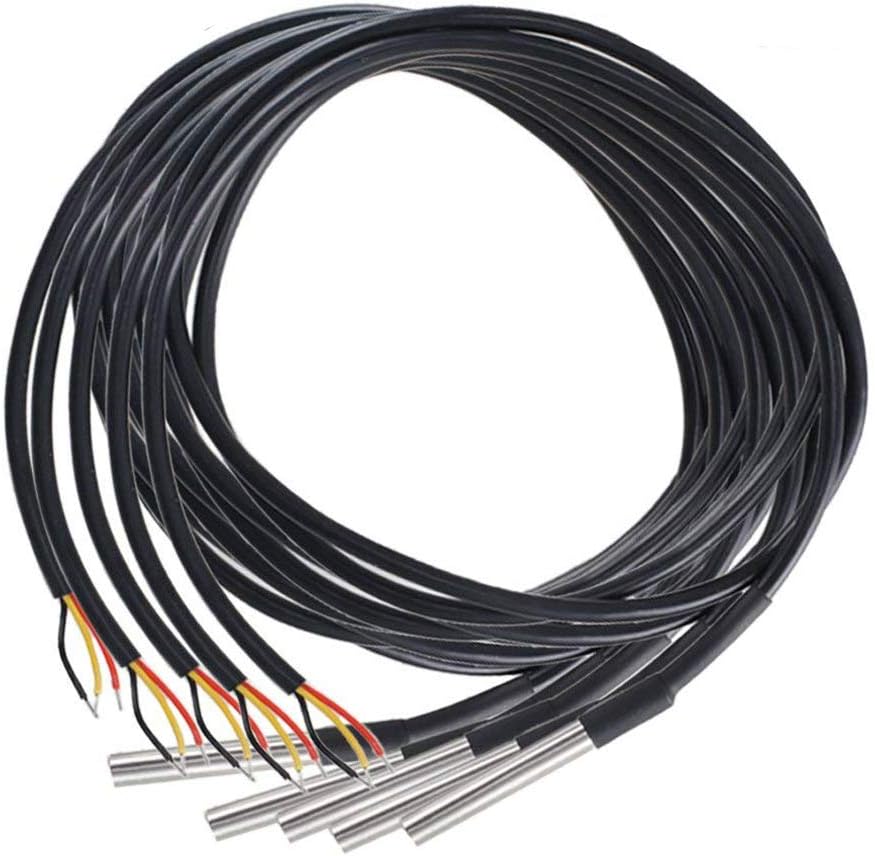
The DROK two-pack stands out as a rugged, accessible option for Arduino projects requiring remote and damp-environment sensing. Its 4.9 rating is supported by a stainless-steel probe housing, stated ±0.5°C accuracy, a −55 to 125°C range, and a 3.0–5.5-volt operating range. The package is also unusually complete, including two adapter boards, female-to-female jumper wires, and 4.7-kilohm resistors.
We may earn a commission when you buy through this link, at no additional cost to you.
The thermally conductive, corrosion-resistant probe is designed for continuous submersion and harsh wet conditions. Heat-shrink tubing protects the transitions between the probe and its red, yellow, and black leads. This makes the sensors suitable for aquariums, outdoor installations, refrigerator monitoring, and other applications where an exposed bare sensor would be vulnerable to moisture.
Communication uses the One-Wire protocol, which allows multiple compatible sensors to share a data line when the wiring topology and pull-up arrangement are correct. The adapter includes a pull-up resistor, which can simplify direct connections, while the included 4.7-kilohm resistor provides flexibility for configurations that call for a discrete bus resistor. The data and power leads remain vulnerable, so the connections should be protected even when the probe itself is submerged.
This is an excellent choice for budget-conscious builders who need more than a basic indoor module without moving to a high-end industrial device. It offers a strong balance of range, accuracy, durability, and included accessories. For the best dedicated climate accuracy, the AHT30 may be preferable; for remote wet-location measurement, the DROK package is especially compelling.
The stainless-steel enclosure and sealant protect the sensing element during submersion. Only the probe assembly is intended to be exposed, so the cable termination and connections still need protection.
Adapter boards, jumpers, and pull-up resistors cover the main assembly requirements. The package can support two monitored points without requiring a separate accessory purchase.
We may earn a commission when you buy through this link, at no additional cost to you.
The Gikfun five-pack gives Arduino builders five one-metre waterproof DS18B20 probes for distributed temperature monitoring. Its 4.5 rating reflects a well-established sensor family, straightforward color-coded wiring, and a 3.0–5.5-volt supply range. The single-bus interface is useful when several probes need to share the Arduino's data connection.
We may earn a commission when you buy through this link, at no additional cost to you.
The pack is suitable for monitoring greenhouses, aquariums, machinery, rooms, or consumer products. Each probe measures temperature in a location selected by the user rather than forcing all measurements to occur at the controller. The stated application list includes thermostatic controls, industrial systems, thermometers, and other thermally sensitive systems.
A 4.7-kilohm resistor between the data and power lines is recommended to make probe testing easier, and a properly selected pull-up is important for stable One-Wire communication. The package description does not indicate that the resistor is included, so users should plan to source one if the development board or interface does not already provide suitable pull-up support. Long cables and poor connections can also make communication less dependable.
Choose this five-pack when you need several remote readings and want the flexibility of standard DS18B20 components. It is especially useful for classroom comparisons or logging several points in one project. The DROK two-pack may be easier for a compact two-channel build because it includes more connection hardware, while the AHT30 offers better stated temperature accuracy for direct air sensing.
Five compatible probes can share a properly configured One-Wire bus. Unique sensor addressing allows the Arduino to identify and report each location separately.
The listing recommends a 4.7-kilohm data-to-power resistor. Confirm that a suitable pull-up is present and use clean connections, especially with longer leads.
We may earn a commission when you buy through this link, at no additional cost to you.
The HiLetgo DHT22/AM2302 two-pack offers a meaningful accuracy and range upgrade over the DHT11 while retaining a familiar single-bus format. Its 4.4 rating is supported by a stated −40 to 80°C temperature range, ±0.5°C temperature accuracy, and 0–100%RH humidity range. This makes it a useful middle ground for projects that want more capable measurements without moving to an I2C bus.
We may earn a commission when you buy through this link, at no additional cost to you.
The main chip is identified as an AOSONG AM2302 high-sensitivity temperature and humidity sensor. It provides a single-bus digital signal with bidirectional serial data, and the module includes a fixing hole for more secure installation. The broader range allows it to operate in cold environments where a basic DHT11 would be unsuitable, while the improved temperature accuracy supports more meaningful setpoint comparisons.
The DHT22 family generally requires more time between readings than some faster digital sensors, so a sketch should avoid sampling it continuously at unrealistic intervals. Accuracy can also be affected by self-heating, airflow, condensation, and installation position. As with any environmental sensor, readings close to a hot regulator, display, or poorly ventilated enclosure may not represent the space the maker intends to monitor.
This pack is a good option for room monitors, weather stations, incubators, and general Arduino climate projects that value familiar wiring and stronger specifications. Select the AHT30 when the narrowest accuracy and 0.01°C resolution are priorities. Select the DHT22 when simple one-bus wiring, a broad range, and a straightforward upgrade path matter more.
The single-bus design remains approachable, yet the stated ±0.5°C accuracy is a substantial improvement over the DHT11. It offers useful precision without requiring a more complex bus arrangement.
A −40 to 80°C range broadens the module's usefulness for outdoor or cooler installations. The sensing environment must remain appropriate for the electronics and enclosure.
We may earn a commission when you buy through this link, at no additional cost to you.
The HiLetgo DS18B20 five-pack is a flexible collection of remote temperature probes for Arduino projects that need multiple measurement locations. Its 4.5 rating reflects a familiar digital sensor platform, a broad −55 to 125°C stated range, and a 3.0–5.5-volt operating supply. The one-metre leads provide enough separation for tanks, cabinets, rooms, and equipment in many practical installations.
We may earn a commission when you buy through this link, at no additional cost to you.
The sensors use red for power, yellow for data, and black for ground. Their stainless-steel probe construction and waterproof package make them suitable for environments where a bare air-sensing board would be exposed to moisture. The DS18B20 is particularly useful for temperature-only monitoring because it does not add humidity measurements to the data stream.
The listing recommends using a 4.7-kilohm resistor between the data and power lines to make testing easier, and that component is not included with the five probes. A suitable pull-up should be installed near the controller according to the One-Wire topology being used. Long data runs, loose joints, and unsuitable power arrangements can reduce reliability, particularly when several sensors are connected.
This pack is useful for multi-point logging, classroom demonstrations, and DIY climate projects where five remote sensors create more flexibility than a single onboard module. The DROK kit is more turnkey because it includes adapters, jumpers, and resistors. For projects that also need humidity, choose an AHT30, SHT31-D, or DHT22 instead.
Five probes support multi-location measurement and side-by-side comparisons. The one-metre length makes each sensor more versatile than a short fixed-lead module.
A 4.7-kilohm data-to-power resistor is recommended for stable communication. Add it to the parts list if the Arduino or interface does not already provide a suitable pull-up.
We may earn a commission when you buy through this link, at no additional cost to you.
Choosing an Arduino temperature sensor involves balancing the required temperature range, accuracy, physical environment, communication protocol, power system, and number of sensing points. The right choice for indoor air monitoring may be entirely different from the right choice for a submerged probe or a multi-location logger.
Begin by deciding whether the project needs temperature alone or both temperature and relative humidity. The DHT11 and DHT22 use dedicated combined sensors, while the AHT30 and SHT31-D also provide digital humidity measurements. The DS18B20 family in this guide focuses on temperature and is often preferable when humidity data is unnecessary, when every probe must be remote, or when each measurement point needs a sealed sensing head.
Stated accuracy determines how closely a reading can be expected to match the true temperature, while resolution describes the smallest change the sensor can report. The AHT30 lists ±0.3°C accuracy and 0.01°C resolution, the SHT31-D lists ±0.3°C accuracy, and the DHT22/AM2302 lists ±0.5°C. These figures are more useful for control and comparison than the DHT11's stated ±2°C. Resolution is not the same as accuracy: a sensor may display fine increments while still carrying a larger systematic error.
Match the sensor's measurement range to the temperatures the project will actually encounter. The DHT11's 0–50°C range suits ordinary indoor conditions, while the DHT22 extends to −40–80°C and the DS18B20 options reach −55–125°C. AHT30 and SHT31-D modules also provide broad ranges suitable for varied environments. Remember that probe range, cable rating, moisture resistance, and electronic enclosure limits are separate concerns; a wide sensing range does not make every exposed component safe at every extreme.
The interface affects wiring, library use, and the number of sensors that can share a connection. DHT11, DHT22, and DS18B20 devices use a single-bus style connection, while AHT30 and SHT31-D boards use I2C. One-wire sensors are intuitive for one or several temperature probes, but reliable multi-sensor layouts require correct addressing and pull-up placement. I2C is efficient for short, structured bus layouts, although address conflicts and voltage compatibility must be checked when adding several devices.
Check the sensor's stated supply range against the Arduino board and any peripherals. The DHT11 operates at 3.3–5.5 volts, the AHT30 accepts 2.0–5.5 volts, the SHT31-D accepts 2.4–5.5 volts, and the listed DS18B20 packs cover approximately 3.0–5.5 volts. Supply compatibility is only one part of the check; the data line must also use a voltage level the sensor and Arduino can safely interpret. When using 5-volt sensors with a 3.3-volt controller, add suitable level shifting rather than assuming every connection is safe.
Board modules are convenient when the surrounding air is the target, while waterproof probes are better for tanks, damp machinery, refrigerators, greenhouses, and remote installation points. DS18B20 options use sealed stainless-steel sensing ends and extended leads, but their wire insulation and connections are not equivalent to the probe's wet rating. For continuous submersion, secure the cable, protect terminations above the waterline when possible, and verify whether the manufacturer intends the full lead assembly for that exposure.
Pack size can determine how easily a project expands. Two-module and three-module packs are convenient for comparisons or small monitoring networks, while five-probe sets make classroom exercises, distributed logging, and redundant installations more convenient. More sensors do not automatically mean a simpler bus. DS18B20 sensors have unique addresses, while identical I2C modules may require address changes, and a large number of long leads can reduce communication reliability. Plan the topology and cable lengths before purchasing a larger set.
The included parts can materially affect the build. Some DHT11 and DHT22 boards come with wires, while the DROK DS18B20 package includes adapter boards, jumper wires, and 4.7-kilohm resistors. Other probe packs require the maker to supply a pull-up resistor. Adapter boards are helpful for beginners, but they should not be treated as a substitute for correct bus design. Check the package contents and ensure the Arduino board, breadboard, jumper wires, and any resistor needed for the data line are already available.
Begin by identifying the sensor interface and consulting the documentation for the specific board. Connect power and ground first, then the data or I2C connections. For DHT-style modules, use the labeled signal, power, and ground pins and allow the appropriate interval between readings. For I2C modules, verify the device address, board voltage, and any pull-up requirements. For a DS18B20, connect the color-coded leads and install a suitable 4.7-kilohm pull-up if the interface does not already provide one.
Mount the sensing element where it can experience the environment being measured. Keep onboard temperature sensors away from the Arduino's voltage regulator, display, power supply, and other heat-producing parts. For remote probes, place the tip in the relevant liquid, soil, air space, or equipment surface without placing the protected electronics beyond their stated limits. Secure long cables so that movement does not pull at the probe or its terminations.
Validate the readings before relying on them for decisions. Compare the Arduino output with a trusted reference thermometer at several points, observe the behavior during rapid temperature changes, and note the effects of airflow, enclosure temperature, and sensor placement. Keep digital sensors away from condensation when possible, clean probe surfaces gently, and inspect the cable and sealant. Firmware should include sensible sampling delays, error handling, and reasonable rounding rather than implying more precision than the sensor can provide.
The AHT30 is a strong choice because it lists ±0.3°C temperature accuracy, 0.01°C resolution, and a −40–85°C range. The SHT31-D offers similar stated temperature accuracy with an even broader range. Placement, airflow, and self-heating can affect either sensor, so accurate hardware does not compensate for a poor mounting position.
Yes. DS18B20 sensors use the One-Wire protocol and provide unique addresses, allowing multiple probes to share the data and power wiring when the bus is wired correctly. Install a suitable pull-up resistor, commonly 4.7 kilohms, and keep cable lengths and connections reliable.
The DHT11 is the simplest and least precise option in this group, with a stated 0–50°C range and approximately ±2°C accuracy. The DHT22/AM2302 improves temperature accuracy to ±0.5°C and broadens the range. The AHT30 uses I2C, lists ±0.3°C accuracy, and has 0.01°C resolution, making it attractive for more precise modern builds.
The sensing probe is designed for wet environments and continuous submersion, making it suitable for many aquarium applications. Keep the Arduino, power supply, adapter board, and cable connections dry unless those components are separately rated for water. Also consider condensation and corrosion around exposed connectors.
A pull-up resistor is normally required on the One-Wire data line, and the listed product recommendations commonly specify 4.7 kilohms. Some adapter boards already include one, while standalone probes usually require a separate resistor. Verify the hardware before connecting the bus so communication remains stable.
Not without checking the signal and power levels. A 5-volt data output can exceed the input tolerance of a 3.3-volt controller, so a suitable bidirectional level shifter may be required. Choose a sensor whose full operating specification includes the controller's voltage when possible.
Readings should be spaced according to the specific sensor family's guidance rather than sampled continuously. DHT11 and DHT22 modules generally benefit from longer delays between measurements, while I2C climate sensors can usually be polled more frequently. Excessively rapid polling may return repeated or inconsistent values.
Differences can result from sensor accuracy, mounting position, airflow, enclosure heat, calibration, and the household thermometer's own tolerance. Compare both devices after allowing them to equilibrate in the same location, and keep the Arduino electronics away from the sensing area. Use multiple reference points rather than adjusting the code after a single comparison.
The AHT30 is the most balanced general-purpose recommendation, combining a 5.0 rating with ±0.3°C stated accuracy, fine resolution, I2C communication, and broad voltage compatibility. The DROK DS18B20 pair is the strongest value-oriented remote-probe option, while the Teyleten SHT31-D is the premium choice for a wide measurement range and multi-point climate monitoring.
Prioritize the sensor family that matches the environment. Use a DHT11 for simple indoor demonstrations, an AHT30 or SHT31-D for precise climate sensing, and a DS18B20 probe when the sensing point is remote, damp, or submerged. Also account for pull-up resistors, signal voltage, sampling intervals, and the physical space available before finalizing a build.
Current prices and availability can change, so check the live listing before ordering. Compare the package contents, stated accuracy, operating range, and included accessories against the project's requirements, and choose the package that provides the needed measurements without adding unnecessary complexity.
