
2500W Sump Pump Battery Backup System
4.7Editor score
2500W pure sine wave
25A selectable charging
Three AC outlets
LCD remote controller
Discover the best battery for sump pump backup choices, comparing pure sine wave inverters, preassembled pump combos, charging speed, monitoring, safety, and
A dependable sump pump backup system can protect a finished basement from sudden water intrusion, especially when storms, flooding, or grid failures interrupt household power. A useful setup should combine suitable deep-cycle battery capacity, clean inverter output, automatic transfer, effective charging, and monitoring that reveals whether the system is ready when needed.
This guide compares ten backup power systems, including standalone inverter-charger units and preassembled primary-and-backup pump combos. The evaluation considers output capacity, pump compatibility, charging features, protection circuitry, installation requirements, monitoring options, physical design, and the important distinction between systems that include a battery and those that require one separately.
The picks show that the right choice depends on more than wattage. A larger household or dual-pump installation may justify greater output and faster charging, while a simpler basement may benefit from a compact unit or a preassembled combo. Product specifications and availability can change, so readers should verify current details, battery requirements, installation guidance, and current prices before purchasing.
4.7Editor score

4.8Editor score

4.4Editor score
The comparison below separates standalone inverter-charger systems from complete pump combos, while showing output, transfer behavior, charging, monitoring, installation, and notable compatibility details for all ten options.
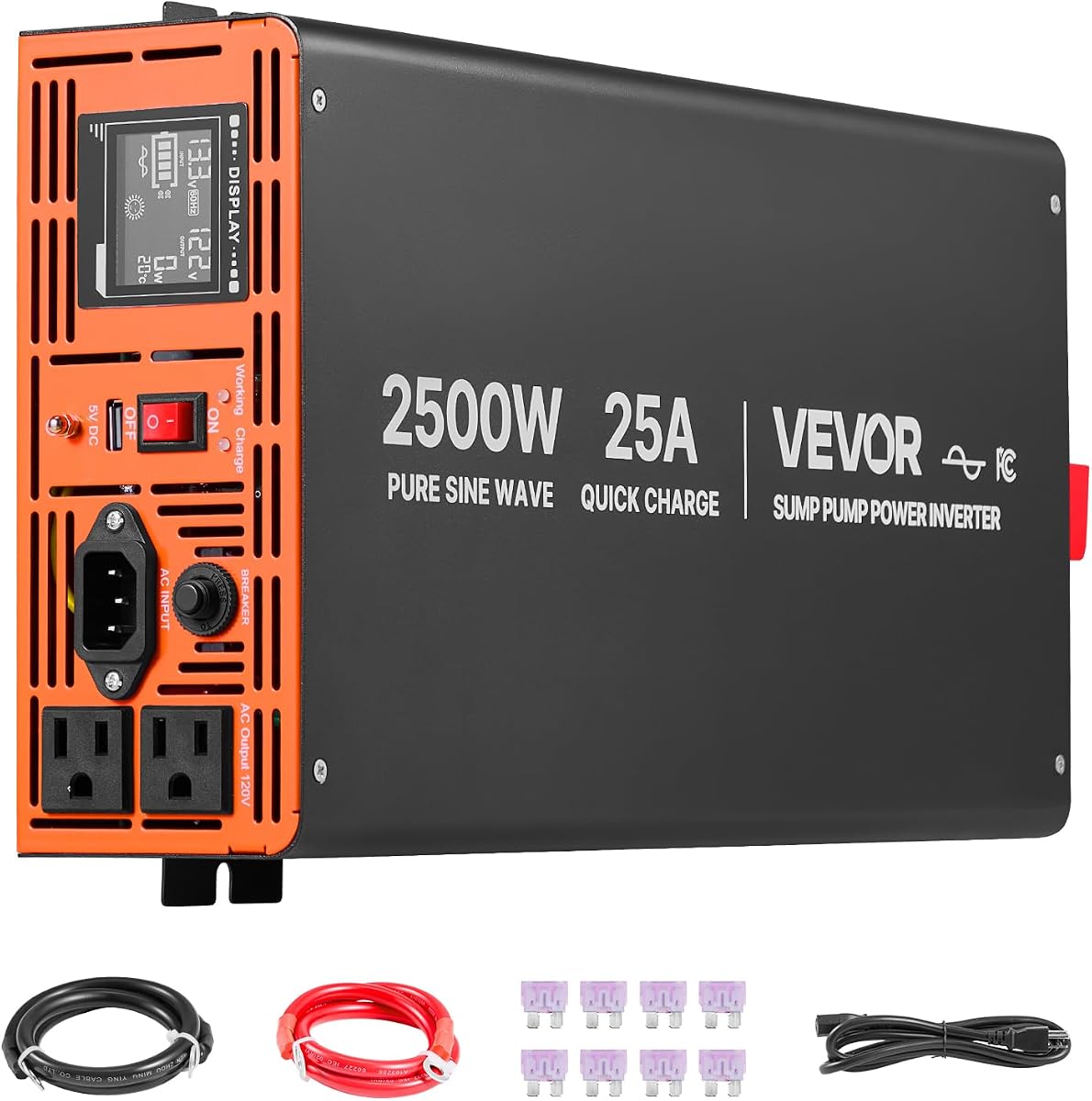


The Viopumpo 2500W Sump Pump Backup Battery System combines pure sine wave output, automatic transfer, a 25A charger, and an LCD remote in a package aimed specifically at basement flood protection. Its 4.8 rating is the highest among the ten products in this guide, although ratings alone do not establish suitability for every pump or household. Its strongest appeal is the balance between capacity, charging speed, monitoring, and a broad set of protective functions.
We may earn a commission when you buy through this link, at no additional cost to you.
The inverter produces up to 2500W of pure sine wave AC, a useful characteristic when the connected load includes a motor-driven pump. Its built-in 25A charger supports fast and trickle charging and is designed for deep-cycle lithium, AGM, and other compatible deep-cycle battery types. The remote LCD can show voltage, power, and battery charge status, reducing the need to approach the unit during bad weather or in a dark utility area.
Safety provisions include overload, overheat, short-circuit, low-voltage, and overcharge protection, along with a cooling system. Installation is presented as relatively accessible: the AC and DC cables are assembled, the pump connects to an AC socket, and the housing can be placed flat or wall-mounted using its fixing holes. That convenience does not eliminate the need to follow electrical safety practices, confirm code requirements, and verify that the pump and battery specifications are compatible.
This is a strong recommendation for a homeowner who wants more capacity than a 1500W unit without moving to a complete pump combo. It is particularly appropriate for a primary sump pump, a larger pump with a meaningful startup load, or a household that wants the inverter available for selected essential loads as well. Buyers should choose an appropriate 12V deep-cycle battery, check the manufacturer’s compatibility instructions, and ensure the installation area is dry, ventilated, and accessible.
Pure sine wave output is designed to provide a smooth, grid-like AC waveform. That makes the system better suited to inductive motor loads than a modified sine wave alternative, while the 2500W ceiling provides useful headroom for demanding residential pump configurations.
The remote LCD puts voltage, power output, and battery charge information within reach. This visibility helps owners identify a depleted battery, an active fault, or an operating-mode change without opening the system housing during an outage.
We may earn a commission when you buy through this link, at no additional cost to you.
The VEVOR 2500W Sump Pump Battery Backup System is designed for households that need a high-output inverter with straightforward installation. It carries a 4.3 rating and supports a combination of a 1 HP main pump and a 1/3 HP backup pump, according to the supplied product information. Pure sine wave output, automatic switching, and a display-focused control panel make it a practical alternative to larger complete pump systems.
We may earn a commission when you buy through this link, at no additional cost to you.
One of the most useful installation details is its standard three-prong plug, which reduces the need for complicated rewiring when compared with a hardwired transfer arrangement. The system has a three-stage charging process covering bulk, absorption, and float stages. It is compatible with 12V lead-acid, AGM, gel, and LiFePO4 batteries, giving owners several options when selecting a deep-cycle battery for the installation.
An LCD screen and LED indicators provide visibility into voltage, battery level, and operating status. Protection against overcurrent, overvoltage, short circuits, reverse polarity, and high temperature adds layers of safeguards, and a circuit breaker is also listed. As with other standalone inverters, the battery is not included, and the final setup still requires confirmation of pump voltage, startup demand, ventilation, and code-compliant placement.
The VEVOR is best suited to a property with a larger primary pump and a smaller backup pump, or to a user who wants flexible AC output without replacing the existing pump installation. It may appeal to buyers who prioritize an uncomplicated plug-in arrangement and familiar battery charging stages. Before buying, compare the combined pump load against the stated operating support and make sure the selected battery is designed for standby charging and repeated deep-cycle use.
The stated support for a 1 HP primary pump and a 1/3 HP backup pump is the defining feature. It makes this system more relevant to installations that already use two pumps than a model intended only for a standard single residential sump pump.
The standard three-prong plug supports a more approachable setup. Property owners can connect the inverter to the sump-pump circuit in a configuration consistent with the instructions and local electrical requirements, then add a compatible deep-cycle battery.
We may earn a commission when you buy through this link, at no additional cost to you.
This 2500W Sump Pump Battery Backup System offers a broad feature set centered on basement flood protection during outages. It has a 4.7 rating, pure sine wave output, a 25A fast charger, an automatic transfer switch, and an LCD remote. It is a particularly compelling option for owners who want a sump-pump inverter with multiple output options and detailed operating information.
We may earn a commission when you buy through this link, at no additional cost to you.
The built-in charger has selectable charging modes and supports LiFePO4, AGM, gel, and flooded deep-cycle batteries. Protection against overcharge, low voltage, overload, short circuits, and overheating is included. During normal operation, the system transfers from grid power to the connected battery when utility power fails and resumes charging after power returns, reducing the need for manual intervention.
Pure sine wave output is designed to support stable operation of sump pumps and other sensitive equipment. Three AC outlets, one USB port, and one Type-C port provide convenient outlets for a sump pump and selected emergency devices. The remote LCD displays battery voltage, load status, and operating mode. Installation allows either wall mounting or flat placement, with simple AC and DC connections and no complicated rewiring according to the product information.
This is the premium-style choice for a finished basement, flood-prone home, or property where a homeowner wants the inverter to serve more than one essential device. The package includes the inverter, battery cables, UPS plug, and manual, along with a stated 12-month warranty and customer support. The battery remains a separate purchase, so the final cost and suitability should be evaluated as a complete system rather than as an inverter alone.
Three AC outlets plus USB and Type-C connections make the unit useful for selected emergency electronics. This convenience does not replace sizing for startup surge, so pump demand should still be checked against the inverter’s operating limits.
Selectable charging modes and support for four common deep-cycle battery families give owners more freedom in building a standby power setup. The battery still needs to be selected for sump-pump cycling, charged in a safe location, and connected with correct polarity.
We may earn a commission when you buy through this link, at no additional cost to you.
The Cantonape 2000W Sump Pump Backup Battery System offers a focused set of features for keeping a pump operating during a power interruption. Its 4.4 rating reflects a broadly favorable reception, and the product combines pure sine wave output, automatic switching, a 20A fast charger, an LED display, and three AC outputs. It is a sensible value-oriented option when remote monitoring is not essential.
We may earn a commission when you buy through this link, at no additional cost to you.
The inverter’s 2000W capacity falls between smaller 1500W choices and the 2500W models in this guide. Its three-stage protections cover overheat, short circuit, low voltage, and overcharge, while a cooling system and overload protector add additional safeguards. The LED display shows battery voltage and AC voltage, giving users a basic view of system status without a separate remote controller.
The battery is not included, and the product information specifically identifies 12V gel, AGM or SLA, and flooded or wet batteries as suitable deep-cycle options. Installation requires assembling the AC and DC cables and connecting the sump pump to the AC socket. It can also power lights, phones, monitors, and similar devices, although a basement sump pump should remain the priority when the available battery capacity is limited.
This Cantonape system is a strong candidate for a standard residential sump pump where the owner wants clean AC output and rapid recharging without paying for a more elaborate remote interface. It is also appropriate for emergency use with a small number of low-demand devices. Homeowners should confirm pump startup requirements, use a battery designed for deep cycling, and follow all manufacturer and local electrical guidance.
Pure sine wave output supports smooth motor operation, while the automatic switchover removes much of the urgency associated with discovering a power failure. The 2000W limit makes careful load selection important, particularly during pump startup.
The built-in 20A fast charger helps return a compatible deep-cycle battery to service after normal power is restored. Users should still avoid treating a quick charger as a substitute for an appropriately sized battery with sufficient usable capacity.
We may earn a commission when you buy through this link, at no additional cost to you.
The 1500W Sump Pump Battery Backup System is designed for homeowners who need dependable backup for a standard residential sump pump without moving to the highest inverter capacity in the guide. It has a 4.7 rating and includes several premium-style conveniences: pure sine wave output, a 25A multi-stage charger, automatic transfer, three AC outlets, and an LCD remote controller.
We may earn a commission when you buy through this link, at no additional cost to you.
Its stated purpose is to keep a primary pump operating during outages and automatically recharge the battery after utility power returns. The system is compatible with LiFePO4, AGM, gel, and flooded deep-cycle batteries. The remote display provides real-time information on battery voltage, load level, and operating mode, which is valuable when the inverter is mounted away from the pump or in a finished utility area.
Protections include overcharge, overload, short circuit, low voltage, and overheat handling. It also provides USB and Type-C ports for essential devices. The unit can be mounted flat or on a wall, and the package includes battery cables, a UPS plug, and a manual. The primary limitation is capacity: users with a larger pump, high startup demand, or plans to operate several loads simultaneously should compare the 2500W options.
This model is best for a typical single-pump basement installation where the pump’s operating and startup requirements fit within the 1500W system. The fast charger and remote monitoring improve convenience, but a separate compatible deep-cycle battery remains essential. Correct polarity, ventilation, moisture protection, and adherence to the installation manual are critical to achieving dependable standby operation.
A 1500W inverter can provide useful backup for many common household sump pumps while keeping the unit more compact than higher-output alternatives. The pump’s label and startup demand should be checked before purchase.
The LCD remote gives users immediate access to voltage, load, and mode information. Three AC outlets plus USB and Type-C ports also make emergency power available for selected low-demand essentials.
We may earn a commission when you buy through this link, at no additional cost to you.
The InsensVert 2500W Sump Pump Backup distinguishes itself with a stated transfer time under 10 milliseconds, a 2500W continuous rating, 5000W peak capability, and a detailed LCD. Its 4.5 rating and extensive monitoring make it a strong option for users who want the inverter to behave like an uninterruptible power supply for a sump pump and selected critical devices.
We may earn a commission when you buy through this link, at no additional cost to you.
Pure sine wave output is specified at less than 6% total harmonic distortion, supporting clean and stable power. Soft-start technology ramps power during pump startup, which can reduce current surges and help protect the motor. Three AC outlets allow multiple connections, while the LCD and LED indicators report voltage, output, battery level, frequency, internal temperature, and active protection states.
Safety features cover over-temperature, short circuit, over- and under-voltage, overload, overcharge, battery voltage limits, reverse polarity, and a circuit breaker. The 25A three-stage smart charger can recharge a 100Ah battery in about four hours according to the supplied information. It supports common lead-acid chemistries and LiFePO4, giving users flexibility in selecting a battery that fits their runtime requirements.
Installation is designed around a convenient three-pin plug, included 3AWG copper battery cables, and a ground wire. It is a strong recommendation for a technically informed homeowner who wants fast transfer, detailed diagnostics, and soft-start motor support. Buyers must still observe polarity, grounding, ventilation, and moisture precautions, and they should ensure the battery and pump loads remain within the unit’s stated limits.
A transfer time under 10 milliseconds is especially notable for an uninterruptible-style design. It minimizes the gap between utility failure and operation on stored battery power, supporting pump continuity when power returns unexpectedly.
Soft-start increases delivered power gradually during motor startup. This approach is intended to reduce damaging current surges while allowing the inverter and pump to operate more smoothly.
We may earn a commission when you buy through this link, at no additional cost to you.
The Viopumpo 1500W Sump Pump Battery Backup System combines a 1500W pure sine wave inverter with automatic grid-to-battery switching and three grounded AC outputs. Its 4.4 rating makes it a competitive mid-capacity option, while the adjustable input-voltage function provides a notable point of differentiation for owners working with compatible lithium batteries.
We may earn a commission when you buy through this link, at no additional cost to you.
The remote high-definition LCD reports voltage, power, and battery charge status. A 5V/3.1A USB port and 30W Type-C port add convenience for phones and other small devices. The system also has a cooling system, a self-recovering overload protector, and safeguards against overheating, short circuits, low voltage, and overcharge, giving it a well-rounded safety-oriented feature set.
Input voltage can be adjusted from 9.5V to 11V to improve compatibility with lithium batteries and reduce unnecessary consumption. The instructions specify making this adjustment while the inverter is off. That requirement is important because changing settings during operation may not be appropriate. The system supports automatic transfer during a rainy-day outage so that compatible sump pumps can continue removing water.
This is a useful choice for a standard pump setup where remote monitoring and grounded outlets matter, but 2500W capacity is unnecessary. The claim that three outlets can support multiple pumps still requires the individual loads to remain within the system’s electrical limits. Homeowners should choose a compatible deep-cycle battery, confirm the adjusted voltage before startup, and follow local electrical and placement rules.
The 9.5V to 11V adjustment range can help match inverter behavior to certain lithium battery configurations. Because the adjustment must be made while the unit is off, owners should set and verify the value before connecting or operating the pump.
Three grounded AC outlets offer practical flexibility for a pump and limited auxiliary loads. The additional USB and Type-C ports are useful for communication devices, but battery capacity should be reserved first for water removal.
We may earn a commission when you buy through this link, at no additional cost to you.
The Basement Watchdog Combo is different from the standalone inverter-charger products in this guide because it combines a primary sump pump, a battery-backed backup pump, and a monitoring controller. Its 4.3 rating reflects a substantial pump-focused system rather than a general-purpose inverter. For a homeowner replacing a complete installation, this integrated approach can simplify component coordination.
We may earn a commission when you buy through this link, at no additional cost to you.
The system arrives preassembled and preplumbed. Its primary pump uses a durable half-horsepower copper-wound permanent split capacitor motor. According to the supplied specifications, the primary pump moves 73 GPM at zero-foot lift and 59 GPM at a 10-foot lift, while the backup pump handles 48 GPM at zero-foot lift and 35 GPM at 10 feet.
The monitoring controller provides around-the-clock monitoring of pump, power, and battery conditions. It can sound an alarm, illuminate a warning light, and describe required maintenance. Real-time text, email, and push notifications are available when the separate Basement Watchdog CONNECT Module is added. The backup system provides days of intermittent pumping on one battery charge, and two batteries can be connected in parallel for double the runtime.
This combo is a compelling recommendation for a new installation or a full replacement where the owner wants primary and backup pumps under one coordinated design. It supports both maintenance-free AGM and wet-cell batteries, although the battery is not listed as included. Prospective buyers should account for the size of the complete assembly, confirm basin and plumbing compatibility, and consider whether adding the WiFi module would improve their monitoring needs.
Preassembly and preplumbing reduce the number of separate components a property owner must plan. The design pairs a primary pump with a battery-backed unit intended to provide added protection when normal power is unavailable.
The controller monitors pump, power, and battery conditions and provides an alarm, warning light, and maintenance description. This feedback is valuable because a backup system cannot help if its battery or discharge path has become unreliable.
We may earn a commission when you buy through this link, at no additional cost to you.
The PumpSpy 2000W Sump Pump Battery Backup System provides pure sine wave power in a comparatively compact enclosure. Its 4.1 rating is the lowest among the ten products, but the system still offers relevant features for basement protection, including automatic outage switching, recharging, two grounded outlets, overcharge prevention, and intelligent cooling.
We may earn a commission when you buy through this link, at no additional cost to you.
The inverter provides 2000W of output and is listed as capable of powering two primary sump pumps simultaneously when their combined current draw does not exceed 16.6A. This is a meaningful capacity claim, but it should not be interpreted as permission to connect pumps of any size. Motor startup demand and the inverter’s continuous-output rating must be considered for the exact installation.
After the battery reaches a full state, the system maintains it with a trickle charge intended to keep it ready for the next outage. A separate 12V deep-cycle battery is required. The product measures 17.5 by 6.75 by 4 inches and weighs 10.5 pounds, which may be easier to accommodate in a tight utility area than larger power systems.
PumpSpy is a reasonable option for a homeowner who values a compact design, cooling, and the possibility of operating two pumps within the stated current limit. It can also power lights, phones, monitors, and other low-demand devices when capacity allows. The product information mentions domestic and imported parts, CE certification, packaging in Kalamazoo, Michigan, and technical support, but buyers should still evaluate warranty terms and verify local electrical compatibility.
The stated housing dimensions and weight make this system easier to consider in confined mechanical areas. Physical fit should be checked against the sump basin, nearby plumbing, ventilation, and service-access requirements.
Intelligent cooling is intended to support safety and service life, while trickle charging helps maintain a compatible battery after it reaches a full state. Neither feature replaces routine inspections of connections, battery condition, and pump operation.
We may earn a commission when you buy through this link, at no additional cost to you.
The Wayne Preassembled Primary & Battery Backup Sump Pump Combo System offers an integrated alternative to standalone backup inverters. It has a 4.6 rating and uses a half-horsepower indoor sump system designed to remove water during heavy flow, including when electricity is lost. The primary selling point is the preassembled, ready-for-installation format.
We may earn a commission when you buy through this link, at no additional cost to you.
The listed WSS30VN configuration can pump up to 5,100 GPH and is stated to remove up to 10,000 gallons on one battery-backed charge when used with the required WAYNE WSB1275 75Ah battery. That battery is required for backup operation but is not included. This makes it important to budget for the complete operational system rather than judging the combo without its power source.
Installation is described as a drop-in process that can take 15 minutes or less without drilling a weep hole, provided the sump basin is at least 16 inches in diameter. The system includes an eight-foot SJTW power cord and is warrantied for three years. The product information also states that the system was tested to one million cycles, although buyers should not treat that claim as a substitute for inspecting and maintaining the installed equipment.
This combo is a strong recommendation for an indoor residential sump-pit replacement where preassembly and straightforward fitting matter. It may be less attractive for someone who wants to preserve an existing pump or use a generic deep-cycle battery. Confirm basin dimensions, plumbing layout, battery compatibility, local electrical requirements, and the need for any required backup controls before installation.
The integrated design reduces assembly work at the property. Its stated fit for a 16-inch-or-larger basin and no-weep-hole installation process make layout planning especially important before purchasing.
The product is specified for a WAYNE WSB1275 75Ah battery, which is required but not included. Buyers should verify the battery specification, connection details, and installation requirements rather than assuming any generic battery will provide the stated performance.
We may earn a commission when you buy through this link, at no additional cost to you.
Choosing a sump-pump backup means balancing pump demand, battery capacity, charging performance, monitoring, installation, and the type of system you want to own. The right choice is the one that protects the basement while remaining serviceable and appropriately sized for the available space.
A standalone inverter-charger lets an owner retain an existing pump and use the backup unit for selected emergency loads. It generally requires a compatible deep-cycle battery, correct connections, and an installation that meets electrical and environmental requirements. A preassembled combo combines a primary pump, a backup pump or battery-powered configuration, and sometimes a controller, which can simplify a complete replacement but may require replacing the whole assembly.
Choose the format that matches the property rather than the one with more advertised features. Full replacement may be convenient for a new sump pit, while an inverter is often more flexible when the current primary pump is already satisfactory.
Compare the pump’s nameplate information and startup demand with the inverter’s continuous output rating. The 1500W options suit many standard single-pump situations, while 2500W units offer more headroom for larger pumps, multiple loads, or dual-pump arrangements. Do not infer compatibility solely from a horsepower label because motor efficiency, voltage, cable length, and starting current all influence the load seen by the inverter.
Also account for the accessories you intend to connect. A pump should have priority when battery capacity is limited, and a product’s stated multi-pump support remains subject to its combined current and power limits.
Most standalone products in this guide require a separate 12V deep-cycle battery, with many supporting AGM, gel, flooded or wet-cell, and some LiFePO4 types. A battery intended for starting vehicles is generally not the correct match for repeated standby discharge and recharge. The usable battery capacity, expected outage length, pump duty cycle, and rate at which the system recharges should all influence the battery decision.
Preassembled combos may specify a particular battery model or capacity. Follow those requirements rather than substituting another type without confirming compatibility, charge voltage, dimensions, terminals, and warranty implications.
A higher charger current can restore useful battery capacity more quickly, allowing the system to be ready for another outage sooner. The listed 20A and 25A chargers offer different recovery characteristics, while three-stage charging methods control bulk, absorption, and float behavior. Ensure the selected battery’s chemistry and charge requirements match the inverter’s charging mode.
Fast charging is useful but cannot compensate for an undersized battery. A high charger rate also makes ventilation, cable condition, terminal compatibility, and safe placement more important.
Automatic transfer is essential because a sump pump must continue operating without someone present to flip a switch. Most products in the guide use pure sine wave output, which is suitable for motor-driven and sensitive loads. The InsensVert additionally advertises transfer under 10 milliseconds, while other products describe automatic grid-to-battery switching without publishing a comparable figure.
Pure sine wave output does not guarantee that any pump will work with any inverter. Verify voltage, frequency, current, and startup requirements, and ensure the installation avoids extension arrangements that reduce performance or create unsafe conditions.
LCD remote controllers, built-in LED displays, and dedicated monitoring controllers can reveal battery voltage, charge state, load condition, faults, and operating mode. The Basement Watchdog goes further with continuous monitoring and optional WiFi alerts through a separately purchased module. More detailed feedback makes preventive maintenance easier, but it should complement rather than replace physical inspections.
Consider where the display will be installed. A remote screen is useful when the inverter sits in a basement corner, while a complete pump system may offer audible alarms and maintenance prompts without requiring a separate display.
Overload, overcharge, low-voltage, over-temperature, over- or under-voltage, short-circuit, and reverse-polarity protection are common safeguards in this category. Self-recovering overload protection, soft-start behavior, cooling systems, and circuit breakers add further layers of resilience. These features are particularly relevant in damp mechanical spaces where pumps may experience demanding startup cycles.
Protection is not a substitute for correct setup. Verify polarity, grounding, ventilation, cable condition, and battery compatibility every time the system is installed or serviced.
Most standalone units allow flat placement or wall mounting and avoid complicated rewiring, but basement conditions still demand care. Keep the inverter accessible, away from standing water, and in a location with suitable ventilation. Do not ignore local electrical codes or manufacturer instructions. Preassembled combos also require accurate basin, plumbing, and clearance measurements before installation.
Establish a maintenance routine that checks the battery, connections, controller warnings, pump operation, and discharge behavior. A clean sump pit, a healthy battery, and a tested switchover are more valuable than extra features that are never inspected.
Begin by identifying the correct battery chemistry, checking its terminal polarity, and confirming that its capacity and condition suit the backup system. Connect the battery with the power off, observe polarity markings, tighten connections, and install any required ground connection. Next, connect the inverter to the appropriate AC circuit and the sump pump to a grounded outlet, following the product instructions and local electrical requirements.
Charge the battery under normal AC power before relying on the system. Use the display or remote to confirm that the input is active, the battery is being charged, and no fault is reported. Test the automatic transfer in accordance with the manual, preferably with the sump pit dry and the pump safely accessible. Confirm that the pump starts, the system transfers to battery power, and the controller indicates the expected operating mode.
Perform scheduled inspections throughout the year, especially before storm season. Check the battery for swelling, corrosion, damage, or loss of charge; clean terminals appropriately; inspect cables and plugs; confirm ventilation around the inverter; and listen for unusual pump behavior. In a preassembled combo, use the controller’s maintenance warnings as prompts rather than ignoring alarms. Replace a worn or unsuitable battery and investigate recurring faults before the next outage.
Most of the standalone inverter-charger systems in this guide do not include a battery. They are designed to work with a compatible 12V deep-cycle battery purchased separately, such as an appropriate AGM, gel, flooded, wet-cell, or supported lithium model. The Basement Watchdog and Wayne combos also require separate batteries, although each product may specify a particular type or capacity. Check the current package contents before ordering.
Pure sine wave output is the preferred choice in this guide because it produces smooth, grid-like AC that is well suited to motor-driven loads and sensitive electronics. A standard residential sump pump may still operate with a modified sine wave inverter, but noise, heat, reduced efficiency, or startup issues can occur. Always verify the pump’s electrical specifications and the inverter’s operating limits.
Battery size depends on the pump’s power draw, how often it runs, the expected outage length, and how much capacity the charger can restore. A deeper or more powerful sump pump needs more usable energy than a small pump, while a faster charger can replenish a compatible battery more quickly. Choose a deep-cycle battery suitable for repeated discharge and standby charging rather than a starting battery.
Some products in this guide describe support for two pumps, but only within stated power and current limits. A 2500W model may suit a 1 HP primary and 1/3 HP backup configuration, while other systems specify combined current limits. Check startup demand, continuous draw, outlet ratings, and the manufacturer’s compatibility instructions before connecting multiple pumps.
Test the system regularly, with extra attention before major storms or extended periods of expected grid disruption. A safe test confirms that the pump starts, the system transfers to battery power, the display reports the correct status, and no alarm is active. Monthly checks are useful, while annual servicing can include battery inspection, terminal cleaning, connection checks, and a review of the manufacturer’s maintenance guidance.
Choose a dry, ventilated, accessible location away from standing water and extreme heat. The area must allow the battery cables and AC connections to be installed safely without creating trip or electrical hazards. Some units can be wall-mounted or placed flat, but local code, manufacturer guidance, pump clearances, and sump-basin layout should determine the final position.
A standalone inverter is attractive when you already own a suitable primary pump and want control over battery and inverter placement. A preassembled combo is often more convenient for a new installation or complete replacement because the pumps and backup components arrive coordinated. Compare basin fit, plumbing, electrical requirements, battery specifications, monitoring, and long-term serviceability rather than choosing solely on installation convenience.
A sump-pump backup system is purpose-built for water removal and may support a few selected emergency devices, but it is not equivalent to a general home generator. Battery capacity, outlet count, and inverter output limit what can run. For essential loads during a long outage, use a properly sized backup power solution and prioritize the sump pump when the battery is operating on reserve.
The Viopumpo 2500W system stands out for its combination of 2500W pure sine wave output, 25A charging, automatic transfer, protective functions, and LCD remote monitoring. The feature-rich 2500W system offers a broader outlet and charging selection, while the Cantonape 2000W model delivers the core functionality at a more value-oriented level. Each remains dependent on choosing a suitable deep-cycle battery.
Prioritize compatibility before features. Confirm pump voltage, startup demand, continuous draw, battery chemistry, charger behavior, physical space, grounding, and local electrical requirements. Complete pump combos may be more appropriate for a full replacement, while standalone inverters offer flexibility for retaining an existing pump and adding carefully selected emergency loads.
Before purchasing, verify the current package contents, battery requirement, warranty, dimensions, compatibility guidance, and current price. Availability and specifications can change, and a complete backup system depends on the inverter or pump combo, a properly sized battery, sound connections, routine testing, and maintenance.