
Portable UHF/VHF Frequency Counter
4.1Editor score
Focused VHF and UHF coverage
Integrated CTCSS and DCS
Single-button user interface
Includes nine-volt battery
Discover the best Frequency Counter for Ham Radio options, comparing range, accuracy, decoding, portability, and advanced analysis for every skill level.
A frequency counter for ham radio helps operators identify transmit frequencies, verify radios, examine signals, and diagnose equipment problems. The most useful model is not necessarily the most elaborate one; range, accuracy, decoding features, display quality, and field portability should match the way you operate.
This guide compares ten frequency counters and related RF instruments for amateur radio enthusiasts, technicians, and builders. We examined the stated frequency ranges, signal-generation capabilities, decoder functions, accuracy claims, controls, power options, accessories, and intended uses, then organized the results by practical value.
Each review explains the strongest reason to consider a product, along with its limitations. The selections include simple handheld counters, compact module boards, a spectrum analyzer, and a precision GPS-disciplined instrument. Product details and availability can change, so verify the current listing before purchasing.
4.1Editor score

4.4Editor score

5.0Editor score
The comparison covers portable counters, bare-board modules, a multifunction spectrum analyzer, and a high-precision GPSDO instrument, making it easy to match measurement capability to your station and mobile needs.


The Mcbazel Surecom SF401 Plus combines a broad 27MHz-to-3000MHz tuning range with CTCSS and DCS decoding in a portable enclosure. Its 4.1 rating reflects a practical balance of capability and simplicity, making it most useful for checking conventional two-way radios, identifying carrier frequencies, and taking quick signal-strength measurements.
We may earn a commission when you buy through this link, at no additional cost to you.
The defining feature is its TCXO-based time base, which is stated to maintain accuracy from approximately ±2ppm to ±4ppm across temperatures of -45°C to 65°C. That makes the counter more reassuring for field use than a simple unqualified oscillator. Selectable ranges simplify the initial setup, while the four-button layout avoids a complicated interface.
The important limitation is that the meter is intended to count continuous carrier signals and is explicitly not suitable for wide-band signals. It also requires the appropriate included antenna and, as with other sensitive RF instruments, sensible input levels. Anyone expecting a full spectrum display or modulation analysis should look elsewhere.
This is a sensible choice for ham operators who test radios in the 144MHz and 430MHz bands, work with local repeaters, or need a portable service tool. It is less appropriate for general wideband signal analysis, but it handles the specific job of reading and decoding conventional RF carriers well.
The stated TCXO performance is especially useful when a counter travels between a warm vehicle and an outdoor operating position. A stable time base helps the displayed frequency remain dependable as ambient conditions change.
CTCSS and DCS decoding can save time when identifying a radio's tone configuration, while the signal-strength indicator adds context that a raw frequency reading alone cannot provide.
We may earn a commission when you buy through this link, at no additional cost to you.
The Surecom SF401 Plus is a portable counter for two-way radio work, covering 27MHz through 3000MHz and adding CTCSS and DCS decoding. Its 4.3 rating is slightly stronger than that of the similarly named Mcbazel listing, and the product description emphasizes straightforward operation rather than a complex measurement workflow.
We may earn a commission when you buy through this link, at no additional cost to you.
Its four-button design, selectable ranges, and compact body make it easy to carry into a shop, vehicle, or radio room. A signal-strength indicator provides useful information while checking a transmission, and the TCXO is stated to deliver accuracy between approximately ±2ppm and ±4ppm from -45°C to 65°C.
Its limitation mirrors that of other dedicated portable carrier counters: it measures continuous-wave signals and does not serve as a wideband analyzer. It should be used with suitable input levels and the proper range rather than connected indiscriminately to a powerful transmitter. The absence of advanced analysis also limits troubleshooting depth.
Buy this model if your routine involves checking handheld radios, confirming programmed frequencies, and identifying tone settings. It offers a little more flexibility than a VHF/UHF-only pocket counter while remaining less complicated and more specialized than the TinySA or TinyGTC instruments in this guide.
The broad range covers common VHF, UHF, and higher-frequency two-way equipment, allowing an operator to confirm a radio's operating frequency without relying only on its display or programmed memory.
The temperature-compensated oscillator helps preserve repeatability in changing environments, while the small enclosure and uncomplicated controls suit rapid field inspections.
We may earn a commission when you buy through this link, at no additional cost to you.
The FC-2800M is the most versatile dedicated counter in this roundup for ordinary ham radio and CB work. It offers two selectable ranges—2MHz to 200MHz and 27MHz to 2800MHz—plus CTCSS and DCS decoding, signal-strength indication, and a stated two-year warranty. Its 4.4 rating reflects a capable, approachable package.
We may earn a commission when you buy through this link, at no additional cost to you.
The lower range reaches the 2-meter amateur band, while the higher range covers common VHF, UHF, CB, and DMR-related frequencies. A low-PPM crystal time base is used to support measurement accuracy, and the four-button interface keeps the meter compact and manageable for beginners and experienced operators alike.
This remains a carrier-frequency meter rather than a full spectrum analyzer. It will tell you the frequency of a continuous transmission and can help identify tone information, but it does not reveal the shape of a broad signal or support advanced phase, FFT, and histogram analysis. Input levels still require appropriate care.
For a buyer seeking one straightforward instrument across the traditional 2-meter band and higher amateur frequencies, it is an excellent fit. It is particularly attractive for portable operation, quick radio programming checks, and basic station troubleshooting without the learning curve of a touchscreen analyzer.
The 2MHz-to-200MHz range brings the 2-meter band within reach, while the 27MHz-to-2800MHz range supports common VHF and UHF activity, making the instrument useful across multiple stages of an amateur setup.
CTCSS and DCS decoding adds practical value when checking whether a radio is using a conventional squelch tone or digital code, reducing the need for a separate decoder for routine inspections.
We may earn a commission when you buy through this link, at no additional cost to you.
The Portable TinySA is more of a spectrum analyzer than a single-value counter, yet it offers one of the most complete visual toolkits in this guide. It covers 100kHz to 960MHz across two analysis ranges, displays up to 290 scan points on a color touchscreen, and carries a 4.4 rating.
We may earn a commission when you buy through this link, at no additional cost to you.
Its signal view makes it valuable when you need to see more than one carrier, examine a band, or understand how a transmission appears relative to nearby activity. A built-in signal generator provides 0.1–350MHz sine-wave output and 240–960MHz square-wave output, while an internal calibration source supports self-testing and low-input calibration.
The included accessory set is generous, with RF cables, a USB cable, an SMA female-to-female connector, a touchscreen pen, SMA male-to-UHF female cables, and a telescopic antenna. USB CDC support allows Windows or Linux users to view measurements, change settings, and issue serial commands, which substantially expands the instrument's potential.
This is the pick for builders and technically curious operators who want a visual view of the RF spectrum. Its main limitation is that it does not cover the entire 2.8GHz range of several dedicated counters, and its generator is a testing aid rather than a laboratory-grade source.
The spectrum display is the decisive advantage over a conventional counter. It can reveal neighboring carriers and help an operator understand signal activity instead of reporting only one frequency at a time.
USB CDC control makes the TinySA useful for longer observations, remote adjustment, and troubleshooting sessions where viewing a live plot on a Windows or Linux computer is more convenient than using the compact touchscreen alone.
We may earn a commission when you buy through this link, at no additional cost to you.
The Portable UHF/VHF Frequency Counter is a small, focused instrument for operators who mostly work with common handheld radios. It measures 136–174MHz VHF and 400–470MHz UHF signals, decodes CTCSS and DCS tones, and has a 4.1 rating for a straightforward field tool.
We may earn a commission when you buy through this link, at no additional cost to you.
Its single-button operation is unusually easy to learn. A long press turns the device on or off, and a subsequent press advances the test. The 9×5.5×2cm housing fits easily in a pocket or tool pouch, while the included nine-volt battery and antenna make it ready for basic work without a complicated setup.
The trade-off is range. Unlike several broader counters, it does not cover the 2-meter band's lower frequencies or 27MHz equipment, and its stated measurement range extends only within one meter of the radio. It is designed for narrow, nearby testing rather than sophisticated antenna or signal analysis.
This is a good choice for a club technician, portable operator, or beginner who wants a tiny device for confirming VHF and UHF handheld frequencies and tone settings. It is best treated as a convenient field companion to a broader bench instrument rather than a complete station diagnostic tool.
The one-button arrangement reduces training time and makes the meter practical in the field. Once the operating method is familiar, a user can power it on, initiate a test, and read the result with minimal interaction.
The specified one-meter operating distance places the tool close to the radio being tested. That limitation is reasonable for checking a handheld, but operators should not confuse it with a wide-area receiving system.
We may earn a commission when you buy through this link, at no additional cost to you.
The Anysecu SF-103 extends the dedicated portable-counter format from 2MHz to 2.8GHz. It can measure continuous carrier signals, indicate signal strength, and handle frequencies associated with DMR radios. Its 4.2 rating places it among the solid mid-range choices for wireless enthusiasts and maintenance personnel.
We may earn a commission when you buy through this link, at no additional cost to you.
Selectable frequency ranges help keep the display focused, while the four-button layout balances capability with simplicity. The compact enclosure makes the instrument useful beyond a fixed workbench, particularly for technicians who move between radios, antennas, and mobile installations.
Like other dedicated counters, it does not provide a visual spectrum, phase measurements, or detailed modulation analysis. It is designed around reading a frequency rather than exploring a broad frequency range. That narrower purpose does not make it less useful, but it should match the buyer's expectations.
Choose the SF-103 when you need more coverage than a VHF/UHF pocket meter without moving to a spectrum analyzer or precision timing instrument. It is especially relevant for radio maintenance, programming checks, and amateur operations centered on common 2-meter, VHF, and UHF equipment.
The lower 2MHz limit includes the 2-meter amateur band, and the upper limit reaches well into UHF territory. That makes the range more useful for a varied ham station than a counter limited to the most common handheld frequencies.
The signal-strength indicator and accessible range controls suit the quick diagnostic workflow described for maintenance personnel, who may need a dependable answer more than elaborate on-screen analysis.
We may earn a commission when you buy through this link, at no additional cost to you.
The Mcbazel Surecom SF-103 provides a 2MHz-to-2.8GHz range, a TCXO time base, signal-strength indication, and a 4.3 rating. It is a practical handheld counter for measuring continuous carrier transmissions from common two-way and amateur radios.
We may earn a commission when you buy through this link, at no additional cost to you.
Its TCXO is stated to maintain accuracy from approximately ±2ppm to ±4ppm between -45°C and 65°C. The graphic battery display is a small but useful addition for field service, and the four-button interface keeps the controls manageable despite the broad tuning range.
The most important safety point is the stated maximum direct input of 5V peak-to-peak. The product information explicitly warns against direct connection to a radio antenna output because doing so could damage the meter. Like the other dedicated counters, it is not a spectrum analyzer and cannot characterize complex or wideband emissions.
It is best suited to ham operators and technicians who need reliable frequency readings in a portable form. With the stated input restriction observed, it becomes a strong tool for checking radios across the 2-meter band, VHF, and UHF without carrying a larger analyzer.
The temperature-compensated oscillator is the main technical distinction in this model. It supports more consistent measurements when temperature changes during mobile service or an outdoor session.
The stated five-volt peak-to-peak limit makes the direct-input warning important. Users should follow the supplied guidance and use the intended connection method rather than attaching the counter directly to a transmitter output.
We may earn a commission when you buy through this link, at no additional cost to you.
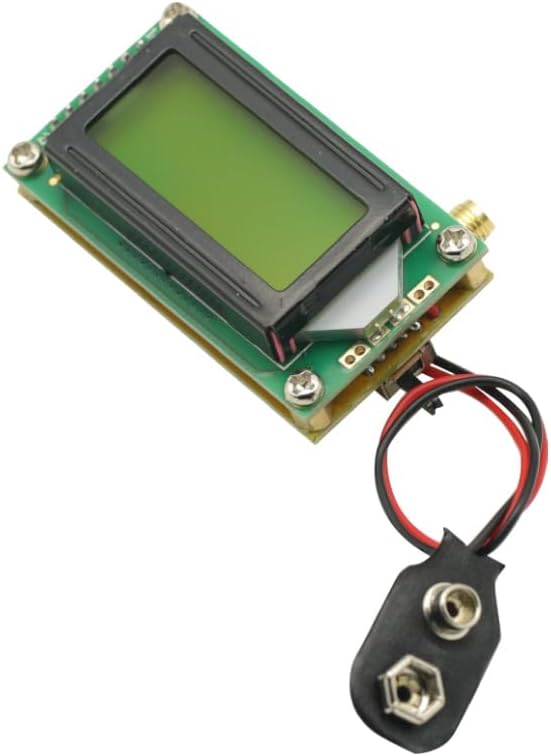
The Acxico 1–500MHz Module is a bare frequency-counter board aimed at ham radio builders rather than buyers seeking a finished handheld instrument. It uses a digital 0802 LCD, PCB and FR4 construction, and a stated 1MHz-to-500MHz measurement range. Its 3.1 rating reflects the limited feature set and calibration constraints.
We may earn a commission when you buy through this link, at no additional cost to you.
The module's appeal lies in what it can become. A hobbyist can incorporate it into a custom enclosure, test fixture, bench instrument, or educational RF project. Covering 1MHz through 500MHz places it across the 2-meter, VHF, and lower UHF bands, making the measured range relevant to many amateur radio experiments.
Its small LCD can only be adjusted to the second digit after the decimal point, with less than one-tenth of that precision available for adjustment. The listing also provides fewer operating and protection details than the complete portable counters. As a bare board, it may require connectors, a suitable power arrangement, and careful signal conditioning.
This is a sensible selection for an experimenter who wants to build around a counter and already understands RF electronics. For a typical ham operator wanting to check a handheld immediately, a complete meter offers fewer integration concerns and a more straightforward experience.
The exposed module format gives builders control over the enclosure, connectors, and surrounding system. It is better suited to a custom project than to a quick field inspection.
The documented adjustment granularity means the display should not be treated as a laboratory reference. Users needing traceable high-precision timing should choose a dedicated counter with a more clearly defined reference system.
We may earn a commission when you buy through this link, at no additional cost to you.
The 1–500MHz Frequency Counter Meter Board is a compact DIY board with an LCD, low-power consumption, and a stated range from 1MHz to 500MHz. Its 3.6 rating places it above the bare Acxico board in overall feedback but still firmly in the entry-level project category.
We may earn a commission when you buy through this link, at no additional cost to you.
The integrated display removes the need to source a separate readout, which can simplify construction of a small frequency-checking device. The range covers the 2-meter band, much of VHF, and the lower portion of UHF, providing useful coverage for several common ham radio activities and general RF experiments.
The supplied information is considerably more limited than for the complete counters. It does not describe controls, calibration procedure, input limits, connector details, or measured accuracy. A single bare board also means the buyer must consider power, enclosure, signal interface, and protection as separate project responsibilities.
It works best for a hobbyist building a simple display or adding a frequency readout to a larger design. A radio operator focused on immediate field use would probably favor the finished Portable UHF/VHF model, while a technically advanced buyer may prefer the TinyGTC's precision, analysis, and extensive accessory package.
The integrated LCD gives a builder a useful starting point without requiring a separate display purchase. It is a convenient foundation for a compact frequency readout.
Because the listing focuses on the board and its range, a complete build still requires decisions about power, connections, enclosure, and safe input handling. Those decisions should be settled before assembly.
We may earn a commission when you buy through this link, at no additional cost to you.
The AURSINC TinyGTC is the advanced instrument in this guide, with dual-channel measurement, a built-in GPS-disciplined oscillator, 40-picosecond resolution, and a stated 0.1Hz-to-7GHz range on Channel A. Its perfect 5.0 rating reflects exceptional capability, though user experience still depends on the complexity of the applications.
We may earn a commission when you buy through this link, at no additional cost to you.
Channel B covers 0.1Hz to 350MHz, while Channel A extends to 7GHz. The device can measure frequency, phase, count, and time intervals, with accuracy stated at up to 5e-12 per second. Its GPSDO uses a premium TCXO and is stated to achieve approximately 1e-10 ADEV at averaging intervals from 1 to 100 seconds.
A 4-inch responsive touchscreen, backup jog wheel, and 4000mAh rechargeable battery make it usable as either a bench or field instrument. Real-time charts, histograms, ADEV, FFT, FM deviation analysis, USB logging, SD-card storage, and SCPC control expand its role well beyond a basic counter. The included GPS antenna, USB cable, coax leads, and SMA tee support immediate setup.
This is the choice for serious calibrators, advanced builders, SDR users, and operators who need a traceable reference for oscillators, radio gear, or SDR boards. It also supports antenna tuning and radio turning. The complexity and specialized feature set may exceed the needs of someone who only checks a handheld radio's frequency.
The integrated GPSDO automatically disciplines the time base to GPS references, which is valuable when long-term stability matters. An external 10MHz reference input also supports calibration of signal generators, SDR boards, and radio equipment.
Frequency, phase, timing, histogram, FFT, and FM-deviation tools turn the TinyGTC into a portable analysis platform. On-screen charts, USB logging, SD storage, and SCPI control support both immediate diagnosis and longer documentation sessions.
The rechargeable battery, compact body, touchscreen, and mechanical jog wheel provide multiple ways to operate the instrument. That flexibility suits portable calibration kits as well as permanent laboratory setups.
We may earn a commission when you buy through this link, at no additional cost to you.
The right frequency counter depends on the signals you expect to measure, the precision you need, and whether you want a simple display or a deeper analysis platform.
Start with the bands and equipment you actually use. A meter covering 136–174MHz and 400–470MHz is sufficient for many handheld-radio checks, while 2-meter operation calls for a lower limit near 2MHz. Broader models reaching 2.8GHz cover more VHF and UHF equipment, and the TinyGTC extends to 7GHz for advanced microwave, oscillator, and homebrew work. Match the instrument's lower and upper limits to your stations rather than assuming a larger number automatically means better performance.
A conventional counter reports the frequency of a continuous carrier, often with a signal-strength or tone-decoding function. A spectrum analyzer displays a range of activity, which is invaluable when investigating interference, multiple nearby signals, or an unexpected transmission. The TinySA supplies that visual perspective up to 960MHz. The TinyGTC adds further analysis functions, including FFT and FM-deviation analysis. Choose a dedicated counter for fast, focused readings or an analyzer when understanding the surrounding spectrum matters.
Accuracy depends on the reference oscillator and how its specifications relate to your environment. TCXO-based models such as the SF401 Plus and SF-103 are designed to limit frequency drift across temperature changes. The TinyGTC goes further with a GPS-disciplined oscillator for long-term stability and an external 10MHz reference input. For routine handheld-radio verification, ppm-level claims are generally more than adequate. For oscillator calibration, phase-sensitive work, or reference verification, the quality and traceability of the time base become central.
Many affordable counters are designed specifically for continuous carrier signals and are not appropriate for wideband emissions. CTCSS and DCS decoding helps identify conventional tone settings, while DMR support can make a counter useful for checking compatible digital-radio frequencies. A signal-strength indicator adds context to a measurement. These features improve a dedicated radio counter, but they do not turn it into a modulation analyzer. Confirm that the input characteristics and signal types match the equipment you intend to test.
A small meter with a battery can be invaluable during club maintenance, field days, antenna work, or mobile installation. The dedicated SF401-style counters and the pocket-sized UHF/VHF model emphasize compactness. The TinySA adds a rechargeable battery and computer connectivity, while the TinyGTC provides a larger touchscreen and 4000mAh battery for field-oriented precision work. Compare dimensions, controls, antenna hardware, and expected battery life rather than assuming a larger instrument is harder to transport.
A dedicated counter benefits from large, legible digits and controls that are easy to operate while wearing gloves or working in a crowded radio room. Four-button layouts keep dedicated meters simple, while one-button operation is even faster but may require learning a particular press sequence. A color touchscreen is more informative for spectrum work, charts, and menus, yet it introduces more settings and a steeper learning curve. The best interface is the one that provides the information you need without distracting from the test.
Advanced analysis can turn a frequency counter into a broader diagnostic instrument. The TinySA supports USB CDC control under Windows and Linux, useful for remote measurements and live analysis. The TinyGTC includes real-time charting, histograms, ADEV, FFT, FM-deviation analysis, USB data logging, SD-card storage, and SCPI remote control. These functions suit calibration records, long-running observations, and integration with professional analysis software. They are unnecessary for basic frequency checks, so consider them only if your workflow will use them.
The included equipment can determine how quickly a new instrument becomes useful. The SF401 Plus listing includes separate VHF and UHF antennas, an AC adapter, a USB cable, and a manual. The TinySA includes RF cables, a USB cable, an adapter, a touchscreen pen, and a telescopic antenna. The TinyGTC includes an active GPS antenna, USB cable, coax cables, and an SMA tee. By contrast, board products may require you to supply a power source, enclosure, connectors, and protection, so compare the whole build rather than the display alone.
Begin by reading the included instructions and identifying the correct input, antenna, and operating range. Confirm that the counter is powered with its intended source, select the range appropriate for the signal, and allow it to stabilize according to the manual. For GPS-based instruments, place the active GPS antenna where it can acquire a clear signal and wait for the reference to lock before making precision measurements.
Keep the input within the manufacturer's stated limits. A maximum direct input of 5V peak-to-peak applies to the Mcbazel SF-103, and the instructions explicitly warn against direct connection to a radio antenna output. Use attenuation, coupling, or the correct intended connection as appropriate. Do not connect unknown or powerful outputs simply to see whether the meter can withstand them. A clean, stable reading is more valuable than risking the instrument or the radio under test.
After each session, disconnect the input, switch the unit off, and return it to a dry storage environment. Remove batteries from a counter that will sit unused for an extended period, especially if its type is prone to leakage. Keep RF connectors clean and dry, avoid pushing test leads or adapters into damaged sockets, and protect touchscreen and display surfaces from impact. For a module-based instrument, document the power supply, calibration setting, connections, and enclosure configuration so future measurements remain repeatable.
Choose a model whose lower limit includes 2MHz and whose upper range covers at least 440MHz. The FC-2800M, Anysecu SF-103, and Mcbazel SF-103 meet that general requirement, while the SF401 Plus models begin at 27MHz and therefore do not cover the full 2-meter band. A dedicated counter is sufficient for reading conventional carrier frequencies, but a spectrum analyzer is preferable when investigating interference or multiple nearby signals.
Yes, provided the transmission falls within the counter's frequency range and the input level is safe for the instrument. Many affordable models are specifically designed to count continuous carrier signals from two-way radios. You may also need the correct antenna, suitable coupling, and any required attenuation. Never assume a counter can accept a transmitter's direct output simply because it covers the frequency.
A frequency counter normally reports the measured frequency of a signal as a numerical value. A spectrum analyzer displays signal strength across a range of frequencies, making it better for locating carriers, examining interference, and understanding spectral activity. The TinySA is the spectrum-analyzer option in this guide, while most of the smaller dedicated counters focus on a direct frequency reading.
Usually not. GPSDO is most valuable for high-precision oscillator calibration, SDR reference verification, long-term stability measurements, phase work, and other advanced RF tests. For checking a handheld radio's programmed frequency, a stable TCXO-based counter is generally adequate. The TinyGTC makes the most sense when its additional precision and analysis functions will be used regularly.
They can be, particularly for local repeater, simplex, and two-way radio work. A decoder can identify whether a signal uses a conventional squelch tone and may reveal the tone or digital code in use. This is different from identifying a station's call sign, and it is not a substitute for a general-purpose radio receiver. It simply saves time during frequency and radio configuration checks.
They are better for beginners who enjoy building electronic projects and already understand basic RF input handling. The Acxico and generic 1–500MHz boards offer a platform for a custom frequency display, but they may require an enclosure, power connection, input interface, and protective design. A finished handheld counter is more convenient for immediate radio testing and learning basic measurements.
It is essential because a signal outside the instrument's range cannot be measured correctly or safely. Select a lower limit that includes every band you use and an upper limit that exceeds the highest expected frequency. Beyond the range, consider signal type: dedicated counters may reject wideband emissions, while a spectrum analyzer offers a more suitable way to investigate complex activity.
It can help during antenna tuning, particularly when a stable reference, suitable coupling, and repeatable measurement method are used. A spectrum analyzer may be more informative because it can show the response across a range rather than a single detected frequency. The TinyGTC also offers advanced analysis and is described as suitable for antenna-tuning work, while the TinySA can serve as a convenient antenna-analysis tool.
The FC-2800M stands out as the most balanced dedicated choice, combining 2MHz-to-2800MHz coverage, CTCSS and DCS decoding, DMR relevance, and a simple portable design. The Portable UHF/VHF Frequency Counter is the focused budget option for common handheld checks, while the AURSINC TinyGTC is the advanced premium instrument for precision, GPS-referenced measurements, and detailed analysis.
Most operators should prioritize safe input handling, a range that includes the 2-meter band if needed, and a time base that suits their environment. Add spectrum views when diagnosing interference, phase and timing tools for calibration, and computer control when long-term logging is valuable. Bare-board products make sense only when the surrounding build is part of the objective.
Before purchasing, confirm the current specifications, included accessories, connection method, and operating limits on the product listing. Product details, seller information, and availability can change over time, so verify the present listing and manufacturer guidance alongside this November 2026 guide.