
RayNeo HDMI Adapter for Air 3, Air 2, and GT
4.2Editor score
Broad native glasses support
Four simultaneous display modes
Compact travel-friendly construction
Our Rayneo HDMI Adapter guide compares 10 options for AR glasses, highlighting video modes, power requirements, device compatibility, portability, and setup
A RayNeo HDMI adapter can transform compatible AR glasses into a large-screen display for gaming, streaming, movies, presentations, and everyday productivity. The right model must match your glasses, provide the required video and power connections, and support the resolution and refresh rate you actually use.
We compared all ten products by examining HDMI-to-USB-C or Lightning compatibility, supported display modes, external power requirements, included cables, device coverage, portability, and setup complexity. The roundup includes native RayNeo accessories and third-party adapters that work with selected RayNeo and competing AR glasses.
Each review explains the product's strongest benefits, limitations, and ideal user, helping you distinguish native models from universal HDMI-to-USB-C converters. Ratings and specifications reflect the supplied product information, while prices and promotional terms can change at any time, so verify current details before purchasing.
4.2Editor score
4.1Editor score
4.6Editor score
The comparison below separates native RayNeo accessories from broader HDMI-to-USB-C adapters, with particular attention to supported glasses, maximum output modes, required power, and directional video conversion.


The RayNeo HDMI 2.0 Adapter is the most direct choice for owners of the Air 4 Pro who want an official-looking connection to HDMI equipment. It carries a 4.1 rating and stands out for HDR10 output, a 201-inch virtual viewing area, and the ability to keep the connected device charged while video is displayed. Its strongest appeal is the combination of native Air 4 Pro support and multiple output options rather than a generic one-way conversion design.
We may earn a commission when you buy through this link, at no additional cost to you.
The adapter supports 4K at 30Hz, 2K at 30Hz, and 1080p at 120Hz. That range is useful for different priorities: 4K30 favors detail, while 1080p120 can suit fast-paced games and motion. HDR10 output adds richer contrast and more vibrant color when the source itself provides compatible HDR10 content. The supplied information also lists HDMI devices, Xbox, PS4 and PS5, iPhones through iPhone 14, and RayNeo Air 4 Pro, Air 3, and GT-series glasses as compatible or supported configurations.
The tradeoff is that the adapter is specialized. HDR10 is available only with an HDR10 source, and Lightning connections need an Apple Digital AV Adapter, which is not included. The 4K30 ceiling is also lower than the 4K60 output offered by several third-party HDMI-to-USB-C products. Those limitations are understandable for a model centered on native RayNeo integration, but buyers should verify the precise port arrangement of their glasses and source device before ordering.
This is the recommendation for an Air 4 Pro owner who values RayNeo-specific compatibility, charging convenience, and HDR10 more than maximum refresh rate. It is less suitable for someone seeking a universal 4K60 converter or a USB-C-only portable-monitor solution. If your equipment supports the required standards, this adapter offers the most focused way to connect an Air 4 Pro to external HDMI entertainment.
Purpose-built compatibility makes this a simpler proposition than a generic converter. The Air 4 Pro, Air 3-series, and GT-series support listed by the product reduce uncertainty about connection direction, although users should still confirm their exact model.
Choosing among 4K30, 2K30, and 1080p120 allows you to balance visual detail against motion smoothness. Simultaneous charging is especially helpful during long gaming sessions or extended movie viewing.
We may earn a commission when you buy through this link, at no additional cost to you.
The RayNeo HDMI Adapter for Air 3, Air 2, and GT-series glasses is a refined native option for users who want a straightforward HDMI connection without a complicated converter setup. Its 4.2 rating reflects a balanced feature set: 4K30 output, 2K30, 1080p120, charging during use, and a claimed 201-inch virtual display. It is particularly attractive to travelers because the product is described as lightweight and compact enough to fit into a pocket or bag.
We may earn a commission when you buy through this link, at no additional cost to you.
The adapter works with the Air 3, Air 2, and GT series, giving it broader coverage than a single-model accessory. Plug-and-play operation means there are no downloads or configuration steps, which is valuable for users who want to move quickly between a console, laptop, streaming device, and their glasses. Multiple resolution options provide flexibility for different source content, while simultaneous charging helps avoid a depleted device during long sessions.
Compatibility boundaries are important. The product information explicitly says that it is not for the Air 4 Pro and does not support HDR10. As a result, buyers should not choose it simply because a listing mentions RayNeo; the exact glasses model matters. There is also no stated support for the broader USB-C display ecosystem offered by many third-party products in this roundup. Its advantages are convenience, native fit, and portability rather than universal conversion.
This adapter is best for owners of the Air 3, Air 2, or GT series who want an easy-to-use RayNeo solution for games, films, and streaming. It is a sensible premium pick when model-specific fit and charging convenience outweigh HDR10 or 4K60 support. Air 4 Pro owners should look to the newer native model instead, while users with portable monitors or other glasses brands should consider a broader HDMI-to-USB-C converter.
Support for the Air 3, Air 2, and GT series makes this a practical choice for households or travelers who move between compatible RayNeo hardware. The emphasis is on immediate use rather than software setup.
A lightweight housing and four supported output modes suit travel, commuting, and shared spaces. You can select 4K30 for detail or 1080p120 when smoother motion matters more.
We may earn a commission when you buy through this link, at no additional cost to you.
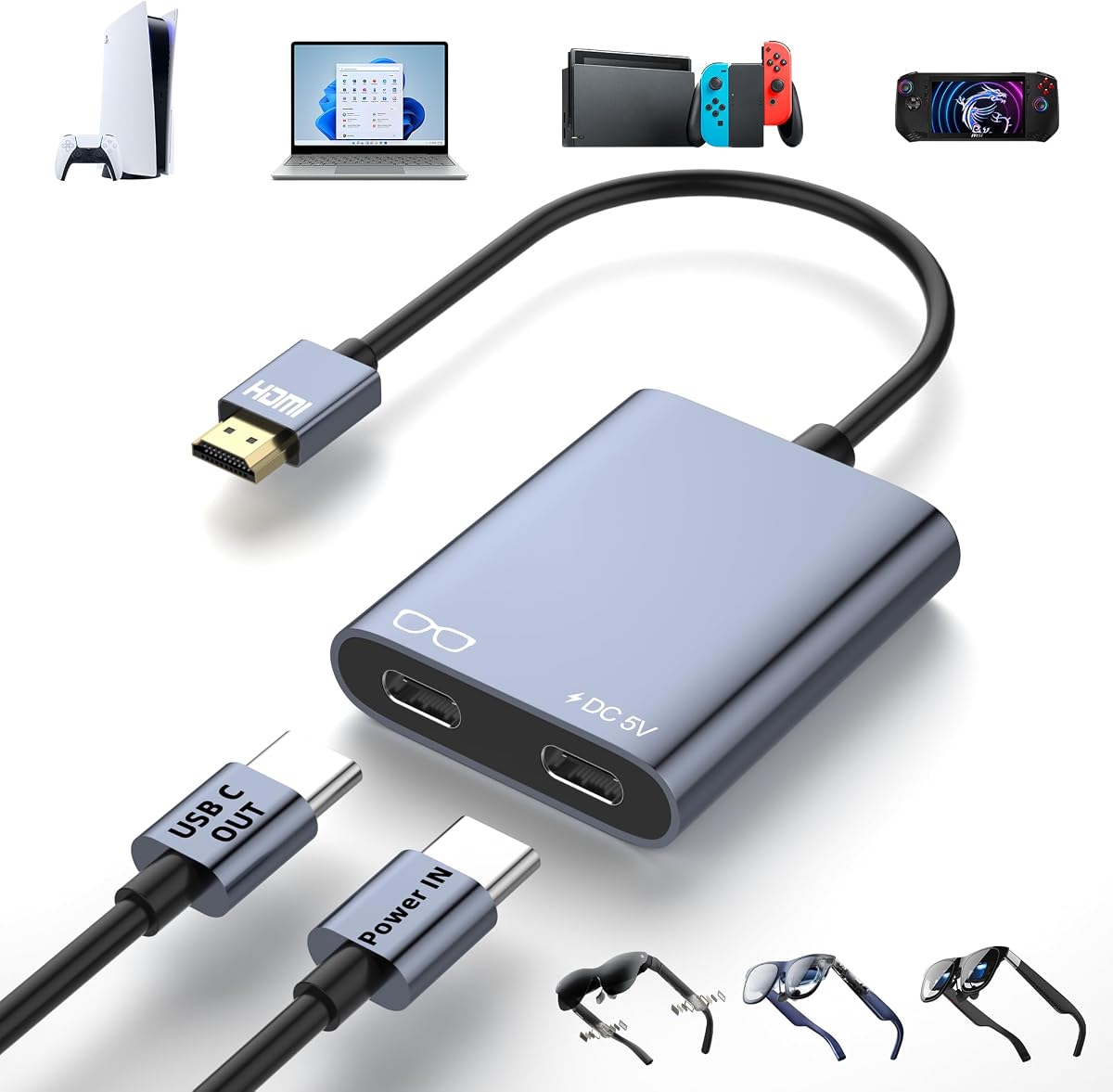
This HDMI-to-USB-C adapter delivers the strongest balance of rating, resolution, and broad device support in the roundup. Its 4.6 rating is the highest among the supplied products, while 4K at 60Hz makes it appealing for gaming, high-motion video, and large virtual displays. It also supports a separate 5V power input, allowing the connected USB-C display or AR glasses to remain powered throughout longer sessions.
We may earn a commission when you buy through this link, at no additional cost to you.
Compatibility is one of the product's defining features. The listed coverage includes XREAL Air, Air 2, Air 2 Pro, One, One Pro, and Ultra; Rokid Air and Max; RayNeo Air 2s XR; Viture Pro and One; and Thunderbird AR. On the source side, it works with HDMI output from PS4, PS5, Xbox, Switch, Switch 2, Steam Deck, ROG Ally, streaming devices, and laptops. It can also serve compatible USB-C portable monitors and projectors. The included USB-A-to-USB-C cable supplies the required external power.
The main complication is that this is a strictly one-way HDMI-to-USB-C adapter. HDMI must connect to the source, while USB-C connects to the display; reversing the arrangement produces no signal. It cannot convert USB-C source output to an HDMI display, and it does not support VR headsets such as Meta Quest, PICO, or HTC Vive. The glasses or monitor must support DisplayPort Alt Mode, and certain XREAL models need their display mode changed manually. Without adequate power, black screens, flickering, or dropped signals may occur.
This is the strongest budget-oriented recommendation for someone who wants 4K60 and broad compatibility without buying a native RayNeo-only adapter. It suits owners of RayNeo Air 2s XR as well as users who want one converter across several compatible glasses, consoles, and displays. Verify DP Alt Mode, power requirements, and connection direction before purchase, but otherwise it is a flexible and well-supported choice.
The 4K60 capability provides more temporal headroom than the native RayNeo adapters' stated 4K30 maximum. The result is smoother motion when the source, cable, and glasses can all support that mode.
A dedicated 5V input helps prevent the black-screen and flicker problems that can arise when an AR display draws too much current. The included 90-centimeter USB-A-to-USB-C cable makes the power connection straightforward.
We may earn a commission when you buy through this link, at no additional cost to you.
This AR Glasses HDMI-to-USB-C adapter combines a 4.5 rating with 4K60 output and one of the broadest compatibility lists in the guide. It is designed for one-way video transmission from an HDMI source to USB-C glasses, a portable monitor, or a USB-C projector. The result is a useful general-purpose converter for anyone who alternates among AR glasses, consoles, laptops, streaming devices, and mobile displays.
We may earn a commission when you buy through this link, at no additional cost to you.
The supported RayNeo model is the Air 2s XR, but the adapter also lists XREAL Air, Air 2, Air 2 Pro, One, One Pro, and Ultra; Rokid Air and Max; Viture Pro and One; and Thunderbird AR. Source compatibility extends to PS5, PS4, Xbox One, Switch 2, Switch, Steam Deck, ROG Ally, Google TV, Fire TV Stick, laptops, MacBook, iMac, iPad, and selected Android and Windows devices. This breadth makes the product more versatile than a narrowly tailored accessory.
A 5V power port supplies stable power to the connected display, and the package includes a 90-centimeter USB-A-to-USB-C cable. However, external power is required; without it, the adapter will not function as intended. The USB-C side must support DisplayPort Alt Mode for video and audio. The converter is not reversible, does not work with Meta Quest, PICO, or HTC Vive headsets, and does not support audio on Studio Display. A full-function USB4 or Thunderbolt 3, 4, or 5 cable may also be needed between the adapter and the display.
Buy this adapter if broad device support and 4K60 are your priorities. Its compact aluminum body measures 2.3 by 1.2 by 0.5 inches, weighs 0.08 pounds, and includes a 5.9-inch attached cable, making it easier to carry than a larger hub. It is particularly attractive to RayNeo Air 2s XR owners who also want to use portable monitors or other supported glasses with one adapter.
The extensive source and display lists reduce the need to carry separate adapters for each ecosystem. It is especially useful for mixed setups involving AR glasses, portable monitors, consoles, and laptops.
At 0.08 pounds, the adapter is light enough for daily transport. Its aluminum housing also provides useful heat dissipation during extended display sessions.
We may earn a commission when you buy through this link, at no additional cost to you.
This HDMI-to-USB-C AR Glasses Adapter is notable for supporting 4K at 60Hz, 1080p at 120Hz, and 1080p at 144Hz. Its 4.3 rating and unusually broad high-refresh list make it a compelling option for fast gaming or demanding display setups. It converts HDMI output from consoles, computers, and TV boxes into a USB-C signal for compatible AR glasses and portable displays.
We may earn a commission when you buy through this link, at no additional cost to you.
The product supports RayNeo, VITURE, XREAL, and Rokid glasses, along with USB-C portable monitors. Common source devices include Switch OLED, Switch 2, PS4, PS5, Xbox, TV boxes, and laptops with HDMI output. A 60-centimeter 4K HDMI cable and a 50-centimeter power cable are included, so the core connection kit is present in the box. The adapter can also be powered by a portable charger, which is useful when a wall outlet is unavailable.
Several setup details require attention. The hub's power output is limited to 10W at 5V and 2A, and it powers the connected display rather than the source device. A portable display may need its own external power connected first to prevent intermittent operation or blackouts. The product is not compatible with DHCP on certain PS4, PS5, laptop, and other HDMI sources, so that feature may need to be disabled. XREAL glasses may also need to be switched into DisplayPort Alt Mode, and Meta Quest, PICO, HTC Vive, and Epson AR glasses are excluded.
This adapter is best for users whose priorities include the highest listed refresh-rate support, especially 1080p144. The included cables and ability to run from a portable charger make it convenient for mobile gaming. Just ensure that both the source and display support the desired mode, because the adapter can pass those capabilities through but cannot improve them.
The 1080p144 option is the standout in this roundup for motion-oriented use. It can benefit fast games and responsive-feeling experiences when the source, glasses, and cable all support that mode.
Both a 4K HDMI cable and a power cable are included. That reduces the number of separate accessories required for a first installation, while portable-charger support improves travel flexibility.
We may earn a commission when you buy through this link, at no additional cost to you.
This adapter is especially relevant to XREAL One owners because its product information provides detailed instructions for enabling the correct DisplayPort audio mode. The adapter carries a 4.4 rating and supports 4K at 60Hz through a one-way HDMI-to-USB-C connection. It works with AR glasses, portable monitors, and USB-C projectors, giving it a useful balance of entertainment and productivity applications.
We may earn a commission when you buy through this link, at no additional cost to you.
The compatibility list includes XREAL Air, Air 2, Air 2 Pro, One, One Pro, and Ultra; Rokid Air and Max; RayNeo Air 2s XR; Viture Pro and One; and Thunderbird AR. It also lists consoles such as Switch, Xbox, and PS4 or PS5, along with Steam Deck and ROG Ally. Other listed source possibilities include Google TV, Fire TV Stick, computers, laptops, mobile phones, cameras, monitors, MacBook, iMac, iPad, and multiple desktop and mobile operating systems.
The adapter uses an aluminum housing for heat dissipation and includes a USB-C power cable. It can transmit 4K60 and provide power to connected glasses or displays. Setup is otherwise plug-and-play, with no software required. As with similar converters, the signal runs only from HDMI to USB-C, and the product explicitly says it cannot be reversed or connected to another adapter. Firmware updates, secure reconnection, and display-side video support are also recommended for reliable operation.
This is a strong recommendation for XREAL One owners seeking straightforward mode guidance in addition to 4K60 conversion. It is also a practical choice for RayNeo Air 2s XR users who need a portable-monitor adapter. The limitation is its one-way architecture: it cannot turn a USB-C computer into an HDMI display receiver. Confirm your glasses and source support the necessary standards before purchase.
The provided XREAL One instructions explain how to enter sound mode, select the audio protocol, and choose DP mode. This level of detail can shorten troubleshooting compared with a generic converter.
The 2.3-by-1.2-by-0.4-inch housing and 6.1-inch cable are easy to carry. The same adapter can serve AR glasses, a portable monitor, or a projector when the connected device supports the necessary video input.
We may earn a commission when you buy through this link, at no additional cost to you.
The Hagibis adapter is a 4K60 HDMI-to-USB-C converter framed around flexible use with AR glasses, portable monitors, projectors, and televisions. Its 4.2 rating reflects a capable and versatile design, while the product information emphasizes business trips, office productivity, meetings, presentations, and home entertainment. The RayNeo Air 2s XR is supported, but so are several XREAL, Rokid, Viture, and Thunderbird models.
We may earn a commission when you buy through this link, at no additional cost to you.
Source coverage includes laptops, game consoles, Steam Deck, ROG Ally, PS4 and PS5, Switch, portable monitors, USB-C projectors, Google TV, Fire TV Stick, phones, cameras, and numerous computers and tablets. This makes the adapter useful beyond AR entertainment. The HDMI male plug enters the source, while the USB-C female end connects to a display using a full-function USB-C cable. The USB-C side is a display connection rather than an input for a docking station or hub.
The mandatory power connection is the most important operational detail. The power port accepts 5V at 1A, or 5W, and can also draw from a laptop's compatible data port. The product instructions say this port must be connected when using the adapter. The display and glasses also need USB 3.1, USB 3.2, USB 4, or Thunderbolt 3 or 4 cable support. While 4K60 is supported, the actual result still depends on the source and display capabilities.
Choose this adapter when you want a single converter that moves between immersive media and professional presentations. It is a good fit for RayNeo Air 2s XR owners who also use portable monitors or projectors and who understand the need for a proper cable and stable external power. It is less convenient for plug-and-only use because the required power lead and full-function cable are central to operation.
Hotel television, meeting-room projector, and portable-monitor support make this useful for travel and office work. The same adapter can therefore serve both a professional display and an AR entertainment setup.
A charging-only cable will not carry display data, and the power port must be connected. Checking those two requirements before travel avoids the most common setup failures.
We may earn a commission when you buy through this link, at no additional cost to you.
The Guermok adapter is a compact hardware converter designed for one-way video from an HDMI source to a USB-C display. It supports 4K at 60Hz and 1080p at 120Hz on compatible AR glasses and USB-C displays, with low latency that makes it appropriate for gaming and real-time viewing. Its 4.2 rating is solid, and the converter requires no drivers or software.
We may earn a commission when you buy through this link, at no additional cost to you.
The display side works with RayNeo, XREAL, Rokid, and other AR glasses that accept USB-C video and audio, as well as compatible portable monitors and USB-C projectors. Compatible HDMI sources include PS5, PS4, Xbox Series X or S, desktop PCs, laptops, media players, and devices such as Switch, Steam, or ROG when used through a dock with HDMI output. The product's source list is broad, but the direction of the connection remains fixed.
The adapter cannot reverse the signal, transfer USB data, recognize devices, provide spatial features or 3D modes, or operate as a video-capture card. A full-function USB-C video cable is not included. The 5V power input requires a 5V, 1 to 1.5-amp source; higher voltage and multi-port fast chargers should be avoided. Without external power, the adapter produces no signal, while inadequate power can lead to flicker, disconnection, or a black screen. Slight warmth from the aluminum housing is expected during extended use.
This converter is a good fit for users who want a simple, low-latency hardware path from HDMI into compatible AR glasses. It works particularly well with RayNeo glasses that accept USB-C video input, provided you source an appropriate full-function cable and stable 5V supply. Its restrictions are substantial but clearly defined, so careful port and cable planning is essential.
This is a display converter, not a general-purpose dock. That focused design keeps the connection direct and supports low-latency gaming and viewing without companion software.
The 5V, 1-to-1.5-amp requirement provides a clear power target. Staying within that range protects the adapter and reduces the chance of unstable video during extended use.
We may earn a commission when you buy through this link, at no additional cost to you.
This adapter stands apart through its built-in 3000mAh rechargeable battery, allowing it to power compatible AR glasses or Type-C phones without finding a separate outlet. It supports 4K at 60Hz and 2K at 120Hz, and its 4.2-style conversion format connects HDMI source devices to USB-C AR glasses or portable monitors. That combination makes it especially relevant to travel and to users of older iPhones with a Lightning connector.
We may earn a commission when you buy through this link, at no additional cost to you.
For iPhone 14, 13, 12, and earlier models, the product requires the official Apple Lightning Digital AV Adapter, which is not included. A third-party adapter described as certified is explicitly not considered an acceptable substitute. The product also supports standard HDMI sources such as PS5, Xbox, Switch, PCs, laptops, TV set-top boxes, TV sticks, DVD players, Apple TV, Fire TV Stick, and Chromecast. The stated glasses compatibility includes Viture, XREAL, Rokid, and RayNeo models.
The built-in battery is the defining convenience, providing power when a wall socket or power bank is unavailable and extending the practical use of the adapter. The tradeoff is that it is a less specialized one-way HDMI-to-USB-C device, and reverse USB-C-to-HDMI transmission is not supported. The supplied information does not describe the same detailed external power arrangement as the dedicated powered converters in the roundup, so buyers should closely review the current instructions and device requirements.
This product is best for a user whose older iPhone is the primary source and who values untethered power more than a native RayNeo-specific accessory. It is less compelling for owners of newer USB-C phones or for people who already have a dependable power bank. The requirement for Apple's official Lightning Digital AV Adapter adds an extra purchase and expense, and its 3.8 rating is the lowest in the group, so expectations should be measured accordingly.
The integrated rechargeable battery is valuable during travel, outdoor use, or long sessions. It can power AR glasses or a compatible Type-C phone when conventional power is inconvenient.
Lightning compatibility can be valuable for users who have not moved to USB-C. The official Apple Digital AV Adapter is mandatory and separate, so account for that before ordering.
We may earn a commission when you buy through this link, at no additional cost to you.
The final adapter is a straightforward 4K60 HDMI-to-USB-C converter designed for AR glasses, portable monitors, and USB-C projectors. Its 4.1 rating reflects a practical feature set rather than standout extras. Importantly, it includes a one-meter full-function USB-C cable, so users do not need to source the display cable separately as they would with some competing converters.
We may earn a commission when you buy through this link, at no additional cost to you.
The listed glasses support covers XREAL One, Air 2 Pro, Air 2, and Air 2 Ultra; Rokid Air and Max; RayNeo Air 2s XR; VITURE Pro; and Thunderbird AR. Compatible HDMI sources include PS5, PS4, Xbox, Switch 2, Switch, media players, Fire TV Stick, and Google TV. The adapter also supports USB-C portable monitors and projectors, making it appropriate for gaming, movies, mirroring, productivity, and presentations.
A dedicated 5V power port supplies the display and must be connected for operation; without power, there is no signal. The port supports 1 to 1.5 amps, and devices requiring more than 5V at 1.5 amps are not supported. The signal path is one-way, so HDMI is always the source and USB-C is always the display. The adapter does not support headphones, docks, or VR headsets, and Studio Display does not receive audio. The display must support DisplayPort Alt Mode, and the source should support HDMI 2.0 for 4K60.
This is a good general converter for users who want a compact aluminum adapter, 4K60 support, and the convenience of an included full-function cable. It is especially relevant to RayNeo Air 2s XR owners who also use compatible portable monitors. The mandatory power lead and strict directional design prevent it from being a universal all-purpose hub, but within that defined role it is a clear and easy-to-understand option.
The included one-meter full-function USB-C cable carries display data and is the correct type for video use. That package detail can simplify setup and avoid a separate cable purchase.
Aluminum construction supports heat dissipation and portability. At the same time, broad source and glasses compatibility makes the adapter useful across gaming, streaming, and presentation workflows.
We may earn a commission when you buy through this link, at no additional cost to you.
The right choice depends first on your exact RayNeo model, the source device's output, and whether the glasses accept HDMI directly or require USB-C video conversion. Resolution, refresh rate, power, and cable support then determine which adapters are practical.
RayNeo compatibility is not uniform across the product range. The native Air 4 Pro adapter supports the Air 4 Pro, Air 3-series, and GT-series glasses, while the native Air 3, Air 2, and GT adapter explicitly excludes the Air 4 Pro. Most third-party products in the roundup list the RayNeo Air 2s XR rather than the Air 4 Pro. Check the model number on your glasses and compare it with every compatibility list before buying. A listing that uses the RayNeo name does not automatically mean it supports every RayNeo product.
Most converters in this guide move video in one direction only: HDMI is the source and USB-C is the display. They cannot take video from a USB-C laptop and send it to an HDMI television, nor can they act as a capture card for a VR headset. Native RayNeo Lightning adapters serve a different role, but they still depend on compatible source devices and the Apple Digital AV Adapter where specified. Understanding the required direction prevents an otherwise compatible adapter from producing no signal.
The strongest options support 4K at 60Hz, while the native RayNeo models list 4K at 30Hz as their maximum. One product also supports 1080p at 144Hz. Higher numbers are not automatically better: 4K60 emphasizes detail and smooth motion, 1080p120 can suit competitive gaming, and 4K30 may be sufficient for a large virtual screen. The source, glasses, adapter, and USB-C cable must all support the selected mode.
Many third-party adapters require a stable 5V external supply and may show a black screen, flicker, or signal dropouts without it. The most clearly specified products accept 1 to 1.5 amps, while another lists 10W at 5V and 2A. The built-in-battery model is the exception, offering greater portability for compatible AR glasses and Type-C phones. Do not assume that the USB-C port carrying video will also charge the adapter; read the connection diagram carefully.
A USB-C port does not automatically support external video. The connected glasses, monitor, or projector must support DisplayPort Alt Mode for video and audio input. XREAL models may require a change to DisplayPort mode, and some other glasses have their own operating-mode instructions. The supplied data also recommends certified USB4 or Thunderbolt 3, 4, or 5 cables for certain adapters. A charging-only cable will not carry the image.
Video compatibility does not always guarantee audio. Some AR glasses may show images without sound unless switched to the correct DP audio mode, and one product specifically excludes audio on Studio Display. The source may also need to be set to output through HDMI or DisplayPort. If sound is essential, check the adapter instructions, the glasses manual, and the source's audio settings before installation.
Some adapters include an HDMI cable, a power cable, a full-function USB-C cable, or a combination of these. Others require the display cable to be purchased separately. The included 4K and 60-centimeter cables in one product are useful for a first setup, while the 90-centimeter power leads on two products offer more placement flexibility. Compare the complete box contents, not just the adapter housing, especially when traveling.
The native RayNeo adapters are described as compact and travel-ready, while several third-party options use aluminum housings for heat dissipation. Two products are listed at only 0.08 pounds, and dimensions around 2.3 by 1.2 inches appear repeatedly. A small adapter is convenient, but stable connections also depend on a secure HDMI plug, a suitable display cable, and uninterrupted power. Favor a design that fits your carrying case without forcing bent cables.
Begin by identifying the source side and display side. For a one-way HDMI-to-USB-C adapter, connect the HDMI male plug to the source, such as a console, laptop, media player, or streaming device. Connect the USB-C female end to the glasses or portable display using a full-function video cable. Never reverse the adapter unless the manufacturer expressly supports bidirectional conversion, and do not connect it to another adapter.
Next, provide the required power. Connect the adapter's 5V power port to an appropriate 5V charger or compatible power source, or use the built-in battery if your selected model has one. If the display has its own power input, connect that first. A charging-only USB-C cable cannot carry video, so use a cable that explicitly supports DisplayPort Alt Mode or the applicable USB4 or Thunderbolt standard.
Power on the source, select its HDMI output, and then power on the glasses or display. If there is no image, reseat the USB-C connection and HDMI plug, verify the display mode, update the glasses firmware, and check that the source is not using an incompatible feature such as DHCP. Disconnect the adapter before changing ports, and keep the aluminum housing ventilated so warmth does not build during long sessions.
No. Compatibility depends on the exact RayNeo model and the adapter's connection standard. The native Air 4 Pro adapter supports specified Air 4 Pro, Air 3-series, and GT-series models, while another native adapter excludes the Air 4 Pro. Many third-party products list the RayNeo Air 2s XR. Verify the precise model before ordering.
Native RayNeo adapters are designed around particular RayNeo glasses and may offer model-specific features such as charging or HDR10. Third-party HDMI-to-USB-C adapters usually support a broader range of glasses, consoles, monitors, and projectors, but require compatible USB-C video input and external power. The best choice depends on whether native fit or device flexibility matters more.
No. The third-party adapters described here are one-way converters that accept HDMI at the source and send video to a USB-C display. They cannot reverse that path. A USB-C laptop that lacks HDMI output needs a native USB-C-to-USB-C video path or another appropriate adapter rather than one of these HDMI-source converters.
First confirm that external 5V power is connected, because many adapters produce no signal without it. Next, check that the glasses support DisplayPort Alt Mode and that the USB-C cable carries video rather than power only. Reseat both ends, select the correct DP or glasses mode, update the glasses firmware, and disable source features such as DHCP if the manufacturer instructs you to do so.
Not necessarily. 4K60 offers smoother motion and greater detail when every connected device supports it, while 4K30 may be adequate for films and general entertainment. The source, adapter, display, and cable all have to support the same mode. In competitive gaming, 1080p120 or 1080p144 can sometimes be more useful than 4K30.
For the native RayNeo Lightning adapter and the Lightning-focused third-party product, an official Apple Lightning Digital AV Adapter is required for compatible iPhone models. The Apple adapter is not included in the box. Newer USB-C iPhones do not need that particular Lightning accessory but still need a compatible source arrangement and the correct Apple Digital AV Adapter if their source path requires one.
Yes, many models list compatible USB-C portable monitors and USB-C projectors as display options. The display must accept DisplayPort Alt Mode video and may need its own external power connected first. Maximum resolution and refresh rate depend on both the adapter and the monitor or projector's supported input modes.
AR glasses and high-resolution portable displays can draw enough power to cause unstable video if the adapter cannot supplement their supply. Dedicated 5V input ports help maintain a stable signal during extended gaming or movie sessions. Use only the specified voltage and current range, and avoid fast chargers that deliver an inappropriate voltage.
The RayNeo HDMI 2.0 Adapter is the most focused recommendation for Air 4 Pro owners because it adds native support, charging, and HDR10 with a compatible source. The RayNeo adapter for Air 3, Air 2, and GT-series glasses suits travelers seeking simple native operation, while the third-party HDMI-to-USB-C models provide broader compatibility and up to 4K60 output.
Prioritize the exact glasses model, connection direction, and power requirements before comparing refresh rates. A 4K60 converter offers excellent headroom, but it is only useful if your RayNeo model accepts USB-C video and can be powered correctly. Native users should also decide whether HDR10 and charging justify staying within the RayNeo ecosystem, while multi-device users may find a dedicated HDMI-to-USB-C converter more versatile.
Ratings, product specifications, availability, and promotional terms can change, so review the current listing before buying. Confirm the latest compatibility guidance, required cables, firmware notes, and power specifications for the exact devices in your setup. With those details verified, you can choose an adapter that provides a stable connection and the display performance your games, films, and work require.
