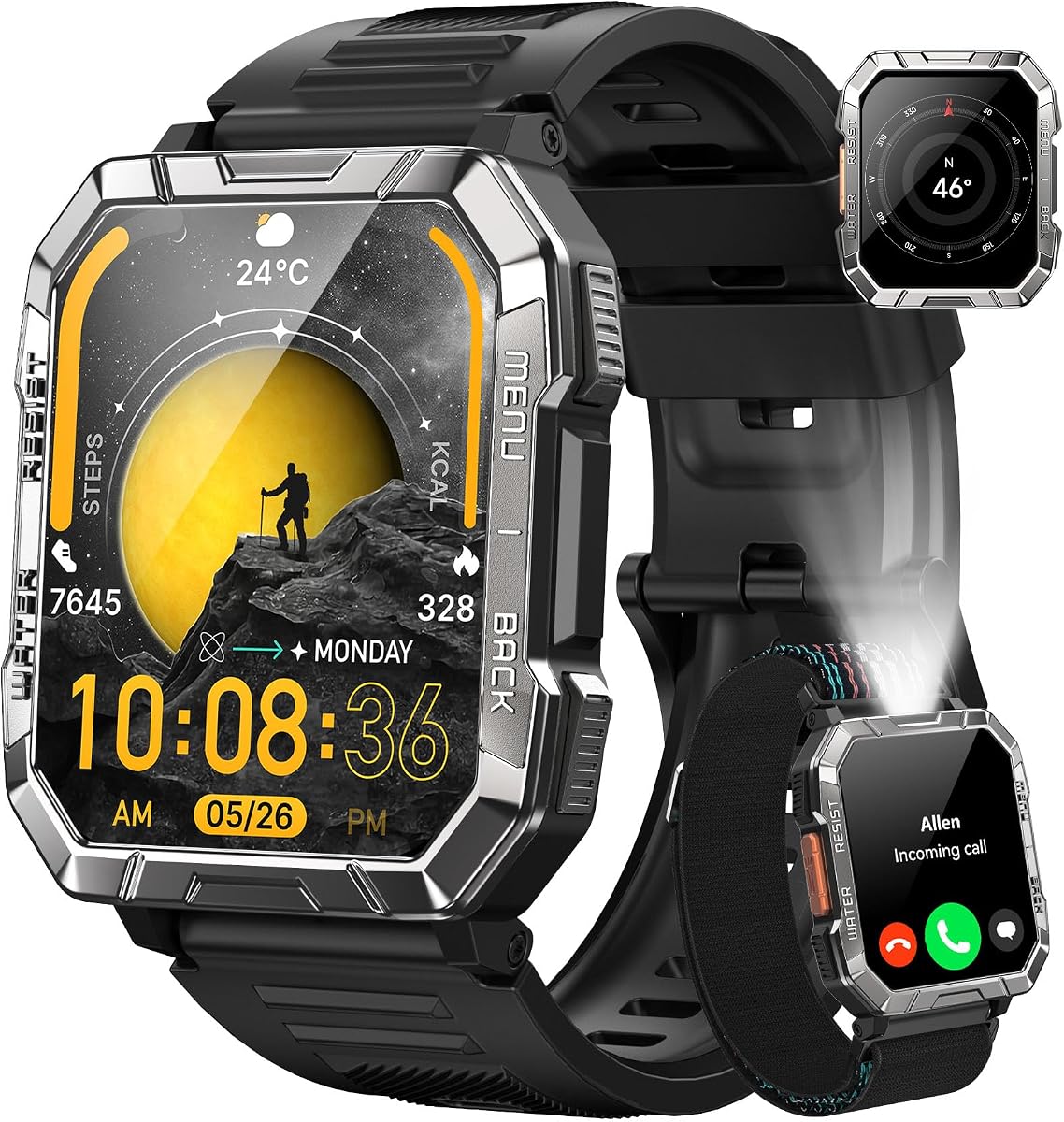
Military Smart Watch for Men with 100-Day Standby/Flashlight/Compass
5.0Editor score
Long standby battery life
Built-in flashlight and compass
Calls, notifications, and GPS
Our smartwatches for law enforcement guide compares 10 rugged GPS, tactical, health, connectivity, battery, and field-ready options for demanding professional
A smartwatch built for law enforcement must do more than display time and track steps. It needs dependable navigation, clear communication, long battery life, rugged construction, and controls that remain useful during long shifts, training exercises, and demanding outdoor operations. The best model depends on agency policy, connectivity needs, and the environments officers actually encounter.
This guide compares 10 smartwatches selected from the supplied product data, covering military-style watches, rugged Garmin multisport models, and a cellular Samsung Galaxy Watch Ultra2. We evaluated the stated features, including GPS support, compasses, altimeters, barometers, flashlight functions, calling, notifications, health sensors, water resistance, battery claims, and tactical tools. We also considered how each watch may fit different patrol, training, and field roles.
Each review identifies the standout benefits, practical trade-offs, and users most likely to benefit from the model. Ratings and feature descriptions reflect the provided information, while operational suitability still depends on agency requirements, communications coverage, device management, and local rules. Prices and availability change, so readers should verify current listings, warranty terms, compatibility, and accessories before purchasing.
5.0Editor score

4.6Editor score

4.1Editor score
The table below compares the ten models by navigation, ruggedness, communications, battery approach, and field-oriented features. It is designed to clarify which watches emphasize budget utility, everyday fitness tracking, standalone location, satellite safety, cellular independence, or dedicated tactical functions.



The Blackview military smartwatch combines a 900mAh battery, a 2.01-inch full-touch TFT display, a built-in LED flashlight, and a compass. Its 5.0 supplied rating reflects a broadly favorable customer response, while the standout proposition is a claimed standby life of 100 days and daily-use life of 30 days. That endurance could make it attractive for personnel who need a watch that spends more time on the wrist than in a charging pouch.
We may earn a commission when you buy through this link, at no additional cost to you.
Practical field tools extend beyond the display. The flashlight has a stated lighting range of 6–10 meters, while the compass provides a basic directional reference. Bluetooth calling, message notifications, music and camera controls, weather, alarms, and an AI voice assistant make the watch function as a compact communications hub. It also includes silicone and nylon straps, giving users a softer option for extended wear and a more suitable choice for sensitive skin.
The main trade-off is that the high-capacity battery comes with a substantial everyday feature set and a screen described as extra large. The product is also IP68 rated for everyday needs but explicitly not intended for saunas, hot water, swimming, or diving. Its health readings are estimates and cannot be used as medical diagnostic tools. For agencies, that makes it better viewed as a general-purpose fitness and utility watch than an authoritative medical or mission-specific device.
This is the strongest budget-oriented choice in the list for users who prioritize long standby time, a flashlight, basic navigation, and wearable calling without moving to a high-end specialist platform. Officers should verify notification reliability, app permissions, strap security, device-management requirements, and local radio or phone policies before relying on it operationally. Subject to those checks, it offers exceptional feature density and endurance for its category.
The stated 100-day standby and 30-day daily-use figures could reduce charging interruptions during long assignments, travel, or training. Real results will depend on Bluetooth use, display settings, workouts, GPS activity, and notification volume, so agencies should test the watch under representative workloads before standardizing it.
A one-button flashlight, compass, calling, notifications, and customizable watch faces give this model more field utility than a basic fitness tracker. These features remain supplements to approved radios, maps, and procedures rather than replacements for official equipment.
We may earn a commission when you buy through this link, at no additional cost to you.
This Blackview model earns a 5.0 supplied rating and emphasizes endurance in a relatively compact 1.45-inch form. Its 960mAh battery is advertised at more than 100 days of standby and more than 30 days of regular use, making it a practical choice for personnel who dislike frequent charging. A plastic case, zinc alloy housing, LED flashlight, and compass form the core of its tactical-style design.
We may earn a commission when you buy through this link, at no additional cost to you.
The watch supports over 100 sport modes, activity statistics, phone-connected route recording through the Da Fit app, and 24/7 heart-rate, blood-oxygen, stress, and sleep tracking. Bluetooth calling allows the wearer to answer or make calls, while stored contacts and notifications for popular messaging services keep basic communication accessible. The 1.45-inch tempered-glass display can be brightened for outdoor visibility, and watch faces can be personalized with images.
A key limitation is that the supplied description does not identify built-in GPS. The app can record workouts using the phone's GPS, but that is different from a watch independently acquiring and storing a route. The watch is also not intended for swimming, diving, hot tubs, or saunas. While the health information may help users understand trends, the product itself is explicitly not a medical device.
The watch is a compelling secondary option for users who want a long battery life, flashlight, compass, and calling at a value-oriented level. It may suit academy students, reserve personnel, or field-oriented users whose work does not require independent navigation. For official deployment, agencies should assess charging logistics, notification behavior, security, and compatibility with managed phones before purchase.
The 960mAh cell and stated 30-day daily-use estimate offer a different balance from GPS-heavy smartwatches. Battery performance will vary with calls, workouts, display use, and sensor activity, so field teams should evaluate it under the same conditions personnel will encounter.
The compass and quick-access LED flashlight are convenient backups for orientation and low-light tasks. Because the watch does not claim standalone GPS, officers needing independent route capture should choose a model with explicitly stated built-in positioning.
We may earn a commission when you buy through this link, at no additional cost to you.
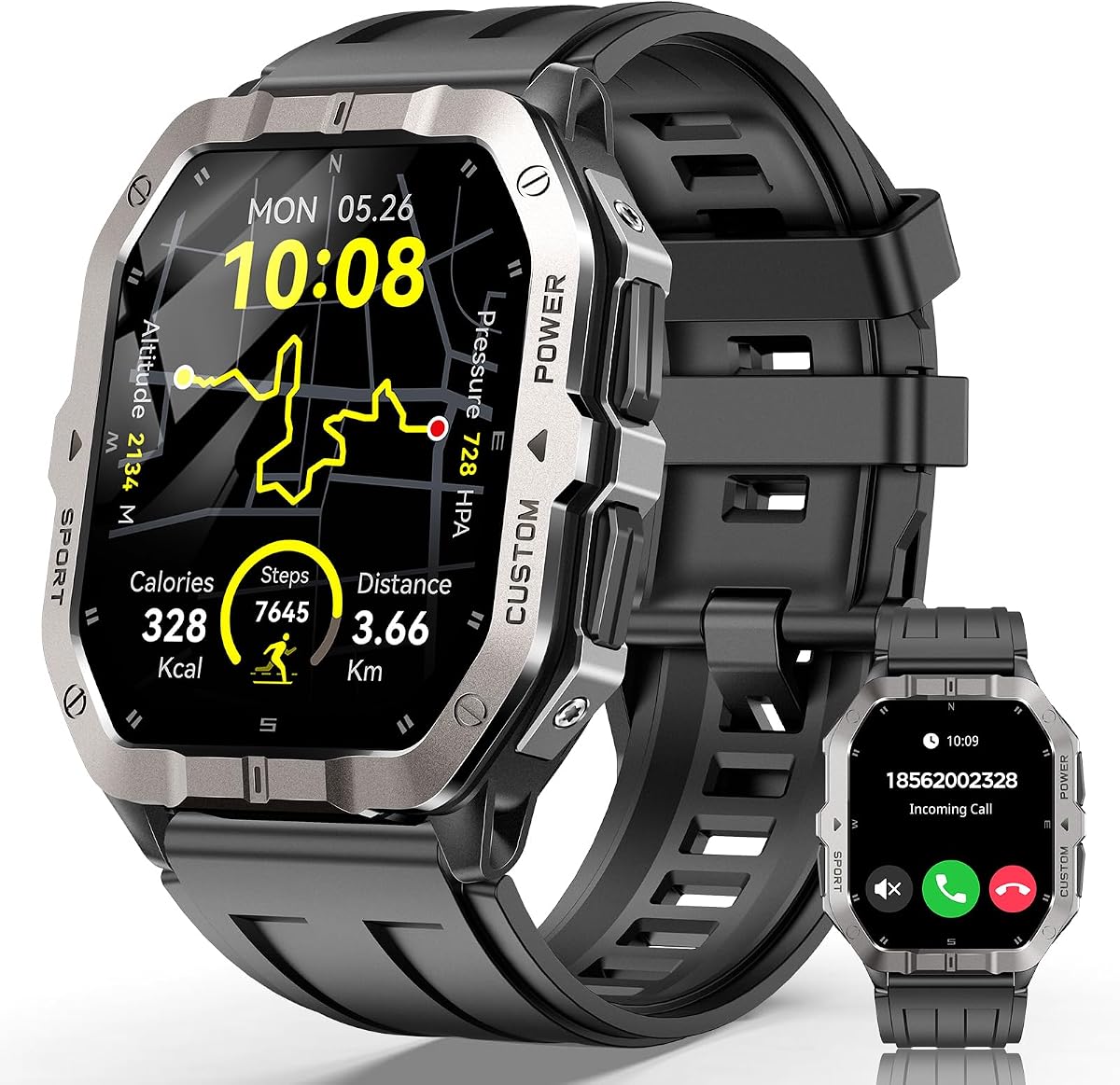
This 2.02-inch military smartwatch is built around standalone GPS, allowing it to record pace, distance, and routes without a nearby phone. It also includes a compass, altimeter, and barometer, giving users a more complete set of outdoor references. The supplied 5.0 rating makes it one of the strongest customer-rated options in this comparison.
We may earn a commission when you buy through this link, at no additional cost to you.
The watch supports 170-plus sport modes, Bluetooth calling, message notifications, music control, camera remote, and weather updates. Its bright display, enlarged fonts, and scratch-resistant tempered glass are well suited to checking information while moving. The construction uses composite material and an aluminum-alloy bezel, with stated resistance to heat, cold, dust, low pressure, and water.
Its advertised battery life of more than 12 days with Bluetooth calling enabled is useful but trails the extended endurance of the two Blackview watches and the 18-day claim of the Garmin Instinct 3 AMOLED. Health monitoring for heart rate, blood oxygen, pressure, and sleep is presented as fitness information rather than medical measurement. Users should also consider the large display and full-touch interface during extended wear.
The watch is a balanced option for users who need independent GPS and detailed outdoor tools without moving into the specialist Garmin ecosystem. It suits training, hiking, route logging, and fitness-focused patrols where phone-free tracking matters. Agencies should check mapping compatibility, notification behavior, device security, and exact water-resistance requirements before adoption.
Built-in GPS lets the watch record a route without relying on phone-based positioning. Combined with the compass, altimeter, and barometer, it provides a more layered set of outdoor references, although users should still carry approved navigation tools and understand local coverage conditions.
The 2.02-inch full-touch screen, large fonts, high contrast, and tempered-glass protection support rapid status checks during activity. Its size may be less comfortable for smaller wrists, so fit and all-day wear should be evaluated before standardization.
We may earn a commission when you buy through this link, at no additional cost to you.
The Garmin fēnix 9 Pro is the most advanced connectivity-oriented watch in this guide, combining LTE, Garmin Messenger, LiveTrack, and optional inReach satellite services. Its supplied 4.1 rating is lower than several competitors, but the feature set is unusually comprehensive for off-grid, travel, expedition, and field scenarios where leaving a phone behind may be desirable.
We may earn a commission when you buy through this link, at no additional cost to you.
The first titanium case in the fēnix line pairs a lightweight material with a scratch-resistant sapphire lens and a large 1.5-inch AMOLED display. A built-in LED flashlight offers white, red, and green settings. LTE supports calls and messages, while LiveTrack shares location on a 30-second update rate. inReach adds satellite messaging, location check-ins, and interactive SOS through Garmin Response, subject to an active plan and coverage limitations.
Important cautions come with the connectivity features. Satellite service is unavailable in certain situations, and some jurisdictions regulate or prohibit satellite communication devices. The watch also relies on subscription services for inReach. Its 51mm dimensions may not suit every wrist, particularly for officers who prefer a less conspicuous profile. Rating and included connectivity options should be evaluated together rather than treating the watch as a simple fitness device.
For users who can manage the service requirements and accept a large case, the fēnix 9 Pro is the premium choice for independent communications and expedition-grade utility. It is particularly compelling for search-and-rescue, rural patrol, training, and travel teams that need more connectivity options than a conventional Bluetooth watch. Organizational approval, regional rules, network coverage, and data policies remain essential before operational use.
LTE messaging and calls can keep the watch connected when the phone stays behind, while inReach extends messaging and check-ins to satellite coverage. These features require compatible service plans, and satellite SOS availability remains subject to coverage, hardware, subscription, and legal limitations.
A titanium case, sapphire lens, large AMOLED display, and integrated flashlight create a high-end tool for demanding outdoor use. The sizable 51mm design should be tried on because bulk, wrist fit, and sleeve clearance can matter significantly during extended shifts.
We may earn a commission when you buy through this link, at no additional cost to you.
The Garmin vívoactive 5 is less overtly tactical than most picks in this guide, but its 42mm case makes it an attractive everyday option for personnel who want health, fitness, and basic GPS tracking without a bulky wrist device. The supplied 4.3 rating reflects a balanced performance history, while Garmin's established fitness platform broadens its appeal.
We may earn a commission when you buy through this link, at no additional cost to you.
Its AMOLED display is bright and colorful, and the stated battery life reaches up to 11 days in smartwatch mode. Body Battery estimates, sleep coaching, HRV status, wrist heart rate, stress tracking, naps, menstrual-cycle and pregnancy tracking, and a morning report create a broad wellness picture. More than 30 indoor and GPS sports apps cover walking, running, cycling, HIIT, swimming, golf, and other activities.
This is primarily a health and fitness watch, not a purpose-built field radio or tactical navigation device. It lacks the flashlight, high-impact case, specialized tactical profiles, cellular connectivity, and satellite messaging found in other selections. The fit is comfortable and versatile, but users needing shock resistance or aggressive durability should select a rugged model. Fitness metrics are estimates and should not be treated as medical measurements.
The vívoactive 5 works best for officers seeking a discreet health-focused smartwatch, training analysis, and basic GPS fitness applications. It can also support wheelchair-mode tracking, adaptive Garmin Coach plans, custom workouts, and phone-free music from Spotify, Amazon Music, or Deezer. For patrol users prioritizing physical protection, emergency lighting, standalone route tools, and all-outdoor construction, one of the rugged alternatives is a stronger match.
Body Battery, sleep coaching, HRV status, naps, stress, and wrist heart rate can help personnel understand how sleep, rest, and exertion interact. These features provide estimates for general wellness and should complement, not replace, medical care or fitness assessments.
The 42mm design is less imposing than the fēnix and Instinct models and works well for training, commuting, and everyday wear. It offers GPS-based sports and music features without a flashlight, cellular radio, or satellite SOS.
We may earn a commission when you buy through this link, at no additional cost to you.
The Garmin Instinct 3 AMOLED balances outdoor capability, readable display technology, and rugged construction in a 45mm package. Its supplied 4.6 rating places it among the strongest customer-rated products in the guide, and its defining features include a 1.2-inch AMOLED screen, multi-band GPS with SatIQ, a built-in flashlight, and a stated battery life of up to 18 days.
We may earn a commission when you buy through this link, at no additional cost to you.
The supertough fiber-reinforced polymer case and metal-reinforced bezel are designed for demanding conditions. Navigation tools include a three-axis compass, barometric altimeter, and multi-band positioning. The flashlight offers variable intensities and strobe modes, which adds a useful hands-free lighting option. Health features include wrist heart rate, advanced sleep monitoring, and Pulse Ox where available.
The watch does not provide LTE voice calling or satellite messaging, so it cannot replace a radio or a dedicated satellite communicator. Pulse Ox is not offered in every country, and Garmin describes the measurements as close estimates rather than medical readings. The 45mm size may feel substantial under a uniform sleeve, and actual display or GPS performance can vary with conditions, settings, and battery mode.
For users wanting a rugged, long-lasting watch with serious navigation and a flashlight, this is the most balanced general-purpose pick. It suits patrol, training, hiking, and fitness use while remaining less specialized than the Instinct 3 Tactical or fēnix 9 Pro. Agencies should evaluate sleeve fit, map behavior, accessory options, and required communications alongside their policies.
The reinforced case, metal bezel, AMOLED display, and multi-band GPS create a practical combination for outdoor work. It is more specialized toward navigation and physical durability than the vívoactive while remaining less communications-heavy than the fēnix.
Variable brightness and strobe modes add quick illumination without a separate handheld light in many situations. It remains a convenience feature rather than a substitute for approved flashlights, entry tools, and other safety equipment.
We may earn a commission when you buy through this link, at no additional cost to you.
The SOUYIE military smartwatch combines built-in GPS, six satellite systems, a compass, altimeter, barometer, and Bluetooth calling in a zinc-alloy case. Its supplied 4.8 rating is one of the highest in this list, and its six-system positioning support gives it a strong appeal for users who want independent route tracking across varied outdoor environments.
We may earn a commission when you buy through this link, at no additional cost to you.
The 1.43-inch AMOLED screen offers an always-on display, stated 466-by-466 resolution, and customizable faces. The watch supports 178 sports modes, automatic detection of five workout types, and real-time tracking for heart rate, distance, pace, and calories. Stored contacts, app messages, an SOS emergency contact, an AI assistant, and 3ATM water resistance extend its usefulness for training and active work.
Battery performance depends heavily on use. The stated normal-use range is 7–10 days, standby is up to 30 days, and continuous GPS use is about three days. The watch also provides blood-pressure, blood-oxygen, stress, and sleep estimates that should not be considered diagnostic. Its 3ATM rating means it can handle rain, sweat, and swimming according to the product description, but users should still verify the exact terms of that rating.
This watch is a strong fit for users who want many satellite systems, extensive workout tracking, calling, and an always-on display without stepping into premium specialist pricing. It may be particularly useful for outdoor training, hiking, and field fitness. Before deployment, check map compatibility, satellite behavior, emergency-contact procedures, and whether continuous GPS endurance meets agency requirements.
Support for GPS, GLONASS, BeiDou, Galileo, NAVIC, and QZSS provides multiple ways to acquire position, while the watch syncs routes to a phone. The breadth of supported systems is useful for travel and varied terrain, but route accuracy still depends on satellite visibility and environmental conditions.
The extensive sports library, automatic workout detection, sleep stages, stress, oxygen, heart rate, and blood-pressure tracking create a broad activity record. Users should treat these readings as fitness guidance rather than medical measurements or operational vital-sign monitors.
We may earn a commission when you buy through this link, at no additional cost to you.
The Galaxy Watch Ultra2 is built for demanding outdoor use and phone-free communication. Its 4.6 supplied rating, titanium construction, 47mm case, 5000-nit display, IP69K rating, and 10ATM water resistance make it one of the most specialized models here. Built-in LTE allows calls, texts, and updates while the phone remains behind.
We may earn a commission when you buy through this link, at no additional cost to you.
For trail movement, the watch supplies path, elevation, pace guidance, and personalized hydration alerts. A Mares dive-computer application adds ascent and descent monitoring, depth-limit notification, safety-stop information, and more through an EN13319-certified smartwatch experience. The display is designed to remain visible in strong sunlight, while the flashlight-free design keeps the case focused on navigation and wrist-based operation.
Cellular connectivity requires compatible service and setup, and the watch works most seamlessly within the Samsung ecosystem. It pairs with Samsung phones and other Android devices through Galaxy Wearable and Samsung Health, but compatibility can vary by function and region. The diving and health capabilities should be used according to their stated limitations, and the watch does not provide satellite SOS like the Garmin fēnix 9 Pro.
This is a compelling option for agencies or individuals that want cellular independence alongside serious outdoor capability. It is particularly relevant for teams operating beyond reliable phone coverage, training, search activities, and travel. Because it is larger than most models and tied to mobile-service administration, buyers should evaluate wrist comfort, carrier coverage, data policies, and wearable-management controls.
Built-in LTE supports calls, texts, and important updates without requiring the paired phone to remain present. Service activation, coverage, permissions, and agency security policies must be managed before relying on the watch in the field.
The stated 5000-nit brightness and 47mm titanium design support demanding daylight and high-impact environments. IP69K and 10ATM ratings add water and dust protection, while the dive app gives the watch a specialized aquatic profile.
We may earn a commission when you buy through this link, at no additional cost to you.
The CARBINOX Edge stands out for the breadth of its package and its combination of ruggedness, dual-frequency positioning, and strong battery claims. The supplied 4.1 rating is moderate, but the watch includes a metal band, six quick-release bands, a magnetic charging cable, and a tempered-glass screen protector, making it a convenient all-in-one setup for teams or individuals rotating straps.
We may earn a commission when you buy through this link, at no additional cost to you.
A stainless-steel bezel and Corning Gorilla Glass are paired with MIL-STD-810H testing, IP69K sealing, and 5ATM water resistance. Its 1.96-inch AMOLED display delivers 1000 nits for sunlight readability. L1+L5 dual-frequency GPS uses six satellite systems for phone-free route tracking, while a compass, altimeter, and barometer support orientation. The watch also provides Bluetooth calls, notifications, 160 sport modes, heart rate, SpO2, and sleep tracking.
The 25-day battery claim applies to basic watch mode, and a full recharge is stated at about two hours. Users who continually operate GPS, calls, or a bright display will see different results. The watch has no cellular radio or satellite emergency service, and its large 1.96-inch screen may be conspicuous under a uniform sleeve. Health readings remain general fitness information.
The Edge is a good value-oriented option for users who value included accessories and a broad mix of field, fitness, and communication features. It may work particularly well for teams that need multiple band options for hygiene, uniform matching, or role changes. Before buying in volume, verify screen visibility, band security, device compatibility, map behavior, and actual endurance under the intended workload.
The L1+L5 system and support for six satellite networks can improve route tracking in challenging terrain. A compass, altimeter, and barometer provide additional orientation references, though users should still follow agency navigation procedures and carry approved backup equipment.
Six quick-release straps, a metal band, screen protector, and charging cable reduce the need to source accessories separately. This is useful for rotating teams, changing uniforms, or personalizing fit, though the full package should be checked for compatibility with uniform standards.
We may earn a commission when you buy through this link, at no additional cost to you.
The Garmin Instinct 3 Tactical is the most explicitly tactical watch in the guide, building on the rugged Instinct platform with a preloaded tactical activity, stealth mode, kill switch, dual-position GPS, waypoint projection, and rucking features. Its 4.6 supplied rating, solar charging, 45mm reinforced case, and specialized tools make it a natural selection for users who need more than ordinary fitness tracking.
We may earn a commission when you buy through this link, at no additional cost to you.
The watch includes an Applied Ballistics solver that requires a one-time purchase through the AB Quantum mobile app. It also has a built-in flashlight with variable intensities and strobe modes, a three-axis compass, barometric altimeter, and multi-band GPS with SatIQ. Garmin Pay works with supported banks, smart notifications pair with a compatible phone, and Connect IQ allows additional apps and watch faces.
Solar charging depends on wear time and light exposure, with the unlimited-battery claim assuming all-day smartwatch use and three hours per day outdoors at 50,000 lux. The watch is 10 ATM rated and designed to MIL-STD-810 for thermal and shock resistance. It does not provide LTE or inReach satellite SOS, and the extra ballistics purchase raises the total ownership cost. Pulse Ox availability also varies by country.
This model is best for users who want a rugged watch with genuine tactical functions rather than merely a military-styled appearance. It can support specialized training, navigation, rucking, and field workflows where the dedicated controls are relevant. Agencies should confirm that these features align with policy, investigate the ballistics subscription, and test solar charging under realistic duty patterns.
Stealth mode, kill switch, waypoint projection, dual-position GPS, tactical activity, and rucking tools serve more specialized needs than a standard fitness watch. Each function should be trained on and used only within agency procedures, legal requirements, and appropriate mission contexts.
Solar charging can improve endurance when the watch receives sufficient direct sunlight and remains in the relevant mode. The stated unlimited-battery scenario depends on specific wear and light conditions, so users should test actual performance under local weather and duty patterns.
We may earn a commission when you buy through this link, at no additional cost to you.
The right choice depends on whether the watch is primarily a fitness device, navigation instrument, communications tool, or tactical accessory. Agencies should begin with documented operational requirements, then balance durability, positioning, battery endurance, and device compatibility without expecting a consumer smartwatch to replace approved radios, medical equipment, or safety gear.
For rural patrol, search operations, training away from a phone, and any assignment where a route must be recorded without a nearby handset, built-in GPS is a high-priority feature. A watch that merely receives the phone's location is not equivalent to a watch that can independently acquire a route, distance, pace, and position. The Garmin fēnix 9 Pro, Garmin Instinct models, CARBINOX Edge, SOUYIE, and the 2.02-inch military GPS watch include standalone positioning in their stated specifications. A three-axis compass, altimeter, and barometer can further support orientation, but each has limitations and should be cross-checked against approved navigation tools.
Battery claims need careful interpretation because standby, basic watch, smartwatch, calling, and continuous GPS modes produce very different results. The Blackview models advertise the longest standby figures, while the CARBINOX Edge claims up to 25 days in basic mode, the Instinct 3 AMOLED states up to 18 days, and the fēnix and vívoactive offer more moderate endurance. Solar charging on the Instinct 3 Tactical may improve flexibility, though its strongest claim assumes regular outdoor light exposure. Teams should compare expected runtime with shift length, battery availability, and the cost of losing tracking or notifications near the end of a duty cycle.
Field watches should tolerate bumps, dust, rain, sweat, and repeated handling without treating the product as indestructible. The Garmin Instinct models use reinforced cases and MIL-STD-810-related construction, while the CARBINOX Edge combines a stainless-steel bezel, Gorilla Glass, and MIL-STD-810H testing. The Samsung Galaxy Watch Ultra2 has IP69K and 10ATM ratings, while several Blackview and SOUYIE models use IP68 or 3ATM language. Water ratings differ in what they permit: the first Blackview explicitly excludes swimming and diving, whereas the SOUYIE description lists swimming. Users should confirm exact water exposure, depth, and activity limitations under their agency's usage conditions.
Bluetooth calling is common in this group, but it still depends on a paired phone. The Galaxy Watch Ultra2 and Garmin fēnix 9 Pro offer cellular connections that can support calls and messages with the phone left behind, creating greater independence at the cost of service and device management. The fēnix 9 Pro can also provide satellite messaging and interactive emergency SOS through inReach when a suitable active plan and coverage are available. Other watches provide app and message notifications over Bluetooth. Law enforcement buyers should distinguish convenience notifications from official radio interoperability and review carrier coverage, data retention, and agency security requirements.
A flashlight, compass, waypoint projection, rucking profile, kill switch, stealth mode, and applied ballistics are more specialized than standard fitness tracking. The Garmin Instinct 3 Tactical offers the broadest explicit tactical feature set, while the fēnix 9 Pro, regular Instinct 3, Samsung Ultra2, CARBINOX, and the military-style watches provide various navigation and lighting tools. Physical controls can be easier to operate with gloves or under stress, but users should verify button placement, accidental activation risk, and compatibility with gloves. A watch marketed for tactical use still requires training, authorization, and adherence to legal rules.
A bright display can be valuable in daylight, nighttime vehicle work, and fast information checks. The Samsung Ultra2 claims up to 5000 nits, the Garmin Instinct 3 AMOLED and fēnix use AMOLED screens, and the first Blackview uses a 2.01-inch full-touch TFT display. Screen size must be balanced against wrist comfort, uniform sleeves, glove operation, and accidental touches. The 42mm vívoactive is the most compact selection, while the 45mm and 47mm Garmin and Samsung models and the 51mm fēnix are noticeably larger. A field trial should include wearing the watch through a full shift with the intended uniform.
Wrist heart rate, sleep stages, stress, blood oxygen, Body Battery, rucking metrics, VO2 max, and activity profiles can support training and wellness programs. The vívoactive 5 is the most health-focused selection, the fēnix 9 Pro emphasizes stamina and performance tools, and the tactical Garmin includes a rucking activity. None of the described health data should be treated as a substitute for professional medical equipment, diagnosis, or duty fitness evaluation. Agencies should establish acceptable use and avoid relying on consumer estimates for critical operational decisions.
Smartwatch selection extends beyond the watch itself. Listed compatibility ranges differ, with examples including Android 8.0 and iOS 13.0, Android 5.0 and iOS 13.0, and iOS 9.0 and Android 9.0 or later. The Galaxy Watch pairs through Samsung Galaxy Wearable and Samsung Health, while several military-style watches use their own companion apps. Departments should evaluate managed-device support, Bluetooth security, account requirements, application permissions, notification handling, update responsibility, and data retention before bulk purchase. Compatibility claims should be confirmed for the exact phone models and operating-system versions used by the agency.
Begin with a complete setup rather than relying on the watch out of the box. Fully charge the device as requested by the manufacturer, install the correct companion app, pair it with an approved phone, and review permissions for calls, messages, location, contacts, health information, and system notifications. Configure emergency contacts carefully, choose the required time format and display settings, and test every control while safely stationary. Agencies should also document the assigned device, account owner, update process, and return procedure before the watch enters active use.
Learn the navigation and fitness features before relying on them during a shift. Practice starting a GPS activity, saving waypoints, switching screens, reading the compass, using the flashlight, checking battery status, and recovering from an accidental press. For models with cellular or satellite plans, verify network coverage and test message and call procedures in a safe area. A backup map, radio, power source, and standard navigation method should remain available whenever the smartwatch is used outdoors.
Care for the watch according to its specific water-rating instructions. Avoid exposing a model to hot tubs, saunas, diving, high-pressure water, or harsh chemicals unless the manufacturer expressly permits it. Clean the case and strap with a soft, damp cloth, dry thoroughly before refastening, and replace a worn strap promptly. Inspect the screen, bezel, seals, buttons, and charging contacts, and stop using the watch if moisture enters it. For agency-owned devices, schedule charging, cleaning, software updates, and secure retirement through a documented chain of custody.
The best choice depends on the required features and operating environment rather than a single universal winner. The Garmin fēnix 9 Pro, Garmin Instinct 3 models, CARBINOX Edge, SOUYIE watch, and 2.02-inch military GPS watch state that they support built-in positioning. Officers should compare route accuracy, battery life, map compatibility, screen readability, charging access, and agency security before choosing.
No consumer smartwatch in this list should be assumed to provide full radio interoperability or meet an agency's certified communications standard. Bluetooth calls, LTE calling, and satellite messaging can add convenience or redundancy, but they may depend on a paired phone, cellular coverage, subscriptions, and local regulation. Official radios and established backup communications should remain the primary mission systems.
The product descriptions consistently treat the health data as estimates for fitness or general wellness rather than medical measurements. Features such as heart rate, blood oxygen, stress, sleep, blood pressure, and Pulse Ox may help track trends, but they are not substitutes for qualified medical equipment or diagnosis. Departments should establish clear policies about when consumer readings may and may not be used.
The two Blackview military watches lead the supplied information with claims of more than 100 days of standby and more than 30 days of daily use. The CARBINOX Edge lists up to 25 days in basic watch mode, while the Instinct 3 AMOLED claims up to 18 days. Actual runtime varies by GPS use, calls, notifications, display brightness, workout tracking, and other settings.
Check the exact rating rather than relying on a broad description of the watch as waterproof. A 3ATM, 5ATM, 10ATM, IP68, or IP69K label represents different capabilities, and some products explicitly exclude swimming, diving, saunas, or hot water. Agencies should compare the rating with expected rain, immersion, cleaning, and high-pressure exposure while also considering case durability.
Several models can independently track routes with built-in GPS, and the fēnix 9 Pro and Galaxy Watch Ultra2 can provide cellular calls and messages when configured with suitable service. The fēnix 9 Pro also offers inReach satellite functions through an active plan. Features vary by model, and users must confirm app, account, network, subscription, and coverage requirements.
A fitness smartwatch can provide a useful route record, compass, altitude, and other orientation data, but it should not be the only navigation method. Search personnel should use agency-approved mapping and communication procedures, carry backup equipment, and verify the watch's behavior under the terrain, weather, battery, and lighting conditions expected for the assignment.
Start with a small user trial that includes the intended phone, uniform, gloves, charging method, and representative shift workload. Test GPS acquisition, notification delivery, call clarity, battery endurance, display visibility, strap security, app stability, security controls, and water limitations. Record issues, update procedures, device-management responsibilities, and replacement processes before expanding the deployment.
The strongest overall balance is the Garmin Instinct 3 AMOLED, with rugged construction, multi-band GPS, a readable AMOLED screen, a flashlight, and up to 18 days of stated battery life. The Garmin fēnix 9 Pro is the premium option for users who need LTE and satellite connectivity, while the first Blackview military smartwatch stands out as the budget leader thanks to its 960mAh-class battery capacity, flashlight, compass, and broad feature set. Each serves a different role, and none should be treated as a universal replacement for approved duty equipment.
Prioritize the requirements that can interrupt a shift: independent positioning where needed, dependable notifications, a display readable under local conditions, battery endurance for the duty cycle, and a case that suits the environment. Tactical tools, cellular independence, satellite SOS, fitness depth, and long standby figures are valuable only when they match the assignment and agency policy. A full-shift trial with the actual phone, uniform, and charging plan is more informative than any single specification.
Before buying, verify current price, availability, warranty, region-specific features, app compatibility, and any subscription or activation costs. Prices and promotions can change at any time, while some services and functions are unavailable in certain countries or jurisdictions. Take the time to compare the current listing with the operational need, and choose the watch that supports the job without creating false confidence in an area where accuracy, reliability, or safety matters most.
