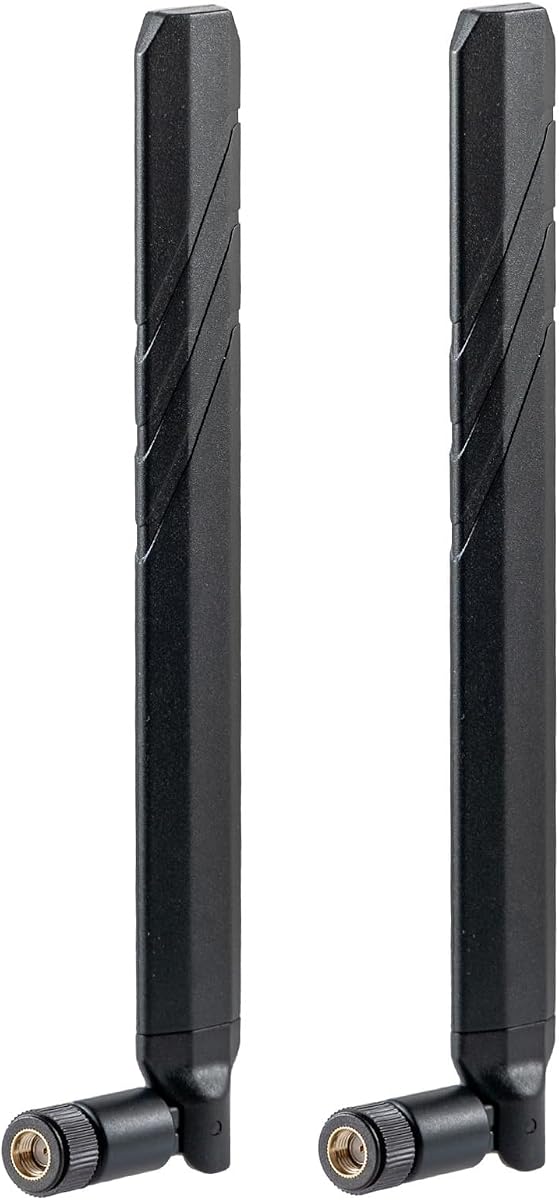
Cellular Trail Camera Replacement RP-SMA Antenna 2-Pack
4.7Editor score
Broad 600-6000 MHz range
10 dBi omni-directional gain
IP67 waterproof construction
Two antennas per package
Wide trail camera compatibility
This guide compares 4G antenna for trail cameras by connector, gain, weather resistance, range, and compatibility to help improve cellular reception outdoors.
A cellular trail camera can capture excellent images yet still fail where it matters most: sending those images to your phone. An external 4G antenna can improve reception, reduce failed uploads, and make remote monitoring more dependable. The right choice depends on connector type, supported frequencies, antenna gain, mounting needs, and compatibility with your camera.
We compared ten replacement and upgrade antennas using the specifications and compatibility information supplied for each product. The list covers RP-SMA and SMA models, single and multi-antenna packs, compact options, long-cable designs, and antennas with differing gain ratings. Every pick includes an outdoor-oriented construction suitable for the demands of trail camera placement.
The entries reveal how each option approaches the same core problem differently. Some prioritize broad camera compatibility, while others concentrate on high gain, simpler installation, multiple-camera support, or weather resistance. Ratings and product details may change over time, and current prices should always be checked before purchasing or comparing the final cost of an antenna.
4.7Editor score

4.6Editor score
4.1Editor score
This side-by-side comparison highlights connector standards, listed gain, operating ranges, outdoor protection, cable or package features, and camera compatibility so buyers can identify the most suitable antenna before ordering.


This Bingfu replacement antenna carries a 4.0 rating and stands out for its unusually broad connector and device compatibility. Its native SMA male connector is accompanied by an RP-SMA male adapter, allowing it to serve both connector types without requiring buyers to choose blindly. The listed 5 dBi gain and support for 698-960 MHz, 1710-2170 MHz, and 2300-2700 MHz make it a general-purpose cellular antenna.
We may earn a commission when you buy through this link, at no additional cost to you.
Compatibility is one of its strongest attributes. The supplied information names numerous Tactacam Reveal and Defend models, multiple Stealth Cam families, Moultrie Edge 3, Covert cameras, Spartan GoLive and GoCam models, Cuddeback j series cameras, and Muddy Manifest cameras. It can also work with cellular routers, hotspots, surveillance cameras, CPE routers, and other 4G equipment. That makes it a practical choice for anyone who wants one antenna to cover several types of hardware.
The package includes the antenna, an RP-SMA adapter, a wall-mount bracket, and four self-tapping screws. A three-meter cable provides useful separation between the antenna and the camera, while the supplied screw dimensions allow for planning a fixed installation. The listed gain is lower than the 8, 9, or 10 dBi options elsewhere in this guide, so buyers seeking maximum directional performance should not treat it as the most aggressive upgrade.
This antenna is best for a trail camera with an SMA connection, especially when the included adapter is needed or when multiple cellular devices will use the same type of antenna. Its broad compatibility and complete mounting package make it easier to recommend than a narrowly matched specialty unit, provided the lower listed gain aligns with the placement challenge.
The included adapter is especially useful for buyers who are unsure whether their trail camera uses SMA or RP-SMA. Verify the fitting before installation, but the package provides a practical way to cover both common cellular connector formats.
A ten-foot lead, wall bracket, and self-tapping screws give the installer more freedom than a short pigtail antenna. Positioning the unit away from the camera enclosure can help it seek a clearer cellular signal while keeping the camera in a concealed location.
We may earn a commission when you buy through this link, at no additional cost to you.
This two-pack of RP-SMA antennas earns a 4.7 rating, the highest among the ten products listed here. It combines a substantial stated 10 dBi gain with an especially broad 600-6000 MHz frequency range. Its IP67 protection, 50-ohm impedance, voltage standing wave ratio below 1.8, and omni-directional radiation pattern make it a technically ambitious choice for cellular trail cameras operating in challenging outdoor locations.
We may earn a commission when you buy through this link, at no additional cost to you.
The compatibility list covers Tactacam Defend, Reveal X Gen 2.0 and 3.0, Reveal X Pro, Reveal Pro 3.0, Reveal XB, and Reveal SK cameras. It also includes Spypoint Link Micro, Link Evo, Link S Sola, Link Dark, and Link W models, plus Stealth Cam Revolver, Fusion X, and Deceptor products. More generally, the antenna is intended for cellular trail cameras using an RP-SMA connector.
The main trade-off is connector specificity. The product is explicitly an RP-SMA male antenna, so it is not a universal solution for cameras with standard SMA fittings. The supplied data also does not list a cable length, mounting bracket, or adapter for the package. Two antennas are included, which is useful for two cameras or a spare, but buyers expecting a complete wall-mounting kit should verify the contents separately.
For buyers who already know their camera uses RP-SMA, this is an attractive balance of gain, frequency coverage, weather protection, and package quantity. It is especially compelling when two trail cameras need improvement or when keeping a compact spare on hand is useful. The lack of listed mounting hardware is modest compared with the unusually broad operating range and top-rated 4.7 customer feedback.
At 10 dBi, this antenna is among the strongest options in the guide by the stated gain specification. That figure can make it especially relevant where cellular reception is marginal and the camera can be positioned to benefit from a clearer signal.
The two-pack provides a practical way to equip more than one camera. It can also serve as an installation for one camera with a replacement held in reserve, reducing the chance that weather damage or an installation issue leaves a remote unit without a spare.
We may earn a commission when you buy through this link, at no additional cost to you.
This Bingfu RPSMA antenna has a 4.3 rating and delivers a listed 9 dBi gain in a two-pack. Its operating bands cover 698-960 MHz, 1710-2170 MHz, and 2300-2700 MHz, while the omni-directional design helps it receive signals from multiple directions rather than requiring a narrowly aimed connection.
We may earn a commission when you buy through this link, at no additional cost to you.
Its camera coverage is extensive but carefully bounded. The product supports a long list of Tactacam Reveal and Defend cameras, several Stealth Cam Fusion, Deceptor, Revolver, and Spectre models, and selected Spypoint Link S, Link S Dark, Link Micro, Link Micro S, and Link Micro Solar units. The description explicitly warns that other Spypoint models are not compatible. It also works with 4G routers, security cameras, modems, hotspots, industrial IoT gateways, and other cellular devices using RP-SMA.
The connector warning deserves attention. This is an RP-SMA male connector with a hole in the center and no pin, which differs from the standard SMA configuration. The package contains two antennas but no adapter or mounting bracket. As a result, buyers should confirm the camera's connector and plan their own secure placement rather than assuming everything needed for installation is included.
This antenna is a strong option for owners of multiple compatible RP-SMA cameras who want high gain without moving to the premium 10 dBi models. It is less suitable for standard SMA equipment unless an appropriate adapter is obtained separately. Within the RP-SMA category, however, its two-pack format and broad named camera support make it a balanced choice.
The 9 dBi specification is close to the highest gain listed in this roundup. For a remote camera struggling with marginal service, that higher figure may be more meaningful than a small difference in package quantity or housing design.
An RP-SMA male fitting has no center pin, while a standard SMA connector uses a different internal arrangement. Confirming the fitting before ordering avoids the most common compatibility problem described in the product information.
We may earn a commission when you buy through this link, at no additional cost to you.
This replacement antenna booster carries a 4.4 rating and combines a listed 9 dBi gain with IP67 weather protection. The 698-2700 MHz frequency range, 50-ohm impedance, voltage standing wave ratio below 1.8, and omni-directional pattern form a solid specification set for a cellular trail camera upgrade.
We may earn a commission when you buy through this link, at no additional cost to you.
Compatibility is a major strength. The supplied information lists Spypoint Link Micro, Link Evo, Link S Sola, Link Dark, and Link W; Tactacam Defend, Reveal X Gen 2.0 and 3.0, Reveal X Pro, Reveal Pro 3.0, Reveal XB, and Reveal SK; and Stealth Cam Revolver, Fusion X, and Deceptor units. It is also described as suitable for other cellular trail cameras with an RP-SMA connector.
This product is not as broadly useful to buyers with standard SMA equipment because it is explicitly an RP-SMA male antenna. The package contains two units, but the provided specifications do not identify any cable length, wall bracket, screws, or alternate connector adapter. Installation planning therefore requires verifying how the antenna will be secured and how much separation from the camera can be achieved.
For a user with a compatible RP-SMA trail camera, this is a balanced selection because it offers more gain than the lower-output alternatives while adding explicit IP67 protection. The two-pack is also helpful for multiple cameras. It is a compelling choice when outdoor durability and signal performance matter more than having a fully specified mounting kit included.
IP67 protection makes this a sensible choice for cameras mounted in open areas or regions where rain, dust, and humidity are persistent concerns. Weather resistance cannot prevent every form of physical damage, but it adds an important layer of protection for an exposed electronic component.
The omni-directional pattern allows the antenna to receive cellular service from varying directions. This is useful in wooded terrain, where the nearest usable tower may not be directly in front of the camera.
We may earn a commission when you buy through this link, at no additional cost to you.
This four-pack of SMA antennas earns a 4.4 rating and is the largest bundle among the standard-SMA options in the guide. Each antenna has a listed 8 dBi gain and an omni-directional pattern across 698-960 MHz, 1710-2170 MHz, and 2300-2700 MHz. Those specifications make the set appropriate for cellular cameras, routers, hotspots, security systems, and other 4G equipment.
We may earn a commission when you buy through this link, at no additional cost to you.
The compatibility information highlights selected Spypoint Flex-S, Flex-S Dark, Flex-Plus, Flex-M, Flex Dual-Sim, Cell-Link, LM2, and Flex G-36 cameras, along with Moultrie Edge 3, Covert cellular cameras, and Spartan GoLive M, Ghost, and GoCam models. It explicitly states that the SMA connector is not RP-SMA and that other Spypoint camera models are outside the listed scope.
The main appeal is quantity. Four antennas can serve four compatible cameras, replace several units at once, or provide practical spares for installations in demanding environments. The 8 dBi listed gain is also higher than the output of many general-purpose trail camera antennas in this guide. On the other hand, the package does not list adapters, brackets, cables, or screws, so mounting hardware is not presented as part of the standard kit.
For a user managing several compatible cameras, this product removes much of the repetition involved in sourcing individual antennas. It is a better fit for standard SMA fittings than RP-SMA cameras and offers more units than most competing packs. Confirm the exact camera connector and model before ordering, then plan a secure and weather-conscious mounting method for each installation.
A four-pack is especially convenient for hunting properties, shared trail systems, or remote monitoring projects. Installing matched antennas can make maintenance and spare planning simpler than maintaining several unrelated antenna models.
The SMA male configuration works with numerous cellular devices, including many trail cameras, routers, and hotspots. It must not be selected for an RP-SMA camera without first obtaining a compatible adapter and confirming the mechanical fit.
We may earn a commission when you buy through this link, at no additional cost to you.
This Eifagur antenna has a 4.1 rating and distinguishes itself through a complete installation-focused package. It includes one antenna, a wall-mount bracket, four screws, and an RP-SMA female-to-SMA male adapter. A three-meter RG58 cable provides a substantial connection length for placing the antenna away from the camera enclosure.
We may earn a commission when you buy through this link, at no additional cost to you.
Its listed 5 dBi gain is modest compared with the 8, 9, and 10 dBi products in the roundup. Nevertheless, the antenna operates across 698-960 MHz, 1710-2170 MHz, and 2300-2700 MHz, uses an omni-directional pattern, has 50-ohm impedance, and carries IP67 protection. The voltage standing wave ratio is listed below 1.8, and the thicker RG58 lead is designed to reduce signal loss over its length.
The stated camera coverage is broad. It includes Spypoint Flex, Link Micro, Link Evo, Link S Sola, Link Dark, and Link W models; Stealth Cam and Tactacam Reveal X Pro units; Moultrie Mobile Edge Pro; HCO Spartan HD GoCam; Covert cellular models; Muddy cameras; and other cellular cameras. Because the adapter is included, the package is more accommodating of both connector styles than a fixed-connector-only alternative.
This is the best fit for buyers who want the essential mounting and connection pieces together rather than assembling the installation separately. Its lower gain means it may not be the strongest option for exceptionally weak coverage, but a well-positioned antenna with a low-loss cable can still provide a useful reception upgrade. The complete kit and included adapter make it an accessible, practical starting point.
The ten-foot RG58 lead allows the antenna to be mounted above, beside, or farther from a camera that is concealed near ground level. That physical separation can be more valuable than adding a small amount of nominal gain when the immediate enclosure area blocks cellular reception.
A bracket, screws, and connector adapter are included in the package. Buyers can inspect the camera fitting, choose the appropriate connection, and plan the mount without treating the antenna as a bare cable-and-connector accessory.
We may earn a commission when you buy through this link, at no additional cost to you.
This Bingfu two-pack carries a 4.5 rating and offers a straightforward upgrade for compatible cellular trail cameras. The listed 6 dBi gain is moderate rather than extreme, while the 698-2700 MHz frequency coverage and omni-directional design support use across common cellular bands. The package includes two RP-SMA antennas.
We may earn a commission when you buy through this link, at no additional cost to you.
Compatibility covers a wide list of Tactacam Reveal and Defend cameras, selected Spypoint Link S, Link S Dark, Link Micro, Link Micro S, and Link Micro Solar models, and several Stealth Cam Fusion, Deceptor, Revolver, and Spectre products. The antenna is also listed for cellular wireless routers, security cameras, wildlife cameras, modems, industrial IoT gateways, hotspots, surveillance systems, and other trail cameras with an RP-SMA connection.
The design is uncomplicated, but buyers must still account for connector differences. The product uses RP-SMA male fittings with a hole in the center and no pin. Standard SMA devices require an appropriate adapter, which is not listed in the package. Mounting hardware and cable length are also not specified, so the included items should not be assumed to include a bracket or long lead.
For owners of one or two supported RP-SMA cameras, this antenna offers a balanced path between signal improvement and simple purchasing. The 4.5 rating is strong, and two units are included. It is most appropriate when the goal is a practical upgrade rather than the highest possible gain specification or a fully bundled wall-mounting system.
A six dBi external antenna can be useful when the camera's built-in antenna struggles because it is low to the ground, enclosed in dense vegetation, or positioned near metal and electronic structures. The actual improvement depends on cellular coverage and placement.
Two matching antennas simplify installations involving multiple cameras and provide a backup for an exposed remote unit. Buyers should still plan their own mounting approach based on the camera's housing and the terrain.
We may earn a commission when you buy through this link, at no additional cost to you.
This Bingfu outdoor antenna has a 4.1 rating and emphasizes durable housing and complete mounting hardware. The antenna cover is made from fiberglass and is described as waterproof and durable for long-term outdoor use. Its 6 dBi gain operates across 698-960 MHz, 1710-2170 MHz, and 2300-2700 MHz with an omni-directional pattern.
We may earn a commission when you buy through this link, at no additional cost to you.
Its compatibility list is one of the broadest in the guide. It covers numerous Spypoint Flex and Link models, Tactacam Reveal XB, Reveal SK, Reveal X Gen 2.0 and 3.0, Reveal Pro 3.0 and 4.0, Reveal X 4.0, Reveal Ultra, Reveal X-Pro, and Defend cameras. The description also names Stealth Cam Fusion, Deceptor, Revolver, and Spectre products, along with Moultrie Edge 3, Covert, Spartan GoLive and GoCam models, Cuddeback j series cameras, and Muddy Manifest cameras.
The physical package supports a more organized installation. It includes one SMA cellular antenna, an RP-SMA connector adapter, a wall-mount bracket, and four self-tapping screws. That combination allows use with both connector formats and provides hardware for attaching the antenna away from the camera. Its listed gain is more restrained than the 8 to 10 dBi options, but the fiberglass enclosure is a notable feature for permanent outdoor placement.
This product is best for someone who prioritizes long-term outdoor construction and broad compatibility over maximum stated gain. It is particularly relevant to cameras mounted in exposed positions where the housing must withstand weather. With its adapter and mounting hardware included, it also offers a more complete installation than many two-packs in the guide.
The fiberglass cover is intended for durable, long-term outdoor service. That makes the antenna a sensible choice for locations where seasonal moisture, direct rain, dust, or frequent handling could shorten the life of a less substantial housing.
Supplying an RP-SMA adapter alongside the SMA antenna broadens its useful range. Buyers should still identify the camera's connector first, as the adapter is appropriate only when the connector type and gender match the camera port.
We may earn a commission when you buy through this link, at no additional cost to you.
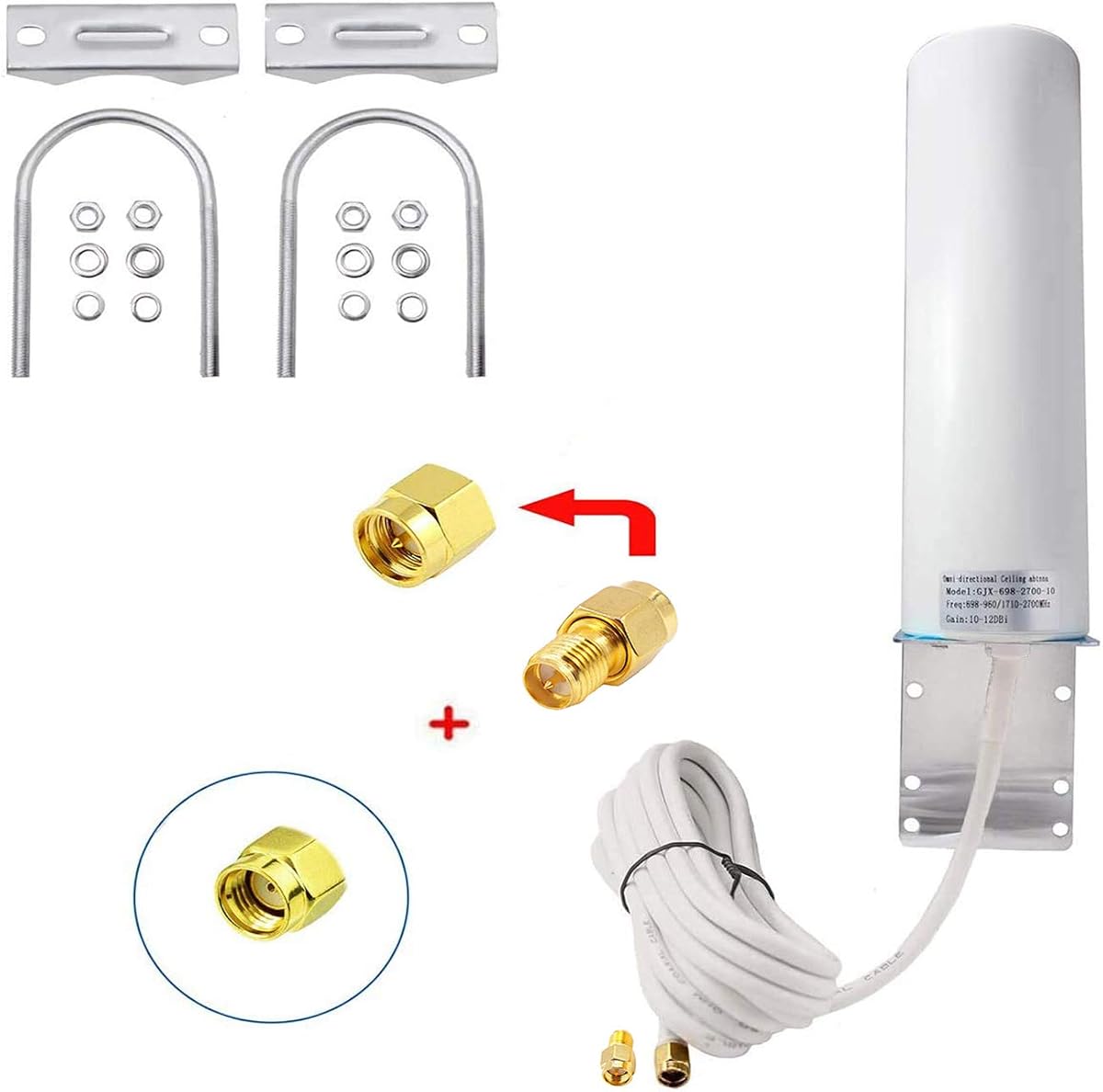
This Eifagur high-gain antenna carries a 4.1 rating and matches the highest stated gain in the guide at 10 dBi. It supports 698-960 MHz, 1710-2170 MHz, and 2300-2700 MHz through an omni-directional design, with 50-ohm impedance. A three-meter RG58 cable and included wall-mounting arrangement allow it to be placed away from the camera's enclosure.
We may earn a commission when you buy through this link, at no additional cost to you.
Compatibility is extensive. The product information refers to all-series Spypoint Flex-M, Flex G-36, Link Micro, Link Dark, Link S, Link Evo, Link Evo-V, and Flex cameras, as well as Tactacam Reveal X Gen 2.0 and 3.0, Reveal X Pro, Reveal Pro 3.0, Defend, and Reveal Ultra units. Additional applications include Moultrie Edge and Mobile Delta, Stealth Cam Fusion X, Revolver, and Deceptor MAX, Muddy wireless cameras, Covert cameras, and Reolink Go PT Plus cellular security cameras.
The installation guidance is a meaningful advantage. Buyers are instructed to keep the omni-directional antenna vertical and as high as possible, while the included U-shaped bracket can be used with an approximately two-inch mast or pipe. The package also includes an RP-SMA female-to-SMA male adapter. Although the specifications do not list an IP67 rating, the design is clearly oriented toward external remote installation.
This antenna makes the most sense for a difficult-coverage location where the camera can be mounted on a tree, pole, or other elevated structure and where signal reception is the central problem. Its 10 dBi specification is attractive, but placement will influence results as much as the number. Buyers should confirm connector compatibility and ensure the antenna can be mounted vertically and high above potential obstructions.
A 10 dBi specification makes this antenna a logical candidate for remote areas with weak cellular service. Higher gain does not create coverage where no network exists, but it can help the camera receive and transmit more reliably within an otherwise usable service area.
The antenna should be mounted vertically and as high as practical. Elevation reduces interference from vegetation, terrain, vehicles, and nearby structures, while the U-shaped bracket supports installation on a narrow mast or pipe.
We may earn a commission when you buy through this link, at no additional cost to you.
This Eifagur replacement antenna has a 4.6 rating and offers a balanced combination of gain, weather protection, cable length, and installation accessories. Its 7 dBi omni-directional gain sits between the lower-output general-purpose antennas and the 8 to 10 dBi high-gain alternatives. It operates from 698-960 MHz through 1710-2170 MHz and 2300-2700 MHz.
We may earn a commission when you buy through this link, at no additional cost to you.
Its IP67 rating, 50-ohm impedance, voltage standing wave ratio below 1.8, and three-meter RG58 cable make it well suited to exposed outdoor placement. The package includes the antenna, a wall-mount bracket, four screws, and an RP-SMA female-to-SMA male adapter. This is more complete than several two-packs that provide only the antennas, giving buyers a clearer path to installation.
Compatibility covers numerous Spypoint LM2, Flex, Flex-S, Flex-M, Flex-Dark, Flex G-36, Link Micro, Link Dark, Link S, and Link Evo variants. The supplied information also names Tactacam Reveal X Gen 2.0 and 3.0, Reveal X Pro, Reveal Pro 3.0, and Reveal Ultra cameras. Further applications include HCO Spartan HD GoCam, Stealth Cam Fusion X and Revolver, Moultrie Mobile Edge Delta, Muddy wireless hunting cameras, Covert hunting cameras, outdoor security cameras, and Reolink Keen Ranger PT trail cameras.
This is an excellent general recommendation for a compatible camera that needs more than a small pigtail improvement but does not necessarily require the maximum listed gain. The included bracket, screws, and adapter improve convenience, while IP67 protection and a long cable support remote installation. It is the top pick for a balanced package rather than for the largest multi-antenna bundle or the highest gain figure.
Seven dBi provides a middle ground between lower-gain antennas and the most aggressive options in the guide. Combined with a ten-foot RG58 cable, it offers meaningful installation flexibility without requiring buyers to focus solely on the highest specification number.
IP67 protection, a wall bracket, four screws, and the connector adapter cover the essential outdoor installation considerations. Position the antenna vertically and away from the camera housing to give the cellular radio the best available view of the service area.
We may earn a commission when you buy through this link, at no additional cost to you.
The most useful trail camera antenna is not automatically the one with the largest gain figure. Start with the camera's connector, then consider radio coverage, weather exposure, mounting flexibility, cable loss, and how many cameras need service.
Connector type is the most critical compatibility check. SMA and RP-SMA fittings may look similar, but they differ internally: the supplied information repeatedly identifies RP-SMA male as having a hole in the center without a pin. An RP-SMA antenna should not be assumed to fit a camera designed for standard SMA, and an SMA male fitting may require an appropriate RP-SMA adapter. Inspect the camera's antenna port and compare its gender and thread style with the replacement before ordering.
Match the connector first, then consider the rest. An adapter can solve some connector differences, but an incorrect combination can prevent the antenna from attaching, may damage threads, or can leave the radio connection poorly terminated. If you cannot identify the fitting, consult the camera manual or seller documentation rather than relying on visual guesswork.
Most of the antennas in this guide support the cellular bands from 698-960 MHz, 1710-2170 MHz, and 2300-2700 MHz. One option expands the stated range to 600-6000 MHz. These ranges matter because cellular trail cameras rely on networks that may transmit on different bands depending on the carrier, location, and network generation. Compatibility with the intended carrier and local LTE bands is more important than a long list of device names.
Choose a range that covers the service used by the camera. All of the products list broad 4G LTE support, but the 600-6000 MHz option provides the widest advertised frequency coverage in this roundup. The broader range may be useful when the antenna will serve several network types or cellular devices, although actual performance still depends on the radio, antenna quality, and installation.
The listed gain in this guide ranges from 5 dBi to 10 dBi. Higher gain can help a camera maintain reception and transmit images in a weak area, but the number does not create cellular coverage and should not be treated as a guaranteed distance multiplier. Antenna placement, nearby terrain, vegetation, tower direction, carrier congestion, and the camera's own radio all influence the final result.
For general upgrades, a 6 or 7 dBi antenna offers a sensible middle ground. A 9 or 10 dBi model is more relevant when reception is persistently poor and the antenna can be elevated well above obstructions. A 5 dBi antenna may still improve on a small built-in antenna when it is positioned carefully and supplied with a suitable low-loss cable.
Cable length can be a benefit or a limitation. Moving the antenna away from the camera enclosure and above low obstructions may improve reception, but a longer run introduces more potential signal loss. Products with a ten-foot RG58 lead provide a useful balance, while shorter or unspecified leads require buyers to make their own placement plan. The connector and antenna itself also influence the efficiency of the complete system.
For long installations, use the shortest cable that gives the antenna a clear, elevated position. Secure the cable away from sharp branches, moving branches, water channels, and animal activity. Do not tightly coil excess cable, and ensure the connector is firmly seated without applying unnecessary torque to the camera's antenna port.
Trail cameras are commonly exposed to rain, humidity, dust, snow, and temperature changes. Six products explicitly list IP67 protection, while another describes a waterproof fiberglass housing and the first-ranked antenna is described as rain resistant. A stated rating gives useful reassurance, but it does not replace sensible positioning. The antenna and connection should ideally be mounted above standing water and shielded from direct impact where practical.
Also consider the mounting location, not only the antenna shell. A durable antenna can still be undermined by a loose connector or a bracket that allows it to swing into vegetation. Weatherproof the connector joint according to the camera and antenna instructions, inspect it periodically, and avoid burying the connection where moisture can remain trapped.
An external antenna cannot perform well if it remains trapped inside the same pocket of interference as the camera. High, unobstructed placement generally gives the cellular radio a better view of nearby towers. The premium high-gain product specifically recommends keeping the antenna vertical and as high as possible, and several other products include brackets for moving the antenna away from the camera housing.
Choose a stable tree, pole, mast, or wall location that will not obstruct the camera's detection zone. A U-shaped bracket, wall plate, or self-tapping screws can serve different installation needs. Confirm the surface, the screw dimensions, and the required clearance before installation, especially where growth, wildlife, or wind may disturb the mount.
Single-antenna packages are sufficient for one camera, while two-packs and the four-pack can serve multiple units or provide spares. Multi-antenna sets may offer better value for a large property, but they do not eliminate the need to verify every camera's connector and model. Some listings cover long lists of camera families but still exclude particular models within those families.
Look for included adapters, brackets, and screws if you want a ready-made installation. The Eifagur low-loss model and long-range Bingfu antenna provide mounting hardware and an adapter, while the higher-gain Eifagur includes an RP-SMA-to-SMA adapter and a wall bracket. Products with only antennas in the box may be more economical for multi-camera setups but require additional planning and hardware.
The antenna is only one part of cellular communication. The camera's modem, internal antenna, cable, connector, local network coverage, carrier congestion, and the terrain between the camera and tower all contribute to performance. An external antenna may improve a marginal installation dramatically, but it cannot overcome an area with no usable cellular service. It also cannot necessarily fix problems caused by an outdated camera firmware, weak carrier support, or a subscription plan with restricted data.
Before replacing the antenna, verify that the camera works elsewhere and that its cellular plan is active. After installation, compare signal indicators, connection behavior, and successful uploads rather than judging the purchase from appearance alone. If regular uploads remain inconsistent, examine carrier coverage and camera placement as well as antenna gain.
Begin by confirming the camera connector and the correct antenna configuration. Turn off the camera before changing an external antenna, follow the camera manufacturer's guidance for opening the compartment, and avoid pulling or twisting the cable at the camera port. If an adapter is needed, make sure its connector type and gender match both the camera and antenna.
Mount the antenna vertically in an open location as far above the camera and surrounding vegetation as practical. Use the included bracket, screws, mast arrangement, or another weather-resistant support. Secure the cable along the tree, pole, or structure, leave enough slack for natural movement, and keep excess cable from rubbing against bark, branches, or sharp hardware. Connect the antenna after the mount is stable and test cellular reception.
During maintenance, inspect the connector, cable, bracket, and antenna housing for looseness, corrosion, cracking, animal damage, or water intrusion. Keep the connection clean and dry, retighten supports when necessary, and check that vegetation has not grown around the antenna. If uploads improve when the camera is moved to a clearer area, that observation may be more informative than the nominal gain figure alone.
An external antenna can improve reception when the camera supports an external cellular antenna and the connector matches. It cannot create coverage where the carrier has no usable service. Camera firmware, carrier support, subscription status, terrain, and local network congestion can also limit the improvement.
SMA and RP-SMA connectors have different internal pin arrangements even though they can look similar. The supplied product information repeatedly describes RP-SMA male as having a hole in the center without a pin. Confirm the camera fitting and the gender of both ends before choosing an antenna or adapter.
No. The highest listed gain can be useful in a weak-coverage area, but placement, obstruction, cable quality, and network availability remain decisive. A 6 or 7 dBi antenna may perform comparably when mounted higher and clearer, while lower-gain options can be sufficient for a modest reception problem.
A longer cable can be beneficial when it allows the antenna to move away from obstructions and be mounted higher. However, longer runs can introduce more signal loss. Use a suitable low-loss cable, avoid tight coiling, and keep the run as short as practical while preserving a clear mounting position.
Mount it vertically and as high as practical, with a clear view toward the likely cellular coverage area. Keep it away from dense foliage and avoid placing it directly against the camera enclosure. A stable tree, pole, mast, or wall mount is generally more effective than leaving the antenna beside the camera at ground level.
Each camera generally needs its own antenna and connection unless the product is specifically designed as a shared cellular system. Two-packs and four-packs make it easier to install matching antennas on multiple cameras or keep a spare, but each camera must have a compatible connector and its own routed cable.
Antennas with IP67 protection or a stated waterproof housing are designed for outdoor exposure, but weather resistance is not unlimited. Secure the mount, protect the connector as instructed, prevent standing water from reaching the joint, and inspect the antenna and cable periodically for cracks, looseness, corrosion, or animal damage.
Failed uploads may result from weak or congested cellular service, an inactive plan, incorrect settings, low battery, camera problems, or a poor mounting position. An antenna addresses reception and transmission quality, but it cannot correct unrelated account, hardware, or network issues. Test the camera and cellular service before and after installation to isolate the cause.
The best budget-oriented choice is the 4.7-rated RP-SMA two-pack with 10 dBi gain and IP67 protection. The Eifagur Replacement Antenna is the editor's choice because its 7 dBi gain, ten-foot RG58 cable, IP67 protection, adapter, and mounting hardware create the most balanced package. For a dedicated high-gain setup, the Eifagur High Gain Antenna reaches 10 dBi and supports elevated mast or pipe placement.
Connector compatibility should come before every other consideration. Once the fitting is correct, prioritize elevation, an unobstructed mounting position, suitable gain, low-loss cabling, and weather-resistant construction. Multi-camera owners should consider the two-packs and four-pack, while buyers needing a complete installation kit may prefer options that include a bracket, screws, and adapter.
Ratings and product details can change, and current prices fluctuate, so check the latest listing information before ordering. Confirm the exact camera model, connector, included hardware, and current coverage in your area. Those final checks will help ensure that the selected 4G antenna for trail cameras is compatible and realistically positioned to improve remote uploads.
