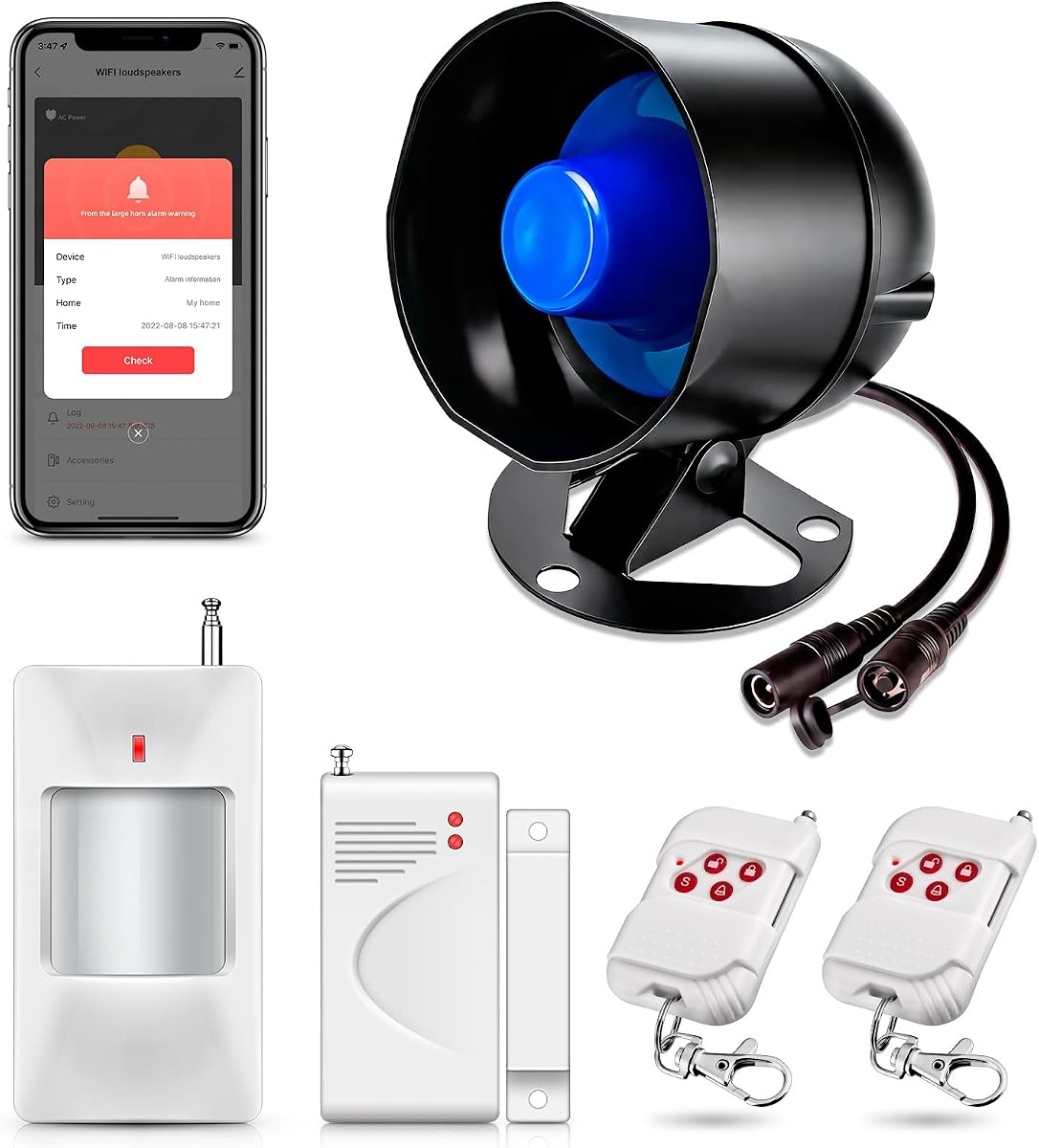
Six-Piece WiFi Alarm System Kit
4.4Editor score
Six-piece wireless alarm kit
120dB weatherproof siren
Tuya app compatibility
Door and motion sensors
This Shed Alarm System guide compares 10 wireless, WiFi, motion, and entry alarms for sheds, garages, gates, and outdoor storage.
A shed alarm system adds audible and remote protection to buildings that are often isolated from the main house. The best setup depends on whether you need entry detection, movement alerts, smartphone notifications, outdoor durability, or a compact alarm for doors and windows.
This guide compares ten systems using their stated detection methods, alarm output, connectivity, power requirements, installation approach, weather resistance, expansion capability, and included accessories. It covers WiFi hubs, standalone motion alarms, portable magnetic contact alarms, and keypad-controlled systems.
Each review explains who the product is best suited to, along with the trade-offs that matter before installation. Ratings and product details reflect the supplied listings, while availability and prices can change, so readers should confirm the current offer and compatibility before buying.
4.4Editor score
5.0Editor score

4.4Editor score
The table below compares all ten options by alert method, connectivity, outdoor suitability, and included components, making it easier to identify the right system for a shed, garage, gate, driveway, or storage building.


This six-piece WiFi alarm system earns a 4.4 rating and stands out as a balanced choice for protecting a shed, garage, workshop, or storage area. Its combination of a 120dB siren, one door contact, one motion sensor, two remotes, a hub, and a power plug covers the two most common entry risks.
We may earn a commission when you buy through this link, at no additional cost to you.
The siren hub connects to the Tuya app through 2.4GHz WiFi, allowing arming, disarming, status checks, and phone notifications through the supplied app. Alarm delays, duration, and timers can be customized, while the weatherproof horn is intended for exposed rooms, garages, and sheds.
Its main limitation is the modest number of sensors supplied. The listed package includes only one door sensor and one motion sensor, although the hub can support up to 30 wireless detectors and 20 remote controls. Users wanting broad coverage should therefore budget for additional compatible accessories or verify expansion support before installation.
This is a strong budget-oriented choice for a single shed or compact garage, particularly when both door-entry alerts and movement detection are desired. It is less suitable for a large property needing immediate coverage across several openings, but the expandability makes it a practical starting point for phased installation.
App-based arming and real-time trigger notifications make the system more useful when the owner is away. The Tuya integration also allows voice-command control according to the listing, reducing the need to interact physically with the hub.
Although the initial package is compact, support for up to 30 wireless detectors makes gradual expansion practical. This is useful for protecting a main shed first and then adding sensors to side doors, windows, or nearby outbuildings.
We may earn a commission when you buy through this link, at no additional cost to you.
This WiFi alarm system has a 5.0 rating and is the strongest fit for protecting a large shed, garage, driveway, or outdoor approach where movement is the primary concern. Four motion sensors, a 120dB siren, remote controls, and a WiFi-connected hub provide extensive coverage from one package.
We may earn a commission when you buy through this link, at no additional cost to you.
Each motion sensor is described as detecting movement up to 26 feet, allowing sensors to be positioned around entrances, open yards, or storage buildings. The IP65-rated siren is designed to withstand rain, heat, and cold, while peel-and-stick installation avoids permanent modification to rental or temporary structures.
The main compromise is that this package focuses on motion rather than door contacts. It may not immediately indicate which specific door was opened, and the listing notes that additional sensors are sold separately. Buyers also need 2.4GHz WiFi and access to a compatible phone app for remote functions.
For a shed approached through an open path or surrounded by space where an intruder could enter without opening a monitored door, this is a particularly effective design. It is the Editor's Choice because the four included sensors create immediate coverage without requiring a separate purchase for multiple detection points.
The IP65 weatherproof siren is intended to handle outdoor conditions, while the motion detectors can cover approaches to a shed or garage. This makes the system more relevant to exterior protection than a basic indoor contact alarm.
Four motion sensors can be distributed around separate approaches rather than clustered in one location. The 26-foot stated range helps provide useful warning before someone reaches the primary entrance.
We may earn a commission when you buy through this link, at no additional cost to you.
This standalone motion alarm carries a 4.0 rating and offers a straightforward way to detect movement in a shed, garage, stairwell, office, or other location without relying on WiFi. Its integrated 125dB siren and strobe provide both audible and visible warnings.
We may earn a commission when you buy through this link, at no additional cost to you.
The listed detection range is 16 to 26 feet, while the remote control can work from up to 328 feet in an open area. Two operating modes allow it to function as an alarm or a gentler doorbell-style chime, and two volume levels help accommodate different locations.
Unlike a connected hub system, it does not send phone notifications or support a collection of remote sensors. The lack of network dependence is also its chief limitation: the owner cannot check status or receive remote alerts through an app.
Choose this product when portability, simple placement, and immediate local sound matter more than remote monitoring. It is especially useful for renters, temporary campsites, a single storage building, or a location where running wiring and maintaining a WiFi connection would be inconvenient.
Because the alarm works as a stand-alone unit, it can be used in sheds, workshops, and temporary outdoor locations where a router may be unavailable. Battery operation further reduces installation constraints.
The mode switch makes the detector useful for both deterrence and less disruptive monitoring. Doorbell mode can serve as a movement chime, while alarm mode and the panic button provide stronger local security responses.
We may earn a commission when you buy through this link, at no additional cost to you.
This expandable WiFi home security system earns a 4.4 rating and is aimed at buyers who want more flexibility than a small, fixed kit can offer. Its 120dB hub can serve as the central siren for motion sensors, door sensors, a broader property, and compatible KERUI hubs.
We may earn a commission when you buy through this link, at no additional cost to you.
Through the Tuya app on 2.4GHz WiFi, users can arm or disarm the system, adjust delays and alarm duration, set timers, and check real-time door states. Trigger notifications can be sent directly to a phone, making the setup practical when nobody is inside the shed.
The principal tradeoff is that large expansion figures do not mean the package itself covers 30 locations. Buyers still need enough compatible sensors, remotes, and suitable 2.4GHz coverage for their intended layout. The siren also requires access to a power outlet.
This is a premium-featured choice for a workshop, garage, rental property, or multi-zone outdoor setup. Its combination of custom controls, phone alerts, and generous expansion potential makes it most valuable for buyers willing to build coverage over time.
Customizable delays, timers, and alarm duration allow the system to fit different routines. This is more flexible than a basic local alarm with a single on-off response.
Support for up to 30 wireless detectors and 20 remote controls is useful for owners of several buildings or a property with multiple access points. Compatibility with other KERUI hubs may further extend the possible network.
We may earn a commission when you buy through this link, at no additional cost to you.
This WiFi alarm system has a 4.5 rating and combines a door contact, a motion sensor, a 120dB siren, remote controls, and a power plug. The combination makes it well suited to a shed where the main door and interior space both need monitoring.
We may earn a commission when you buy through this link, at no additional cost to you.
The hub integrates with the Tuya app over 2.4GHz WiFi and provides phone notifications when a sensor is triggered. Owners can arm or disarm the system remotely, check the real-time condition of doors, and customize delays, alarm duration, and timers.
The package is balanced rather than extensive, so a larger property may require additional detectors. Users must also plan around the app connection and provide a plugged-in location for the siren, which can be inconvenient where a reliable outlet is distant from vulnerable openings.
For a single workshop or garage, however, this arrangement covers the essential detection methods without requiring separate products. It is a strong middle-ground option for owners who want entry-specific information as well as broader movement detection.
A contact sensor identifies an opened door or window, while the motion sensor detects activity within the protected area. Together they provide more context than a system relying on one trigger type.
Real-time door status through the app is helpful for checking a building remotely. Instant trigger alerts also provide information while the owner is away.
We may earn a commission when you buy through this link, at no additional cost to you.
This compact door and window alarm has a 4.1 rating and focuses on one clear task: warning when a monitored entry is opened. Its IP66 certification, 113dB alarm mode, adjustable magnetic gap, and included remote make it especially relevant to exterior shed and garage doors.
We may earn a commission when you buy through this link, at no additional cost to you.
The sensor accommodates gaps of up to 40 millimeters, which is useful for uneven frames and sliding glass doors. Peeling and sticking installs it on wood, metal, or glass, while low-battery alerts help owners avoid discovering a dead alarm only after an intrusion attempt.
Its limitations are equally clear. Only one main unit and one remote are included, and the product does not offer a WiFi hub, movement detection, or phone notifications. The listing also explicitly states that it is not UL 2017 compliant, which may matter for buyers with formal certification requirements.
This alarm is best for a single vulnerable door, rental property, RV, gate, or temporary room where portable entry warning is sufficient. It offers strong weather-oriented value without requiring a larger installation, but it is not a complete whole-building monitoring solution.
The IP66 enclosure is designed to resist dust and heavy rain, making the unit more appropriate for an exterior shed door than many basic contact alarms. It can also operate indoors for flexible use.
The adjustable magnetic sensor supports gaps up to 40 millimeters. This broad compatibility helps it work with sliding doors and irregular frames that may not maintain a consistently narrow separation.
We may earn a commission when you buy through this link, at no additional cost to you.
This ten-piece WiFi alarm system has a 4.0 rating and provides a broader mix of sensors than most compact kits. Four door or window contacts, two motion sensors, two remotes, a WiFi siren hub, and a power plug create a useful package for a shed with multiple access points.
We may earn a commission when you buy through this link, at no additional cost to you.
The 120dB weatherproof horn serves as the local deterrent, while the Tuya app supports arming, status checks, and phone notifications over 2.4GHz WiFi. Users can customize alarm timing and expand the hub to as many as 30 wireless detectors and 20 remote controls.
The package is larger but still may not match a property with numerous windows or a very large building. Setup involves pairing wireless accessories and connecting the hub to the app, which is less effortless than installing one self-contained sensor. Its 4.0 rating also suggests some variability in user satisfaction.
This system is a good match for owners who want multiple monitored openings in one purchase. It is especially attractive for a workshop with a personnel door, double vehicle door, side entrance, and internal motion-sensitive area.
Four door contacts reduce the need to purchase separate units for each common entry. This makes the kit more convenient for buildings with multiple doors or a combination of shed and garage access points.
The weatherproof siren sounds on site, while app notifications can inform the owner elsewhere. Using both provides a stronger response than relying exclusively on a network-dependent alert.
We may earn a commission when you buy through this link, at no additional cost to you.
This three-pack of TECKNET door alarms has a 4.6 rating, the highest among the compact magnetic contact options in this guide. Each small unit can provide an audible warning when its separation from the magnetic sensor exceeds 0.78 inches, making the set useful for several shed or RV openings.
We may earn a commission when you buy through this link, at no additional cost to you.
The 2-in-1 design supports alarm and chime behavior, while three volume levels allow owners to tune the response for bedrooms, offices, vehicles, caravans, or outdoor structures. Adhesive installation makes the devices portable and suitable for temporary lodging, while the compact size allows easy packing.
These alarms do not connect to WiFi, send smartphone notifications, or detect movement. They also require batteries, which means occasional replacement. The listing notes a 36-month warranty for registered products, and owners should confirm operating status and battery condition if a unit fails to sound.
This three-pack is a straightforward choice for monitoring multiple doors without installing a central hub. It is particularly useful for travelers, families concerned about child access to sheds, or anyone who wants a simple local chime and alarm at low-profile entry points.
The multi-unit package allows one alarm to cover the shed door, one the garage, and one a vehicle, cabinet, or travel room. Their small size and adhesive mounting make repositioning straightforward.
Three volume levels and two operating modes let the owner choose a gentle chime for routine use or a stronger alarm for security. This flexibility makes the set less intrusive than a permanently loud siren.
We may earn a commission when you buy through this link, at no additional cost to you.
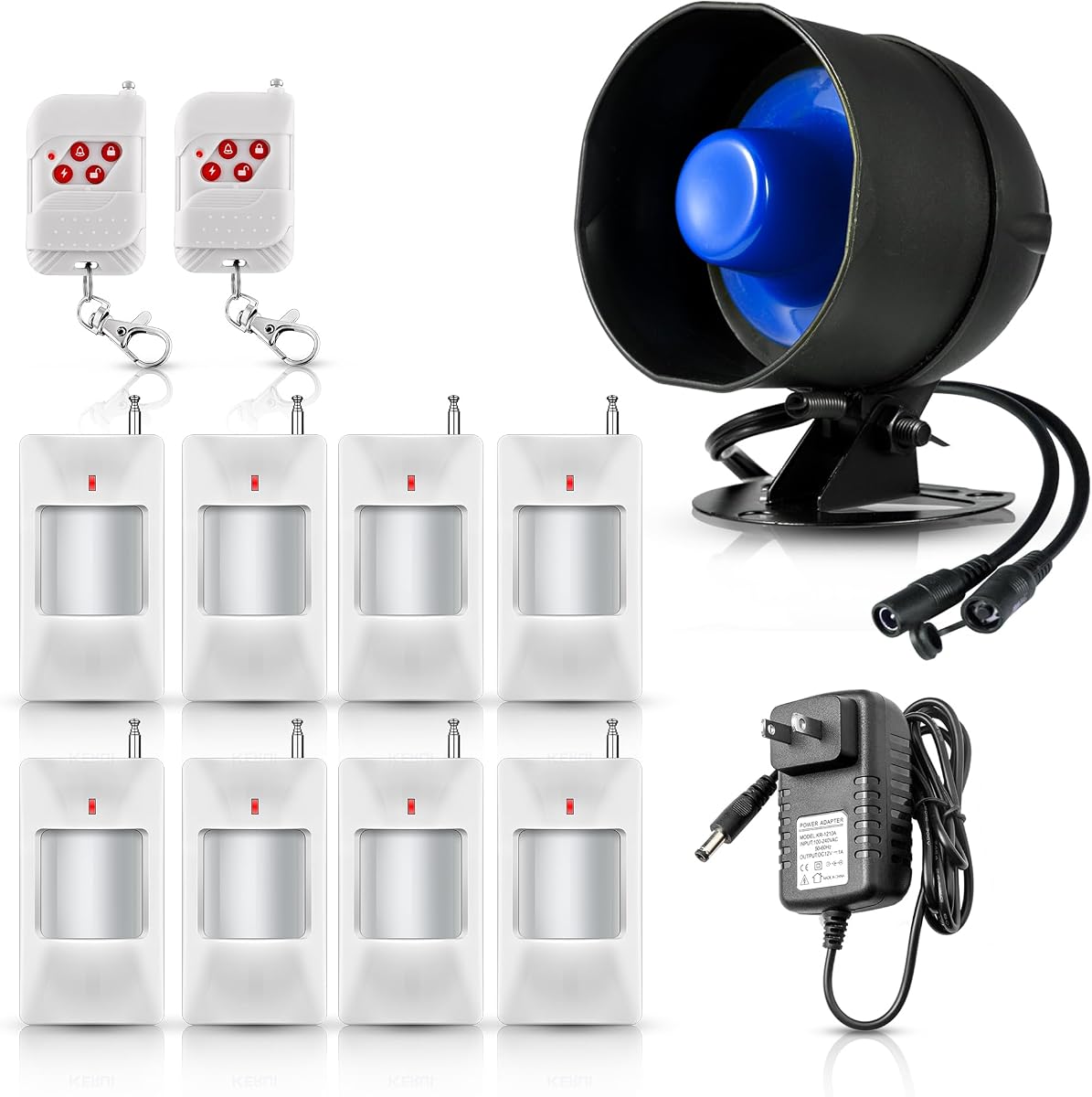
This eight-motion WiFi alarm kit holds a 5.0 rating and offers the largest ready-made motion-detector package in the roundup. Eight sensors, two remotes, a 120dB weatherproof siren, and a power plug create extensive coverage for a large shed, garage complex, yard, or driveway.
We may earn a commission when you buy through this link, at no additional cost to you.
The hub connects to the Tuya app over 2.4GHz WiFi, supports remote arming and disarming, and can send immediate phone notifications when motion is detected. The listing also states that the alarm horn can expand to 30 wireless detectors and 20 remotes.
The package concentrates on movement rather than specific door contacts. That makes it ideal for open approaches and broad interior coverage, but less suitable for owners who need to know precisely which hinged door was opened. The siren also needs a nearby outlet, and network access remains necessary for app-based features.
This is the premium pick for a buyer who wants immediate multi-zone coverage without assembling a system one sensor at a time. Its 5.0 rating, eight included detectors, and weatherproof 120dB alert make it a strong choice for monitoring several exterior approaches simultaneously.
The generous sensor count enables distribution across the front, sides, and rear of a building. That is especially helpful for detached properties where one detector would leave major blind areas.
Smartphone arming, status control, and trigger notifications make the system practical during travel or extended periods away. The remote controls provide a convenient alternative for people at the property.
We may earn a commission when you buy through this link, at no additional cost to you.
This wireless keypad alarm has a 3.3 rating and serves as a basic, local security device for a garage, shed, caravan, or single door. It supports CHIME, INSTANT, and DELAY modes, allowing the owner to select a welcoming chime, immediate alert, or delayed entry warning.
We may earn a commission when you buy through this link, at no additional cost to you.
The magnetic contact triggers the system when separated by at least one centimeter. In INSTANT mode, the siren runs for about 30 seconds; DELAY provides a brief warning period before the same type of siren, while CHIME produces a repeated ding-dong tone. A password and keypad control entry to these settings.
This is the least technically advanced option. It has no WiFi, app, smartphone notifications, or motion detection, and it includes only a basic magnetic entry point. The required three AA batteries are not included, and the 3.3 rating indicates comparatively weaker satisfaction than the other systems.
Despite those limits, it may suit a simple installation where local sound and keypad mode selection are enough. It is best for a basic door in a low-risk location rather than a large property requiring comprehensive awareness and remote monitoring.
CHIME, INSTANT, and DELAY modes provide a meaningful range of responses. The delay setting can offer time to enter a code before the siren activates, while instant mode reacts as soon as the contact separates.
The keypad system avoids WiFi setup and ongoing app dependence, making it approachable for basic use. Its limitation is that it cannot provide remote awareness or identify multiple separate entry points.
We may earn a commission when you buy through this link, at no additional cost to you.
The right shed alarm depends on the building's layout, exposure, access points, and whether remote phone awareness matters. Review detection methods, power, connectivity, weather resistance, and expansion before choosing.
Motion sensors are best for open approaches, wide interiors, driveways, and yards where a door contact would not be triggered. Door or window contacts are more precise for monitoring a specific opening, especially if a numbered or app-based status can identify the entry. A mixed system provides broader protection but may require more setup and accessories.
Loud sirens can deter intruders and wake occupants, but their usefulness depends on building construction, distance, and nearby neighbors. The systems in this guide state outputs from 113dB to 125dB. A strobe can add a visual warning, which may help in a bright shed or where audible alerts are hard to distinguish.
WiFi-enabled hubs provide phone notifications, remote arming, app status checks, and programmable schedules. They connect through 2.4GHz WiFi according to the supplied information, so buyers should confirm router compatibility. Standalone systems are simpler and more portable but cannot report events or confirm status remotely.
A shed siren may face rain, heat, cold, dust, and direct sunlight. The IP65-rated options are specifically described as weatherproof, while the portable door alarm carries IP66 protection. Even when the hub is rated for exterior use, placement under an eave or inside a protected structure may improve longevity and reduce nuisance exposure.
Most WiFi siren hubs plug into an outlet, so the protected building needs a reliable power source. Standalone detectors may use AAA batteries, USB charging, or both. Owners should check battery life, outlet access, and the distance between the hub, sensors, and their intended coverage area before mounting.
Most products use adhesive pads or screws, avoiding the need for professional wiring. Peel-and-stick installation is useful for rentals but requires clean, stable surfaces. Keypad and contact systems may need careful alignment, while app-based kits require pairing and account setup. Temporary and adhesive fixtures should be checked periodically.
Some WiFi hubs support up to 30 wireless detectors and 20 remotes, while the four-motion set explicitly supports additional sensors sold separately. Expansion figures are useful for a growing property but do not represent included coverage. Confirm compatibility before planning a large network, particularly when mixing contact and motion accessories.
Animals, vegetation, vehicles, and moving shadows can affect motion sensors, while improperly aligned magnetic contacts can cause nuisance sounds. A stand-alone alarm with selectable chime mode can reduce annoyance during normal use. Motion sensors should be aimed away from moving branches and tested for unwanted triggers during different times of day.
Begin by mapping every vulnerable opening and approach, then choose the sensor type that matches each zone. Clean the mounting surfaces, position contact sensors with the magnet aligned opposite the alarm body, and aim motion detectors across likely approaches rather than directly through doors, windows, or vegetation.
For connected systems, connect the siren hub to 2.4GHz WiFi, pair the included sensors and remotes, and configure arming delays, alarm duration, and timers in the app. Place the hub within radio range of its accessories and near a suitable outlet, while also ensuring the alarm will be loud enough to warn occupants or nearby listeners.
Test the setup by walking through every protected zone and opening each monitored entry while the system is armed. Check battery-operated units for low-battery warnings, inspect adhesive mounts, clean weather-exposed housings, and retest after moving objects or changing the building's surroundings. Replace batteries according to usage and keep the contact sensor gap within its stated tolerance.
The best type depends on how people might enter the shed. Motion sensors work well for open approaches and broad interior coverage, while door contacts are more precise for a specific entrance. A mixed WiFi system is useful when both methods and phone notifications are wanted, while a standalone alarm is simpler and better for a single low-risk location.
Yes, but only selected products in this guide offer a completely standalone operating mode. Local motion alarms and magnetic contact alarms can sound locally without internet access, while WiFi systems need a 2.4GHz connection for app control and phone notifications. Confirm the product's connectivity before buying if remote awareness is important.
A WiFi hub with a high stated expansion capacity may be suitable for several buildings, provided the sensors remain within working range and are compatible with the hub. The listed systems support as many as 30 wireless detectors and 20 remotes, but that is a maximum capability rather than an included quantity. Test placement carefully because walls and building materials can affect wireless range.
A loud alarm can be disruptive, particularly in a dense neighborhood or late at night. Several products offer lower volume levels, doorbell-style chime modes, delays, and adjustable alarm duration, which can reduce unnecessary noise. Choose a suitable output level and test it during normal and quiet hours before relying on it.
The product descriptions do not state that every listed motion sensor is designed to penetrate glass or exterior walls. Detection performance depends on the sensor's placement and field of view, and glass can affect infrared sensing. Place the detector where it has a clear view of the intended movement area and test the setup before relying on it.
First identify the correct magnetic side of the main unit and position the smaller sensor directly opposite it. Keep the separation within the stated limit, which is 40 millimeters for the IP66 model and 0.78 inches for the TECKNET units. If the frame varies substantially, test the gap in both closed and open positions and choose a model with wider adjustable spacing.
Most options are designed for wireless, do-it-yourself installation using adhesive pads or screws. The main task is pairing accessories and positioning sensors effectively rather than running cables. Keypad models require entering a password, and WiFi systems require app and network setup, so some technical care is still needed even though professional wiring is generally unnecessary.
Inspect sensors and mounting points periodically, especially after severe weather or changes around the building. Replace batteries when low-battery warnings appear, keep the contact sensors aligned, and clean outdoor housings without opening sealed units. Arm the system and test each opening and detection zone regularly to confirm that every component still communicates.
The Editor's Choice four-motion WiFi alarm is the most complete option for broad, immediate coverage, with four detectors, a 120dB IP65 siren, and app-based alerts. The six-piece WiFi kit provides a more economical entry-and-motion combination, while the expandable WiFi security system is the premium option for buyers who want greater control and long-term expansion potential.
For a single door, the waterproof magnetic alarm or TECKNET three-pack is simpler and less dependent on network access. For a large yard or several approaches, prioritize included motion detectors, wireless range, outdoor ratings, and an accessible hub location. Remote awareness, specific entry identification, and local deterrent volume should all influence the final choice.
Before purchasing, verify current product details, app compatibility, included accessories, expansion requirements, and power arrangements. Prices and availability change, so checking the current listing can prevent surprises and help ensure the selected alarm system matches the intended shed layout.