
GL.iNet GL-MT3000 Beryl AX
4.5Editor score
Compact travel-friendly design
Preinstalled VPN clients
2.5G multi-gig WAN
Our guide compares the 10 best Router with Vpn Built options, covering VPN speed, Wi-Fi generation, ports, coverage, security, ease of use, and ideal use cases
A router with VPN built in can protect an entire household without requiring every phone, laptop, television, or smart-home device to run a separate VPN application. The best models combine encrypted client or server functionality with strong wireless performance, useful port selection, dependable coverage, and an interface that does not require advanced networking knowledge.
We compared ten leading routers with built-in VPN support across protocol support, stated VPN throughput, Wi-Fi generation, wired connectivity, coverage, security features, customization, and travel suitability. The list includes full-home Wi-Fi 6 and Wi-Fi 7 models, compact routers for hotels and temporary workspaces, and a wired VPN router for small offices.
Each review identifies the strongest reason to consider that model while also explaining its limitations. The GL.iNet Flint 2, Beryl AX, and Flint 3 stand out as our leading options, but the right choice depends on whether your priority is home performance, portability, high-speed VPN processing, or business-grade connection support. Prices and availability change over time.
4.5Editor score

4.5Editor score
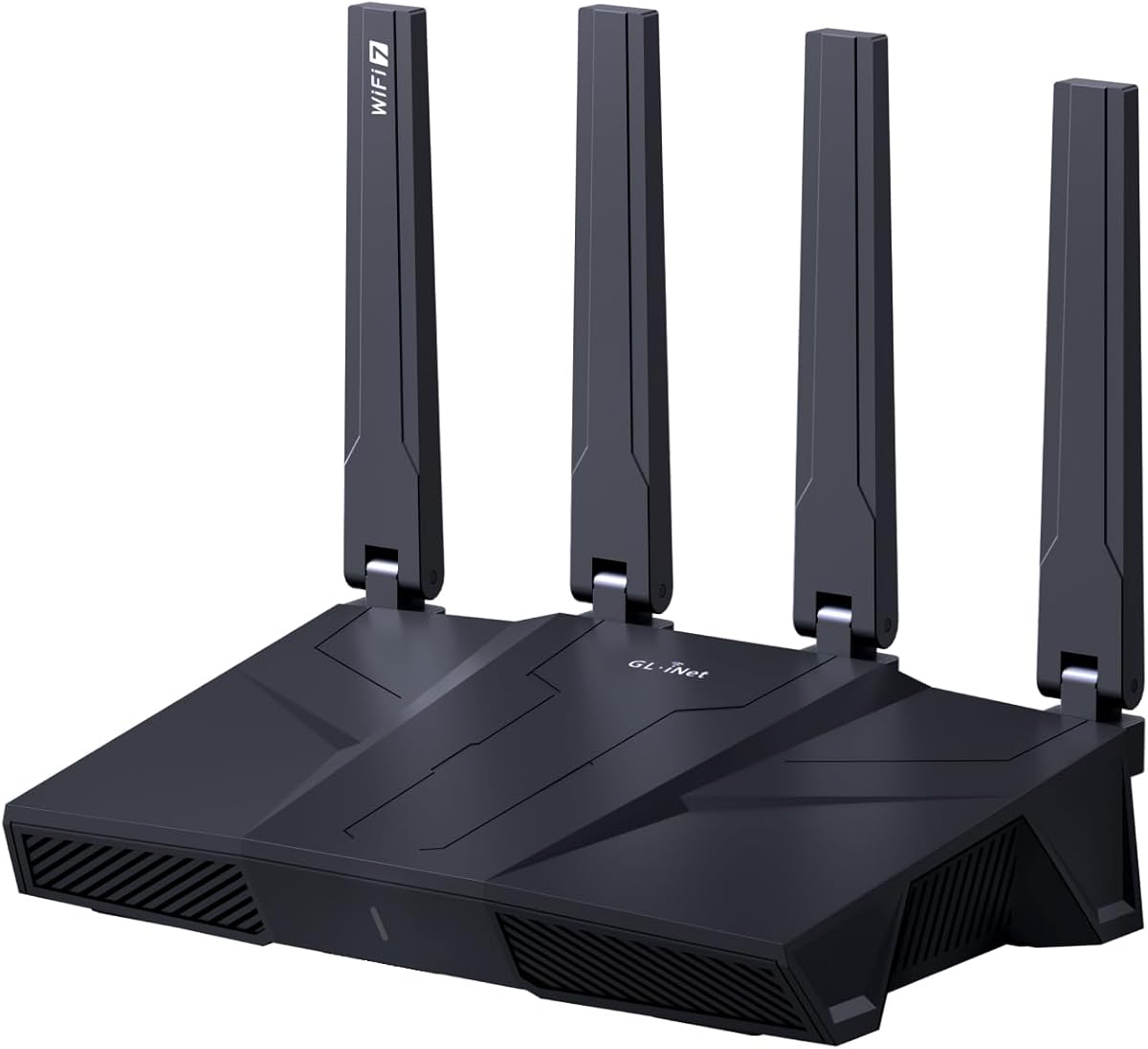
4.3Editor score
The comparison below highlights the major differences among ten routers with integrated VPN functionality, from portable OpenWrt models to Wi-Fi 7 home systems and a dedicated wired VPN router.




The GL.iNet GL-MT6000 Flint 2 combines high-speed Wi-Fi 6, dual 2.5-gigabit Ethernet connectivity, and a capable OpenWrt-based platform. Its 4.5 rating reflects a well-rounded feature set, particularly for users who want VPN protection across many devices without installing client software on every one. It is the most balanced option in this guide for a modern home network.
We may earn a commission when you buy through this link, at no additional cost to you.
The router supports eight-stream Wi-Fi 6 and advertises aggregate wireless speeds of up to 6 Gbps. More importantly for this category, it offers OpenVPN and WireGuard, with stated throughput of up to 880 Mbps and 900 Mbps respectively. Actual results will depend on the internet connection, VPN server, service provider, and local network. The 1GB DDR4 memory and 8GB eMMC storage also provide room for plugins and services.
Two 2.5G ports are useful for fast fiber or cable service, modern NAS equipment, or a high-performance wired network. AdGuard Home support adds another layer of network control by enabling DNS-based filtering. On the other hand, Wi-Fi 6 now sits below the newest Wi-Fi 7 standard, and some users may prefer a more conventional router interface. A current firmware update is specifically recommended after setup.
This is the right recommendation for a user who wants serious VPN functionality, expandable storage, and strong multi-device networking without moving to a premium Wi-Fi 7 platform. It may be overkill for a small apartment, while travelers should look to the Beryl AX. For most buyers seeking a capable all-purpose VPN router, however, the Flint 2 offers the strongest balance in the list.
WireGuard and OpenVPN support allow connected clients to use the router as a secure gateway. The stated VPN speeds are particularly compelling for a home router, although actual performance depends heavily on the chosen server and upstream connection.
OpenWrt firmware, generous memory, and AdGuard Home support make the Flint 2 useful beyond basic Wi-Fi. It suits users who want DNS filtering, additional packages, or controlled network behavior without deploying a separate advanced router.
We may earn a commission when you buy through this link, at no additional cost to you.
The TP-Link AXE5400 Archer AXE75 is a tri-band Wi-Fi 6E router that combines 6 GHz, 5 GHz, and 2.4 GHz wireless service. It carries a 4.3 rating and stands out for straightforward setup, HomeShield management, EasyMesh expansion, and support for both VPN server and client roles. It is a sensible choice for households that prioritize an approachable interface over deep customization.
We may earn a commission when you buy through this link, at no additional cost to you.
The router advertises up to 5,400 Mbps of combined wireless speed, with 2,402 Mbps on the 6 GHz band, 2,402 Mbps on the 5 GHz band, and 574 Mbps on the 2.4 GHz band. A 1.0 GHz dual-core processor and 512 MB of memory support simultaneous traffic, while the housing is designed to dissipate heat more effectively. OFDMA and true tri-band operation help serve a crowded home.
For VPN use, the AXE75 supports OpenVPN, PPTP, and L2TP in both client and server roles. The supplied information does not state maximum VPN throughput, and it does not identify WireGuard support, so buyers prioritizing modern VPN speed should verify compatibility before purchasing. It also offers less freedom for package installation than the OpenWrt-based GL.iNet models.
Choose the Archer AXE75 if you want broad Wi-Fi 6E coverage, a familiar management experience, and simple VPN support in a home design. It is particularly suitable for people adding an EasyMesh node to reduce dead zones. Users needing high stated VPN throughput or advanced plug-ins should compare the Flint 2, Slate 7, or other OpenWrt options.
The dedicated 6 GHz band provides additional bandwidth for compatible devices, while 2.4 GHz remains available for longer-range and lower-bandwidth devices. OFDMA improves simultaneous transmission efficiency in crowded wireless environments.
VPN server support allows authorized remote users to reach the home network, while client support routes selected traffic through a remote server. HomeShield adds network scans, IoT identification, parental controls, and quality-of-service tools.
We may earn a commission when you buy through this link, at no additional cost to you.
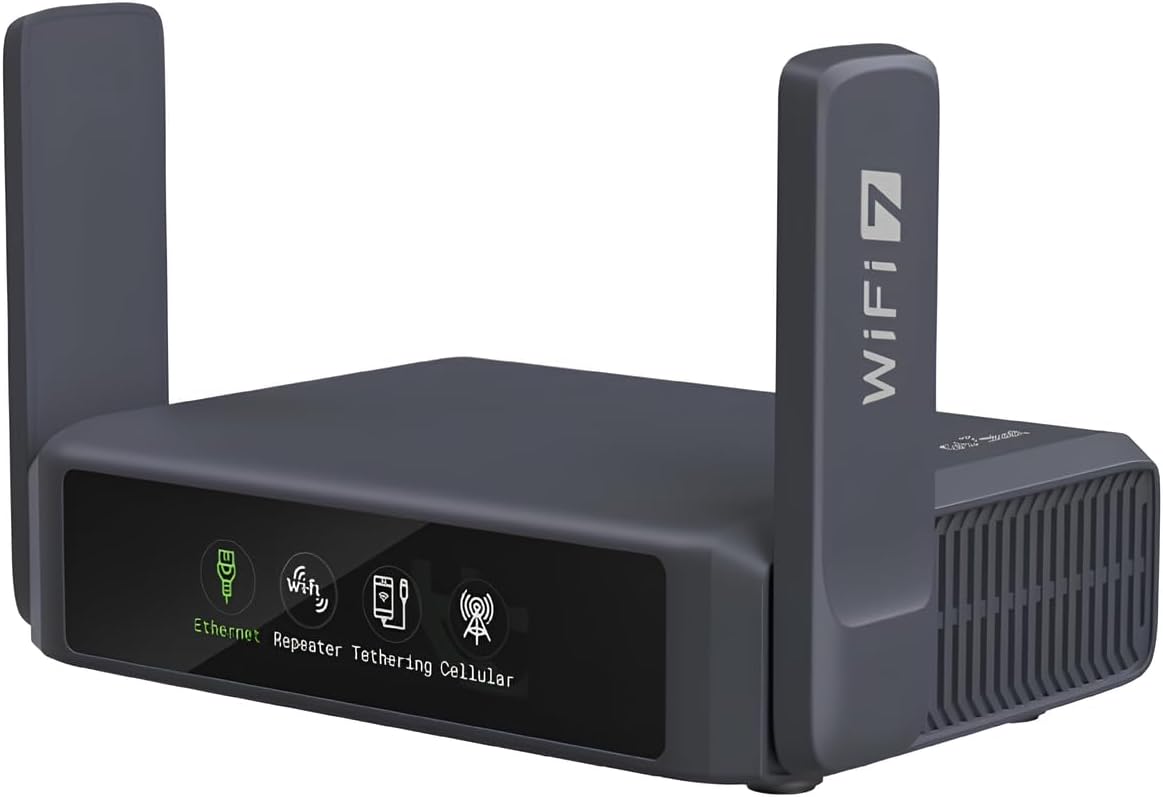
The GL.iNet GL-BE3600 Slate 7 is a compact dual-band Wi-Fi 7 travel router with a touchscreen, two 2.5G Ethernet ports, and integrated OpenVPN and WireGuard support. Its 4.4 rating and unusual interface make it one of the most distinctive choices for travelers, temporary offices, and users who want visible network status at a glance.
We may earn a commission when you buy through this link, at no additional cost to you.
Wireless performance is specified at 688 Mbps on 2.4 GHz and 2,882 Mbps on 5 GHz. The touchscreen can display network speed, scan Wi-Fi QR codes, toggle VPN functions, change VPN providers, and show status for Ethernet, tethering, repeater, and cellular modes. OpenWrt 23.05 firmware provides advanced configuration, while the USB 3.0 port expands the device's practical utility.
OpenVPN and WireGuard are pre-installed and compatible with more than 30 VPN services, though an active subscription is required for the service itself. Stated maximum speeds reach 100 Mbps for OpenVPN and 540 Mbps for WireGuard in local-network tests. Real-world performance varies. The device can also operate a VPN client and server at the same time, supporting remote access to local resources.
The Slate 7 is ideal for business travel, hotel stays, shared workspaces, and temporary internet arrangements where a personal encrypted network is valuable. It may be too large for the smallest travel day bag, and having only one LAN port may limit a permanent desktop setup. Even so, its touchscreen and travel-focused operation make it a compelling specialized pick.
The color-coded touchscreen reduces the need to open the admin panel for routine checks. Users can see connection modes, monitor speed, and toggle selected security functions directly from the device.
Connecting devices to the Slate 7 lets them use the router's VPN connection as their gateway. That avoids managing a VPN profile on every phone, tablet, and laptop sharing the temporary network.
We may earn a commission when you buy through this link, at no additional cost to you.
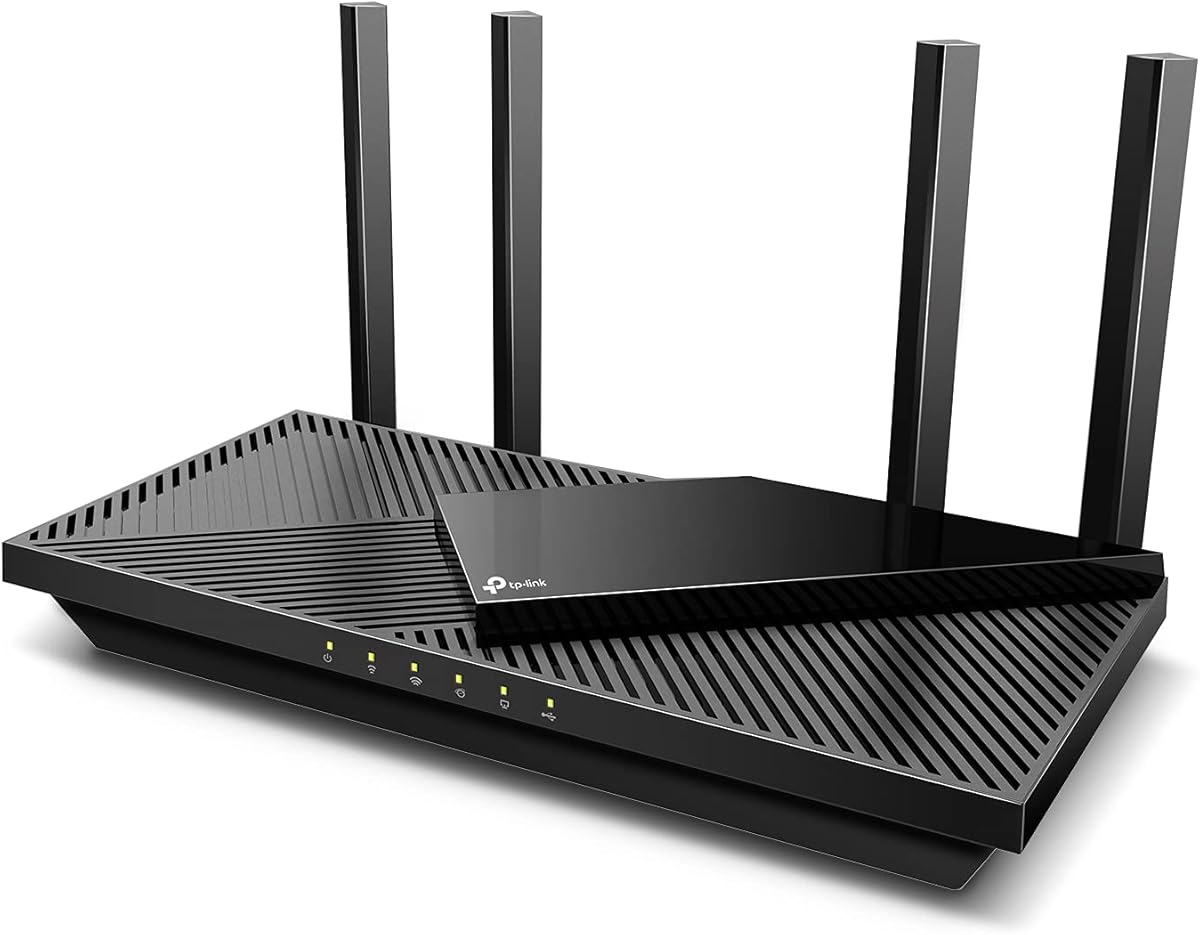
The TP-Link AX3000 is a straightforward dual-band Wi-Fi 6 router with VPN server and client functionality. Its 4.4 rating reflects a capable low-cost option for homes that want network-wide VPN support, basic parental controls, and modern wireless performance without moving into the more specialized category of high-speed VPN routers.
We may earn a commission when you buy through this link, at no additional cost to you.
The router offers 2,402 Mbps on the 5 GHz band and 574 Mbps on 2.4 GHz, for a stated combined maximum of 2,976 Mbps. OFDMA allows multiple clients to share a band more efficiently, which is valuable in homes containing numerous phones, televisions, speakers, and other connected products. Four external antennas and beamforming support broader, more stable coverage.
The supplied specifications confirm support for a VPN server and client but do not identify particular protocols or maximum tunnel speeds. That makes the model more appropriate for basic secure routing and remote access than for buyers who require a specific modern protocol or maximum throughput figure. Its simpler design also offers fewer expansion opportunities than an OpenWrt system.
This router makes sense for budget-conscious households seeking dependable Wi-Fi 6 and a straightforward VPN gateway. It works well as a starter router in a moderate-sized home, and HomeShield provides useful network scans, IoT identification, parental controls, and quality-of-service settings. Buyers needing multi-gigabit ports, travel flexibility, or advanced customization should look elsewhere.
OFDMA and beamforming address two common challenges in modern homes: multiple active clients and weak coverage in particular rooms. The result is a more balanced network for everyday streaming, calls, and browsing.
HomeShield provides basic parental controls, weekly and monthly reports, quality-of-service configuration, and device identification. These features make the router more approachable for families that do not want to manage every setting manually.
We may earn a commission when you buy through this link, at no additional cost to you.
The GL.iNet GL-BE9300 Flint 3 is a premium tri-band Wi-Fi 7 router with five 2.5-gigabit Ethernet ports and built-in OpenVPN and WireGuard. Its 4.3 rating and comprehensive hardware make it a top choice for a modern home that needs fast wireless, multi-gig wired connectivity, and advanced control over VPN and network services.
We may earn a commission when you buy through this link, at no additional cost to you.
The router advertises Wi-Fi 7 speeds of up to 9 Gbps and uses Multi-Link Operation, enhanced OFDMA, 4K-QAM, and preamble puncturing. It is designed to deliver strong coverage across up to 2,000 square feet and accommodate more than 100 connected devices. The five 2.5G ports are particularly useful for a NAS, high-speed switches, and multiple wired workstations.
Both OpenVPN and WireGuard have stated maximum speeds of 680 Mbps, although real performance depends on the internet service, VPN location, provider, and network environment. AdGuard Home support adds DNS-level filtering, while integrated Bark support provides website filtering, safe search, and usage limits for families. Like other GL.iNet models, it benefits from an initial firmware update.
The Flint 3 is recommended for users with current Wi-Fi 7 devices, high-speed broadband, or a need for numerous multi-gig wired connections. It can also operate as a remote-access server through its VPN functionality. Buyers with modest internet service and older equipment may find the Flint 2 more rational, while travelers should consider a smaller travel router instead.
Five 2.5G ports reduce the need for additional switching equipment in a home with a NAS or several wired devices. The premium interface can take advantage of fiber, multigig cable, and other fast broadband services.
Bark integration supports website filtering, safe-search enforcement, and screen-time limits, while AdGuard Home can block unwanted tracking through DNS. Together they add useful visibility and control for connected households.
We may earn a commission when you buy through this link, at no additional cost to you.
The GL.iNet GL-MT3000 Beryl AX is a compact Wi-Fi 6 travel router that combines a 2.5-gigabit WAN connection with built-in OpenVPN and WireGuard. Its 4.5 rating makes it one of the strongest value choices in the roundup, especially for travelers, remote workers, and users who want advanced VPN functions in a portable form.
We may earn a commission when you buy through this link, at no additional cost to you.
Wireless speeds are specified at 574 Mbps on 2.4 GHz and 2,402 Mbps on 5 GHz. The hardware includes a 2.5G multi-gig WAN port, one gigabit LAN port, and USB 3.0. The design is particularly useful in hotels, cruise ships, temporary rentals, and shared offices where the public connection may be unsecured and users want every device protected through one gateway.
OpenVPN and WireGuard are pre-installed and compatible with more than 30 service providers, although a service subscription is required. Stated local-network speeds reach 150 Mbps for OpenVPN and 300 Mbps for WireGuard. The router runs OpenWrt 21.02, supports more than 5,000 available plug-ins, and can operate VPN client and server roles simultaneously.
The Beryl AX is an excellent recommendation for people who travel regularly but do not need a full-size home router. It is also useful as a dedicated secure gateway or a compact unit for a secondary office. The single gigabit LAN port limits wired expansion, and its stated VPN throughput is lower than some larger models, but portability and feature balance remain exceptional.
The router can create a private local network over a hotel or public connection. Connected devices then use its VPN client without needing individual VPN applications, which is especially useful for teams sharing a temporary workspace.
OpenWrt support, a physical VPN toggle, simultaneous client and server operation, and AdGuard Home availability give the Beryl AX more depth than a basic portable hotspot. It remains small enough for a carry-on or laptop bag.
We may earn a commission when you buy through this link, at no additional cost to you.
The GL.iNet GL-BE6500 Flint 3e is a dual-band Wi-Fi 7 router designed for homes and gaming environments where the VPN connection itself must remain fast. Its 4.2 rating reflects a modern, capable platform, while the headline attraction is stated OpenVPN and WireGuard performance of up to 1,100 Mbps.
We may earn a commission when you buy through this link, at no additional cost to you.
The router supports Wi-Fi 7 speeds of up to 6.5 Gbps, Multi-Link Operation, enhanced OFDMA, 4K-QAM, preamble puncturing, and Multi-RUs. It is advertised to provide strong coverage across up to 2,500 square feet and includes 1GB DDR4 memory. These specifications make it attractive to owners of recent laptops, phones, televisions, and game consoles that support Wi-Fi 7 features.
AdGuard Home is supported, and Bark integration offers parental filtering, safe search, and usage limits. VPN performance depends on the upstream connection, selected server, service provider, and local conditions, so the stated maximum should be treated as a best-case indicator rather than a guarantee. The device also supports additional packages through its customization platform.
Choose the Flint 3e when gaming, fast downloads, and a low-latency Wi-Fi 7 network are the priority. Its coverage target and processing resources should suit larger homes, while VPN speed makes it a compelling companion to a fast broadband plan. Those wanting more multi-gig ports or a third wireless band should consider the Flint 3.
The stated 1,100 Mbps VPN capability is designed to preserve throughput when encryption is active. This makes the model more compelling for gaming and large downloads than a router whose VPN processor is limited to much lower rates.
MLO, 4K-QAM, Multi-RUs, and enhanced OFDMA are designed to improve latency and reliability in dense wireless environments. The benefits are greatest when clients and the internet service can also support high throughput.
We may earn a commission when you buy through this link, at no additional cost to you.
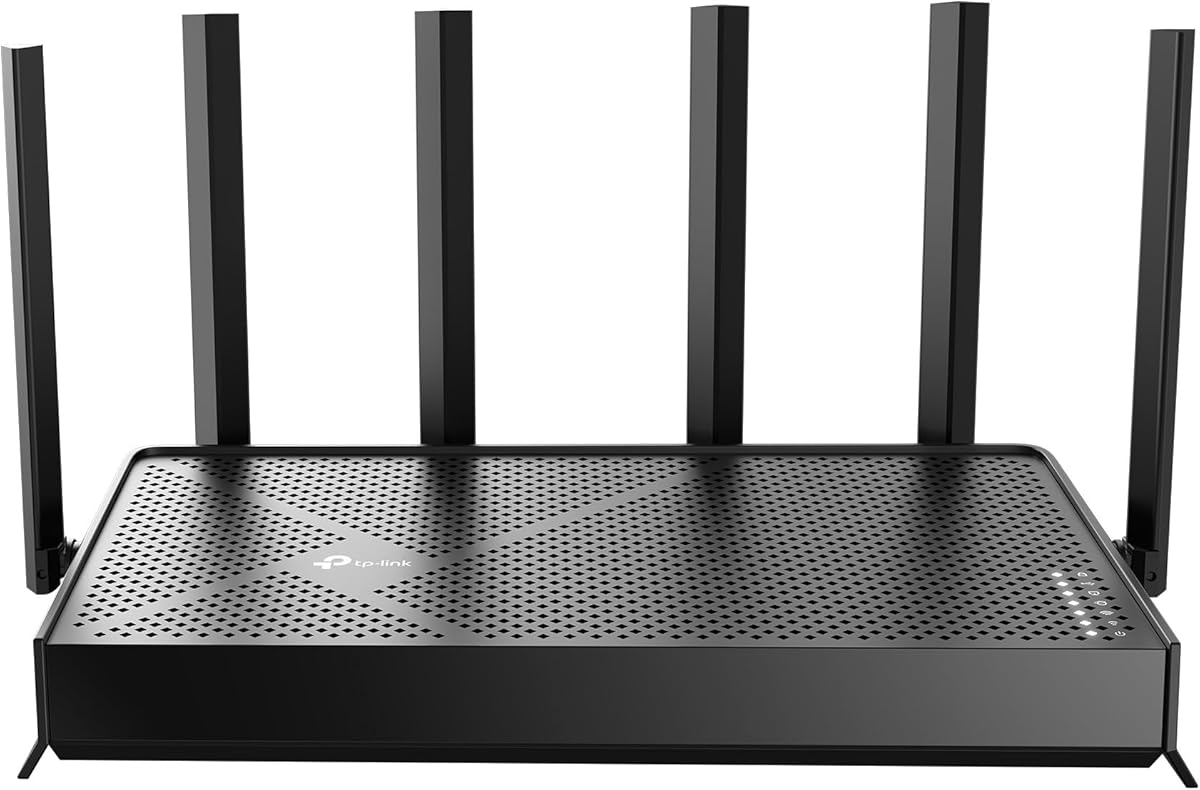
The TP-Link Archer BE600 is a tri-band Wi-Fi 7 router built around high-speed broadband and flexible multi-gig Ethernet connectivity. Its 4.2 rating and combination of a 10 Gbps port, multiple 2.5G ports, and VPN client support make it a strong choice for large homes, advanced smart-home systems, and users with a multigig internet service.
We may earn a commission when you buy through this link, at no additional cost to you.
The router advertises combined speeds of 5,765 Mbps on 6 GHz, 2,882 Mbps on 5 GHz, and 1,032 Mbps on 2.4 GHz. MLO combines multiple bands to improve continuity, while up-to-320-MHz channels can deliver greater bandwidth where spectrum conditions allow. Coverage is specified for up to 2,600 square feet and as many as 120 devices, supported by six strategically placed antennas.
Its Ethernet configuration includes one 10 Gbps WAN/LAN port, one 2.5 Gbps WAN/LAN port, and three 2.5 Gbps LAN ports. That is excellent for a multigig modem, high-speed NAS, or local backbone. VPN client support lets home devices reach remote servers without installing VPN software individually, and the router can maintain simultaneous VPN and regular internet connections.
The Archer BE600 is recommended for users who have invested in Wi-Fi 7 endpoints and want a router capable of feeding them with a fast wired backbone. TP-Link HomeShield adds parental controls and IoT security, while the Tether app simplifies setup. Users who only need basic VPN routing may find the complexity and hardware excessive.
The 10 Gbps port can serve a multigig connection or a high-speed local backbone, while the 2.5G ports are suitable for a NAS, access points, and demanding wired devices. This is one of the strongest Ethernet layouts among the listed home routers.
Instead of installing a VPN client on every device, compatible home hardware can send traffic through the router. Simultaneous VPN and regular connections maintain flexibility for local devices and services that may not use the tunnel.
We may earn a commission when you buy through this link, at no additional cost to you.
The TP-Link ER605 is a wired Gigabit VPN router for small offices, branch networks, and other installations where stable wired connectivity matters more than wireless. Its 4.4 rating reflects a focused design with multiple WAN options, extensive firewall capabilities, and support for several widely used VPN protocols.
We may earn a commission when you buy through this link, at no additional cost to you.
The hardware provides one Gigabit WAN port, two Gigabit WAN/LAN ports, and two Gigabit LAN ports. Up to three ports can operate as WAN connections, allowing services to be distributed across separate links. A USB WAN port supports compatible 4G or 3G modems for backup connectivity, which is useful where a secondary broadband or cellular connection is available.
The router supports up to 20 IPsec LAN-to-LAN connections, 16 OpenVPN connections, 16 L2TP connections, and 16 PPTP connections. Security tools include SPI firewall protection, denial-of-service defense, IP, MAC, and URL filtering, VPN pass-through, and support for several application protocols. These are meaningful controls for a managed branch or small professional network.
The ER605 is the right choice for administrators who want a dedicated VPN gateway without wireless features. It can serve a small office, connect branches, or provide remote access to authorized LAN resources. It is not suitable as a replacement for a home Wi-Fi router, so most households should look to the Flint 2 or another wireless model.
Three ports can be assigned as WAN interfaces, which allows administrators to divide services across links or maintain a secondary path. USB-connected cellular modems offer another potential backup when compatible hardware and service are available.
IPsec, OpenVPN, L2TP, and PPTP support covers common remote-access and site-to-site needs. Firewall policies, URL and address filtering, and denial-of-service defenses provide granular administrative controls.
We may earn a commission when you buy through this link, at no additional cost to you.
The GL.iNet GL-AXT1800 Slate AX is a pocket-sized Wi-Fi 6 travel router with integrated OpenVPN and WireGuard. Its 4.4 rating makes it a compelling secondary pick for travelers who prioritize compact size, strong stated VPN throughput, and useful security features over maximum wired speed.
We may earn a commission when you buy through this link, at no additional cost to you.
The router provides a combined wireless rate of up to 1,800 Mbps, split between 600 Mbps on 2.4 GHz and 1,200 Mbps on 5 GHz. MU-MIMO, OFDMA, BSS coloring, and support for up to 120 simultaneous devices help it handle a crowded temporary network. OpenWrt 21.02 firmware allows customization, and a physical toggle can control VPN or AdGuard Home once configured in the admin panel.
Stated VPN performance reaches 500 Mbps with OpenVPN and 550 Mbps with WireGuard. Cloudflare encryption is supported, along with IPv6, OpenWrt applications, and private file sharing through SAMBA and WebDAV when an external USB drive is attached. In repeater mode, the router can turn a public wired or wireless connection into a private local network, including use with captive portals.
The Slate AX is best for frequent travelers, international users, and anyone needing a secure personal network in a hotel or temporary office. It is also useful for creating a private network around shared public Wi-Fi. For heavier home use, the Beryl AX offers a 2.5G WAN port, while the Flint 2 supplies greater overall capacity and customization.
Repeater mode lets a single Slate AX create a local network over a public connection. Compatible devices can then connect to that private network, and the VPN client can encrypt traffic without separate applications on every device.
OpenWrt support opens the door to packages and configuration changes that are unavailable on many travel routers. The compact enclosure, physical shortcut, and support for more than 100 connected clients make it useful for shared travel setups.
We may earn a commission when you buy through this link, at no additional cost to you.
The best router with VPN built in depends on your network size, the protocols you need, the speed of your internet service, and whether you value portability or expandability. These factors help separate a basic VPN gateway from a router designed for sustained encrypted traffic, remote access, and advanced local control.
Begin by confirming which VPN protocols the router supports. OpenVPN and WireGuard are common in modern models, while some business routers add IPsec, L2TP, and PPTP. A client mode sends traffic from connected devices through a remote VPN server, whereas server mode allows authorized users to connect into the local network. The best router for you is one that supports the exact protocol and service used by your organization or household, not simply the protocol with the most familiar name. Check the manufacturer's current documentation because support can change with firmware updates.
VPN encryption consumes processing resources, so a fast processor and sufficient memory matter when many clients connect simultaneously. Published figures are best-case maximums and may be based on local-network tests. Real results depend on internet speed, server distance, provider load, configuration, and the number of active users. If routine streaming, gaming, large file transfers, or video calls occur while the VPN is active, prioritize a model with a strong stated rate rather than selecting solely on wireless generation. It is also sensible to confirm the device can maintain ordinary direct traffic while the tunnel is operating.
A router with VPN built in must also provide adequate wireless service for the devices sharing the tunnel. Wi-Fi 6 remains broadly useful, while Wi-Fi 7 adds features such as Multi-Link Operation, 4K-QAM, and wider channels for compatible hardware. Tri-band systems can separate traffic across 2.4, 5, and 6 GHz, improving flexibility in crowded homes. Pay attention to the number of streams, client capacity, processor, and memory rather than focusing only on the headline aggregate speed. For a modest home, a dual-band Wi-Fi 6 router may be sufficient; busy, large, or technology-forward homes gain more from Wi-Fi 7 and tri-band operation.
VPN routing is not the only consideration because local file transfers, media servers, cloud backups, and online gaming can all benefit from fast Ethernet. A gigabit port is the common baseline, while 2.5G ports allow routers to work with fiber, multigig cable, modern NAS equipment, and speedy laptop docks. A 10G port provides additional backbone capacity for advanced networks. Count the ports you need rather than assuming more is always better, and check whether WAN and LAN functions can be reassigned. Wired business users may value multiple WAN ports more than a fast wireless radio.
Coverage depends on the home's construction, floor plan, interference, router placement, and client capabilities. A stated square-foot figure is only a guide, and a powerful router placed in a poor central location may perform worse than a modest model positioned correctly. Dense environments benefit from tri-band operation, beamforming, OFDMA, and multiple antennas. Homes with many connected appliances should also examine the processor and memory. Access points, EasyMesh-compatible extenders, and wired backhaul can improve the result in large properties, but a mesh system with integrated VPN support may be more appropriate than a standalone high-power router when consistent whole-home roaming is the priority.
Integrated VPN support should be evaluated alongside the router's wider security controls. Useful additions include firewall policies, DNS filtering, URL and device filtering, parental controls, access logs, intrusion protections, and remote management. GL.iNet routers commonly expose OpenWrt and AdGuard Home capabilities, while TP-Link HomeShield focuses on easier family and IoT management. For a small business, consider the number of simultaneous tunnels, LAN-to-LAN site connections, USB backup options, and quality-of-service controls. For a home, a clear interface and useful defaults may matter more than a long list of rarely changed security menus.
Travel routers need a balance between capability and convenience. Look for compact construction, a clear way to connect to hotel or café Wi-Fi, captive-portal support, USB connectivity, and an interface that can be operated without a wired computer. A multi-gig WAN port may help when the local network is fast, while a single gigabit LAN port is usually sufficient for temporary use. Verify whether the device works in repeater mode, tethering mode, and router mode, and check the plug options available for your destination. A physical VPN toggle is helpful, but it generally must be assigned a function in the admin panel before it performs any action.
Firmware determines the features and long-term flexibility of the router. OpenWrt-based systems support extensive customization, additional packages, DNS services, and advanced networking controls, but they may require more setup than a simplified interface. Traditional router software often emphasizes accessibility, automatic updates, mobile apps, and familiar family controls. Confirm that the manufacturer provides firmware updates and clear documentation for the VPN configuration. GL.iNet specifically recommends updating firmware during initial setup for several models in this guide. Before purchasing, review the product's support options and the availability of configuration files or subscription compatibility for your chosen VPN provider.
Begin by placing the router in a central, open location where it is not enclosed by furniture or surrounded by dense electronic equipment. Connect the WAN port to the modem or optical network terminal, power the router, and complete the web-based setup using the instructions supplied with the model. Many routers begin with an open or easily guessed administrative network, so change the wireless password, administrative credentials, and any default access details before connecting sensitive devices.
Install the latest firmware before configuring advanced features. For the GL.iNet models in this guide, the product information specifically recommends an initial update. After updating, create a separate wireless network for guest or travel use if appropriate, enable a strong WPA2 or WPA3 security mode, and decide whether the VPN should apply to all devices, selected clients, or a particular traffic category. When using a commercial VPN service, sign in with the credentials supplied by that provider and confirm that the desired server location and protocol are active.
Treat the VPN as one part of a healthy network rather than a substitute for basic security. Keep firmware current, use unique administrator and Wi-Fi passwords, disable unnecessary remote-management features, review connected clients periodically, and update the software on phones, laptops, and other devices. Back up router settings when possible, record the VPN configuration, and test both encrypted and direct connections after any major firmware change. If performance declines, compare results with the VPN temporarily disconnected and check for interference, outdated firmware, weak Wi-Fi placement, or a distant VPN server.
It can when the router is operating in VPN client mode, because connected devices send their traffic through the router's tunnel. Some models also support per-device policies, selective routing, or split tunneling. Check whether the router supports the VPN service and protocol you intend to use, and confirm how newly connected devices are handled.
Client mode protects outgoing traffic by connecting the router to a remote VPN server. Server mode allows authorized remote users to connect to devices on the local network. Some GL.iNet models support both functions simultaneously, while other routers offer only one mode or limit the number of active tunnels.
WireGuard is often favored for its modern design and efficient performance, while OpenVPN is widely supported and familiar. The better option depends on your provider, router support, network conditions, and administration preferences. In this roundup, certain GL.iNet models publish higher maximum figures for WireGuard, but real-world results can vary considerably.
Encryption and routing add processing overhead, so some reduction is possible, particularly on hardware with limited resources or at very high tunnel speeds. A capable processor, fast internet connection, nearby VPN server, and current firmware can minimize the effect. Published maximum speeds are usually best-case results and should not be treated as guaranteed real-world rates.
You usually do not for devices that route through the router's VPN client. However, individual apps may still offer features the router cannot provide, such as selecting a different server for each application or applying a VPN to traffic outside the home network. VPN applications can remain useful on phones and laptops used away from home.
The GL.iNet Beryl AX and Slate AX are the most travel-focused options because they combine compact construction, OpenWrt features, and preinstalled VPN clients. The Beryl AX adds a 2.5G WAN port, while the Slate AX offers a touchscreen and convenient status display. Both can create a private network over public Wi-Fi, though the Beryl AX may be more practical when a faster hotel connection is available.
Often, yes. A standalone VPN-capable router can act as the main gateway while mesh nodes extend Wi-Fi coverage, but each node and connected device must use the intended path. Some mesh systems handle VPN differently or offer their own subscription-based protection. Check compatibility, subnet behavior, and whether remote access continues to work before removing any existing equipment.
First, update the router firmware and test the internet connection without the tunnel. Next, try a closer or less busy VPN server, confirm the chosen protocol and encryption settings, and check whether a firewall or quality-of-service rule is restricting traffic. Comparing direct and encrypted speed tests can help identify whether the bottleneck is the VPN, broadband connection, Wi-Fi environment, or a remote server.
The GL.iNet Flint 2 is the strongest overall recommendation because it balances Wi-Fi 6 performance, fast stated VPN throughput, multi-gig Ethernet, OpenWrt customization, and AdGuard Home support. The Beryl AX is the most compelling budget and travel choice, while the Flint 3 delivers the premium combination of tri-band Wi-Fi 7 and five 2.5G ports.
Before buying, prioritize the functions you will actually use. Frequent travelers should look for compact construction, public-network repeater support, and easy VPN controls. Large homes should investigate wireless capacity, bands, and wired backhaul, while small offices may need the ER605's many VPN tunnels and multiple WAN connections. Verify protocol compatibility, provider requirements, port speed, and the management interface before committing.
Remember that prices, promotions, firmware versions, and product availability can change. Review the current listing, manufacturer documentation, and subscription requirements at the time of purchase. With those checks in place, the right router with VPN built in can provide secure, convenient protection for an entire home, office, or temporary travel network.